White Oak Tree Care: Planting and Growing Quercus alba
Learn how to identify, plant, water, and prune white oak trees. This Quercus alba guide covers space needs, acorns, wildlife value, and common problems.
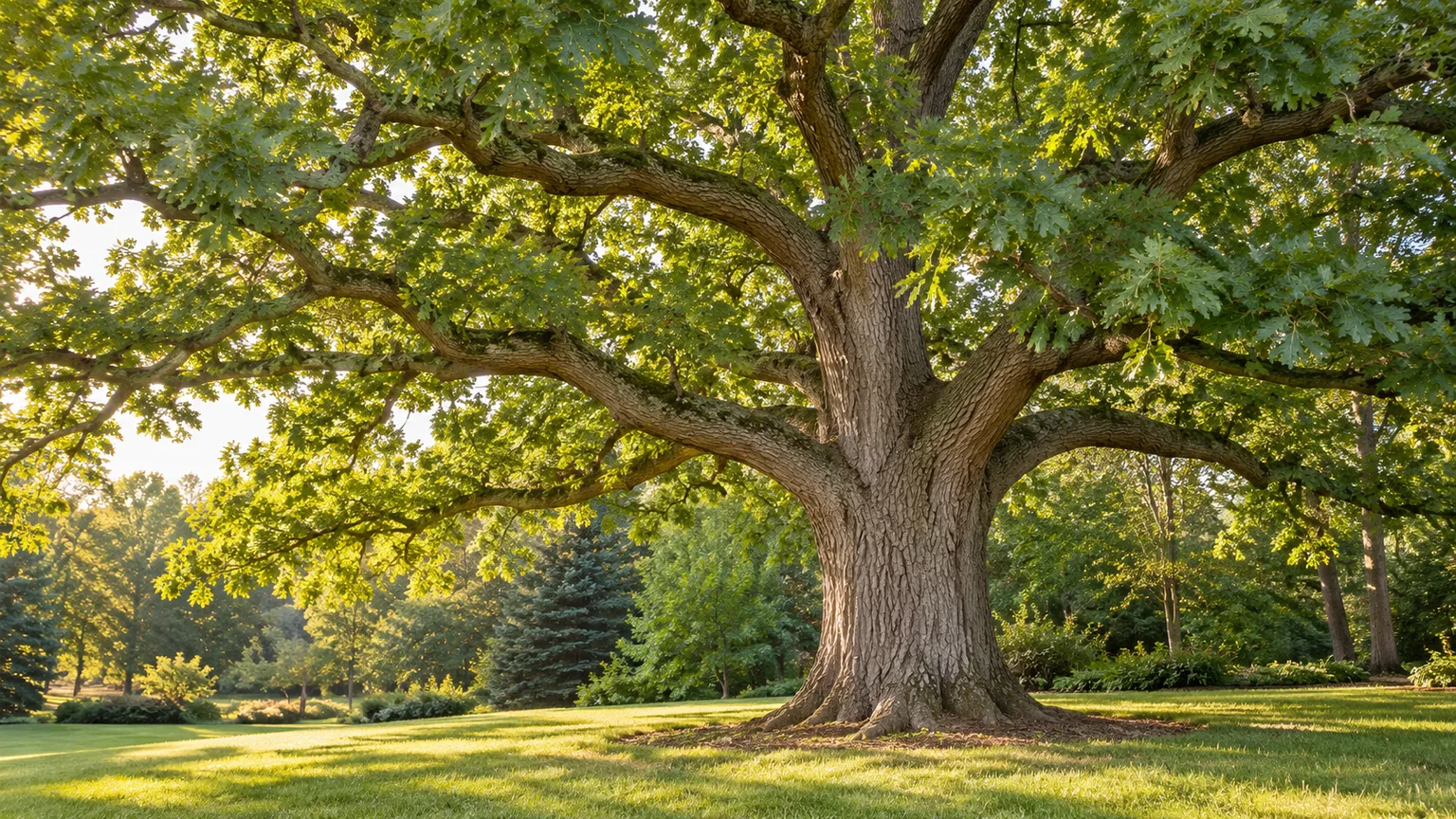
A white oak is a decision measured in decades, not a quick landscape upgrade. Quercus alba grows slowly, eventually spreads a broad canopy, drops acorns, and can outlive the people who plant it. Choose a site that can accommodate the mature tree, protect its roots while it establishes, and the payoff is a durable shade tree with distinctive fall color and unusually rich wildlife value.
The most important care step happens before planting: confirm that the tree has room above and below ground. White oak develops a deep root system and is difficult to move once established, so a small tree that fits beside a patio today may become a costly conflict later. This guide explains how to assess the space, identify the species, plant and water it, grow one from an acorn, and respond sensibly to common problems.
White oak at a glance
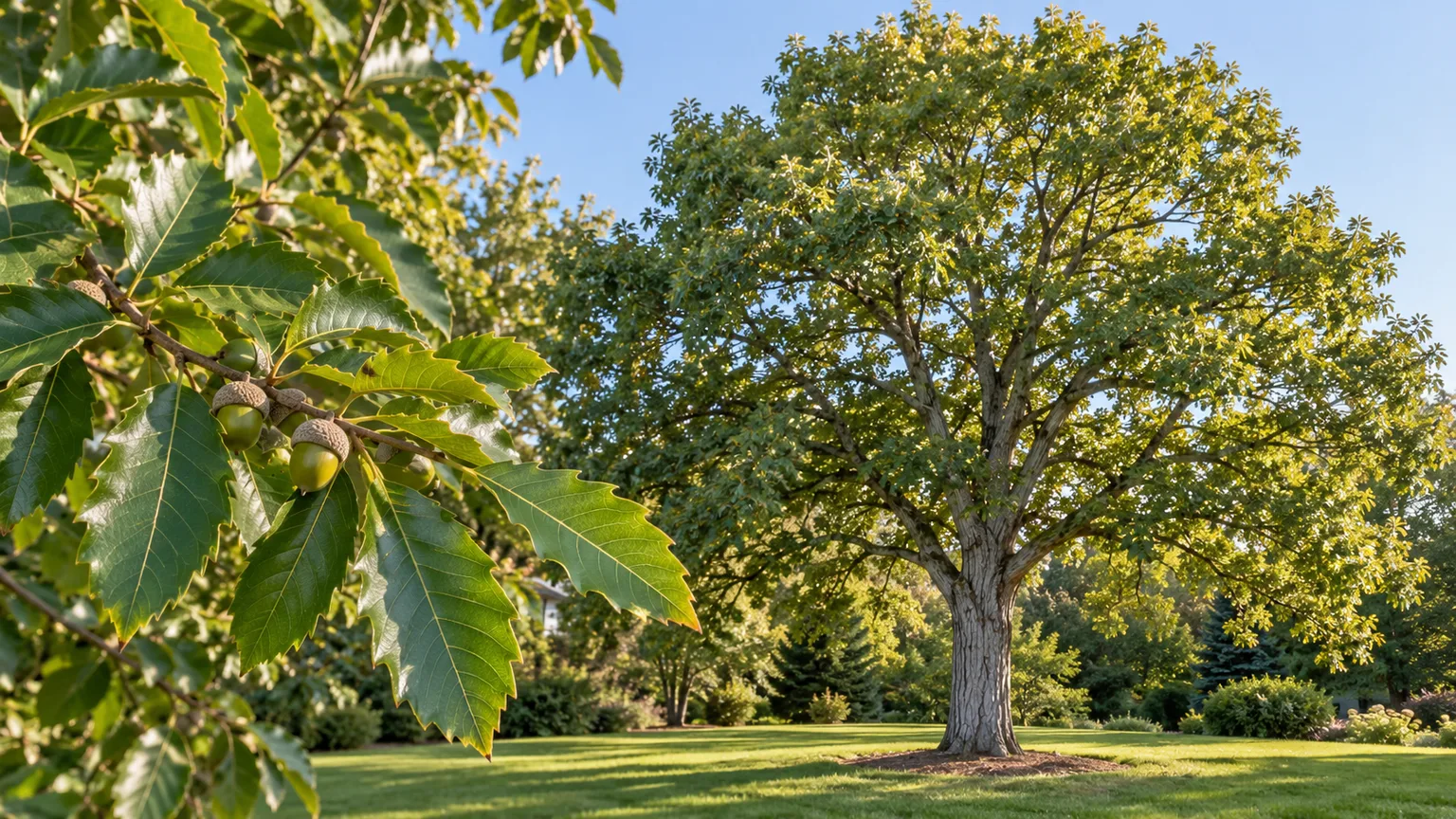
White oak is a deciduous hardwood in the beech family, Fagaceae, native across much of eastern North America. In a landscape it starts with a pyramidal outline and develops a wide, rounded crown with strong horizontal branches. NC State Extension’s white oak profile reports that mature trees commonly reach about 80 to 100 feet tall, with exceptional trees reaching higher; a spread of 50 to 80 feet is also possible. Think of those numbers as planning ranges, not guarantees for every soil or climate.
The species prefers full sun to partial shade and deep, moist, well-drained soil. It tolerates a range of soils and can withstand periods of drought after its root system is established, but standing water and severe root-zone compaction work against it. A young tree may look slow to change above ground while investing in roots, so judge its progress over years rather than expecting a fast-growing shade tree. The nursery profile from Van den Berk likewise emphasizes its slow development, broad mature crown, and need for deep, penetrable soil.
White oak is a strong choice for a large yard, park, or naturalized planting where it can mature without being repeatedly cut back. It is a poor fit for a narrow planting strip, a small courtyard, or a site crowded by pavement and buildings. Its acorns can feed wildlife and create seasonal cleanup, and its long life means that choosing well matters more than selecting the fastest-growing nursery specimen.
Is a white oak right for your site?
Start with the space, not the current height of the sapling. Picture a mature crown that may be wider than a suburban garage and consider where branches, shade, falling acorns, and leaf litter will land. A useful test is to imagine the tree at its full size on the lot plan, including the distance to roofs, driveways, overhead lines, neighboring trees, septic components, and property boundaries.
Plan for the mature crown and root zone
A crown that overhangs a lawn is usually manageable; a crown growing into wires or a structure can require repeated, expensive pruning. Roots also spread well beyond the trunk and need oxygen, water, and uncompacted soil. Avoid placing the tree where construction, trenching, frequent vehicle traffic, or a planned hardscape will disturb the future root zone. Do not assume that roots will stay under the crown or that a root barrier will make a cramped site suitable.
White oak belongs to the eastern and central North American landscape, but “native” does not mean equally appropriate everywhere in that broad range. Local climate, drainage, soil chemistry, and disease pressure vary. Check regional plant guidance before buying, especially if your location is at the edge of the species’ range or you are comparing it with a locally native oak that better matches your soil.
The Morton Arboretum’s oak overview describes white oak as a long-lived tree that can persist for more than two centuries, while also noting that older regional oaks face stress from habitat loss, climate change, and disease. That lifespan is an advantage only when the tree has room and a suitable site. If the planting spot is constrained, choose a smaller species rather than planning to control a large oak through aggressive pruning.
How to identify white oak in every season
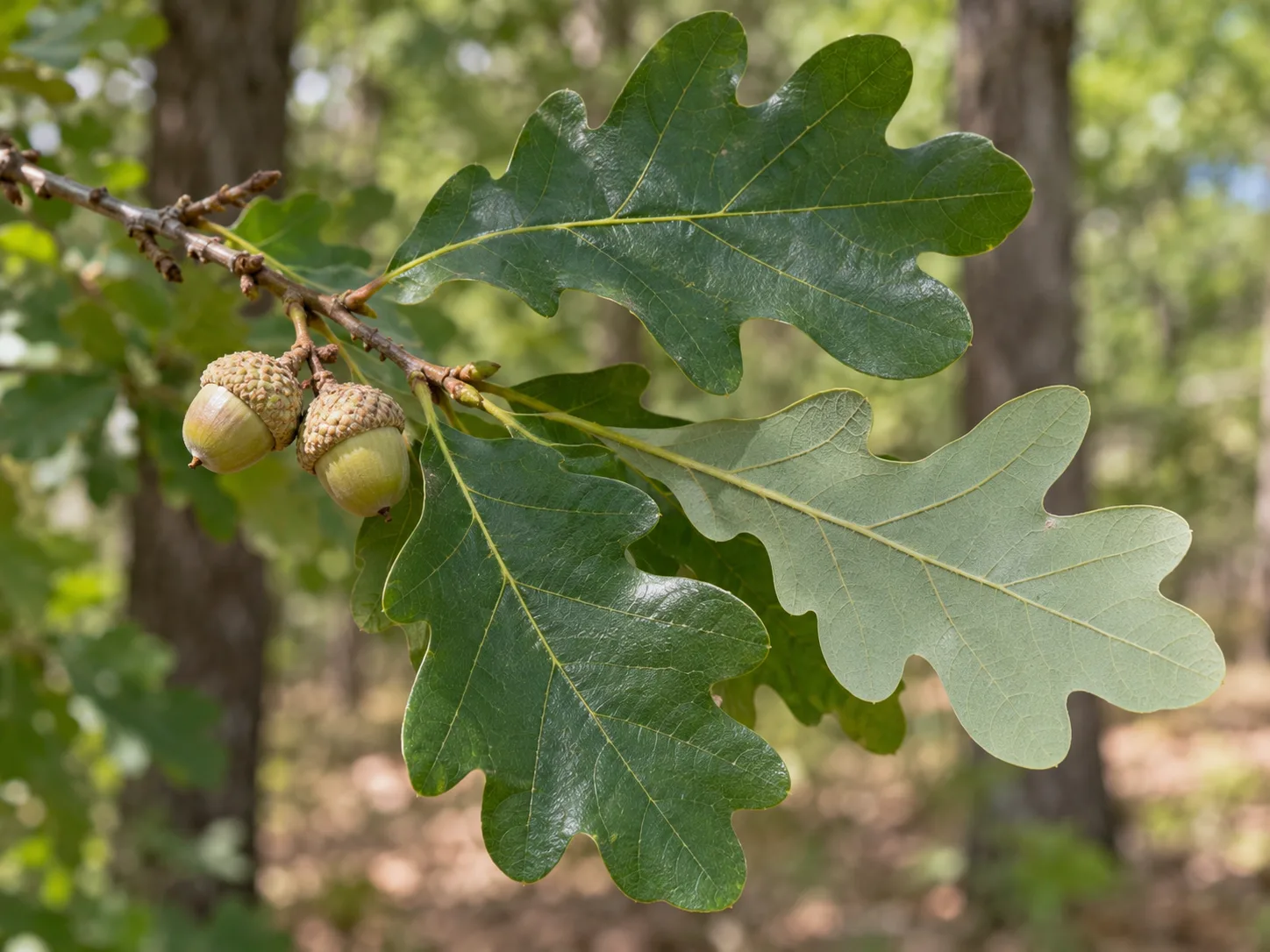
The clearest field mark is the leaf: it is simple and alternate, with several rounded lobes and no bristle tips. Mature leaves are usually dark green above and paler underneath; in autumn they may turn reddish, wine-colored, or brown. White oak leaves often remain attached after they change color, especially on younger branches, so a brown leaf in winter does not by itself signal disease.
Acorns are another useful clue. The nut is roughly three-quarters to one inch long, with a relatively shallow, knobby cap covering only part of it. White oak group acorns mature in one growing season, whereas red oak group acorns generally take two; that distinction can help with identification, but combine it with leaves, bark, and the tree’s overall form rather than relying on a single acorn.
The bark on younger trunks is light gray and scaly; older bark becomes more ridged and blocky. In spring, look for long yellow-green male catkins and small, less conspicuous female flowers. The common name refers to the pale finished wood, not a bright white trunk. NC State Extension’s plant profile describes these seasonal traits and notes the tree’s broad, rounded crown at maturity.
Tell white oak from similar oaks
White oak and northern red oak are often confused when a young tree is sold under a broad “oak” label. White oak leaf lobes are rounded; red oak leaves have pointed, bristle-tipped lobes. Acorn maturity offers a second clue, but leaves are usually easier to inspect on a nursery plant. Swamp white oak is a different species, Quercus bicolor, with shallower, scalloped leaves and stronger adaptation to wet conditions; do not use its tag or care needs as a substitute for checking the species name.
If you are identifying a mature tree without leaves, use more than bark color. Check the acorn cap and nut, twig arrangement, crown shape, and location, then compare those traits with a reliable regional tree key. Several oaks share gray bark, and bark appearance changes with age, growing conditions, and site. A photo of a single leaf may not be enough for confident species identification.
Choose the planting site and season
White oak does best with ample light, although young trees tolerate some partial shade. Favor a site with deep, drainable soil rather than a low pocket that stays saturated after rain. A soil test is useful if the ground is very alkaline, unusually compacted, or otherwise difficult; testing before planting prevents you from trying to correct a problem after the tree has rooted in.
Plant when the tree is dormant and the ground is workable, avoiding frozen soil and periods of extreme heat. Dormant-season planting gives roots time to begin establishing before summer demand increases. If you buy container-grown or balled-and-burlapped stock, choose a small, healthy specimen with a visible root flare and a sound root ball. A larger nursery tree is not automatically a better investment: it is heavier to plant, more expensive to establish, and white oak’s deep-rooting habit makes transplanting large specimens difficult.
Before digging, check for underground utilities and local planting rules. Leave enough clearance for the final crown and avoid locations where runoff carries road salt or where construction will compact the soil. If the lot is small, inspect nearby mature oaks in your neighborhood and ask a local arborist or extension office whether the site can realistically support another one.
How to plant a white oak seedling
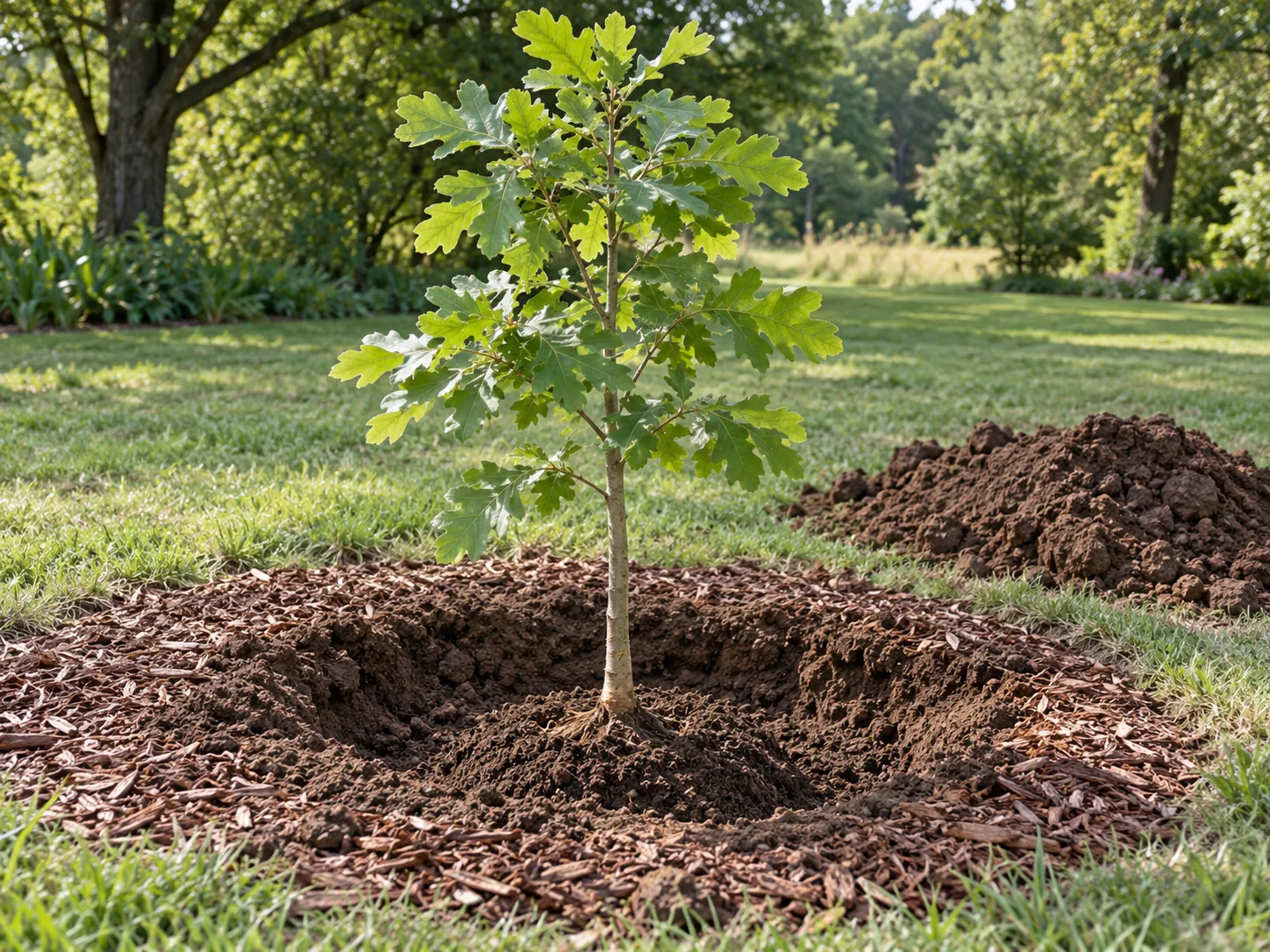
Measure the root ball and dig a broad hole with sloping sides, no deeper than the distance from the root flare to the bottom of the ball. A hole that is too deep can settle and bury the trunk base; a narrow, smooth-sided hole can make it harder for new roots to move into surrounding soil. Loosen compacted soil around the opening, but do not turn the entire planting area into an amended pocket that holds water differently from the native soil.
Set the tree upright, find the point where the trunk widens into the first structural roots, and position that flare level with or slightly above the surrounding grade. Remove burlap, twine, tags, and any container before backfilling; if roots circle inside a pot, correct them carefully without stripping the root ball. Return mostly native soil, firm it lightly to remove large air pockets, and water slowly so the soil settles around the roots.
Set the root flare at grade
The root flare should remain visible after the soil settles. Do not bury the trunk to make a leaning tree appear straight, and do not pile mulch against the bark. Spread a shallow layer of organic mulch over the root zone, extending it as far as practical while keeping a clear gap around the trunk. A wide, thin mulch ring helps reduce grass competition and moderates soil moisture; a deep mound against the stem can keep bark wet and invite damage.
Stake only if the root ball cannot stay stable in wind. Use flexible ties and remove them once the tree can stand securely; rigid, long-term staking can restrict trunk movement and create weak growth. Harvest to Table’s oak-growing guidance likewise recommends handling young root balls carefully and planting dormant nursery stock in well-drained soil. After planting, record the date and take a photo of the root flare so you can notice settling or mulch creep later.
Water a young white oak without overwatering
For the first growing season, water deeply whenever the root-ball soil is beginning to dry, then let excess water drain. The right interval depends on rainfall, temperature, soil texture, root-ball size, and exposure; a fixed “twice a week” schedule can drown a tree in clay or leave it thirsty in sand. Check moisture in the original root ball and surrounding soil with a finger or narrow trowel rather than judging only the surface.
Apply water slowly over the root ball and the adjacent soil so moisture reaches below the top inch. A hose trickle, soaker hose, or carefully placed slow-release watering bag can work if it wets the full root zone without keeping the trunk base soggy. After rain, check before watering again. If the soil is damp several inches down, wait; if it is dry and the canopy is exposed to heat, water thoroughly.
Continue checking through the second and sometimes third season, especially during drought, heat waves, or after nearby construction. As roots extend, water over a wider area instead of concentrating at the trunk. Once established, white oak is relatively drought tolerant, but that does not mean a new tree can be left dry or that an established tree will never need help during prolonged drought. Watch for persistent wilting, scorched leaf edges, and early leaf drop, then check soil moisture before assuming the problem is a disease.
Soil, light, and fertilizer
A deep, well-drained loam with slightly acidic conditions is ideal, but white oak can adapt to several soil textures if water can move through the profile and roots can penetrate. Heavy clay is not automatically disqualifying; persistent saturation and compaction are the bigger warning signs. Similarly, a dry site may be workable after the tree establishes, but a young oak planted in shallow, dry soil will need closer attention while roots expand.
Give the tree as much sun as the site allows. A young specimen can grow in partial shade, but a mature canopy in deep shade is likely to be less vigorous and may have a lopsided shape as it reaches for light. Do not prune neighboring plants or remove healthy mature trees just to manufacture full sun unless you have a broader landscape plan; adequate light is one factor among drainage, space, and root-zone health.
Do not fertilize by habit. If the tree grows poorly, first check whether it is planted too deeply, receiving too much or too little water, competing with turf, or stressed by compacted soil. A soil test can show whether a nutrient problem exists. High soil pH can make iron less available and cause chlorosis, but adding sulfur or fertilizer without a test may create a new imbalance. Correct the site condition that limits roots before reaching for a product.
Grow a white oak from an acorn
Growing an oak from seed is satisfying, but it adds years to the wait and does not guarantee a tree identical to a named selection. Collect mature acorns from a healthy local white oak soon after they fall. Select full, firm nuts without holes, splits, or soft spots; discard any that are visibly damaged or moldy. White oak acorns are best handled as fresh seed, not dried for long-term storage, and Harvest to Table recommends sowing oak seed as soon as it ripens.
Plant acorns in a deep container or prepared nursery bed with drainage, placing each nut on its side and covering it with a modest layer of soil. Label the species and collection date, water to keep the mix evenly moist rather than saturated, and protect the container from rodents. A long taproot develops early, so a shallow tray is a poor choice. Keep the young seedling in a protected outdoor location where it experiences normal seasonal conditions, and shield it from browsing animals.
When the seedling is sturdy and the root system can be handled without breaking its main root, move it to its permanent site while it is dormant. Do this early rather than keeping an oak in a small pot for years: roots can become crowded or distorted, and the tree will be harder to transplant as it grows. If the seedling has a strong taproot extending through a container, choose a deeper pot or plant it out instead of cutting that root casually.
A seed-grown tree may vary in form, vigor, and fall color from the parent. For a predictable landscape specimen, buy correctly labeled nursery stock; for a restoration planting or a long-term project, a local acorn can be a meaningful start. In either case, protect the seedling from mower damage, deer browsing, and competition from turf during its vulnerable first years.
Prune for a sound structure
A young white oak usually needs only light structural pruning. Remove a broken branch, a dead limb, or a branch that rubs against another; retain a strong central leader and well-spaced scaffold branches. A narrow, weakly attached fork can become a future problem, but avoid removing too much live canopy at once. A young tree needs leaves to make energy and a balanced crown to develop.
Make cuts just outside the branch collar, where the limb joins the trunk or a larger branch. Do not leave a long stub, cut flush against the trunk, or apply wound paint as a routine. For a small branch within safe reach, use sharp, clean pruners or a pruning saw suited to its diameter. Never climb a ladder with a chainsaw or attempt to remove a heavy limb that could fall unpredictably.
Dormant-season pruning is a common recommendation for oaks, and Harvest to Table advises avoiding spring cuts when bark beetles are active. However, oak wilt risk and insect activity vary by region, and local rules can change the safest pruning window. Check with your extension service or municipal forester if oak wilt occurs nearby. Hire a qualified arborist for mature-tree pruning, large limbs, storm damage, structural defects, or any work near wires; the cost of a professional assessment is small compared with an avoidable injury or major canopy loss.
Acorns, wildlife, and seasonal care
White oak offers more than shade. Oaks support many caterpillars and other insects, and those insects become food for birds and other wildlife. The Morton Arboretum describes oaks as ecologically important trees and notes that white oak acorns and canopy help sustain wildlife. If you want a resilient habitat planting, let some leaf litter remain under the tree where it will not smother turf or block drainage, and avoid broad-spectrum insect treatments unless a locally identified problem justifies action.
Acorn crops vary from year to year. A heavy crop can make a lawn slippery, complicate mowing, and attract squirrels, deer, and other animals; a lighter year does not mean the tree is unhealthy. Plan the main gathering areas away from patios and high-traffic paths if you have a choice. Do not mistake normal acorn drop for a pest outbreak, and remember that a young tree may take many years before it produces a meaningful crop.
White oak acorns can be processed as food only after tannins are removed, but this is a separate food-preparation task, not a reason to sample raw acorns. More importantly, NC State Extension flags white oak as toxic to horses. If horses have access to fallen acorns or oak foliage, prevent heavy exposure and consult an equine veterinarian promptly if ingestion is suspected, especially when an animal shows illness. Keep livestock safety in mind when selecting a planting location.
White oak pests and diseases
Many insects feed on oak leaves, buds, or acorns, and small amounts of feeding are part of a functioning habitat. NC State’s species profile lists issues such as leaf miners, scales, caterpillars, galls, leaf spots, powdery mildew, anthracnose, and oak wilt. The presence of a few chewed leaves or galls is not a reason to spray. First identify the symptom, estimate how much of the canopy is affected, and look for whether the damage is expanding.
Oak wilt is more serious than ordinary leaf chewing. It can cause rapid canopy decline and leaf wilt, but symptoms can overlap with drought, root injury, and other diseases. If leaves wilt or brown across the crown unusually early, especially when decline is moving quickly, photograph the canopy and contact a local extension office or certified arborist for diagnosis. Do not prune or move infected wood until you know the local guidance; disease spread and recommended actions depend on the region.
Root-zone damage is a common, preventable stressor. Soil piled over the base, repeated vehicle traffic, trenching, and construction compaction can reduce oxygen and damage roots that are hard to replace. Protect a broad area around the tree, keep heavy equipment away, and avoid changing grade near established roots. If a mature oak declines after construction, a tree-care professional can evaluate the root zone and determine whether the damage is manageable.
Read yellowing and browning leaves carefully
A few older leaves changing color in autumn are normal; a whole canopy yellowing in midsummer is not. Yellow leaves with green veins can point to iron chlorosis associated with high-pH soil, while scorched margins during hot, dry weather may reflect water stress. In either case, check the season, soil moisture, and pattern of damage before deciding what to do.
Do not treat every yellow leaf with iron or fertilizer. A soil test can confirm pH and nutrient levels, and a site inspection can reveal buried roots, drainage trouble, or compacted ground. If symptoms are widespread, worsening, or accompanied by branch dieback, get a diagnosis before applying a treatment. For oaks, the wrong intervention can waste money and delay attention to the real problem.
White oak benefits, drawbacks, and alternatives
White oak’s strongest advantages are longevity, substantial shade, attractive branching, fall color, and habitat value. It is native over a broad eastern range and can fit a naturalized yard or spacious lawn better than a short-lived ornamental tree. Once established in a suitable site, it needs less routine care than many high-maintenance landscape plants.
Its tradeoffs are equally real. It grows slowly, becomes enormous, produces acorns and leaf litter, and is difficult to relocate after establishment. Wind damage is possible, and soil compaction, wet ground, and oak diseases can undermine a tree that otherwise appears hardy. The tree is a commitment, not a convenient way to fill an empty corner.
If you want an oak but have a smaller property, compare locally native species with a more modest mature size, and check that their drainage and soil preferences match your site. A swamp white oak may suit a wetter location than white oak, while a smaller native oak may fit a compact yard better; those are different species with different requirements, so verify the label and local recommendations. If the site cannot accommodate a mature crown and protected root zone, choose a smaller native shade tree rather than planting white oak and planning to keep it small.
Conclusion
Plant a white oak when you can give it deep, well-drained soil, establishment watering, and room to become a very large tree. Identify the species by its rounded, bristle-free leaf lobes, protect the root zone from compaction, and keep pruning light while the structure develops. A correctly placed white oak asks for patience and space; in return, it can become a long-lived shade tree and a lasting source of habitat.