Variegated Peace Lily 'Domino' Care: What It Needs
Care for a variegated peace lily 'Domino' with bright indirect light, soil-based watering, an airy mix, and practical fixes for fading leaves or no blooms.
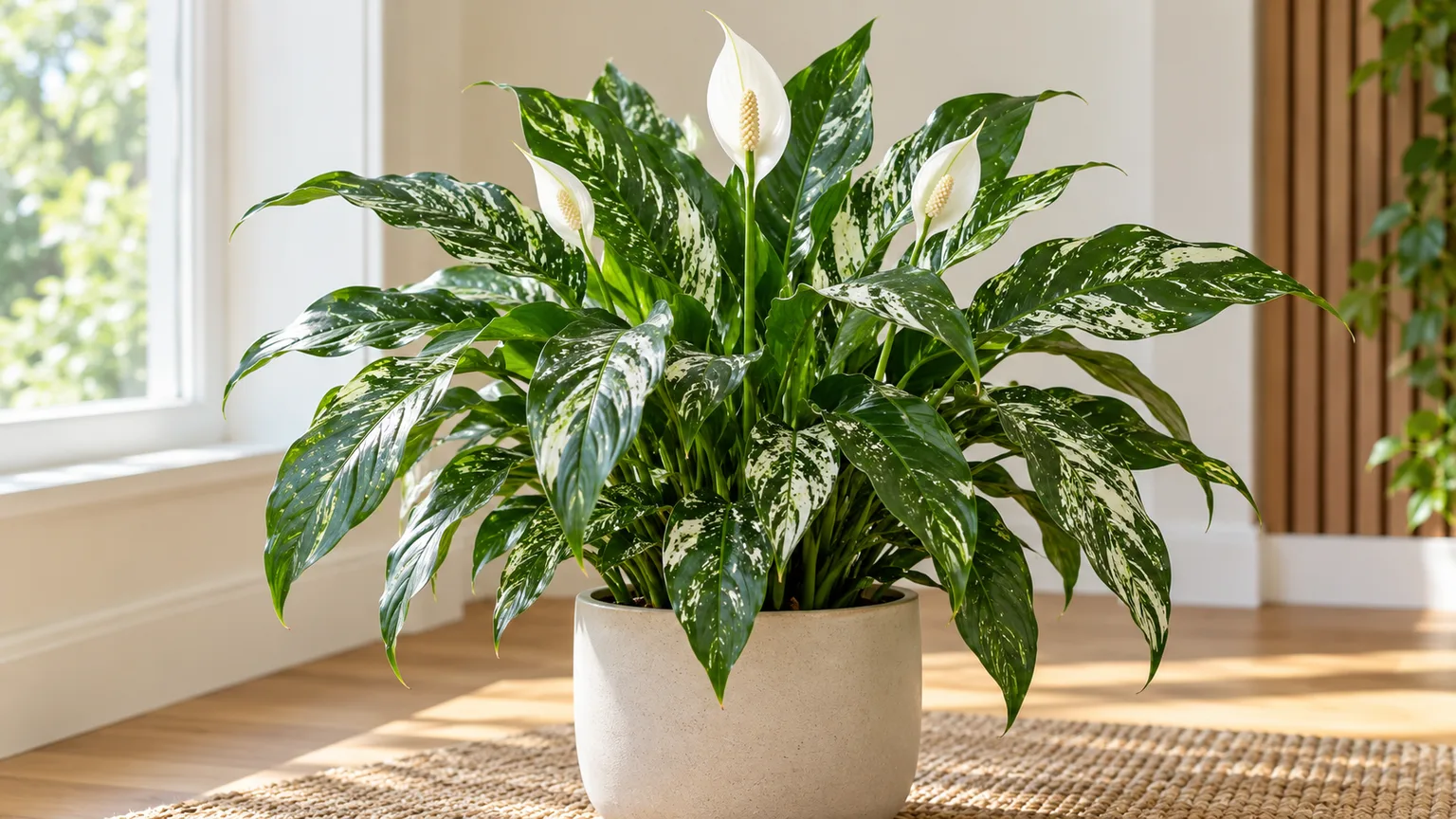
A variegated peace lily ‘Domino’ brings cream and pale-green markings to the familiar arching leaves and white sail-shaped blooms of a peace lily. Its needs are familiar if you have grown another Spathiphyllum, but the lighter leaf areas contain less chlorophyll, so a Domino generally benefits from a brighter position than a solid-green peace lily. The practical target is steady warmth, bright filtered light, and a potting mix that stays lightly moist while still letting roots breathe.
The easiest way to avoid most problems is to stop using a weekly watering rule. Check the mix, pot, and room conditions first; then make one adjustment at a time. That approach helps you distinguish thirst from root stress, keep the variegation visible without scorching leaves, and avoid feeding a plant that is already struggling.
What makes ‘Domino’ different
‘Domino’ is a variegated cultivar of peace lily, generally sold under Spathiphyllum wallisii. Its leaves have irregular pale markings over green tissue, and the amount and pattern of variegation can differ from leaf to leaf. Those cream areas are attractive, but they contribute less photosynthesis than green tissue. That is why the plant usually needs good indirect light to grow steadily and hold its pattern; more sun is not automatically better.
A peace lily’s showy white part is a spathe, a modified leaf that surrounds the small flowers carried on the central spadix. The spathe may fade toward green as it ages, which is part of its normal life cycle rather than proof that the plant is sick. NC State Extension describes peace lilies as tropical, semi-evergreen aroids and notes that their spathes can change from white to green as they mature. NC State Extension’s Spathiphyllum profile is useful for the broader species-level culture, while the cultivar-specific advice here stays conservative where published guidance is limited.
Indoors, a Domino is grown mainly for patterned foliage and occasional flowers, not fast growth. A recently purchased plant may pause while it adjusts to a new room, and a young or divided crown may take time to settle before flowering. Don’t interpret every quiet month as a care failure.
Give it bright, filtered light
Set the plant where it receives bright, indirect light for much of the day: near an east-facing window, or a few feet back from a brighter south- or west-facing window. A sheer curtain can soften direct rays. A spot that is comfortable for reading during the day without a lamp is a reasonable starting point, but observe the leaves over time rather than relying on a room label such as “bright.”
Low light often shows up gradually. New growth may arrive slowly, flowers may be scarce, and the pale markings can become less distinct or more green. Move the plant closer to a window in small steps, and give it a week or two to respond before moving it again. The lighter foliage makes strong direct afternoon sun a poor shortcut: bleached patches, dry tan areas, or crisp margins on the window-facing side point toward excessive exposure rather than a need for more light.
Domino can tolerate a dimmer corner for a while, but survival is not the same as maintaining compact, patterned growth. If the only available site is low-light, consider a plant light on a timer and follow the fixture’s distance guidance; don’t place a lamp so close that leaves warm up. Rotate the pot occasionally if one side leans toward the window, but keep the change modest so the plant is not constantly adapting to a new direction.
Water by checking the mix, not the calendar
Peace lilies prefer a mix that stays evenly moist but not waterlogged. A weekly check can be a useful reminder, but a weekly watering prescription fails when light, pot size, room temperature, and season change how fast the root ball dries. Start by pressing a finger about an inch into the mix. If it still feels damp, wait and check again in a few days; if the surface layer has dried and the deeper mix is only slightly moist, water thoroughly.
Pour slowly over the surface until water runs from the drainage holes. Let the pot drain completely, then empty the saucer or cachepot so roots are not left in standing water. A light pot can also signal that the mix has dried, while a heavy pot after many days can suggest that the mix is staying wet too long. These clues become more reliable as you learn how your particular pot feels.
If the mix has become very dry and pulled away from the pot, water in several passes so it can absorb instead of channeling down the sides. If the plant is limp while the mix is wet, adding more water is the wrong first move: check that the container drains and look for a sour smell or soft, dark roots. NC State Extension’s general guidance likewise pairs moist soil with a warning against sogginess and notes that overfeeding and salt buildup can burn roots and leaf tips. Indoor watering guidance from Epic Gardening also emphasizes adjusting care to the conditions rather than treating a calendar as a substitute for observation.
Use room-temperature water when practical. If repeated brown tips persist despite sensible watering, consider whether your tap water is hard or high in dissolved minerals, but treat that as one possibility rather than the diagnosis. A periodic flush can help remove accumulated soluble salts only when the pot has open drainage and the mix does not stay saturated; flush with water, allow it to drain fully, and do not leave the pot soaking.
Choose an airy, moisture-holding potting mix
A useful mix holds enough water for the roots to access between checks but contains air spaces after watering. Start with a quality indoor potting mix and loosen it with perlite or fine orchid bark if it stays dense or takes a long time to drain. The goal is not a very dry, coarse mix that needs constant watering, nor a heavy soil that remains wet at the bottom after the surface looks dry.
Use a pot with at least one unobstructed drainage hole. A decorative cachepot is fine if the nursery pot can be lifted out for watering and draining. Do not put a layer of stones in the bottom to “improve drainage”; it reduces usable root space and does not fix a compact mix. Choose a container only slightly wider than the root mass so extra soil does not remain wet for too long.
If water pools on top of the mix or runs down a gap between the root ball and pot, check whether the mix has compacted, become hydrophobic, or is packed tightly with roots. Those are different problems with different fixes. Replacing degraded mix or repotting a crowded plant is more reliable than repeatedly watering more often.
Keep temperatures steady; manage humidity simply
Domino is a tropical houseplant, so a consistently warm room is better than a drafty sill or a position above a heater. NC State Extension lists daytime conditions around 68–85°F for peace lilies and warns that cold or drafty conditions slow growth. In a home, aim for comfortable room temperatures and avoid prolonged chilling, cold glass, and blasts from heating or air-conditioning vents. If you move the plant outdoors for warm weather, wait until nights are reliably mild, keep it in shade, and bring it back before temperatures fall.
Average household humidity is often adequate if watering and light are steady. If the air is very dry and several leaves develop crisp edges, group plants together or use a room humidifier, while leaving space for air movement. Misting does not hold humidity around leaves for long and can leave water spots; a pebble tray has limited reach and should never leave the pot sitting in water. Humidity is a supporting factor, not a fix for a root ball that is either bone-dry or constantly wet.
Feed lightly during active growth
A Domino that is producing healthy leaves in fresh, nutrient-containing potting mix may need little fertilizer at first. During active spring and summer growth, you can use a balanced liquid houseplant fertilizer at a conservative dilution, following the product label and erring on the weaker side. Apply it to already-moist soil, not a dry root ball, and pause in winter if growth slows with shorter days.
More fertilizer does not make a variegated plant grow faster or flower on command. Too much soluble fertilizer can leave salts in the mix and damage roots or tips; pale or slow growth alone does not prove a nutrient deficiency. First check light, drainage, root crowding, and watering consistency. If you fertilize, use a measured amount, keep a note of when, and avoid stacking liquid feed with fertilizer spikes or frequent compost amendments.
If brown tips appear soon after feeding, stop fertilizing and review the label dose. For a plant in a pot that drains freely, a thorough plain-water flush may remove some built-up salts. If symptoms continue, inspect the roots and the mix rather than repeating the flush or applying a second product.
Encourage flowers without forcing them
A peace lily flower stalk rises above the foliage with a white spathe around a central spadix. On Domino, flowers may be less frequent than the patterned leaves, especially when the plant is young, recently divided, or kept in low light. Bright filtered light, steady moisture, warm conditions, and healthy roots give it the resources to bloom, but no schedule can guarantee flowers in a living room.
If the plant is healthy but has not flowered, first improve the light gradually. Do not move it straight into hot sun, keep the mix from swinging between drought and saturation, and avoid heavy feeding as a bloom trigger. NC State Extension notes that peace lilies can flower freely under suitable conditions and that blooms shift toward green with age; that general behavior is more dependable than claims that every Domino flowers on a fixed spring calendar.
When a spathe turns green or brown and begins to look spent, follow its stalk down and snip it near the base with clean scissors. This tidies the plant and lets it direct resources toward leaves and roots. Do not cut off healthy green leaves to make the plant “save energy” for flowers; those leaves are still supporting growth.
Prune and clean with a light touch
Remove fully yellow, dead, or badly damaged leaves by cutting the leaf stalk close to its base. Use clean, sharp scissors and avoid pulling leaves, which can tear the crown. A single old outside leaf yellowing while the rest of the plant continues to produce healthy growth is often ordinary turnover; several leaves yellowing together call for a check of watering, light, and roots.
Dust broad leaves with a damp soft cloth so they can receive light and so you can inspect their undersides. Avoid leaf-shine products and routine pesticide sprays. If you find a pest, isolate the plant and identify it before choosing a response. A few targeted cuts are enough; frequent hard pruning will not correct low light, root problems, or a poor watering routine.
Repot only when roots or mix call for it
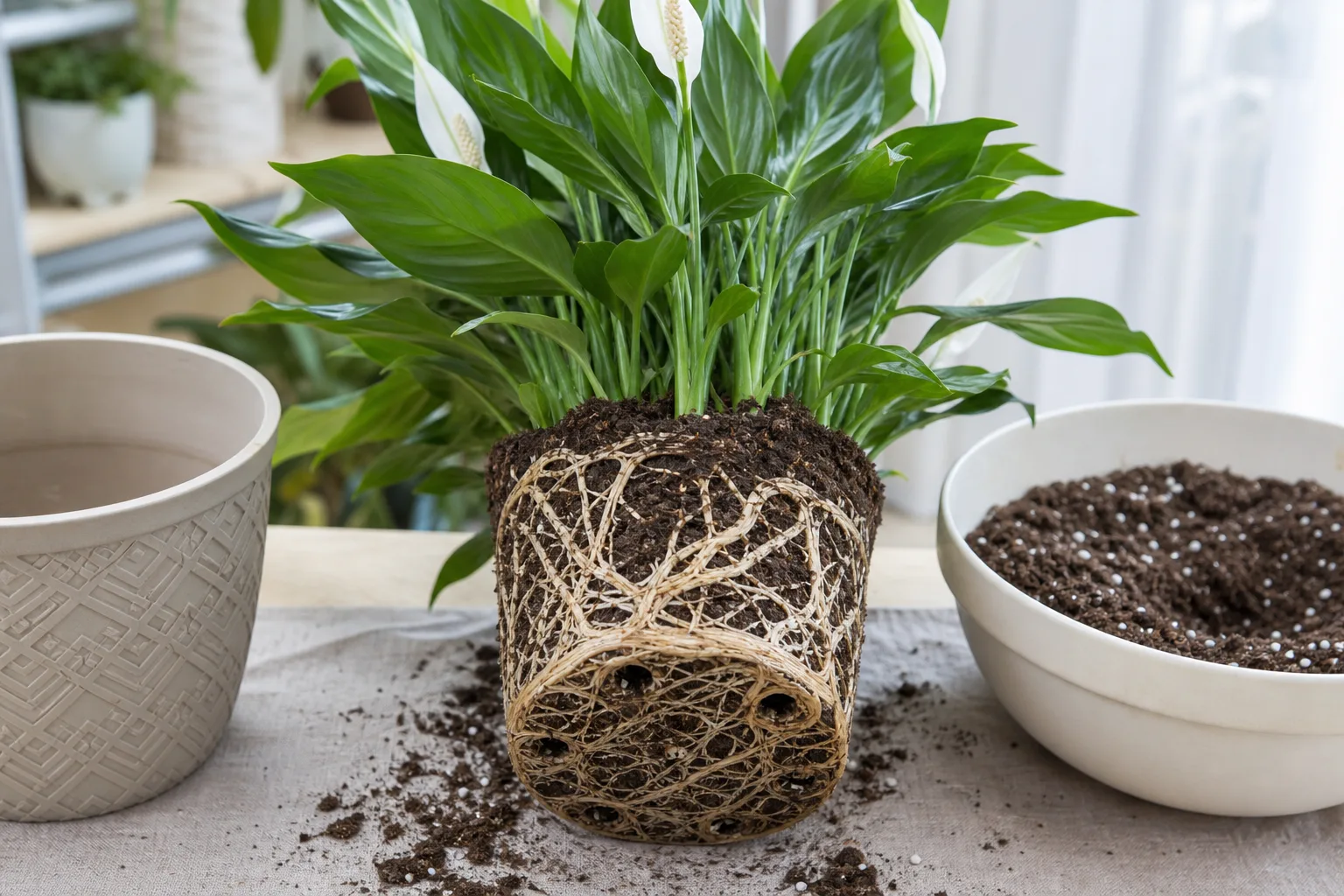
A peace lily can tolerate being somewhat snug in its pot, so do not repot just because a year has passed. Look for roots circling densely or emerging from drainage holes, a root ball that dries unusually fast, water that cannot soak into compacted mix, or a plant that has outgrown its stable container. A few roots at one hole by themselves are not an emergency if water drains and the plant is growing well.
Repot during active growth when possible. Choose a pot roughly one size larger, loosen only the outermost circling roots, and set the plant at the same soil depth it had before. Fill around the root ball with fresh airy mix, water it in, and let excess drain. A container that is far larger than the root system may hold too much wet mix, which can prolong recovery and raise the risk of root trouble.
After repotting, return the plant to bright indirect light and keep moisture steady while it settles. Do not fertilize immediately; fresh mix and disturbed roots are enough change for one week. Some temporary droop can follow repotting, but persistent decline in wet soil is a cue to check drainage and roots rather than add more water.
Propagate by dividing rooted crowns
The reliable home method is division: separate a mature clump into sections that each have their own roots and several leaves. A single leaf or leaf cutting without a piece of the crown will not grow into a new peace lily. Divide when the plant is large enough to separate naturally, ideally while repotting in spring or early summer, rather than repeatedly disturbing a small plant.
Water the parent plant lightly the day before if the mix is dry, then slide it from its pot and tease away enough mix to see where individual crowns connect. Gently pull apart sections with roots attached; use a clean knife only when roots are tightly joined. Keep each division substantial, with a healthy root system and more than one leaf, because tiny sections have fewer reserves and may take longer to recover.
Plant each section at its previous depth in a small pot with drainage and fresh mix. Water until the mix settles and drains, then keep the divisions warm in bright indirect light. Expect a short adjustment period; do not keep lifting the plant to inspect it, soak it continuously, or fertilize new divisions heavily. If there are not clear rooted crowns to separate, wait for the plant to fill out rather than forcing a division.
Troubleshoot problems by reading the pattern
One leaf rarely identifies the cause by itself. Check four things in order: how wet the mix is below the surface, whether the pot drains, where the newest damage appears, and whether the plant recently changed position or care. Correct the likely cause and give new growth time to show whether the change helped; already-browned tissue will not turn green again.
Drooping or yellow leaves
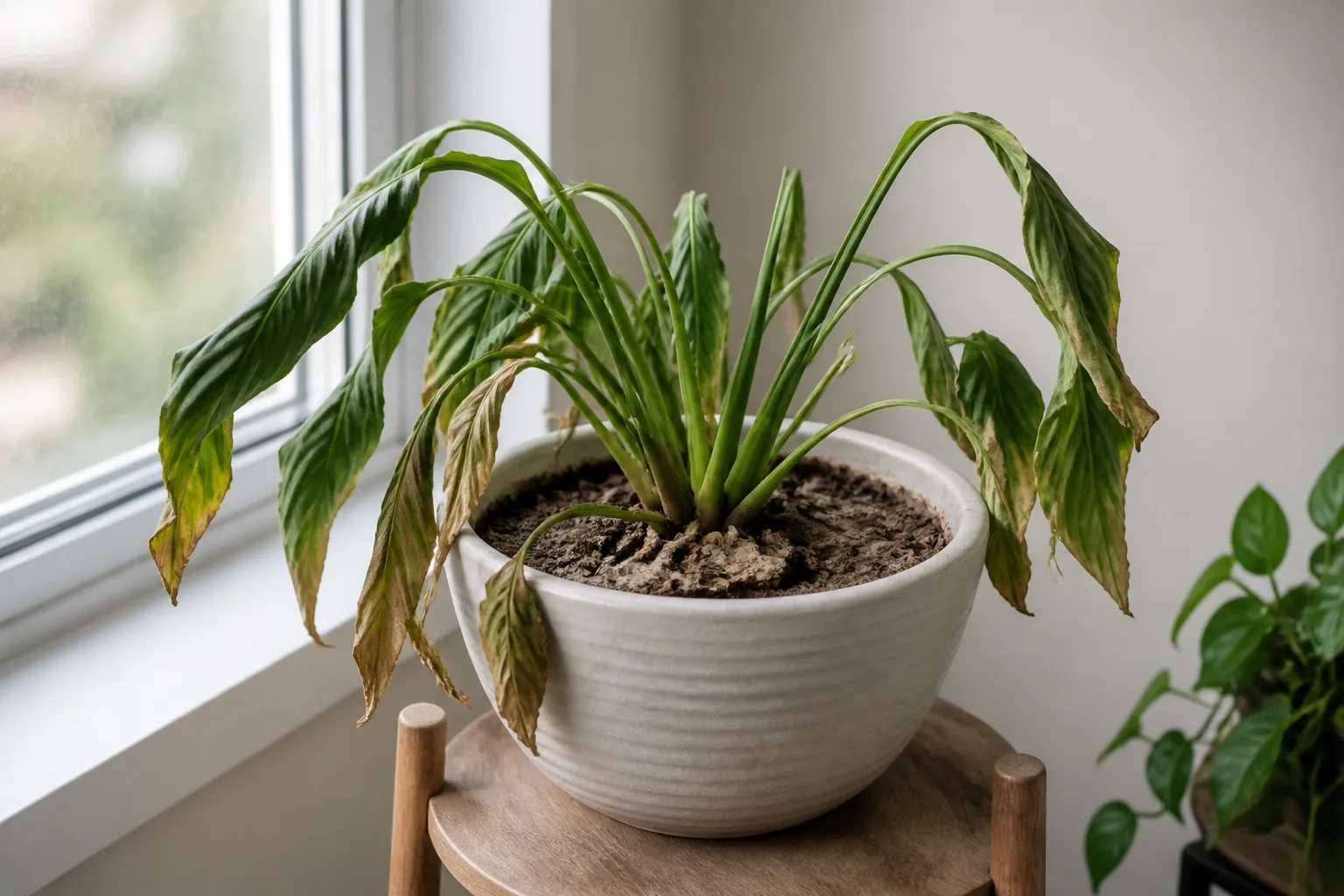
If the mix is dry several inches down and the pot feels light, underwatering is plausible. Water thoroughly and let the pot drain; a thirsty peace lily often perks up after the root ball is rehydrated, though severely dried roots may recover more slowly. Do not repeat watering until the mix begins to dry again.
If the mix is persistently wet, the pot has no drainage, or the plant remains limp after watering, investigate root stress. Remove the plant only if the evidence points to a problem; healthy pale roots do not need to be disturbed. Brown, soft, or foul-smelling roots suggest rot, in which case trim damaged tissue with clean tools and repot into fresh, free-draining mix. Yellow leaves can also follow a cold draft, sudden light change, or normal aging, so note whether the newest leaves or just one older leaf is affected.
Brown tips, edges, or sun patches
Brown tips can follow dry air, irregular watering, fertilizer salts, mineral-heavy water, or root stress. The pattern helps narrow it down: many tips browning after feeding suggests excess fertilizer; crisp areas facing a window suggest direct sun; widespread browning with a constantly wet mix demands a root check. Trim only the dead portion if you want a neater look, leaving a narrow brown border so you do not cut into living tissue.
Use clean, lower-mineral water for a few waterings if mineral buildup seems likely, and check that the pot drains. Do not assume chlorine is the only cause or keep flushing a poorly draining container. If browning keeps spreading, inspect the roots and review recent changes in light, temperature, and feeding before making another adjustment.
Fading variegation or no flowers
New leaves that are greener than older leaves may indicate that the plant is receiving too little light, especially if stems stretch and growth slows. Move it toward brighter filtered light gradually. Some variation between leaves is normal, and a leaf that opened with little cream may stay that way; moving the plant cannot recolor existing tissue.
If leaves are patterned but the plant does not flower, consider age and overall light before fertilizer. A mature, healthy plant in brighter indirect light is more likely to flower than one kept in a dim corner, but indoor bloom timing varies. If foliage is becoming pale or scorched on the window side, step back from direct rays rather than increasing exposure.
Mealybugs, scale, and other pests
Inspect leaf undersides, leaf joints, and the crown for cottony mealybugs, hard brown scale, fine webbing, or sticky residue. Isolate the plant as soon as you find pests, then wipe or rinse visible insects from accessible leaves and repeat inspections every few days. Check nearby plants too; pests are easier to manage before they spread.
For a light infestation, a cotton swab can remove individual scale or mealybugs. If you use insecticidal soap or another labeled treatment, follow its label, test a small area first, and keep the plant away from direct sun until treated leaves are dry. Avoid household cleaners or improvised concentrated mixtures, which can injure foliage and do not reliably solve an infestation.
Keep the plant away from pets and curious children
Peace lilies contain insoluble calcium oxalate crystals. Chewing or swallowing leaves, stems, or flowers can cause immediate mouth irritation, drooling, swelling, difficulty swallowing, and sometimes vomiting. The ASPCA lists peace lily as toxic to cats and dogs, and Poison Control explains the irritation mechanism and offers exposure guidance. Keep the plant out of reach of pets and young children, and do not treat it as edible because it is a houseplant.
If a person chews the plant, remove visible pieces and rinse the mouth; contact Poison Control for case-specific advice, especially if symptoms continue or there is swelling or difficulty swallowing. If a pet may have chewed it, call a veterinarian or an animal poison service and identify the plant if you can. Do not induce vomiting or rely on an online photo to judge how much was eaten. The ASPCA’s peace lily entry and Poison Control’s peace lily guidance provide specific next steps.
Conclusion
A Domino peace lily does best when you treat it as a tropical foliage plant with a little more need for useful light than a solid-green peace lily. Give it bright filtered light, a draining pot and airy mix, and water when the upper mix has begun to dry rather than on a fixed weekday. Feed modestly only while it is growing, and let the plant’s condition—not the calendar—decide when it needs repotting or division.
When leaves droop, yellow, or brown, inspect the soil and drainage before reaching for fertilizer or changing several conditions at once. Protect the plant from strong direct sun, cold drafts, and chewing pets, and give new leaves time to show whether your adjustment worked. That steady, observation-led routine is the simplest way to preserve the foliage that makes ‘Domino’ special.