How to Make and Use Manure Tea More Carefully at Home
Learn how to make manure tea from finished manure compost, where to apply it, and why steeping raw manure does not make it safe for edible crops at home.
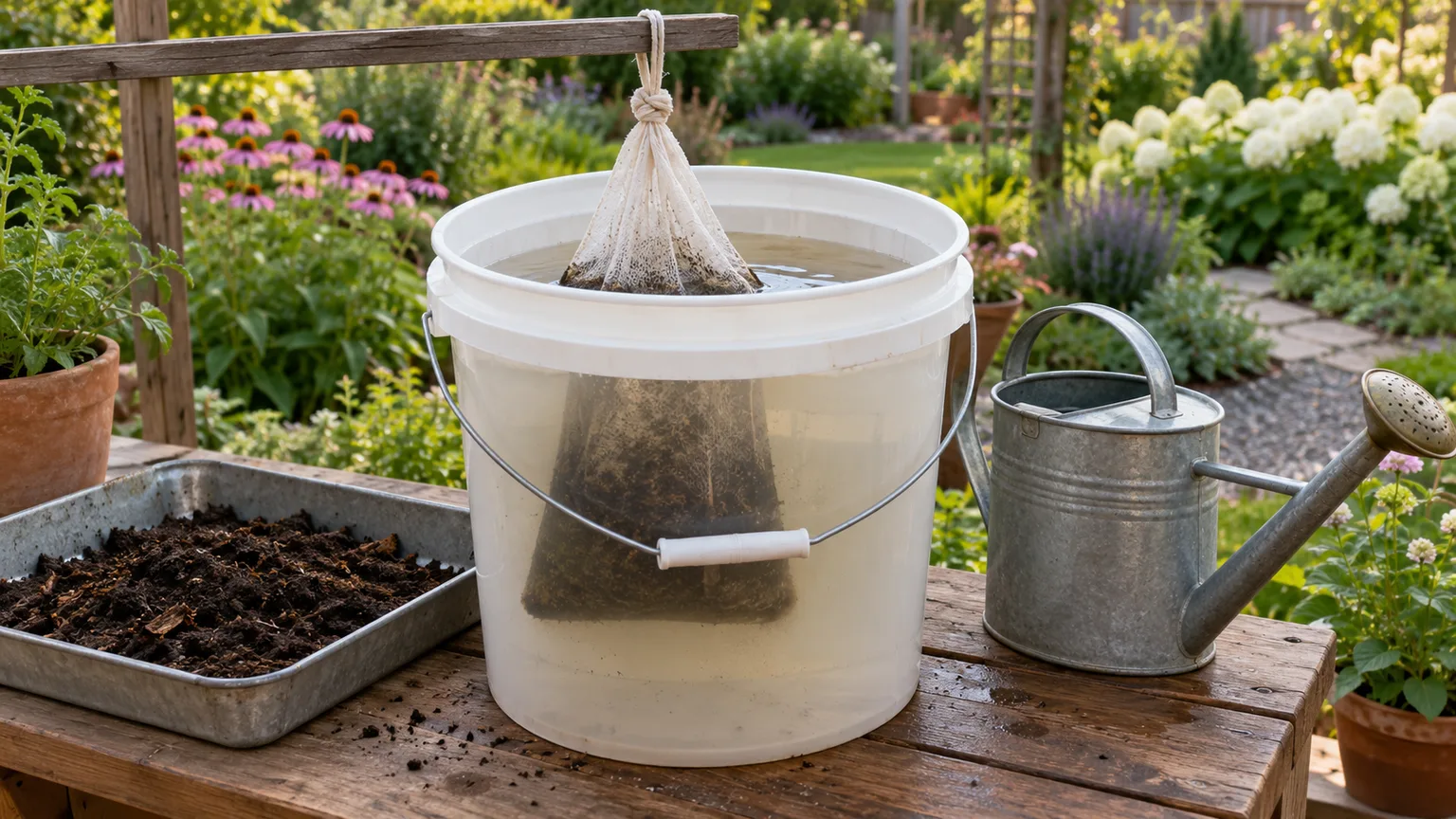
Manure tea is liquid made by steeping manure or manure compost in water. It may carry some soluble nutrients into the liquid, but the recipe does not create a predictable fertilizer, and steeping raw manure does not reliably kill pathogens. For a home garden, the cautious choice is to skip raw manure tea, keep homemade manure-based liquids away from food crops, and use only finished, documented compost if you decide to make a small soil drench for established ornamentals.
That is a narrower use than many garden recipes suggest, but it answers the important question before you fill a bucket: what is in the material, and where will the liquid go? A watering can can splash onto leaves, tools, shoes, harvest containers, and nearby beds. A good smell, a pale color, or a few days in water tells you nothing reliable about microbial safety or exact nutrient strength.
What Manure Tea Is—and What It Is Not
A manure tea is an extract: water has been in contact with animal manure or manure compost, and the strained liquid is applied to soil or plants. The liquid can carry dissolved salts and nutrients, along with fine organic particles and microbes. The amounts vary with animal type, feed, bedding, compost maturity, water quality, the manure-to-water ratio, temperature, and steeping time, so a homemade batch has no guaranteed nitrogen-phosphorus-potassium analysis.
That variability matters more than the word “tea” suggests. A dark brew is not necessarily strong, a pale brew is not necessarily mild, and diluting it by eye cannot tell you whether a plant needs those nutrients. Penn State Extension notes that manure lacks the guaranteed analysis of a packaged fertilizer; it is better understood as an organic amendment with variable nutrient content than a precise plant food (Penn State Extension’s guide to using manure in home vegetable gardens).
Manure tea, compost tea, and aerated compost tea
The names overlap in casual conversation, but the starting materials differ. Manure tea traditionally means animal manure steeped in water. Compost tea is extracted from mature compost, which may or may not contain composted manure. Aerated compost tea uses air stones or a pump to circulate oxygen during brewing, sometimes with additives intended to feed microbes.
Those labels do not certify a brew as safe. An air pump is not a pasteurizer, and steeping is not the same as thermophilic composting. For farms covered by the Produce Safety Rule, Penn State explains that agricultural tea has additional conditions: its biological inputs need to be processed, and the water must meet the rule’s microbial standard; certain microbial-growth additives can cause a tea to be treated as untreated. A home gardener does not need to turn a bucket into a regulatory project, but the principle is useful: the treatment history of the input and the cleanliness of the water matter more than the name on the bucket (Penn State Extension on soil amendments under the Produce Safety Rule).

The Safety Question Comes Before the Recipe
Manure comes from animals that can carry microorganisms capable of making people ill. Penn State’s home-garden guidance identifies risks such as E. coli, Salmonella, and Listeria in contaminated produce and emphasizes careful manure handling, clean tools, and handwashing. The University of Minnesota Extension’s food-safety educators likewise explain that animal-based amendments can carry microbial risk even when they have been composted; the risk depends on how the material was treated, handled, and stored (Penn State’s home-garden food-safety guidance; University of Minnesota Extension’s guidance on animal-based compost).
Why steeping does not sanitize raw manure
A bucket of manure and water does not reach or hold the controlled temperatures and conditions used in a validated composting process. Some organisms may decline over time under certain conditions, but a gardener cannot infer a safe pathogen level from steeping duration, smell, foam, color, or the absence of visible solids. Dilution changes concentration; it does not remove or reliably destroy pathogens.
This is why a one- or two-day soak is not a shortcut for composting, and why adding molasses, sugar, yeast extract, or other microbial “food” is a poor safety experiment. Penn State Extension’s explanation of agricultural teas notes that untreated biological inputs, water that fails the relevant standard, or additives intended to increase microbial biomass can change how a tea is classified under produce-safety rules. The rule applies to covered operations, but it underscores the practical risk: a home brewer cannot see which microbes are multiplying in a bucket.
Foliar spraying raises the stakes because droplets can land directly on edible leaves or fruit, then dry there. A soil drench can also splash onto low-growing crops, contaminate tools, or be tracked into a harvest area. The simplest way to avoid that pathway is not to use homemade manure tea on edible crops or anywhere its spray or runoff could reach them.
What properly treated compost means
“Old,” “aged,” “dark,” and “crumbly” are not interchangeable with properly composted. Aged manure may have sat for months without the entire pile reaching a pathogen-reducing temperature; a hot center alone does not prove that the outer material was treated. When the supplier cannot explain the treatment process, treat the material as unverified rather than assuming time has made it safe.
For covered produce farms, FDA’s Produce Safety Rule recognizes validated composting examples that include aerobic static composting held at a minimum of 131°F (55°C) for three consecutive days followed by curing, or turned composting held at that temperature for 15 days with at least five turnings followed by curing. These are process examples in a regulated context, not a claim that a bucket of manure tea becomes safe or that every backyard pile meets the standard (FDA’s raw-manure and produce-safety overview; Penn State Extension’s soil-amendment guidance). For a garden product, prefer a reputable supplier that labels the manure compost as treated or fully composted and follow its instructions.
Decide Whether Manure Tea Belongs in Your Garden
Use a simple decision rule. If your goal is to feed vegetables, herbs, strawberries, or any crop eaten raw, choose finished plant-based compost or a fertilizer labeled for that use instead of homemade manure tea. If your goal is to reuse a known, treated manure compost on a non-edible ornamental bed, a small soil drench may be a reasonable garden experiment, provided the source is documented and you use clean, dedicated equipment.
There is also a good reason to skip the brew entirely: solid compost usually does the soil-building job more directly. Manure incorporated into soil can add organic matter and may improve soil structure, while a liquid extract does not provide the same bulk organic material. If you are trying to correct a nutrient deficiency, get a soil test and use an amendment with a known analysis rather than guessing from the color of a tea.
Choose the Manure, Water, and Equipment Carefully
For the narrow ornamental use described here, choose finished composted livestock manure from a source that can describe how it was treated. Bagged product from a reputable supplier with a clear label is easier to evaluate than a bucket of fresh material from an unknown pile. Poultry manure can be especially concentrated in nitrogen; fresh or incompletely composted material can injure roots as well as create a food-safety concern. Penn State Extension advises composting high-nitrogen chicken manure before home-garden use and warns against dog, cat, pig, and human waste in edible gardens because of pathogen or parasite concerns.
Do not use pet or human feces in a homemade tea. Avoid raw poultry litter, fresh manure, manure from an animal with unknown health or feed history, or a product whose treatment status is unclear. If you keep animals, remember that a source that looks dry or has lost its smell is not proof of proper treatment. A trusted gardening guide can help with the mechanics of a recipe, but it cannot certify a specific farm’s manure or a home bucket’s microbial safety.
Use potable water, a clean bucket reserved for garden amendments, a washable mesh bag or cloth, gloves, and a dedicated strainer or watering can. Keep the setup away from kitchens, harvest bins, children, pets, and vegetable beds. Do not reuse manure-tea equipment for drinking water, food preparation, or harvest; wash your hands with soap and water after handling the material, then clean the tools and let them dry.
How to Make a Cautious Small Batch for Ornamentals
There is no standard manure-tea formula that produces a known nutrient concentration. Published garden recipes differ in how much manure they use and how long they steep it; Farmers’ Almanac, for example, describes a bucket steep and advises dilution, but a recipe is not a test of the finished liquid’s N-P-K or pathogen level (Farmers’ Almanac’s fertilizer-tea guide). Use a label rate when a treated product supplies one. If you are using a documented, finished manure compost with no label rate, keep the first batch small and weak: loosely fill a mesh bag with about one cup of composted material per gallon of potable water.
That ratio is a cautious trial amount, not an evidence-based fertilizer standard or a safety control. The safest practical application remains ornamental soil only; do not use the batch on produce, seedlings, houseplants kept near food-preparation areas, or any plant whose leaves you plan to eat. If you need a measured feeding rate, choose a labeled product instead.
Steep, strain, use, and clean up
- Set up outdoors. Put the bucket in a shaded, out-of-the-way spot where spills will not run into a vegetable bed, storm drain, well, or water feature. Add potable water and place the bag of finished compost in it; tie the bag so solids stay contained.
- Steep briefly without additives. Leave it for about 12 to 24 hours, then lift the bag out. Do not add molasses, sugar, or yeast, do not aerate it as a presumed safety step, and do not extend brewing just to make the liquid darker.
- Strain and use the same day. Let loose particles settle, pour the liquid through a dedicated strainer if needed, and use it promptly for a soil drench on selected ornamentals. The appearance is not a nutrient reading or a pathogen test, so do not make a “weak tea” color promise.
- Handle leftovers and tools deliberately. Return the bag contents to a managed compost pile that will be properly processed, or follow the product label for disposal. Keep the liquid and solids out of food beds and water; clean the bucket, bag, strainer, and watering can separately from food-contact equipment.
Small batches reduce waste and make it easier to see whether the plant responds, but they do not make untreated manure safe. The method above begins with already finished compost and limits exposure; it does not turn a raw-manure brewing process into a validated pathogen-reduction treatment.
How to Apply It With Less Risk
Soil drench only, away from stems and foliage
If you choose to use the liquid, apply it at soil level to established ornamentals, preferably when the ground is not saturated and rain is not about to wash it away. Keep the spout close to the soil, avoid splashing stems or leaves, and stop if liquid runs off the bed. A dedicated watering can or a low-pour container makes it easier to keep the stream where you intend it.
Do not spray it as a foliar feed. Spraying puts droplets on the surface where people touch and harvest, can leave residue on leaves, and creates drift onto nearby crops or garden tools. The idea that foliar feeding is automatically more effective or harmless is not a reason to accept a food-safety risk; use foliar fertilizers only when their product label supports that use and the plants are not edible crops being harvested.
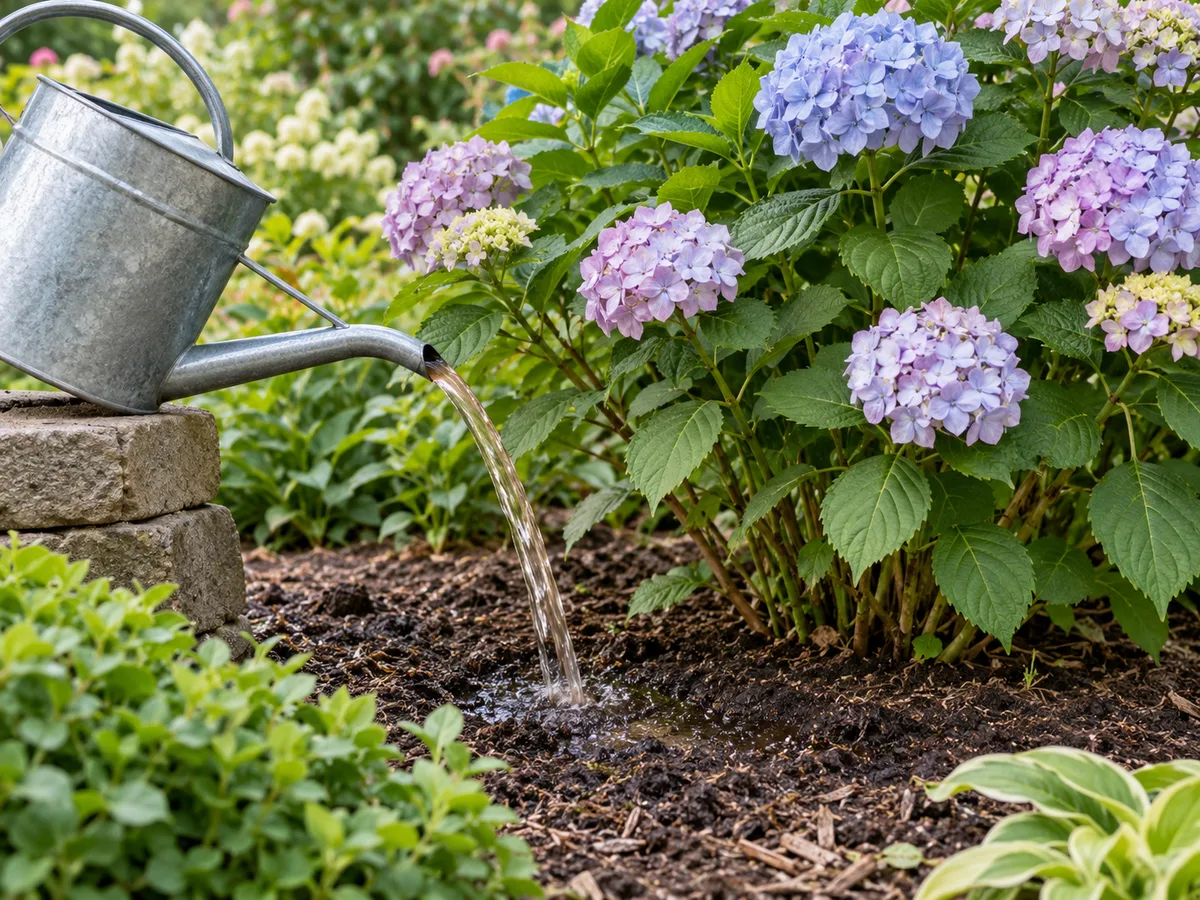
Keep homemade manure tea out of edible-crop contact
Do not pour homemade manure tea onto the leaves, fruit, or root zone of vegetables and herbs, and do not use it as a transplant soak, seedling feed, or irrigation-water supplement for food crops. Water can carry fine particles beyond the spot where it lands; droplets can splash; and a hose, shoe, hand, or tool can move contamination from the amendment area to a harvest bed. Separate the amendment area and tools from the crop area rather than relying on a careful aim alone.
People often quote a 90-day or 120-day wait after applying raw manure. Penn State Extension describes the USDA National Organic Program’s intervals as 90 days for edible crops not in contact with soil and 120 days for crops that touch soil or soil particles. Those are risk-management intervals for raw manure applied to soil, not a validated waiting period for homemade manure tea or a guarantee that a contaminated crop is safe. Commercial growers and certified-organic operations should follow their current FDA, state, and certifier requirements; home gardeners should take the conservative route and keep manure tea out of edible-crop contact.
Which Plants Might Benefit—and When to Skip It
A manure-based extract is sometimes used as a supplemental source of soluble nutrients for actively growing ornamentals, especially in a bed where a soil test or product label indicates a need. That does not mean every flowering plant needs it, or that an application will create more blooms. Extra nitrogen can encourage soft leafy growth at the expense of flowering or fruiting, and an unknown concentration can stress tender roots or seedlings.
Skip it if the plant is drought-stressed, newly planted, dormant, or already growing well in fertile soil. Do not use a tea to treat leaf disease, root rot, pests, or a diagnosed nutrient problem; manure tea is not a pesticide or a proven disease cure. For an ornamental that responds normally, there is no universal weekly schedule. Apply only if you have a reason, follow the package label if one exists, and stop if the soil or plant shows a problem.
This is also a poor fit for container plants, where a liquid amendment can accumulate salts in a small volume of potting mix and where a spill is harder to isolate from household surfaces. For potted plants, use a labeled fertilizer at the stated rate or refresh the potting mix when appropriate. For vegetables and fruit, use finished plant-based compost or a labeled fertilizer matched to the crop and soil test.
Troubleshoot Odor, Residue, and Plant Stress
A sharp ammonia smell, rotten-egg odor, thick slime, or a strong, persistent stench means the batch is not a reassuring “finished tea.” It may reflect decomposing organic matter or poor storage, but smell cannot diagnose microbial content. Do not bring a foul batch indoors, do not spray it on leaves, and do not try to fix it by adding more water or perfume-like additives; dispose of it according to the manure or product guidance and clean the equipment.
If the plant develops scorched leaf edges, wilting after application, an unusual flush of weak growth, or a crust on the soil, stop using the tea. Gently flush the ornamental’s root zone with clean water only if the soil drains freely and the product has not created a runoff hazard; otherwise, remove visible solids and ask a local extension office about the specific plant and soil. Avoid adding another fertilizer to “balance” the tea, because you do not know the first application’s nutrient or salt content.
If you have already splashed manure tea onto edible leaves, do not assume that rinsing converts the crop into a low-risk harvest. Remove visibly contaminated produce, wash hands and tools, and seek specific guidance from your local extension service or food-safety authority for the crop and use. For a small home garden, the easiest prevention is to keep manure-based amendments and their equipment out of the harvest zone in the first place.
Safer Ways to Feed an Edible Garden
For edible beds, build fertility with mature plant-based compost, leaf mold, or a fertilizer labeled for food crops. These options make it easier to avoid raw animal manure while still adding organic matter or a known nutrient analysis. If you use packaged composted-manure pellets or another animal-derived product, read the label for treatment, crop-use directions, application rate, and any harvest interval; storage and handling after treatment can also reintroduce contamination (University of Minnesota Extension on treated animal-based amendments).
If you want to use solid manure compost, start with a supplier who can explain the process, apply it according to the label, and keep it away from produce that will be eaten raw. Penn State Extension’s home-garden page and FDA’s Produce Safety Rule overview explain why treatment and the crop’s contact with soil matter. For a commercial farm, community garden, or certified-organic plot, check the applicable requirements before applying any animal-origin amendment; a household recipe should not substitute for a food-safety plan.
The simplest nutrition decision is often a soil test. It can show whether nitrogen, phosphorus, potassium, pH, or other factors need attention, while a homemade tea cannot tell you what it contributes. If the test does not call for fertilizer, leave the tea in the bucket and protect the soil with mulch and finished compost instead.
Conclusion
Manure tea is a steeped liquid, not a dependable fertilizer formula and not a way to sanitize manure. Raw manure tea is a poor choice around food crops; a color-based dilution, extra steeping, or an air pump cannot make it safe. If you decide to brew any, start only with documented finished manure compost, use potable water and dedicated tools, make a small batch, and apply it as a same-day soil drench to established ornamentals.
For vegetable gardens, use finished plant-based compost or a labeled fertilizer instead. That choice gives you a clearer nutrient plan and avoids turning a food-safety question into guesswork.



