Dylan Dreyer’s Back-to-School Organizing Tips
See how Dylan Dreyer organizes lunch gear, school clothes, and kids’ papers, then adapt those back-to-school habits for a small home or busy week.
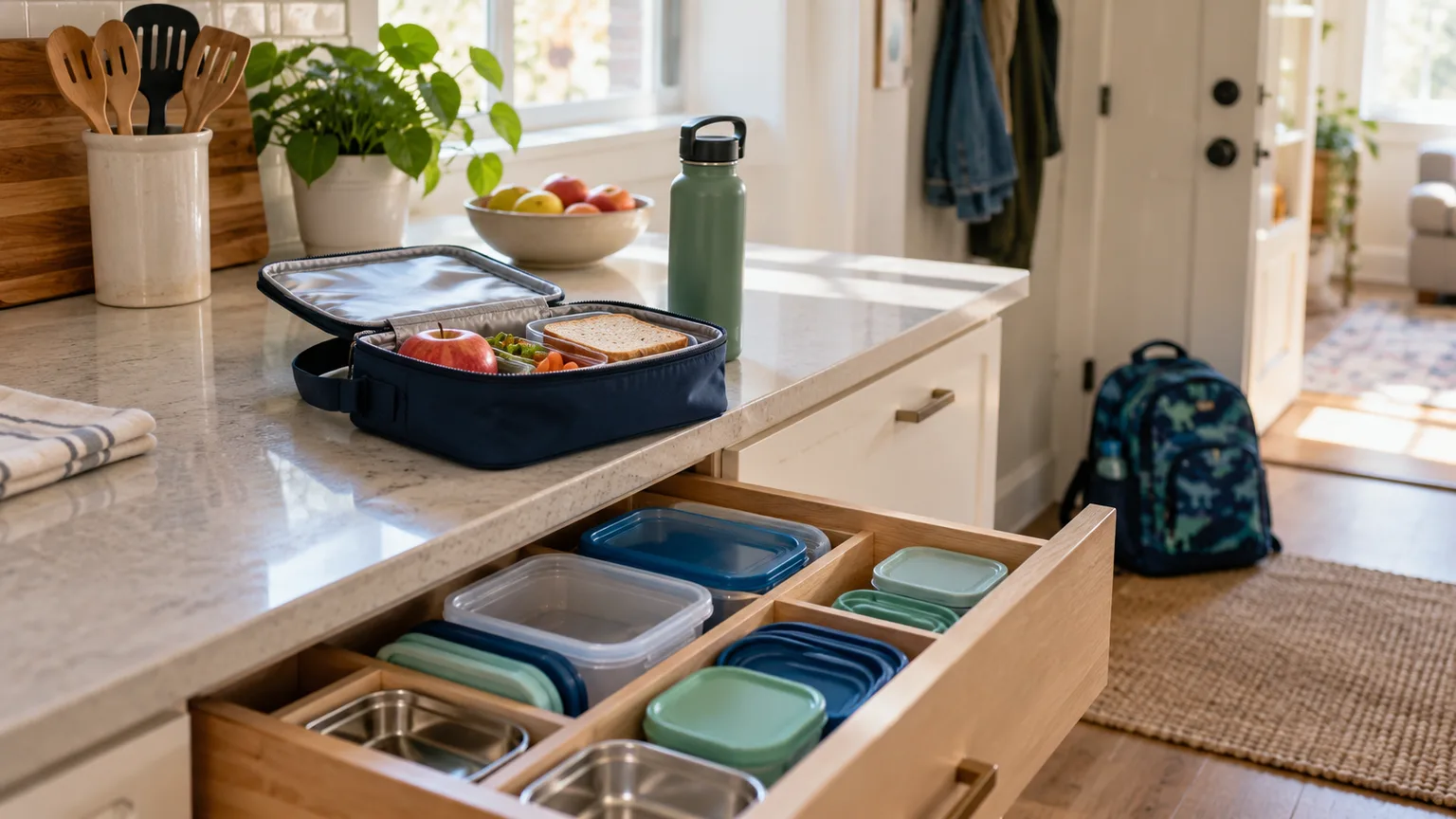
Dylan Dreyer’s back-to-school organizing ideas are useful because they make ordinary school tasks easier to repeat: keep lunch-container pieces together, reduce clothes to what children can wear, give school papers a temporary home, and decide a few things the night before. In a 2023 school-season conversation, Dreyer described these approaches while caring for three young sons in a two-bedroom New York City apartment. That is a time-specific snapshot, not a claim about the family’s current routine.
Dreyer is a co-host of the third hour of TODAY and a weekday weather correspondent, according to her TODAY profile. The organizing details here come from the supplied 2023 interview; the practical guidance below distinguishes those reported details from ideas any family can adapt. The point is not to reproduce someone else’s exact household, but to reduce the places where a school morning repeatedly stalls.
What Her 2023 School-Year Snapshot Does—and Does Not—Tell Us
The interview described a busy arrangement with different adults taking different jobs: Dreyer handled lunch planning and packing, while her husband got the boys ready. Her oldest son, Calvin, sometimes helped with lunch preparation, and Dreyer said he had opinions about what he wanted to eat. The useful lesson is visible ownership—each job had a person, a place, and a predictable sequence—not that one parent should always cook while another handles clothing.
The four concrete systems were modest. Lunchbox components were to live together in a bin inside one drawer; clothes were being edited down to items that fit and were liked; papers from backpacks went into a bin for later review; and a small amount of next-day food planning happened before bed. Dreyer also described involving the children in trying on clothes and choosing which school papers or artwork felt worth keeping.
That interview does not establish that every tactic still works for her family, that it suits every child, or that an organized room guarantees an easy morning. The family’s routines, children’s ages, school requirements, and storage all change. Treat the details as a starting point for a system that fits your own space and the one or two tasks that reliably cause friction.
Start With One Friction Point, Not a Whole-House Reset
Before buying organizers or emptying every drawer, write down the last three school-morning snags you remember. If they all involve missing lunch lids, start in the lunch drawer; if shoes and backpacks are the problem, work near the exit; if forms vanish under drawings, create a paper inbox. This small audit prevents a common mistake: building a beautiful system for the part of the day that already works.
The strongest system has a short path from use to reset. A child should be able to see where an item belongs, reach it safely, and put it away without opening several containers or asking an adult to decode labels. If that cannot happen, the fix is usually fewer steps, not a more elaborate label maker or a larger collection of matching bins.
Pick the system by the moment it fails
A useful setup answers three questions: What item is missing or accumulating? Where does that item get used? Who will return it to its home? A lunch system should be close to the food-prep area; a backpack station should be near the place bags enter; and school papers should land where an adult can review them before they disappear into a drawer.
Keep the first experiment narrow enough to test for one school week. If a container is still repeatedly missing, adjust its location or reduce the number of pieces; if papers still reach the table, move the inbox closer to the bag-emptying spot. A system earns its place by making the next action easier, not by looking complete on the first day.
Fit the Plan to the Home and the Adults Who Use It
A small apartment may not have a mudroom, pantry, or spare homework desk, and it does not need one. Dreyer’s interview described a two-bedroom New York City home, so her choice to concentrate a few items in one drawer or bin is a more useful model than assuming every family has a dedicated school zone. Use the space where the routine already happens, even if that means one drawer in a shared kitchen.
Professional organizers interviewed by Parents similarly recommend starting with simple school-year systems: one accessible homework spot, a home for the backpack, and a dedicated basket or folder for papers. Their practical criterion is that children can use the system themselves; a hook or tray that is easy to reach will often be more useful than a storage unit that looks tidier but requires adult help. (Parents’ interviews with professional organizers)
In a small home, store by routine rather than room
Think in terms of a portable “school kit,” not a permanent command center. One lidded bin can hold reusable lunch containers and their lids; one hook or basket can hold the bag and the next-day note; one shallow tray can catch forms that need a signature. When the kitchen or dining table doubles as a work surface, a movable container lets the family clear the surface without losing the system.
Keep only current daily-use items in the high-traffic spot. Extra art projects, outgrown clothes, spare lunch containers, and last year’s school supplies can live elsewhere or be sorted on a separate day. A school station that becomes storage for every seasonal item tends to hide the things children need first.
Make caregiver handoffs visible
When two or more adults share the routine, the handoff is part of the system. A short note on the family calendar or a shared checklist can record who is packing lunch, who is checking the backpack, and what needs to be refrigerated. It avoids relying on memory or assuming the other person knows what has already been done.
The goal is not to assign permanent roles based on Dreyer’s household. Agree on roles that fit each adult’s schedule, then make the result visible enough that a substitute caregiver can follow it. If one adult is away, the backup should be able to find lunch containers, school forms, and the departure checklist without searching through private messages.
Keep Lunch Supplies Together and Easy to Return
Dreyer’s lunch idea started with a small but recurring nuisance: assembling a bento box was manageable, but hunting for its tiny containers and lids was not. Her proposed answer was to keep the full kit together in one bin in one drawer. The distinction matters; buying a new lunch box does not solve missing pieces unless every part has a reliable place between uses.
Choose a drawer, shelf, or washable bin near the area where lunches are assembled. Put the boxes, lids, small cups, reusable utensils, and napkins in that single zone, but leave enough room to put pieces away without stacking them so tightly that a child has to remove half the drawer. If multiple lunch systems are in circulation, give each child a small divided section or a separate container rather than creating a mixed pile.
After school, empty lunch bags and return washable parts to the same spot. Once a week, check for lids that have migrated into the sink, backpack, or dishwasher; missing pieces are easier to find before the next morning. If you repeatedly need more containers than fit in the drawer, pause before buying another organizer—first check whether some pieces belong to old or rarely used sets.
Give the complete lunch kit one home
Use the smallest container that holds the set without forcing it. A shallow drawer divider can separate lids from boxes, while a handled bin can be lifted from a high shelf for a child who cannot reach the cabinet. Avoid a system with a different home for every tiny item unless the child actually returns those items to separate compartments.
Do not make the lunch drawer the place for every snack and grocery item. Keep food choices separate from the reusable gear so that the container parts stay together and the food remains stored according to its package or safety needs. If the school has allergy restrictions or specific packing rules, those requirements take priority over a convenience routine.
Give children tasks they can manage
Dreyer described her oldest helping with lunch, but a child’s job should match their age, dexterity, and the family’s safety rules. Younger children can choose between two approved fruits, place a napkin in the bag, or return a clean container; older children may be ready to assemble more of the meal or check a list. A task is only independent if the child can do it without unsafe tools or repeated rescue.
An age-aware division of lunch preparation can also lower the parent’s workload without turning food into a test of obedience. A 2026 Parents guide to lunch preparation recommends involving children in planning and packing while adjusting the job to their age; its examples emphasize small choices rather than handing every child the same responsibility. (Parents’ guide to involving children in school-lunch preparation)
If lunch includes perishable food, organization still has to preserve safe storage. USDA FSIS advises packing school lunches in an insulated soft-sided bag with two cold sources, and using an insulated container for hot foods; check the USDA FSIS back-to-school lunch guidance and your school’s own rules when planning what can be prepared ahead.
Reset School Clothes Around Fit and Wear
A crowded clothing drawer creates extra decisions: children dig through items that no longer fit, parents refold the same unworn pieces, and favorite clothes may be in the laundry when the school day starts. Dreyer’s 2023 plan was to reduce the school drawers to clothes that fit, and she described inviting Calvin to try things on and say what he did or did not want to wear. This is more useful than organizing every garment by color while keeping the wrong size.
Start with a short fitting session, not an entire wardrobe overhaul. Ask the child to try on the daily-use basics that are hard to substitute—pants, shirts, uniform items, socks, and shoes—and remove what is uncomfortable, damaged, too small, or no longer worn. The child can help choose favorites, while an adult checks that the remaining pieces suit the school’s dress code and the family’s laundry rhythm.
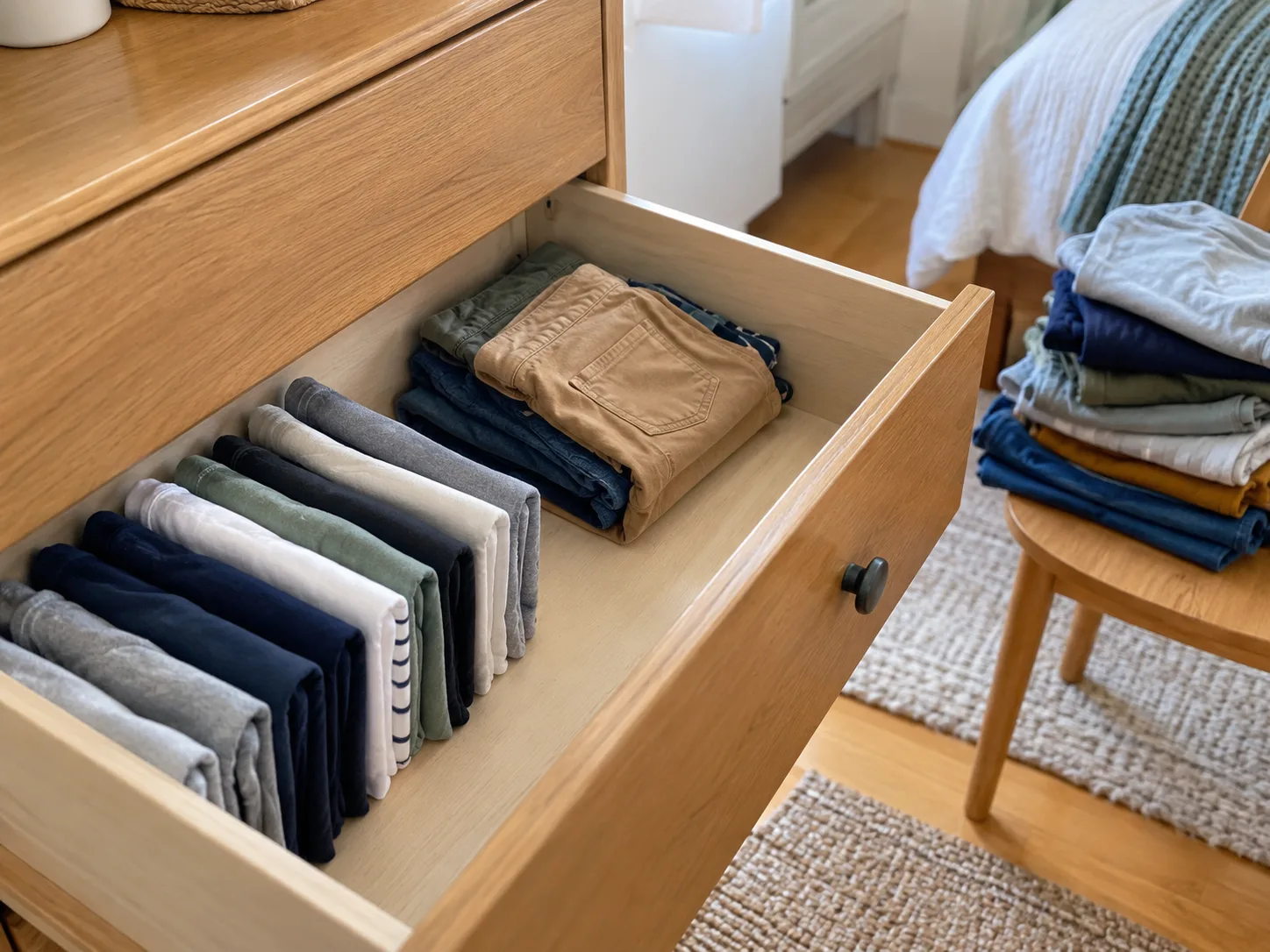
Keep the clothes the child actually reaches in the most accessible drawer or section. File-folding can make choices visible, but it is optional; folded stacks work if the drawer is not so full that one shirt topples the rest. If your child does not maintain a precise arrangement, choose broad categories such as tops and bottoms, or simply reserve a small front section for the week’s school basics.
Try on, sort, and donate without pressure
Use three practical piles: keep and wear, repair or wash, and no longer needed. A fourth “decide later” bag can prevent a tense fitting session from turning into an argument, especially for children who are attached to a particular shirt or are still adjusting to a new school. Revisit that bag with the child after a few days rather than quietly discarding it.
Only donate clean, usable clothes that another person could wear. Items with permanent stains, broken fasteners, holes, or heavy wear may need repair or textile recycling, depending on local options; do not pass them to a donation center as if they were ready to use. Make a small replacement list after the try-on so shopping fills real gaps instead of adding more clothing to a crowded drawer.
Give Backpack Papers a Short-Term Home and an Archive Rule
Children may bring home worksheets, notices, drawings, reading logs, and forms in the same backpack. If every paper goes straight onto the counter, the household has to make a keep-or-discard decision dozens of times a month; if every paper goes into long-term storage, the bin becomes a second counter that no one reviews. Dreyer’s system was to empty the backpacks into a temporary bin and make the keep decisions later.
Set the paper landing spot where the backpack gets opened, not in an office cabinet across the home. A shallow tray or folder is enough for a few days of papers. Keep school notices that need a signature or action in a separate front section so that a keepsake drawing does not hide a permission slip.
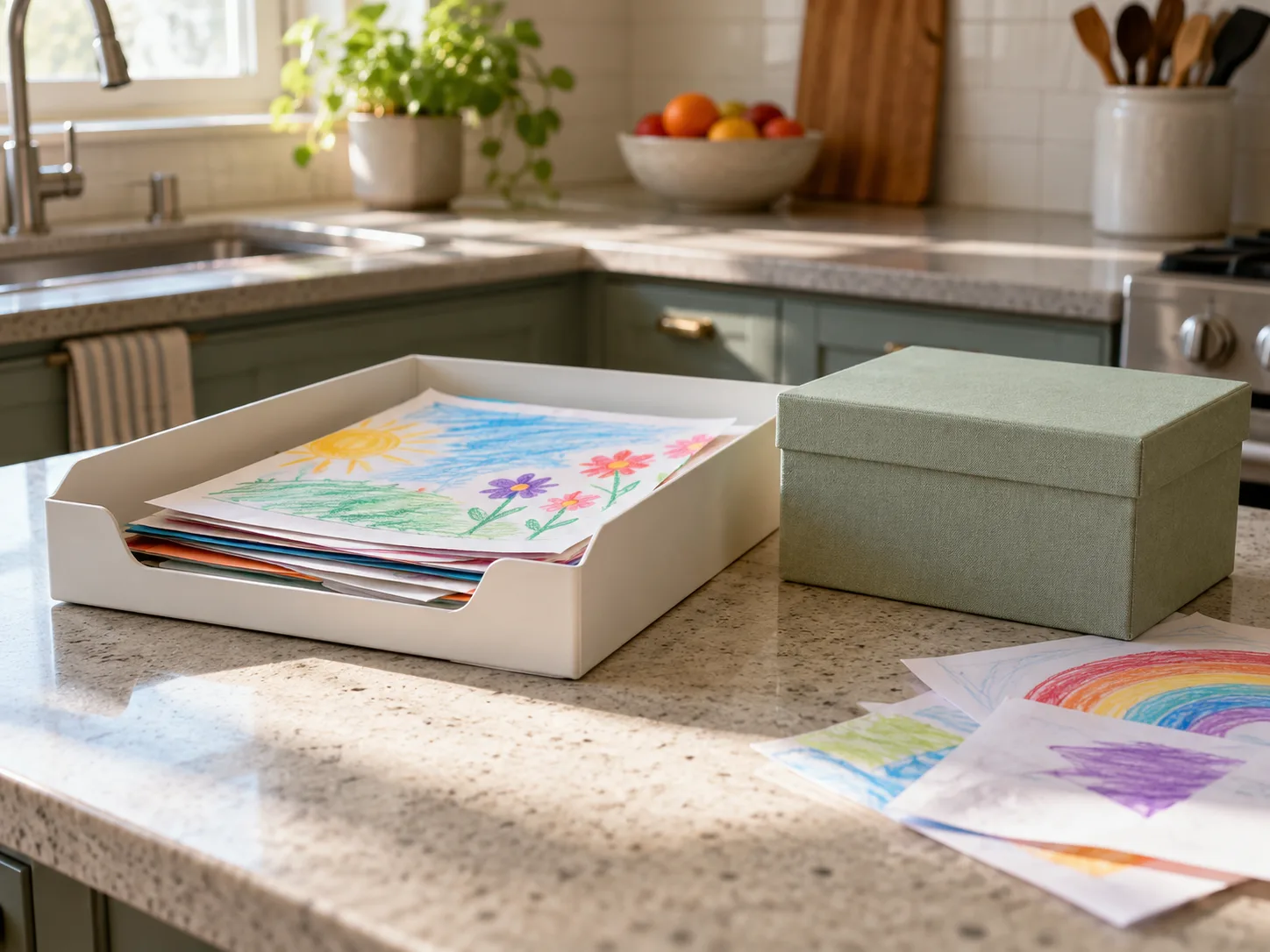
Professional organizers interviewed by Parents recommend deciding in advance where artwork, report cards, forms, and school papers will go, such as one basket, folder, or wall organizer. The key is to separate the paper’s job: a form that requires action is not a keepsake, and a favorite drawing does not need to live in the same pile as a calendar reminder. (Parents’ school-year organization guidance)
Separate action papers from keepsakes
When you empty a backpack, sort papers into three destinations. First, handle anything that needs an adult response: sign, pay, schedule, or add the date to the calendar. Second, set aside work the child wants to discuss or display. Third, move routine practice sheets to recycling once you have checked that no teacher instruction, school policy, or required assignment says to return them.
Do not assume a child’s worksheet is disposable just because it looks ordinary; check both sides and look for return dates, teacher notes, or names. For personal information, avoid posting a paper publicly with the child’s full name, school, classroom, or schedule visible. The file is a home-management tool, not a reason to circulate identifying details.
At the end of a term or school year, review the keep pile with the child and choose a small, meaningful set. Dreyer said her children joined that review and that she labeled selected work with the child’s name and year before putting it in a larger storage bin. A dated envelope or slim portfolio per child can preserve the same context without saving every worksheet; if the container fills, choose the strongest examples together before adding more.
Move Decisions to the Night Before
Dreyer’s final tactic was to make some breakfast and lunch decisions before bed so the morning did not begin with a blank slate. She mentioned preparing overnight oats and thinking through the next day’s lunch. This does not require making an entire day’s food in advance; it means deciding what can be prepared safely and what still needs to happen fresh.
Start with the task that repeatedly delays your household. Put a clean uniform or outfit where the child can reach it, refill the water bottle if appropriate, check that the lunch containers are clean, and place the backpack near the exit. If breakfast can be prepared ahead, store it as needed and make sure the child knows where it is. The best evening reset may take two minutes; a complicated checklist that requires a parent to stay up late is not a useful improvement.
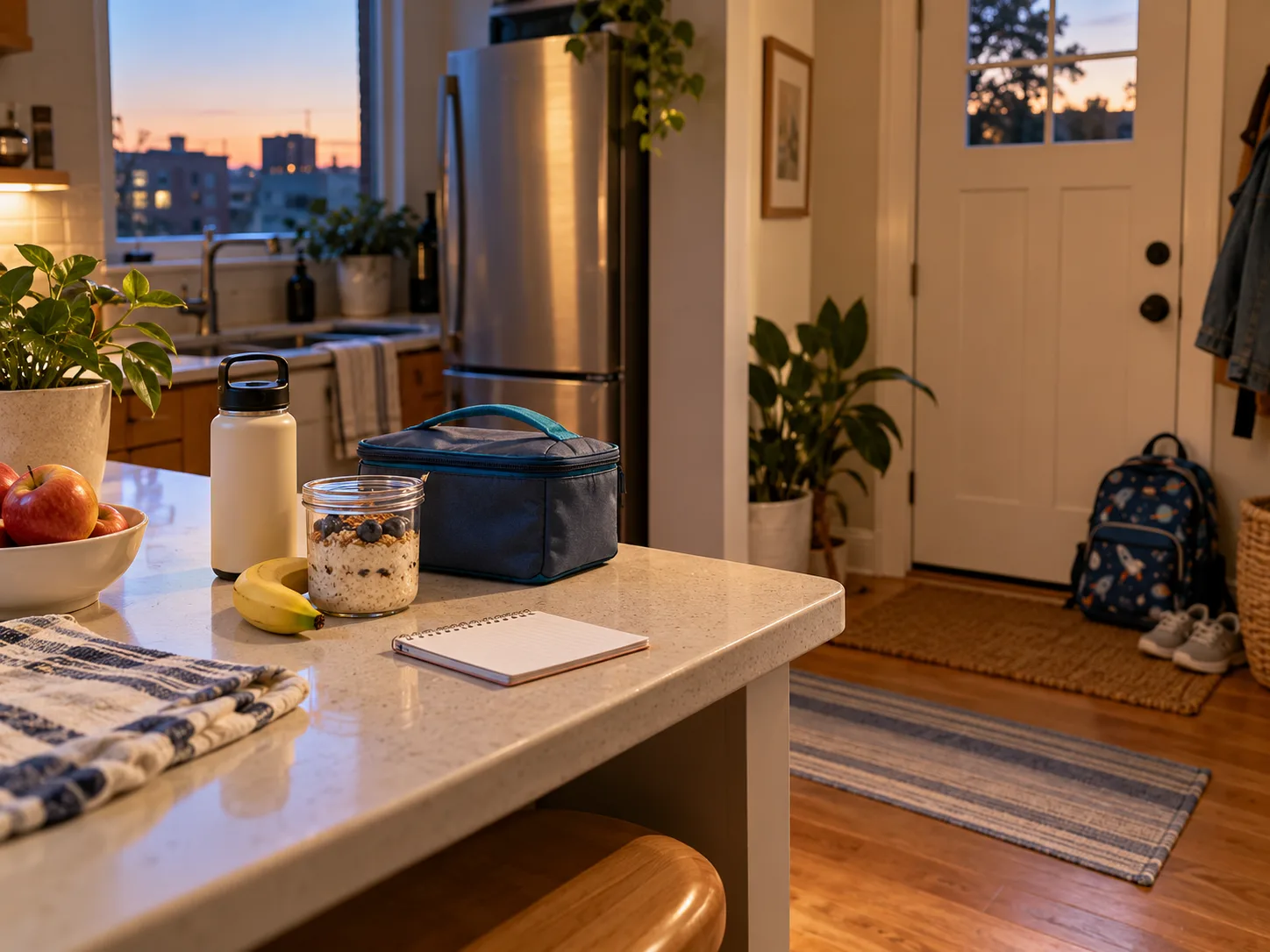
Real Simple’s school-morning routine advice similarly puts some choices—such as setting out clothes and packing a bag—on the previous evening, leaving fewer decisions for the morning. Massachusetts guidance for families with young children also describes predictable schedules as a way to help children understand what comes next and ease transitions. Those sources support a consistent sequence, not a guarantee that a routine will prevent lateness or conflict. (Real Simple’s school morning routine; Massachusetts daily schedule and routine guidance)
Let actual morning misses shape the checklist
Do not copy a generic 12-step morning list. For five school days, note only what was forgotten or caused a delay: lunch bag, permission form, clean socks, water bottle, or a weather-appropriate layer. At the weekend, move one or two of those steps to the evening and leave the rest where they are until you know they need attention.
Keep the list where the final check happens, such as by the front door or next to the backpack. A young child may do better with a few simple pictures or a spoken two-step reminder; an older child may prefer checking the bag independently. Add the time-sensitive school item—like a special project or library book—only on the day it is needed so the everyday checklist stays short.
Make the System Smaller When It Starts to Slip
Most household organization systems fail for ordinary reasons: the bin is too far from the door, the drawer has more lunch parts than it can hold, a child outgrows clothes, the paper inbox becomes permanent, or a new activity changes the evening schedule. Treat those failures as information about the setup, not proof that the family is bad at being organized. A smaller version often works better than a fresh weekend-long reset.
If lunch gear keeps migrating, reduce the sets in rotation or place the container closer to the dishwasher. If clothes become jumbled, keep fewer daily choices in the drawer and move off-season items elsewhere. If papers build up, schedule a five-minute review at a predictable point in the week and keep action forms separate from art. If caregivers are repeating work, make the handoff visible in one shared place rather than adding another private reminder app.
A school routine also needs slack. Sick days, schedule changes, food preferences, weather, and children’s developmental changes can disrupt even a well-designed setup. Keep a backup plan for the parts that matter most—such as an easy breakfast, an alternate lunch option permitted by the school, or a spare set of clean basics—and accept that not every morning will follow the checklist.
For a quick start, choose just four actions: pick one repeated snag, put its supplies where the task happens, give each item one obvious return spot, and review after five school days. This approach is less dramatic than organizing every closet and drawer, but it tests whether the change saves time in the part of the day that needs it. Once one system is working, you can decide whether another task is worth organizing.
Conclusion
Dylan Dreyer’s back-to-school ideas are grounded in a few small decisions: keep lunch components together, make room for clothes that fit, give school papers a temporary landing zone, and prepare the next day before bed. Their value comes from reducing repeated searches and making the return path clear, not from copying her family’s exact setup.
Pick the point that causes the most friction in your own morning, build the smallest system that addresses it, and test it for one school week. If children and caregivers can use it without extra steps, keep it; if not, make it simpler and try again.