Taylor Juniper Guide: Planting, Size, and Pruning Advice
Plan a Taylor juniper screen with realistic mature dimensions, planting steps, first-year watering guidance, pruning limits, and clear troubleshooting advice.
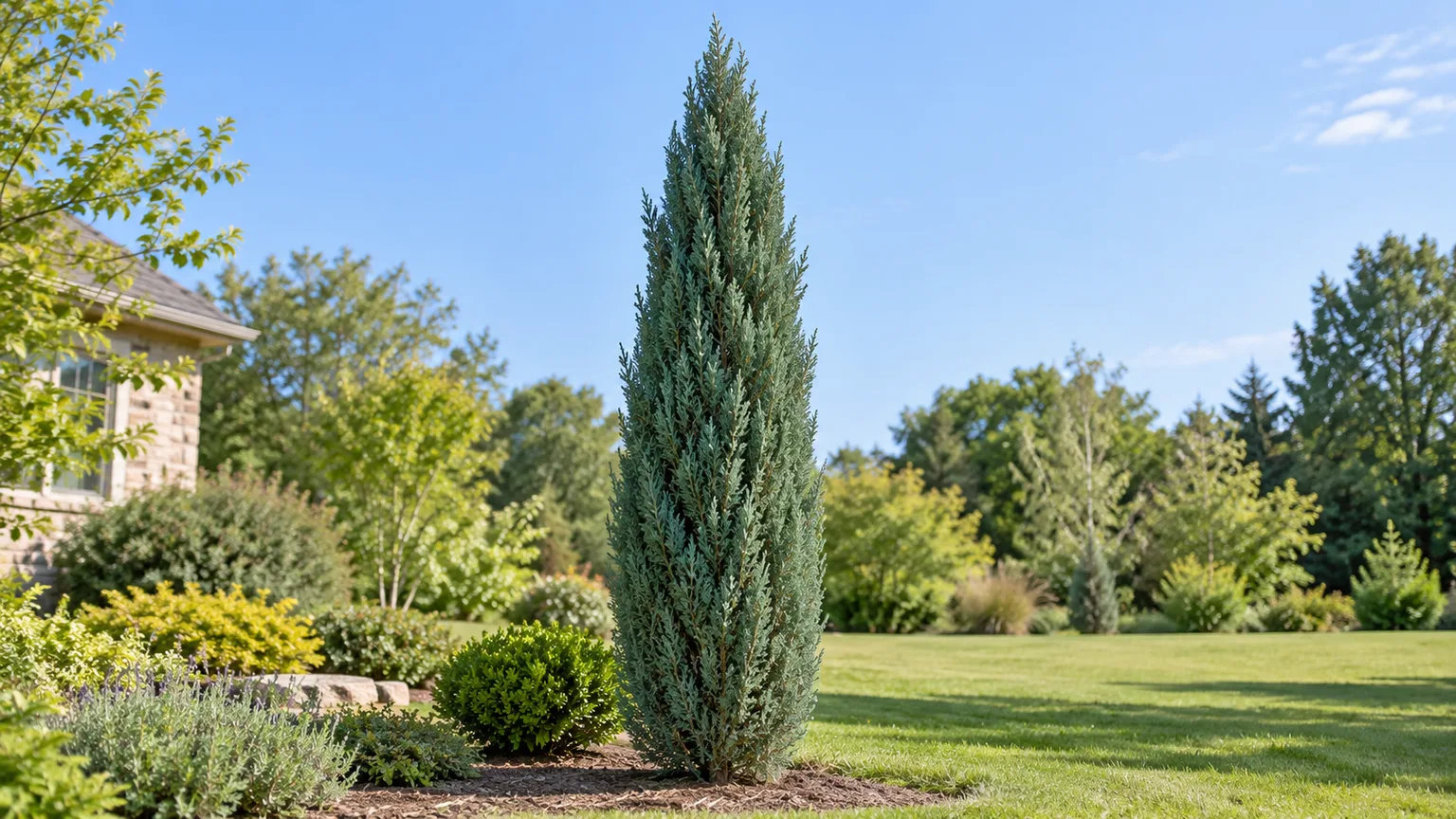
Taylor juniper is a narrow, upright selection of eastern redcedar that solves a specific landscape problem: you want evergreen height without giving up much ground space. It can work as a single vertical accent, a loose boundary row, or a screen, but only if the planting site is sunny and the soil does not stay wet. Before you buy, check the full botanical name—Juniperus virginiana ‘Taylor’—and plan for a tree, not a small hedge shrub.
| At a glance | Taylor juniper |
|---|---|
| Mature size cited by NC State Extension | About 20–25 feet tall and 3–4 feet wide |
| Growth rate | Medium in the NC State profile; annual growth varies by site |
| Habit | Narrow, columnar evergreen tree |
| Hardiness range | USDA Zones 4–9 in the NC State profile |
| Light | Full sun is best for a dense, upright screen; some partial shade is tolerated |
| Soil | Adaptable, but does not tolerate wet soil |
| Water | Consistent checks while establishing; less supplemental water once rooted |
| Routine pruning and fertilizer | Usually unnecessary |
Is Taylor Juniper the Right Evergreen for Your Yard?
Choose Taylor juniper when the site has strong sun, reliable drainage, and enough vertical clearance for a tree that can exceed 20 feet. Its compact width is useful along a sunny property line, driveway, or narrow side yard, but “narrow” describes the crown, not the root zone or future height. Confirm that neither overhead wires nor a roofline will force you to top it later.
This cultivar is not a universal replacement for arborvitae or Italian cypress. It tolerates drought and poor soil better than plants that need richer, consistently moist ground, but persistent wetness is a serious mismatch. NC State Extension flags Taylor eastern redcedar as highly flammable, so in a wildfire-prone landscape, check local defensible-space guidance before placing it near a home or relying on it as a screen beside structures.
Its deer resistance is useful but not an absolute guarantee. Browsing pressure varies with season, food availability, and local herds; protect a new tree if deer routinely browse woody plants in your yard. Also note that the cultivar listed by NC State is male and does not produce the blue, berry-like cones gardeners may expect from eastern redcedar.
Mature Size, Shape, and What “Taylor” Means
Reference profiles disagree on mature height: NC State Extension lists 20–25 feet tall and 3–4 feet wide, while the Missouri Botanical Garden lists 15–20 feet tall and 3–4 feet wide. Use 25 feet as a conservative clearance estimate unless you can check mature Taylor specimens in your region; both sources agree that the crown stays only a few feet wide. NC State classifies its growth rate as medium but does not give a dependable annual inch figure for this cultivar; weather, soil, and nursery stock change the pace. The tree’s growth is not a dependable “screen by year three” promise, so plan the row for mature crowns rather than planting too tightly to force quick coverage.
Taylor is a named cultivar within Juniperus virginiana. The parent species is much broader in size and can develop a large conical form, so species-level data should not be used as the exact dimensions for this narrow selection. The NC State Extension Taylor profile and Missouri Botanical Garden’s Taylor entry are the relevant cultivar references; the Garden’s eastern redcedar species profile helps explain the larger species, its habitat, and its tolerance of dry to medium, well-drained conditions.
The foliage is scale-like and blue-green to gray-green, with an aromatic quality when handled. In winter, color can shift toward a duller or bronzier tone depending on weather and the individual plant; a seasonal color change does not automatically mean the tree is dying. NC State lists the selection as male and says it does not produce blue, berry-like cones; the Missouri Botanical Garden notes that the original release did not specify sex and describes Taylor as believed male. If cone production matters, ask the nursery about its specific stock rather than assuming every plant label resolves the uncertainty.
Choose a Site That Keeps Roots Dry
The best site combines full sun with soil that drains after rain. Look at the planting area after a heavy shower, not just on a dry day: if water stands there or the ground stays saturated for a long period, move the tree or choose a different plant. Taylor juniper is adaptable to clay, loam, sand, and shallow rocky soils when drainage is adequate, but its ability to tolerate poor soil should not be mistaken for an ability to grow in waterlogged soil.
Full Sun for a Dense Column
Aim for an open location with at least six hours of direct sun if you want the characteristic tight, upright outline. NC State describes Taylor as tolerant of full to partial sun, but also identifies full sun as the preferred light condition. In a shaded side yard, the tree may remain alive while growing more loosely, with weaker screening and less even foliage on the shaded face.
For a row, assess the shade each future tree will cast on its neighbor. A row against a north-facing wall or beneath mature trees can produce bare-looking sides even if the top receives sun. If the site only gets a few hours of direct light, use a shade-tolerant evergreen whose natural habit matches the space instead of trying to solve the problem with extra fertilizer.
Drainage Matters More Than Soil pH
The competitor scrape emphasizes acidic soil, but the cultivar profile does not set an acidic pH as a requirement. More importantly, NC State says Taylor juniper does not tolerate wet soil and advises against humus-rich soil and excessive fertilizer. Avoid adding peat, compost, or a small pocket of potting mix to “fix” the planting hole; an amended pocket can hold water differently from the surrounding soil and may create a bathtub effect.
Do not change the entire bed’s pH unless a soil test and a separate planting need justify it. For this juniper, start with a simple drainage check and the local soil texture. If water perches in heavy clay, consider a raised planting position only where the root ball can remain stable and water can drain away, or select another species better suited to the site.
Planting a Taylor Juniper Without Burying It
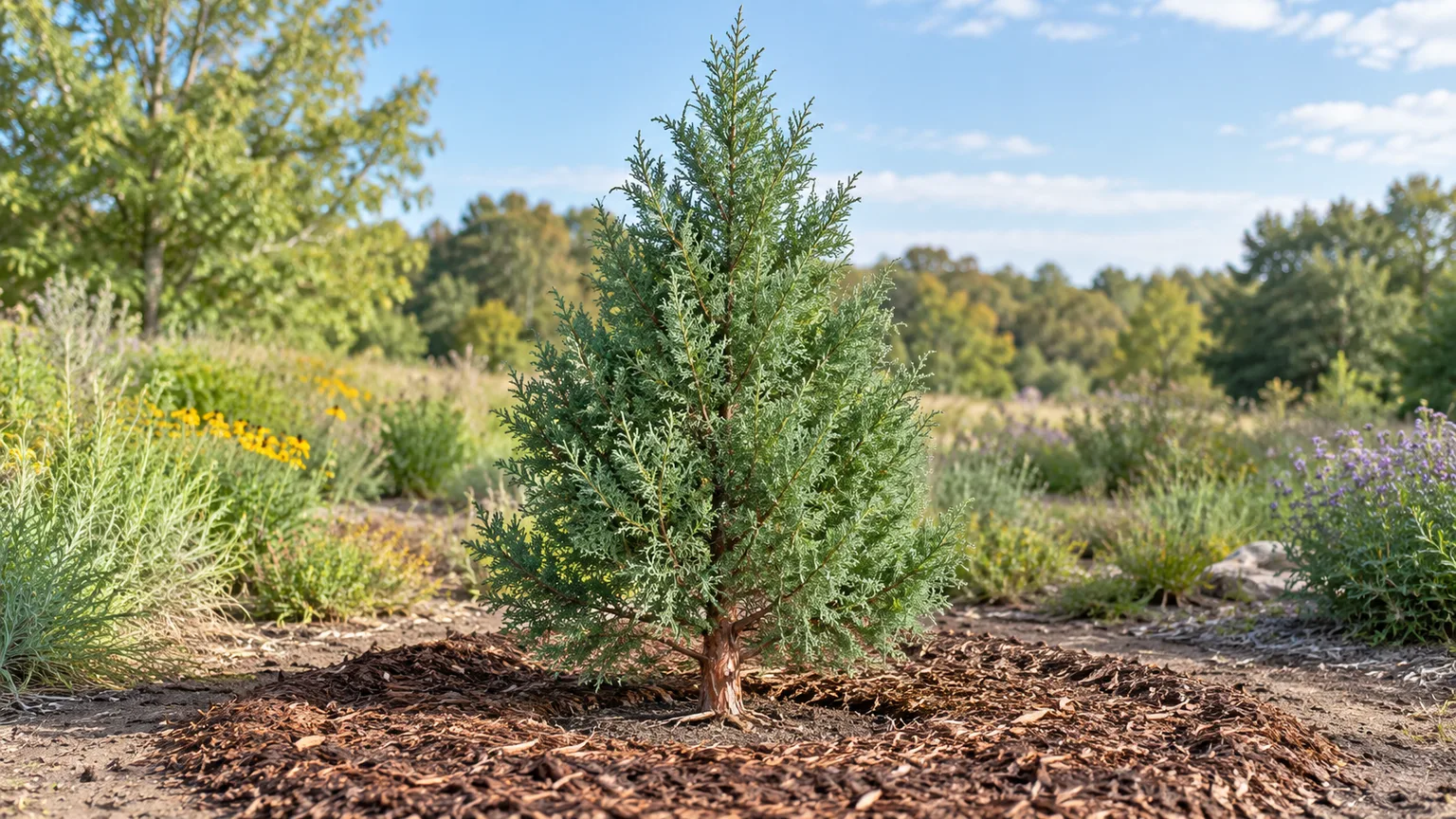
Plant in a cool period when the soil is workable and the tree can be watered as needed, avoiding frozen, waterlogged, or intensely hot conditions. A container-grown tree is usually easier to handle than an oversized balled-and-burlapped specimen in a tight site. Inspect the plant before purchase: look for a straight central leader, even foliage, a root ball that is moist but not sour-smelling, and no webbing, bags, or widespread browning.
Dig a broad hole about twice the root ball’s width, but no deeper than the root ball itself. Set the tree so the root flare—the point where the trunk widens into the first roots—sits at or slightly above finished soil grade. Backfill with the native soil, firm it gently to remove large air pockets, and water slowly to settle the root zone; do not bury the trunk flare or mound soil against the bark. This planting sequence follows the general juniper guidance in BBC Gardeners’ World’s care guide, adjusted for Taylor’s cultivar-specific sun and drainage needs.
Add a modest layer of organic mulch over the root zone to limit weeds and help soil moisture stay even. Leave an open ring around the trunk rather than piling mulch against the bark. A mulch “volcano” traps moisture at the trunk and hides the flare, which makes later inspection harder.
Watering During Establishment
Watering is most important while the root ball is reconnecting with the surrounding soil. Immediately after planting, soak it slowly enough that water reaches the full root ball rather than running off the surface. Through the first growing season, check both the original root ball and the soil around it; a container-grown root ball can dry faster than the surrounding clay, while clay itself can stay wet long after the surface looks dry.
There is no reliable single weekly gallon quota for every Taylor juniper. Soil texture, rainfall, heat, wind, planting size, and drainage change how quickly water is used. Water deeply when the root ball is drying, then wait and check again; do not keep the soil continuously saturated. A slow trickle at the base or a soaker hose is often easier to manage than a brief spray over the foliage.
Check Moisture Before You Water Again
Use a narrow trowel or your finger to check several inches down near the edge of the root ball. If the soil is cool and moist, postpone watering and check again later; if it is dry and crumbly, water the root zone slowly. During hot, windy weather, check more often, and after a soaking rain, skip irrigation unless the root ball itself remains dry beneath the surface.
As new growth appears and the tree establishes, stretch the interval between deep waterings. A mature Taylor juniper is drought-tolerant, but “drought-tolerant” does not mean immune to prolonged heat, reflected pavement, or years of severe drought. Water during extended dry spells if the root zone is dry, then let the soil drain instead of maintaining constant moisture.
Fertilizer and Mulch
Do not fertilize automatically each spring. NC State describes this cultivar as tolerant of poor soils and specifically warns against much fertilizer and humus-rich soil. Extra nitrogen is not a substitute for sunlight or drainage, and an unnecessary feed can produce growth that is too soft for the tree’s site conditions.
If a tree has persistently weak growth, first check planting depth, root-ball moisture, drainage, light, and root competition. A soil test can identify a genuine nutrient deficiency; if one exists, follow the local test recommendation rather than applying a generic conifer spike. Maintain mulch instead as a low-risk way to suppress weeds, but keep it several inches away from the trunk and refresh it only as it decomposes.
Pruning: Preserve the Green Column
Taylor juniper’s narrow architecture is the reason to choose it, so routine shearing usually creates more work than value. Remove a broken, dead, or diseased branch with a clean cut back to a suitable branch junction. If you need to remove a live branch for clearance, do it selectively and keep the natural leader intact.
Do not cut the top to control height or shear deeply into the sides. Junipers often have little foliage in the inner wood, and old bare stems may not sprout enough to hide a hard cut. Fine Gardening’s general Juniperus profile calls for well-drained soil and little or no pruning; BBC Gardeners’ World likewise advises against routine pruning and cautions against cutting into dead wood. Both sources discuss junipers broadly, so the practical cultivar-specific rule is to protect Taylor’s natural column and remove only what the site or tree health requires.
If the tree has outgrown the space, pruning cannot make a 20-foot tree into a permanently shorter one without changing its shape. Replace it with a lower-growing plant or relocate a young specimen while that remains practical. Before planting, compare mature height with nearby wires, eaves, windows, and the view you want to keep.
Spacing a Screen or Row
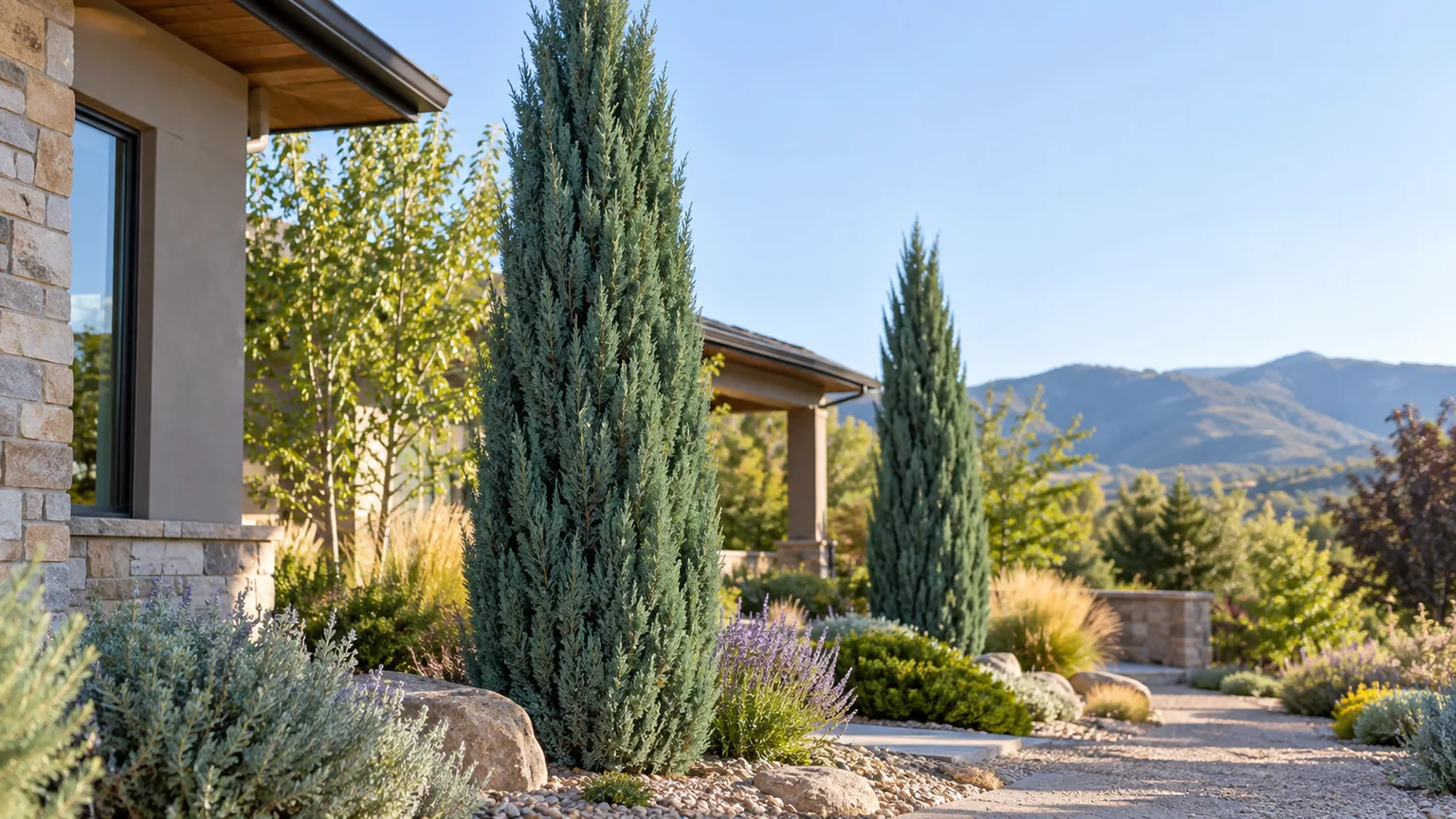
Space plants according to the screen you want at maturity, not the small gaps between nursery pots. NC State lists a mature spread of 3–4 feet, so use the larger width for a conservative design. With centers 4 feet apart, mature crowns may just meet if they reach the broad end of that estimate; closer centers create overlap sooner but also increase competition and make airflow and access less convenient.
For individual vertical accents, leave a visible gap between mature crowns so each column reads clearly. For a continuous screen, calculate the row by measuring from trunk center to trunk center and decide how much overlap you want. This simple rule is more dependable than a fixed “privacy spacing” number: center spacing minus expected mature width gives the approximate gap, while spacing below the mature width creates overlap. The result will still vary by site and pruning, so do not assume a solid wall appears in one or two seasons.
Set the row far enough from a fence, house, driveway, or path to allow the mature crown and maintenance access. Also consider the tree’s height relative to the screening target. A narrow tree can block an upper-floor view while leaving eye-level gaps, especially if you plant too far apart; a living screen is not the same as a fence and will not be opaque from day one.
Winter Color, Snow, and Wind
Taylor juniper keeps its foliage through winter, but evergreen does not mean unchanging. Cold, dry winds and frozen soil can cause bronzing or browning on exposed foliage, while snow or ice can bend upright branches. Before planting in an exposed corridor, consider prevailing winds and avoid a spot where road salt or plowed snow will repeatedly hit the tree.
After a heavy snowfall, let light snow melt on its own. If a branch is bowed under wet snow, gently brush the load away only when it is safe and the branch is not frozen; do not yank at brittle foliage. If the leader is damaged, wait until you can assess the break and choose a replacement shoot before pruning, because an impulsive cut can leave a lopsided column.
Pests and Diseases
A healthy, well-sited tree may have few problems, but Taylor juniper is not pest-proof or disease-proof. Inspect the inner and lower foliage during routine watering, and note whether browning affects one branch, one side, the whole tree, or new growth. The pattern and the soil moisture usually provide better first clues than a blanket treatment.
Bagworms, Webworms, and Other Insects
Bagworms make spindle-shaped bags from silk and pieces of foliage; juniper webworms bind foliage with silk and leave dead needles inside the webbing. These signs are more informative than the word “mite” on a general symptom list. NC State Extension’s conifer pest guide notes that bagworms feed on many conifers and that juniper webworms can damage ornamental junipers, sometimes leaving webbed masses of dead foliage.
When there are only a few bags within reach, remove and dispose of them rather than applying a pesticide by default. For webbing, confirm that it contains caterpillars and feeding debris before pruning it out; spider silk or harmless wildlife may look different. If damage is widespread, identify the pest and contact a local extension office for a control plan that fits the pest’s life stage. Do not spray a product simply because foliage is brown, and follow the current label for any pesticide you use.
Cedar-Apple Rust and Other Browning
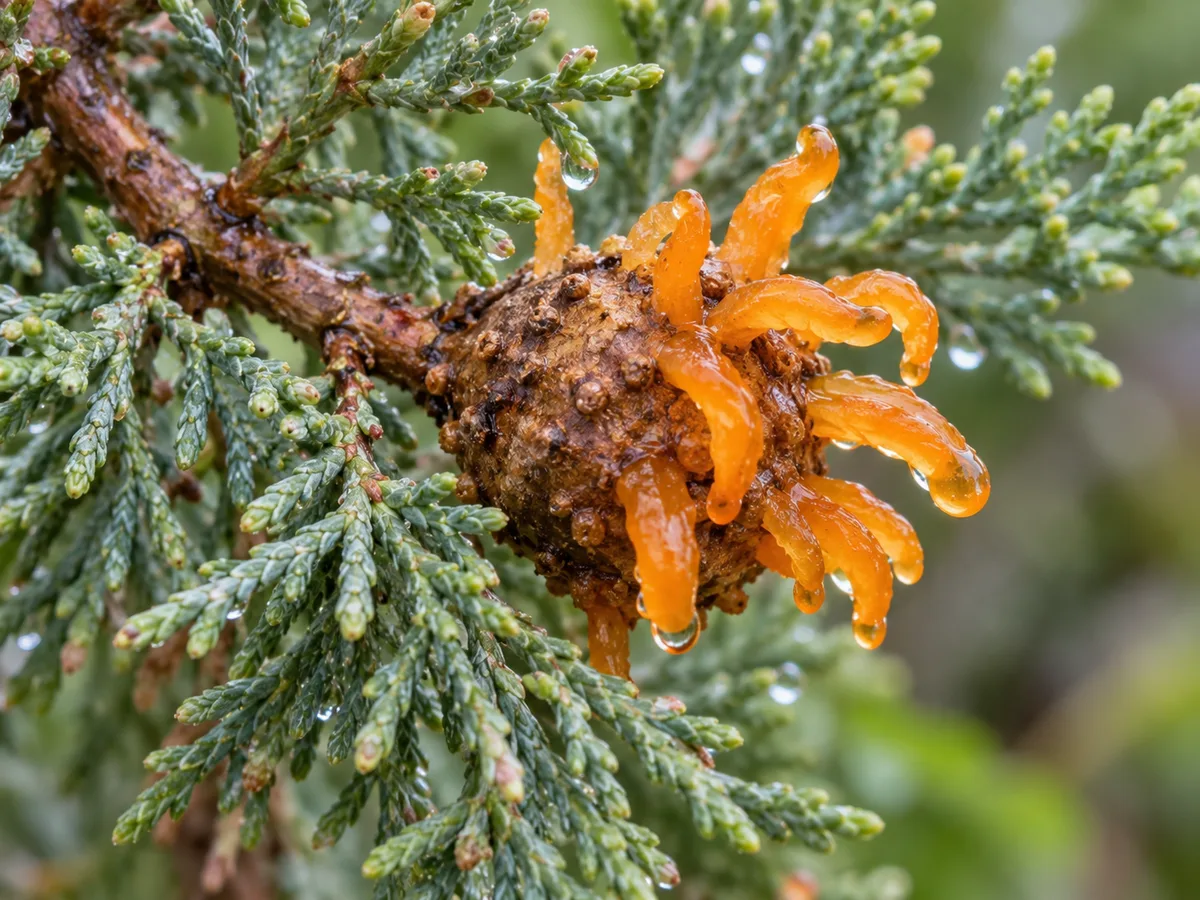
Do not assume Taylor juniper is immune to cedar-apple rust. NC State’s Taylor profile says the disease can occur, and its cedar-apple rust factsheet explains that the fungus needs both susceptible junipers or red cedars and apple hosts to complete its life cycle. The disease is therefore a regional and neighborhood issue as well as a tree issue; removing one juniper is not a dependable way to eliminate it where other hosts are common.
Rust may form rounded, dimpled galls on a juniper that swell in wet spring weather and release orange, gelatinous horns. That is a useful clue, not a reason to assume every orange or brown mark is cedar-apple rust; related rusts and other disorders can look similar. The NC State profile notes that rust can occur, so treat cultivar claims about resistance cautiously and ask your county extension office to verify uncertain symptoms before taking action.
Uniform decline or browning across the whole tree often points first to an establishment or site problem: a root ball that repeatedly dries, waterlogged soil, deep planting, or heavy shade. A single dead branch can reflect injury, local disease, or a broken connection to the trunk. Check soil below the surface, inspect the root flare, and look for webbing, bags, or galls before changing water, pruning healthy tissue, or reaching for a spray. For a broader symptom comparison, see this site’s eastern redcedar browning guide and juniper selection guide.
Propagating Taylor Juniper
A named cultivar is maintained by cloning, not by sowing seeds and hoping the offspring keep the same form. NC State describes Taylor as a male tree without blue berry-like cones, so seed collection is not a practical home route for this selection. A seed-grown eastern redcedar would not be a dependable copy of the narrow Taylor habit.
Cuttings are the more appropriate route when you want a genetic copy, but juniper cuttings can be slow and are not guaranteed to root. Fine Gardening’s genus-level guidance describes taking cuttings under controlled humidity, with a humid cold frame or mist and bottom heat; that is more controlled than a pot on an ordinary windowsill. If you want one or two reliable landscape trees, buying a properly labeled plant is usually simpler. If you experiment with cuttings, take several healthy shoots, keep them evenly moist rather than waterlogged, and expect to wait months before deciding whether they have rooted.
Conclusion
Taylor juniper earns its place where a narrow evergreen column is useful and the soil drains freely. Check the cultivar label, make room for a potential 20–25-foot tree, plant it in sun with the root flare visible, and water according to root-zone moisture while it establishes. Once rooted, it needs little feeding, little pruning, and occasional inspection rather than a fixed schedule of treatments.
The best result starts with saying no to the wrong site: avoid a wet low spot, deep shade, a space under wires, or a high-fire-risk location where a highly flammable evergreen is not appropriate. Plan spacing from the mature width, preserve the natural outline, and investigate browning before making changes. Those choices do more for long-term health than fertilizer spikes, aggressive shaping, or watering by the calendar.



