How to Get a Phalaenopsis Orchid to Rebloom
Learn how to get orchids to rebloom by identifying a Phalaenopsis, choosing whether to prune its spike, and tuning light, water, and night temperatures.
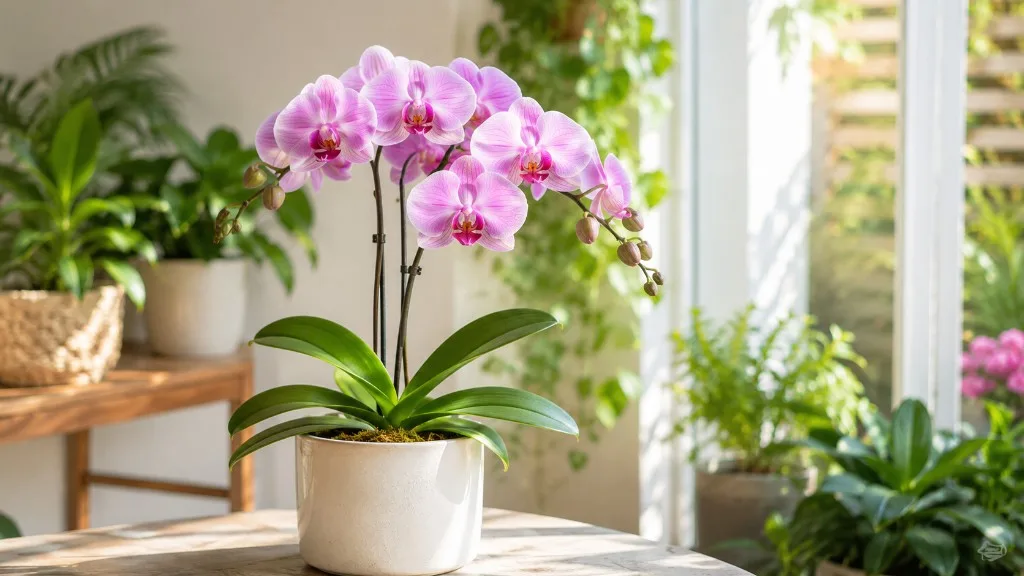
If a grocery-store orchid has dropped its last flower, do not throw it away or immediately cut every stem. A healthy Phalaenopsis, also called a moth orchid, can flower again after it has rebuilt energy and received the right light and seasonal temperature cues, but it may take months rather than days.
First identify the plant. The advice below is mainly for Phalaenopsis, the broad-leaved orchid with arching sprays sold in many supermarkets and garden centers; Cattleya, Dendrobium, Cymbidium, and other orchids have different growth cycles and should not automatically receive the same pruning or temperature routine.
First, identify which orchid you have
Phalaenopsis grows from a short central stem with leaves arranged in a fan. It does not make the thick pseudobulbs or upright canes that store water in some other orchids, and its flower spike emerges from the side of that leafy stem. If the plant has canes, bulb-like swellings, or a label with a different genus, use that name to look up its seasonal care before cutting stems or lowering temperatures.
This distinction matters because “orchid” describes a very large plant family, not one universal houseplant. Moth orchids often respond to a seasonal drop in night temperature, while other types may need a brighter growing position, a drier rest, or a cooler season; a technique that helps one can stress another.
The American Orchid Society’s Phalaenopsis culture sheet is a useful baseline for the common houseplant type. If you cannot identify the orchid, keep it in stable conditions and avoid a drastic temperature treatment until you know what it is.
Check whether the plant is ready to flower again
Falling flowers are usually the end of a bloom cycle, not proof that the orchid is dying. Look at the plant underneath them: firm leaves, a stable crown, and roots that are plump rather than mushy are better signs of readiness than a particular month on the calendar.
An orchid with one or two firm leaves and mostly healthy roots can continue its ordinary care while it grows. If its leaves are deeply wrinkled, the crown is soft, the pot smells sour, or most roots are brown and hollow, put flower production on hold; repair the root or crown problem first because a new spike adds a demanding growth sink.
Do not label the flower-free period as a required deep dormancy. Phalaenopsis keeps its leaves year-round and may grow roots or a new leaf between displays; during that quiet interval it still needs water and light, with watering adjusted to how quickly its medium dries.
Choose between a green spike and a fresh start
Once flowers fade, inspect the entire spike before making a cut. A firm green stem may still have active nodes and can sometimes produce a side branch; a uniformly yellow or brown, dry stem has finished and will not turn green again.
Keeping a viable green spike can shorten the wait for another set of flowers, but that second flush is often smaller and the plant spends energy on it instead of a new root or leaf cycle. Cutting the spike back to its base takes longer to produce the next display, yet it is the better choice for a weak plant that needs to rebuild.
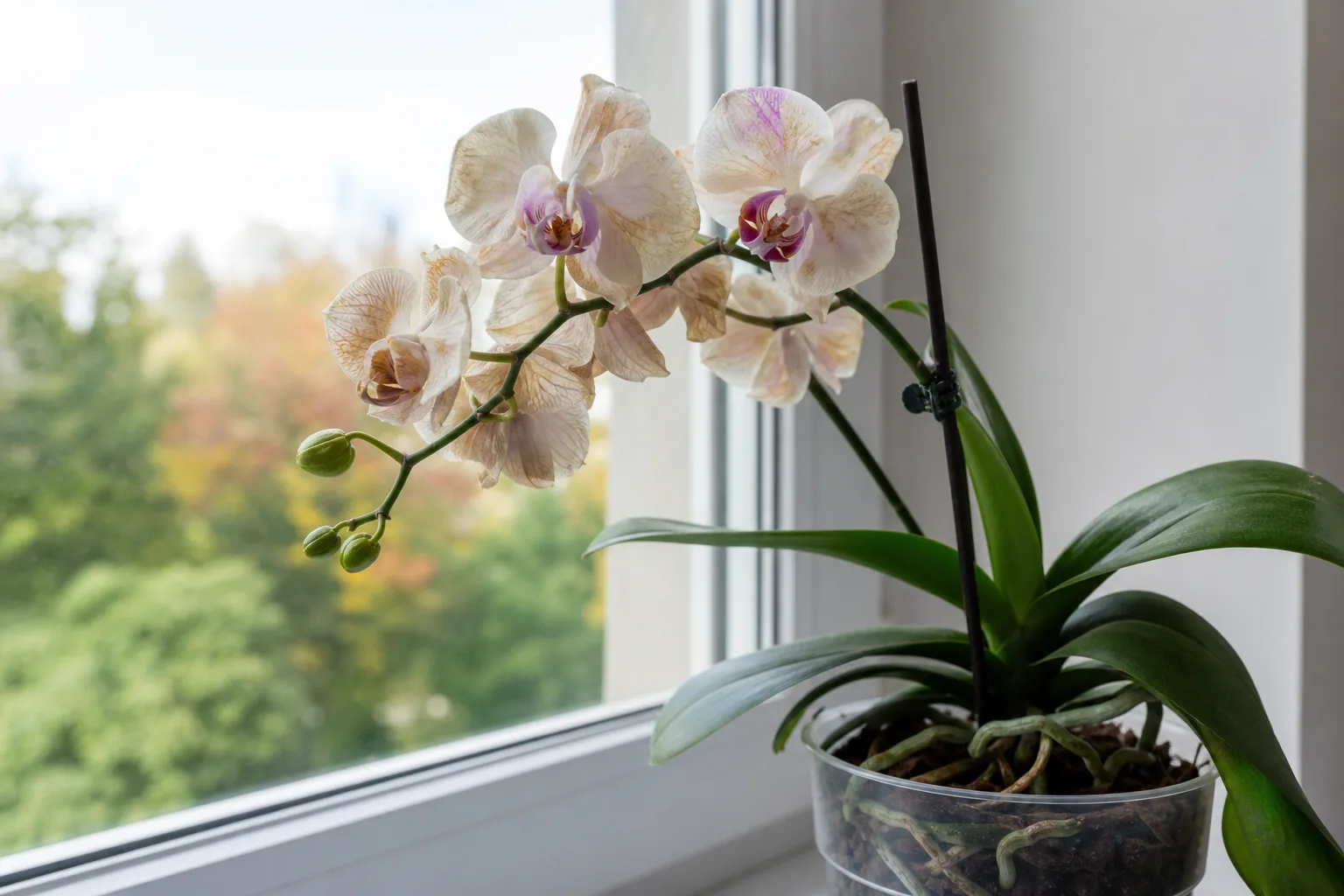
Keep a green spike or remove a brown one
For a healthy plant and a green spike, you can leave the stem alone or trim it just above a strong lower node with clean, sharp snips. A node is the small joint under a papery covering along the spike; leaving some stem above it protects the node, while cutting a few inches below the last flower is not a reliable way to “reset” every orchid.
If you want the plant to invest in leaves and roots, or the spike has turned brown, remove it near its base without cutting into the leafy crown. A weak or recently repotted orchid is a good candidate for this full cut; there is little benefit in preserving a green stem if the roots cannot supply it. RHS advice and a practical Homes & Gardens reblooming guide both describe the option of a green-spike side branch and the different choice for a spent brown spike.
Use a clean blade or snips and avoid twisting or pulling the stem. Do not cut aerial roots or leaves to make the plant look tidier; green or silvery firm roots outside the pot are normal for an epiphytic orchid.
Give the orchid brighter filtered light
Good light is the plant’s energy source, so fertilizer cannot compensate for a dim corner. Place a Phalaenopsis where it receives bright, filtered daylight—often near an east window or behind a sheer curtain at a brighter south or west window—without letting hot direct sun scorch the leaves.
Use the foliage as a rough signal. Medium-green, firm leaves generally suggest a workable position; very dark leaves and little new growth can indicate too little light, while pale, bleached, or crisp tan patches on the window-facing side point to excessive sun or an abrupt move.

Move the pot gradually if it has been in a low-light room. Give it a week or two to adjust before placing it closer to stronger light, and do not rotate a developing spike repeatedly if you want it to grow in one direction toward the window.
Use cooler nights as a cue, not a shock
For many standard Phalaenopsis hybrids, a sustained difference between warm days and cooler nights helps initiate a new flower spike. The American Orchid Society’s flower-induction guidance describes a night-time drop of about 15°F (8°C) for two to three weeks as a trigger for winter-blooming Phalaenopsis; its culture sheet notes that several weeks of autumn nights near 55°F can also initiate spikes, while ordinary night culture is generally kept above 60°F.
Treat those figures as grower guidance, not a countdown or a mandatory thermostat setting. Hybrids differ, and a plant in a naturally cooler autumn room may already receive enough seasonal signal; cooler nights cannot make up for weak roots or inadequate light.
Cool the plant gently and measure near its leaves
If your home stays warm around the clock, place the orchid in a room with a modestly cooler night temperature while keeping the daytime light bright and the roots in good condition. A small room thermometer near the foliage is more useful than guessing from the thermostat because windows, heater vents, and closed doors create local temperature pockets.
Do not set the plant outdoors overnight as a shortcut unless you can reliably keep it within its safe range. Avoid cold drafts, frost, air-conditioning blasts, and leaves pressed against cold window glass; sudden swings can damage a warm-growing plant or cause buds to drop. If the available night spot falls below about 55°F, choose a warmer location rather than pushing the plant colder.
When your home already cools at night, leave the plant where it is and let the season do the work. After a few weeks, return to ordinary stable household conditions once a spike is visible; do not keep moving the orchid to chase a number.
Water by the roots and medium, not the calendar
Keep watering during the flower-free interval. Phalaenopsis has no large water-storage pseudobulb, so it should be watered thoroughly and allowed to approach dryness—not left bone-dry for long stretches and not kept constantly wet. The American Orchid Society recommends a complete watering followed by a near-dry interval, with the exact timing changing with temperature, medium, and growing conditions.
In a clear pot, roots that are green and plump have recently absorbed water; silvery roots and a light pot suggest the medium is drying. With an opaque pot, check the middle of the bark or moss with a wooden skewer and lift the container to learn how it feels when dry, since the surface can dry long before the core.
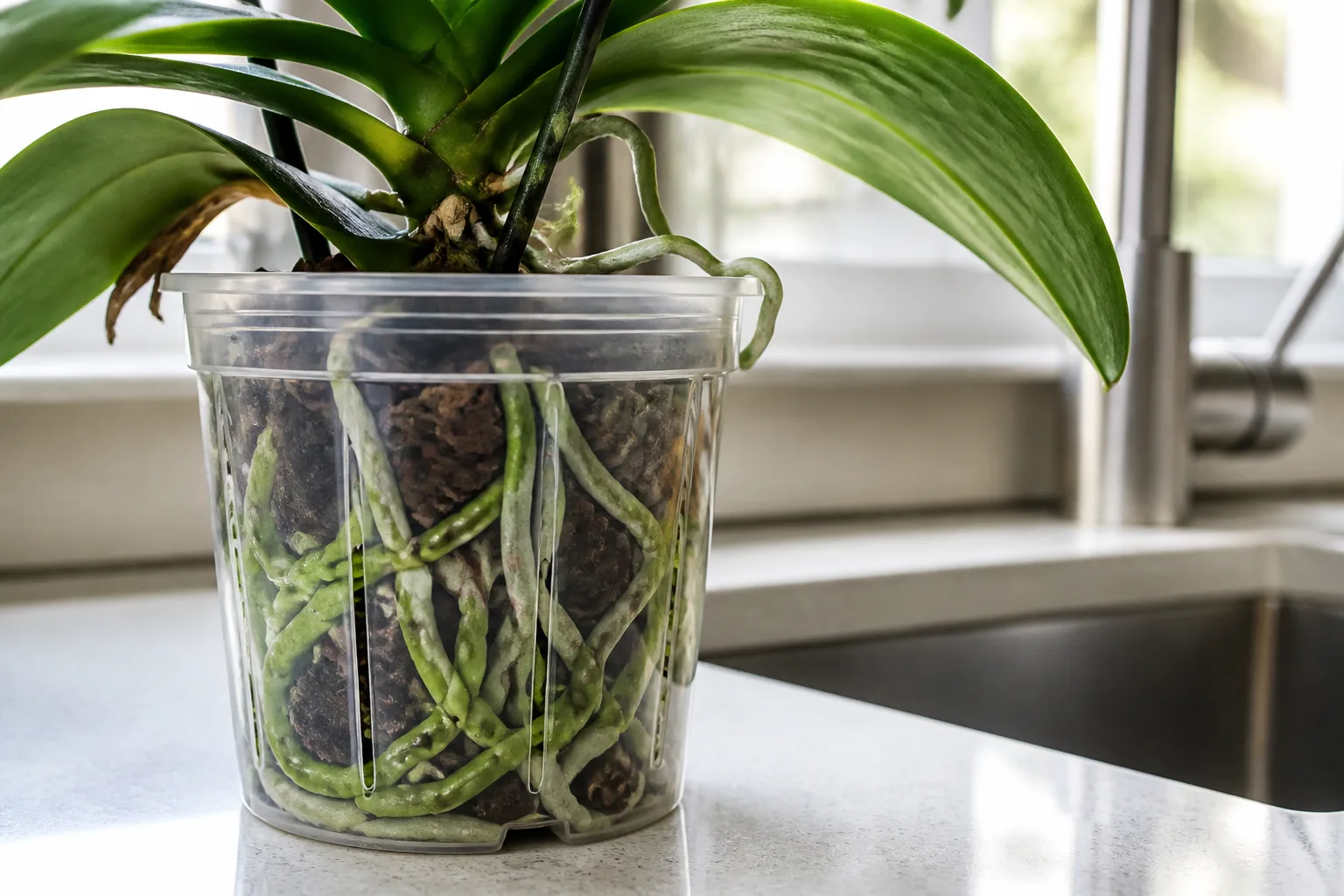
When the pot is nearly dry, run tepid water through the medium until it drains freely, then empty the outer cachepot or saucer. Water in the morning when possible and keep water from standing in the crown—the tight center where the leaves meet. A weekly schedule may fit one warm, airy bark pot and fail badly for another orchid packed in moss in a cool room.
Feed lightly while roots and leaves are growing
An orchid needs nutrients to build leaves, roots, and the stored energy that supports later flowering, but extra fertilizer does not force a healthy spike on demand. Use a complete orchid fertilizer at the label’s diluted rate during active root or leaf growth, and reduce feeding if the plant is not growing or the medium remains cool and wet for a long time.
Fertilizer recommendations vary with medium and conditions. The American Orchid Society’s culture sheet gives different feeding approaches for bark and other media, which is a reminder to follow a product’s orchid directions rather than copy a fixed schedule or mix strong solutions by eye. Flush the medium with plain water periodically so unused salts do not accumulate around roots.
Do not increase phosphorus or add a “bloom booster” as a substitute for light or a seasonal cue. A plant that has enough resources may flower without a special formula; a weak-rooted plant can be injured by excess fertilizer even if the label promises more blooms.
Keep humidity comfortable and air moving
Phalaenopsis appreciates moderate humidity, but most homes do not need greenhouse conditions for a plant to rebloom. The American Orchid Society gives a broad humidity range for culture and emphasizes air movement, especially when humidity is higher; for a home grower, avoiding very dry air and stagnant wet foliage matters more than chasing a number.
If indoor air is consistently dry, a room humidifier or a shallow pebble tray can help modestly. In a tray, keep the bottom of the pot above the water line, and do not leave the orchid standing in water; a tray will not fix dry roots or poor watering.
Misting the leaves is not a dependable way to raise room humidity. It can leave water in the crown or on flowers without changing the room’s overall moisture, so use airflow and a stable room setup instead.
Tell a new flower spike from a root
A root and an emerging spike can both look like a small green point at first, which is why early growth is easy to misread. A new root usually has a smooth, rounded, shiny tip and tends to point outward or downward; a flower spike grows from the side of the leafy stem and often has a flatter tip shaped like a mitten.
Do not force the direction while the tip is tiny. Once it is clearly a spike and several inches long, you can add a stake beside it and attach it loosely with a soft clip; leave room for the stem to thicken and keep the tie away from buds.
New spikes normally emerge from the leaf axil—the junction between a leaf and the short central stem. A side branch can instead appear from a node on an old green spike, so note where the growth begins before deciding whether it needs a stake or a different care routine.
Return to steady conditions as the spike grows
When you can identify a flower spike, stop trying to induce it and return the plant to a bright, steady room. Keep it away from heaters, cold windows, repeated moves, and sudden changes in watering; all of those can stress a spike as it develops.
Continue to water when the medium is nearly dry and feed modestly while roots are active. Turn the pot only if necessary, because repeatedly changing the direction of light can twist the emerging stem; a stake can support the natural arch without pulling it straight.
If the buds form and then shrivel or fall, review what changed in the preceding weeks. A move to a drafty window, abrupt temperature swings, root trouble, or a large change in water can all be more plausible than “not enough bloom fertilizer.” Return to a stable location and check the root system before adding more inputs.
Diagnose why no new spike has appeared
First separate a plant that is alive but between flowers from one that is struggling. Firm leaves and active root tips with no spike call for patience and a review of light and seasonal conditions; a limp plant with failing roots needs recovery, not another attempt to cool it.
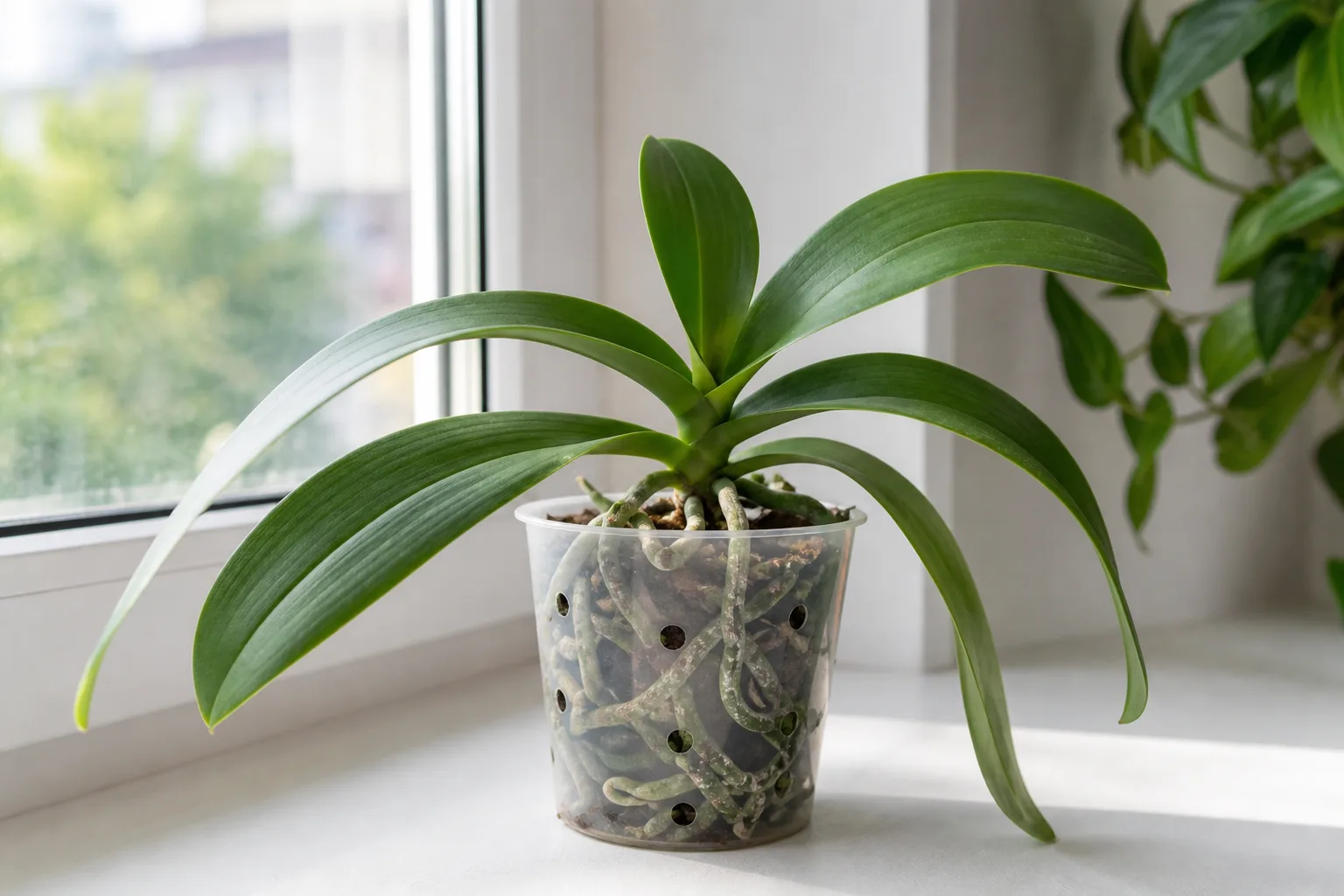
Low light or no seasonal temperature cue
If the orchid sits several feet from its brightest window, move it closer gradually or supplement with an appropriate grow light on a consistent timer. Very dark green leaves, slow leaf growth, or years without a spike make low light a reasonable first check, but leaf color alone cannot diagnose the problem.
If light is already adequate and roots are healthy, note day and night temperatures over several weeks. A warm room with little nighttime change may be missing the seasonal cue; try a naturally cooler room within the safe range instead of using a refrigerator, an unheated porch, or an outdoor cold snap.
Root stress, weak leaves, or too much pruning
Brown, hollow, papery, or mushy roots, a potting mix that stays soggy, and a soft or dark crown all point to root or crown trouble. Remove the decorative pot and inspect the inner pot’s drainage; if the medium has broken down or the roots are rotting, repot into an airy orchid mix and allow the plant to rebuild before expecting flowers.
One aging lower leaf can yellow naturally, but several leaves becoming limp or yellow together deserve attention. Correct the growing conditions first, avoid repeated fertilizer changes, and remove only a fully spent spike or a green one that is taxing an obviously weak plant.
Skip bloom boosters and other shortcuts
The most common shortcut is changing several conditions at once: cutting the stem, moving the orchid, increasing fertilizer, reducing water, and placing it in a cold room all in one weekend. When the plant responds—or declines—you cannot tell which change mattered, and several of these changes can stress roots or buds.
Make one correction at a time and keep a simple note of the date, approximate night temperature, watering, and new growth. Give light and temperature a few weeks to influence the plant, but keep checking roots in the meantime; the purpose of the log is to identify patterns, not to enforce a rigid care calendar.
Do not use drought, ice cubes, unverified fertilizer concentrations, or overnight outdoor exposure as bloom triggers. The most reliable approach is to keep the plant healthy enough to respond to ordinary seasonal conditions, then let the spike form at its own pace.
How long does orchid reblooming take?
There is no dependable number of days from the last flower to the next bloom. A green old spike may branch sooner than a plant that is building a fresh spike, while a mature plant that needs a new leaf or stronger roots may take a longer recovery interval; hybrids and indoor conditions also vary.
The cool-night cue itself is usually measured in weeks, but that is not the same as flowers opening in a few weeks. Once a new spike is visible, it still needs to extend, form buds, and open, so plan for a process that can span several months rather than expecting a bloom a month after moving the pot.
Judge progress by healthy roots, a firm new leaf, and a gradually growing spike. If those signs are present, keep the routine steady; if they are absent, reassess light and root condition instead of repeating a colder or stronger treatment.
Conclusion
To get a Phalaenopsis orchid to rebloom, begin with a healthy plant, decide whether its green spike is worth keeping, provide bright filtered light, and let safe seasonal nights support new spike formation. Continue to water by the condition of the roots and medium, fertilize modestly during growth, and keep conditions steady once the spike appears.
Most importantly, do not treat a bare flower stem as an emergency. A moth orchid may spend a long stretch building leaves and roots before it flowers again; give it sound care and time, and avoid forcing it with cold, drought, or extra fertilizer.