Why Is Your Monstera Drooping? 3 Causes to Check Today
Learn how to diagnose a droopy monstera by checking soil moisture, roots, cold exposure, and posture, then choose a safe first fix based on the evidence.
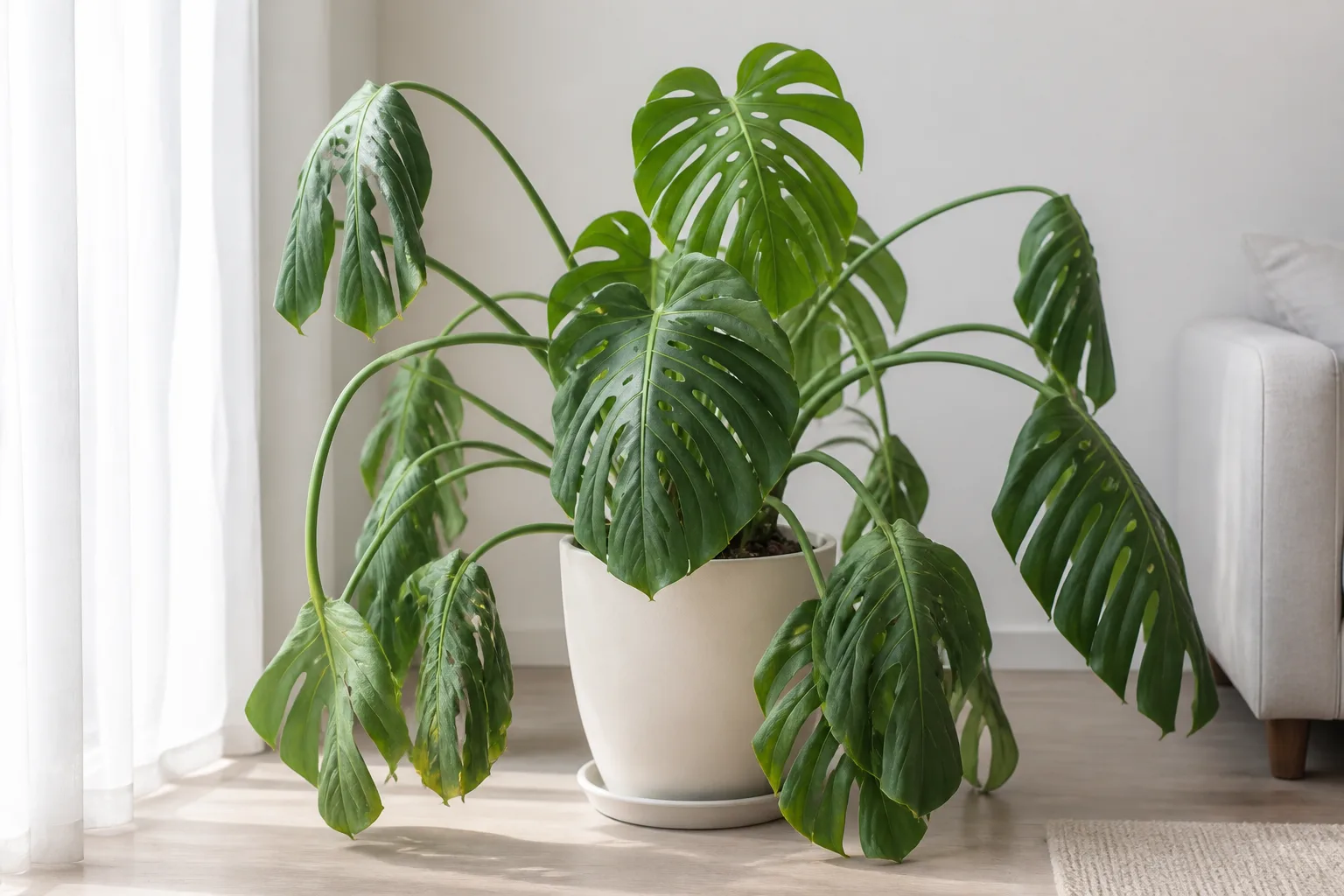
A drooping Monstera can look thirsty even when its pot is already too wet. The useful first step is not another splash of water; it is checking the soil and the plant’s recent conditions together. Dry roots, oxygen-starved roots, and cold stress are three common causes of true wilting, while a healthy but unsupported vine may simply be leaning under the weight of its leaves.
Before you change anything, notice whether the leaves feel limp or whether the stems are merely sprawling. Then check the root-zone moisture, drainage, and any recent move near a draft or cold window. Those clues are more reliable than a watering schedule or a single leaf.
First, Check Whether It Is Wilting or Simply Leaning
Monstera deliciosa is a climbing vine, not a naturally compact rosette. As its stems lengthen and its leaves enlarge, the plant can tilt toward a window or flop outward if it has no support. A firm green leaf attached to a stable stem can hang at an angle without the plant being dehydrated.
Wilting is different: leaf blades or petioles lose firmness, and several parts of the plant may sag at once. A leaf that is normally glossy may look dull, feel soft, or fold more than usual. If only the whole stem leans while leaves remain firm and the soil is neither bone-dry nor waterlogged, think about light direction and support before treating it like a water emergency.
The plant may also have one older lower leaf that droops or yellows as it ages. One aging leaf, by itself, is not evidence that all the roots are failing. Look for a pattern across newer leaves or several stems, and compare it with what changed in the room or pot.
A 60-Second Monstera Droop Check
Start with the pot, not the watering can. Feel the mix several inches below the surface in more than one spot; a dry crust on top can sit above a wet lower root ball, especially in a deep pot. Lift the nursery pot if you can: a very light pot plus dry mix supports thirst, while a heavy pot that stays wet points in another direction.
Check that the pot has drainage holes and that the inner pot is not standing in water inside a decorative cachepot. Smell near the drainage holes for a sour, swampy odor, and look for yellowing lower leaves, blackened patches, or a soft base. Those signs do not prove rot, but they make “water it now” a risky first move.
Then ask what happened in the last few days: Did the plant dry out while you were away, get soaked repeatedly, come home from a cold store or delivery, sit against a cold pane, or get repotted? The timing of a sudden collapse often narrows the possibilities. North Carolina State Extension describes Monstera as a warm-growing plant and recommends thorough watering followed by letting the upper part of the mix dry; use that as a condition-based rhythm, not a fixed weekly appointment.
Read the leaves together with the root ball
No single leaf symptom is a perfect diagnosis. Dry mix with a light pot and limp leaves points toward underwatering; persistently wet mix paired with declining leaves suggests the roots are struggling to take up water. Black, water-soaked patches after a cold night point to temperature injury, while white crust around the pot rim after heavy feeding raises suspicion of salt buildup.
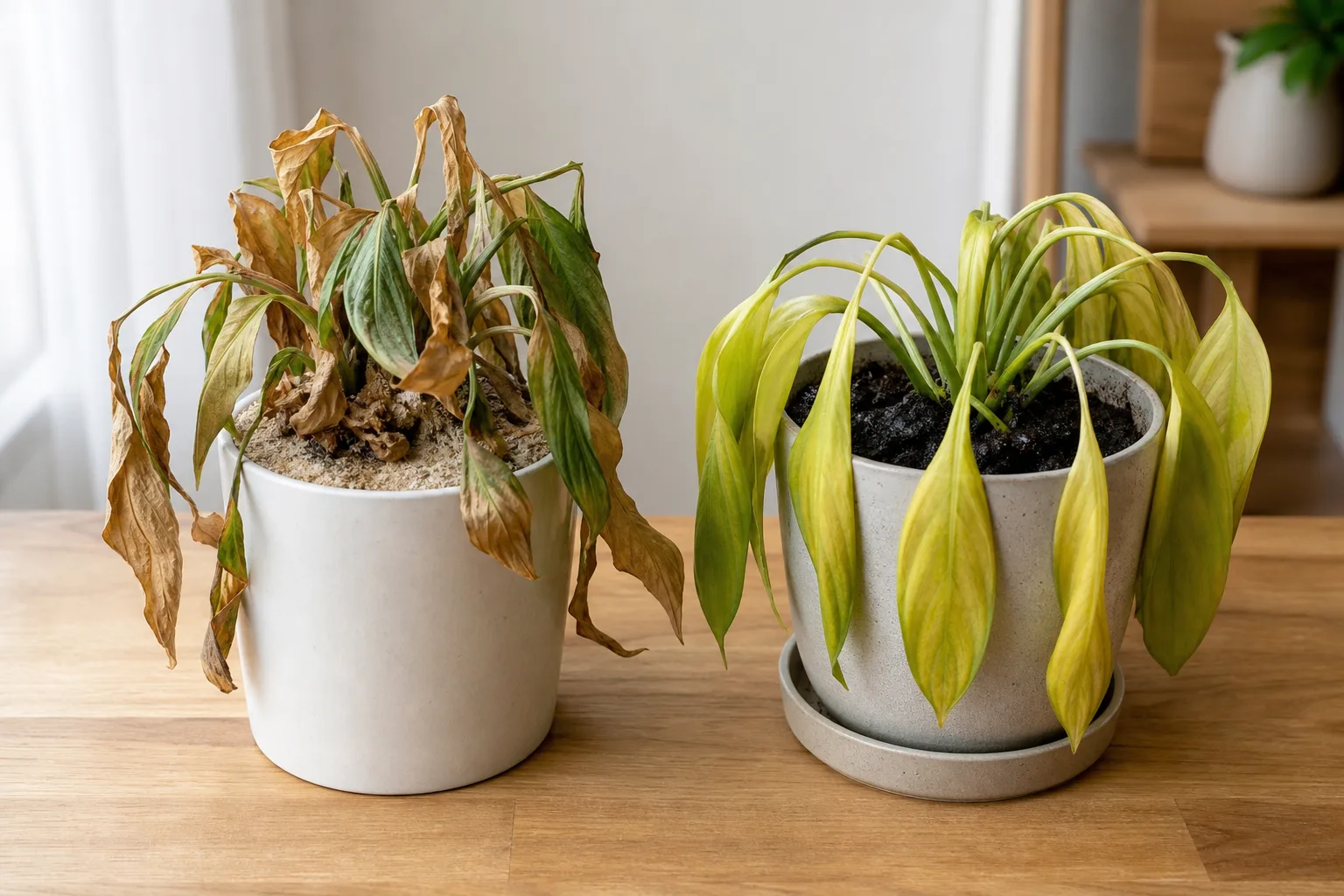
Check whether the whole plant changed at once or whether only one exposed leaf is damaged. A whole-plant change after a missed watering differs from a few cold-damaged leaves on the side facing a window. Root trouble also tends to linger or worsen while the mix remains wet, rather than improving after one careful watering.
1. Dry Soil: The Plant Is Thirsty
When a Monstera’s root ball dries too far, the leaves lose the water pressure that helps hold them out. The mix may pull away from the pot wall, become hard to penetrate, or feel dry several inches down; the pot is often noticeably light. Leaves may hang softly, and prolonged dryness can lead to curling or brown, crisp edges.
Do not rely on “the top inch is dry” as an automatic signal in every setup. Pot size, material, soil texture, room temperature, light, and season all change how fast the center dries. A small plant in a porous terracotta pot near a bright window can dry much faster than a large plant in a plastic pot in a cool, low-light room.
Probe the mix at more than one point, or use a clean wooden skewer as a rough check: if it comes out nearly clean and dry from the middle, the root zone may need water. If the upper layer is dry but the skewer comes out damp and cool from deeper down, wait and check again. Moisture meters can help compare one reading to another, but treat them as another clue rather than a diagnosis; dense bark, salts, and the location of the probe can affect readings.
How to rehydrate a dry Monstera
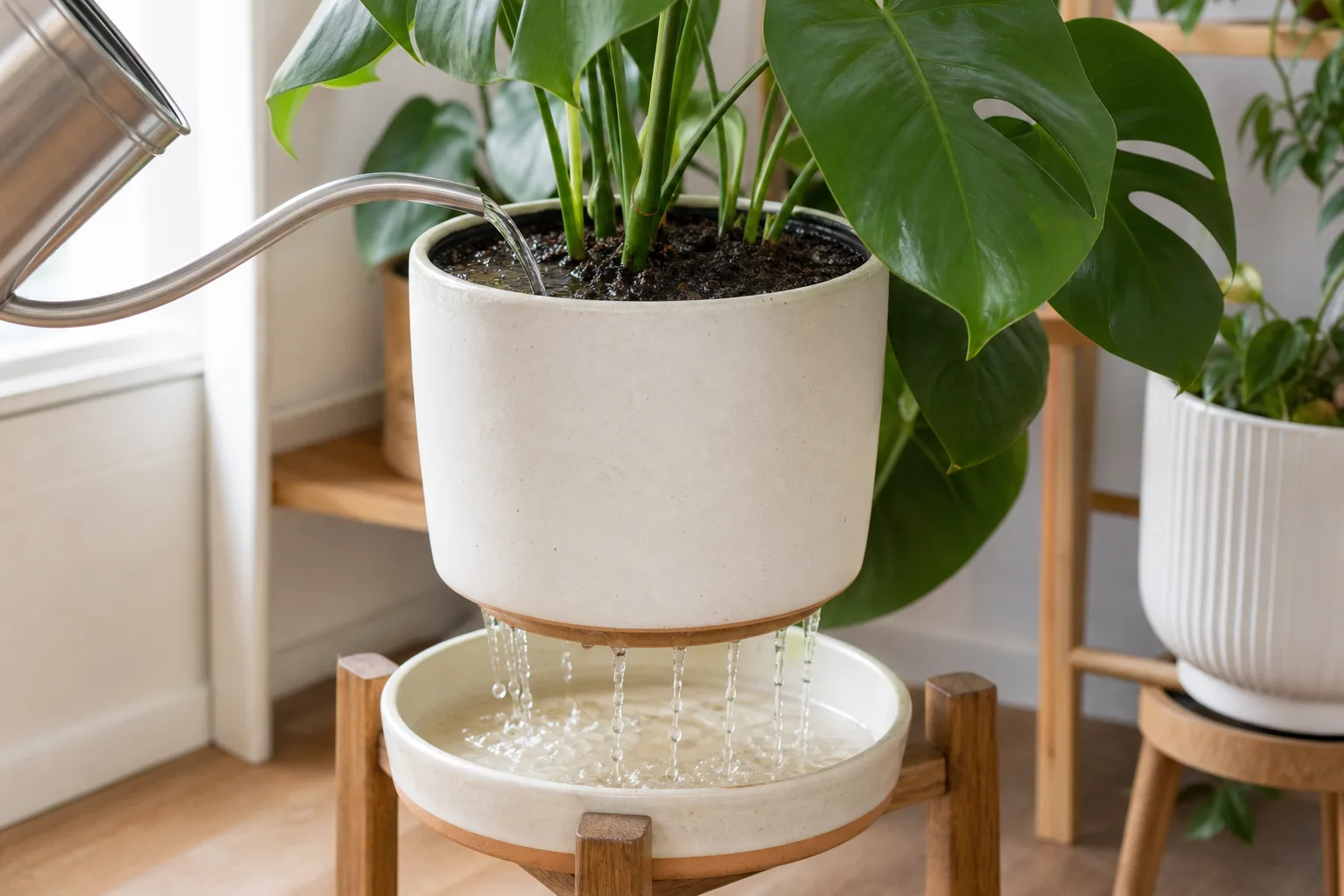
If the root ball is dry, water slowly and evenly across the surface until water runs freely from the drainage holes. A full soak wets roots throughout the pot more reliably than repeated small sips around the stem. BBC Gardeners’ World gives similar Monstera guidance: water around the soil until it drains, then let the mix mostly dry before the next watering.
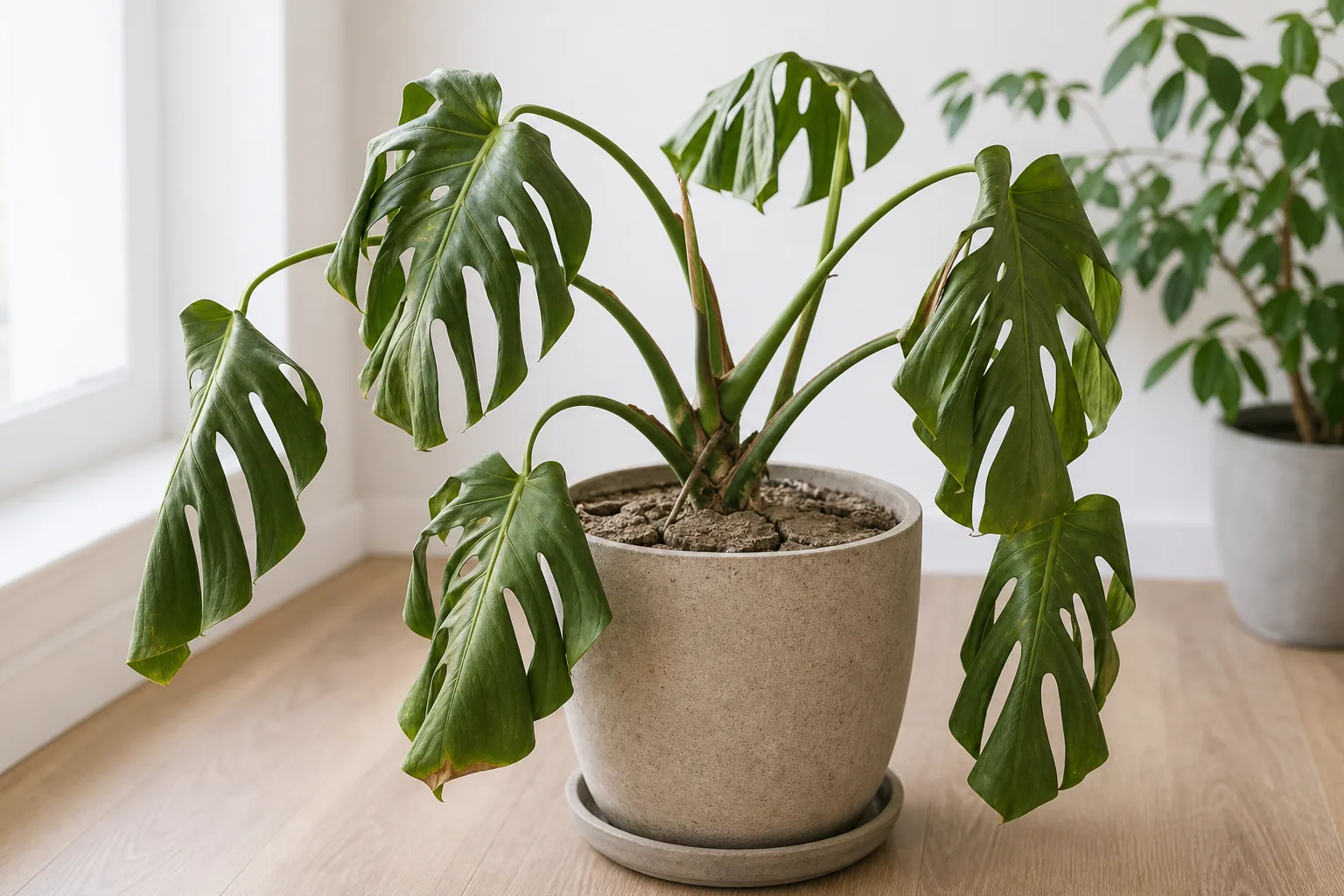
Let the pot drain completely, then empty the cachepot or saucer so the root ball is not sitting in runoff. If very dry peat-based mix repels water and the first pour runs down the sides, set the inner pot in a shallow basin of room-temperature water briefly, then lift it out once the mix has begun to absorb moisture. Drain it well; do not leave it soaking for hours or overnight.
A thirsty plant may regain some firmness within hours or by the following day, but recovery is not always immediate. Brown, crisp tissue will not turn green again, and a badly stressed leaf may remain misshapen even after the roots are hydrated. Wait before watering again and use the mix’s moisture, not the droop, to decide when the next soak is due.
2. Wet Soil: Roots Can No Longer Supply Water
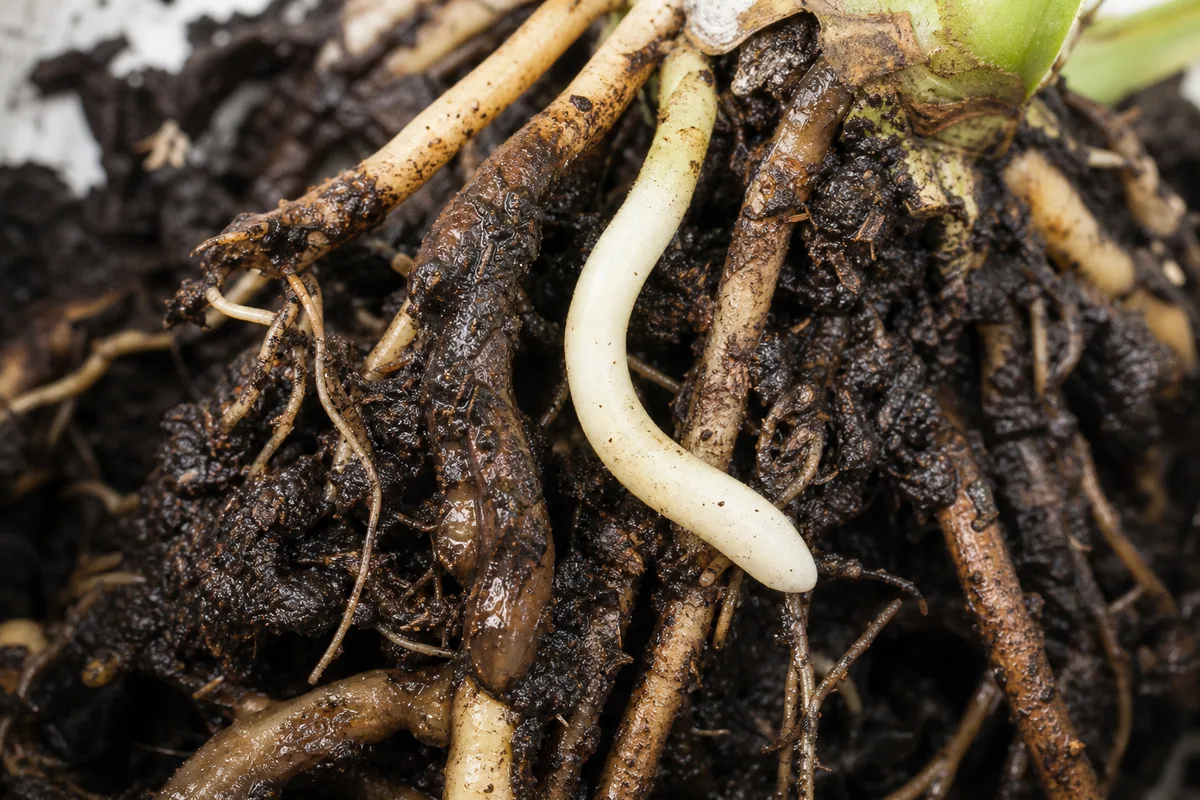
A Monstera can wilt in wet soil because damaged roots cannot move water effectively to the leaves. Constantly saturated mix has less air space, and roots that remain oxygen-starved can deteriorate; root rot and ordinary waterlogging produce overlapping above-ground symptoms. The Connecticut Agricultural Experiment Station describes general wilting and plant collapse as possible signs of houseplant root or crown rot, especially when roots are brown or black and mushy.
Look for a combination: the pot stays heavy and damp for much longer than usual, lower leaves yellow or decline, stems near the soil feel soft, or the mix smells stale. A pot without drainage, a blocked drainage hole, a dense compacted mix, a large pot with more wet soil than roots can use, or water trapped in an outer pot can all keep the root zone wet. One watering does not cause rot by itself; repeated wet conditions and poor drainage are the concern.
Do not unpot a plant just because a leaf drooped once after watering. If the mix is draining, the leaves remain mostly firm, and there is no spreading yellowing or soft tissue, let it drain and monitor. Digging through healthy roots can add stress without solving anything.
When to inspect and how to rescue roots
Inspect the root ball if the mix remains wet, decline continues, or the base becomes soft. Slide the plant gently from its pot and check the roots by texture and smell rather than color alone: healthy roots feel firm; rotting roots are often mushy, hollow, or have an unpleasant odor. Some healthy roots are naturally tan from potting mix, so color by itself is not enough.
If you find limited rot, trim only the dead, soft roots with clean scissors and remove the soggiest, broken-down mix. Use a clean pot with open drainage and fresh, airy houseplant mix; choose a container that fits the remaining root ball rather than moving automatically into a much larger pot. Fine Gardening’s Monstera guidance likewise emphasizes drainage and avoiding an oversized pot that holds excess moisture.
After repotting, water the fresh mix enough to settle it and let all extra water drain. Keep the plant in bright, indirect light and a stable warm room while it recovers. Do not fertilize a damaged root system, add stones to the bottom as a substitute for drainage, or repeatedly unpot it to check progress. If most roots are gone and the main stem is soft, recovery is uncertain; a healthy stem cutting with a node may be a backup, but it is a separate propagation project rather than a quick repair.
3. Cold Stress or a Sudden Temperature Change
Monsteras prefer warmth. North Carolina State Extension lists an average temperature range of about 60 to 85°F for this species, while BBC Gardeners’ World notes that blackened leaves can follow exposure below roughly 54°F. These ranges are useful context, not a magic threshold: how cold the plant got, for how long, whether the root ball was wet, and whether the change was sudden all matter.
Cold stress becomes more likely when drooping follows a winter delivery, a move near a drafty window, an open door, or air conditioning blowing directly on the leaves. Damaged tissue may look dark, translucent, or water-soaked before it browns; the exposed side may show the clearest damage. That pattern differs from a plant gradually drooping as its whole pot dries, although a cold-stressed plant can also have dry soil.

What to do after cold exposure
Move the plant to a stable, warm room with bright indirect light, away from cold glass, heating vents, and radiators. Warm it gradually; putting it right against a heater or in direct sun can create another stress. Check the mix before watering because cold, low-light soil dries more slowly than warm soil.
Do not expect cold-injured leaf tissue to repair itself. Leave a partly damaged leaf attached while it still has firm green tissue, and remove it with clean pruners only when it is mostly dead, mushy, or creating a sanitation problem. Watch the stem near the soil line: if it remains firm and new growth later appears healthy, the plant has a path forward even if older leaves keep their scars.
Fertilizer Salt Buildup Is a Less Common Lookalike
Excess fertilizer can injure roots, which can leave a plant weak or wilted even when the soil is moist. This is more plausible if the droop began soon after a concentrated feeding, if fertilizer was applied to dry mix, or if there is a white crust on the soil surface or pot rim. The Connecticut Agricultural Experiment Station notes that excessive soluble salts can injure houseplant roots and cause general decline; that decline can resemble root rot.
Stop fertilizing while the plant is stressed. If the pot drains freely, the mix is not already saturated, and roots appear generally healthy, a thorough watering that drains away can help leach accumulated salts; empty the runoff immediately. Do not keep flushing a pot with blocked drainage or a wet, sour-smelling root ball, because more water can compound the real problem. If salts are severe or the mix has become compacted, repotting into fresh mix may be safer than repeated leaching.
Once the plant resumes healthy growth, return to a balanced houseplant fertilizer diluted and applied according to its label. More fertilizer does not make a droopy plant recover faster. Avoid feeding in cold, dim conditions or immediately after root damage, when the plant is not using nutrients quickly.
Drooping Leaves vs. a Top-Heavy Plant
A Monstera can look floppy because it is built to climb. In nature, its stems attach to vertical supports; indoors, a mature vine may reach toward a window and spread outward. If leaves remain firm and the plant has not suddenly lost turgor, the issue may be structure rather than hydration.
Use a sturdy moss pole, coir pole, or stake to support the main stem. Position the support near the stem’s back and secure the stem loosely with soft ties; avoid cinching around a leaf stalk or crushing an aerial root. As the plant grows, check ties so they do not cut into the stem. A support changes posture but cannot fix wilt caused by dry or rotting roots.
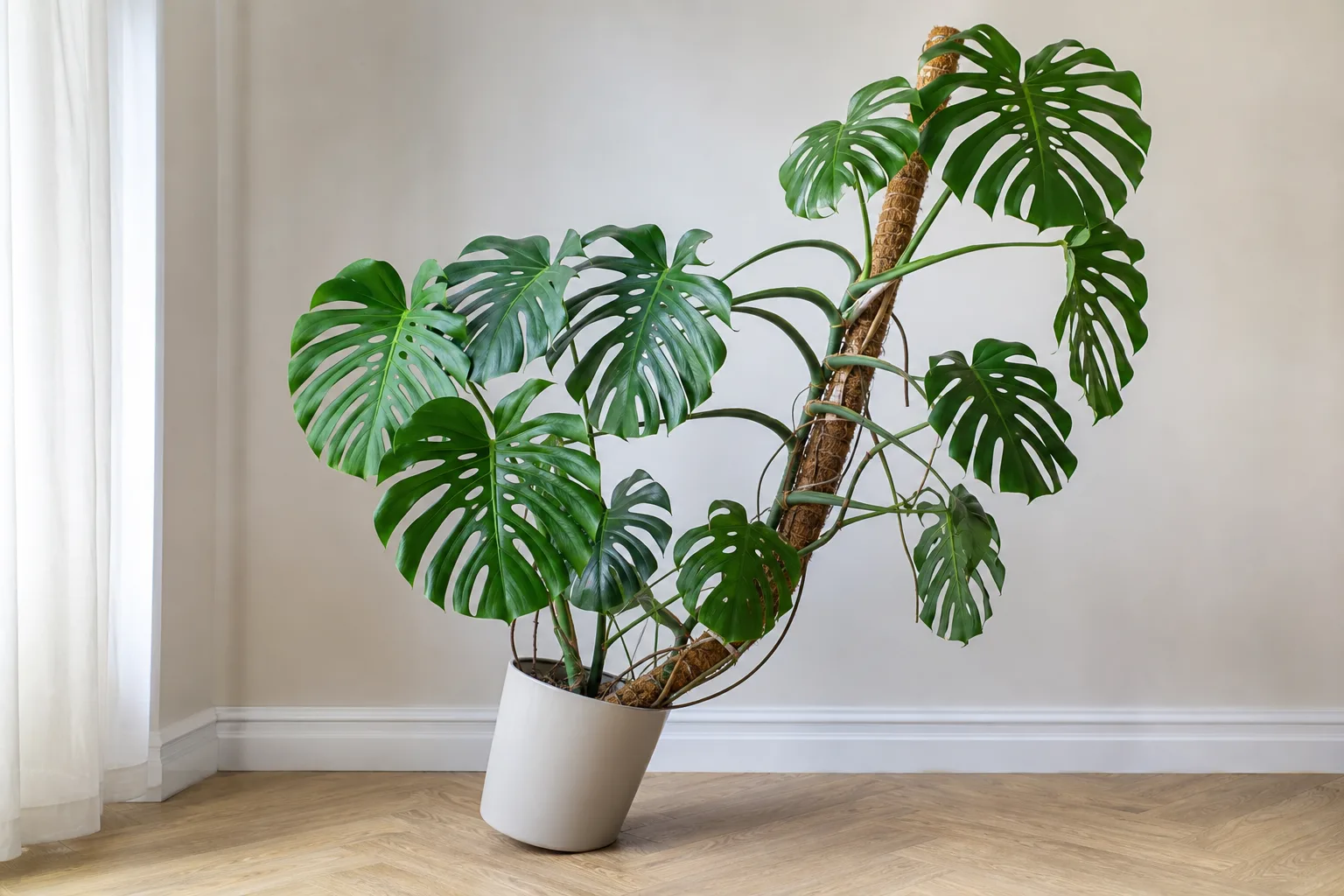
Do not prune healthy leaves just because the plant leans. Rotate the pot a little at a time if growth is strongly one-sided, and improve light gradually rather than moving a low-light plant straight into hot direct sun. If the pot itself tips, use a heavier stable cachepot or a properly sized container with drainage; never seal the drainage holes to make the plant less top-heavy.
Other Clues: Light, Pests, and Recent Repotting
Low light usually causes slow, stretched growth and a plant that gradually leans toward the brightest window; it is less likely to make every leaf go limp overnight. Monstera does best in bright indirect light, and North Carolina State Extension advises avoiding direct sun. If light is weak, move it closer to a bright window over several days or add an appropriate grow light; check moisture more often after increasing light because the mix may dry faster.
Inspect leaf undersides, stems, and new growth if drooping accompanies stippling, silver streaks, fine webbing, sticky residue, or black specks. Sap-feeding pests such as thrips or spider mites can weaken foliage, but a pest problem usually leaves visible marks or affects growth over time rather than making a healthy plant collapse without other clues. Isolate a suspicious plant from nearby houseplants and identify the pest before choosing a treatment.
A Monstera may also droop temporarily after repotting if roots were disturbed or the root ball dried out during the move. Check the mix once, restore a stable warm bright-indirect position, and avoid immediately adding fertilizer, extra water, pruning, and another repot. BBC Gardeners’ World cautions that wilting after repotting can reflect root disturbance; a sequence of calm, measured checks is less stressful than changing every condition at once.
Quick Decision Table: What to Check and Do
| What you see | Most useful first check | First response |
|---|---|---|
| Limp leaves; mix dry well below the surface; pot feels light | Probe the middle of the root ball | Water evenly to drainage, then empty runoff |
| Limp leaves; mix stays wet; pot is heavy; decline continues | Drainage, odor, stem base, and root texture | Stop watering; inspect roots if the decline persists |
| Dark or translucent patches after a cold event | Which side faced the cold and whether stems are firm | Move to stable warmth; wait before pruning |
| White crust after recent feeding | Fertilizer dose and drainage holes | Stop feeding; leach only if drainage is good |
| Firm leaves on a leaning, elongated vine | Light direction and stem support | Add a loose support; do not water solely for posture |
What to Do in the First 24 Hours
First, remove standing water from the cachepot and identify whether the soil is dry, evenly moist, or saturated below the surface. Second, check the stem base and the undersides of leaves without pulling the plant apart. Third, think about the most recent change: a missed watering, a cold trip home, a repot, a fertilizer dose, or a shift in light.
Choose one matching response and give it time. Water only a genuinely dry root ball; let a wet, draining pot breathe; move a cold-exposed plant away from drafts; or add support to a firm but leaning vine. Taking a photo now can help you compare the plant tomorrow, especially if the change is subtle.
Do not combine a soil flush, root pruning, fertilizing, and a new location as one rescue treatment. Each change makes it harder to tell what helped, and repeated handling can damage fine roots. If the stem is soft at the soil line, the mix smells foul, or most foliage collapses despite corrected conditions, inspect the roots promptly and consider asking a local extension service or experienced plant diagnostician to assess an unusual case.
Prevent a Repeat with a Simple Care Rhythm
Water by checking the plant, not by choosing a day of the week. Let the upper portion of the mix dry between thorough waterings, then soak evenly and allow the excess to drain; NC State describes letting roughly the top quarter to third dry for Monstera. Your own interval will change with pot size, mix, season, warmth, and light, so make a quick soil check part of the routine rather than following a fixed number of days.
Use a pot with drainage and a loose mix that holds some moisture but does not stay swampy. Keep the plant in steady bright indirect light, out of cold drafts and direct blasts from heating or cooling equipment. In winter or in a dim room, expect the soil to stay wet longer and reduce the frequency of watering instead of giving the same volume on the summer schedule.
Feed only when the plant is actively growing, and follow the fertilizer label rather than doubling the dose to encourage bigger leaves. Rinse accumulated dust from foliage as needed, check for pests when watering, and support the main stem as it climbs. If a previously balanced plant begins drooping, review what changed before changing its whole care setup.
Conclusion
A droopy Monstera needs a diagnosis before it needs another drink. Dry mix and a light pot point toward thirst; a heavy, persistently wet pot and deteriorating roots point toward waterlogging; and a sudden collapse after cold exposure calls for stable warmth and patience. A firm but sprawling vine may simply need a stake.
Check the root ball, drainage, leaf texture, and recent conditions, then make one targeted adjustment. That approach protects healthy roots, makes recovery easier to judge, and keeps normal climbing growth from being mistaken for a plant emergency.