How to Grow and Care for the Purpleleaf Plum Tree: A Guide
Get practical purpleleaf plum tree care advice on watering, soil, cultivars, spring blooms, fruit, pruning, safe handling, and common pests and diseases.
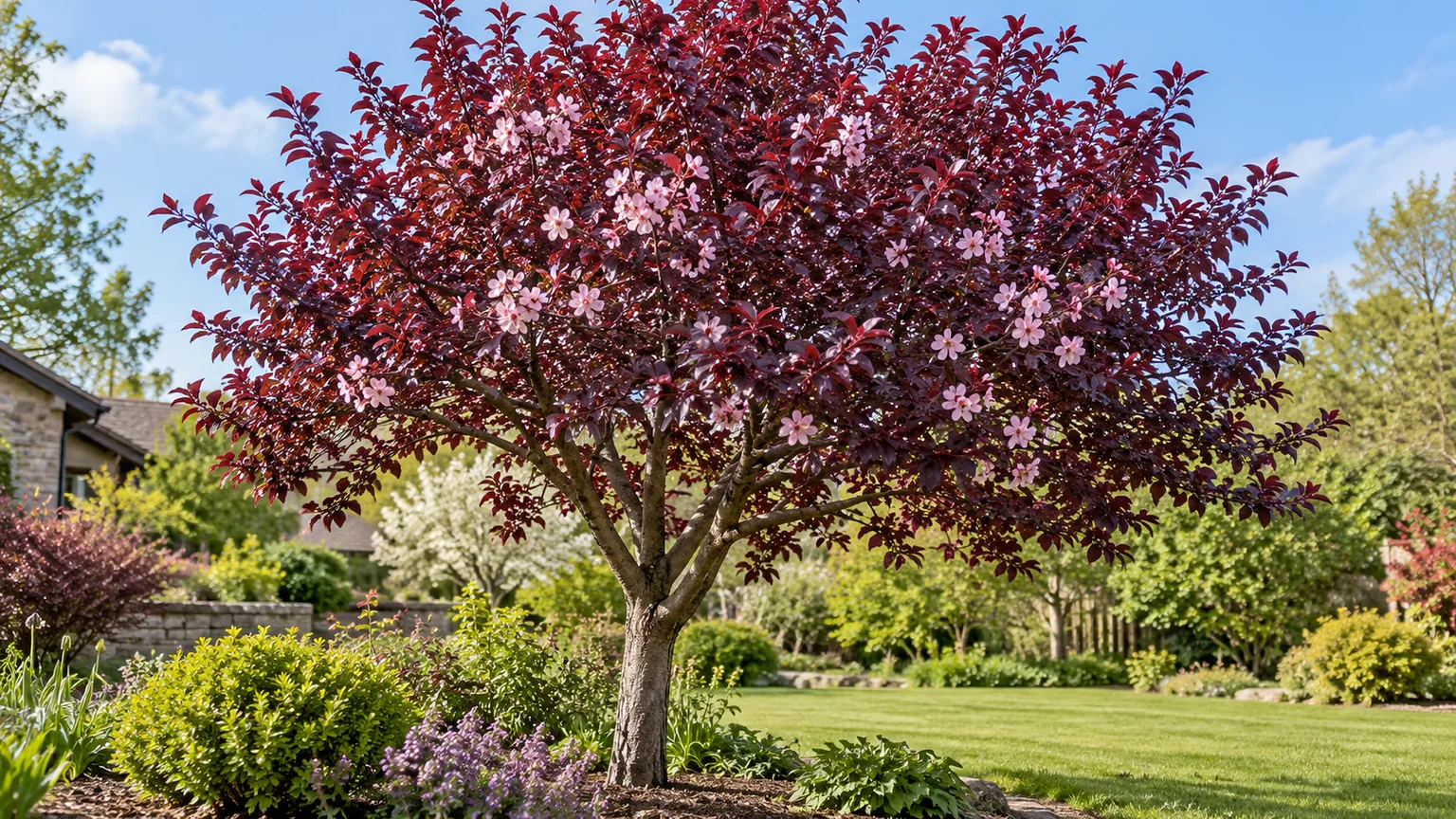
A purpleleaf plum can give a small yard a season-long color anchor: pale blossoms arrive early, then burgundy foliage holds its own through summer. It is not a carefree substitute for a long-lived shade tree, though. Prunus cerasifera has brittle branches, can attract a range of insects and diseases, and is often planted for foliage rather than dependable fruit, so its success begins with choosing a healthy specimen and a site that suits its limits.
The simple care formula is full sun, soil that drains, deep water while roots establish, and restrained pruning. The details below help you decide which cultivar fits, how to avoid common planting errors, and when a problem needs a local diagnosis rather than another round of fertilizer or spray.
Purpleleaf plum at a glance
Purpleleaf plum is the common name for ornamental selections of Prunus cerasifera, also known as cherry plum or myrobalan plum. The species is deciduous; purple-leaved cultivars typically start with coppery or reddish new growth, deepen to purple, and drop their leaves in fall. Flowers are small and fragrant, usually pale pink or white, and open very early in spring—sometimes before the foliage fully emerges. Mature size is commonly in the 15-to-25-foot range, but the label for a specific cultivar is more useful than a generic height estimate. NC State Extension’s plant profile describes the cultivar and seasonal variation, while Oregon State University’s Landscape Plants database distinguishes several named forms.
| Need | Practical target |
|---|---|
| Light | At least 6 hours of direct sun for strong purple foliage and flowering |
| Soil | Moist but well drained; adaptable to texture, less tolerant of waterlogged roots |
| Water | Regular deep watering during establishment; less often once well rooted, but do not let the root zone bake dry for long periods |
| Pruning | Minimal; remove dead, damaged, crossing, or poorly attached growth in a locally appropriate dry-weather window |
| Best use | A specimen accent or small ornamental grouping, away from pavement where fallen fruit will be a nuisance |
Zone claims vary among references and cultivars, with purple-leaved forms commonly listed around USDA zones 5 through 8 and the broader species sometimes listed at the colder edge of zone 4. Treat that broad span as an initial screen, not a guarantee: the cultivar, nursery stock, winter exposure, and local guidance all matter. Early flowers can be damaged by a late frost even where the wood survives winter, so a cold-air pocket can reduce the spring display without killing the tree.
Start with the right tree and realistic expectations
Buy a named cultivar when foliage color, mature height, or crown shape matters. The species sold as “purpleleaf plum” includes several selections, and labels sometimes blur botanical names; for example, Oregon State notes that ‘Newport’ is classified as Prunus ‘Newport’ rather than P. cerasifera ‘Newport’. That distinction is useful when comparing nursery descriptions, but the practical priorities remain the plant’s actual size, form, and flower color.
Before paying, walk around the tree and look above the graft union. Favor a specimen with a visible root flare, one main trunk or a deliberate multi-stem form, well-spaced branches, and no large dead tips, sunken cankers, or blackened wounds. A tree with two competing leaders, tight included bark, or a trunk buried in potting mix starts with a structural disadvantage; pruning cannot always correct a poor framework without removing a large share of the crown. NC State specifically recommends selecting a good central leader for this species because its wood and branch structure can be brittle.
Also decide what you want from it. For year-round shade or reliable harvests, another species or a fruit-bred plum is usually a better investment. Purpleleaf selections are strongest as ornamental accents, and many years they produce little fruit; when they do, small plums can drop onto walks and patios.
Find a sunny, well-drained site with room
Choose the location before you dig. A mature crown can spread roughly as wide as it is tall, and branches can be vulnerable to breakage, so leave clearance from roofs, overhead wires, driveways, and places where a falling twig or fruit would create a regular cleanup problem. Do not plant close to a retaining wall, paved edge, or utility line just because the nursery tree looks compact.
Light sets foliage color
Give the tree at least six hours of direct sun, ideally through the middle of the day. Purple pigment is strongest in bright light; in substantial shade, foliage often looks greener and the tree may flower less. If you are choosing between a shady site and a sunnier site with slightly less-than-perfect soil, favor the sunnier spot as long as the soil drains and can be watered during establishment.
Some cultivars emerge red or bronze and darken as leaves mature, so a temporary change in spring color is not automatically a problem. Compare the same tree across the season before diagnosing it. If leaves remain mostly green in midsummer, check the canopy for shade from a growing neighboring tree, a fence, or a building before reaching for fertilizer.
Soil, drainage, and airflow matter
Purpleleaf plum tolerates a range of soil textures and pH, but “adaptable” does not mean “happy in standing water.” After a soaking rain, note whether water disappears rather than lingering in the planting area. Persistent saturation, compacted fill, or a low hollow can stress roots and increase the chance of decline; if drainage is poor, plant on a broad raised mound or choose a different tree rather than putting gravel at the bottom of a deep hole.
Leave space around the canopy so leaves dry after rain and branches do not press against buildings or neighboring shrubs. Airflow is not a cure for every fungal disease, but a crowded, constantly wet crown makes inspection and cleanup harder. BBC Gardeners’ World recommends a reasonably fertile, well-drained site and warns that very early blossom is more exposed in cold low-lying positions; its cherry plum growing guide covers that seasonal trade-off.
Plant correctly: keep the root flare at grade
Plant in fall or early spring when the soil is workable and the tree can establish without summer heat stress. Container-grown trees can go in at other times if you can keep the root ball evenly moist, but avoid planting into frozen, waterlogged, or baking-hot soil. The hole should be wide enough to spread roots outward, not deeper than the root ball.
Find the root flare—the point where the trunk widens and the main roots begin. Set that flare at or slightly above finished soil level; do not bury it beneath fill or a thick mulch mound. Backfill with the excavated soil, break up large clods, water to settle air pockets, and apply a broad, shallow mulch ring while leaving several inches clear around the trunk. A stake is useful only if the root ball moves in wind; use a flexible tie and remove it once the tree stands securely on its own.
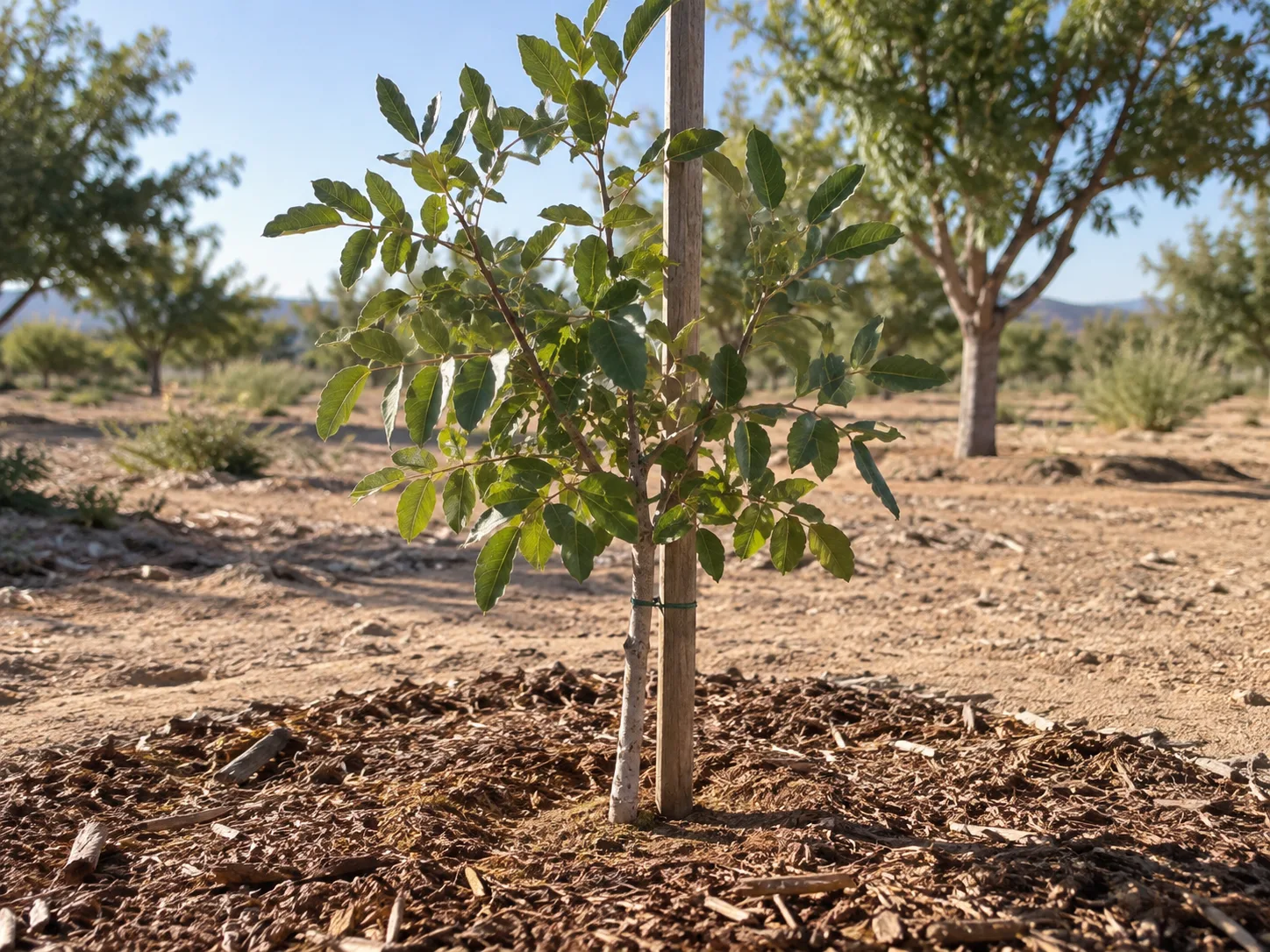
After planting, check the trunk base again once the soil has settled. A low mound of mulch shaped like a volcano keeps the bark constantly damp and can hide a too-deep flare; pull that material back rather than adding more. The BBC Gardeners’ World planting sequence likewise keeps the root ball at ground level, waters it in, and uses a surface mulch to reduce competition and moisture loss.
Water for establishment, then adjust to weather
For the first growing season—and often the second—water slowly and deeply enough to moisten the nursery root ball and the surrounding soil. A short daily sprinkle wets the surface but may leave the roots dry, so use a hose at a low flow or a soaker line and let the water soak in. Check soil by hand several inches down near the edge of the root ball: if it is cool and damp, wait; if it is drying out, water thoroughly.
The exact interval depends on rainfall, soil, temperature, and planting season. Sandy ground dries faster than loam; clay stays wet longer, so a fixed calendar can either under-water one site or suffocate another. During a hot, rainless stretch, check more often, but do not keep the root zone constantly saturated. A broad mulch ring helps conserve moisture and reduces grass competition, while keeping the trunk dry and visible.
Once established, the tree tolerates some drought, but prolonged hot, dry weather can cause leaf scorch, early leaf drop, or weak growth. Water the root area during extended dry spells, especially if the soil is sandy or the tree is surrounded by turf. If wilting appears, check soil moisture and drainage first; adding water to a saturated site worsens the problem instead of solving it. Gardening Know How also emphasizes regular irrigation after planting, while NC State describes the purple-leaved form as moderately drought tolerant once established.
Fertilize only when growth or soil tests call for it
A yearly dose of all-purpose fertilizer is not an automatic requirement. If the tree produces normal seasonal growth and foliage, feeding can add little; excess nitrogen can push long, soft shoots that create more pruning work and may not improve bloom or purple color. Keep the area around the trunk free of dense turf and replenish a thin surface layer of compost or mulch instead of piling fertilizer against the bark.
If growth is unusually weak, leaves are small, or color is poor, first compare the symptoms with shade, drought, waterlogging, root injury, and pest damage. A soil test is more useful than guessing at a nutrient deficiency, particularly where pH or construction fill may be involved. Correct the diagnosed issue and follow the test’s rate rather than applying a concentrated product near the trunk. If the canopy is declining from one side, a nutrient shortage is less likely than a branch, root, or disease problem.
Read the seasonal cycle: flowers, leaves, and fruit
The spring show is short, often lasting about one or two weeks depending on weather. Flowers can open before leaves, then foliage develops from bronze or red to deeper purple as the season warms. This sequence is normal; a tree that looks sparse during the transition may simply be between flower and leaf flush, while buds blackened after a late freeze point toward cold injury.
Summer is the main foliage season. Inspect leaves and new shoots every few weeks, particularly after hot, wet, or unusually dry weather. A few insect-chewed leaves rarely justify treatment, but widespread distortion, sticky honeydew, premature leaf drop, or dying branch tips deserve closer attention. By late summer, any fruit that forms ripens and may attract birds; remove fallen fruit from a walkway if it is slippery or begins to attract insects.
In fall, let the tree drop leaves naturally and remove diseased material from the ground. Purpleleaf plum is deciduous; leaf loss is not a sign it has died. In winter, check the framework for cracks, rubbing branches, and dead wood while the canopy is open, but wait for an appropriate dry pruning window before making routine cuts.
Choose a cultivar to fit the space
Cultivar names help narrow the choice, but nursery stock and local conditions affect the final size and color. NC State lists ‘Thundercloud’, ‘Krauter Vesuvius’, ‘Newport’, ‘Nigra’, ‘Atropurpurea’, ‘Crimson Pointe’, and the dwarf ‘Purple Pony’ among forms sold under the purpleleaf-plum umbrella. Compare mature height and width on the actual tag; do not assume “dwarf” means patio-sized or that every tree with purple leaves will keep the same shade all summer.
‘Thundercloud’ is widely planted for dark foliage and pink-to-white flowers. ‘Krauter Vesuvius’ is often described as darker and more upright; ‘Nigra’ can shift from bronze spring growth to very dark summer leaves and reddish fall color. ‘Newport’ is commonly selected for cold tolerance, but local cultivar labeling and regional performance still matter. ‘Purple Pony’ is marketed as a smaller form, so it may suit tighter yards better than a standard spreading selection, but it still needs outdoor root space and sunlight.
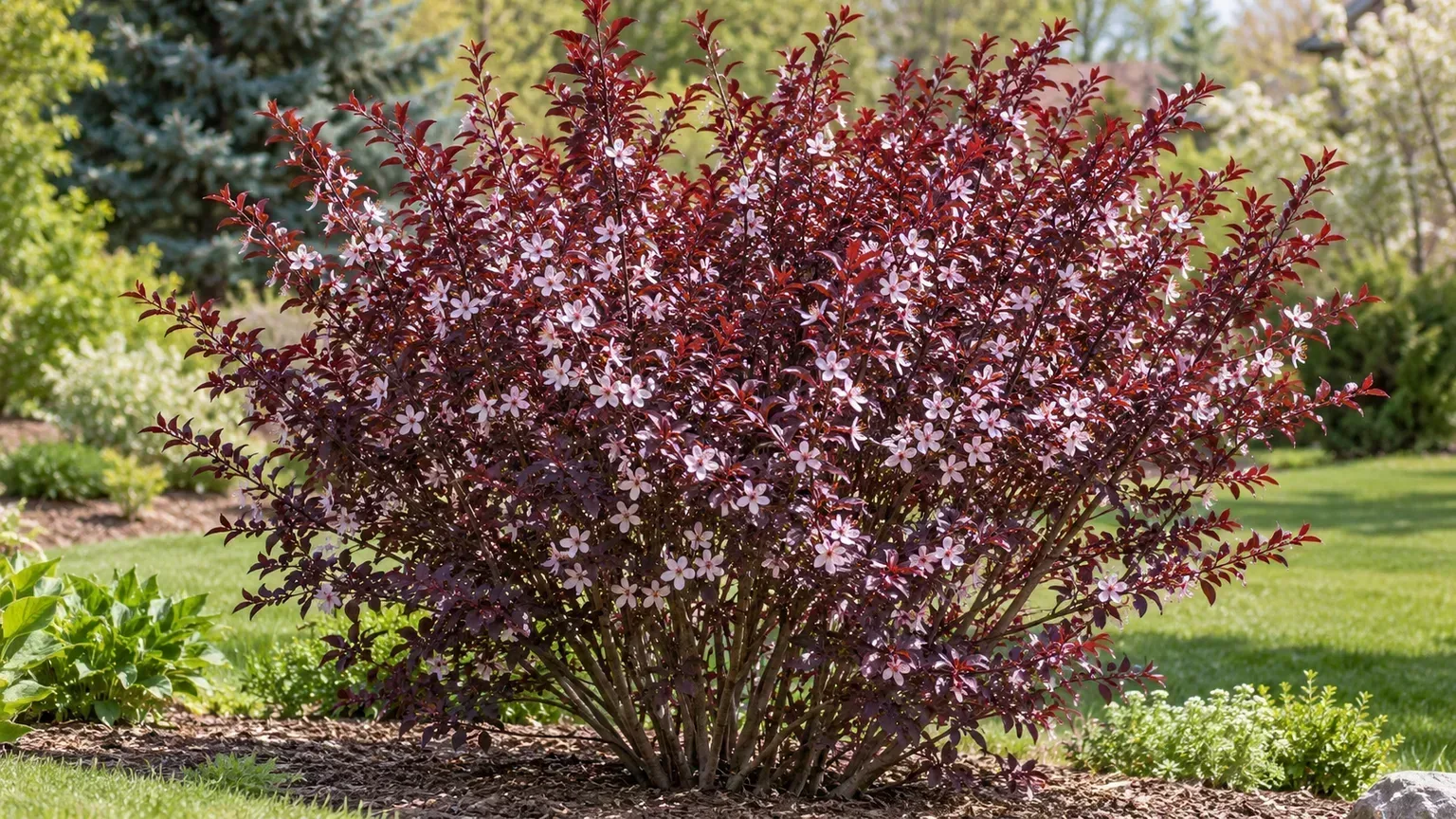
Do not confuse purpleleaf plum with purple-leaf sand cherry (Prunus × cistena). The sand cherry is generally a smaller, multi-stem shrub; the purpleleaf plum is a small tree with a trunk and a broader crown. The photograph above shows the shrub, not the tree. If the nursery’s tag is missing or ambiguous, ask for the botanical name and mature dimensions before buying.
Prune for a strong, open framework
Prune to remove a specific problem, not to force a dense round shape. The tree’s natural habit is rounded to vase-shaped, and repeated shearing creates a crowded canopy that needs continual correction. When the tree is young, preserve a well-spaced scaffold framework and remove only branches that compete with the chosen leader, cross, rub, or attach at a weak angle. A tree with major structural defects may need assessment by a certified arborist while cuts are still small.
Make small cuts in the right season
Advice about timing differs because the goal and disease pressure differ. NC State’s cultivar guidance says to prune just after flowering to maintain shape; BBC Gardeners’ World recommends pruning plums sparingly in summer, when cuts heal quickly and disease risk can be reduced. A sensible rule is to make only small shaping cuts in dry weather after bloom, then follow local extension advice if silver leaf or canker is common in your area. Avoid routine pruning in cold, wet weather, and do not remove so much canopy that you expose large limbs to sun or leave the tree unbalanced.
Use sharp, clean bypass pruners for small branches and a pruning saw for larger ones. Cut just outside the branch collar—the slight swelling where a branch joins the trunk—rather than flush to the trunk or leaving a long stub. Do not apply wound paint unless a local arborist specifically recommends it for a diagnosed issue; most routine cuts should be left open to close naturally. For a large limb over a structure, a split trunk, or a major canker, hire a qualified arborist instead of working overhead.
Remove suckers without damaging the trunk
Shoots arising from the base or roots may be suckers from the rootstock, particularly if the ornamental crown is grafted. They may have green leaves or a different growth habit from the purple canopy. Follow a shoot to its point of origin and remove it cleanly at the base; clipping only the tip encourages it to branch and return.
Do not dig aggressively around the trunk to chase every root shoot, and do not use herbicide on a sucker attached to a living tree. Repeated suckering can signal rootstock growth, trunk injury, or stress, so inspect the root flare and bark while removing it. If the crown above the graft is declining while vigorous green shoots rise below, ask an arborist whether the grafted top is failing before investing in further pruning.
Propagate named cultivars carefully
Seeds from an ornamental purpleleaf plum may germinate, but seedlings do not reliably reproduce the parent cultivar’s leaf color, flower traits, size, or habit. Use seed only if you want an experiment, not an exact replacement for a named tree. Most named selections are maintained vegetatively, commonly through grafting or budding; Oregon State notes these propagation methods for Prunus cerasifera, while softwood cuttings can succeed under controlled conditions but are less predictable for a home grower.
For a dependable landscape tree, buy a correctly labeled nursery specimen and inspect the graft union, root flare, and branching before planting. If you want to propagate a valued cultivar, use clean material from a healthy tree and learn the appropriate grafting method for that cultivar, or ask a local nursery to do it. Do not take cuttings from a tree with cankers, dieback, or unexplained leaf symptoms, since propagation preserves neither health nor good structure automatically.
Diagnose pests and diseases by evidence
Purpleleaf plum can be affected by aphids, scale, borers, caterpillars, Japanese beetles, mites, leaf spots, cankers, black knot, root rot, and other common Prunus problems. NC State’s profile lists a broad range of insect and disease issues, and Purdue Arboretum likewise characterizes the species as susceptible to pests and diseases and not especially pollution tolerant. Susceptibility is not a diagnosis: identify what is present before treating.
Start with the pattern. Sticky leaves and curled new growth suggest sap-feeding insects such as aphids; inspect leaf undersides and tender tips. Discrete spots or shot holes may follow wet weather, while hard, dark swellings on branches are consistent with black knot. Sunken bark, gum, or a branch that dies back from its tip can indicate canker or other stress, and a tree declining across the whole canopy may have root or planting-depth problems. Take clear photographs of both sides of affected leaves, the twig, and the trunk base, then send them to your cooperative extension diagnostic service if the cause is uncertain.
Remove small dead or clearly diseased twigs with clean tools when local guidance supports pruning, and discard infected material rather than composting it. Improve drainage, reduce trunk injury, avoid wetting foliage late in the day, and keep mulch away from bark. Do not spray on a calendar: a pesticide will not fix root rot, a cankered limb, shade, or an overwatered planting site, and chemical decisions should follow the product label and local extension recommendations. For trunk cankers, rapid dieback, large branch failures, or a declining mature specimen, request an arborist’s assessment.
Weigh mess, lifespan, and landscape fit
The purpleleaf plum is at its best where the seasonal display matters more than a long-term shade canopy. Early flowers feed pollinators, foliage brings strong contrast, and birds use the fruit; however, fallen fruit and twigs can make a patio or sidewalk messy. The tree is not a good choice under power lines, in a narrow planting strip, in compacted urban fill, or beside a heavily used path if cleanup and branch risk are unacceptable.
Published lifespan estimates are not consistent. Purdue Arboretum says the species often lives about 20 years, while NC State notes that a well-pruned and cared-for specimen may live considerably longer, giving 60 to 80 years as a possible upper outcome. These are not guarantees for the same cultivar under the same conditions. Treat purpleleaf plum as a tree with meaningful pest, disease, and structural risk, and plan for inspection and eventual replacement rather than assuming it will be a permanent canopy tree.
If you want to keep it, inspect the structure annually and avoid piling soil or mulch against the trunk. If major limbs repeatedly die back, the trunk splits, or the crown becomes unsafe over a target, get an arborist’s opinion about whether pruning can restore a sound framework. A young replacement planted while the old specimen is still safe can preserve the design better than waiting for a hazardous failure.
Handle fruit and plant parts safely
Some cherry-plum fruit is edible when ripe, but ornamental cultivars may produce little fruit and are not selected for reliable flavor. NC State describes P. cerasifera fruit as edible while warning that pits contain cyanogenic compounds; the pit should not be chewed, crushed, or blended into food. Remove fallen fruit from a play area or walkway, and do not assume that an ornamental label means a tree is intended for eating.
Leaves, stems, and seeds also deserve caution around children, dogs, cats, and horses. The ASPCA’s plum listing identifies plum plant material as toxic to pets and notes cyanogenic compounds in stems, leaves, and seeds, with greater risk in wilted material; NC State lists the purpleleaf plum’s leaves, seeds, and stems as poisonous plant parts. Keep pets from chewing prunings or wilted leaf piles, and contact a veterinarian or animal poison-control service promptly if you suspect ingestion. Do not try to induce vomiting unless a veterinary professional tells you to.
Conclusion
Purpleleaf plum tree care is mostly about getting the setup right and avoiding unnecessary intervention. Give it full sun, drainage, enough room for its crown, and a correctly planted root flare; water deeply while it establishes, then respond to actual weather and soil rather than a fixed schedule. Choose a cultivar by mature size and local hardiness, and buy a specimen with sound structure because brittle wood and disease susceptibility make that decision consequential.
Keep fertilizer and pruning modest, watch for symptoms before treating, and take regional disease guidance seriously when timing cuts. If your priority is long life, clean pavement, or reliable edible plums, another tree may serve you better. If you want a vivid ornamental accent and accept its maintenance and lifespan uncertainty, a well-sited purpleleaf plum can reward the space with fragrant spring bloom and deep summer foliage.



