The One-Third Rule for Pruning Shrubs: What It Means
The one-third rule can renew established shrubs, but it is not a haircut formula. Learn how to choose canes, time cuts, and protect next year’s blooms.

The one-third rule for pruning shrubs is a useful guide for renewing many established, multi-stemmed shrubs: in a gradual renewal plan, remove up to about one-third of the oldest stems at ground level in a season. It is not a command to shorten every branch by one-third, remove one-third of the leaves, or prune every shrub once a year. Use it when the plant’s structure and your goal call for renewal, then let the species’ flowering cycle determine when you cut.
That distinction prevents two common disappointments: removing next year’s flower buds at the wrong time, and giving a healthy shrub an unnecessary haircut. Before you pick up pruners, identify what needs fixing and whether selective renewal is the right tool.
What the one-third rule means—and what it does not
Gardeners use “one-third rule” to describe more than one pruning practice. In shrub renewal, it most often means removing roughly one-third of the oldest, thickest canes at their origin or near the soil line, then allowing younger stems to replace them. Penn State Extension advises removing no more than one-third of a shrub’s largest stems in a renewal pruning; Colorado State University Extension describes annual thinning as removing one-third of the oldest wood to the ground. Those are specific approaches for suitable shrubs, not a universal quota.
The number is best treated as a conservative ceiling, not a target you must reach. If only one stem is dead, remove that stem; if the shrub has a good shape and flowers well, leave it alone. Stacey Hirvela’s practical guidance for Proven Winners makes the same useful starting point: decide whether there is a reason to prune before deciding how much to remove.
The phrase also gets confused with cutting every stem back by one-third of its length. That is a different action, called heading back. A gardener might shorten a few long shoots to a side branch or outward-facing bud to reduce height, but doing this to every branch creates an outer shell of dense growth and can leave the interior shaded. A shrub can lose one-third of its old canes while keeping most of its canopy, or it can lose a third of its height while retaining all its crowded old stems. Those results are not interchangeable.
There is no single biological threshold at which a shrub abruptly switches from safe to harmed. How much a plant can tolerate depends on its species, vigor, age, root health, weather, and the kind of cut. The practical lesson from extension recommendations is to make measured cuts, avoid stacking several major pruning sessions in one growing season, and follow plant-specific advice when it is available.
Check whether the shrub is ready for pruning
Start with the plant, not the calendar. Ask what you want the cut to accomplish: remove dead or damaged wood, open a crowded center, lower an overgrown shrub, encourage young stems, or maintain a formal hedge. If there is no clear problem to solve, pruning is optional. Some dwarf cultivars and naturally compact shrubs need little routine pruning, and a shrub that is healthy, flowering well, and in the right space may need only occasional cleanup.
A newly planted shrub is usually a poor candidate for major renewal. It needs its leaves to support root establishment, so avoid removing a large share of healthy growth just to shape it. Rutgers New Jersey Agricultural Experiment Station advises leaving newly planted shrubs alone unless limbs are damaged. Remove broken or clearly diseased branches, water appropriately for the plant and weather, and wait until it is established before planning structural pruning.
Stress changes the decision too. A shrub that is wilting in ordinary weather, losing leaves, showing widespread dieback, or recovering from root disturbance should not automatically receive a hard cut. First look for the cause: drought, waterlogged soil, planting depth, root damage, pests, or a site that no longer suits the plant. Pruning cannot correct a failing root system or make a shade-loving shrub thrive in full afternoon sun.
“Established” is more useful than a fixed number of years. A shrub is more likely to handle renewal when it has been growing in place, produces healthy new shoots, and does not depend on frequent supplemental watering outside dry spells. A vigorous, healthy plant with many basal canes is a better candidate than a newly moved, weak, drought-stressed, or sparse shrub.
Start with the shrub’s structure and your goal
The one-third renewal method works most naturally on multi-stemmed shrubs that send up new canes from the base or crown. Forsythia, lilac, many spireas, weigela, and some hydrangeas are familiar examples, but the exact method varies by species and cultivar. A multi-stem shrub gives you a choice of old and young stems to rotate out over several seasons.
A shrub trained as a small tree, or one with a few permanent trunks and a woody framework, is different. Cutting a third of its stems at ground level may remove its structure rather than renew it. Use selective cuts back to a suitable side branch, and check the species’ pruning guidance before removing a main trunk. The plant’s label, local extension service, or an arborist can help when you cannot tell whether a shrub is cane-forming or tree-like.
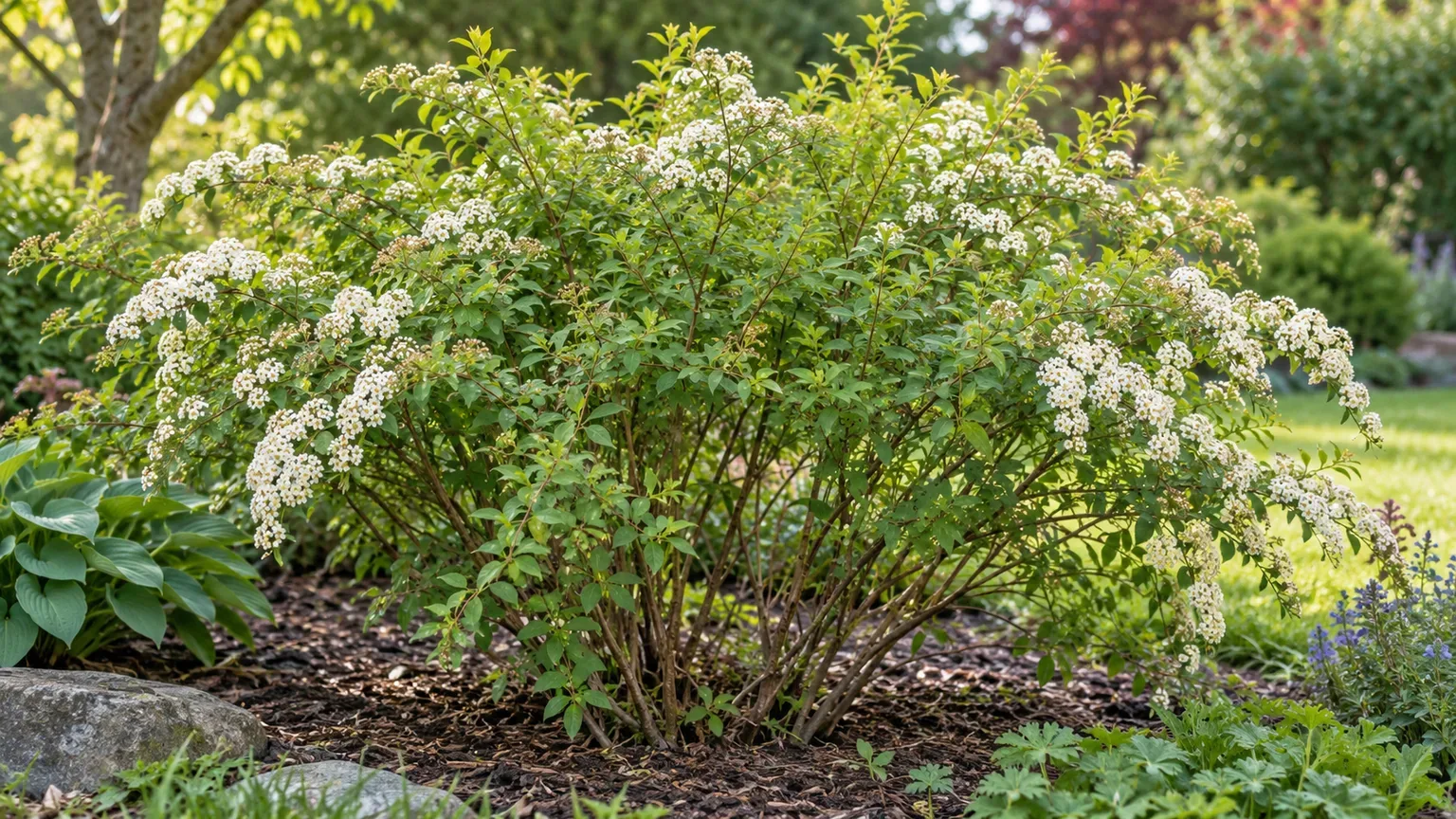
A useful visual test is whether the shrub has several distinct stems of different ages emerging from the base. Look for the oldest canes: they are often thicker, darker, more branched, less productive, or crowded across the center. Do not assume that every old-looking stem is useless; some shrubs flower on older wood, and a healthy mature stem may still be part of the plant’s best framework.
Your goal determines the cut. To remove rubbing branches, make a few selective thinning cuts. To reduce height, shorten selected long stems to a strong side branch or bud. To restore a cane shrub that has become woody and crowded, remove some of its oldest canes at the base. The one-third rule belongs mainly to that last, gradual renewal plan.
Decide which stems belong in the one-third
Inspect the shrub from the outside and then look into the center. First remove dead, broken, crossing, or diseased branches; they do not need to be counted as healthy renewal stems. Then choose the oldest unproductive canes, especially those that crowd the center or block light and airflow, while preserving a balanced spread of vigorous younger stems.
Make the first pass slowly. Mark the stems you are considering with a loose piece of garden twine, step back, and check whether the remaining framework still looks evenly distributed. This pause matters because a third of the stems on one side may be far more than a third of the shrub’s useful structure. Do not select only the tallest shoots or cut a straight line across the top.
A removal cut takes a whole cane back to its point of origin, usually close to ground level for a cane-forming shrub. Avoid leaving a long stub, but do not dig the blade into the crown or scrape the soil. When reducing a branch rather than removing it, cut back to a healthy side branch or a bud that points toward the space you want new growth to fill.
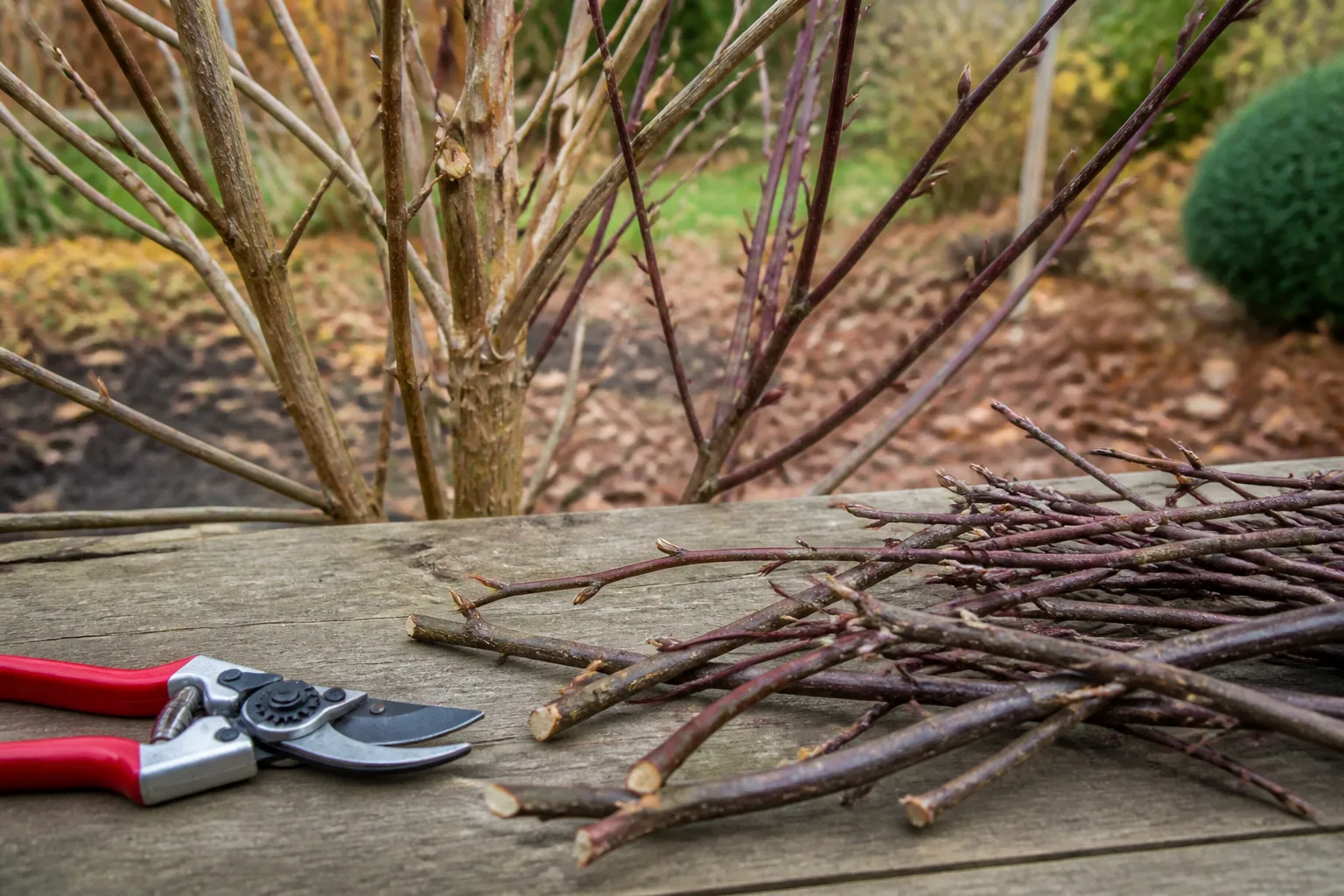
A useful distinction: remove old stems with thinning cuts; use heading cuts only on selected younger growth that needs shortening. Rutgers describes the one-third rule for flowering shrubs as a combination of removing some oldest stems and selectively shortening some newer canes. That does not mean every gardener should apply both cuts to every shrub in the same year. Choose the operation that serves your goal and species.
Time pruning around flower buds, not the calendar
Timing depends on where the shrub forms its flower buds. A rule that is safe for a summer-flowering shrub can erase the coming bloom on a spring-flowering one. Late winter and early spring are common windows for dormant structural pruning, but “before spring growth” is not a safe instruction for every flowering shrub.
Spring-flowering shrubs: prune after the show
Many spring-flowering shrubs form next year’s buds on growth made during the previous season. Lilac, forsythia, weigela, mock orange, flowering quince, and many early-blooming viburnums are examples. If you prune them hard in late winter, you may remove buds that were already set and end up with fewer flowers.
For these shrubs, wait until the flowering display fades, then prune promptly if renewal or shaping is needed. Penn State Extension and Rutgers both recommend pruning spring bloomers after flowering; Colorado State notes that fall or winter cuts can remove the wood carrying the next spring’s buds. You do not need to prune simply because flowers have finished. If the plant is young or well-shaped, enjoy the flowers and skip the saw.
Lilacs illustrate why the timing window matters. Gardening Know How, in a practical lilac guide by Nikki Tilley, describes removing older stems gradually and pruning after flowering so that the new growth has time to develop. If you wait until late summer or fall, you may remove developing buds or stimulate tender growth before winter; if you prune before bloom, you can lose that season’s flowers.
Summer-flowering shrubs: prune before growth begins
Many shrubs that flower later in summer bloom on new growth produced during the current season. Some blue mist spireas, potentillas, and panicle or smooth hydrangeas fall into this broad pattern, though hydrangea species and cultivars differ. These plants are often pruned in late winter or early spring, before active growth, so new shoots can develop and flower that season.
Do not classify a shrub by common name alone if the bloom timing matters. Hydrangeas are a frequent source of confusion: bigleaf and oakleaf types often carry flower buds on older wood, while smooth and panicle types typically flower on new wood. If you are unsure which hydrangea you have, make only necessary cleanup cuts until you identify it, or consult a reliable local guide.
Major pruning in late summer or fall can be risky in cold regions because it may prompt growth that does not harden before winter. It can also remove buds on old-wood bloomers. Dead, broken, or diseased branches are a different matter and can be removed when needed; for disease, disinfect tools between affected cuts and avoid spreading contaminated material.
Use renewal pruning as a measured rotation
For a healthy, established, cane-forming shrub, the simplest renewal plan is to remove a portion of the oldest stems each season over several years. Begin with no more than about one-third, then pause and assess the response. In the following season, remove another share of the oldest canes only if the shrub remains vigorous and still benefits from renewal. By the third season, you will have gradually replaced much of the old framework without removing every stem at once.
This is a flexible rotation, not a standing requirement to prune one-third every year forever. If the shrub has regained a balanced shape and produces healthy canes, reduce the pruning frequency. Some species benefit from regular removal of old canes; others need only occasional thinning. Colorado State Extension notes that annual thinning does not suit every shrub, including twiggy spireas for which the method is less effective.
Expect a trade-off with spring bloomers: removing older stems may reduce some flowers, particularly if you remove many flowering canes or cut at the wrong time. Renewal can improve access to light and encourage younger growth over time, but it does not guarantee a bigger display the following year. Penn State’s guidance is to remove no more than a third of the largest stems; use fewer cuts when the shrub is small, stressed, or slow-growing.
A 12-cane example
Imagine a lilac with 12 healthy basal canes, of which three are thick, old, and crowded in the center. After flowering, you could remove those three at ground level. That is one-quarter of its canes, not exactly one-third, and it may be enough to open the plant without changing its outline dramatically.
If four of the 12 canes are clearly the oldest and the shrub is vigorous, removing up to four would reach one-third. But the arithmetic is a check, not the decision. If all four sit on one side, or if the remaining canes are weak, remove fewer and revisit the plant next season. Do not count a small side twig as a cane or count every branch tip as a separate stem; count the main stems emerging from the base that form the shrub’s framework.
The same arithmetic does not translate to a shrub with three main trunks. Removing one trunk is a major structural change even though it is “only one-third.” In that case, look up the species-specific method before cutting, or ask a qualified professional if the plant is large or close to a structure.
Make clean cuts without turning the shrub into a box
Use sharp bypass pruners for small stems, loppers for thicker canes that fit within their rated capacity, and a pruning saw for larger wood. Cut within the tool’s size limit instead of twisting or crushing a branch. Wear eye protection when working near stiff or thorny stems, and keep the branch stable so it does not split as it falls.
For a cane removed at the base, cut close to where it emerges without gouging the crown. For a branch shortened to a bud, Rutgers recommends a cut just above the bud, angled away from it. For a thinning cut, remove the branch back to its origin or a suitable side branch; do not leave an awkward long stub and do not cut flush into the trunk or main stem.
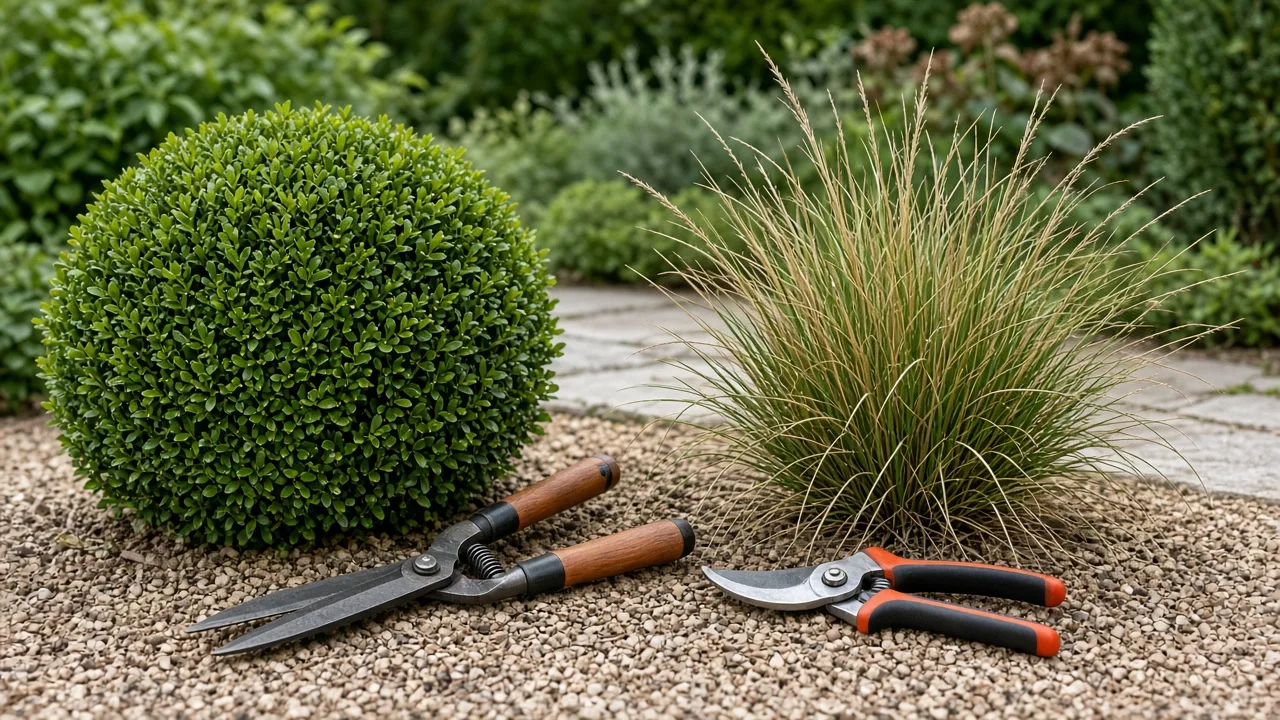
Work around the shrub rather than shearing its surface into a rounded shell. Repeated shearing can leave a dense outer layer that shades the interior, while the oldest branches inside become bare and woody. If you maintain a formal hedge, shape it slightly wider at the base than the top so sunlight can reach the lower foliage. A hedge’s maintenance cuts are a different job from renewing a flowering specimen shrub.
A clean tool is important, especially when you find disease. Rutgers advises disinfecting tools between cuts on diseased wood. For ordinary healthy stems, keep blades sharp and clean, then clean them before moving to a plant with suspected disease. Do not apply pruning paint to routine cuts; the shrub will form its own protective tissue.
When the one-third rule is the wrong tool
Skip major pruning when the shrub is newly planted, visibly stressed, declining, or already the size and shape you want. Also pause when you cannot identify the species or its flowering habit. A small amount of deadwood removal can be sensible, but an arbitrary one-third cut does not solve a problem caused by poor drainage, unsuitable light, root loss, or a plant that outgrew its site.
For a badly overgrown but vigorous multi-stem shrub, rejuvenation pruning may be an alternative. This more drastic method cuts all stems back close to the ground or to short stubs, usually while the plant is dormant. It can temporarily remove most or all flowers, and only certain shrubs tolerate it well. Colorado State Extension and Rutgers list a range of responsive cane-forming shrubs, including forsythia, lilac, spirea, and weigela, but they also caution against using it indiscriminately.
Do not rejuvenate a grafted lilac by cutting it to the ground unless you know the rootstock will produce the cultivar you want; shoots from below a graft may not match the named plant. Avoid a ground-level reset on a shrub with a few permanent trunks, an evergreen that will not sprout from bare old wood, a very weak plant, or a specimen with extensive dead stems. If an old shrub is hollow, mostly dead, or repeatedly sheared into a woody shell, replacement may be more reliable than trying to force new growth.
The one-third rule is also not a way to keep an oversized shrub permanently small. If the mature plant is too large for the site, repeated hard cuts can produce an unattractive cycle of vigorous shoots and more cutting. Colorado State Extension recommends considering a smaller cultivar or different species when pruning cannot make the plant fit the space.
Aftercare: what to watch for this season
After pruning, clear away cut stems so you can see what remains and avoid leaving diseased debris beneath the shrub. Water according to the plant’s needs and local rainfall; do not compensate for pruning by soaking a plant that already sits in wet soil. A healthy, established shrub generally needs normal care rather than a heavy dose of fertilizer intended to force quick regrowth.
Watch where the new shoots emerge. A good renewal response should add healthy growth in the opened area and maintain a balanced outline, though the amount and speed vary by species and weather. If the shrub produces many thin, weak shoots, do not immediately remove more wood; review light, water, root competition, and whether the pruning was too severe for that plant.
Keep a short note or photograph of which canes you removed. The record helps you avoid taking the same side of the plant each year and makes the next decision easier. If the shrub is due for another round, reassess it next dormant season or after flowering, according to its bloom habit; if it looks balanced, leave it alone.
Common mistakes that leave shrubs thinner or bloomless
The first mistake is treating one-third as a yearly obligation. Pruning is a tool, not a ritual. Repeatedly removing healthy wood can reduce flowers, expose the interior, and create more work than the shrub needs.
The second is confusing the height of the shrub with the number of stems. Cutting every branch tip by one-third is not the same as removing one-third of the oldest canes from the base. Use thinning cuts for renewal and selective heading cuts for a specific branch that needs shortening.
The third is pruning all flowering shrubs in late winter. That timing suits many new-wood bloomers, but spring bloomers often carry buds on the previous year’s growth. Identify the flower cycle before making a large cut, and use the plant’s scientific name or a trusted local extension reference when a common name covers several species.
Finally, do not shear a natural-form shrub because the top looks uneven, remove a third of the plant after transplanting, or rejuvenate a shrub just because it is old. A smaller cut at the right time is often safer and more effective than a dramatic cut made to satisfy a percentage.
Conclusion
Use the one-third rule as a cautious framework for renewing a vigorous, established shrub with multiple canes: remove no more than about one-third of its oldest stems at the base, then give it time to respond. Do not automatically shorten every branch or prune every shrub annually. The right amount depends on the plant’s structure and condition, while the right time depends on when it forms flower buds.
Before cutting, name the goal, identify the shrub, and choose the stems that solve the problem with the fewest cuts. For spring bloomers, prune after flowering; for many summer bloomers, prune before new growth begins. If the shrub is young, stressed, single-trunked, or too large for its location, pause and choose a species-specific approach. A measured plan produces a more natural shrub and protects the flowers you planted it for.