Rust Fungus on Plants: Identification and Control Guide
Identify rust fungus by its colored leaf pustules, separate it from lookalikes, and use careful cleanup and prevention steps tailored to your plant and season.
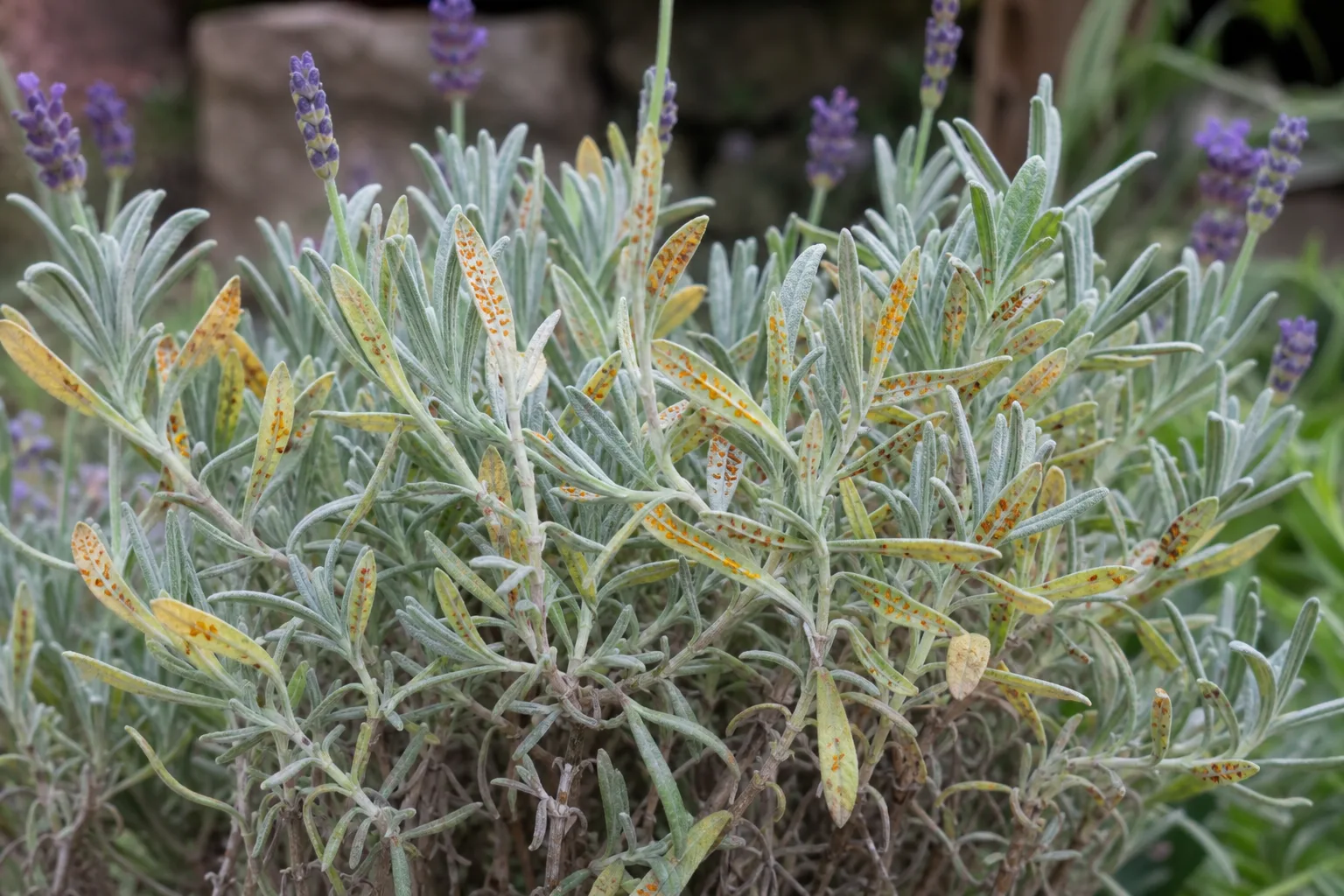
Rust fungus is easiest to recognize by checking the leaf, not by judging the color from across the garden. Look for small, raised, powdery pustules—often orange, yellow, brown, reddish, purple, black, or occasionally white—especially on the underside of a leaf. The upper surface may show pale or yellow spots in the same places. That pattern is a useful clue, but it is not enough to identify the exact rust species or choose a treatment.
Rust diseases are a large group of fungi that affect many unrelated garden plants. Some infections remain mainly cosmetic; others weaken a plant through repeated leaf loss, and a few rusts on woody plants can cause more serious stem damage. The best response is proportional: confirm the pattern, reduce the chance of new infection, remove only foliage the plant can spare, and use a fungicide only when a product is labeled for the particular host and disease.
How to Recognize Rust on Leaves and Stems
A typical rust infection starts as a pale, yellow, or discolored spot on a leaf. As the disease develops, one or more spore-producing pustules form, usually on the lower surface. They may look like dust, tiny blisters, or short colored streaks; on a heavily affected leaf, separate spots can merge, then the leaf may yellow, curl, dry, and drop. Pustules can also develop on leaf stalks, stems, or, less often, flowers and fruit. The Royal Horticultural Society describes rust symptoms across many types of garden plants, with color and location varying by rust and host (RHS rust diseases).
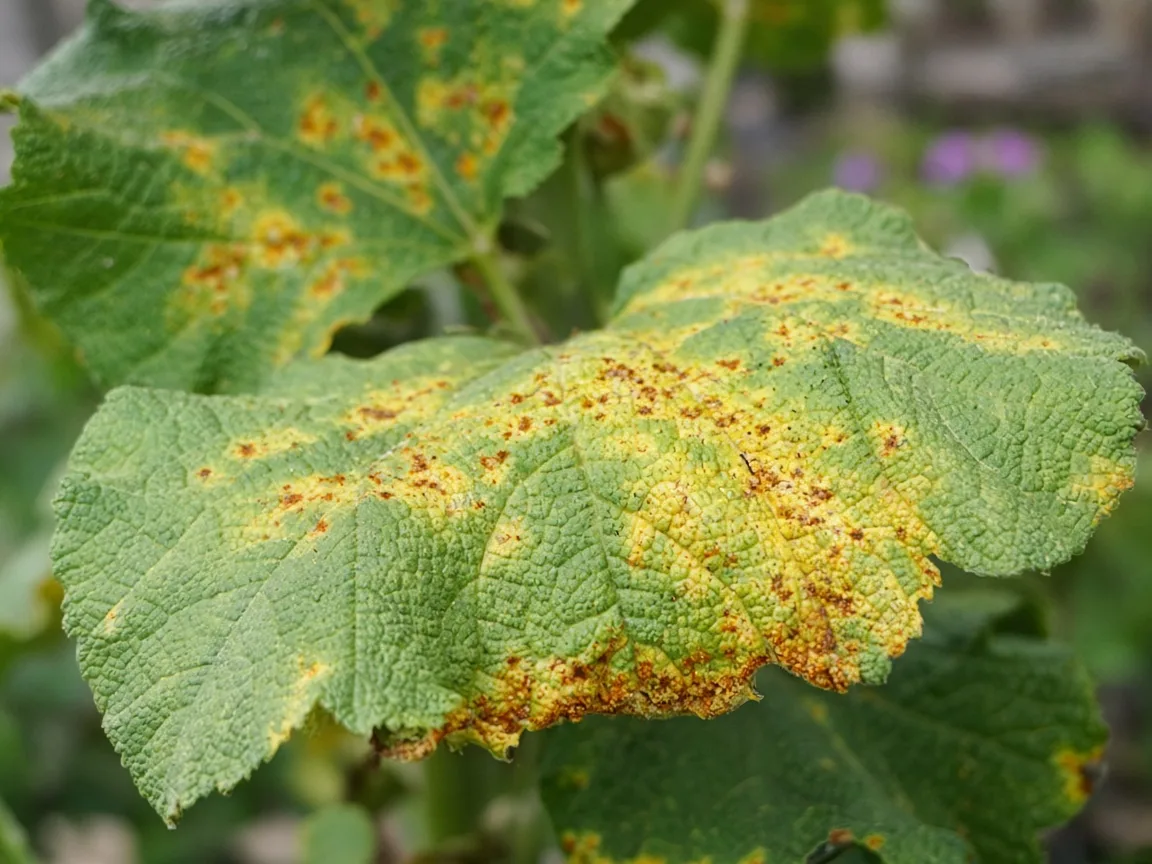
Rust pustules often stand out more clearly on the underside of a leaf than from above.
Check the Underside Before You Treat
Turn over several affected leaves and compare the top and bottom. Use a hand lens or your phone’s close-up camera if the marks are small. A genuine rust lesion often has a powdery or slightly raised center on one surface, with a corresponding pale or yellow area on the other. A clean white tissue lightly dabbed near a pustule may pick up colored spores, but this is only a clue: dirt and other surface material can transfer too, and a negative wipe does not rule rust out.
Check more than one leaf and more than one part of the plant. Rust may appear first on older or lower foliage, but that is not universal. Also inspect nearby plants from the same genus or family if they share similar symptoms. Do not assume every colored spot is rust simply because a neighbor has it; many rust fungi have narrow host ranges, and several different species can appear in the same garden.
Rust vs. Other Leaf Spots: A Quick Decision Check
Rust tends to produce visible, powdery pustules. Many other leaf diseases create flat, dry, or water-soaked spots without a mass of spores that rubs off. Insect feeding can create stippling, holes, or distortion; scale insects may look like fixed bumps, but they do not produce the characteristic powdery spore beds. Mineral residue, dried spray, and dust may sit on the surface but usually do not align with a matching spot inside the leaf tissue.
Look at the pattern, not just the color. Do the raised dots sit below corresponding yellow spots? Are they clustered in small groups, and do they recur on the same type of plant? Those observations increase suspicion of rust. If the lesions have dark concentric rings, water-soaked margins, a bacterial ooze, or rapid collapse of shoots, the problem may be something else. Take a clear photo of both leaf surfaces and note which plant is affected before applying anything; fungicides will not correct nutrient problems, bacterial disease, or insect damage.
What Rust Needs to Infect a Plant
Rust spores move through the air and can also be carried by splashing water. Infection generally needs moisture on the leaf surface, though the length of time and temperature required differ among rusts and hosts. UC Integrated Pest Management notes that some rust spores can germinate and infect after relatively short periods of leaf wetness; heavy dew may be enough (UC IPM: Rust in ornamental crops). A rainy stretch, dense planting, persistent dew, or evening overhead irrigation can therefore create repeated opportunities for infection.
The important distinction is that wet foliage helps spores begin an infection; once a leaf is infected, keeping it dry will not make the pustules disappear. The infected tissue will remain damaged, and new spores may continue to form. Drying foliage faster and reducing splash are preventive measures for new leaves and nearby plants, not a cure for every leaf that already has spots.
Do not respond by withholding root-zone water. Rust needs moisture on leaves for infection, but the plant still needs enough water at the roots; drought stress can weaken it and does not sterilize the foliage. Adjust irrigation to the crop and soil, then change delivery or timing so leaves dry sooner. In a rainy spell, adding less water may be appropriate if the soil remains moist; in a hot, dry spell, keep roots supplied while avoiding frequent evening sprays across the canopy. Check soil moisture near roots rather than reading a rusty leaf as a sign of underwatering.
Why Rust on One Plant May Not Threaten Every Neighbor
“Rust fungus” is a common name for many related fungi, not one generalist that attacks every green leaf it encounters. The RHS explains that rust fungi often have limited host ranges: rust on hollyhock is not the same species as rust on antirrhinum, and some rusts need two different host plants to complete their life cycle. European pear rust, for example, alternates between pear and juniper (RHS rust biology).
This changes how you scout and manage. If rust appears on hollyhocks, look closely at other hollyhocks and related mallows rather than treating the entire garden as equally vulnerable. Gardening Know How’s hollyhock-specific overview also describes rust concentrated on Alcea and related mallow hosts (Hollyhock rust). For an unfamiliar infection, avoid removing a nearby alternate host based only on a general article: identifying the rust and its full host cycle may require a plant diagnostic service.
First Response: Keep Spores From Moving
Start on a dry day, when spores are less likely to be dislodged by wet leaves and splashing. Photograph the symptoms before pruning, including a close image of the underside and a wider image that shows which parts of the plant are affected. This record helps you see whether the problem is spreading and gives an extension diagnostician more context if you need help.
If just a few leaves are affected and the plant has a healthy canopy, remove those leaves carefully. If a large share of the foliage is spotted, first weigh the plant’s need for its leaves against the value of reducing visible spore-producing tissue. Removing half the canopy to make the plant look clean can weaken it more than a manageable rust infection.
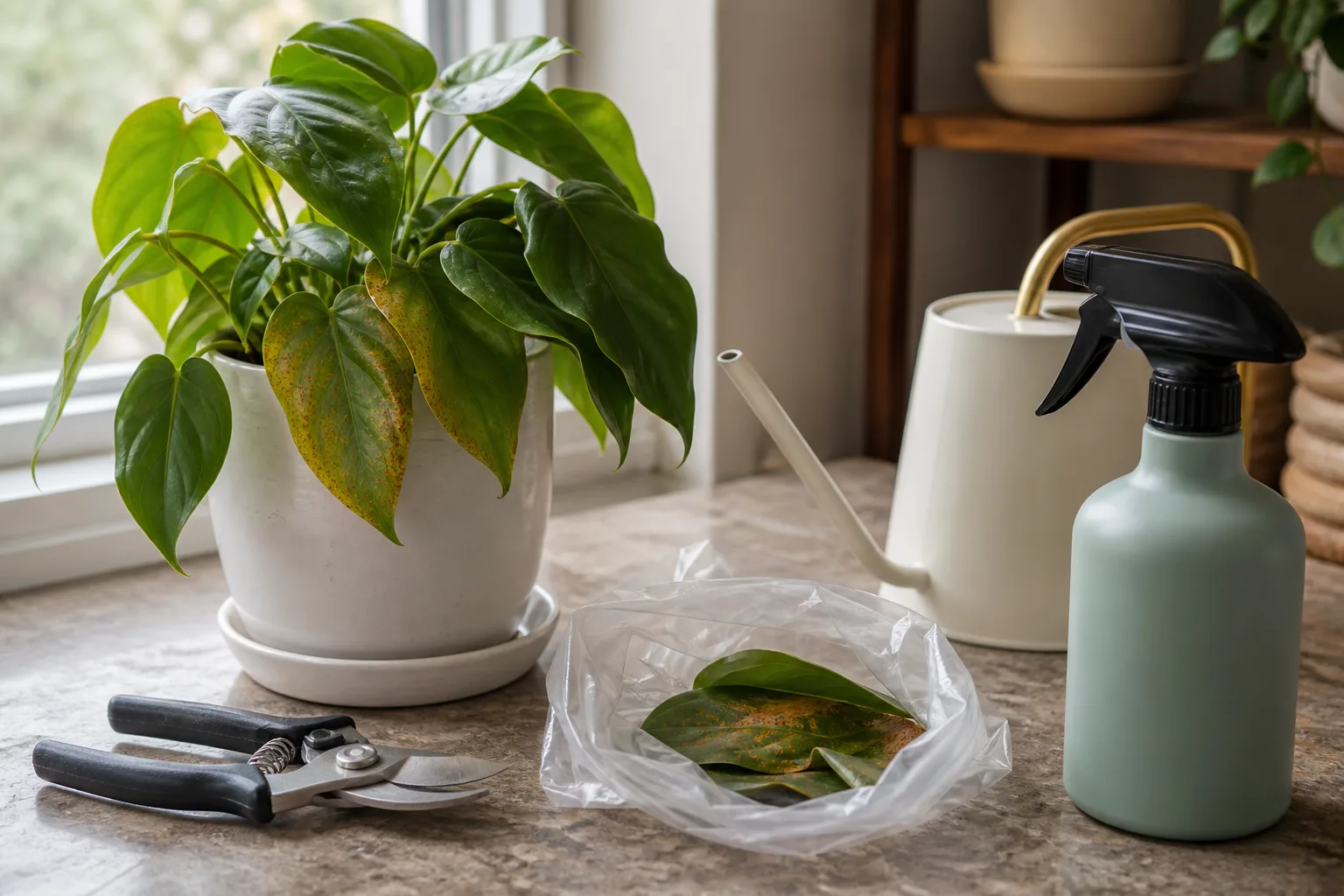
Selective removal is most useful when only a small number of leaves are involved.
Remove Only the Leaves You Can Spare
Use clean, sharp pruners and cut the leaf stalk without tearing healthy tissue. Put removed material directly into a bag or container instead of carrying it loosely through the bed. Avoid shaking, brushing, or stacking diseased leaves on top of healthy foliage, because that can scatter spores. If you find only one or two affected leaves, selective removal may slow local spread; it cannot guarantee that the infection is gone.
When infection is extensive, repeated defoliation is usually a poor trade. The RHS warns that removing many leaves can do more harm than good, while UC IPM recommends sanitation as one part of an overall management plan (RHS rust control; UC IPM rust management). Leave enough sound foliage for the plant to photosynthesize. If the plant is nearly bare, or the same annual repeatedly collapses from rust, removing the whole plant may be more sensible than cutting it down in stages.
Clean Tools and Dispose of Infected Debris Carefully
After pruning, brush visible plant debris from the blades and clean tools before moving to another susceptible plant. Follow the cleaner’s directions, including any contact time, rather than relying on a quick wipe that may leave residue. Wash hands or gloves if they touched pustules, and avoid working through the bed while leaves are damp.
Do not put severely infected leaves into an ordinary cool compost pile and assume the spores will be killed. Home piles vary in temperature and may not heat every scrap evenly. Some rust spores are short-lived, while other rusts produce resilient overwintering stages; the RHS says seasonal timing matters and advises a more cautious disposal route for late-season infected material (RHS rust diseases). For a small home garden, bagging heavily diseased or late-season debris for municipal disposal is a conservative choice; follow local yard-waste rules. A managed municipal compost facility may accept diseased foliage because its process differs from a backyard pile, but check its policy rather than guessing.
Water, Spacing, and Airflow That Reduce Risk
Water the soil, not the leaves, when practical. Drip irrigation and soaker hoses keep water near the root zone; if overhead watering is the only option, water early enough for foliage to dry before night. The University of California IPM and Gardener’s Supply both advise limiting prolonged leaf wetness and using ground-level irrigation where possible (UC IPM: Home and landscape rusts; Gardener’s Supply: Rust).
Give mature plants the space their tags or reliable local guidance recommend. Airflow helps leaves dry, but it does not compensate for a site that stays shaded and damp all day. Avoid crowding seedlings together, and thin or divide plants when an overgrown clump stays wet inside after rain. Mulch can reduce soil splash, but keep it from touching stems and do not pile it over the crown. These changes lower risk; they cannot guarantee that spores carried in by wind will never land on the plant.
Keep the plant growing steadily without pushing it into soft, overly lush growth. Excess nitrogen can encourage tender growth that is more easily colonized by some rusts, so avoid fertilizing in response to every yellow leaf. First check the plant’s normal feeding needs and correct only a demonstrated deficiency. A soil test is more useful than guessing when a nutrient problem is plausible.
Choose Resistant Cultivars, Not Generic “Rust-Proof” Claims
Where rust returns on the same host each year, resistance can be more durable than a recurring spray routine. Check for cultivars specifically described as resistant to the disease affecting your plant, not merely “disease resistant” in general. Resistance is not immunity: it may reduce symptoms or delay disease, and rust populations can change. The RHS notes that resistance in available cultivars can occasionally be overcome by changes in the pathogen.
For hollyhocks, snapdragons, asters, and other ornamentals, ask a local nursery or extension office which cultivars perform reliably in your climate and against the local rust problem. A cultivar praised for one region may not be offered or tested in another. Buy plants with clean foliage, inspect leaf undersides before planting, and keep unfamiliar new plants apart long enough to notice symptoms before they join a dense collection.
When a Fungicide Can Help
Fungicides are most useful when they protect healthy tissue before infection or limit very early disease, not when used to restore a leaf already covered in pustules. UC IPM describes some materials as protectants and others as having both protective and early eradicant activity, but its ornamental-crop guide includes production settings and products that may not be available or appropriate for a home garden. Its own pesticide guidance warns that products and labels change, and some are restricted to licensed applicators (UC IPM ornamental rust guidelines).
For a minor outbreak on a resilient perennial, improving airflow, removing a few affected leaves, and monitoring may be enough. For a valuable plant with a confirmed, recurring rust problem, ask your Cooperative Extension office whether treatment is justified and which options are labeled locally. A spray is unlikely to be worth the cost if symptoms appear late in the season and the plant is otherwise healthy; it may also fail if the disease is misidentified or the product cannot reach the affected canopy.
Match the Product to the Plant, Disease, and Site
Before using any fungicide, verify that the label names the plant or plant group, the disease, and the site where it will be used. A product permitted on a commercial nursery crop may not be labeled for a home flower bed, an edible herb, or a plant kept indoors. Follow the label’s rate, protective equipment, weather limits, repeat interval, pollinator precautions, and disposal directions. Never use a product simply because its active ingredient appeared in a treatment table for another crop.
Coverage and timing matter, but more spray is not better. Do not apply during wind, before rain if the label prohibits it, or when bees are visiting blooming plants unless the label specifically allows that use and all precautions can be met. If the label does not clearly permit the use you need, do not improvise; ask a local extension educator or choose nonchemical management.
Are Neem, Sulfur, Baking Soda, or Homemade Sprays Reliable?
A product’s “natural” label does not prove that it controls every rust or is harmless to plants, pollinators, and soil organisms. University of California IPM notes that neem has some protectant properties against certain rusts, but its disease-specific advice also identifies rusts for which it is not effective. The RHS recommends that gardeners avoid fungicides as a default and notes that homemade mixes are often unregulated and untested. Those recommendations differ in emphasis, but both point to the same practical rule: choose treatment by the confirmed disease and label, not by the product’s reputation.
Do not count on baking soda mixtures as a proven cure for rust, and do not mix household products or oils with a fungicide unless the label explicitly allows it. A homemade spray can injure foliage, and it may leave you with no reliable dose or application instructions. Sulfur and botanical products can also have crop-specific restrictions or weather limits. If you are considering any of these options, read the entire label and get local plant-specific advice first.
Special Cases: Edibles, Lawns, Trees, and Alternate Hosts
For edible plants, the crop and harvest interval matter. Do not apply an ornamental fungicide to vegetables, fruit, herbs, or edible flowers unless the label explicitly includes that crop and gives the required preharvest interval. If rust affects a food crop, ask an extension office about a plant-specific diagnosis and whether resistant varieties or cultural control are a better choice than spraying.
Lawn rust is a separate management problem from rusty spots on a flower leaf. Turf rust may leave orange spores on shoes, but treatment decisions depend on grass species, growth, mowing, weather, and local guidance; do not transfer ornamental-fungicide advice to turf. Tree rust also needs a host-specific diagnosis: some infections are mostly seasonal leaf blemishes, while rusts on woody tissues can produce galls, cankers, or dieback. The RHS describes rusts on a wide range of hosts and cautions that some have two-host life cycles, so indiscriminately removing nearby plants is not a sound first step.
Monitor the Plant and Plan for Next Season
Check the same plant weekly during the weather that has favored rust, looking first at lower leaves and the undersides of newer growth. Note whether new pustules are appearing, whether leaves are dropping, and whether the infection is limited to one species. If no new symptoms appear after a dry spell and sanitation, keep monitoring rather than repeating a spray automatically.
At the end of the growing season, remove fallen foliage if that rust is known to overwinter on debris. Use a resistant cultivar next time where available, and adjust spacing before the clump fills in. If the plant stays healthy despite a few late-season spots, it may need no further treatment. A clean-looking leaf is not the only measure of success; retaining enough healthy foliage for the plant’s normal growth matters too.
When to Ask an Extension Diagnostic Service
Ask for help if the symptoms do not match the typical raised pustule pattern, if several unrelated plants are declining quickly, if stems or woody parts are swollen or cankered, or if rust returns despite reasonable sanitation and watering changes. A diagnosis is especially valuable before applying a pesticide to an edible plant, a high-value specimen, or a plant that may be part of a regulated disease concern.
Send sharp photographs of the upper and lower leaf surfaces, the whole plant, and the planting area. Include the plant’s name if known, when symptoms began, recent weather, watering practices, and any treatments already applied. An extension office may request a physical sample; follow its packaging directions so the sample arrives intact and does not spread spores. A confirmed identification can prevent unnecessary pruning or a treatment aimed at the wrong fungus.
Conclusion
Rust fungus is a recognizable group of diseases, but no single spray or cleanup rule fits every host. Check both sides of the leaf, compare the symptom pattern with a reliable plant-specific source, then remove only the foliage the plant can spare and reduce the wet conditions that favor fresh infection.
Keep debris and tools from carrying spores through the garden, use resistant cultivars where they exist, and treat fungicides as a carefully labeled option rather than a universal cure. If symptoms are severe, unusual, or recurring, a local diagnosis is more useful than guessing at the rust species.