Poison Sumac vs. Staghorn Sumac: Identification Guide
Compare poison sumac and staghorn sumac by berries, leaflets, stems, habitat, and season—plus what to do if you are unsure or may have touched the wrong plant.

Standing beside a tall shrub with compound leaves and colorful fall foliage, it is easy to assume every sumac-looking plant follows the same rules. Poison sumac (Toxicodendron vernix) and staghorn sumac (Rhus typhina) share a family and a general silhouette, but one can trigger a severe urushiol rash and the other is a common native landscape plant with edible red fruit. The mistake that matters is not botanical trivia—it is contact with the wrong plant or a panicked reaction to a harmless colony on a dry roadside.
If you are within arm’s reach of an unknown shrub, stop. Do not break a twig to check fuzziness, do not crush a leaflet to smell sap, and do not assume red fall color means safety. Use several visible traits from a distance, note the habitat under your feet, and treat uncertainty as a reason to back away rather than investigate.
Safety First: Never Touch an Uncertain Sumac
Poison sumac carries urushiol, the same class of oily irritants found in poison ivy (Toxicodendron radicans) and poison oak. The oil can bind to skin within minutes, linger on tools, gloves, shoes, and pet fur, and cause delayed redness, blistering, and swelling. For sensitive people, reactions can be more severe than poison ivy because poison sumac often grows as a larger woody plant with more surface area at face and arm height.
Burning poison sumac is especially dangerous. Smoke and ash can carry urushiol particles, and inhalation can lead to serious respiratory inflammation. Never burn brush piles that may contain unknown wetland shrubs, and do not use chipped material from an unidentified colony as mulch.
A phone photo is safer than a fingertip test. If you need a definitive ID for removal or landscaping, send images to your county extension office, a local botanist, or a qualified arborist. A clear picture of fruit position, leaflet margins, stem texture, and the ground around the plant is more useful than a close-up of a single leaf.
Children and pets deserve the same caution. Dogs running through shrub swamps can carry urushiol on fur, and kids exploring wetland edges may not recognize compound leaves as a warning sign. Teach the simple rule—pale hanging berries in wet ground, do not touch—before trail walks in eastern and midwestern states where poison sumac occurs.
Same Family, Very Different Risk
Both plants belong to Anacardiaceae, the cashew family. That family also includes mango, pistachio, and several rash-causing Toxicodendron species. Botanists moved poison sumac out of the old Rhus genus decades ago, but nursery tags, older field guides, and casual conversation still blur the names.
Poison sumac is a native wetland shrub or small tree, usually 5 to 25 feet tall, with an open crown and smooth gray-brown bark. NC State Extension lists it as having high-severity poison characteristics: all parts contain urushiol, and the plant is best left in the wild rather than introduced to gardens.
Staghorn sumac is also native, but it colonizes drier, disturbed ground—roadsides, railroad embankments, woodland edges, and open slopes. It spreads by seed and root suckers, often forming broad thickets. NC State Extension notes that staghorn sumac is not poisonous, though its aggressive suckering can make it weedy in small yards. The red fruit clusters are used to make a tart, lemonade-like drink after soaking in cool water.
The practical takeaway is simple: family resemblance is not safety. You need species-level traits, not a vague “sumac” label.
Quick Side-by-Side Comparison
Use the table below as a field checklist, not a single-trait shortcut. Several rows must agree before you treat a plant as safe.
| Trait | Poison sumac (Toxicodendron vernix) | Staghorn sumac (Rhus typhina) |
|---|---|---|
| Typical habitat | Swamps, bogs, wet woods, saturated acidic soils | Dry roadsides, field edges, disturbed upland soils |
| Leaf arrangement | Alternate compound leaves | Alternate compound leaves |
| Leaflet count | Usually 7–13 leaflets | Often 9–31 leaflets |
| Leaflet margin | Smooth (entire), no teeth | Toothed or serrated |
| Rachis (leaf stalk) | Often reddish | Hairy, reddish-brown, velvety |
| Fruit color | Pale, gray-white, cream | Bright red to reddish-brown |
| Fruit position | Drooping clusters from leaf axils | Upright terminal cones at branch tips |
| Young stems | Smooth, reddish | Densely fuzzy, like velvet antlers |
| Rash risk | Urushiol in all parts | Not a urushiol plant for most people |
| Garden use | Avoid; leave in wild wetlands | Ornamental colonizer; manage suckers |
If fruit color and habitat disagree—red berries in a swamp, or pale fruit on a dry embankment—assume you are looking at a look-alike or an atypical specimen and seek expert confirmation.
Poison Sumac: How to Recognize It
Poison sumac is rarer in everyday yards than poison ivy, but it is common enough in eastern North America that hikers, wetland restorers, and lakeshore property owners should know it. According to NC State Extension, it is found primarily in coastal plains and wet regions, rarely in piedmont or mountain sections in some states, though range maps vary by county.
Leaves, Leaflets, and the Red Rachis
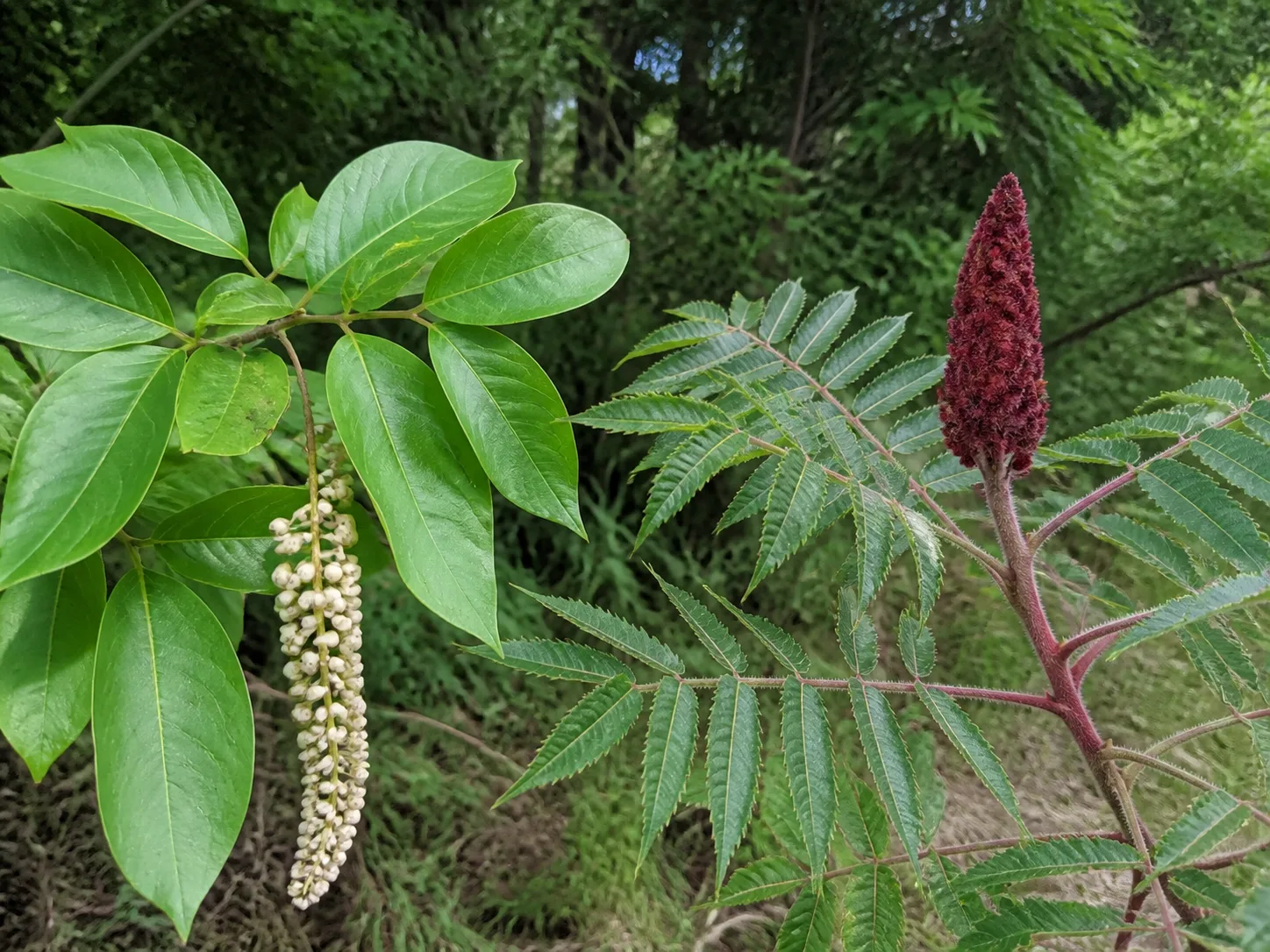
Poison sumac leaves are pinnately compound: a central stalk with paired leaflets running along it. Expect 7 to 13 leaflets with smooth, untoothed margins. The leaflets are elongated and elegant, often described as lacelike compared with the coarser look of staghorn sumac.
A helpful detail extension botanists emphasize is the reddish rachis—the stem connecting the leaflets. That red central stalk can stand out against green leaf tissue, especially in summer. Leaflets are alternate along the rachis, and the whole leaf is alternate on the branch, not opposite like ash.
Fall color can be brilliant orange-red, which is one reason poison sumac surprises people who assume only “safe” plants color up nicely. Fall foliage does not cancel urushiol risk.
Pale Hanging Fruit Clusters
Poison sumac fruit is not a tight red cone. Mature drupes are yellowish-white to gray-white, arranged in loose, drooping clusters that hang beneath the foliage near leaf axils. Individual berries are small and not fused into the dense, fuzzy head you see on staghorn sumac.
Fruit is most visible in late summer and fall. If berries are absent, shift weight to leaflet margins, stem texture, and habitat rather than guessing from leaf shape alone.
Smooth Twigs and Wetland Habit
Young poison sumac twigs are comparatively smooth, without the dense velvet hairs of staghorn sumac. Bark on older stems is smooth and gray-brown with lenticels. The plant often grows with its feet in saturated soil—sphagnum margins, shrub swamps, floodplain backwaters, and acidic bog edges.
Poison sumac can resemble a young white ash (Fraxinus americana) when fruit is absent. Ash, however, has opposite branching and winged samaras instead of drupes. That opposite-vs-alternate leaf arrangement is a reliable tiebreaker when you can see several nodes on a branch.
NC State Extension’s distribution notes list poison sumac across much of the eastern United States and into eastern Canada—from New England and the Great Lakes south to parts of the Gulf Coast and Texas, with strongest association in wet coastal plain and riparian zones. You will not find it on every hiking trail, but you should not assume it is absent simply because you have never reacted to poison ivy before. Sensitivity varies, and poison sumac’s taller growth habit can expose arms, face, and torso more readily than low poison ivy along a path edge.
Staghorn Sumac: How to Recognize It
Staghorn sumac is the shrub many people picture when they hear “sumac” in the Northeast and Midwest: flame-red autumn thickets along highways and dramatic upright fruit heads that persist into winter. It is native from Quebec and Ontario south to Georgia and Iowa, and NC State Extension describes it as particularly common in the western part of North Carolina’s range, though colonies appear widely in eastern North America.
Toothed Leaflets and Fuzzy Stems
Staghorn sumac leaves are also compound, but they typically carry many more leaflets—often 9 to 31—with clearly toothed margins. The central rachis and young branchlets are covered in dense reddish-brown hairs, giving them a velvety texture. That fuzz is the “staghorn” reference: it resembles the velvet on a male deer’s antlers.
Touching those fuzzy stems is generally safe for most people, but you should still confirm identity before handling any wild plant. A staghorn colony on dry ground can sit only a short distance from wetland poison sumac in complex terrain, and tools or boots can track urushiol from one site to another.
Upright Red Berry Cones
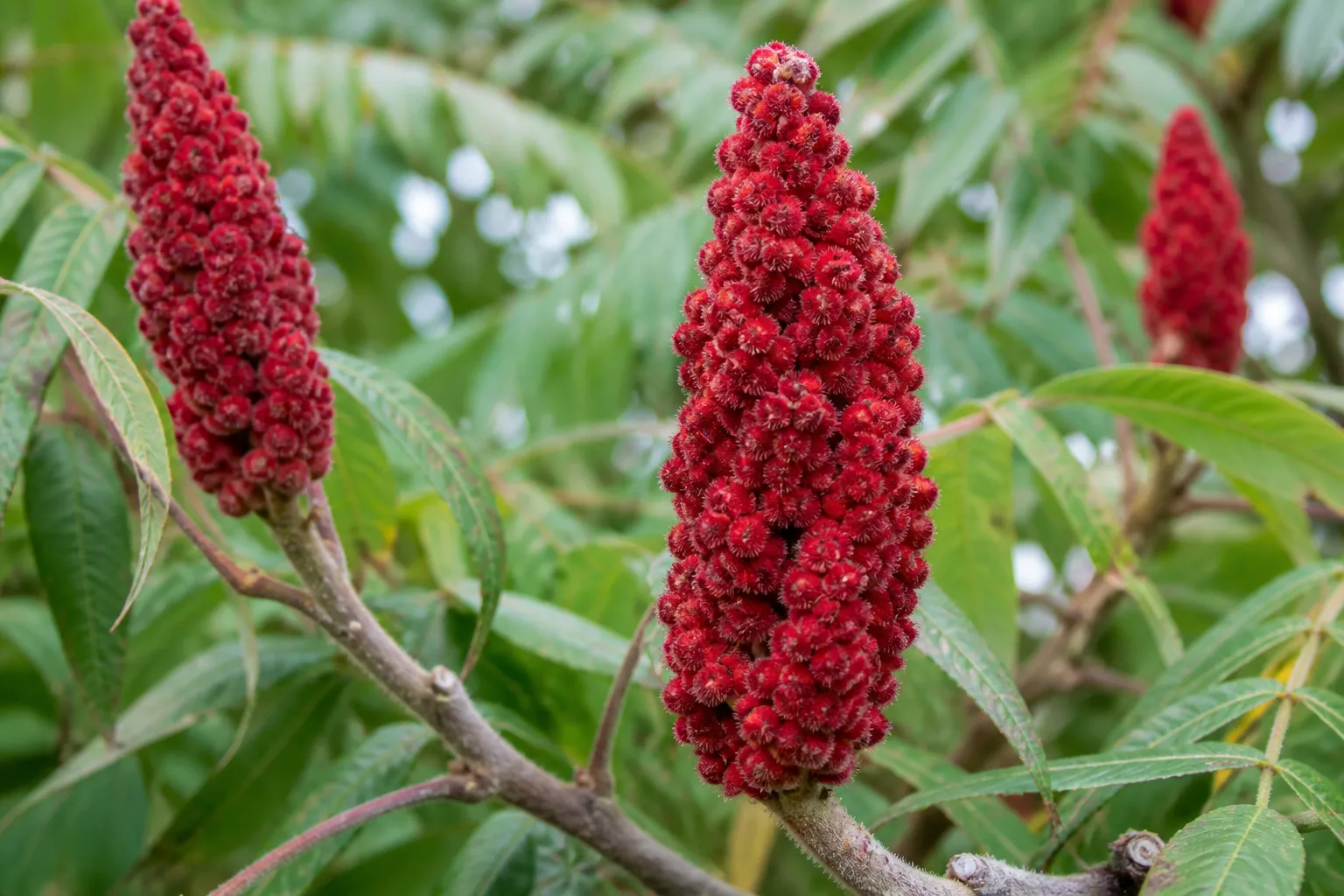
Staghorn sumac produces tight, cone-shaped clusters of red drupes at the tips of branches, standing upright like small torches. The fruit is covered in fine hairs and acid-rich tissue—NC State Extension notes that soaking the heads in water makes a tart drink, though this is a foraging choice only after positive identification and proper preparation, not a beginner assumption.
Greenish-white flower panicles appear in spring and early summer before fruit ripens. Wildlife value is high: songbirds, game birds, and mammals consume the fruit, and native bees visit the flowers.
Dry-Site Colonies and Fall Color
Staghorn sumac thrives in well-drained to dry soils and full sun to part shade. It tolerates drought, compaction, and urban edge conditions better than poison sumac tolerates garden beds. Colonies spread by root suckers; a single plant can become a 15- to 25-foot-wide thicket within a few years.
Fall color is a major landscape feature—scarlet, orange, and yellow on the same thicket. Cultivars such as ‘Tiger Eyes’ offer golden foliage with reduced suckering for managed gardens. For broader context on native sumac species, see the North American sumac guide.
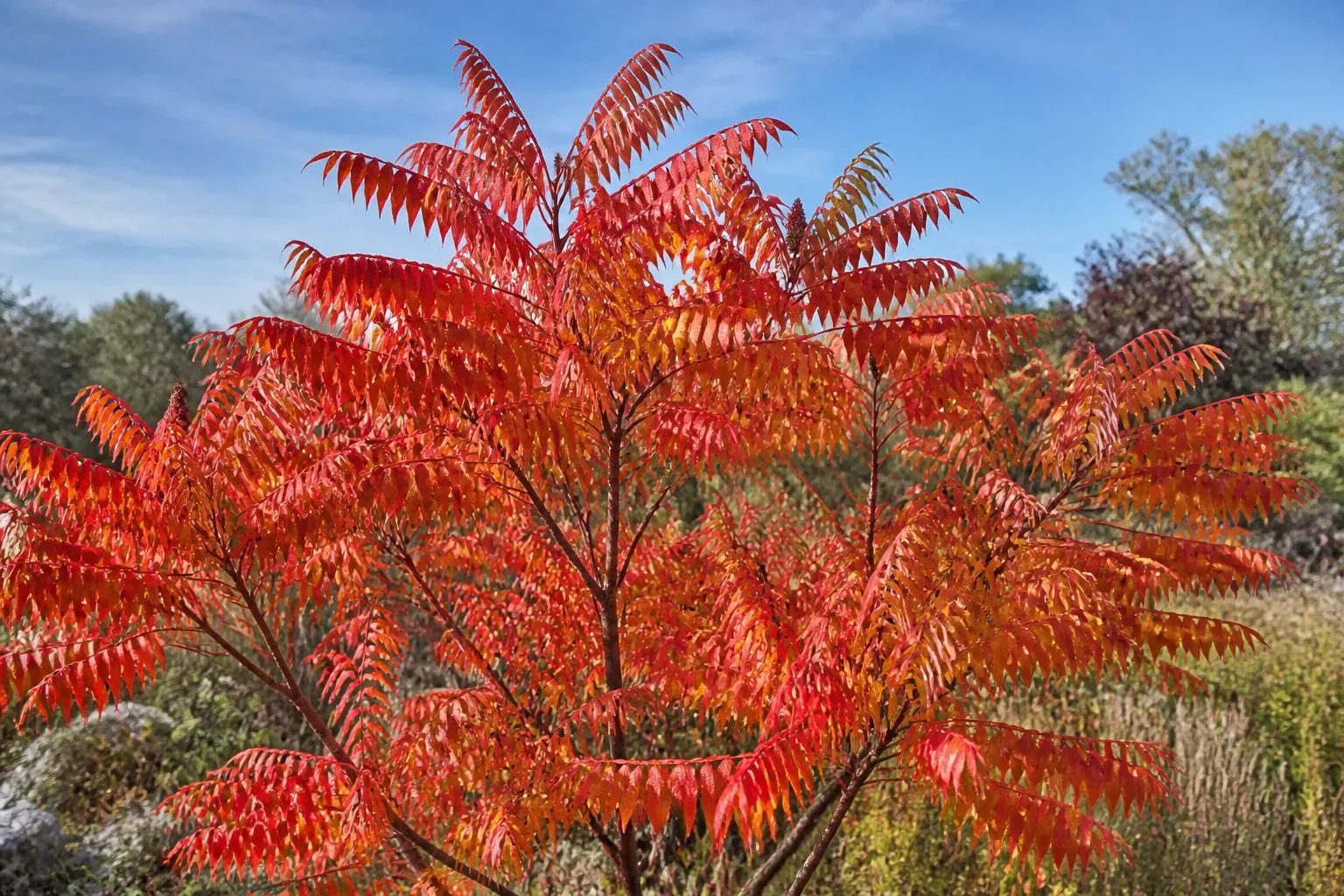
Florists and foragers sometimes use staghorn sumac stems with intact red fruit heads in autumn arrangements. That is reasonable only after positive ID on dry upland ground. Never harvest red cones from a wetland margin “just in case” they are staghorn—fruit position and site context must align. The tart drink made from soaked red drupes—sometimes called sumac-ade—is a traditional use of Rhus fruit, but white or gray berries from any wetland shrub are never candidates for kitchen experiments.
Habitat Is Often Your Fastest Clue
If you can read the ground, habitat narrows the odds quickly. Poison sumac signals wet feet: standing water nearby, sphagnum moss, cattails, buttonbush, willows, or other wetland associates. Staghorn sumac signals dry or disturbed upland: gravel shoulders, fence lines, old fields, sunny slopes, and woodland margins with well-drained soil.
Habitat is not a courtroom proof. Drainage projects, beaver activity, and heavy rain can place plants outside their textbook zone. A red-fruited sumac in a swamp still deserves a careful check of fruit position and leaflet teeth. A smooth-leafed shrub on a dry roadside is not automatically poison sumac—ash, young tree-of-heaven, or damaged foliage can mislead.
Use habitat to decide how cautious to be, not to override visible fruit and leaflet traits. When wetland context and pale drooping fruit align, treat the plant as high risk even if you cannot see every leaflet clearly.
Property owners reviewing a boundary line should map wet vs. dry zones before planning paths, play equipment, or brush clearing. A dry roadside colony of staghorn sumac may be harmless to leave as wildlife cover, while a poison sumac stem leaning over a dock or kayak launch needs professional assessment even if the plant looks small. Drainage changes from new construction can shift moisture patterns over several years, so a shrub that once seemed safely upland may later behave like a wetland species.
Seasonal Identification: Summer Through Winter
Identification difficulty changes through the year. Plan for the season you are actually standing in.
Leafy Season Field Marks
From late spring through early fall, prioritize four traits in this order: fruit position (hanging pale vs. upright red), fruit color, leaflet margin (smooth vs. toothed), and stem texture (smooth vs. velvety). Photograph each trait from a safe distance rather than collecting samples with bare hands.
Summer is the best season for beginners because fruit and foliage overlap. Early spring is harder: flowers on staghorn sumac are showy but greenish, and poison sumac flowers are easy to overlook. If you are clearing land in spring, mark suspicious wetland shrubs and revisit when fruit develops.
Late Fall and Dormant-Season Limits
After leaf drop, staghorn sumac often still shows persistent red fruit heads on bare branches—a useful winter landmark on dry sites. Poison sumac may retain pale fruit clusters too, but they are less conspicuous and the plant is less commonly encountered on casual winter walks unless you frequent swamps.
Winter ID without fruit is a job for experienced eyes or professional help. Smooth twig texture vs. velvety texture is subtle at a distance, and leaf scars can be confusing. Do not approach a leafless wetland shrub for a tactile twig test. Flag the location, take photos, and confirm in summer or hire a qualified remover.
Look-Alikes That Trip People Up
Comparison articles fail when they only discuss two species. Real woods contain more than two shrubs with compound leaves.
Smooth Sumac and Other Safe Red-Berry Sumacs
Smooth sumac (Rhus glabra) is another native red-fruited species with toothed leaflets and upright fruit clusters. Its young stems are smooth rather than velvety, which can make people nervous—but it shares staghorn’s dry habitat preference and red terminal fruit. The sumac species guide covers smooth, fragrant, and other ornamental sumacs in more detail.
The critical split remains red upright fruit on dry ground versus pale drooping fruit in wetlands. Smooth and staghorn sumac are not urushiol hazards for typical skin contact once identified; poison sumac is.
Ash Saplings and Tree of Heaven
Young ash trees are a classic poison-sumac look-alike because both can have smooth-edged leaflets. Check whether leaves and buds are opposite (ash) or alternate (sumac and poison sumac). Ash fruit is a winged samara, not a berry cluster.
Tree of heaven (Ailanthus altissima) is often confused with staghorn sumac because of large compound leaves and roadside habit. Tree of heaven has malodorous crushed foliage, glandular notches at the leaflet base, and winged seeds—not red drupe cones. It is invasive rather than toxic in the urushiol sense, but it is still a plant you do not want to misidentify as a native sumac in restoration work.
What to Do If You May Have Touched Poison Sumac
Speed matters, but panic spreads oil. Remove contaminated clothing carefully, avoiding contact with the outer surface against bare skin. Wash exposed skin with plenty of soap and cool-to-lukewarm water; hot water can open pores and is not recommended in first-aid guidance for urushiol exposure. Clean under fingernails and wipe phones, tools, and glasses that may have been handled with contaminated hands.
Launder clothing separately from other laundry. Wear disposable gloves while handling tools or shoes, then discard the gloves. Pets that ran through brush should be bathed with gloves; urushiol on fur is a common secondary exposure route.
Seek medical care for widespread rash, facial or genital involvement, eye contact, difficulty breathing, or symptoms after possible smoke exposure. Poison Control (1-800-222-1222 in the United States) can provide situation-specific guidance. CDC NIOSH also warns outdoor workers that sensitization can increase with repeated exposure—past tolerance does not guarantee future immunity.
Over-the-counter topical treatments may ease mild poison-ivy-type rashes after the fact, but they do not replace washing off urushiol promptly. If blisters develop, avoid puncturing them; broken skin increases infection risk. Document when and where exposure likely occurred so a clinician can distinguish urushiol dermatitis from insect bites, impetigo, or other skin conditions if the rash pattern is unusual.
Removal, Landscaping, and When to Call a Pro
Staghorn sumac in the wrong bed is a suckering problem, not a toxic emergency. Manage it with root barriers, regular mowing of suckers, or renovation cutting in late winter followed by selective shoot removal. It can be used as dramatic cut greenery in fall arrangements once you are certain of the ID.
Poison sumac removal is a different category. Small, confidently identified plants sometimes can be handled by homeowners using long sleeves, pants, eye protection, disposable gloves, and labeled herbicides applied per the product label—but pulling and dragging stems by hand spreads sap and contaminated debris. Large colonies, plants intertwined with desirable wetland species, specimens near structures or utilities, and any ID uncertainty belong with an experienced professional.
Never chip poison sumac for mulch, never compost it casually, and never burn it. Bag and dispose of material according to local yard-waste rules; some municipalities treat toxic brush separately. If chemical control is used, expect resprouts from roots and plan follow-up treatments rather than assuming one cut solves the colony.
For property lines bordering swamps, the safest landscaping strategy is buffer and awareness: keep play areas and paths on upland ground, teach household members the pale-fruit/wetland combination, and photograph boundary shrubs seasonally so you recognize changes after storms.
Glyphosate or triclopyr products labeled for woody brush control may be appropriate on some sites, but wetland buffers often have legal restrictions on herbicide use near open water. Read the entire label, including aquatic-setback language, before treating any shrub whose roots may sit in saturated soil. Mechanical cutting without chemical follow-up frequently produces dense resprouting on both poison sumac and staghorn sumac, so plan for repeat visits rather than a single afternoon project.
Conclusion
Poison sumac and staghorn sumac are not two color variants of the same plant. Poison sumac pairs smooth leaflets, pale drooping fruit, smooth twigs, and wetland habitat with serious urushiol risk. Staghorn sumac pairs toothed leaflets, upright red fruit cones, velvety young stems, and dry disturbed habitat with ornamental and wildlife value for most gardeners.
The reliable distinction uses several traits together, respects seasonal limits, and stops when you would need to touch the plant to decide. When the stakes are a rash, contaminated tools, or smoke exposure, a cautious retreat and a clear photo beat a confident guess every time.