Philodendron Verrucosum Care: Light, Water, Soil
Learn Philodendron verrucosum care with practical advice on filtered light, watering, humidity, airy soil, climbing support, propagation, and leaf problems.
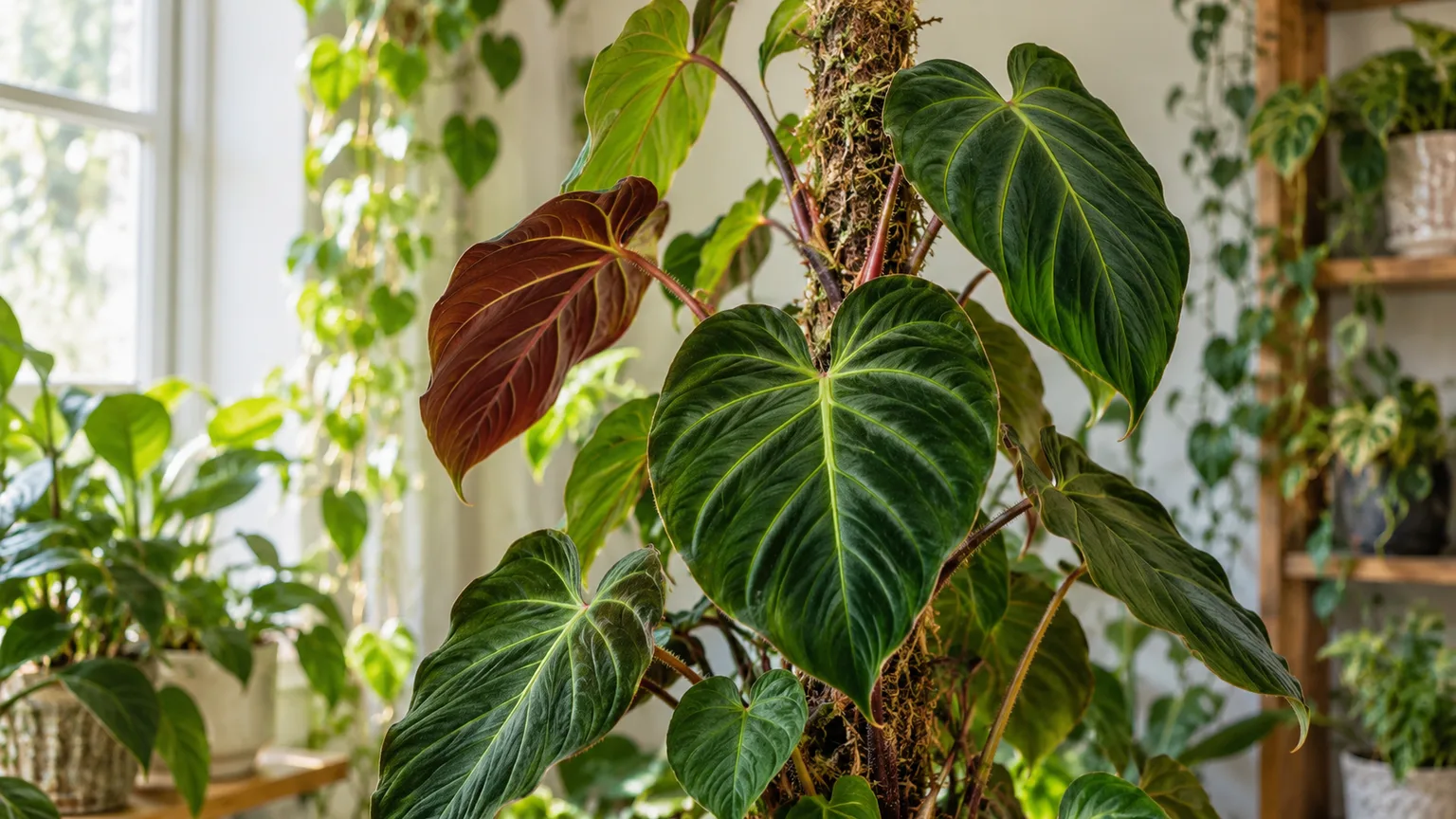
Philodendron verrucosum is a climbing tropical aroid grown for heart-shaped, velvety leaves, bright veins, reddish undersides, and bristly petioles. It is more particular than a common heartleaf philodendron, but it does not need a complicated collection of gadgets. Give it steady warmth, bright filtered light, a root mix that drains while retaining some moisture, and a support it can climb. Then water according to the pot’s condition rather than the calendar.
The name “Ecuador philodendron” can be misleading: Kew records the species from Costa Rica to Peru, including Colombia, Ecuador, and Panama, and describes it as a climber in a wet tropical biome. That natural history explains why a cool, dry room and a dense, soggy pot often produce trouble. It does not mean the plant needs a permanently wet substrate or a sealed terrarium. The aim indoors is steady moisture around oxygenated roots, with humidity and airflow kept in balance. Kew’s Plants of the World Online recognizes P. verrucosum as an accepted species and documents its range and climbing habit.
Quick care profile
| Need | Practical starting point |
|---|---|
| Light | Bright, indirect light; soften hot direct sun |
| Water | Water thoroughly when the upper layer has begun to dry and the pot feels lighter |
| Mix | Loose, airy, moisture-retentive but fast-draining |
| Humidity | Aim for a moderately humid, stable space; measure at leaf level and keep air moving |
| Temperature | Warm room conditions; avoid cold windows, drafts, and sudden swings |
| Growth habit | Climber; a moss pole or textured plank can support more mature growth |
| Safety | Keep leaves and sap away from pets and children; philodendrons contain irritating calcium oxalate crystals |
These are starting points, not rigid targets. A small plant in a warm bright room dries faster than a large specimen in a cool cabinet. Check what the pot and plant are doing before you change several conditions at once.
Stabilize a new plant before changing its setup
A newly purchased or shipped verrucosum may shed a leaf or pause while it adjusts. That alone does not prove the plant is declining. Moving from a greenhouse or propagation enclosure to a home changes light, temperature, humidity, and airflow at the same time. Give the plant a stable spot, check the pot’s moisture, and inspect leaf undersides and petioles for pests. Keep it away from other plants for a short observation period if its source is unknown.
Avoid immediately repotting, dividing, adding fertilizer, and installing a wet moss pole all in one session. Each intervention makes it harder to tell what is helping. If the mix is not waterlogged and drains, leave the roots alone until the plant settles. If the potting medium is compacted, sour-smelling, or staying wet for many days, prioritize correcting the root problem rather than preserving the acclimation schedule. The goal is not to maintain nursery conditions exactly; it is to make one measured adjustment at a time and watch the next leaf for a response.
Choose bright, filtered light
Place the plant where it receives abundant light without prolonged harsh sun on the leaves. An east-facing window often works well; a brighter south- or west-facing window can also work if a sheer curtain or extra distance softens midday and afternoon sun. A north-facing window may be adequate in a bright room, but growth can slow if the plant sits far from it or is shaded by a building.
Use growth as feedback. Long gaps between leaves, small new blades, and a stem stretching toward the window can indicate insufficient light, though root stress and cool temperatures can also slow growth. Pale, crispy patches on the window-facing surface suggest sun or heat damage; move the plant gradually rather than into a dark corner. Rotate the pot a little every week or two if growth leans strongly in one direction. Wipe dust from the leaves with a soft, barely damp cloth and support the blade with your other hand; velvet can mark when rubbed hard. General philodendron guidance from the Royal Horticultural Society also favors indirect light and warns that direct summer sun can scorch foliage.
Water by checking the root ball
Water when the top layer has started to dry but before the whole root ball becomes bone dry. For a small pot, feel the mix about an inch below the surface; for a larger pot, check deeper with a wooden skewer or judge how much the pot weighs after watering and as it dries. A dry surface does not always mean the center is dry, especially in a large container or a dense mix. Conversely, a moisture-retentive inner core may stay wet while the top looks dry.
When it is time, pour room-temperature water over the mix until it runs freely from the drainage holes. Let the pot drain completely and empty the cachepot or saucer. Do not leave the base standing in water. Avoid repeated tiny sips: they can wet only part of the root ball and leave salts concentrated in the mix. If water races down the pot’s edge, the medium may have shrunk or become hydrophobic; re-wet it slowly in two passes, then let it drain.
A weekly schedule is a poor substitute for checking. Light, pot size, medium, humidity, and seasonal growth all alter drying time. The RHS philodendron guide similarly recommends allowing the compost to dry slightly and avoiding saturated roots. If you use hard tap water and see recurring mineral crust or leaf-edge damage, try rainwater or filtered water when practical, but do not let water quality distract from a consistently soggy mix.
Build an airy mix that still holds moisture
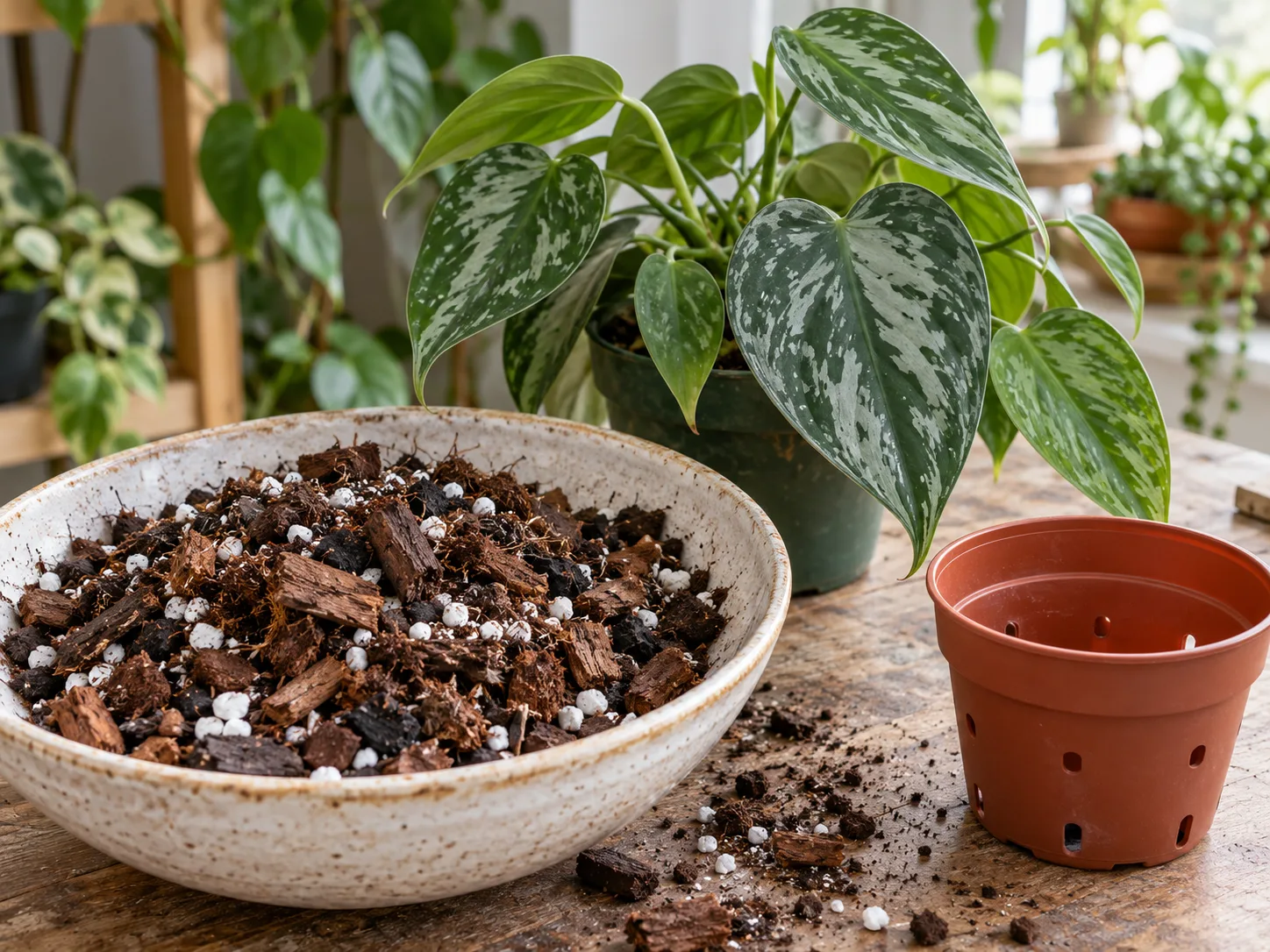
The right mix does two jobs at once: it holds enough water for roots to take up between waterings, and it leaves air spaces so roots are not smothered after watering. A practical starting blend is two parts quality indoor potting mix or coir-based mix, one part fine orchid bark, and one part perlite or pumice. Use ingredients in similar-sized pieces so the pot does not separate into a dense bottom and a coarse top. If the mix dries too quickly in your home, increase the potting-mix fraction slightly; if it remains wet, add more bark or perlite and reduce the container size if necessary.
Do not interpret “chunky” as “mostly dry bark.” In bright, warm, humid conditions, a very open mix may be easy to over-dry; in a cool room, the same blend may stay damp if the pot is large. Avoid a dense garden soil or a pot with no drainage. The RHS guidance suggests a loose, free-draining medium for philodendrons, while specialist plant-care references such as Gardenia’s verrucosum profile also emphasize combining moisture retention with drainage. You do not need a precise pH adjustment for routine houseplant care; stable structure and sensible watering matter more than chasing a number.
Balance humidity with fresh air
Verrucosum’s new leaves often unfurl more cleanly when humidity is steady, but high humidity without air movement can leave foliage wet for too long and encourage problems. If the room is dry, begin by measuring relative humidity near the leaves with a small hygrometer. A humidifier is more predictable than occasional misting; clean it on the schedule in its manual, and place it so leaves do not stay damp or receive a cold, direct plume. A group of plants can modestly buffer humidity, but a pebble tray is not a room humidifier and will not correct very dry air across a whole room.
Many growers find the plant easier to manage when humidity is in the moderate-to-high range, especially while a new leaf is opening. However, there is no single threshold that guarantees success: temperature, airflow, root hydration, and the plant’s acclimation all matter. A plant growing at ordinary home humidity may be healthier than one in a closed cabinet that is constantly wet. In an enclosure, provide gentle circulation and ventilate enough to avoid condensation sitting on the leaves overnight. Avoid routine misting as the main humidity strategy; it raises humidity only briefly and may leave water caught in the leaf texture. PLNTS’ practical verrucosum care notes likewise advise against misting velvet foliage and recommend keeping the mix from staying wet.
A hygrometer reading around 55–65% at leaf level is a reasonable starting band to try if your home air is dry; it is not a scientifically established species threshold. If your plant grows well at lower humidity, do not add equipment just to reach a number. If new leaves repeatedly stick or tear while the roots, light, and temperature are stable, raise humidity modestly and observe the next leaf.
Keep temperatures warm and steady
A comfortable, consistently warm room is usually more useful than pursuing a precise tropical thermostat number. Keep the plant away from cold glass in winter, opening exterior doors, heating vents, and air conditioners that blow directly onto the leaves. Sudden temperature swings can stress roots and new growth even when the average room temperature seems acceptable. If a windowsill becomes cold at night, move the pot a short distance inward rather than compensating with more water or fertilizer.
The RHS advises keeping philodendrons above about 15°C (59°F) and away from cold drafts and radiators. For this species, a warmer range in normal living spaces supports active growth; treat persistent cool conditions as a reason to let the mix dry more slowly and reduce feeding. If you grow it outdoors in a frost-free climate, acclimate it gradually to shaded, protected conditions, and bring it inside before cold nights. A warm tropical origin does not make it frost hardy, and hardiness-zone labels for outdoor planting should not be treated as a guarantee for a potted indoor specimen.
Give the climbing stem a useful support
Philodendron verrucosum is a climber, not a self-clinging wall vine. In nature it uses a trunk or other structure to rise toward better light. Indoors, a moss pole, coir pole, or textured plank gives the stem a vertical route and aerial roots somewhere to grip. A support is optional if you prefer a trailing plant, but a supported vine is more likely to develop the larger, more mature leaves collectors value. It cannot guarantee a particular leaf size; light, root health, plant age, and growing space still matter.
Install a stable support while repotting if possible, so you do not drive it through an established root ball. Place the stem close to the surface and attach the stem loosely with soft plant ties. Tie the stem or node area, never cinch the petiole or leaf stalk. Direct visible aerial roots toward the pole. If using a moss-filled pole, keep it lightly moist rather than waterlogged, and include pole moisture when judging the pot’s watering needs. A dry pole does not automatically mean the potting mix needs water. A plank or coir pole is lower maintenance but may not stay moist enough for roots to anchor. The RHS training guidance notes that climbing philodendrons can be tied to a moss pole and root into it when it remains moist.

Feed during active growth
Feed a plant that is actively making leaves with a balanced liquid houseplant fertilizer, diluted according to its label. A cautious schedule is a light application about once a month during spring and summer when growth is visible. If the plant is not growing because light is low or roots are unhealthy, fertilizer will not solve the problem and may add salts to an already stressed pot. Stop or reduce feeding when growth slows in winter, when light levels drop, or after a recent repot into a fresh nutrient-containing mix.
Once or twice during the active season, water thoroughly enough that some water drains through the pot to help limit salt accumulation. Do not use fertilizer at a stronger concentration to force larger leaves. Brown tips, a crust on the mix, or root damage after repeated feeding can point to excess salts, but similar leaf damage can also come from dry air, irregular watering, or direct sun. Correct the growing conditions first, then resume feeding gently when healthy new growth appears. Fertilizer is maintenance, not a substitute for a functioning root system.
Forms, flowers, and winter expectations
Retailers sometimes attach names such as “Rojo,” “Verde,” or “El Valle” to plants sold as verrucosum. Ask the seller what the name identifies and look at the actual plant rather than assuming a label guarantees a particular leaf size, color, or care need. Treat the species’ basic requirements as your starting point, then adjust only after observing how that specimen grows. A seedling or small cutting may look quite different from a mature climbing plant, and leaf color can change as each blade hardens.
Availability depends on the season, region, and retailer, so “rare” is a moving market label rather than a useful care category. Compared with common heartleaf types, verrucosum is less likely to be stocked everywhere, but the label alone does not tell you whether a particular plant is healthy or worth a premium. Check the newest leaf, stem nodes, roots, and leaf undersides for damage or pests. Growth speed is similarly conditional: warmth, light, a functioning root system, and active climbing all affect how often a new leaf appears. A plant that pauses after shipping or in winter is not automatically dying; compare its newest growth over several weeks before changing the setup.
Like other philodendrons, verrucosum can form an inflorescence with a spathe surrounding a spadix, but indoor plants are grown for their foliage and do not reliably flower in ordinary rooms. NC State Extension notes that philodendron houseplants usually do not flower. Do not increase fertilizer or keep the roots wet in an attempt to trigger blooms. In winter, growth often slows as daylight falls; move the plant away from cold glass and reduce fertilizer, but keep normal room warmth and water when the mix begins to dry. The correct interval may lengthen because the plant is using less water, not because it needs to become bone-dry.
Repot when roots or mix give you a reason
Repot when roots are densely circling the pot, emerging from the drainage holes, or drying unusually fast because little mix remains. A mix that has collapsed into a compact mass, smells sour, or stays wet far longer than it used to also needs attention. Do not repot automatically each year. Some plants fill a small nursery pot quickly; others can remain in the same container for a couple of years. The RHS recommends waiting until roots are densely packed, choosing a pot only a few centimeters wider than the root ball because excess unused mix can stay wet longer.
Use a clean container with open drainage holes, usually one size wider rather than a much larger decorative pot. Ease the root ball out without pulling the vine by its leaves. If roots are firm and pale or tan, loosen only the outer circling roots. Trim roots that are black, mushy, or hollow with clean snips, then replace the old medium with fresh airy mix. Set the plant at the same depth; burying the stem deeply can trap moisture around the petioles. Water once to settle the mix and allow it to drain. Wait until the plant resumes growth before feeding.
Propagate from a stem node
A leaf by itself cannot produce a new climbing philodendron because a viable cutting needs a node, the joint where a leaf and growth point attach to the stem. Choose a healthy section with at least one node and preferably an aerial root. Use sanitized shears and make the cut just below the node so the node remains on the cutting. Keep one leaf if it can be supported without being submerged or pressed against a wet enclosure wall.
You can root the cutting in water or a lightly moist medium such as perlite with a little sphagnum. In water, submerge the node but keep the leaf above the surface and refresh the water when it becomes cloudy. In a medium, keep it evenly damp, never saturated. Place the cutting in warm, bright indirect light. A clear cover can reduce moisture loss, but open it regularly; trapped condensation and stagnant air raise rot risk. Once roots are branching and several centimeters long, move the cutting to a small pot with the same airy mix used for the parent. Keep the medium a little more evenly moist during the transition, then return to the ordinary check-before-watering routine. NC State Extension lists stem cutting and layering among philodendron propagation methods; either way, preserve a node rather than trying to root a detached leaf.
Read leaf symptoms before changing care
One damaged leaf rarely identifies one exact cause. Check the pattern, the moisture in the pot, recent changes, and the condition of roots before making a correction. A plant may have several issues at once: low light slows water use, so a previously safe watering routine can become too frequent during winter.
Yellow leaves and soft roots
If several leaves yellow while the mix stays wet, the pot feels heavy for many days, or the stem base feels soft, suspect oxygen-starved roots before assuming the plant needs fertilizer. Slide the root ball out if the mix remains saturated or smells sour. Remove mushy roots with clean shears, repot in a fast-draining mix and a pot that fits the remaining roots, then wait before watering again until the new medium has begun to dry. A single older bottom leaf yellowing while new growth is healthy may simply be normal leaf turnover; remove it after it has mostly yellowed rather than stripping green leaves in a panic.
If the mix is dry deep into the pot and the leaves are limp, water slowly until the root ball is evenly damp and let it drain. Do not increase watering frequency blindly after one drooping episode. Use the pot’s weight and next-day recovery to learn how quickly that specific container dries. General guidance from NC State Extension flags overwatering as a cause of root rot in philodendrons, so moisture and drainage should be checked together.
Brown edges, stuck leaves, and small growth
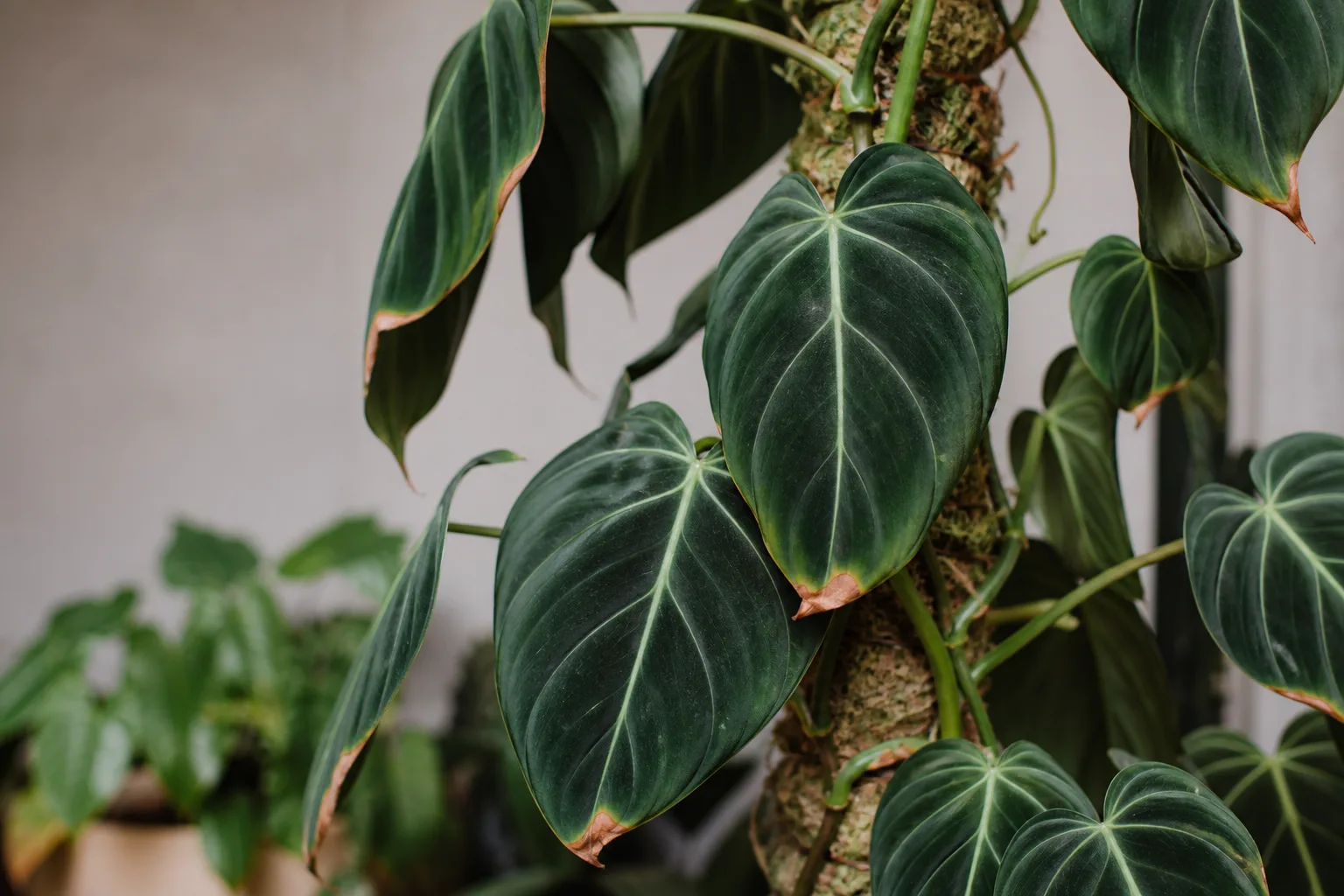
Crispy tips or edges can follow a dry root ball, very dry air, fertilizer salts, hot sun, or a heater vent. Look for a pattern: damage on the window-facing side suggests sun; a crust on the potting mix points toward salts; a crispy margin on new leaves in a dry room may reflect low humidity. Change one likely factor at a time. Trim only the dead tissue with clean scissors if its appearance bothers you; brown edges will not turn green again.
A new leaf that pauses in its sheath may need stable moisture and humidity while it unfurls. Check that the root ball is not dry, move the plant away from drafts, and avoid pulling the leaf out by hand. Forcing it can split the blade or damage the growth point. If new leaves are consistently small and internodes stretch, improve light and offer support before increasing fertilizer. Leaves that develop dark, spreading spots deserve isolation from other plants, dry foliage, and better airflow; if lesions continue, seek a reliable local plant diagnostic rather than treating every mark as a fungal infection.
Watch for pests without over-treating
Inspect the undersides of leaves, along petioles, and where the stem meets a support every week or two. Spider mites can leave fine stippling or webbing; mealybugs look like small cottony clusters; thrips may leave silvery scarring and tiny dark specks. New purchases and plants moved outdoors are common ways pests arrive, so quarantine unfamiliar plants when practical and check them before they join a collection. A magnifying glass helps distinguish dust, mineral spots, and insects.
If you find pests, isolate the plant and identify the insect before choosing a treatment. Rinse foliage carefully, remove visible pests, and use only a product labeled for the plant and pest in your location, following its directions. Test a small area first: soft velvet leaves can be sensitive to oils and soaps, especially in bright light. Avoid mixing products or spraying preventively without a reason. Continue inspections after treatment because eggs or hidden insects can survive a first pass. Keep leaves from remaining wet overnight, and provide gentle circulation without directing a drying fan at the plant.
Handle the plant safely around pets and children
Philodendrons contain insoluble calcium oxalate crystals. Chewing plant tissue can cause intense irritation and swelling in the mouth; sap may also irritate skin. Keep the plant, cuttings, and fallen leaves out of reach of children and pets, and wear gloves if pruning or handling damaged stems bothers your skin. Wash hands and tools afterward. Hanging the vine high is not enough if leaves can trail down within reach.
If someone chews the plant, remove visible pieces and contact a poison center or medical professional for advice. Severe mouth swelling, heavy drooling, difficulty swallowing, or breathing trouble requires urgent medical help. In the United States, Poison Control explains philodendron exposure and when to seek emergency care; the ASPCA also lists philodendron species as a pet hazard. Do not assume a small nibble is safe simply because the plant is a common houseplant.
Conclusion
Philodendron verrucosum grows best when its roots stay moist but aerated, its leaves receive bright filtered light, and its climbing stem has a stable route upward. Start by placing it in a warm, well-lit spot and checking how quickly its pot dries. Build care around that observation instead of watering every week or chasing a single humidity percentage.
Once the plant is settled, improve one factor at a time: refresh a compact mix, add a pole during repotting, or raise room humidity if new leaves repeatedly struggle to open. Watch the roots and the newest growth for feedback. Keep it away from pets and children, and avoid sudden cold, wet roots, and harsh sun. With those basics in place, this velvet-leaf philodendron can grow steadily without turning routine care into guesswork.



