How to Grow and Care for Philodendron Florida Ghost
Learn how to grow Philodendron Florida Ghost with practical advice on light, watering, soil, climbing support, propagation, and its changing leaf color.
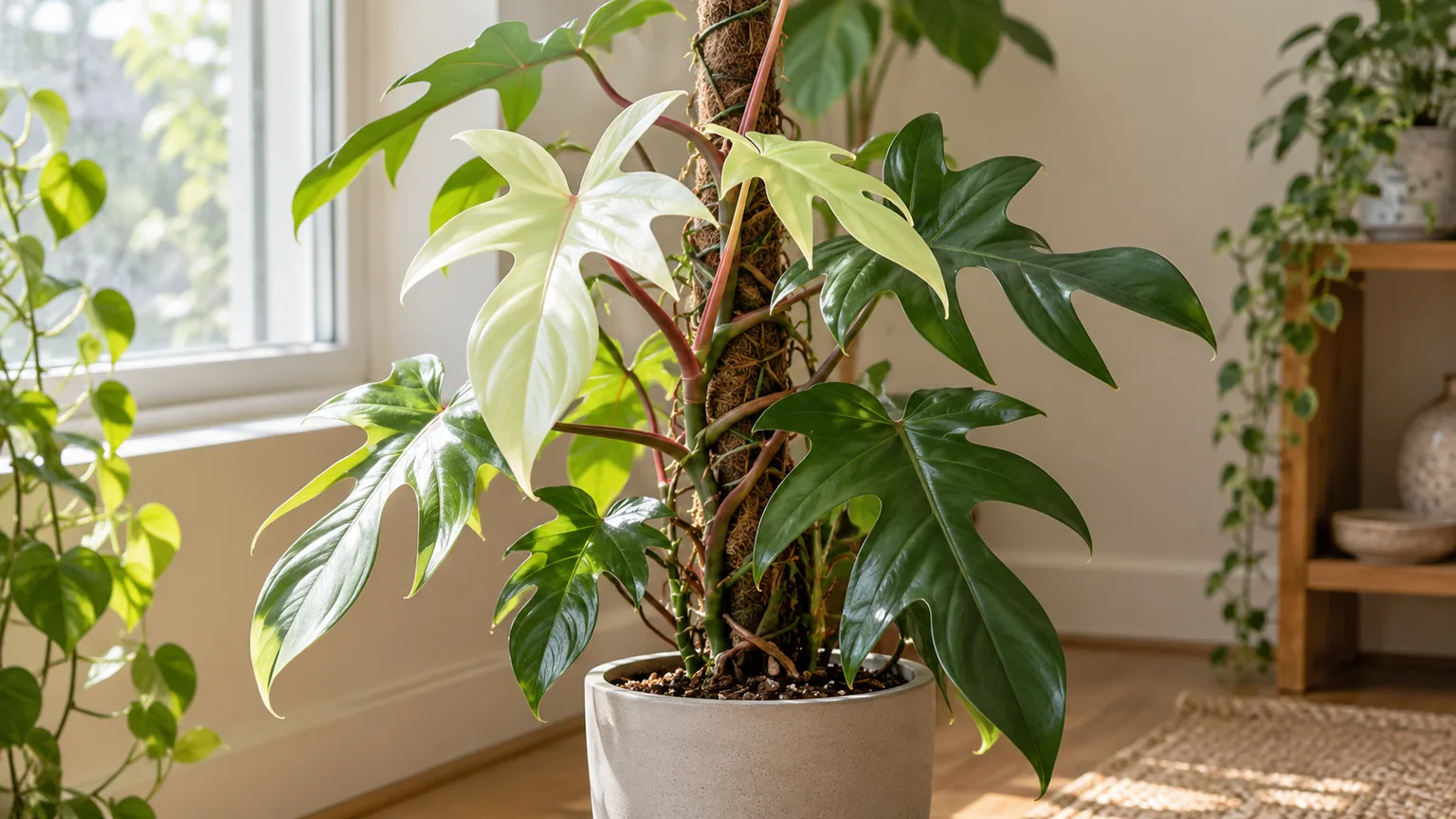
Philodendron Florida Ghost is a climbing tropical plant known for its deeply lobed leaves and striking flushes of pale new growth. The leaves often emerge ivory, cream, or very light green before darkening as they mature, so the plant’s appeal comes from watching several stages coexist on one vine—not from keeping every leaf white.
Give it bright filtered light, a loose mix that drains freely, a pot with drainage holes, and something sturdy to climb. Water when the upper layer of mix has started to dry, then let excess drain away. These simple habits matter more than trying to recreate greenhouse humidity or follow a rigid watering calendar.
Meet the Florida Ghost: What Changes as Leaves Mature
Plants sold as Florida Ghost are climbing philodendrons in the aroid family. Their signature look combines lobed leaves, reddish petioles that may have a fine textured surface, and new leaves that open much paler than the older foliage. A young leaf can look almost ivory at first, then pass through pale green and settle into a deeper green as it develops.
That color change is normal. It is not automatically a sign that the plant is losing variegation, reverting, or receiving too little fertilizer. A pale leaf has less chlorophyll than a mature green one, so it contributes less photosynthetic surface while it is young; over time, the leaf develops and greens up. The plant can still be healthy even when the oldest leaves are green.
Names can be confusing at the point of sale. “Florida Ghost Mint” is used by some sellers and collectors for plants whose emerging leaves lean mint or pale green, but the label is not a dependable promise of a separate, stable color form. Cultivar naming and appearance vary across sellers, and lighting, plant maturity, and growing conditions can influence what you see. Buy the actual plant or recent growth photos when color matters, rather than relying on a label alone.
Quick Care Profile and the First-Year Priorities
| Need | Practical starting point | What to watch |
|---|---|---|
| Light | Bright, filtered or indirect light | New growth becomes smaller or stems stretch when light is weak |
| Water | Water thoroughly after the upper mix begins to dry | A pot that stays heavy and wet needs better airflow or a faster-draining mix |
| Mix | Airy, moisture-holding aroid blend | Fine, compacted soil can remain wet around roots |
| Support | Moss pole, coir pole, or trellis | Secure the stem loosely; never crush the petiole |
| Temperature | Warm, stable indoor conditions | Cold glass, drafts, and sudden temperature swings stress tropical foliage |
| Humidity | Average home humidity is workable; moderate humidity can help | Improve airflow as humidity rises |
| Feeding | Dilute houseplant fertilizer during active growth | Pale new growth alone is not proof of nutrient deficiency |
In the first month, prioritize a stable location, careful watering, and observation. Avoid repotting immediately unless the mix is sour, waterlogged, or badly compacted; a move to a new home already changes light and humidity. Once the plant is acclimated, check whether its roots and climbing stem need more space or support.
The Royal Horticultural Society’s philodendron guide recommends indirect light, letting the compost dry slightly between waterings, and keeping philodendrons above 15°C (59°F). Treat these as useful genus-level guardrails, then adjust to the Florida Ghost’s actual pot, room, and growth rate.
Where to Put It: Bright, Filtered Light
Set the plant where it receives bright light for much of the day without long periods of harsh direct sun. Near an east-facing window is often a forgiving starting point; a bright north-facing window may work in a sunny climate, while a south- or west-facing window may need a sheer curtain or a little more distance from the glass. The right spot depends on window size, season, outdoor shade, and how far the leaves sit from the window.
Use the plant’s growth as feedback. A healthy vine should make reasonably sturdy new growth and retain its established leaves. If new leaves are smaller, internodes become long, or the stem leans strongly toward a window, increase usable light gradually. Turn the pot a quarter turn every week or two if growth is reaching in one direction.
Direct midday sun can scorch foliage, especially leaves that have recently unfurled. If you are moving it from a dim shop or a shaded room to a sunnier place, step it into brighter conditions over a week or two. A pale leaf may show sun injury as bleached, papery patches rather than simply turning evenly green with age.
A white-light grow lamp can supplement a dark room, but the plant still needs sensible distance and a consistent day-night rhythm. House Plant Journal’s guide to assessing indoor light explains why measuring at the plant’s position is more useful than relying on labels such as “low” or “bright” alone. A basic light meter or phone app can help compare two positions, though it is the growth response over several weeks that tells you whether the setup is working.
Why New Leaves Start White and Turn Green
The pale flush is a developmental feature of the plant sold as Florida Ghost. It does not mean the whole plant is a stable white-variegated cultivar. As each leaf hardens and matures, its color generally deepens, and a range of green shades on one plant is expected.
Good light helps the plant make energy and supports stronger growth, but it cannot force an individual leaf to stay white indefinitely. Do not expose the plant to scorching sun, withhold fertilizer, or keep it root-bound in an attempt to preserve pale color. Those strategies can weaken the plant without guaranteeing a particular shade on its next leaf.
Look at the newest growth rather than comparing only old leaves. If the newest leaf begins pale and gradually greens over a few weeks, that pattern is normal. If it opens yellow, develops dry brown margins, remains distorted, or arrives smaller while the stem stretches, check water, roots, light, and pests before changing fertilizer.
No single white-leaf count is a useful health target. The number and shade of pale leaves can vary from flush to flush, and newly acquired plants may need time to resume growth after transport. A sturdy plant with healthy roots and regular new leaves is a better success measure than a gallery-perfect color ratio.
Water by Root-Zone Dryness, Not Calendar
Water when the upper portion of the potting mix has dried and the pot feels lighter, then water slowly until liquid runs from the drainage holes. Empty the saucer or decorative cachepot afterward. This wets the root ball evenly while avoiding the standing water that deprives roots of oxygen.
A fixed interval fails because pots dry at different speeds. A small nursery pot near a warm window can need water sooner than a larger plant in a cool room. During active growth and long bright days, check more often; in winter or after light levels drop, the mix may take longer to dry.
Check below the surface rather than judging by a dry crust alone. Push a finger or wooden skewer a couple of inches into the mix, or lift the pot and learn its weight after watering and as it dries. If the surface is dry but the pot still feels heavy and the lower mix is cool and damp, wait. If water runs straight down the side of a shrunken root ball without wetting it, soak the pot evenly and allow it to drain.
Persistently soggy soil, a sour smell, or blackened soft roots signals a drainage or root problem; adding water because a leaf droops can make that worse. Wrinkled stems and a very light pot with dry mix point more toward dehydration. The RHS also advises allowing philodendron compost to dry slightly and avoiding waterlogged pots in its growing guidance.
Choose a Chunky, Airy Aroid Mix
Florida Ghost needs moisture around its roots but also air spaces after watering. A dense, fine potting soil can stay wet for too long, particularly in a cool or low-light room. A practical home blend is two parts peat-free indoor potting mix or coir-based mix, one part orchid bark, and one part perlite or pumice by volume. This is a starting recipe, not a formula the plant needs in exact proportions.
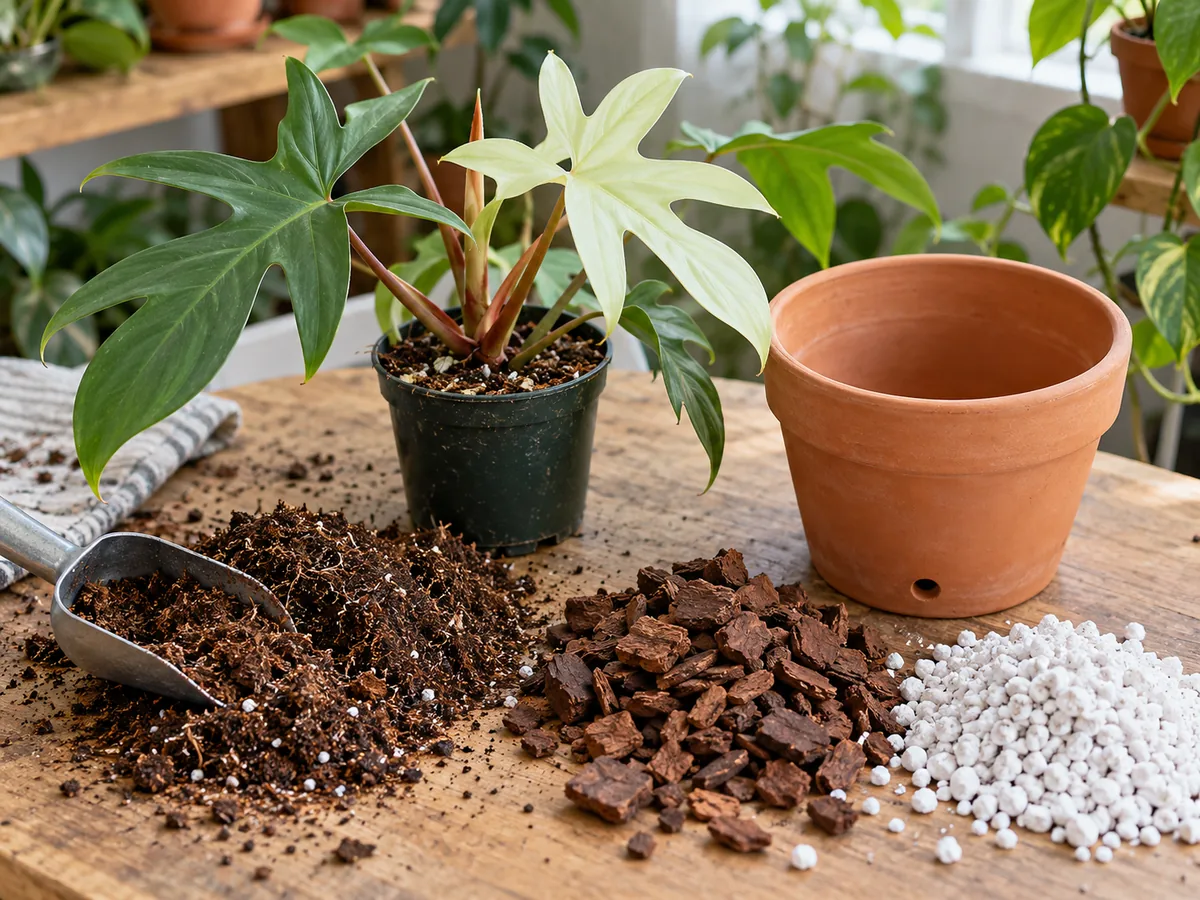
Adjust the components to your conditions. A warm, dry home may benefit from a little more moisture-holding mix; a cool room or a heavy-handed watering style calls for more coarse bark and perlite. If water drains instantly and the plant wilts between checks, the mix may be too coarse or the root ball may have dried unevenly. If it stays wet for many days, improve the mix before increasing the time between waterings.
Do not use a layer of gravel at the pot bottom as a substitute for a suitable mix or drainage holes. It reduces root space and does not fix compacted soil. The RHS recommends a loose, free-draining, slightly acidic mix for philodendrons; its genus-level planting advice is a good foundation for this climbing type.
Pick a Pot and Repot Without Overpotting
Use a pot with open drainage holes that is only modestly larger than the root ball. An oversized container holds a larger volume of wet mix than the roots can use, extending the time before it dries. If you like a decorative cachepot without holes, keep the plant in a draining nursery pot inside it and remove the inner pot when watering.
Check the root ball before repotting. Roots circling densely around the bottom, emerging through drainage holes, or leaving very little mix visible are stronger signs than a calendar. If the plant is growing well and the mix remains airy, it can stay in the same pot. When you do repot, choose fresh mix and move up one pot size, usually about 2–5 cm (1–2 inches) wider.
Spring or early summer is convenient because the plant can resume growth as light improves, but correcting a failing, waterlogged mix should not wait for a preferred season. Slide the plant out gently, loosen only the outer roots that release easily, and trim roots that are clearly mushy or dead with clean shears. Keep the stem base at the same depth; burying petioles or aerial roots into wet mix can invite rot.
Water the fresh mix to settle it and let all excess drain. Hold off on fertilizer until the plant shows resumed growth, since fresh potting mix may already contain nutrients and stressed roots are easy to overfeed. If the vine wobbles after repotting, secure it to a support rather than packing the mix down hard.
Give the Climbing Stem Something to Grip
Florida Ghost is grown as a climber, and a vertical support can help keep a long vine upright and accessible. A moss pole, coir pole, narrow trellis, or sturdy stake can work. A moss pole that stays lightly moist may encourage aerial roots to attach, while a dry coir pole or trellis mainly provides structure; neither is mandatory if the plant is small and stable.
Place the support close to the stem when you pot or repot, so you do not drive it through established roots later. Use soft plant tape or a loose tie around the stem between nodes. Do not tie tightly around a leaf stalk: petioles need to move, and a constricting tie can damage the plant as the stem thickens.
Point the side of the stem with aerial roots toward the pole. You can pin the stem gently against moist sphagnum or a damp pole, but do not force every aerial root into soil. Check attachments as the plant grows and replace ties that begin to bite. The RHS notes that climbing philodendrons can be tied to a moss pole and may root into it when it is kept moist; support is a training choice, not a substitute for adequate light.
Keep Temperature Stable and Humidity Comfortable
A warm room with few abrupt changes is usually enough. Keep the plant away from cold drafts, exterior doors, air-conditioning blasts, and heat vents that dry one side of the foliage. The RHS advises maintaining philodendrons above 15°C (59°F); in ordinary home care, avoiding chilly nights and sudden temperature shifts is more useful than chasing a precise tropical target.
Average household humidity is usually manageable if watering is steady and the roots are healthy. If new leaves repeatedly dry while unfurling, or leaf edges crisp despite appropriate watering, consider grouping plants, using a humidifier, or moving the plant to a naturally more humid room. Raise humidity without trapping stagnant air around wet foliage.
Misting offers only a brief change and is not a reliable way to control room humidity. A pebble tray also has limited effect on a large room. If you use a humidifier, clean it as directed and keep the potting mix from remaining wet for longer simply because the air is humid. A small hygrometer can show whether the room is unusually dry and whether your changes actually affect it.
Feed Lightly While It Is Growing
Feed during active growth, usually spring through early fall indoors, with a complete liquid houseplant fertilizer diluted according to its label. Start at a conservative strength if the plant is newly purchased or recently repotted. Apply fertilizer to already moist mix rather than bone-dry roots, and do not add extra doses to make the white leaves whiter.
Pause or reduce feeding when growth slows in winter, especially if the plant receives less light. Salt buildup can appear as a crust on the mix or pot rim and may contribute to stressed roots. If that happens, flush the mix thoroughly with plain water and let it drain, or repot if the substrate is old and compacted.
Read the fertilizer label and avoid stacking liquid feed, slow-release pellets, and nutrient-rich potting mix without accounting for them. New pale growth can be normal for this plant; judge nutrition by overall vigor, leaf size, and the conditions at the roots. The RHS recommends a general houseplant fertilizer during the growing season for philodendrons.
Prune for Shape and Propagate at a Node
Prune to control a vine that has outgrown its support, remove damaged foliage, or take a cutting. Use clean, sharp shears and wear gloves if you are sensitive to plant sap. Make a cut just below a node—the slightly raised point where a leaf and aerial root emerge—because a cutting without a node cannot produce a new shoot.
For a manageable cutting, include at least one healthy node and one leaf, with an aerial root if available. Remove a lower leaf only if it would sit underwater or inside the rooting medium. Root the node in clean water, damp sphagnum, or a loose propagation mix; keep the leaf and most of the petiole above the medium. Bright indirect light and warm conditions support rooting without exposing the cutting to direct hot sun.
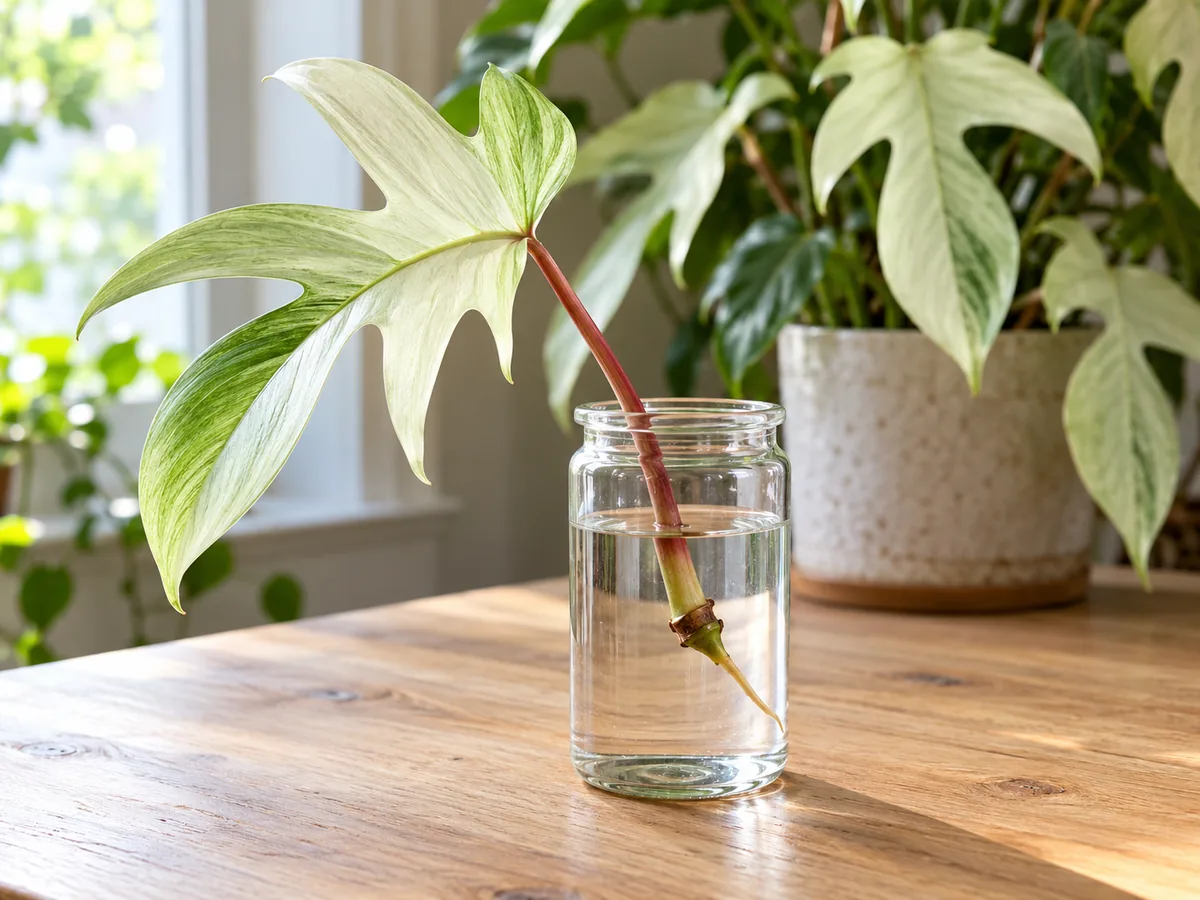
For water propagation, keep the node submerged and refresh the water when it becomes cloudy. For a loose medium, keep it lightly moist, not saturated, and use a clear cup only if you can still provide drainage or avoid standing water. Check for firm new roots rather than tugging on the cutting; repeated pulling can tear developing roots.
Pot the cutting when it has several established roots and begins to hold itself in place. Transfer it to an airy mix, water it in, and keep it in a stable spot while it adjusts. A cutting may produce green leaves before it produces another pale one; propagation copies the growing stem, but it cannot promise the exact color or timing of each new leaf. The RHS describes spring-to-late-summer stem cuttings as a practical propagation method for climbing philodendrons.
Diagnose Yellow, Brown, Drooping, or Small Leaves
Read symptoms together with the pot and stem rather than reacting to color alone. One older leaf yellowing as the plant grows can be ordinary turnover. Several yellow leaves, especially with wet mix and a heavy pot, suggest checking for overwatering, poor drainage, or damaged roots before adding fertilizer.
Brown tips or margins can follow uneven drying, low humidity, excess fertilizer salts, or sun scorch. A dry, crisp patch on the window-facing side suggests too much direct sun; soft brown areas near the stem or a sour mix point toward excess moisture or rot. Remove only dead tissue if you want to tidy the plant, but correct the cause before pruning healthy leaves.
Drooping has more than one cause. Feel the mix and lift the pot: very dry, light mix suggests a thorough drink, while heavy, wet mix calls for drainage and root inspection. Do not water a wet plant simply because leaves are limp. If roots are firm and conditions are corrected, give the plant time to recover instead of changing light, soil, fertilizer, and humidity all at once.
Small leaves and long gaps between leaves usually indicate that the plant needs more usable light or a climbing surface. A support alone cannot compensate for a dark corner. Move it closer to a bright window gradually, and compare the next two or three leaves rather than expecting an immediate change.
Check for Common Houseplant Pests
Inspect the undersides of leaves, petiole joints, and the stem where it touches its support. Spider mites may leave fine webbing and stippled foliage; mealybugs look like small cottony clusters; scale insects appear as fixed bumps; aphids gather around tender growth. A quick weekly look catches many infestations before they spread.
If you find pests, isolate the plant and identify the insect before choosing a treatment. Wipe or rinse foliage where appropriate, remove heavily affected material, and use a product labeled for the pest and indoor ornamental plants exactly as directed. Test any spray on one leaf first, keep it out of direct sun until dry, and repeat inspections because one cleaning rarely removes every life stage.
Avoid combining several sprays or applying concentrated homemade mixes to pale leaves. Light-colored new foliage can mark or burn more easily than mature green leaves. Clean the support and nearby surfaces, check adjacent plants, and follow label precautions for people and pets. The RHS philodendron guide also flags mealybugs, red spider mites, and scale as pests to watch.
Keep Sap Away From Children and Pets
Treat Florida Ghost as a philodendron for household safety. Poison Control explains that philodendrons contain calcium oxalate crystals called raphides; chewing plant material can cause immediate irritation and swelling in the mouth, and sap can irritate skin or eyes. Its Philodendron safety guidance includes symptom and exposure advice.
The ASPCA lists multiple Philodendron entries as toxic to cats and dogs because of insoluble calcium oxalates, including its Philodendron spp. entry. That listing is genus-level, not a test of this named cultivar; treat the Florida Ghost accordingly and place it where children and animals cannot chew it. Keep fallen leaves and pruning scraps out of reach.
When pruning or repotting, avoid touching your eyes and wash your hands and tools afterward. If a person or pet chews the plant or has a concerning reaction, contact Poison Control or a veterinarian for case-specific advice rather than relying on a general plant-care article. The purpose of this guidance is prevention, not to diagnose an exposure.
Buy and Acclimate a Healthy Plant
Choose a plant with firm stems, several healthy leaves, and no widespread yellowing, mushiness, or visible pests. Check leaf undersides, the stem base, and the potting mix before bringing it home. If buying online, ask for current photos of the exact plant, especially if you are paying a premium for pale new growth or a “Mint” label.
A white leaf in a listing photo does not tell you how recently it emerged, how the plant is rooted, or whether its next leaf will look the same. Ask whether the plant is rooted, how long it has been established, and whether the seller can identify its growth point. Avoid sellers who promise a fixed number of white leaves or claim that direct sun or nutrient deprivation is required to create them.
Keep the plant separate from your collection for a couple of weeks while you inspect it for pests. Give it stable bright indirect light and wait to see how quickly the existing mix dries. Once it has adjusted, decide whether it needs a larger pot, a support, or a different substrate; making every change on arrival can make it difficult to identify the cause if it declines.
Follow a Seasonal Care Routine That Prevents Guesswork
In spring and summer, look for active growth, check moisture more often as the room brightens, feed conservatively, and extend the support as the vine climbs. A new leaf may take time to unfurl, so leave it alone rather than helping it open. Keep the pole and ties positioned so the leaf can emerge without rubbing against a wall or shelf.
In fall and winter, growth often slows as daylight decreases. Let the mix dry a little longer before watering again, reduce or pause fertilizer if growth has stopped, and move the plant away from cold glass or heating vents. If you supplement with a grow light, keep its schedule consistent and make sure the plant still has a dark period.
Once a month, check the plant from roots to leaf tips: pot weight and mix moisture; drainage holes and roots; stem attachments and aerial roots; undersides of leaves; and the size and spacing of recent growth. Record a quick photo from the same angle if you want to compare seasonal changes. This routine helps separate normal leaf maturation from a real change in conditions.
Conclusion: Grow for Healthy Growth, Not a White-Leaf Count
Philodendron Florida Ghost is easiest to enjoy when you let it be a climbing philodendron first and a color novelty second. Give it bright filtered light, water according to how its mix dries, plant it in an airy substrate, and train the stem gently as it grows. Use the newest growth and the condition of the roots to guide adjustments.
Pale leaves that mature toward green are part of the plant’s appeal, not a care failure. Keep the plant steady, make one change at a time when symptoms appear, and judge success by healthy roots and continued growth rather than a guaranteed shade of white.



