How to Grow and Care for Paphiopedilum Orchids
Learn Paphiopedilum orchid care by leaf type: set the right light and temperature, keep roots evenly moist, choose a suitable mix, and troubleshoot blooms.
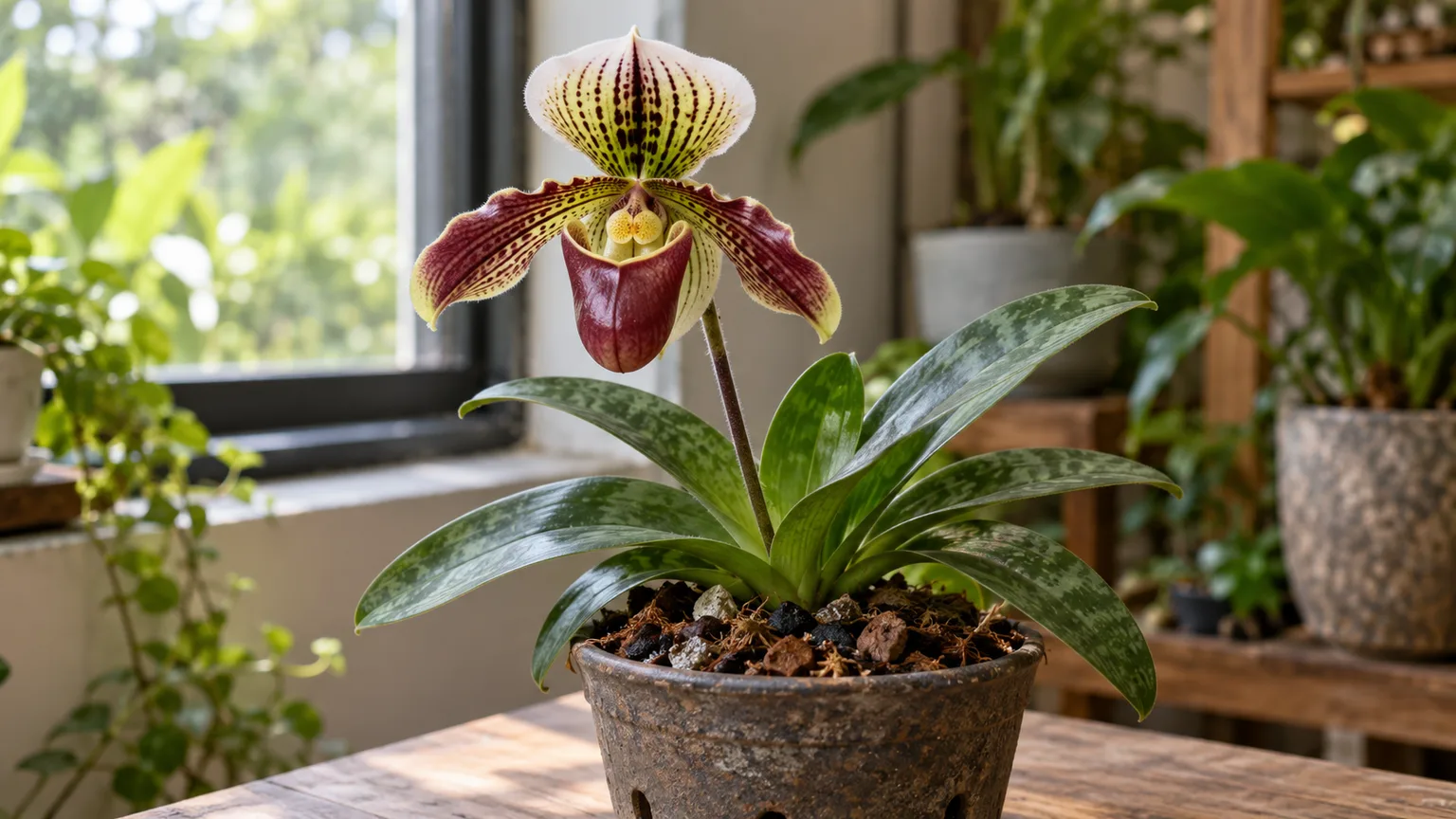
Paphiopedilum orchids, often called lady’s slipper or slipper orchids, are grown for a flower with a distinctive pouch and a tidy fan of leaves. Their care is manageable once you stop treating them like miniature Phalaenopsis: Paphiopedilums have no water-storing pseudobulbs, and most prefer roots that stay gently moist rather than drying hard between waterings. The right routine still depends on the plant’s growth type, potting medium, and the conditions in your room.
Start with three checks before changing anything: identify whether the leaves are mottled or plain green, feel or inspect the medium below its surface, and check that the pot drains freely. Those clues tell you more than a generic “water weekly” rule. The American Orchid Society’s Paphiopedilum culture sheet is a useful baseline, but the plant’s label and its response in your home should guide fine adjustments.
Know which slipper orchid you have
Paphiopedilum is a genus, not a single care formula. Hybrids differ in how much warmth they prefer, and the foliage offers a practical first clue: mottled leaves usually point toward warmer-growing types, while many solid green, strap-leaved types are cooler-growing. Multifloral slipper orchids are often strap-leaved but tend to prefer warmer conditions, so leaf color is helpful, not infallible. If a nursery tag gives a species, hybrid, or section, use that information before applying a broad rule.
The growth habit also changes how you judge the plant. Each fan is a growth that can eventually flower; after it has bloomed, it will not make a second flower stem from that same fan, but the plant can bloom again from a later new growth. A healthy plant therefore gains fans over time. It can look leafy and flowerless for a while if the newest growth is still maturing, or if light and temperature are not suited to its group. The American Orchid Society’s Paphiopedilum culture sheet describes the genus’ broad growth groups and explains why their needs differ.
Mottled-leaf types
Mottled-leaf hybrids are commonly grown warm and are a forgiving starting point for many homes. Their leaves are patterned with lighter and darker green, and they often tolerate ordinary indoor temperatures without a pronounced cool season. Give them bright, filtered light and stable moisture; do not move them into strong midday sun just because they have not flowered yet.
Green-leaf and strap-leaf types
Many plain green, strap-leaved Paphiopedilums prefer cooler nights than mottled types. Multifloral types can also have strap-like leaves but may be warm-growing, so do not identify a plant by leaf shape alone. When the exact name is known, follow a grower or society profile for that hybrid, especially if the home remains warm overnight. This small identification step prevents the common mistake of trying to trigger blooms by chilling a plant that is not suited to cool conditions.
Choose a place with bright, filtered light
A north- or east-facing window is often a dependable starting point; a west window can also work if the plant is set back or protected from hot late-afternoon rays. In the Northern Hemisphere, a south window usually needs a sheer curtain or more distance from the glass. The goal is enough gentle light to support steady leaf growth and mature a new fan, without heating or bleaching the leaves. The American Orchid Society’s genus-specific guide includes north, east, and west windows among workable indoor placements when direct sun is limited.
Watch the foliage rather than relying only on compass direction. Leaves that become reddish or develop dry, bleached patches can signal too much light or heat; very dark, soft-looking growth and a plant that produces leaves but never matures a fan can point toward too little. These signs are not a diagnosis by themselves, so compare them with temperature, root health, and the plant’s seasonal pattern before making a large move.
A practical test is to shift the plant a short distance at a time and give it several weeks to respond. If you use grow lights, place them above the foliage and start with a conservative duration and distance, then adjust according to manufacturer guidance and leaf response. A sudden switch from a dim shelf to direct sun can scorch leaves even when the final spot is suitable.
Keep temperatures steady and fit the group
The American Orchid Society gives a broad home-growing range of roughly 55–72°F (13–22°C) at night and 70–85°F (21–29°C) by day, while noting that temperature preferences vary with species and hybrid. Mottled-leaf types generally favor warmth, many green-leaf types favor cooler conditions, and multifloral strap-leaf types are often warmer growers. The Royal Horticultural Society’s Paphiopedilum guide gives more specific ranges for plain green and mottled groups. These are guideposts, not thermostat targets for every hybrid.
Most homes already provide a workable daytime range. The more useful check is what happens at night: a cool-growing plant in a consistently warm room may grow well but fail to initiate flowers, while a warm grower exposed to cold drafts may stall or suffer damage. Keep the plant away from heating vents, air-conditioner discharge, exterior doors, and cold window glass.
If you do not know the cultivar, keep it in normal comfortable room conditions rather than forcing a cold spell. Note the night temperature near the plant for a week and compare it with the growth type and the seller’s description. Adjust only one factor at a time; if you change both temperature and light, you will not know which change helped.
Maintain moderate humidity with airflow
Paphiopedilums appreciate moderate humidity, but a humid corner with still air is not automatically better. The American Orchid Society lists about 40–50 percent as a suitable home range for the genus and stresses air movement when humidity is higher. If your home sits near that range and the plant is growing steadily, a humidifier is unnecessary.
In very dry heated rooms, a small room humidifier can help if the leaves are drying faster than the pot can supply water. Keep it clean and use a hygrometer at plant height; a reading across the room may not reflect the shelf microclimate. A pebble tray can raise local humidity slightly, but the pot must sit above the water rather than in it. The AOS range is a practical target, not a reason to build a greenhouse: an experienced home orchid grower in Calgary describes maintaining a varied collection through dry indoor winters by balancing hydration, light, and airflow (Here…but Not’s growing account). That is one grower’s experience across multiple orchid types, so treat it as context rather than a Paphiopedilum humidity prescription.
Leave enough space around the plant for air to circulate and avoid routinely misting the crown. Persistent droplets in leaf joints, especially in cool or poorly ventilated conditions, can encourage rot. Humidity should support the roots and foliage, not replace proper watering or drainage.
Use a moist, airy medium and a snug pot
Paphiopedilums are terrestrial or ground-growing orchids, so they do not need to be mounted like many epiphytic orchids. They do need a medium that holds a little moisture around their roots while allowing excess water and air to move through. The American Orchid Society describes fine- to medium-grade fir bark with additions such as perlite, coarse sand, or sphagnum; some growers use tree-fern fiber. The right blend depends on how quickly your home dries a pot (Paphiopedilum culture sheet).
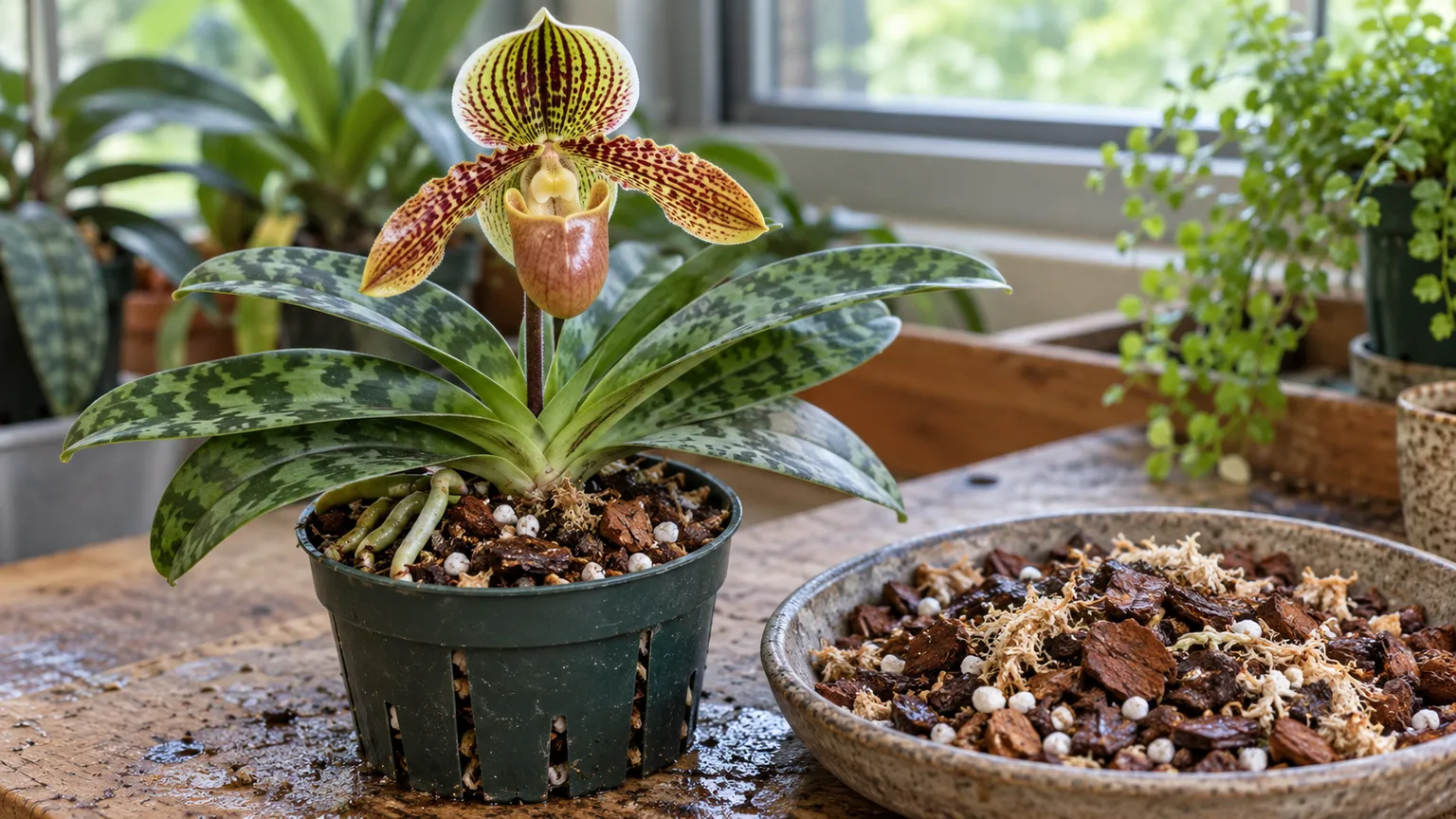
If you tend to underwater, choose a mix with more moisture-retentive material, such as a modest amount of sphagnum or fine bark. If you water frequently, your room is cool, or the pot remains wet for days, use a slightly coarser blend and improve airflow instead of letting the plant sit in saturated mix. BBC Gardeners’ World gives a similar general orchid-potting principle: keep the medium loose rather than compressing it, so water can pass through and roots retain air.
Choose a pot only slightly larger than the root mass, with unobstructed drainage holes. A very large pot contains unused medium that dries slowly and can stay wet around the roots; a tight pot dries faster and may need more frequent checks. Plastic retains moisture longer than porous terracotta, so match the pot to your habits and room. A decorative cachepot is fine if you remove the inner pot to water and let it drain fully before returning it. The AOS repotting guide also stresses selecting a container with drainage and a medium that fits the grower’s conditions.
Do not reach for garden soil or assume every slipper orchid needs an acidic mix. The American Orchid Society notes that some Paphiopedilum species and hybrids are “limey” and need calcareous, alkaline components such as horticultural-grade limestone or oyster shell. Only add these when the plant’s identity or a reliable grower’s instructions support it; guessing at pH amendments can create a new problem.
Water when the medium is nearly dry
Aim for evenly moist, not waterlogged, roots. Instead of watering on a fixed weekday, check the mix with a finger or wooden skewer just below the surface and lift the pot to learn its weight after watering and as it dries. Water when the mix is approaching dry but still has a little coolness or moisture deeper down. In a warm bright room with a small pot, that may happen several times a week; in cool low light with a larger pot, it may take longer. This reconciles two useful descriptions: the AOS culture sheet says to water when indoor medium reaches dry, while the RHS Paphiopedilum guide says to let it dry a little but never completely. In practice, avoid both a saturated pot and a bone-dry root ball.
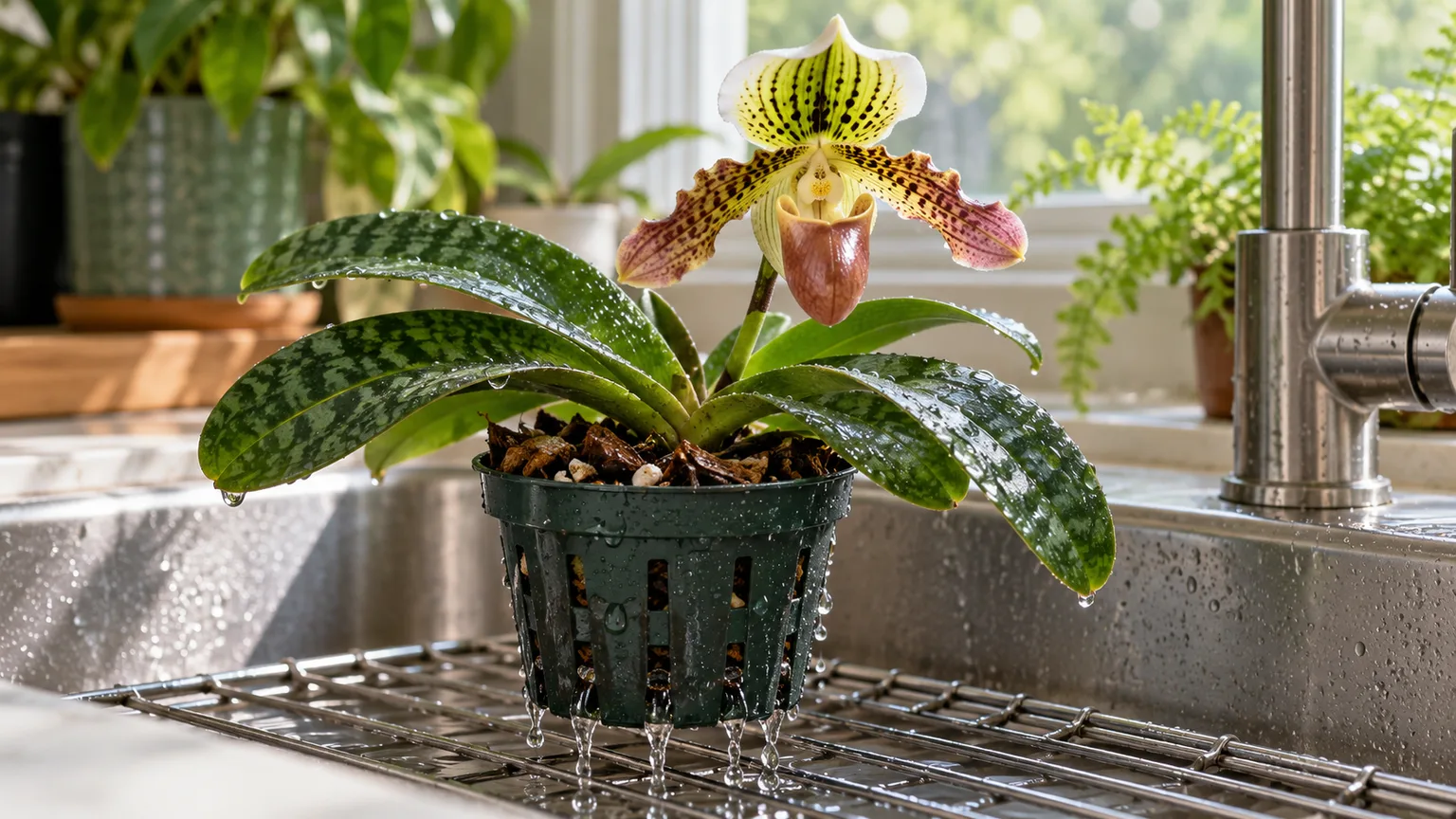
When it is time to water, soak the mix thoroughly with room-temperature water until it runs through the drainage holes, then empty the saucer or cachepot. This flushes the root zone rather than wetting only the surface. Avoid leaving the crown wet overnight, and do not use ice cubes as a substitute for watering: they do not wet the entire root zone evenly and expose tropical roots to a cold spot.
Frequency changes with the season and setup. Warm air, active growth, a small plastic pot, and coarse mix all shorten the interval. Lower light, cooler temperatures, a larger pot, and dense or decomposing mix extend it. The American Orchid Society’s watering guidance explains that “overwatering” is often a medium that stays wet too long because light, airflow, humidity, and potting mix all affect how quickly water leaves the pot. If the mix is still wet, solve the slow-drying cause instead of adding more water.
Feed lightly and flush accumulated salts
A dilute, balanced orchid fertilizer is easier to use consistently than a strong concentrate. Follow the product label, and begin at the lower end of its recommended strength if you are uncertain about your water quality or how often you water. Paphiopedilums can be fertilized through the year when actively growing, but a weak, regular feeding is safer than occasional heavy doses; do not put concentrated fertilizer onto dry roots.
Mineral crust on the pot or medium, or a white residue around the base, is a cue to flush the pot with clean water. The American Orchid Society recommends regular feeding for Paphiopedilums and notes that growers flush monthly or quarterly to remove accumulated salts (genus-specific guidance). The RHS guide recommends following the fertilizer label and reducing feeding in winter. If your tap water is hard or softened, check the source’s mineral content and consider rainwater or low-mineral water when deposits build quickly; do not assume all tap water is unsuitable.
Repot when the medium or roots call for it
Repot when the medium has broken down and stays wet, drainage has become poor, roots are crowding out the mix, or the plant has outgrown its pot. A calendar interval of about every one or two years is a useful reminder, not a deadline: a fresh, airy mix can last longer, while old material that has become fine and sour needs attention sooner. If you bring home a plant in visibly decomposed or sour-smelling medium, it may need repotting before its next scheduled cycle. The AOS repotting guidance gives an annual-to-biennial interval as a common range, while the RHS recommends repotting after flowering when needed.
Paphiopedilums are best repotted as flowering finishes and new roots or growth begin, when the plant can establish itself in fresh medium. If root rot or a failing mix is putting the plant at risk, do not wait for a perfect season; protecting healthy roots is more important than preserving a flower. The American Orchid Society’s general repotting guidance also emphasizes that the mix should suit both the plant and the grower’s watering conditions.
A low-stress repotting sequence
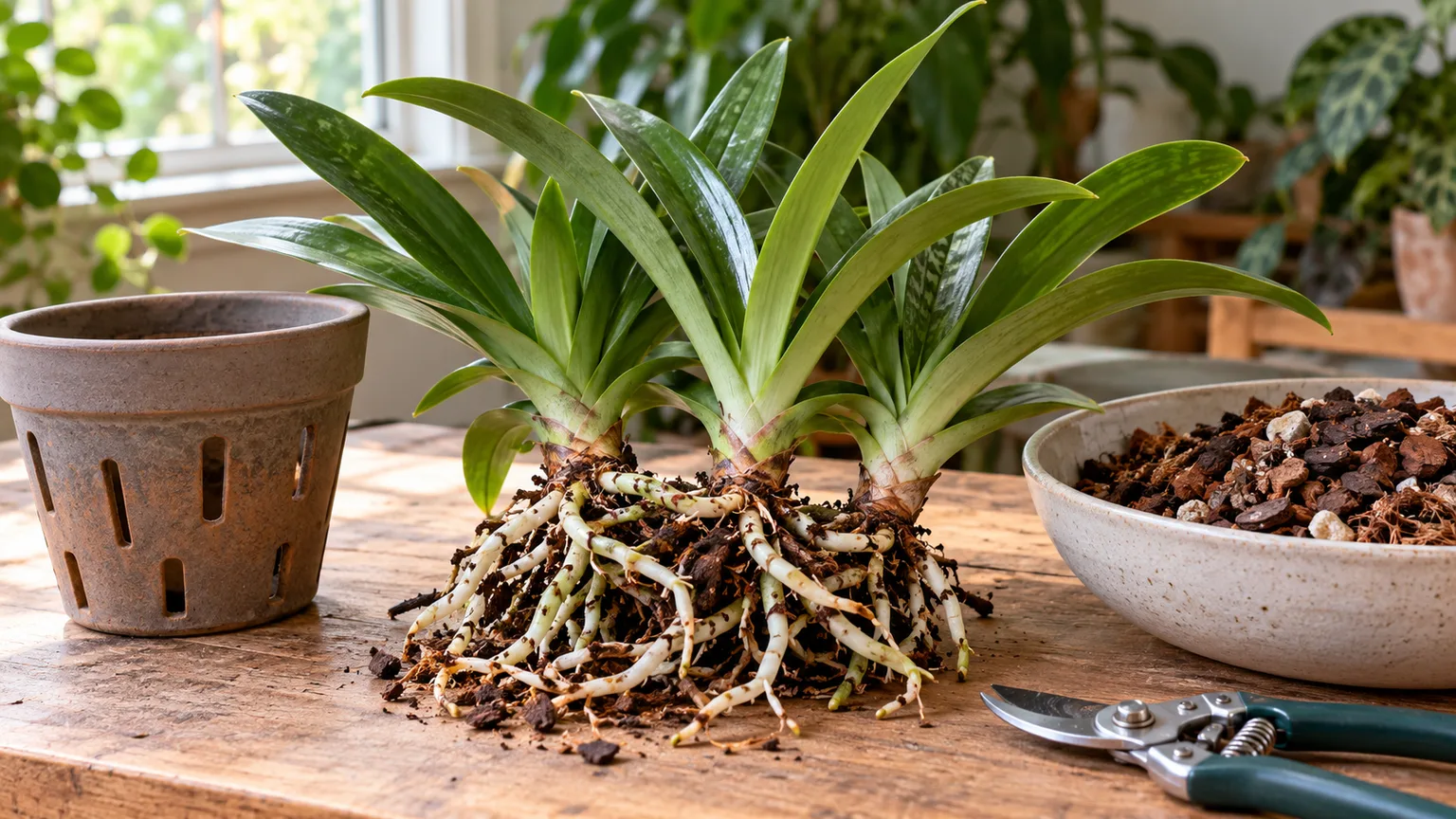
- Prepare fresh medium and a clean pot with drainage before removing the plant. Choose a pot that gives the roots room without leaving a large ring of unused mix.
- Ease the root ball out and remove old mix gently. If the roots cling to bark, soak the root ball briefly to soften the material rather than tearing roots away.
- Inspect the roots. Keep firm roots; remove only roots that are hollow, mushy, or clearly dead with a clean blade. Disinfect tools before and after working on a plant.
- Set the plant so its roots are supported in the mix and the growing point is not buried deeply. The American Orchid Society’s genus-specific sheet recommends spreading the roots over a small amount of mix and covering the root-to-stem junction lightly; keep water from pooling in the crown.
- Work mix around the roots without packing it tight. Tap the pot to settle the mix, water it through, and let it drain. Keep the plant stable in bright shade while new roots re-establish.
Do not automatically move the plant into a much larger pot or divide it during every repot. A simple refresh of medium is less disruptive than a division, and mature roots are valuable stores of energy for the next growth.
Divide only a mature, multi-growth plant
A Paphiopedilum makes new fans from the base, so division is possible when a clump becomes crowded. Wait until it has several mature growths and a natural point where the clump separates; the American Orchid Society recommends divisions of roughly three to five growths for larger plants. A small division with a single fan may survive, but it can take longer to reach flowering size and may not bloom for a while.
Divide during repotting after flowering, using a sterilized blade. Separate the plant at a natural junction rather than cutting through the center of a fan, and preserve as many healthy roots as possible on each division. The RHS propagation guidance recommends selecting an offshoot on the edge of a large clump with a good root system. Pot divisions in appropriately small containers with fresh mix, water them in, and keep humidity and moisture steady while they recover.
Propagation by seed is a specialist process and not a practical home shortcut. Orchid seeds are dust-like and typically require sterile laboratory culture and precise growing conditions. For a home grower, keeping a mature clump healthy and dividing only when necessary is the reliable option.
Prune only what is finished or damaged
Paphiopedilums do not need routine shaping. Remove a leaf only when it is completely dead or clearly diseased, cutting it near the base with a clean tool. A lower leaf that yellows slowly as the plant grows is not the same as several leaves yellowing at once; inspect the mix and roots before removing green foliage.
After a flower has faded, cut the spent flower stem close to the base once it is finished. Do not cut off a green, healthy leaf to make the plant look neater, and do not cut into the crown where new fans emerge. Clean cuts and restraint help protect the plant’s limited active growth points.
Encourage flowering by correcting the conditions
A slipper orchid blooms when a mature growth is ready and its basic needs line up; fertilizer alone will not force it. The RHS notes that flowering is generally from November to March but can occur at other times, so the calendar is only a broad clue. First check whether the newest fan is mature enough to flower, then confirm it gets sufficient gentle light. If the plant adds leaves but never forms a bud, low light and an immature growth are more likely starting points than a need for an aggressive fertilizer dose.
Next match temperature to the plant type. Many green-leaf types benefit from cooler nights than mottled forms, while multifloral strap-leaf types are often warm growers. There is no universal “cold treatment” for the genus; use the plant’s name, seller notes, or a reputable species profile before deliberately lowering temperatures.
Keep moisture especially steady while a spike and buds develop. A plant that is allowed to dry hard, then soaked, may abort buds or produce weaker growth. Avoid moving it repeatedly, changing several conditions at once, or repotting just to trigger a bloom. A Paphiopedilum may flower only once from each growth, but newer fans provide future flowering points when they mature.
Troubleshoot stalled growth and leaf changes
Look at the pattern before choosing a fix. One aging lower leaf that yellows over time may simply be natural turnover; several yellow leaves, a sour-smelling pot, or a plant that rocks loosely can point to root trouble. Unpot only when the clues justify it, since repeatedly disturbing healthy roots creates stress without solving a light or temperature issue.
Soft or black roots and medium that stays wet suggest poor drainage, a pot that is too large, or mix that has decomposed. Remove dead roots only when you repot, refresh the medium, and choose a smaller draining pot if the root mass has shrunk. If the roots are firm but the growth is slow, check light, night temperatures, fertilizer residue, and whether the newest fan is still maturing before changing the pot.
Dry brown leaf tips can result from repeated dry periods, mineral buildup, fertilizer concentration, or low humidity; they are not a reason to increase watering blindly. Check how quickly the pot dries and inspect for crusty deposits. Flowers or buds that drop may follow sudden temperature changes, dry mix, transport, or a major move. Stabilize the environment and keep the root zone evenly moist rather than trying several remedies at once.
Inspect leaf undersides and the crown periodically for scale and mealybugs, especially if growth becomes sticky or discolored. Isolate a newly affected plant, remove visible pests with a damp cotton swab, and identify the pest before choosing any control. If you use a treatment, follow its label and test it on a small area first; delicate leaves and flowers can be sensitive to products intended for other plants.
A quick symptom check
| What you see | First checks | A sensible next step |
|---|---|---|
| One older lower leaf yellowing slowly | Is new growth firm and roots healthy? | Monitor; remove only when fully dead. |
| Several leaves yellowing or a sour pot | Is the mix dense, persistently wet, or without drainage? | Inspect roots and repot if the medium has failed. |
| Dark, soft growth or no new fan | Is light too low or the root zone staying wet? | Improve gentle light and airflow; correct the medium if needed. |
| Brown tips or mineral crust | Is the mix drying too much, or are salts accumulating? | Adjust the moisture interval and flush the pot. |
| Buds dropping after a move | Did light, temperature, or moisture change suddenly? | Keep conditions stable and water consistently. |
| Leaves look healthy but no flowers | Is the latest fan mature, and does the type get suitable light and nights? | Correct one growing condition and give it time. |
Conclusion
Paphiopedilum care is a balance of steady moisture, gentle light, and enough air around the roots. Identify whether your plant is warm- or cool-growing when you can, then match the mix and pot to how quickly your room dries them. A healthy plant builds new fans before it flowers, so give it time, keep the routine consistent, and make changes in response to what the roots and leaves show.