How to Grow and Care for Neon Pothos
Learn Neon Pothos care with practical light and watering cues, airy soil, pruning and propagation steps, and fixes for yellow leaves and sparse vines.
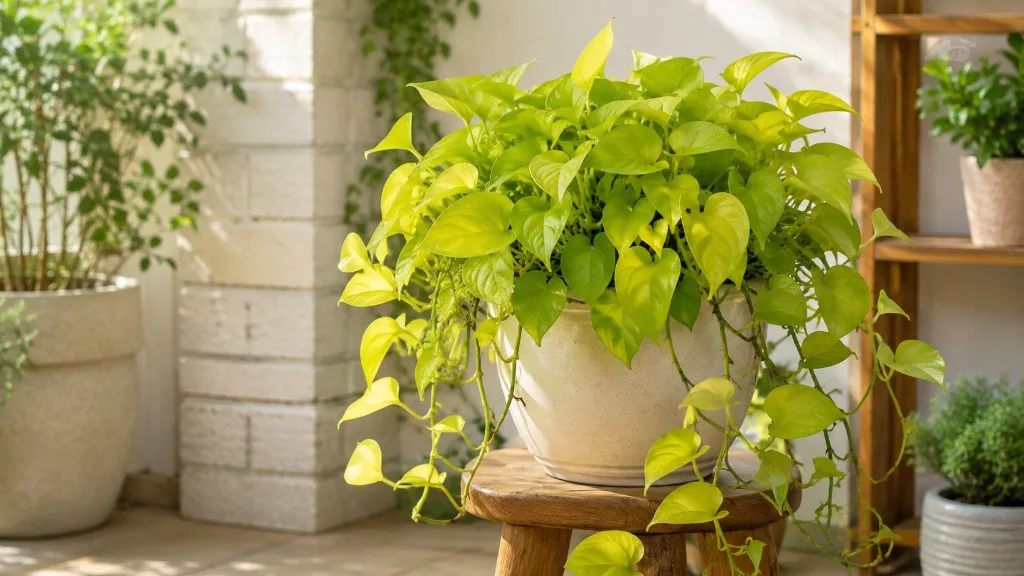
Neon pothos is an easy indoor vine, but it has one feature that makes its care feel less forgiving than a dark-green pothos: the bright chartreuse foliage shows changes in light and age. If you want new leaves to stay vivid and vines to fill out instead of stretching, put the plant in bright, indirect light and let the potting mix partly dry before you water again.
The rest of the routine is simple: use a loose mix in a pot with drainage, keep the plant away from cold drafts and harsh afternoon sun, and prune whenever a vine is too long or bare. Those choices matter more than misting, a strict watering day, or a frequent fertilizer schedule.
Know what makes Neon Pothos different
Neon pothos is the cultivar Epipremnum aureum ‘Neon’, a tropical climbing vine in the arum family, Araceae. Its heart-shaped leaves are usually a fairly even lime or chartreuse rather than the cream-and-green pattern of Marble Queen or the yellow streaks of Golden pothos. The cultivar is not a separate species; it shares the adaptable roots and vining growth habit of other E. aureum plants. NC State Extension describes pothos as native to the Society Islands and notes that the species climbs with aerial roots.
Those aerial roots help a stem attach to a trunk or support; they are not a sign that the plant needs to be buried deeper. In a home, a neon pothos can trail from a shelf or climb a pole, and its leaves may stay in the juvenile heart shape for years. It is usually grown for foliage rather than flowers. If you just brought one home, keep the nursery tag and look for the solid bright-green leaves before making major changes; several pothos cultivars share a similar vining shape but do not have the same color.
Choose light by the color and shape of new growth
Give neon pothos bright, indirect light for the best balance of color and steady growth. A bright room near a window is usually enough; filtered morning sun can be tolerated, while intense midday or afternoon rays through glass can bleach or scorch leaves. If the plant casts a sharp shadow for much of the day, move it farther from the window or soften the light with a sheer curtain.
Low light is not an instant death sentence, but it changes the tradeoff. The plant may continue living while producing longer gaps between leaves, smaller growth, and a less vivid tone. University of Wisconsin–Madison Extension notes that pothos tolerates a wide range of conditions but that cultivars can lose color in deep shade; the New York Botanical Garden specifically cautions that light-leaved forms can burn in direct sun and recommends indirect, medium light. UW–Madison Extension and the New York Botanical Garden offer useful guardrails for finding the middle ground.
Judge the plant by the newest leaves, not by one older leaf that is already changing. If new growth comes in darker and the stems stretch toward the window, increase light gradually over a week or two. If the window-facing leaves develop pale, dry patches, move the pot back; damaged spots will not turn green again, but new leaves should emerge without the same injury. In a dim room, a grow light can help, but place it above or beside the plant rather than so close that foliage warms.
Water when the upper mix dries, not by the calendar
Check the pot before watering. Press a finger into the top 1 to 2 inches of mix; when that layer is dry and the pot feels lighter, water slowly until excess runs from the drainage holes. Let the pot finish draining, then empty the saucer or outer cachepot. This wets the full root ball and clears accumulated salts more effectively than frequent small splashes.
The interval changes with pot size, season, room temperature, light, and the mix. A small pot in a warm bright room may dry in a few days, while a large pot in winter may stay damp much longer. Use the soil check as the decision rule, then make a note of how long your own plant takes; a calendar reminder should prompt a check, not an automatic pour. In low light or cool months, growth slows and the plant uses less water, so check less often without leaving it bone-dry for weeks.
Overwatering is usually about the mix staying wet, not about the number of times you touched the watering can. A plant in dense soil, a pot without holes, or an oversized container can remain waterlogged long after the surface looks dry. NC State Extension advises letting well-drained medium dry between waterings, while Wisconsin Extension links pothos root rot and blackened leaf margins to overwatering. If the plant droops while the soil is still wet, do not add water until you have checked the roots and drainage.
Use airy potting mix and a pot that drains
Start with standard indoor potting mix and make it more open with perlite, pumice, or fine orchid bark. One practical blend is two parts houseplant mix to one part perlite or pumice; for a mix that holds water for a long time, add a little bark and reduce the moisture-retentive base. The goal is not a dry cactus mix: neon pothos needs moisture it can use, but roots need air after the excess drains away.
Choose a container with at least one unobstructed drainage hole. A nursery pot inside a decorative cachepot works well if you lift it out to water and pour away all runoff; a pebble layer at the bottom of a sealed pot does not substitute for a drainage hole. If the potting mix has collapsed into a dense, sour-smelling mass, changing the medium is more useful than buying a larger pot. UF/IFAS production guidance likewise calls for media with both moisture-holding capacity and aeration, a balance that matters in a home container as well.
Keep it warm; let normal home humidity do most of the work
A comfortable, stable room is better than a hot spot or a chilly window ledge. A range around 65 to 80°F (18 to 27°C) suits typical indoor growth; protect the plant from cold glass, air-conditioning blasts, and doors that open to winter air. It can tolerate brief variation, but cold stress and abrupt changes can slow growth and leave foliage damaged. The New York Botanical Garden recommends a warm household and warns against temperatures below 55°F (13°C).
Average household humidity is usually adequate. If leaf edges repeatedly dry in a very dry heated room, first check whether the pot is drying too far between waterings and whether a vent is blowing directly on the leaves. A humidifier nearby can help in a persistently dry room, but misting does not keep humidity stable and can leave water spots on foliage. Wisconsin Extension describes pothos as thriving with higher humidity while also noting its broad tolerance, so extra moisture in the air is an optional comfort measure, not a fix for soggy roots.
Fertilize modestly during active growth
Feed only when the plant is growing, usually in spring and summer indoors. A balanced houseplant fertilizer at the label’s maintenance rate, or at half strength if you prefer a cautious start, every six to eight weeks is enough for most potted neon pothos. Water the plant first if the mix is bone-dry, and do not apply fertilizer to a wilted or recently repotted plant.
More fertilizer will not make the leaves turn neon. Excess salts can injure roots and produce brown tips, especially when the plant is already drying unevenly or the pot does not drain well. Skip feeding in winter if growth has slowed, and flush the mix occasionally by watering thoroughly and letting all runoff leave the pot. NC State Extension’s pothos profile recommends occasional feeding during active growth and pausing while the plant is dormant.
Let it trail or train it up a support
Choose a display that fits the room. Trailing stems work well from a hanging pot or shelf; a moss pole, coir pole, or sturdy trellis gives the vine somewhere to climb. Tie stems loosely with soft plant ties and position nodes against the support so their aerial roots can make contact. Do not cinch ties around the stem as it thickens.
Climbing can change the plant’s shape, but it does not guarantee giant leaves. Aerial roots allow pothos to cling and climb, and NC State notes that supported plants with adequate light can produce larger mature leaves. In an ordinary home, light, plant age, and root health still limit size; a pole is a training choice, not a growth shortcut. If you do not want to maintain a damp moss pole, a dry coir stake or trellis will still hold the vine upright, though it may not offer the same root-contact conditions.
Prune to shape the plant and make cuttings
Pruning is the most reliable way to shorten long stems and encourage a fuller-looking pot. Use clean, sharp scissors and cut just above a node, the point where a leaf and small aerial root emerge. New side growth can develop at nodes below the cut, while the section you remove can be divided into propagation pieces. You do not need to wait for a particular month indoors; spring and summer are simply the easiest times for the plant to respond.
If the pot looks sparse, trim a few healthy vines rather than cutting every stem back at once. Root several cuttings and plant them around the rim of the same pot to fill empty areas, keeping the rooted sections close to the soil surface. That gives a more even result than expecting a single bare vine to branch densely from one cut. A heavily stressed or root-damaged plant should recover first; pruning it hard while roots are failing removes the foliage it needs to support new growth.
Propagate from a node in water or soil
A neon pothos cutting needs a node—the joint where a leaf attaches to the vine and an aerial root may be visible. A leaf without a node can stay green for a while but cannot grow into a new vine because it has no active stem bud. Take a cutting with at least one healthy node and one leaf, cutting just below the node with a clean blade. Longer pieces with two or three nodes can be split into several cuttings.
Water is easy to monitor; soil avoids a later transition from water-grown roots. Both methods can work, so choose the one that fits how you plan to grow the new plant. UF/IFAS Extension describes node-bearing pothos stem cuttings as the standard propagation method and reports rooting in roughly three to four weeks under production conditions; home timing varies with warmth, light, and the condition of the cutting.
Use water when you want to watch roots develop
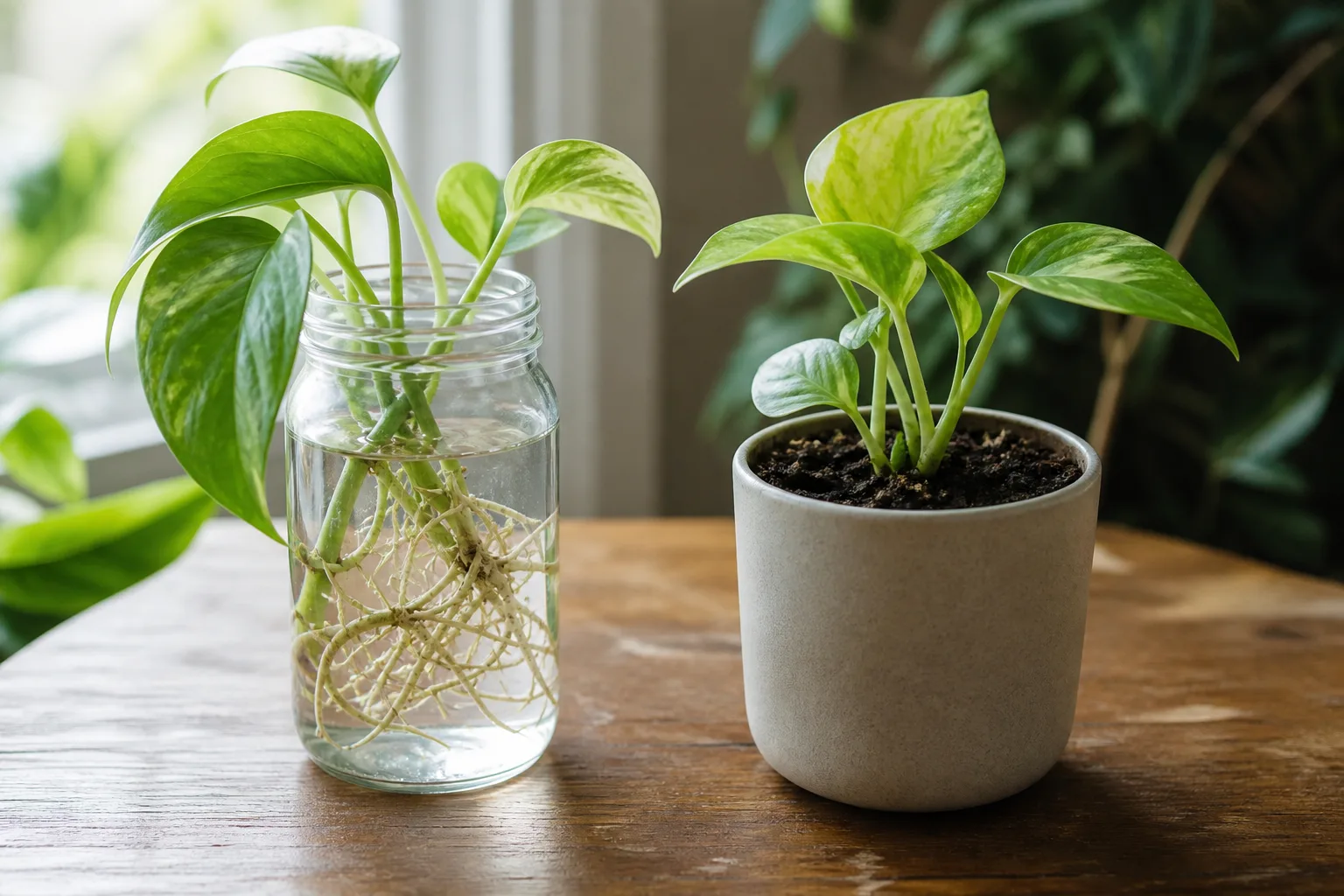
Place the cut end in a clean glass so the node sits under water and the leaf stays above the surface. Set the jar in bright indirect light, away from strong sun that heats the water. Top it up as needed and replace it if it turns cloudy or develops an odor; clean water and a warm, stable location matter more than a strict daily routine.
When the cutting has several firm roots about 1 to 2 inches long, move it into a small pot with pre-moistened, airy mix. Spread the roots gently instead of coiling them into a dense ball, cover the node, and water enough to settle the mix. Keep it a little more evenly moist for the first week while it adjusts, then return to the normal partial-dry watering cue. BBC Gardeners’ World Magazine outlines the same basic sequence: root a node-bearing cutting in water, then pot it once roots form.
Use soil when you want to skip the transplant
For direct soil rooting, place the lower node just beneath the surface of a small pot of lightly moistened mix. Keep the leaf above the medium, set the pot in bright indirect light, and keep the mix gently moist—not soaked—until the cutting resists a very light tug. If your room is dry, a loose clear cover can slow moisture loss, but open it daily for airflow and remove fallen leaves.
Soil-rooted cuttings often show no visible progress at first because you cannot watch the roots. Do not tug every day or add water whenever the surface changes color; check the mix with a finger and wait for new growth or resistance before assuming the cutting has failed. Gardening Know How’s pothos propagation guide recommends bright indirect light and spring-to-early-fall propagation when the plant is actively growing, though a healthy cutting can root outside that window in a warm room.
Repot only when the root zone has outgrown its setup
Roots emerging from the drainage holes are one clue, but they do not automatically mean the plant needs a bigger pot. Repot when the root ball is densely circling, the mix has broken down or stays wet for too long, or the plant is drying out much faster than it used to despite the same conditions. If the plant is healthy and the pot drains well, it can stay slightly snug.
Move it up only one pot size, roughly 1 to 2 inches wider, and use a container with drainage. Loosen only the outer circling roots, keep the plant at its old soil depth, and fill around the root ball with fresh airy mix. A huge pot holds more wet soil than the current roots can use, which can make a healthy plant harder to water. If you just bought a healthy plant, let it settle for a few weeks before repotting; UF/IFAS interior-care guidance advises avoiding repotting and fertilizer soon after shipment so the plant can adjust.
Diagnose yellow, brown, and sparse growth before changing care
The same leaf color can have more than one cause, so check the soil, pot, and light before changing the routine. A single old lower leaf that yellows and drops while the rest of the vine keeps growing is different from several leaves changing at once. If multiple symptoms appear together, start with drainage and root condition before adding humidity or fertilizer.
Yellow leaves: check moisture before light
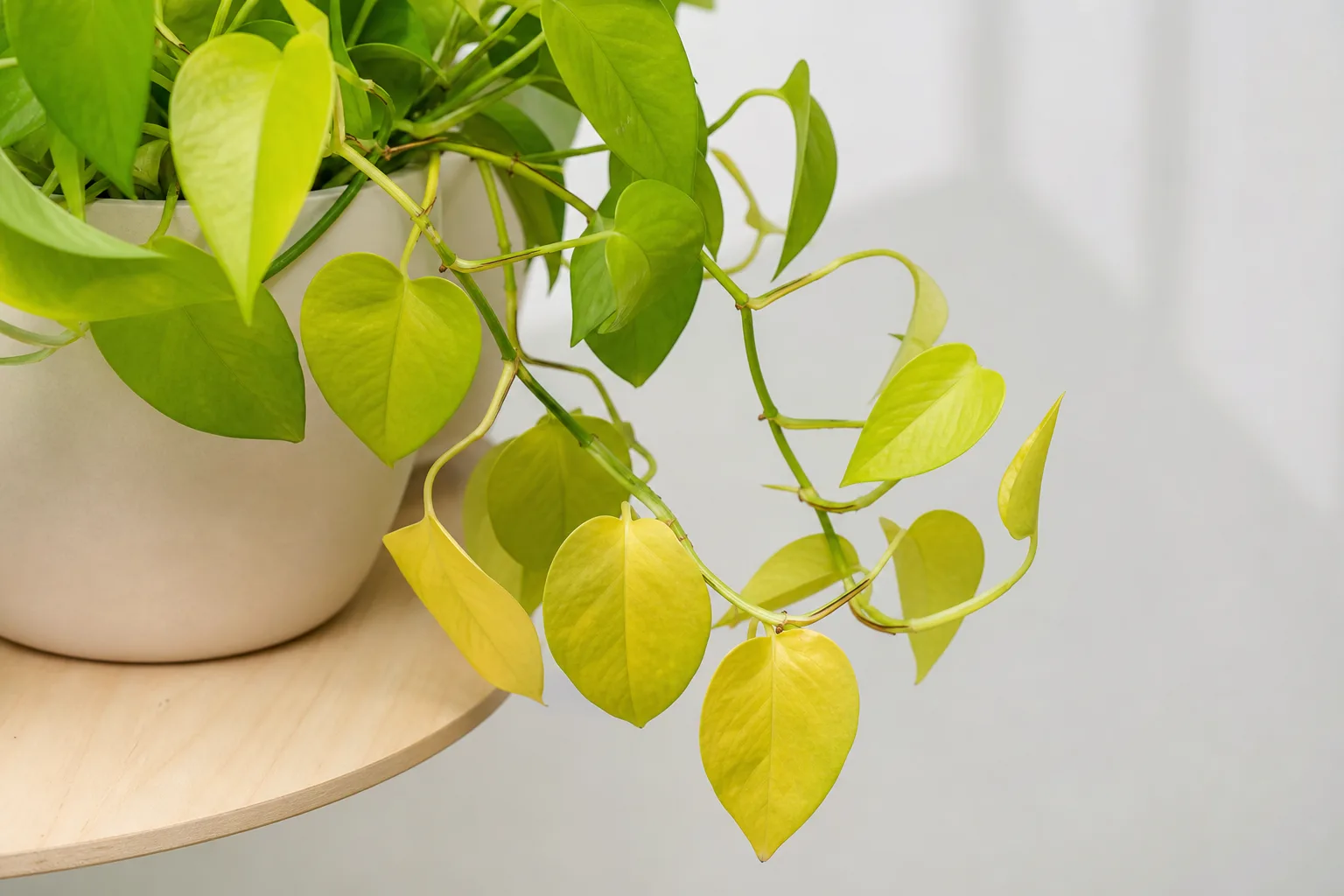
If several leaves yellow and the mix is wet days after watering, look for poor drainage, an oversized pot, or roots that have begun to rot. Slide the root ball out only if the plant continues declining; healthy roots should be firm, while dark, mushy, or foul-smelling roots need attention. Remove clearly dead roots with clean scissors, refresh the mix, and use a pot that drains before watering again.
If the mix is dry and the pot is light, a thorough drink may correct a drought-stressed plant. One older yellow leaf at the base can be normal leaf turnover, especially on a long vine, and it does not call for repotting. Wisconsin Extension notes that older pothos leaves eventually yellow and fall, while persistently wet conditions can produce root rot and further yellowing. Do not treat naturally chartreuse foliage as a yellow-leaf problem; look for a sudden change in multiple leaves or tissue that is soft, spotted, or declining.
Brown tips or patches: separate dry air from root trouble
A dry, crisp tip can follow a long dry-down, direct sun, salt buildup, or air blowing from a heater. Check whether the entire pot dried too far, whether damage is concentrated on the window-facing side, and whether fertilizer has been used more often or more strongly than the label recommends. Small old marks will not heal, so judge whether new leaves emerge cleanly after you correct the likely cause.
Brown patches with wet soil, yellowing, or a soft vine are more concerning for root stress than low humidity. Fix drainage and watering first, and avoid leaving the pot in standing water. The New York Botanical Garden distinguishes brown edges or spots associated with a drying root ball from yellowing and rotting stems associated with excess water retention; that is more useful than misting every plant with brown tips.
Bare vines: improve light before pruning
Long stems with few leaves usually point to too little usable light or a long period without pruning. Move the plant gradually to a brighter indirect spot and give new growth time to respond; old gaps will not fill in along the bare stem just because the room is brighter. Then cut back the sparsest sections and use healthy nodes to make new starts around the pot.
If only one side of the plant is sparse, rotate the pot a quarter turn every few weeks while it is actively growing, rather than turning it daily. A climbing support can also help organize a long vine, but a dark corner will still produce weak, widely spaced leaves. Give the plant a month or more to show whether the brighter placement is helping before making another major adjustment.
Inspect for pests before treating
Look over a new plant before placing it beside established houseplants, and check leaf undersides, stem joints, and the soil surface during routine watering. Mealybugs look like small cottony clusters; scale appears as firm brown or tan bumps; spider mites can leave fine webbing and stippled leaves. Fungus gnats hovering near the pot often indicate persistently damp mix, so letting the surface dry more between waterings may be part of the fix.
Isolate a plant with visible pests and wipe or rinse a small infestation before reaching for a spray. Repeat the inspection because eggs and hidden insects may survive one cleaning. If you use an insecticidal soap or another product, choose one labeled for indoor plants and the pest you identified, then follow its label exactly; do not combine homemade oils or detergent mixtures with commercial pesticides. NC State lists mealybugs and scale among pothos problems, and Wisconsin Extension describes their common hiding places on leaves and stems.
Keep pothos away from pets and chewing children
Pothos is not a pet-safe foliage plant. The ASPCA lists Epipremnum aureum as toxic to cats and dogs because it contains insoluble calcium oxalates; chewing can cause oral irritation and pain, swelling of the mouth or tongue, drooling, vomiting, or difficulty swallowing. The plant is not a food, and the safest choice is to prevent access rather than rely on an animal to avoid it.
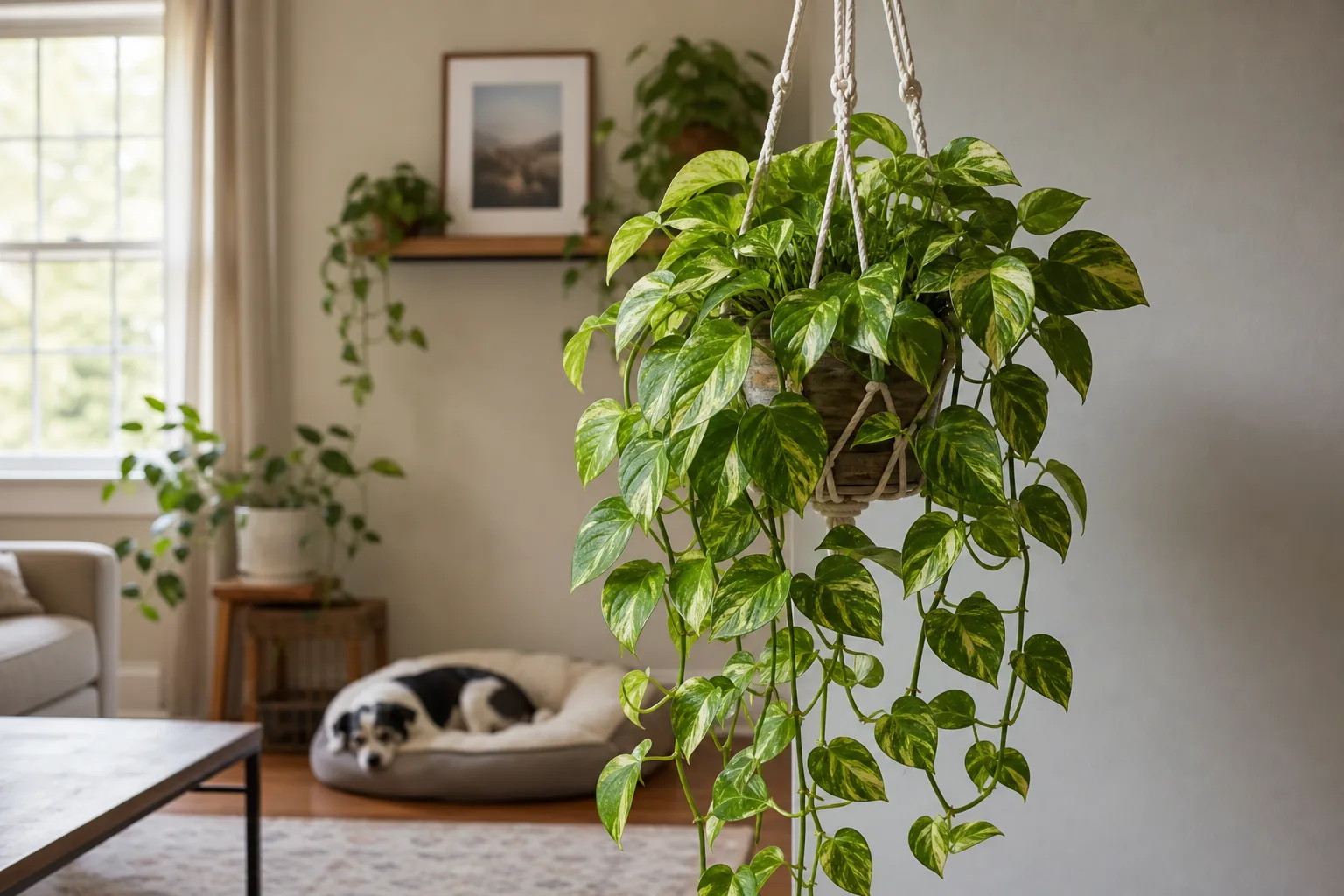
A high shelf is not enough if trailing stems hang within reach. Place the pot in a room or on a support that pets and children cannot access, collect trimmed leaves and cuttings promptly, and wash your hands after pruning. If a pet eats part of the plant or develops symptoms, contact a veterinarian or animal poison-control service for advice. ASPCA Animal Poison Control’s listing identifies the toxic principle and clinical signs; keep that information available before an exposure occurs.
Conclusion: make light and watering work together
Neon pothos stays easiest when you focus on two things: enough bright, indirect light to support compact, vivid new growth, and a root zone that drains and dries partway between thorough waterings. Put those in place first, then use pruning, modest feeding, and a pole or hanging basket to shape the plant the way you want.
When something looks wrong, check the recent pattern before changing several variables. Wet mix plus yellow leaves calls for a root and drainage check; a stretched vine calls for more light; isolated crispy tips call for a closer look at watering, direct sun, and salts. With a stable setup, neon pothos can trail, climb, or provide healthy cuttings for a fuller pot without demanding a complicated care schedule.