How to Grow and Care for Kalanchoe Thyrsiflora at Home
Grow Kalanchoe thyrsiflora with bright light, gritty soil, and dry-down watering. Learn to identify true paddle plant, protect it from frost, and save offsets.
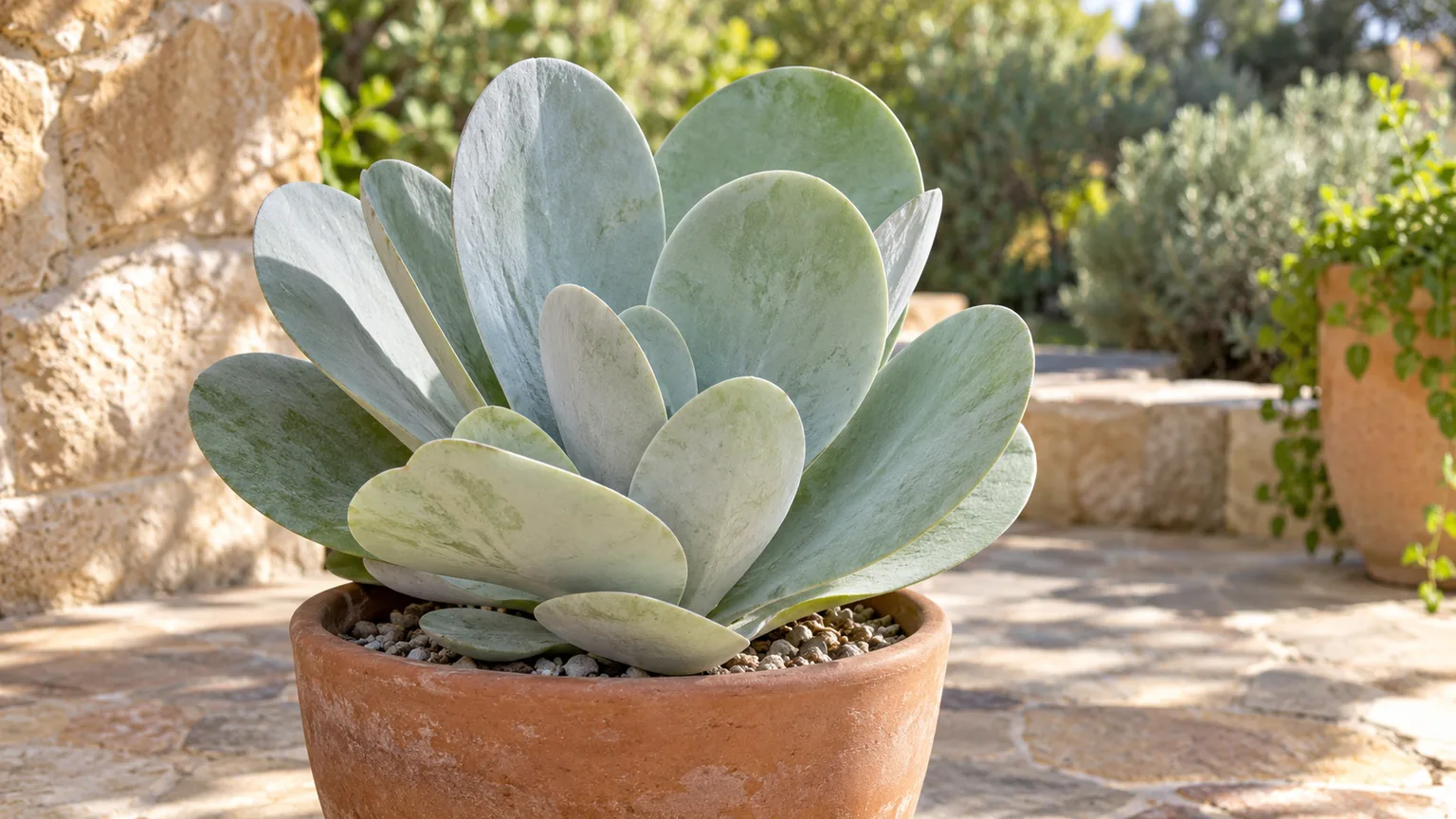
A healthy Kalanchoe thyrsiflora is a compact rosette of broad, upright paddles coated in a soft, chalky film. The plant is often sold as “flapjack” or “paddle plant,” names that can also refer to its look-alike relative, Kalanchoe luciae. That difference matters because a red-edged plant with less powder may be a different species than the label says, and many nursery plants are mislabeled. Start with the plant’s identity, then match its care to what you can provide: strong light, fast drainage, and a watering rhythm that follows the soil rather than the calendar.
Identify the True Paddle Plant
Both species form a basal rosette of fleshy, rounded leaves, and both come from South Africa. Their appearance also shifts with sun, temperature, and growing conditions, so a young plant may be difficult to identify from one photograph. The University of Wisconsin–Madison Extension notes that many plants sold as K. thyrsiflora are probably the more common K. luciae, and that flowering often makes the distinction clearer. Wisconsin Horticulture, University of Wisconsin–Madison Extension is the most useful field reference for this comparison.
Kalanchoe thyrsiflora vs. Kalanchoe luciae
True K. thyrsiflora tends to have smaller, slightly cupped, uniformly chalky leaves with a thick, flour-like coating of farina—the plant’s natural wax layer. It rarely develops the pink-to-red margins associated with K. luciae. The latter usually has less wax, larger flatter leaves, and more noticeable red or pink coloring along the edges when it receives strong light. Color is not a perfect test because lighting and stress can alter it, but heavy white powder with little margin color points more toward K. thyrsiflora.
Flowers can help confirm a mature plant. K. thyrsiflora bears yellow, fragrant flowers, while K. luciae flowers are paler and generally not noticeably scented, according to Wisconsin Extension. Until a plant blooms, treat the name on a retail tag as a clue rather than proof. The two species have similar cultivation needs, so you can grow a healthy specimen without a definitive identification; precise naming matters most when you want to describe or propagate the plant accurately.
Quick Care Snapshot
| Need | Practical target |
|---|---|
| Light | Bright light with several hours of direct sun after gradual acclimation; brightest available window indoors |
| Water | Soak the root ball when the mix has dried throughout, then let all excess drain |
| Soil | Airy succulent mix amended with coarse mineral material; avoid dense, moisture-retentive soil |
| Pot | Container with an open drainage hole, only slightly larger than the root ball |
| Temperature | Warm conditions; protect from frost and cold, wet soil |
| Feeding | Light feeding during active growth only; stop in fall and winter |
| Growth cycle | Rosette may flower once and die; offsets can survive and continue the plant |
| Pet safety | ASPCA lists Kalanchoe species as toxic to cats and dogs; keep the plant inaccessible |
These are starting points, not a fixed schedule. A small plant in a plastic nursery pot will dry at a different pace than a large specimen in porous terracotta, and a bright summer patio is not equivalent to a dim winter windowsill. Check the pot and soil before changing your watering routine.
Give It Strong Light Without Sunshock
This succulent needs more light than a typical leafy houseplant. Outdoors, a settled plant can grow in full sun or part sun; indoors, place it at the brightest available window, often a south- or west-facing one in the Northern Hemisphere. If the rosette stretches, leans toward the glass, or produces widely spaced leaves, light is probably too weak. Moving it to a sunnier position gradually is more effective than compensating with fertilizer.
Indoor light and outdoor acclimation
A plant raised under greenhouse shade can scorch if you put it straight into strong afternoon sun. For an outdoor move, begin in bright shade or gentle morning sun and add direct exposure over a week or two. Watch the leaf surfaces as you increase light: dry tan patches on the sun-facing side suggest the change was too abrupt, while a tighter, more compact rosette is a sign that the plant is receiving better light. In very hot climates, a place with morning sun and some protection from the most intense afternoon heat may be easier to manage than a western wall that reflects heat.
Indoors, rotate the pot periodically if the rosette bends toward one window, but do not expect an ordinary room to substitute for strong daylight. A bright grow light can help if the plant has no sunny window; position and run it according to its manufacturer’s distance and timing guidance rather than guessing from wattage alone. If winter light drops sharply, reduce watering as growth slows instead of keeping a summer routine.
The powder on the leaves is not a sign of poor health. Avoid rubbing, polishing, or repeatedly handling the paddles: farina helps protect the surface, and fingerprints or wet smears can leave permanent marks. Wisconsin Extension describes the protective coating and the difference in its density between the two flapjack species. A plant with rubbed patches can still grow well; new leaves will carry their own coating.
Use a Fast-Draining Mix and Stable Pot
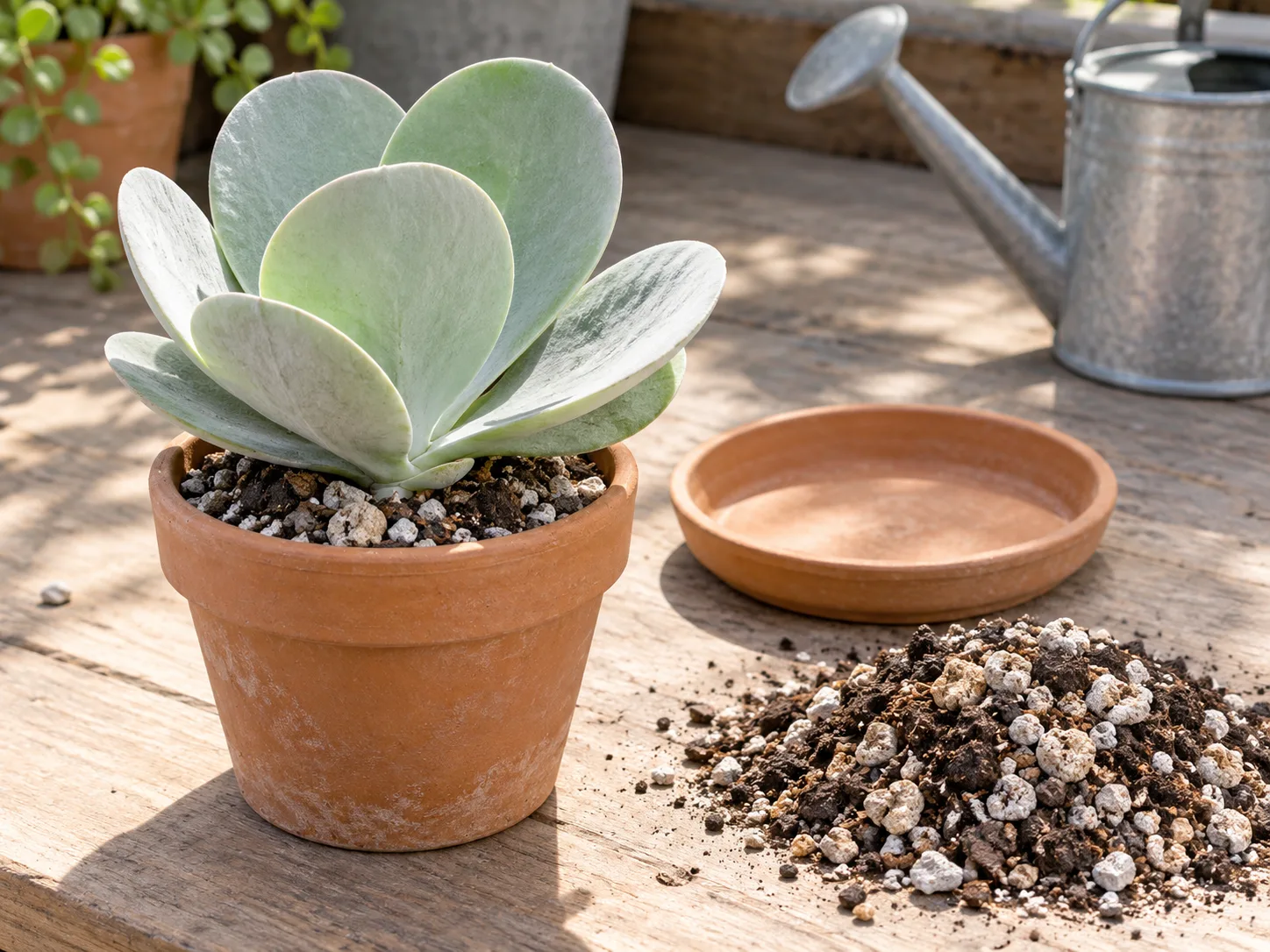
The root zone should get thoroughly wet when you water and then dry efficiently. Use a commercial cactus or succulent mix as a base, but check how it behaves in your home: if it stays cool and damp for many days, amend it with pumice, perlite, or coarse horticultural grit. A practical starting blend is roughly two parts potting mix to one part mineral amendment, adjusted toward more grit in a humid home or a pot that dries slowly. Avoid fine sand or garden soil, which can pack down and hold water around the roots.
A drain hole is essential. A cachepot without drainage can be used as an outer cover only if you remove the nursery pot for watering and empty any water that collects at the bottom. Do not add a layer of gravel to the base as a substitute for drainage; it does not correct a dense mix or a closed pot. Use an unglazed terracotta container if your space is humid or you tend to water too often, but remember that porous clay dries faster and may require more frequent checks in hot weather.
Choose a pot only modestly wider than the root ball. An oversized container holds a larger volume of wet mix than the plant can use, increasing the time roots remain damp. Because the leaves can spread and a flowering stalk may grow several feet tall, favor a stable, broad-based pot over a tiny decorative cup that tips easily. Set it on a saucer that you can empty after watering.
Water by Dry-Down, Not by Calendar
Water deeply enough to wet the root ball, then let the pot drain completely. Wait until the growing mix is dry throughout before watering again. “Every Sunday” is a poor rule for this plant: frequency changes with pot size, soil, temperature, light, and season. A small terracotta pot in bright summer light may dry in a few days; a larger plastic pot in a cool room may remain damp much longer.
To check, push a wooden skewer into the mix near the pot’s edge or feel the mix below the surface rather than judging only the top layer. If the skewer comes out cool or with damp particles, wait. You can also lift the pot after watering and again when it is dry; the difference in weight becomes a quick cue. When it is time, water the soil evenly until liquid exits the drainage hole, then empty the saucer. Frequent small sips wet only the upper roots and make it harder to judge whether the lower mix has dried.
Diagnose thirsty leaves vs. root trouble
A thirsty plant may develop slightly soft or wrinkled leaves, especially after a long dry period. If the mix is bone-dry and the roots look healthy, give it a full drink and let it drain; the leaves should gradually firm up. Do not keep repeating the watering if there is no improvement, because damaged roots cannot take up water normally.
Soft, yellowing, translucent, or mushy leaves—especially at the base—point more toward excess moisture or root rot than thirst. If that happens, stop watering and inspect the roots and stem base. Healthy roots are firm; dark, slimy roots or a soft central stem need prompt attention. Remove rotted tissue with a clean blade, let any cuts dry, and repot surviving healthy material in fresh, dry, fast-draining mix. If the entire crown is collapsing, take a healthy offset or stem section before the rot reaches it, if one is available.
Season changes are a major reason the same plant suddenly starts having trouble. During active spring and summer growth, the mix can dry more quickly, especially outside. In winter, indoor light and evaporation fall, so wait longer between waterings and use the soil’s condition—not a monthly target—to decide. This measured dry-down approach is also consistent with the practical guidance for other Kalanchoe and succulent species from Savvy Gardening and Epic Gardening; those articles cover different species, so use them for general technique rather than as species-specific schedules.
Manage Temperature and Seasonal Changes
Paddle plants prefer warm, relatively dry conditions and are not reliable frost-hardy garden plants. In a cold-winter region, grow the plant in a container so you can move it before frost. The Wisconsin Extension flapjack profile says leaves can be damaged around 30°F and plants may survive temperatures in the mid-20s under some conditions; those figures are not a safe target for a rare or misidentified specimen. Protect the plant before freezing weather, and do not assume a dry-looking plant can tolerate cold, wet soil.
If the plant spends summer outside, bring it in before frost and inspect it for insects first. Give it a place with strong light and good air movement, then reduce watering to match slower winter growth. Avoid placing it against a cold pane, next to a heating vent, or in a closed, humid bathroom. Ordinary indoor humidity is usually adequate; misting adds no useful benefit and leaves water sitting on the farina-coated leaves.
In warm, frost-free climates, the plant can be grown outside in a raised or well-drained bed, a gravel garden, or a container. Choose a site where rainwater does not pool around the crown. If your local winters are cool or rainy even without hard freezes, container culture offers more control over both temperature and drainage.
Feed Lightly and Prune Only With a Reason
This is not a heavy feeder. If the plant is growing steadily in fresh succulent mix, it may need little or no added fertilizer that year. Otherwise, apply a balanced liquid fertilizer at half strength once or twice during spring and summer, watering first if the mix is dry. Stop in fall and winter, when low light and slower growth make fertilizer less useful. Excess nitrogen can produce soft, stretched growth that is less stable and less attractive than the compact rosette you are trying to maintain.
Routine shaping is unnecessary. Remove only dead lower leaves or a spent flower stalk, using clean shears and taking care not to scrape the farina from healthy paddles. A tall central stalk is not a pruning emergency; it is the plant’s flowering structure. If you want to enjoy the flowers, leave it in place. If it has finished and looks untidy, cut the stalk near its base after checking that viable offsets remain.
Repot When the Root Ball Needs It
Repot in spring or early summer when roots circle the container, grow through the drainage hole, or the mix has broken down and stopped drying predictably. A plant that dries unusually fast may also be root-bound, but fast drying alone is not proof: heat, terracotta, and active growth can cause the same pattern. Slide the plant out gently and look at the roots before choosing the next pot.
Move it into a container one size larger, not several sizes larger. Loosen only the outermost compacted soil and remove dead roots; avoid tearing healthy roots to make the root ball fit. If you cut or bruise roots, let the wounds dry before returning to normal watering. Otherwise, repot with dry mix and resume watering cautiously once the plant has settled. Keep the rosette above the soil line so moisture does not sit between the lower leaves and stem.
Propagate Offsets Before the Mother Rosette Blooms
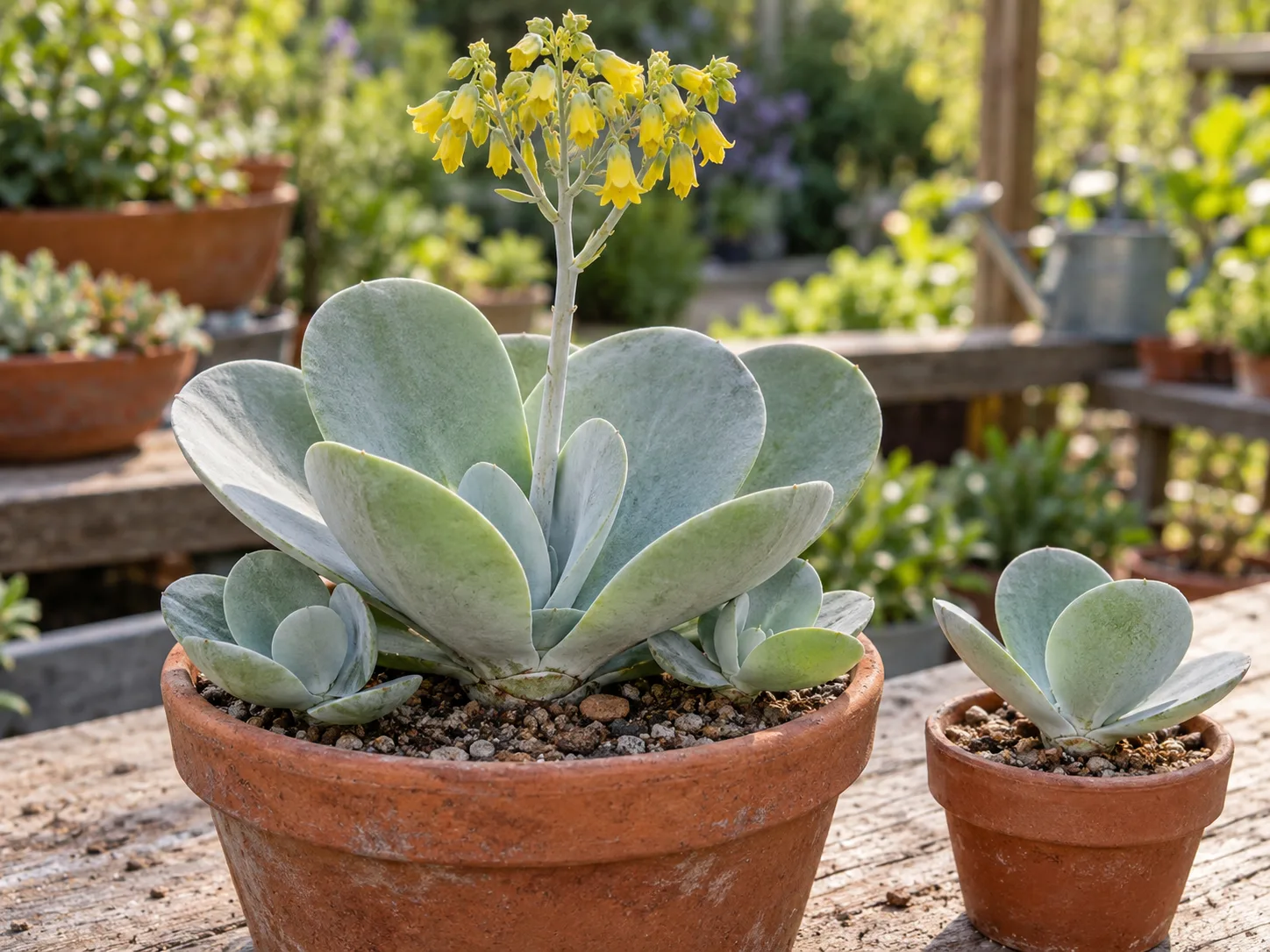
The easiest way to continue a paddle plant is usually to keep one or more offsets. Mature plants may produce small rosettes at the base or along the lower part of the flower stalk, particularly around flowering. Because the main rosette is monocarpic, planning before it blooms gives you a better chance of preserving the plant’s next generation. A healthy offset with its own roots is more dependable than trying to force a leaf to grow.
Separate rooted offsets and handle leaf cuttings
Wait until an offset is large enough to handle and has formed roots, if possible. Remove the plant from its pot, brush away enough mix to see where the offset joins the parent, then separate it with clean shears or a clean knife. Keep the new rosette upright and do not bury its leaves. If the cut surface is wet or damaged, leave it in a shaded, airy spot until dry before planting in a small pot of succulent mix.
Set a newly planted offset in bright indirect light while it establishes; move it into stronger sun gradually after it begins to root and grow. Avoid keeping its mix constantly damp. A young plant has less stored water than a mature one, but repeatedly wet soil is still more dangerous than a short dry interval. If it resists a gentle tug after a few weeks or begins producing new leaves, roots are likely anchoring it.
Leaf propagation is possible, but it is slower and less predictable than a rooted offset. A cleanly removed leaf may root in a light succulent mix after the cut end dries, though not every leaf will produce a new rosette. The general Kalanchoe propagation methods described by Epic Gardening emphasize clean cuts and allowing wounds to dry; use those steps as a cautious starting point, not a guarantee for every K. thyrsiflora leaf. Seed is another option for patient growers, but it is not the simplest way to make a matching plant at home.
Understand the Tall Flower Spike and Monocarpic Cycle
A mature rosette can send up a central flowering stalk several feet tall, with clusters of small yellow, tubular flowers. Wisconsin Extension places flapjack bloom in late winter to early spring when plants receive enough light and protection through winter; exact timing shifts with climate and indoor conditions. True K. thyrsiflora flowers are strongly fragrant, another clue that may help distinguish it from K. luciae. A flowering plant can look suddenly tall and unusual, but the central stalk is a normal part of its life cycle.
The rosette that flowers is monocarpic: after flowering, that rosette dies. That does not necessarily mean every plant in the pot is lost. Offsets may remain at the base or lower on the flower stalk, and those can be separated and grown on. Keep the flowering plant stable while it blooms, then inspect the base and stalk for offsets before discarding anything. If you do not want the flowers, cutting the stalk will not reverse the plant’s biological cycle; it may still decline after flowering.
Troubleshoot Wax, Stretching, and Damaged Leaves
The most useful first step is to read the pattern rather than react to one imperfect leaf. A lower outer leaf slowly drying as the plant grows can be normal. Several leaves changing at once, a soft center, new elongated growth, or damage concentrated on the window-facing side points to a different cause. Check the soil and light before adding water or fertilizer.
Yellowing, softness, wrinkles, and sun marks
- Smooth, even white coating: This is natural farina, not dust or mildew. Do not wipe it off; the old leaf may remain marked where the coating is rubbed away.
- Yellow, translucent, or soft leaves: Check for a wet mix, water trapped at the base, and a pot without free drainage. Let the mix dry and inspect roots if the stem is soft.
- Firm but wrinkled leaves: If the root zone is dry, water fully. If the mix is wet, inspect roots instead of watering again.
- Long stem and widely spaced leaves: Increase light gradually. The plant is stretching for light; fertilizer will not fix the underlying cause.
- Dry tan patches on one side: Consider sun scorch, especially after moving the plant outdoors or closer to glass. Return it to bright indirect light and acclimate more slowly.
- Irregular cottony clusters: Look closely for mealybugs rather than assuming every white mark is farina. Insects cluster at leaf joints and may leave sticky residue.
Do not scrub, polish, or spray the whole plant to “clean” its powdery surface. Water spots and handling marks can be permanent, and oily products may disturb the coating. If a leaf is badly damaged, wait until it is fully dry or clearly declining before removing it; green leaves still store water and support growth.
Check for Mealybugs, Scale, and Aphids
Inspect where leaves meet the stem and around the base of the rosette. Mealybugs look like small cottony clusters, scale appears as firm bumps attached to the plant, and aphids tend to gather on tender new growth or flower stalks. Isolate an infested plant before treatment so pests do not spread to nearby succulents.
For a small infestation, remove visible insects with a cotton swab or a soft cloth, taking care not to rub broad areas of farina. Repeat inspections every few days because hidden insects can reappear. If you use insecticidal soap or another pesticide, follow the product label and test a small area first; succulents can mark or burn, particularly under strong sun. Recheck the plant and neighboring pots for several weeks rather than assuming one treatment solved the problem.
Keep the Plant Away From Pets and Curious Children
The ASPCA lists Kalanchoe spp. as toxic to cats and dogs, with bufadienolides as the toxic principle and vomiting, diarrhea, and—more rarely—abnormal heart rhythm among possible signs. ASPCA Animal Poison Control and Pet Poison Helpline advise prompt veterinary or poison-service guidance if an animal eats the plant. Keep the pot in a location that pets cannot reach, especially if they chew leaves or knock over containers.
Do not treat the plant as edible, and wash your hands after handling damaged plant material. If a child or pet may have eaten any part, contact a medical professional, veterinarian, or poison service for case-specific advice rather than waiting for symptoms or trying a home remedy. The plant is easy to keep safely when placed out of reach, but its ornamental value is not worth leaving it where a curious animal can nibble it.
Conclusion
Kalanchoe thyrsiflora is easiest to grow when you treat it as a bright-light, fast-draining succulent and pay attention to the plant’s actual drying conditions. Confirm the species as best you can, protect the natural leaf coating, water only after the mix dries through, and bring outdoor pots in before frost. If the rosette sends up a flower spike, enjoy the bloom and check for rooted offsets before the parent rosette fades. Those few decisions prevent most avoidable problems and give the next generation a strong start.



