How to Mount and Care for a Staghorn Fern
Learn how to mount a staghorn fern on wood, cork, a basket, or a tree, then water and secure it without trapping moisture or damaging its shield fronds.
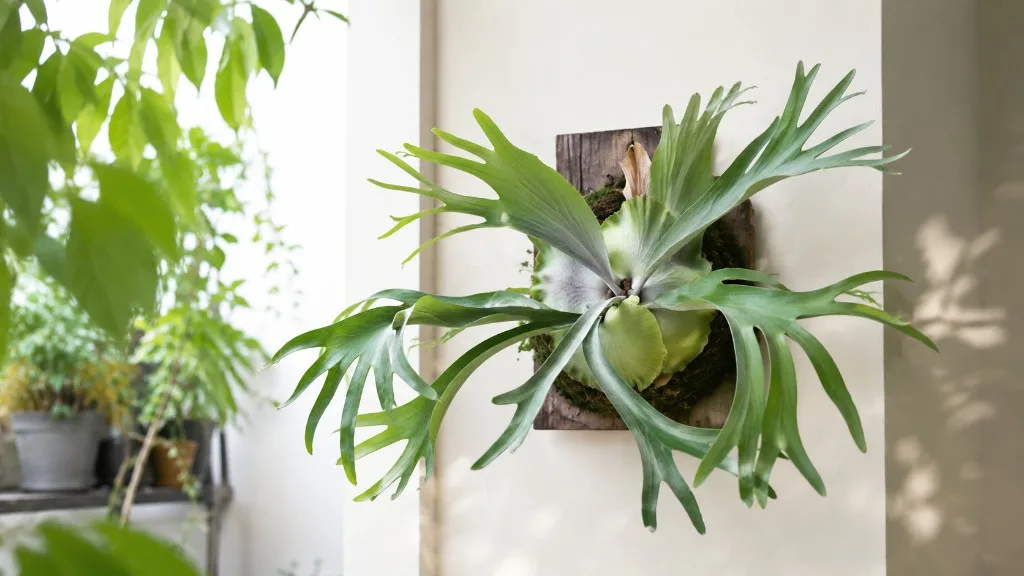
A staghorn fern can grow on a board, cork slab, wire basket, or tree, but “any surface” has practical limits. The support must hold the plant when its moss is wet, allow air around the roots, and make it possible to water the root pad without leaving it saturated for days. Choose the mount around those needs first; the decorative shape comes second.
The common houseplant Platycerium bifurcatum is an epiphyte. In nature, it clings to trees rather than rooting in soil, and it produces two very different frond types: flat shield fronds against the support and long, forked antler fronds that project outward. A mount recreates that attachment without making mounting mandatory: a staghorn can stay in a roomy, well-drained pot if that setup is working for you.
Does a staghorn fern need to be mounted?
No. Mounting suits the fern’s epiphytic growth and makes its form visible, but it is a display choice, not a survival requirement. The NC State Extension profile for Platycerium bifurcatum notes that staghorn fern can be grown as a houseplant in a container or hanging basket as well as on a slab of wood or bark. If your plant is healthy in a pot and you do not want a wall-mounted plant, there is no horticultural reason to bare its roots and remount it simply for appearance.
A mount does change the care routine. A small pot holds more water than a thin moss pad, while a board-mounted root pad dries faster in warm air, bright light, or a breezy spot. If you cannot lift the display down for soaking, cannot reach it safely, or have no secure place to fasten its wet weight, choose a pot or a supported basket instead.
Check the plant before you start. If the shield fronds and root mass are firm and the antler fronds are not collapsing, mount it during active growth when you can give it a stable, warm, bright-indirect-light position. A severely dehydrated, rotting, recently divided, or pest-covered fern needs recovery first; adding the stress of unpotting and tying it to a new surface makes diagnosis harder.
Choose a surface that fits the plant and your space
Pick a surface by asking four questions: Can it support the plant after watering? Does it drain and dry between soaks? Can the fern’s roots and shields attach without being pierced? Can you take the plant down or reach it when it needs water? A “yes” to all four matters more than whether a material is trendy.
Wood plaque or slab
A stable plaque or broad slab is the easiest first mount for a small or medium staghorn. It gives you a flat area for the moss pad, clear points for tying the plant, and a back where you can install a hanger. A rot-resistant, unfinished board is a practical choice; avoid a thin decorative piece that can warp or split after repeated wetting.
Leave room for the shield fronds to expand beyond the original root pad. The plant does not need a huge board at first, but a mount that is only just larger than the fern may need extending sooner. If a specimen becomes too heavy to handle, attaching the old plaque to a larger board can be less disruptive than prying an established fern off its roots.
Wire basket or open cradle
A wire basket works well for a larger plant or one that is going to live outdoors in a sheltered climate. Gardening Know How also compares baskets, wood, rock, and tree mounts, emphasizing that the support must be secure enough for the individual surface. The open structure allows drainage, and pups can eventually grow around the sides. It also lets the plant become a rounded mass rather than a flat wall display.
The trade-off is that an open basket exposes more of the root pad to air. That can mean faster drying indoors, especially near a heater or in a dry room, and it can be awkward to dunk a large, full basket in a sink. Choose a basket with a shape that holds the moss securely, a mesh small enough to contain the growing medium, and a suspension point rated for the wet plant’s weight.
Cork, rock, or living tree
Cork bark is light and naturally irregular, so it can suit a small fern when there is enough depth to hold the root pad. A stone is less forgiving: it is heavy, has fewer easy tie points, and can stay cool or wet in a damp location. With either, use a separate hanger or cradle that supports the material; do not assume a fern’s tie line is also a safe hanging system.
A living tree is an outdoor option only where the plant’s species and climate fit. UF/IFAS Gardening Solutions says staghorn ferns thrive in Florida heat and humidity but need protection from freezes; cold tolerance varies among species. In Florida, the UF/IFAS Assessment of Non-native Plants also advises planting P. bifurcatum with caution and managing it to prevent escape into natural areas. Follow local guidance before installing one outside, and never treat a warm-climate exception as permission to naturalize it.
If attaching to a tree, use a broad, soft, weather-resistant tie around a small board or basket rather than driving nails into the trunk. Keep the tie loose enough that it cannot girdle the tree as the trunk grows, and inspect it regularly. Avoid trunks in full, hot sun, locations exposed to strong wind, and trees where falling leaf litter will bury the fern’s crown.
Gather materials and prepare the mount
For a board mount, gather the fern, a sound board, damp sphagnum or another airy epiphytic medium, non-copper fastening material, corrosion-resistant anchors for the mount, a hanger, and a basin or towel for watering. Use hardware sized for the board and plant rather than choosing it by appearance. A mounted fern gains weight when saturated, and the wall attachment must bear the board plus the wet root pad with a margin for handling.
Soak dry sphagnum before assembling the pad, then squeeze it until it is moist but not dripping. Dry moss can pull water away from roots at the start, while a compressed, dripping mass can stay airless. You want a springy layer that covers the root area and holds moisture while excess water can drain away.
Lay the board flat and decide the plant’s top edge before adding hardware. If using nails or screws as tie anchors, place them outside the area where roots and shields need to grow. Do not use copper wire: UF/IFAS specifically excludes copper from its suggested mounting materials. Keep every sharp point, staple, or screw away from the plant’s crown and roots.
Mount a potted staghorn fern step by step
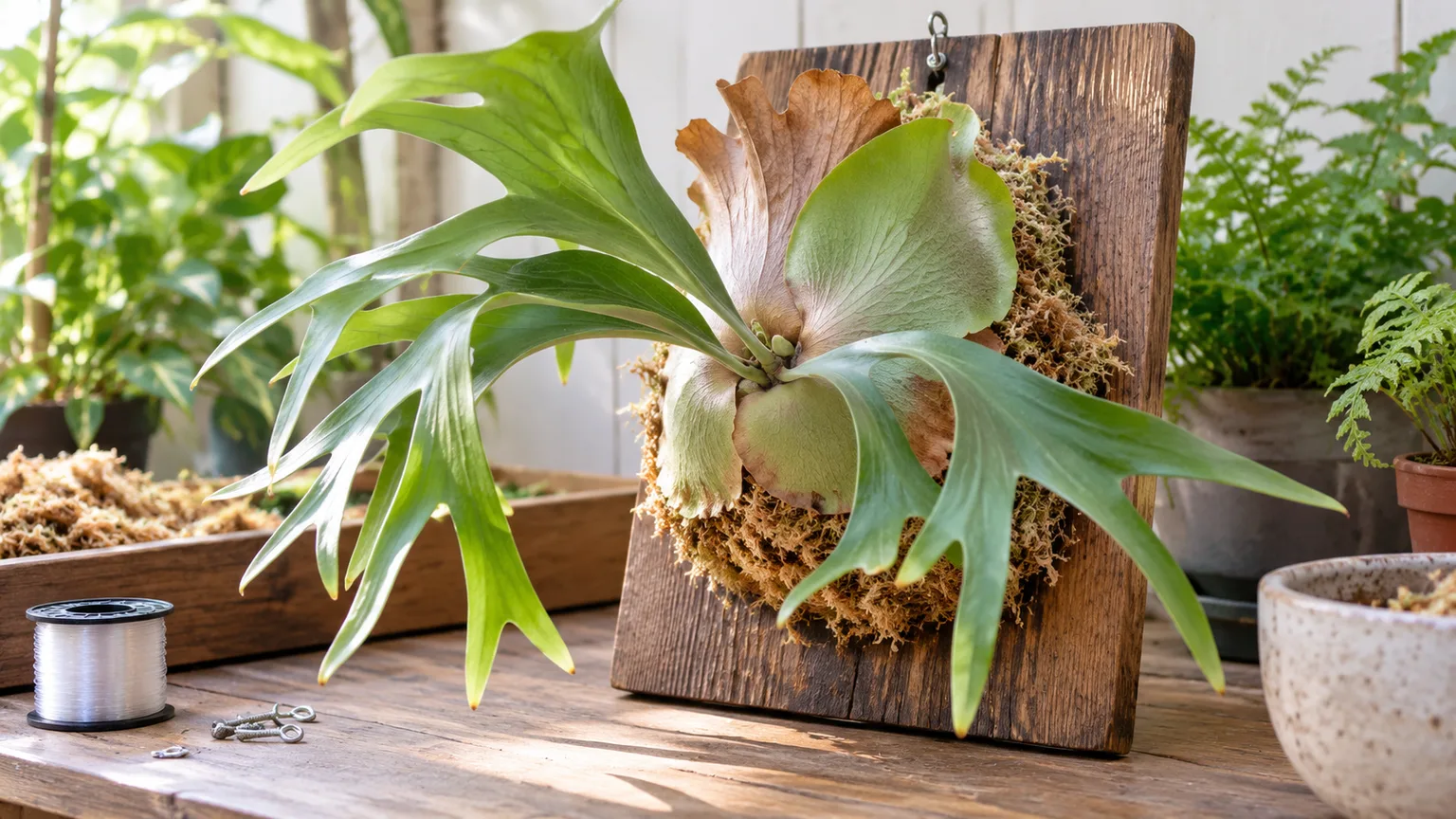
Work on a stable table, not while holding the board in the air. Test-fit the plant first, and have the line cut to a usable length before your hands are wet. If the fern is large, ask someone to steady the board while you position and tie the plant.
-
Remove the pot carefully. Slide the root mass out without pulling on the antler fronds. Brush away only loose potting mix from the outside; do not scrape or wash every root clean. If the center is a dense soil plug that holds water, gently tease the outer surface open enough to fit against the mount, preserving the healthy roots and any pups.
-
Make a shallow moss pad. Put a layer of damp sphagnum on the board where the roots will sit. Shape it slightly larger than the root pad and thick enough to cushion it, but do not build a deep, packed ball that will remain wet inside.
Position the shield and antler fronds
-
Set the fern in its natural orientation. Place the root pad against the moss, with the shield fronds facing the support and the antler fronds directed outward. Position the crown—the point where new fronds emerge—so it is not buried under moss or trapped beneath a tie. Leave the shield-frond edges visible; they will expand over the support as the plant grows.
-
Add only the moss that the roots need. Tuck damp moss around exposed roots and the outside of the root pad to keep it from drying too quickly. Do not cover the crown, pack moss between emerging fronds, or wrap the entire plant in a wet blanket. More moss is not better if the middle cannot dry or air cannot reach the base.
Tie the plant in without constricting growth
-
Anchor the pad. Tie nylon line or another non-copper, plant-safe fastening material from one anchor point across the moss and root pad to an anchor on the opposite side. Repeat in a loose crisscross pattern until the plant cannot slide when you gently lift the board. Route line around the root mass and over sturdy shield areas rather than across the tender growing point or pinching a frond.
-
Check the tension and drainage. The line should hold the plant firmly without cutting into the shields or flattening the moss into a hard disk. Turn the board upright briefly; if the plant shifts, add another support pass. Then water the mount over a sink or outside and make sure water runs through instead of pooling behind the root pad.
The same basic sequence works with cork and a basket, but the anchor points differ. The board-and-line approach follows practical methods described by Get Busy Gardening, with additional checks here for crown clearance, drainage, and wet hanging weight. For a basket, place the moss pad inside the bowl and secure the fern through the mesh with soft line; for cork, choose existing holes or add anchors before the plant is in place. Do not substitute adhesive as the only support: watering and temperature changes can weaken a bond, and the mount still needs a mechanical connection.
Hang the fern where you can reach it
A mount that is difficult to water is a poor mount, even if it looks perfect on the wall. Before hanging it, weigh or hold the saturated board and plan for that heavier condition. Attach the hanger to the board itself with hardware appropriate for the material, then fasten the wall side to a stud, masonry anchor, or another support rated for the load; a small picture hook in drywall alone is not a safe bet for a heavy wet fern.
Choose bright, indirect light or filtered shade. NC State Extension describes P. bifurcatum as suited to dappled sun through partial shade, while UF/IFAS warns that very low light can encourage disease and pests. An east-facing window or a bright position screened from intense midday and afternoon sun is usually easier than a dark corner or a hot, exposed glass wall.
Leave clearance for antler fronds to grow and for the board to come down for soaking. Indoors, a bathroom can help with humidity only if it is bright enough; a nearby humidifier is more controllable than keeping the fern in a dim room. Outdoors, shelter it from scorching sun, harsh wind, and freezing conditions. If you move a houseplant outside for warm weather, acclimate it to brighter conditions gradually and bring it back in before cold nights threaten the particular species.
Water the root pad without leaving it soggy
Water the growing medium, not a calendar. Feel the moss behind the root pad and lift the mount to learn its dry weight; when the pad is approaching dry and the board feels noticeably lighter, soak it thoroughly, then let it drain. A light mist on fronds does not replace wetting the root pad.
For a manageable plaque, place it in a sink or basin and soak the root pad for about five minutes, or run room-temperature water over the back until the moss is evenly saturated. This soak-and-drain method is also outlined by Pistils Nursery. Let it drip until water stops running before rehanging. For a large basket or tree-mounted fern, water slowly over the root pad and confirm that the center was reached; a quick spray across the fronds can leave the roots dry.
Once a week during warm, dry weather is a reasonable starting check, not a fixed rule. A small moss pad in a heated room may need water sooner; a large basket in cool, humid weather may stay moist much longer. UF/IFAS recommends watering less in cool or cloudy weather and warns that an overwatered staghorn can rot. If the root pad remains wet for days, increase airflow and wait longer between soaks instead of watering on schedule.
Do not panic at the first slight droop, but treat it as a prompt to inspect the pad. A dry fern often perks up after watering; a plant with dark, soft tissue at the base or a sour smell may have rot, and adding more water will worsen it. Check the medium and root area before diagnosing any change from the antler tips alone.
Maintain the mount as the fern grows
The fern will gradually spread its shield fronds over the support, and the mount may become a small colony as pups develop. That growth is a sign the support is being used; it is not a reason to peel off healthy shields or trim brown basal fronds. NC State Extension explains that shield fronds trap debris and cover the root crown, and UF/IFAS notes they naturally age from green to brown.
Keep the mount clean enough that fallen leaves do not smother the crown or hold the root pad continuously wet. Remove loose debris by hand without scraping shields, and check tie points, board cracks, hanger screws, and tree straps each season. A mount outdoors also needs a frost plan: move a removable board indoors or to a protected space before a freeze rather than waiting for cold injury to appear.
Fertilizer is optional for establishing a fresh mount. Once the plant is growing steadily, UF/IFAS recommends a balanced fertilizer according to label directions, with more frequent feeding for young plants than mature specimens. Use a dilute liquid feed during active growth, let it drain through the pad, and avoid leaving concentrated fertilizer salts on the shields.
Know when to extend, remount, or divide
A fern does not need to leave its mount just because its shields reach the edge. UF/IFAS says staghorns tolerate crowded conditions; Pistils Nursery describes extending the existing plaque by fastening it to a larger board as a way to avoid disturbing the established plant. This is usually the gentler option when the original mount remains sound and there is room to attach another board.
Remount when the support is rotting, cracked, too small to hold the plant securely, or impossible to water and drain properly. If the shield fronds have grown well beyond the board, choose a larger support and work slowly so you do not tear through the root mass. A very large specimen may be safer left crowded or divided by an experienced grower than lifted and flattened onto a new plaque.
If pups are emerging, do not remove them simply to make the display look tidy. Wait until an offset has its own shield growth and roots, then divide only if it can be separated without slicing through the parent crown. A division may be mounted with the same damp-pad method, but it will need close monitoring while it establishes.
Troubleshoot a loose, dry, or rotting mount
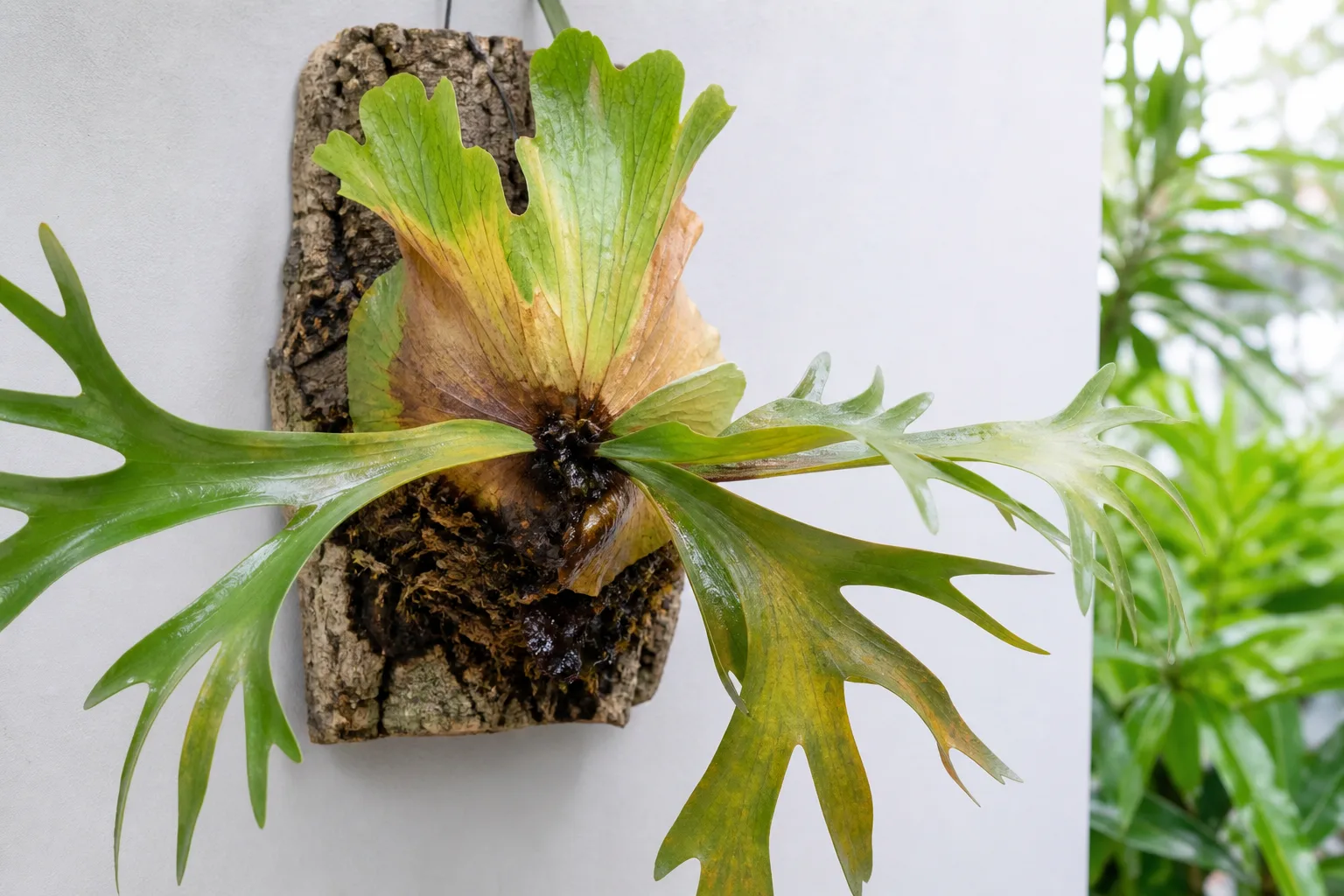
Use the symptom and the root pad together. Dry tips do not automatically mean underwatering, and brown shields are not automatically damage. Before changing the routine, check whether the medium is dry, wet for too long, or simply covered by the plant’s normal aging shields.
- The fern slips or tilts: Take the board down and check the line, anchors, and moss. Add support around the root pad, not through the crown; if the board is splitting or the hardware is loose, remount onto sound backing before rehanging.
- The moss dries very quickly: Move the plant away from hot sun, a heater, or a strong draft. A slightly deeper moss pad or an open basket liner can buffer drying, but do not pack the mount so tightly that the center stays wet.
- The root pad stays wet or smells sour: Pause watering and improve airflow. If the pad remains saturated, remove excess packed medium and inspect for soft, dark roots; a sick plant may need a drier, better-drained support rather than more misting.
- Shield fronds turn brown: Older shields normally become brown and papery while protecting the roots. Leave them in place; remove only tissue that is completely loose and dead, and do not cut into living green shields.
- Antler fronds develop dark patches or collapse at the base: Check for prolonged wetness, poor airflow, cold exposure, or direct sun before adding fertilizer. If the base is soft, isolate the plant from other houseplants and correct the growing conditions; persistent disease symptoms may need local extension diagnosis.
- The wall or tree mount moves: Remove the fern until the support is repaired. The weight increases after watering, so do not rely on a loose wall hook or a tight tree strap to hold it indefinitely.
Conclusion
A good staghorn fern mount is stable, airy, and easy to water. A plaque offers the clearest first project, while a basket suits a plant that needs room to round out and a tree is an outdoor choice for climates that can support the species. Whatever surface you choose, preserve the root pad and crown, keep copper out of the fastening system, and secure the wet weight independently from the plant’s tie line.
After mounting, water when the moss is nearing dry, drain the plant before rehanging, and give it bright filtered light with protection from cold and harsh sun. Leave normal brown shields in place, inspect the hardware as the fern grows, and extend the board before a healthy plant becomes difficult to handle. If the mount makes those steps impractical, a well-drained pot is still a sensible way to grow the fern.