Hydrangeas in Winter: Which Types Need Protection?
Hydrangeas in winter need different care by species. Protect old-wood buds, insulate roots, water when needed, and avoid pruning away next season’s flowers.

A hydrangea can come through winter alive and still fail to flower. That difference explains why a shrub may leaf out normally after a cold season but produce few or no blooms: its roots survived, while flower buds on last year’s stems did not. The right winter care depends on which part of the plant you need to protect, what kind of hydrangea you have, and how exposed your garden is.
Most established hydrangeas do not need to be wrapped simply because the calendar says winter. In many gardens, the useful jobs are simpler: water before the ground freezes if autumn has been dry, insulate the root zone with a modest mulch layer, keep tools away from old-wood stems, and protect vulnerable buds only when the cultivar and site justify it. Rutgers Cooperative Extension and Penn State Extension both stress that hydrangea species differ in when they form flower buds, so identifying the plant is the first step toward preserving next summer’s flowers (Rutgers Cooperative Extension; Penn State Extension).
Start with what winter can damage
Cold affects hydrangeas in two separate ways. It can injure roots, crowns, and stems enough to threaten survival, or it can kill flower buds while leaving the shrub healthy enough to leaf out. Winter covers, mulch, and sheltered placement should be chosen with the actual risk in mind; no wrap can promise flowers if the plant is a tender cultivar in a severe exposure or if spring frost damages newly swelling buds.
The winter question is therefore not just “Is this hydrangea hardy here?” Ask, “Is this specific cultivar hardy in this spot, and does it carry next year’s flowers on stems that must survive?” A sheltered courtyard, a wind-scoured north-facing bed, a newly planted shrub, and a pot on a stone patio can all experience different stress even within the same USDA hardiness zone.
Know whether your plant blooms on old or new wood
Old-wood hydrangeas form flower buds on stems made during the previous growing season. Bigleaf hydrangeas (Hydrangea macrophylla), mountain hydrangeas (H. serrata), oakleaf hydrangeas (H. quercifolia), and climbing hydrangeas (H. anomala subsp. petiolaris) generally fall into this group. Buds are already present during winter, so cutting stems back or exposing a tender cultivar to harsh cold can reduce the next display even when the roots remain healthy.
New-wood hydrangeas, especially smooth hydrangeas (H. arborescens) and panicle hydrangeas (H. paniculata), form their flowers on shoots that grow in spring. Their coming flowers are not sitting on last year’s branch tips through the coldest months, which makes them more forgiving after winter dieback. Some bigleaf cultivars rebloom on both old and new growth; reblooming gives them another route to flowers, but it does not make old stems disposable or guarantee a second flush.
If you do not know the type, look up the cultivar on the nursery tag or in a reliable plant profile before making a major cut. Cone-shaped flower clusters often point to a panicle type, while rounded or lacecap clusters are common on bigleaf hydrangeas, but flower shape is only a clue, not a definitive identification. When the label is gone, preserve healthy stems through winter and prune conservatively after the shrub begins growing.
Hardiness zones describe survival, not guaranteed flowers
A USDA hardiness-zone rating is a useful starting point for choosing a plant, but it is not a forecast of how many flowers it will produce. A bigleaf hydrangea may survive a winter because the roots and crown remain alive while exposed stems or their buds are injured. Some cultivars are bred to rebloom, while others are less reliable in cold regions; a protected wall or a layer of snow can also change the conditions a plant experiences.
Do not treat one air-temperature threshold as a universal trigger to cover every hydrangea. Bud injury varies with the species, cultivar, how acclimated the plant is, how long the cold lasts, wind exposure, and the timing of freeze-thaw swings. Follow the plant label and local extension guidance, and give extra attention to old-wood cultivars in exposed sites or at the cold edge of their recommended range. Panicle and smooth hydrangeas usually need less stem protection, though their roots can still benefit from mulch in harsh climates.
Do the essential work before the ground freezes
Start with a quick fall inspection rather than a heavy cleanup. Remove weeds and diseased debris from the bed, note whether the soil is dry, and identify any branches that are already split or hanging. Leave healthy stems and dried flower heads in place unless there is a specific reason to remove them; they can add winter structure, and cutting back an old-wood shrub may remove buds that formed months earlier.
If autumn has been unusually dry, give the root zone a thorough, slow watering while the soil is still unfrozen and water can soak in. Then add mulch when the soil has cooled and before repeated hard freezes or strong freeze-thaw cycles arrive. A newly planted hydrangea, a cultivar with tender old-wood buds, and a shrub exposed to prevailing winter wind deserve more attention than a mature panicle hydrangea in a sheltered bed.
Compost is not a required winter treatment. If the soil needs organic matter, a thin top-dressing of mature compost can be incorporated into a broader soil-building plan, but it does not substitute for insulating mulch or a stem shelter. Avoid pushing a hydrangea into soft late-season growth with a high-nitrogen fertilizer; follow a soil test and the product label if a nutrient correction is actually needed. Garden Design advises against winter fertilizing, while Savvy Gardening treats fall fertilizer as optional and warns that mistimed feeding can encourage growth vulnerable to frost (Garden Design; Savvy Gardening).
Water only when soil conditions call for it
Dormant does not mean the roots have no need for moisture. Hydrangeas have shallow, fibrous roots, and dry soil before a long cold spell can increase stress, especially for a newly planted shrub. In a cold-winter region, water deeply late in fall if the soil is dry and before it freezes solid; in a mild-winter region, check the root zone during prolonged dry weather and water on a mild day when the soil can absorb it.
Do not follow a rigid “once a month” schedule without checking rainfall, snowmelt, drainage, and soil moisture. A hydrangea in damp clay after steady rain does not need extra irrigation, while a plant beside a roof overhang may remain dry even when the rest of the garden is wet. Push a finger or narrow trowel a few inches into the soil near the outer canopy: if it is moist, wait; if it is dry and unfrozen, water slowly at the base rather than wetting stems and flower heads.
Never water frozen soil or leave a container sitting in a water-filled saucer. In a region with snow cover, snowfall and melt may supply enough moisture; do not pour water over snow hoping it will reach the roots. If a winter thaw opens a mild, unfrozen period and the soil is dry, a measured watering can help, but avoid saturating the bed just before a hard freeze. Garden Design recommends occasional winter watering in dry cold climates, with attention to timing and rainfall rather than watering by habit.
Mulch the root zone without burying the crown
Mulch buffers soil temperature, limits rapid freeze-thaw swings, and slows moisture loss. Apply roughly 2 to 3 inches of shredded bark, leaf mold, pine needles, or shredded leaves over the root zone; spread it broadly beneath the shrub rather than piling it into a cone against the stems. Leave a small open collar around the crown so air can move and wet material does not remain packed against the base.
The mulch should cover the area where feeder roots extend, often out toward the dripline, not just the few inches beside the main stems. If your bed already has a healthy layer, adding more may create a soggy, compacted mat rather than better protection. Rake matted leaves lightly so water can pass through, and use clean, disease-free material. Savvy Gardening recommends a modest 2- to 3-inch layer and a donut shape rather than a mound against the plant; that is a useful default for many garden beds (Savvy Gardening).

In very cold places, some gardeners add a deeper, loose insulating layer after the ground begins to freeze, especially around a young or marginally hardy plant. Keep that material loose and do not bury stems with wet leaves or compost. In spring, pull the excess back gradually as the soil warms; a permanent volcano of mulch can hold moisture against the crown and shelter rodents.
Skip fall fertilizer and use compost thoughtfully
Hydrangeas do not need a winter fertilizer application to “wake up” in spring. Once growth has slowed and the plant is preparing for dormancy, a quick-release, nitrogen-heavy feed can encourage tender shoots that will not harden before frost. It also cannot repair winter-killed flower buds or fix a shrub planted in too much shade.
If a soil test or a diagnosed deficiency calls for fertilizer, use the recommended product and timing for your region and species rather than guessing from leaf color or bloom count. Excess fertilizer can favor leafy growth and increase salt buildup, while phosphorus-heavy “bloom” products may be unhelpful where soil already contains enough phosphorus. For winter, focus on sound moisture and a clear mulch layer. Mature compost can be used as a light organic-matter top-dressing when appropriate, but it is not a treatment that guarantees blooms or cold hardiness.
Protect old-wood stems when the site warrants it
A stem shelter is most useful when the hydrangea carries next summer’s buds on last year’s wood and the site is exposed, unusually cold, or at the edge of the cultivar’s hardiness. Bigleaf and mountain hydrangeas are common candidates; oakleaf hydrangeas are often hardier but still bloom on old wood, so a tender cultivar in an open, windy location may benefit too. A sheltered shrub with a hardy cultivar may need no wrap at all.
The purpose of a cover is to reduce wind exposure and moderate temperature swings around the bud-bearing stems. It cannot make a plant suitable for every climate, and it should not be treated as a sealed greenhouse. If repeated deep cold regularly kills the old wood, choose a hardier cultivar or a new-wood hydrangea for that site instead of relying on an increasingly elaborate wrap. A practical comparison is in Garden Design’s winter-care overview, which distinguishes types that are more likely to need protection from smooth and panicle forms that are generally hardier (Garden Design).
Build a loose, breathable cage
After the shrub has gone dormant, set several stakes around it far enough from the crown to avoid damaging major roots. Attach wire mesh or chicken wire to form a cylinder or simple frame, then wrap the outside with one or two layers of burlap and secure it with twine. Keep the fabric off the branches where possible, leave the top open or loosely covered, and allow air to circulate; the goal is a windbreak, not an airtight bundle.
Some gardeners loosely fill the frame with dry leaves or clean straw to insulate old-wood branches. Use only dry, fluffy material and avoid packing it hard around stems, where moisture can linger. A frame is especially helpful for a broad shrub because it keeps the fabric from pressing down on buds and makes the cover easier to remove in spring. Tie the burlap so winter gusts cannot peel it away, but do not cinch twine tightly around living stems.
Install protection before a forecast stretch of severe cold, not weeks before the shrub has naturally slowed down. Plastic film is a poor wrap because it can trap moisture, overheat on sunny days, and rub or press against branches. If a temporary sheet is all you have during an unexpected cold snap, remove it when temperatures rise; do not leave it sealed around the plant for the season.
Manage snow, ice, and winter wind safely
A light, settled layer of snow can insulate soil, but heavy wet snow may bend hydrangea branches or pull a cage out of position. If snow piles up on a shrub, gently lift it from below with a broom or your hands while the branches are flexible. Do not strike, shake, or yank frozen stems; brittle wood can split under the added movement.
Ice is different from snow. Do not chip ice from branches or pour warm water over the plant. Let the ice thaw naturally and prune only stems that are clearly broken or hanging dangerously. If the hydrangea is beside a driveway or road, keep salt-laden snow and de-icing runoff away from the root zone; repeated salt exposure can stress soil and roots even when the shrub itself is dormant.
Wind can dry exposed stems and loosen mulch or coverings. A burlap screen placed on the windward side may be enough for a shrub that does not need a full cage. Check ties and stakes after storms, and avoid plastic bags or tightly wrapped fabric that keeps the shrub damp. The safest intervention is often the smallest one that blocks direct wind without turning a natural dormant shrub into a sealed enclosure.
Overwinter container hydrangeas differently
A container changes the problem because cold reaches the roots from the sides and bottom, not only from the soil surface. A hydrangea that is hardy in the ground may be less reliable in a pot, especially in a small container exposed on a deck. In mild regions, move it against a sheltered wall, group it with other pots, and insulate the container; in colder regions, an unheated garage, shed, or protected ground-burial method may be safer if it keeps the plant cold and dormant.
Do not bring a dormant outdoor hydrangea into a heated living room for the whole winter. Warm indoor conditions can interrupt the seasonal cycle and may prompt weak growth when light is poor. If you use an unheated garage or shed, keep the pot out of standing water, check the mix periodically, and give a small amount of water if it is drying while unfrozen. The root ball should not be bone dry for months, but it should not sit saturated either.
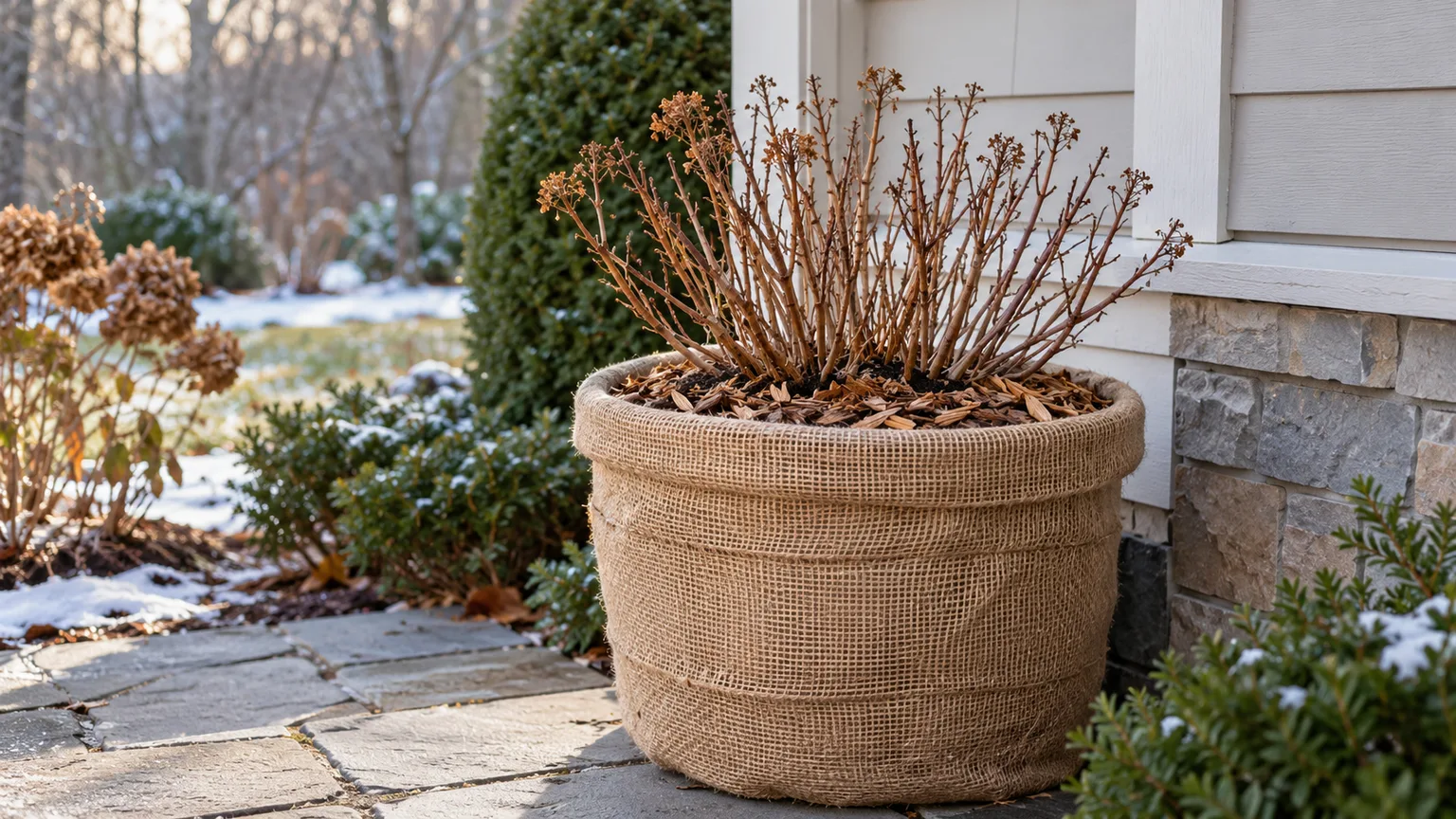
For a pot that must remain outdoors, wrap or surround the container with insulating material, not just the branches, and place it where wind will not repeatedly chill the root ball. You can bury the pot in garden soil up to its rim where digging is practical, then mulch over the surface. Make sure drainage holes remain open. Savvy Gardening outlines several options for container protection and stresses that roots in pots face more cold exposure than roots insulated by the ground (Savvy Gardening).
Prune by species, not by season
Winter is not a universal hydrangea pruning window. Bigleaf, mountain, oakleaf, and climbing types generally carry flower buds on old wood, so a winter haircut can remove the coming flowers before you see them. For these hydrangeas, shape or thin the shrub soon after flowering if it truly needs pruning; otherwise, leaving healthy stems alone is usually the safest option. Penn State Extension and the RHS both distinguish species by flowering wood and recommend timing cuts around that growth pattern (Penn State Extension; RHS hydrangea pruning guide).
Smooth and panicle hydrangeas flower on new growth and can generally be pruned in late winter or early spring before new shoots expand. Even then, a hard cut is optional, not mandatory. A light reduction or selective thinning may be enough to maintain shape; severe cuts can produce long, vigorous stems that bend beneath large flower heads, depending on the cultivar. Leave a framework if your plant tends to flop.
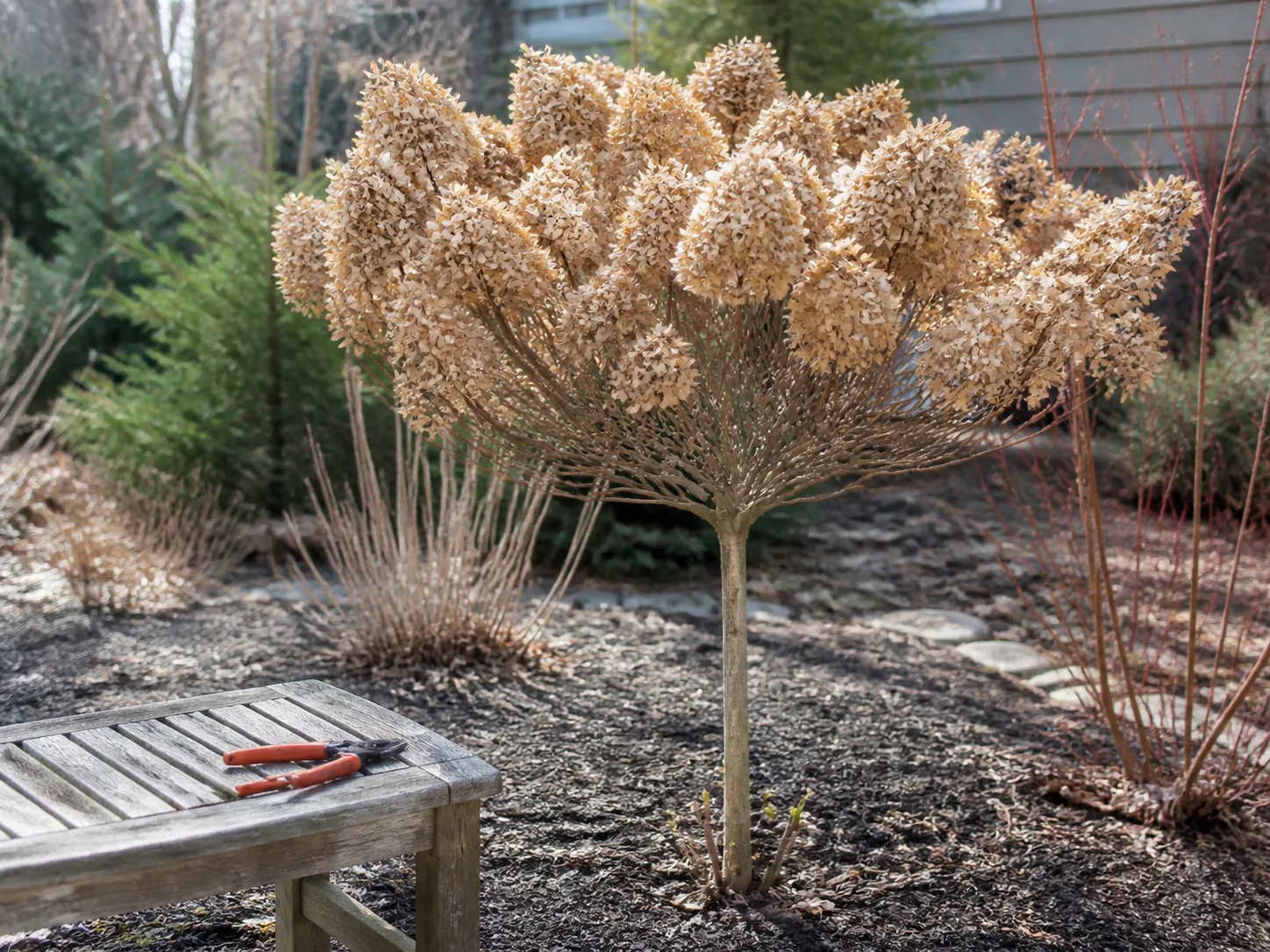
Dried flowers can stay through winter if you like their shape or want to avoid unnecessary cutting. If you remove flowerheads for appearance, do not cut deep into old-wood stems; trim just beneath the flowerhead while preserving the buds below. If a hydrangea has reblooming genetics, its first flowers may still depend on old stems, so wait for the cultivar’s instructions rather than assuming all new growth will replace them. For an unknown plant, delay shaping until you can identify it.
The low-risk winter cut: confirmed dead or broken wood
Remove a branch that has snapped in a storm or is rubbing against another branch if leaving it would create damage. Make a clean cut back to a sound side branch or to the base of a truly broken stem, using clean, sharp shears. Do not use winter appearance alone to declare a whole hydrangea dead: leafless stems are normal during dormancy, and freeze injury can be hard to distinguish from living wood until buds begin to swell.
If a stem is questionable but not hazardous, mark it and wait until spring growth begins. Once healthy buds leaf out, you can see which sections are alive and cut dead wood back to living growth. This delay protects viable old-wood buds and prevents a panicked cleanup from making a flower problem worse. Pruning to tidy the garden is not worth sacrificing a season’s blooms when the plant’s type is uncertain.
Diagnose damage after growth resumes
A hydrangea that looks rough in February is not necessarily dead. Wait for the normal leaf-out period in your area and compare buds along the stem. If the tips fail to open but lower buds or the base produce new shoots, winter likely damaged part of the old wood rather than the root system. If the plant remains bare well after similar hydrangeas nearby have started growing, inspect for brittle, shriveled stems and check near the base for live shoots before removing the shrub.
A leafing shrub with few flowers often points to bud loss, wrong-season pruning, a late spring freeze, or a cultivar poorly matched to the site. It does not automatically call for more fertilizer. Record when the plant was pruned, how cold and windy the winter became, whether protection stayed in place, and which parts of the shrub budded first. That record helps distinguish cold damage from a recurring pruning mistake or a location issue.
If a tender bigleaf hydrangea loses buds every year, decide whether you want to protect it annually or replace it with a hardier cultivar or new-wood type. A protected location may help, but a site that repeatedly freezes exposed stems can make bloom reliability difficult. Choosing a shrub better suited to the microclimate may save more effort than adding another layer of fabric.
Unwrap gradually in spring
Remove burlap and loose insulation when the worst of the prolonged winter cold has passed, but keep a cover nearby if late freezes are common in your region. Unwrap on a mild, calm day so the shrub can begin adjusting to light and moving air. Pull back extra mulch gradually as the ground warms; leave a normal root-zone layer in place to conserve moisture later.
Do not wait until vigorous growth is trapped inside a warm, damp cage, and do not uncover a tender cultivar just because one sunny afternoon feels like spring. Use the local forecast and the plant’s stage: dormant stems can tolerate a different exposure than tender new leaves or swelling buds. If a late freeze is predicted after uncovering, use breathable frost cloth temporarily and remove it once the threat passes.
Avoid these winter-care mistakes
The most common mistake is treating all hydrangeas as if they have the same cold tolerance and pruning schedule. The second is cutting a dormant old-wood shrub because the bare stems look untidy. Others include watering on a calendar without checking the soil, piling mulch against the crown, sealing branches in plastic, leaving a container’s root ball fully exposed, or assuming that a winter cover will guarantee flowers.
A better order is straightforward: identify the hydrangea; check its cultivar guidance and site exposure; make sure the soil is not dry before it freezes; mulch the roots modestly; shelter old-wood buds only when there is a real risk; and wait to prune uncertain stems until growth reveals what survived. This routine is intentionally conservative. Hydrangeas usually benefit more from correct timing and stable roots than from extra layers of intervention.
Conclusion
Hydrangea winter care is mostly about matching protection to the plant. A mulch ring and a final autumn watering may be enough for many established shrubs, while an exposed bigleaf or mountain hydrangea may need a breathable stem shelter to preserve old-wood buds. Potted plants need special attention because their roots lack the insulation of garden soil.
Before pruning or wrapping, identify the type and cultivar if you can. Keep the root zone evenly moist but not waterlogged, preserve healthy old-wood stems, protect only when the climate and site call for it, and wait for spring growth before judging cold damage. Those steps cannot control every freeze, but they reduce avoidable injury and give your hydrangea a better chance to leaf out and flower on its own schedule.