How to Propagate a Fiddle Leaf Fig: All Three Methods
Learn how to propagate a fiddle leaf fig in water, airy mix, or by air layering. Choose the method for your plant, spot a real node, and pot roots safely.
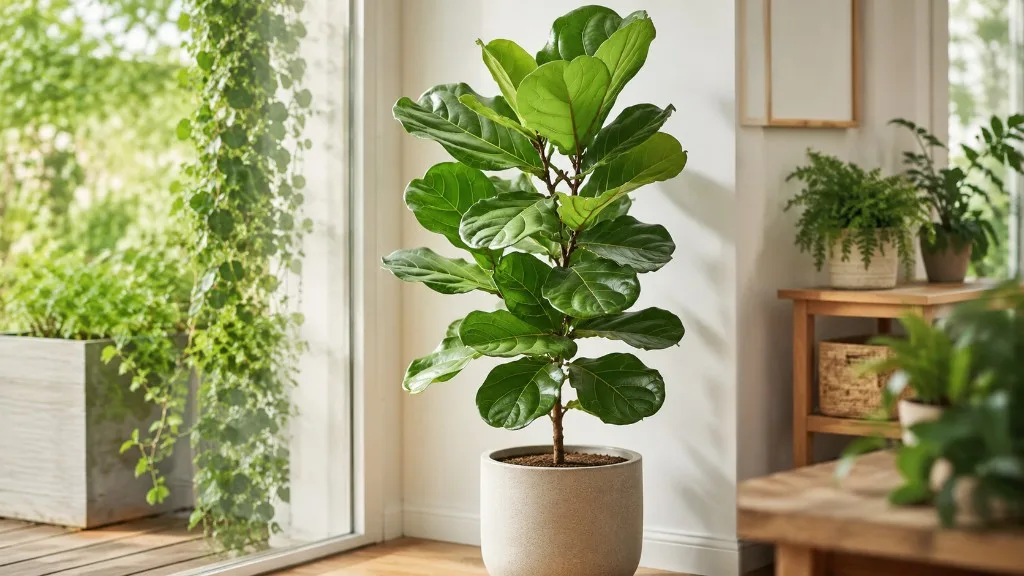
Quick answer: match the method to the size of the cutting
To propagate a fiddle leaf fig, start with a healthy piece of stem that has a node—the joint where a leaf grows or once grew. Root a manageable cutting in water or a moist, airy medium; if you want to turn a tall, leafy top into another plant, air-layer it while it is still attached and wait for roots before cutting it free.
The choice matters because a big fiddle-leaf fig top can carry more leaves than a newly cut stem can support before roots form. A small cutting loses water more slowly and is easier to keep humid; a large, leafy section can wilt while it is still unrooted. Air layering gives that top time to produce roots while the parent plant continues supplying water.
There is no method that guarantees success or a universal rooting deadline. A firm, healthy stem and a workable balance of warmth, light, humidity, and moisture matter more than rooting hormone or a particular jar.
NC State Extension lists stem cuttings as a propagation route for Ficus lyrata, while extension references also describe air layering for woody figs; both approaches can make sense when matched to the plant and the piece you plan to remove. NC State Extension’s fiddle-leaf fig profile and Cornell Cooperative Extension’s houseplant propagation guide support those species-specific options.
Choose between water, rooting mix, and air layering
Think first about what you want to change. If the plant is healthy and you have a modest tip or branch section to spare, a stem cutting is the simplest project. If the plant is tall and you want to keep its leafy crown intact until it has roots, use air layering.
If your main priority is watching root development, water is convenient; if you want roots to start in the environment where they will live, use a propagation medium.
| Method | Best fit | Main advantage | Main trade-off |
|---|---|---|---|
| Water cutting | Smaller stem piece with a few leaves | You can see roots developing | Roots must adjust from water to potting mix |
| Airy medium cutting | Small or medium stem piece | Roots begin in a soil-like environment | Roots are hidden, and wet mix can rot the stem |
| Air layering | Tall, leafy top on a woody trunk | The section stays attached while it roots | Takes more setup and careful moss-moisture checks |
These are choices, not ranks. A direct-to-medium cutting is often the sensible default when you have a small piece and can keep its pot evenly damp but not saturated. Water is useful for a single cutting you want to monitor, but water roots are adapted to liquid and may pause when moved into a substrate.
The Royal Horticultural Society lists semi-hardwood cuttings among ways to propagate Ficus lyrata; its guidance for ornamental figs also places semi-ripe cuttings in spring or summer, when warmth can support rooting. RHS guidance for Ficus lyrata and RHS ornamental-fig growing guidance describe that broader timing and method context.
What each method gives you
A cutting is already detached, so you must keep its leaves from losing water faster than the stem can replace it. A humidity cover can slow that loss, but it also traps moisture; warm, wet, stagnant conditions can encourage mold or stem rot. That is why cutting size and ventilation are as important as which container you use.
With air layering, roots form around a wound on the parent plant before you remove the branch. This is especially useful when the section you want to save has a heavy crown of leaves or when a bare trunk has become too tall: you can make the separation after a real root system is visible.
Iowa State Extension names fiddle-leaf figs among the houseplants suited to air layering and describes the technique for tall or lanky plants. Iowa State University Extension’s layering guide explains why that attached phase is useful.
Find the node before you cut
A node is the point on a stem where a leaf or branch attaches. On a bare part of a fiddle-leaf fig trunk, an old leaf may have left a scar or slight ring; a small bud may sit near it. The node matters because it contains the growing tissues that can produce a new shoot.
Roots may appear from cut stem tissue, but a leaf with only its petiole and no stem node cannot reliably become a full new tree.
Select a cutting that includes at least one node below the waterline or inside the rooting medium, plus a leaf or two to keep producing energy. Several nodes give you flexibility when positioning it, but length alone is not a useful test: a long section of bare stem without a node in the right place is a poor cutting. If you are air-layering, choose a node on a healthy branch where the future plant will have a balanced top and enough stem below the roots to anchor it in a pot.
Look closely at the stem before making any cut. Avoid a section that is shriveled, soft, blackened, badly scarred, or carrying scale or mealybugs. New growth that is still extremely soft can collapse more easily, while very old, thick wood may root slowly; a firm, partly mature stem is a practical middle ground.
The RHS specifically includes semi-hardwood cuttings for Ficus lyrata, which is a better guide than choosing a stem by calendar alone.
Choose a healthy parent and an active growth window
Propagation adds work for the parent plant as well as the cutting. Do not take a large top from a fiddle leaf fig that is already dropping leaves, has persistently wet soil, or has recently been moved, repotted, chilled, or attacked by pests. Stabilize the plant first; a stressed parent has less healthy growth to spare, and the cutting begins with whatever problems it carries.
Spring and summer are often the easiest indoor windows because light and temperature are rising and many plants are making new growth. In a bright, warm room, a healthy fig may continue growing outside those months, but a dim winter sill can slow rooting and increase the time a cutting spends vulnerable without roots. Use the plant’s actual growth and your indoor conditions as the signal, not a date on a calendar.
In the Southern Hemisphere, the active season falls at a different time of year.
Take cuttings from a plant that is watered normally, not bone-dry or recently flooded. A hydrated parent is less likely to produce a wilted cutting, but do not waterlog the soil to “load” the plant with moisture. If you see persistent leaf drop or brown patches, diagnose the underlying light, watering, or root issue before pruning for propagation.
Gather tools and protect yourself from sap
Use sharp bypass pruners or a clean knife that can make a single, smooth cut. Wipe the blade before use and between cuts, especially if any stem looks diseased. Have a clean jar or pot, fresh rooting medium, and ties or a loose clear cover ready before you cut so the stem is not left waiting while you search for supplies.
Fiddle-leaf fig stems release milky latex sap that can irritate skin; NC State Extension also cautions that the plant is toxic if ingested and recommends gloves when pruning or propagating. Wear gloves, keep sap and cuttings away from children and pets, and wash skin promptly if sap gets on it.
Do not touch your eyes or mouth while handling fresh cuts. NC State Extension’s profile describes the plant’s contact and ingestion risks.
Set a towel or washable mat beneath the work area, and place removed leaves and stems where pets cannot reach them. If you are air-layering above shoulder height or working with a large, top-heavy plant, secure the pot and ask someone to stabilize the tree rather than making a one-handed cut. Rooting hormone is optional, not a substitute for healthy stem tissue or good conditions.
If you use it, follow the product label and pour a small amount into a separate dish instead of dipping the cutting into the original container; Iowa State Extension notes that careful handling helps avoid spreading disease between cuttings.
Method 1: root a stem cutting in water
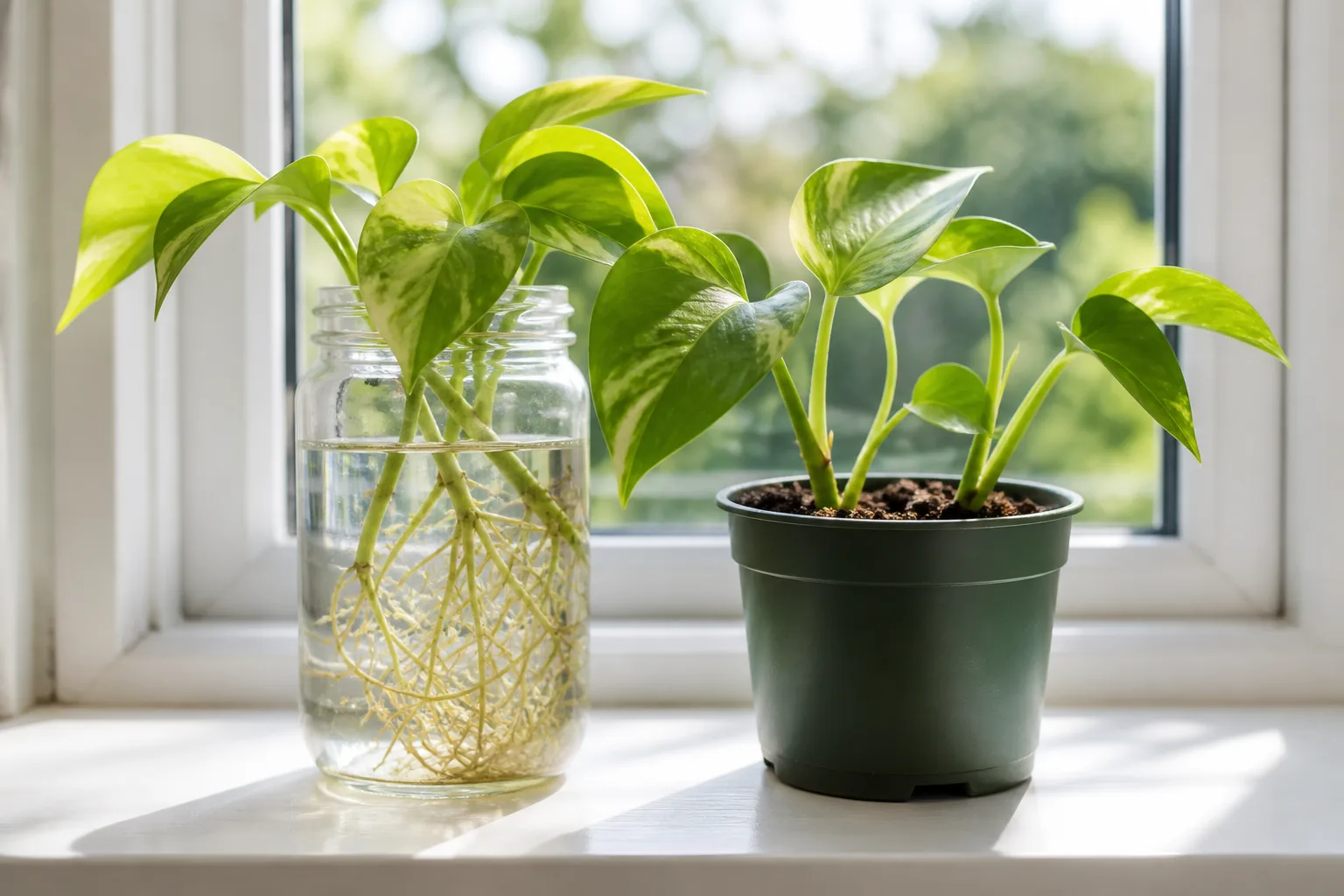
Water propagation is appealing because the roots are visible and the setup is simple. Choose a sturdy stem tip with a few leaves and one or more nodes. Cut below a node so that at least one node will sit in water; remove leaves that would be submerged, since decaying foliage clouds the water and adds rot risk.
Rinse away latex from the cut end and let the sap stop flowing before you put the stem in the jar. Set the cutting in clean, room-temperature water with the bare lower stem and node under the surface and every leaf above it. A narrow glass can help keep a top-heavy cutting upright, but the stem should not be wedged so tightly that new roots are damaged when you lift it out.
Place the jar somewhere warm with bright, indirect light. Avoid direct sun through the glass: it can heat the water and leaves, while the unrooted cutting has little ability to replace lost water. Check the water regularly and replace it when it becomes cloudy, develops a film, or smells stale; top it up if evaporation exposes the node.
A weekly check is more useful than a rigid schedule because a cool room and a warm, bright windowsill do not lose water at the same rate.
Root bumps are an encouraging early sign, not the finish line. Let a small network of firm, branching roots form before potting. If one root grows long while the rest of the cutting has none, give it more time rather than treating a single string as a robust root system.
Water rooting is a monitoring-friendly approach, but it asks the cutting to adjust again when it moves into potting mix.
Method 2: root a stem cutting in an airy medium
For a direct-to-medium cutting, use a small pot with drainage and a fresh, open propagation medium. A seed-starting or cutting mix, or a blend containing perlite, can retain some moisture while leaving air around the stem. Ordinary dense potting soil can stay wet for too long in a small container, so avoid packing it tightly around the cutting.
Moisten the medium first, then let excess water drain. Make a hole with a pencil or dibber so that the stem slides in without scraping off its base. Place at least one node below the surface, firm the mix gently, and keep the pot in a warm spot with bright indirect light.
Rooting hormone may help with some woody cuttings, but it is optional; use only a small amount according to the product label.
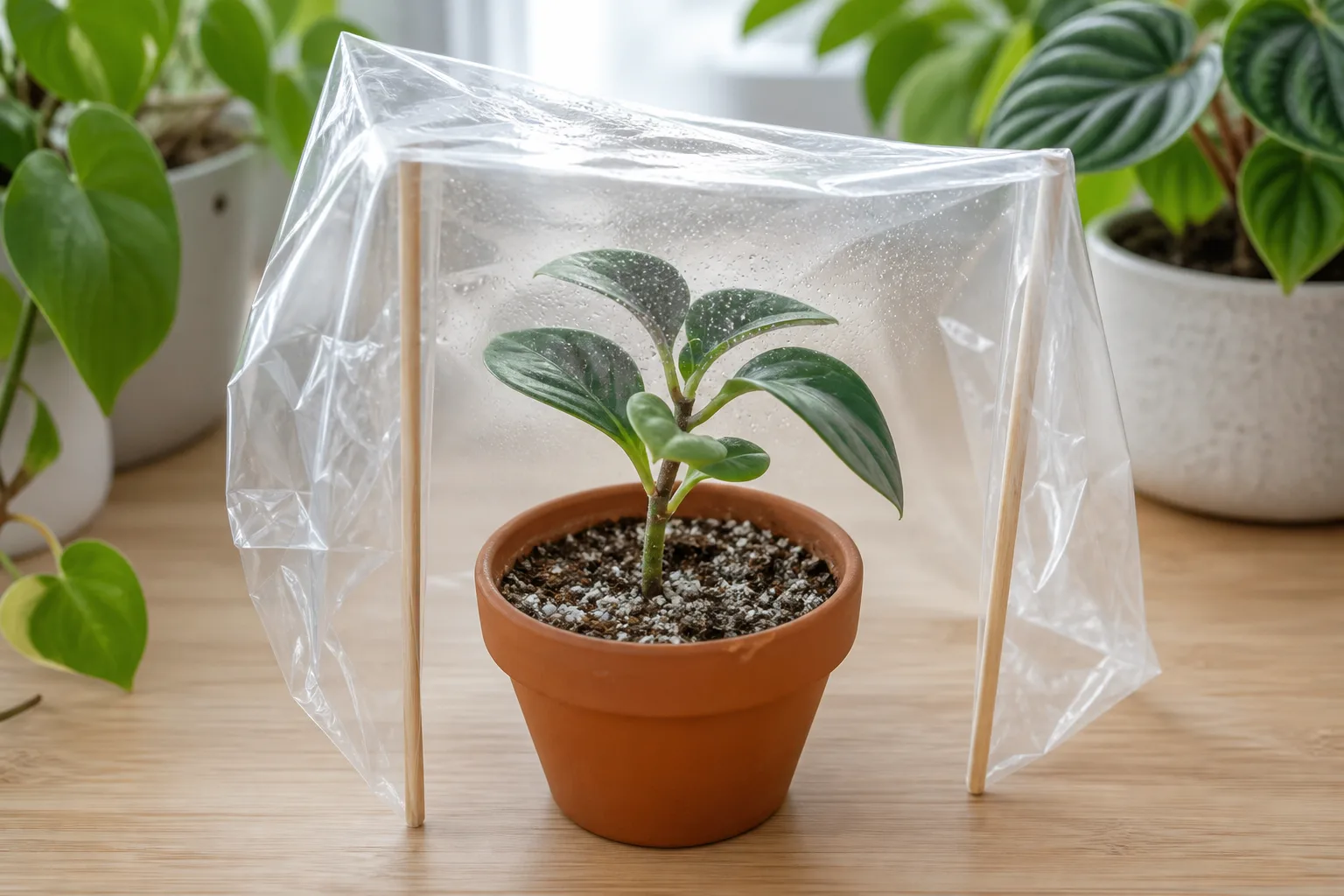
A clear bag or propagation cover can reduce moisture loss from the leaves, especially in a dry home. Keep the plastic from touching the foliage and leave a small opening or lift it periodically so stale, wet air does not collect. Condensation on the cover is normal; persistent dripping, mold, or a sour smell means the enclosure is too wet or poorly ventilated.
Nebraska Extension’s houseplant guidance emphasizes maintaining moisture and humidity during propagation, while Virginia Tech’s cutting guidance also stresses bright indirect light and air circulation to discourage fungal problems. Nebraska Extension’s houseplant propagation guide and Virginia Tech’s propagation reference support those basics.
Keep moisture steady without soaking the stem
The medium should feel lightly and evenly damp, not swampy. Let the surface begin to lose its wet sheen before watering again, and empty any saucer that holds runoff. A cutting without roots cannot drink like a mature fig, but a saturated mix deprives the stem base of air and makes decay more likely.
Do not pull the cutting up every few days to look for roots. That can break fragile root tips just as they begin to form. Instead, watch for a combination of signs: the stem remains firm, leaves hold their shape, and a very gentle tug after several weeks meets resistance.
New leaf growth by itself is not proof of roots; a cutting can spend stored energy before it has established a root system.
Method 3: air-layer a tall fiddle leaf fig
Air layering is the best fit when you want a substantial, leafy top from a plant with a stiff, upright trunk. The stem stays connected to the parent while roots develop around a wounded section, so you do not ask the detached crown to survive on a few fresh roots from day one.
University of Florida IFAS specifically lists fiddle-leaf figs as plants commonly reproduced by air layering. Florida IFAS’s plant propagation guide describes the method for this species and explains why the wound must be prepared carefully.
Choose a healthy stem where the future tree will have a useful shape. Leave enough stem below the planned root zone to anchor the new plant and enough leaves above it to make a balanced crown. Remove a leaf at the node or clear a small working area, but do not strip the entire branch.
Air layering involves a deliberate wound, so work slowly and keep the plant supported. A common method for woody ficus stems is to remove a narrow ring of bark and scrape the exposed surface clean of the soft cambial layer; another extension method uses a partial cut held open with a spacer. These approaches are not identical, so follow one method carefully rather than combining cuts at random.
Iowa State Extension gives a ring-bark procedure for dicots such as fiddle-leaf fig, while Illinois Extension illustrates a partial slit approach for large tropical houseplants. The goal in either case is to prevent the wound from simply closing over before roots form.
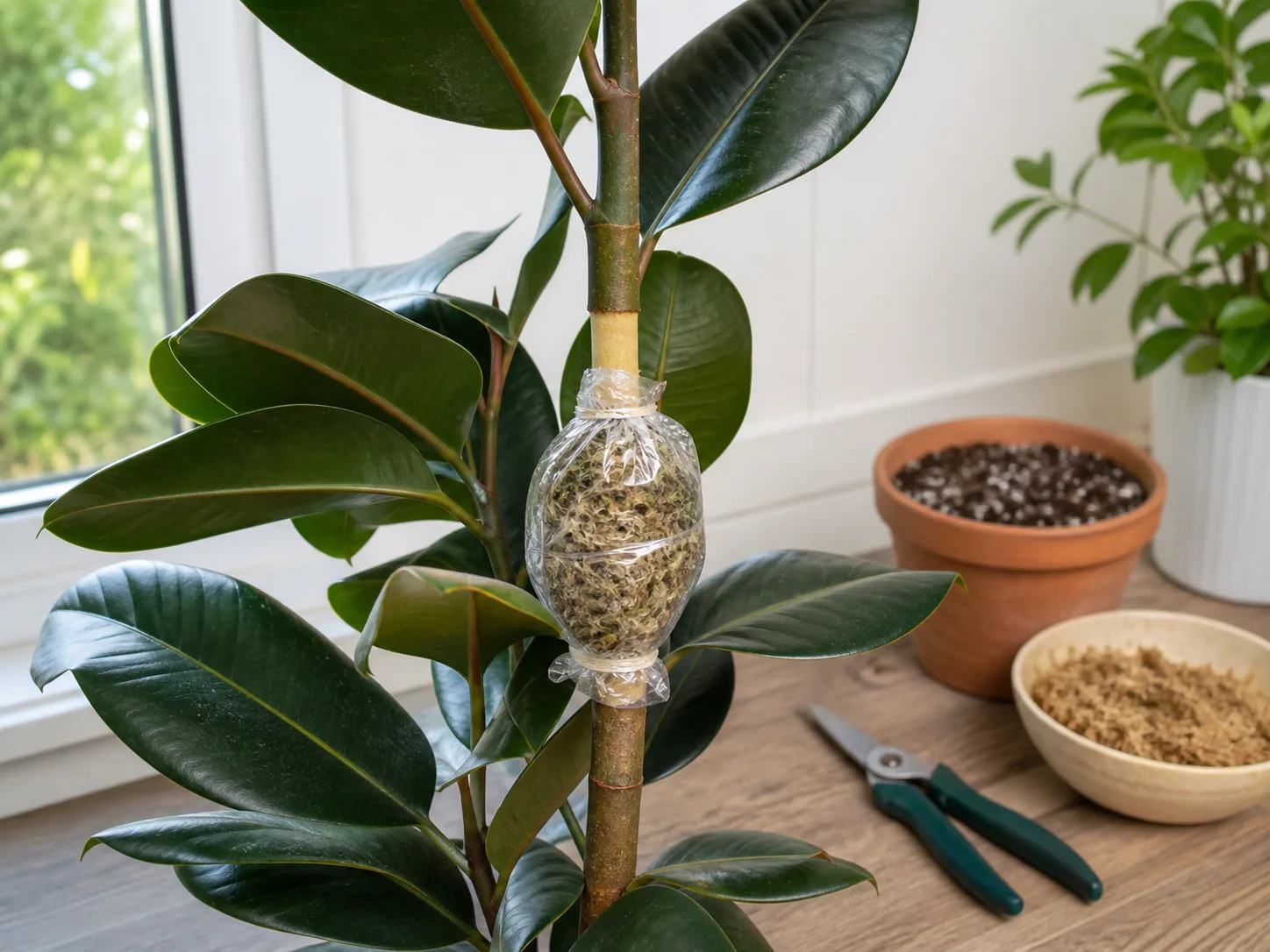
Soak sphagnum moss, then squeeze it until it is evenly moist but not dripping. Pack it around the wound in a fist-sized ball and wrap it in clear plastic, securing both ends so the moss does not fall out or dry quickly. The wrap lets you inspect root development without unwrapping the whole layer.
In a very warm window, direct sun on clear plastic can heat the moss; shade the wrapped section lightly if it gets hot.
Check the moss every week or two. If it is drying, open one end enough to add a little water, then reseal it. It should stay damp, not waterlogged.
Rooting hormone can be used sparingly if the product is labeled for this kind of propagation, but Florida IFAS notes it is not essential for most air layers. The main success factors are a healthy branch, a properly maintained wound, and moss that stays moist without turning into a wet, airless mass.
Separate the layer only after roots fill the moss
Do not remove the branch because a set number of weeks has passed or because you see one pale root. Wait until several roots have grown through the moss and formed a visible network.
Extension timelines range from several weeks to several months depending on species, season, and conditions; a woody houseplant may need longer than a soft cutting. Illinois Extension’s air-layering instructions notes that roots may take three to four months to appear, while Florida IFAS describes a much wider one-month-to-a-year window across different species and seasons.
Once a useful root mass is visible, cut the stem just below it with clean pruners. Keep the moss around the roots while you pot the new plant; pulling or combing it off can tear the fine roots. Use a pot only slightly wider than the root ball, add a free-draining potting mix around the moss, water to settle the mix, and support the tall stem with a stake if it wobbles.
The remaining parent stump may push new growth below the cut, but neither the number nor timing of those shoots is guaranteed.
How long propagation takes and what counts as progress
Rooting time is a range, not a promise. A small stem cutting may show early roots in several weeks under warm, bright conditions, but slow winter growth, a large leafy top, or a cool propagation area can stretch the wait. Air layers often take longer because they are building a root system around woody stem tissue; the extension guidance above puts that wait anywhere from several weeks to months, with wide variation.
Use condition, not the calendar, to decide what to do next. A water cutting with firm white roots branching from the base is progressing; a soil cutting with a firm stem and gentle resistance is promising; an air layer with roots visible in more than one part of the moss ball is nearing separation. A cutting that stays green but has not rooted may still be alive, while black, soft, or foul-smelling tissue is a warning that it is rotting.
Keep a simple date label on each setup, especially if you are trying more than one method. A weekly photo makes slow changes easier to notice and discourages unnecessary unwrapping, pulling, or repotting. If the parent plant is healthy and the cutting is firm, patience is safer than adding fertilizer or repeatedly changing the setup.
Pot up a rooted cutting without losing momentum
A water-rooted cutting needs a careful move into mix. Wait until it has several roots with some branching, rather than transferring at the first white nub. Set it into a small draining pot, arrange the roots downward without bending them sharply, and fill around them with a lightly moist, airy mix.
Water gently to settle the medium; do not compact it into a dense, wet plug.
For a cutting rooted directly in mix, potting may mean moving it from a propagation cell into its first permanent container. Slide the plug out only when roots hold the medium together. If it falls apart and has very few roots, put it back into its original setup and wait.
For an air layer, preserve the moss around the root ball and avoid pulling the new root mass apart.
Use a pot sized for the roots, not for the eventual tree. A container that is much too large keeps excess mix wet around a small root system. Make sure the pot has drainage holes and that water can leave freely; a decorative cachepot can be used outside the nursery pot, but empty its water after draining.
Aftercare while the new plant establishes
For the first week or two after potting, keep the mix evenly moist while the cutting adjusts, then return to a normal light-touch watering routine as new growth appears. “Evenly moist” does not mean constantly saturated: the root zone still needs air. NC State notes that fiddle-leaf figs are sensitive to overwatering, so a newly potted cutting should not sit in a tray of water or receive frequent small splashes that keep the surface perpetually wet.
Place the new fig in warm, bright indirect light, away from cold drafts, heating vents, and harsh direct sun. Keep its environment steady while roots adapt. If a cutting was under a plastic cover, gradually increase airflow over several days rather than removing the cover for the first time and placing the plant in dry air all at once.
Do not rush fertilizer. Fresh roots and a small cutting are vulnerable to salt buildup, and fertilizer cannot compensate for poor light or a damaged base. Wait until the plant is established and growing, then resume a conservative houseplant feeding routine in the active season.
Resist combining repotting, a new location, heavy pruning, and aggressive feeding in one week; if leaves react, you will not know which change caused it.
General indoor-propagation guidance also treats water, rooting mix, and localized humidity as choices that depend on the species and the cutting, not as interchangeable recipes. This houseplant propagation overview makes the same practical distinction.
The original plant also needs calm care after you take a cutting or separate an air layer. Keep it in its familiar bright spot, water based on how the soil dries, and avoid immediately moving it or cutting several more branches. A healthy parent may produce new shoots below the cut, but that is a separate growth response, not proof that propagation has succeeded.
Troubleshoot wilt, rot, and stalled roots
When a cutting wilts, first ask whether it still has enough water and whether it can replace what its leaves lose. An unrooted cutting in direct sun or a dry draft may lose moisture quickly. Move it to bright indirect light, check that the node remains in water or damp mix, and reduce leaf area only if the stem has more foliage than it can support; do not remove every healthy leaf.
If the stem base is black, soft, slimy, or smells sour, suspect rot. In water, discard the old water, clean the jar, and recut above any damaged tissue only if a firm, healthy node remains. In a medium, check drainage and loosen the next batch with fresh, airy mix rather than watering more often.
A humidity cover that drips constantly also needs more ventilation.
A cutting that stays green but has no visible roots is harder to judge. Confirm that a node is actually submerged or below the medium; a leaf or bare internode alone is not enough. Then check warmth and light and wait if the stem remains firm.
Do not keep a soft, collapsing cutting in a sealed bag or stale jar simply because it once looked healthy.
If an air layer shows no roots, check whether the moss dried out, whether it has become waterlogged, or whether the wound healed across. You can refresh a dry moss ball and keep waiting if the branch remains healthy. If the stem above or below the wrap is deteriorating, remove the wrap and reassess; a failing layer should not be left to damage the parent trunk.
Why a single leaf rarely becomes a new fig
A detached fiddle-leaf fig leaf can sometimes stay green for a long time and may even produce roots, but a leaf without stem node tissue usually cannot make a new growing shoot. Rooting and producing a whole plant are separate biological steps. The new fig needs a bud or node capable of making a stem; this is why a leaf-bud cutting includes a small section of stem attached to the leaf, while a leaf on its own is not a dependable propagation piece.
If a leaf has fallen from the plant, inspect it for a small piece of stem at its base. A leaf with no node is best treated as a decorative leaf rather than a clone.
The RHS lists leaf-bud cuttings as a propagation method for Ficus lyrata, which is different from putting a bare leaf and petiole in water. The RHS species profile makes that distinction useful when deciding whether a fallen leaf is viable.
Mistakes that make propagation less reliable
- Cutting before choosing the method. A small side stem and a heavy top need different support. Decide whether to detach now or root while attached before pruning.
- Taking a piece without a node. Make sure a node will sit below water or mix, or choose a node as the air-layer wound site.
- Overloading a cutting with leaves. A large leaf canopy loses water while the cutting has no roots. Keep enough healthy foliage to support growth, but reduce the load if the piece wilts repeatedly.
- Keeping mix or moss saturated. Moisture helps roots form; stagnant water pushes oxygen out and encourages decay. Use drainage, airy medium, and a moisture check rather than a watering schedule.
- Treating rooting hormone as a guarantee. It may support rooting, but it cannot rescue a dead node, an unhealthy parent, or a cold, dim setup.
- Separating an air layer too soon. One root does not anchor a tall crown. Wait for a visible root network through the moss.
- Changing several conditions at once. Keep light, warmth, and watering steady so you can identify what the plant needs.
- Ignoring the sap. Wear gloves, clean the work area, and keep fresh cut material away from pets and children.
Conclusion
To propagate a fiddle leaf fig, use a node-bearing stem cutting for a manageable piece and choose water or an airy medium based on whether visibility or an easier transition matters more. For a tall, leafy top, air-layer it first so roots can develop while it remains connected to the parent.
Keep the setup warm, bright, and moist without leaving the stem in stale water or saturated mix. Wait for branching roots before potting or cutting the layer free, and give the new plant steady conditions as it establishes. The node and the root system—not a particular calendar date or a bag of rooting powder—are the best guides to whether you have a viable new fig.



