How to Get Rid of Paper Wasps Safely Around Your Home
Learn how to get rid of paper wasps safely: identify an open comb, decide whether to leave it, know when to call a pro, and prevent repeat nesting next season.
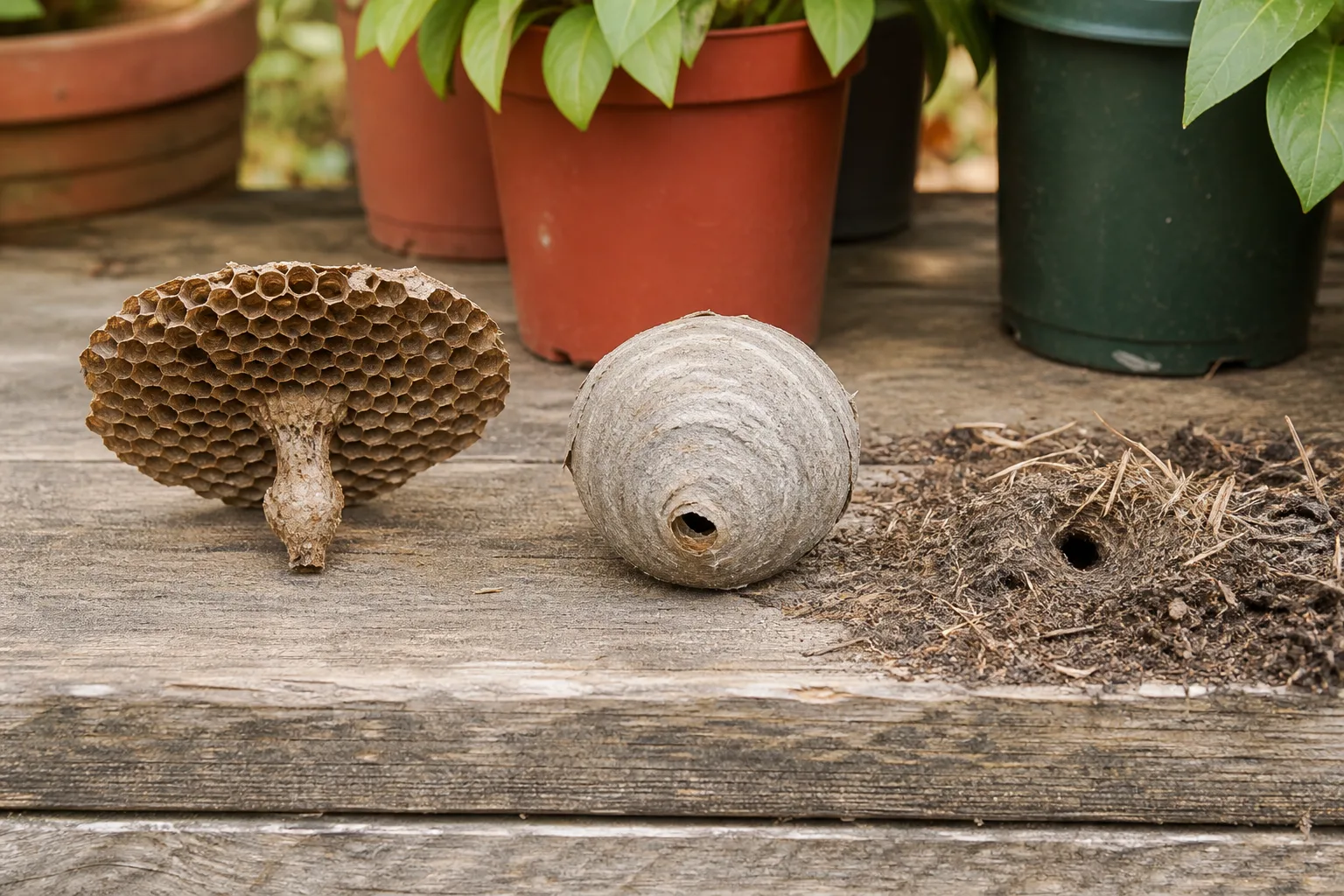
If you have found a papery nest beneath an eave, the first step is not to knock it down. Confirm what you are looking at from a safe distance, decide whether the nest creates a real risk where people walk or gather, and then choose between leaving it alone, calling a pest professional, or using a product specifically labeled for that nest and location. A small nest can still be defended, and the wrong nest may be much harder to treat than it appears.
Paper wasps are often less troublesome than their reputation suggests when a nest is away from regular activity. They can sting if someone disturbs or crowds the colony, though, so an active nest beside a doorway, deck, play area, or high-traffic path deserves a different response from one high on a quiet shed. The practical goal is to reduce exposure without creating a bigger hazard by climbing, spraying indiscriminately, or striking the nest.
Make the First Decision: Remove, Avoid, or Call
Use the nest’s location and your ability to keep a safe buffer as the first decision points. If wasps are flying around flowers or fruit but you cannot see a repeated route to one fixed point, observe from indoors or across the yard before deciding there is a nest to remove. Foragers may visit the garden without nesting on your property, and killing individual visitors will not solve a nest that has not been located.
If an active nest is in a place people can avoid, closing off that part of the yard may be the simplest and lowest-impact response. If you cannot keep children, pets, visitors, or a person with a known severe sting allergy away from it, or if it sits above a frequently used entrance, hire a qualified pest professional. Do not treat a nest yourself if you cannot identify it, reach it without a ladder, and follow every requirement on the treatment product’s label.
A workable rule is simple: if avoiding the nest is easy and safe, leave it; if people must pass close to it, get expert help; if access, identification, or label compliance is uncertain, do not attempt DIY treatment. This is more useful than deciding from nest size alone. A small colony beside a door can create more day-to-day risk than a larger one over an unused outbuilding.
Identify a Paper Wasp Nest Before You Act
Paper wasps often build beneath eaves, porch ceilings, railings, outdoor light fixtures, and other sheltered horizontal surfaces. Their open nests can be easy to overlook until the colony has expanded, but their visible structure gives you an important clue before you choose any response.
Use the Nest Shape as Your First Clue
A typical paper-wasp nest is a single exposed comb of hexagonal cells connected to a surface by a short stalk. You can see the cells from below because the comb has no papery outer envelope. The Illinois Department of Public Health description of paper wasps describes that single comb as a papery structure made from chewed wood fibers and saliva. A Joe Gardener interview with biologist Heather Holm likewise distinguishes an exposed single comb from the covered, multi-tier nests built by yellowjackets.
A large, enclosed papery ball is not the same kind of nest. It may belong to an aerial yellowjacket or a hornet; a steady stream of insects entering a hole in soil, a wall, or a roof cavity points to a different problem again. Color alone is unreliable, and “paper nest” is not a precise identification. If the shape is closed, the nest is in a cavity, or the insects do not fit a clear open comb, keep your distance and ask a local extension office or pest company to identify it from a photograph.
Confirm Activity Without Walking Under It
A nest is active when wasps repeatedly return to or leave the same fixed point. Watch from a window or a place well outside the area around the nest; note where the flight line begins and ends rather than following an individual wasp. A wasp visiting blossoms, sipping from fallen fruit, or circling a drink is foraging, not proof that a colony is above that spot.
Do not stand under the nest to count insects, tap the eave, shake a branch, shine a flashlight into cells, or climb a ladder for a closer look. If you need to document it, use a phone’s zoom from a safe position and include the attachment point and surrounding structure. A clear distant photo is more useful than a close-up that puts you within striking distance.
Decide Whether the Nest Is a Real Problem
A nest’s presence does not automatically mean you need to destroy it. The key question is whether people or animals are likely to disturb it during ordinary use. A colony under the far corner of a detached shed may be tolerable if everyone can walk around it; one over the main door can expose household members and deliveries several times a day. A Savvy Gardening guide to paper wasps also recommends avoiding a nest that can safely be left alone. Treat that as a risk-management option, not an absolute rule: a buffer only works if everyone who uses the yard can maintain it reliably.
Check the route, not just the nest. Consider whether a person opening a door, mowing, trimming shrubs, emptying a compost bin, or retrieving a ball could pass close to the colony. The RHS notes that wasps generally defend a nest when it is disturbed and tend not to be aggressive when left alone; ordinary garden work can turn an out-of-the-way colony into a conflict if it shakes the nest or blocks its flight route.
Season also matters, but it should not be your only evidence. Many social wasp colonies are seasonal, with new queens leaving to overwinter after the active nest cycle ends, yet timing varies among species and climates. The Joe Gardener interview notes that most nests are annual while warm regions can have different patterns, so a date on the calendar is not a reliable test of whether a nest is empty.
Know When to Call a Pest Professional
Professional removal is the sensible choice when the nest is close to a door, window, walkway, play space, or animal enclosure and you cannot reliably reroute people. Call if anyone in the household has had a severe sting reaction, if pets or children cannot be kept away, or if a person would have to reach over a railing, lean from a roof, use a ladder, or work above their head. A nest hidden in a wall, attic, soffit, or other cavity also needs professional assessment because spraying an entrance may not reach the colony and could drive wasps into an occupied space.
Call rather than guess when the nest is enclosed, underground, unusually large, or occupied by insects you cannot identify. Treating an unknown nest as a paper-wasp nest can put you close to a species or location that requires a different plan. A local cooperative extension office, university insect diagnostic service, or licensed pest-management company may be able to identify it from a safe-distance photo; ask the company whether it can inspect first and explain the least disruptive effective option. When you call, describe where the nest sits, how people use the area, whether the insects enter a structure, and any known sting allergy in the household. Ask what the proposed treatment does, what must stay clear, whether the nest itself will be removed, and how the technician will confirm the colony is inactive. A responsible provider should explain why treatment is warranted and what follow-up is included instead of relying on a vague promise to make every wasp disappear.
You do not have to wait for a sting to justify help. The Illinois Department of Public Health warns that bees and wasps can pose a health threat and notes that nest destruction can create a greater risk than leaving a nest in some cases. When access or health risk makes DIY action questionable, the cost of a professional visit buys a safer assessment as well as treatment.
If a Labeled Nest Treatment Is Appropriate
A homeowner treatment should be the exception, not the default. Consider it only for a clearly identified, exposed paper-wasp comb in an accessible outdoor location, with no known severe sting allergy and no need to climb or cross the wasps’ flight path. If any of those conditions fail, choose a pest professional or avoid the area until expert advice is available.
Set Up a Safe, Uncrowded Work Area
Before opening a product, read the entire label and decide whether you can meet its directions exactly. Keep children, pets, and other people away from the area; make sure no one needs to use the nearby door or path; and check that the application will not drift onto people, neighboring property, food, water, flowers, or useful insects. If the label requires weather, protective equipment, distance, or a re-entry period that you cannot reliably manage, do not improvise.
Do not use a spray from a ladder, a roof, or a precarious porch step. A sudden movement or a few wasps approaching can turn a short task into a fall, and an aerosol can does not make the nest harmless. The Illinois Department of Public Health states that pesticide users are responsible for following the product label; the product’s legal directions take precedence over a generic internet recipe or an old how-to.

Follow the Product Label Exactly
Use only a product whose current label permits treatment of wasp nests at that site. Labels differ in target insects, application method, protective equipment, weather limits, distance, and restrictions around people, pets, water, and plants. Do not assume that two cans with similar names have the same directions, and do not use a garden insecticide, household cleaner, or homemade mixture as a substitute.
If the label does not clearly cover the nest you have identified, stop and call a professional. Do not apply extra product because the first application appears ineffective, and do not spray flowers or broad areas in an attempt to kill wasps that are merely foraging. Broad, repeated insecticide use can affect insects that are not part of the colony and may still leave the nest active. After any allowed treatment, wait for the label’s stated interval and confirm from a safe place that activity has stopped before anyone returns to the area or the nest is handled.
Why Knocking Down an Active Nest Is a Bad Shortcut
Do not knock, scrape, hose, pressure-wash, burn, vacuum, or stomp an active nest. The exposed comb may look fragile, but striking it puts you close to the colony and can trigger defensive stings before the nest falls. A broom or water jet does not reliably neutralize the wasps, and a falling nest can scatter adults and developing insects into an area where people are standing.
Do not crush an active nest on the ground after knocking it loose. That requires approaching the nest after you have already disturbed it, when wasps may still be moving or returning. Avoid gasoline, boiling water, bleach, dish-soap mixtures, and fire as well: improvised methods can injure people, damage siding or plants, contaminate soil or water, or fail to reach the insects protected within the comb.
The nest’s apparent small size is not a safety rating. A person with no sting history can still be stung, and a household with one member who is allergic has to plan around that person’s exposure, not only the average risk. The RHS guidance on wasps describes stinging as a defensive response to nest disturbance; avoiding contact is often more effective than trying to outpace the colony.
How to Handle an Inactive Nest
An old, empty nest is usually a cleanup question rather than an urgent pest problem. Confirm inactivity by observing from a distance over time, especially if warm weather continues; one quiet moment does not prove that all workers are gone. Do not treat a nest as abandoned simply because its paper looks weathered, because a live colony may also have damaged or faded material.
In many temperate regions, a social wasp colony declines at the end of its season and does not reuse the old nest. RHS notes that social wasp nests die out in late summer or autumn and are not re-used, while new queens leave to overwinter and start colonies later. The exact timeline depends on species and local climate, so if you still see regular traffic, leave cleanup to a professional or wait until activity has clearly ceased.
If a nest is confirmed inactive, low enough to reach from the ground, and not attached to electrical equipment or fragile material, you can remove it with a scraper and gloves or leave it in place if it is harmless. Put the material directly into a sealed bag for disposal, then clean away loose fibers if needed. There is no benefit to spraying an empty nest, and removing it does not guarantee that a new queen will not choose a nearby sheltered spot next spring. Do not climb to retrieve a nest simply because it is empty; if access is awkward, leaving it or hiring help is safer than a fall. If a cold snap has not happened, or the weather turns warm again, keep checking from a distance rather than assuming seasonal inactivity.
Reduce Nesting and Foraging Conflicts Next Season
Prevention means making a nesting spot harder to use and keeping food activity away from places where people gather. It does not mean stripping out flowering plants or trying to eliminate every insect in the yard. Wasps may visit a flower bed while nesting somewhere else, so focus on the structure and activity pattern rather than treating every wasp sighting as a reason to spray.
Maintain Sheltered Eaves and Exterior Openings
In early spring, inspect the underside of porch roofs, eaves, sheds, railings, and light fixtures from the ground. A queen may begin a nest alone before workers emerge, so a small exposed comb is easier to identify early than a growing colony later. This inspection is visual only: use binoculars or phone zoom rather than a ladder or a hand near the attachment point.
After a nest is confirmed inactive and removed, repair loose soffit edges, torn screens, or gaps that lead into walls and roof cavities. Do not seal an opening while insects are still entering it; trapped wasps may look for another way out, potentially into the building. Fix the structure after activity stops, and ask a professional to investigate any recurring traffic into a hidden space.
Manage Food and Activity Near People
Keep picnic food and sweet drinks covered, use tight-fitting lids on outdoor trash, and pick up fallen fruit that is drawing wasps into a patio or play area. These changes can reduce foraging around people, but they will not remove a nest under an eave. Adults may visit sugary food while workers collect insects to feed larvae, so an attractive meal and a nesting site are related but separate issues.
A bait trap is not a nest-removal method. It may catch some foragers, but it does not reliably stop a colony from producing more workers, and bait near a table or doorway can put activity where you do not want it. The RHS says the local effect of wasp traps is uncertain and that they may attract wasps from elsewhere, so prioritize covered food and a safe buffer over adding traps beside people.
What Paper Wasps Do for a Garden
Paper wasps are not simply unwanted visitors. Workers hunt insects and other small invertebrates to feed developing larvae, including some caterpillars that feed on garden plants, and adults also visit flowers for sugary food. The RHS describes social wasps as useful garden predators, while the Joe Gardener interview with biologist Heather Holm explains that wasps can provide some pollination and pest-control value, though they are not as efficient at carrying pollen as bees. Their contribution is a reason to avoid broad yard-wide spraying, not a reason to accept a nest beside a busy entrance. The useful distinction is between protecting a place people must use and trying to erase wasps from a whole garden.
Those benefits do not obligate you to keep a nest beside a door. A practical approach is to tolerate a colony only where people can safely avoid it, protect high-use areas when activity is present, and use professional help when risk or identification is uncertain. Removing one nest from a hazardous location can be reasonable while still avoiding blanket spraying of flowers and harmless foragers.
A Practical Plan for Three Common Situations
| Situation | Best first response |
|---|---|
| A visible open comb is high on a quiet shed away from people | Keep a buffer, observe from a distance, and consider leaving it until the colony naturally declines. |
| A nest is over a frequently used doorway, deck, or play area | Reroute people and pets immediately; arrange professional assessment and removal if a safe buffer is not practical. |
| Wasps enter a wall, roof, ground hole, or enclosed nest | Do not seal, spray, or disturb the opening; contact a pest professional because the colony may be hidden or the insect may be a different species. |
If anyone is stung, move away from the nest without swatting at insects and seek medical help for a severe reaction, trouble breathing, or swelling of the face or throat. A person who has previously had a serious reaction should follow their clinician’s emergency plan and should not be the person assessing or treating the nest.
Conclusion
The safest way to get rid of paper wasps is to start with identification and exposure, not a tool or spray. A clearly open comb in a place everyone can avoid may be left alone; a nest near daily traffic, a hidden colony, a lookalike nest, or a situation involving allergy or difficult access belongs with a pest professional. If a homeowner product is appropriate, the label—not a general recipe—sets the conditions for its use.
Keep people away from an active nest, avoid knocking it down, and confirm inactivity before cleanup. A small amount of seasonal inspection and sensible food management can reduce future conflicts without treating the whole garden as a pest problem.



