How to Grow and Care for a Himalayan Birch Tree
Plan a site that suits Himalayan birch, then follow clear planting and care steps for steady establishment, bright bark, yellow fall leaves, and fewer stress problems.
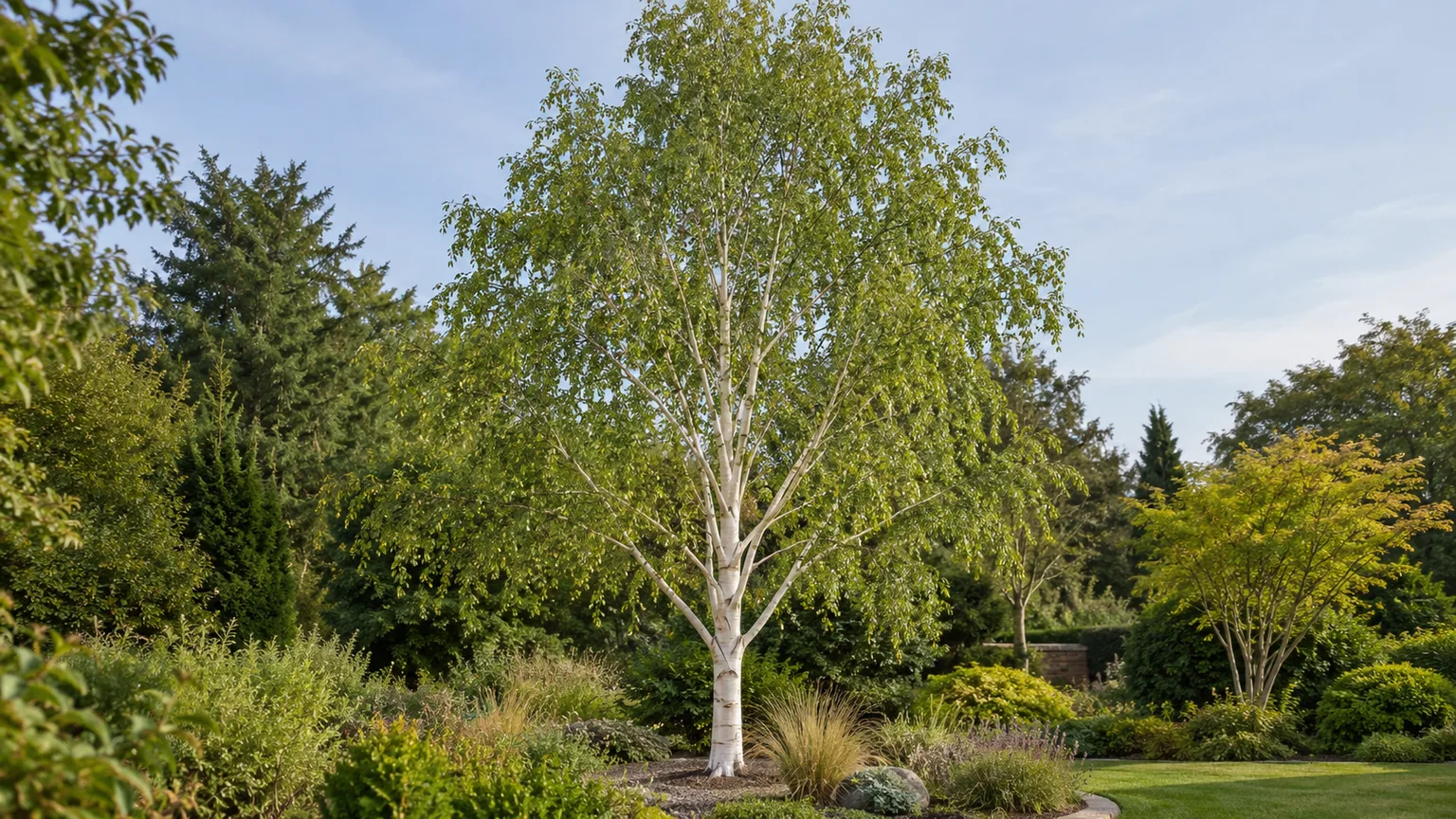
Himalayan birch (Betula utilis) is best known for the white-barked form often sold as Betula utilis var. jacquemontii. It earns its place through a graceful open crown, spring catkins, yellow autumn leaves, and luminous trunks that remain visible after leaf fall. The catch is that this is a substantial, cool-climate tree: a good planting site needs enough room for its eventual canopy and summers that do not routinely push it into heat stress.
Before buying, check the nursery label for the botanical name and cultivar, then compare that tree’s expected mature size with the actual space. Once planted, focus on a wide, undisturbed root zone, steady moisture during establishment, and protection from heat and lawn competition. Fertilizer and regular pruning are usually not the shortcuts people hope they are.
Himalayan Birch at a Glance
The names on labels can be confusing. Himalayan birch is the broad species Betula utilis, native to the Himalayan region; the especially white-barked plant commonly called Jacquemont’s or white-barked Himalayan birch is listed as B. utilis var. jacquemontii, B. utilis subsp. jacquemontii, or B. jacquemontii in different references. These names do not always refer to a separate species. North Carolina State Extension notes that the Jacquemontii form is distinguished by whiter bark and fewer pairs of leaf veins than the broader species, while Oregon State University documents the accepted subspecies treatment and associated synonyms. (NC State Extension Plant Toolbox; Oregon State University Landscape Plants)
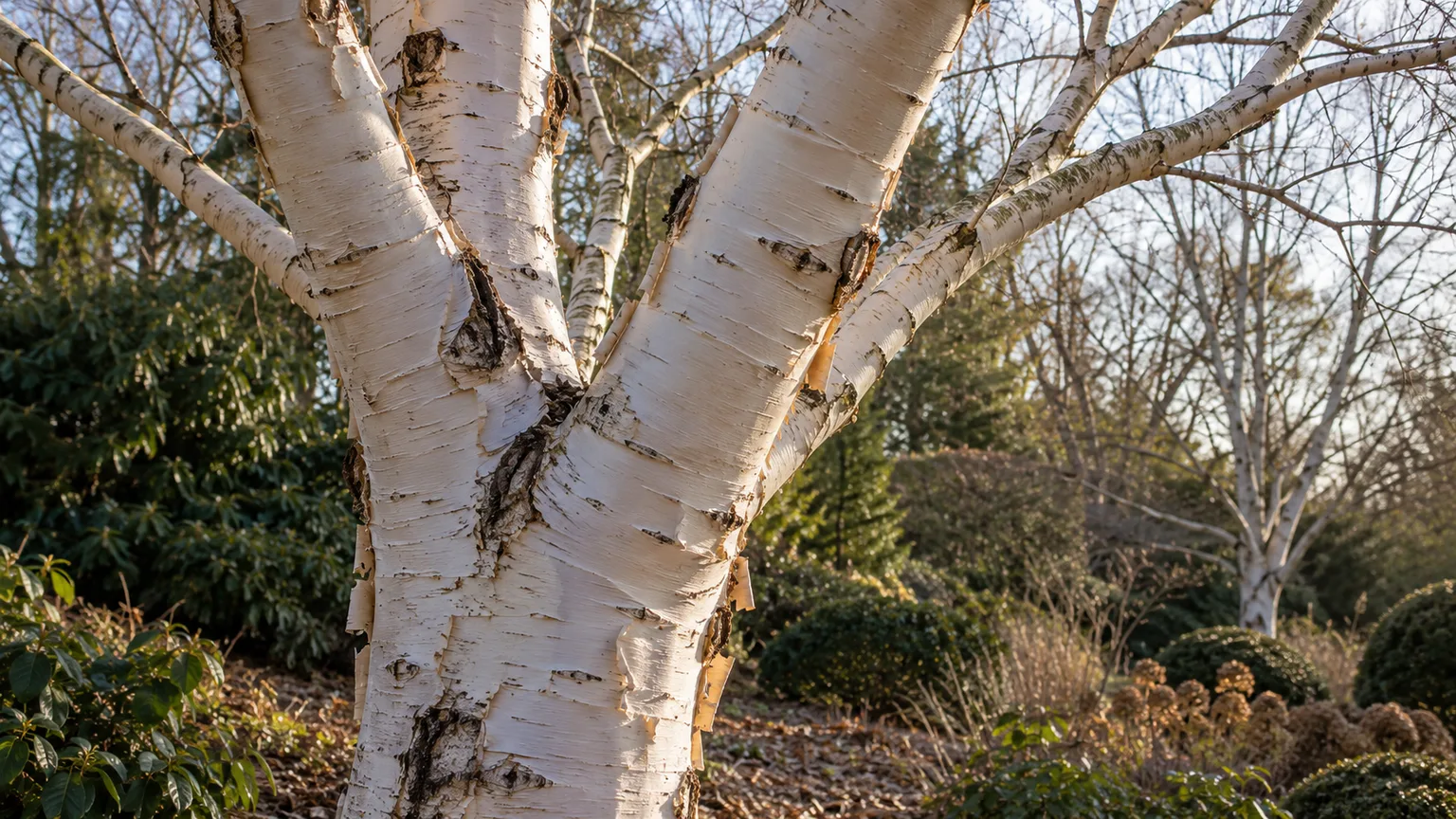
This is a deciduous tree, not an evergreen. It typically has an upright or open pyramidal habit, alternate oval leaves with toothed edges, dangling male catkins, smaller female catkins, and small winged fruits. The bark color is variable across B. utilis: the white-barked form has the clearest winter contrast, but even that can be creamier or less intensely white depending on cultivar, age, and growing conditions. (RHS plant profile; Morton Arboretum Himalayan birch profile)
| Feature | Practical expectation |
|---|---|
| Mature size | Commonly about 30–50 feet tall, with a spread around 20–35 feet; cultivar and site change the final size |
| Light | Full sun to partial shade; cooler root conditions matter in warm areas |
| Soil | Moist but well-drained; tolerates several soil textures, but avoid chronic saturation |
| Best planting window | Dormant autumn or early spring when the soil is workable |
| Main care priority | Keep the root zone moist during establishment and reduce summer stress |
| Main caution | Large canopy and susceptibility to bronze birch borer when stressed |
Size estimates vary because profiles may describe different selections and regions. The Morton Arboretum lists Himalayan birch around 30–40 feet tall and 18–25 feet wide; the RHS describes the Jacquemontii form as capable of exceeding 12 meters in height and spreading 4–8 meters, while Gardeners’ World gives a still larger long-term estimate. Treat a nursery’s cultivar-specific size as a planning range rather than a promise that the tree will stay small. (Morton Arboretum; RHS; Gardeners’ World)
Is Himalayan Birch Right for Your Garden?
Choose this tree when you have room for a full-sized deciduous specimen and want winter bark as much as summer foliage. Its light, open canopy can allow dappled light through, and its changing appearance gives it a longer season of interest than a tree chosen only for flowers. Spring catkins feed pollinating insects, and seeds can be used by birds, although the tree’s wildlife value should be considered a bonus rather than the sole reason to plant a nonnative species.
The biggest suitability question is not whether the tree can survive a cold winter; it is whether your site can keep it from repeated summer stress. Himalayan birch comes from a mountain region and performs best where summers are relatively cool and the soil does not bake dry. In hot, humid regions, especially where pavement, reflected heat, compacted ground, or turf irrigation create extremes around the roots, a native or more heat-tolerant birch is usually a better long-term choice.
Also consider practical scale. A sapling that looks modest at the nursery can develop into a tall, broad-crowned tree with surface roots competing for water and room. Do not squeeze it between a building, driveway, and overhead wires, then plan to shear it down later; hard pruning is not a reliable way to keep a large birch in bounds. If the only available site is a narrow foundation bed, select a genuinely compact tree instead.
Site, Sun, Soil, and Climate
Give Himalayan birch open light and enough airflow, with full sun or partial shade depending on the local climate. In a cool-summer garden, a sunny site encourages a balanced crown and strong autumn color. Where afternoon heat is intense, light afternoon shade can reduce stress, but deep shade is not a solution: it can lead to a sparse, unbalanced canopy and does not correct a hot or compacted root zone.
The soil can be loam, sand, or clay if it drains adequately and stays reasonably cool and moist. The RHS plant profile lists a broad range of soil textures and pH conditions, but also specifies moist yet well-drained soil. That distinction is more useful than searching for one “perfect” soil: the rootball should not dry completely between waterings while the tree is young, but the planting hole must not sit full of water after rain. (RHS plant profile)
Before planting in heavy clay, check drainage after a soaking rain. If the site stays saturated or is a low point that collects runoff, plant on a broad raised mound only if it will remain stable and watered, or choose a tree adapted to wet soil. Amending a small planting hole with a rich, loose pocket of compost is not a reliable fix; water can collect where that amended pocket meets dense surrounding soil. Improve a broad area or choose a better-matched species.
Hardiness ratings also vary by reference and cultivar. Some horticultural profiles place the tree across zones 4–7, while arboretum collections often describe their own regional performance in zones 5–7. A zone number summarizes winter low temperatures; it does not tell you whether the tree will tolerate humid heat, a long dry season, reflected pavement heat, or a waterlogged root zone. Verify the cultivar with a regional nursery or extension service before buying near the warm edge of its range.
Why Summer Heat Changes the Decision
Heat is more than a cosmetic issue for this birch. Hot weather and dry soil increase stress, and stressed birches become more vulnerable to bronze birch borer and other decline problems. University of Minnesota Extension specifically warns that Himalayan birch is among the white-barked birches highly susceptible to bronze birch borer; it recommends choosing a resistant species where that pest is a concern. (UMN Extension: bronze birch borer)
If your summers are often hot and humid, do not assume that frequent irrigation alone will make the tree suitable. A cool root zone, adequate soil volume, and a lower-stress climate all work together; extra water cannot compensate for poor drainage or sustained heat around the trunk. Ask a local arborist or extension office whether the white-barked Himalayan birch is performing reliably in your county, and consider river birch or a locally native birch if they recommend against it.
Choose a Tree for the Space
Buy by botanical name, cultivar, and expected size—not by a common name alone. “Himalayan birch” may mean B. utilis broadly, while “Jacquemontii,” “white-barked birch,” or a cultivar name may describe a selected form with whiter bark. Inspect the actual nursery specimen: look for a straight, undamaged trunk, evenly spaced branches, and a rootball without circling roots that wrap tightly around the stem.
Calculate space from the listed mature spread, not from the plant’s current height. If a tree is expected to spread 25 feet, reserve roughly 12 feet of canopy radius from its trunk as a starting point, then add clearance from structures, paving, utilities, and neighboring trees as appropriate. This is a layout estimate, not a root-barrier guarantee; mature roots may extend beyond the crown, and the canopy can vary with climate and pruning history.
For a small yard, ask whether a named, smaller selection is available and confirm its mature measurements from a reliable botanical or nursery source. Multi-stem forms can be attractive but still need lateral room. If your goal is white trunks in a tight space, a group of genuinely compact trees or a smaller ornamental with pale bark may fit better than forcing a standard Himalayan birch into an undersized bed.
When and How to Plant
Plant while the tree is dormant, usually in autumn or early spring when the soil is neither frozen nor saturated. The RHS recommends autumn as a preferred planting window, with late winter or early spring as a next choice; a container-grown tree can be planted in other seasons if you can provide close watering through warm weather. Avoid planting just before a heat wave or when the rootball is already dry. (Gardeners’ World birch guide)
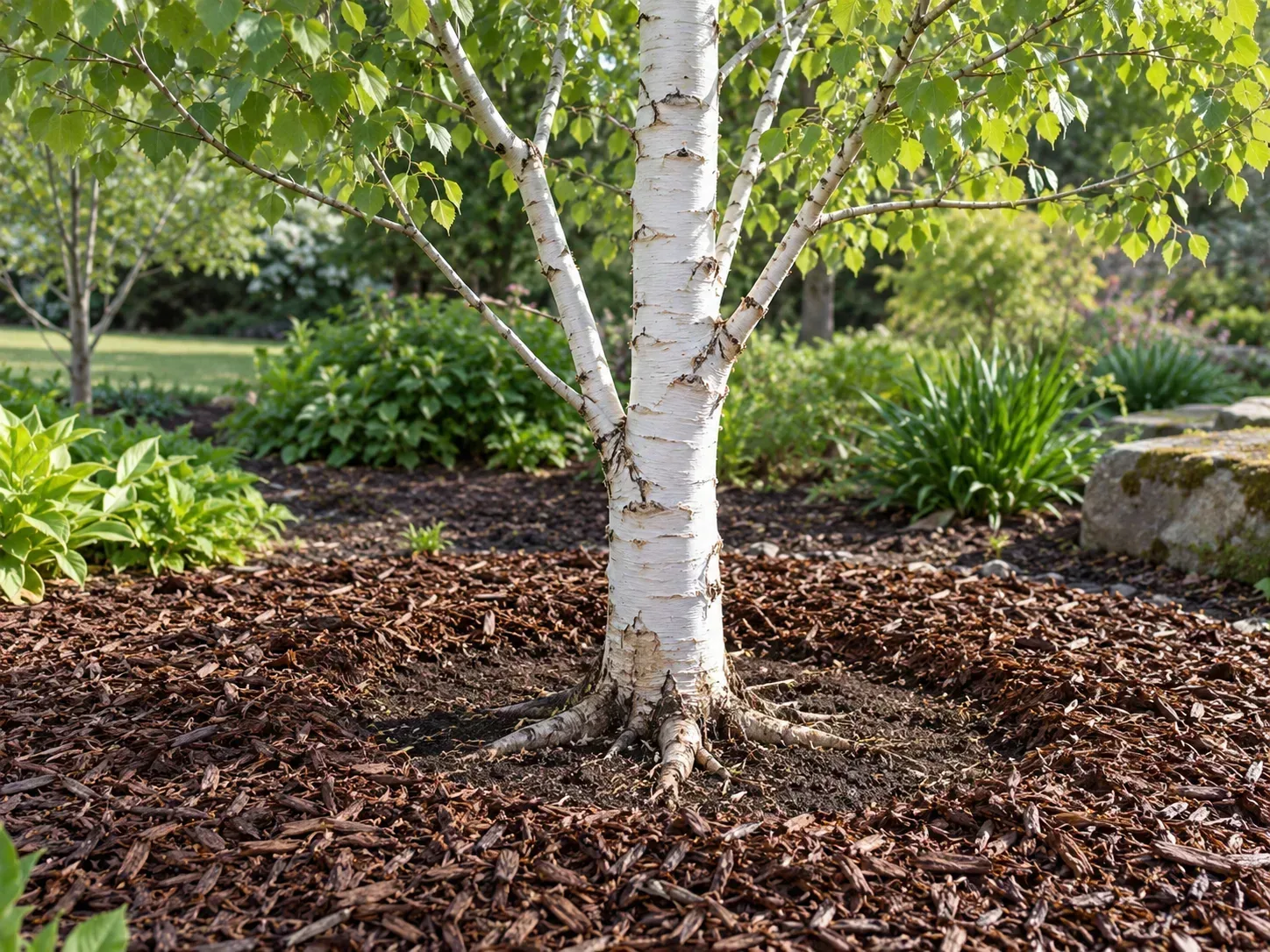
Water the nursery container before planting so the rootball is evenly damp, and identify the root flare—the point where the trunk widens into the first structural roots. Remove any excess potting mix covering that flare. Set the tree so the first roots sit at or slightly above the surrounding soil line, then backfill with the excavated soil and water slowly to settle it around the rootball.
Make a Wide Hole and Keep the Root Flare Visible
Dig a broad, shallow hole, often two to three times the rootball width, but no deeper than the rootball’s actual height. The wider loosened area gives roots a route into the surrounding soil; undisturbed ground under the rootball helps prevent the tree from settling too deep. Utah State University Extension also stresses that root collar depth matters and advises keeping the root collar at or just above grade. (USU Extension tree planting rules)
Do not judge planting depth by the top of the nursery potting mix alone; the root flare may be buried inside the container. If the nursery has planted it deeply, expose the flare before setting the tree. On compacted or wet ground, do not dig a deep basin and hope mulch will solve the drainage. Correct the site broadly, raise the planting area where appropriate, or pick another location.
Use a stake only if the rootball shifts or the planting is exposed to strong wind, and keep any ties loose enough to allow slight trunk movement. Remove staking as soon as the tree stands firmly on its own, generally after its first growing season. Check the label, twine, and ties around the trunk and remove them before they constrict the bark.
Water During Establishment and Afterward
The first one or two growing seasons are the period when water management matters most. The nursery rootball can dry faster than surrounding soil, especially in sandy ground, wind, or warm spells, so check both the rootball and adjacent soil rather than watering only the lawn or the wider garden. Water slowly enough to soak the root zone, then pause and let excess drain before repeating.
Use soil feel and recent weather instead of a fixed calendar. Check several inches down near the outer edge of the rootball; if it is dry and crumbly, water deeply, then recheck. If it is cool and damp, wait. Clay soil may stay wet for longer than sand, and a shaded site needs less frequent irrigation than a windy south-facing bed. A soaker hose or a slow trickle helps water penetrate without running off.
Once established, Himalayan birch still benefits from adequate moisture during prolonged drought, particularly in warm regions. “Drought tolerant” does not mean a newly planted tree can be left dry; nor does “likes moist soil” mean the roots should remain saturated. If leaves scorch or drop early during a heat spell, first review rootball moisture, drainage, mulch, and nearby turf competition. Do not add fertilizer as the first response.
Mulch, Fertilizer, and Underplanting
Spread organic mulch over a broad circle to shade the shallow feeder roots, conserve moisture, moderate soil temperature, and reduce competition from grass. A layer around 2–4 inches deep is a useful general tree-care range; keep it pulled back several inches from the trunk so the bark stays dry and visible. Utah State University Extension notes the value of a wide mulch area and specifically cautions against piling mulch against the trunk. (USU Extension post-planting care)
Do not automatically apply low-nitrogen fertilizer or iron because a birch is newly planted. Fertilizer does not correct transplant shock, buried roots, drought, waterlogging, or heat stress, and extra growth can increase the tree’s water demand. If growth is poor after the tree has had time to establish, check soil pH and nutrients through a local soil test, then use only the amendment that the test or extension guidance supports.
Underplant with low-growing plants that tolerate dappled shade and do not require frequent digging or heavy irrigation. Keep turf, edging tools, and foot traffic away from the trunk, because repeated compaction and mower damage create avoidable stress. As the canopy grows, adjust companion plants and irrigation so they shade soil without keeping the birch’s roots constantly wet.
Prune Without Losing the Natural Form
Himalayan birch generally needs only corrective pruning: remove dead, broken, crossing, or hazardous branches and preserve the tree’s open natural shape. The RHS warns that hard pruning is not suitable for birches; Gardeners’ World recommends pruning only when necessary, in late summer. Avoid topping or cutting the crown back to fit an undersized site, because this spoils the form and does not solve the space mismatch. (RHS birch growing guide; Gardeners’ World)
Make clean cuts just outside the branch collar, not flush against the trunk and not leaving a long stub. If you need to remove a large limb over a roof, walkway, or power line, hire a qualified arborist instead of trying to reach it from a ladder. Do not remove a large share of the live crown in one session. If you want a single-stem or multi-stem silhouette, buy a tree already trained to that form rather than attempting to remake it after planting.
Birch sap can flow heavily in late winter and spring. Timing recommendations vary by region, but late summer after the main spring sap flow is a practical window for small necessary cuts; dead or broken wood can be handled as needed. If pruning requires removing large structural limbs, have an arborist decide on timing and technique based on the tree’s condition and local disease risks.
Propagation From Seed or Cuttings
You can grow birch from seed, but a seedling will not necessarily reproduce the bark color or shape of a named cultivar. The RHS recommends sowing fresh birch seed in autumn or refrigerating it for winter sowing, then spreading the tiny seed on the surface of seed compost and covering it only lightly. Keep it in good light and evenly moist; seedlings are delicate and need protection from drying, wind, and competition. (RHS birch propagation guide)
For a named selection such as a white-barked Jacquemontii cultivar, vegetative propagation is needed to preserve the parent’s traits. The RHS lists softwood cuttings or grafting, but also notes that birch cuttings can be challenging even for commercial growers. Take softwood material in spring to early summer and use a clean, free-draining medium; expect uneven rooting, and do not rely on one cutting if you are learning the method.
For most home gardens, buying a correctly labeled nursery tree is more reliable than raising a specific cultivar from seed. If you do sow seed, confirm it is fresh and species-identified, and grow several seedlings because germination and early survival can vary. Never collect seed or cuttings from protected land or a private tree without permission.
Seasonal Care Through the Year
In autumn, plant new stock while the soil is workable, replenish mulch, and remove fallen leaves if a disease issue in your garden calls for sanitation. Do not pile mulch against the trunk. The bare branches make it easier to inspect the crown’s structure and appreciate the bark, but avoid washing or scraping it to make it look whiter; damaging the bark invites stress rather than improving the tree.
In late winter and early spring, look for broken limbs and signs of trunk injury before leaf-out. This is also when male catkins become visible. Do not confuse natural catkin drop or a modest amount of interior twig loss with widespread decline. If you prune, use the least disruptive cuts and avoid major shaping.
In spring and early summer, check new plantings regularly as weather warms. Keep the rootball from drying and make sure the mulch ring still separates the tree from turf. In hot-summer regions, monitor soil moisture more often during heat waves and do not treat wilting at midday as proof of drought until you check the soil; heat itself can cause temporary leaf stress.
In late summer and autumn, maintain deep watering through dry spells, then allow the soil to drain between irrigation. Yellow fall foliage is normal; sudden browning across multiple branches, premature leaf drop, or crown dieback needs investigation. Young trees may show less dramatic white bark than mature specimens, and bark color can vary among cultivars, so judge health from leaves, twigs, and overall growth rather than whiteness alone.
Pests, Dieback, and Preventable Problems
Most visible trouble begins with stress, not with a need for stronger treatment. Look at the whole site first: has the tree been watered through a dry period, is the root flare buried, is soil staying wet, has a mower struck the trunk, or has pavement raised root-zone temperatures? Then compare the pattern of symptoms. A few interior leaves yellowing as the canopy matures differs from progressive browning at branch tips or dieback moving down from the top.
Himalayan birch can be affected by bronze birch borer, leaf miners, aphids, Japanese beetles in some regions, and fungal problems such as rust or powdery mildew. Minor leaf feeding does not automatically justify pesticide. Identify the pest and level of damage first, and consult a local extension office or certified arborist before using a pesticide on a mature tree; product labels and local rules determine whether a treatment is appropriate.
Keep the trunk free of mower and string-trimmer wounds, maintain a broad mulch area, and water deeply during establishment and prolonged drought. Avoid heavy fertilizing, root disturbance, and unnecessary pruning. These steps cannot guarantee that a susceptible tree will never be attacked, but they reduce the stress conditions that often make decline more likely.
Bronze Birch Borer and Heat Stress
Bronze birch borer larvae feed beneath the bark and can interrupt water movement through the tree. Signs may include thinning or dying branches near the top, progressive dieback, small D-shaped exit holes, or ridged and swollen areas on the trunk. Similar symptoms can have other causes, so do not diagnose the beetle from one brown branch alone. University of Minnesota Extension says Himalayan birch is highly susceptible and emphasizes avoiding stress and choosing a more resistant species where the borer is established. (UMN Extension; Oregon State University Landscape Plants)
If decline is progressing, photograph the crown and trunk, note when it started, check whether irrigation reaches the original rootball, and arrange an assessment by a certified arborist or extension plant clinic. Do not immediately apply a systemic insecticide: treatment depends on accurate identification, timing, tree condition, and local regulations, and a severely declining tree may not recover. Where the climate is repeatedly too hot or the borer is common, replacing a declining specimen with a locally adapted birch may be the sounder long-term decision.
Similar Birches and White-Barked Cultivars
Silver birch (Betula pendula) also has pale bark but commonly shows darker markings and a more pendulous branching habit. Paper birch (B. papyrifera) has papery bark that can peel in sheets and is native to North America; river birch (B. nigra) typically has peeling tan, cinnamon, or brown bark and tolerates wetter conditions better than Himalayan birch. These are useful starting distinctions, not substitutes for checking leaves, bark, branching, and a reliable plant label. The RHS birch guide describes the different bark characters and warns against choosing a large birch that later needs hard pruning. (RHS: how to grow birch)
Within Himalayan birch, cultivar selection affects bark whiteness, crown habit, and eventual size. The name “Jacquemontii” is often used loosely in garden commerce, so ask whether the plant is a named cultivar and request its expected mature height and spread. The RHS lists the Jacquemontii variety as capable of growing beyond 12 meters, while some arboretum references describe smaller mature dimensions for their regional specimens; choose a source that is specific to the actual selection and climate.
If you are planting several trees, plan their spacing from the expected mature width and decide whether you want individual trunks or a multi-stem group. A tightly packed line may look elegant when young but can become crowded, shade out lower branches, and complicate pruning as trunks widen. Planting fewer trees with room to develop usually preserves the clean bark and airy silhouette that make this birch worth growing.
Conclusion
Himalayan birch is a strong choice for a cool-summer garden with generous space, reliable drainage, and enough soil moisture to carry a young tree through establishment. Its white bark, spring catkins, and yellow autumn foliage reward patient gardeners, but the tree is not a quick screen or a dependable fit for hot, humid sites where stress and bronze birch borer are persistent risks.
Start by confirming the botanical name and mature dimensions of the nursery selection. Plant it dormant in a wide, shallow hole with the root flare visible, mulch broadly without touching the trunk, and water according to root-zone moisture rather than a fixed schedule. After that, prune sparingly, skip fertilizer unless a soil test supports it, and treat progressive dieback as a reason to inspect the site and seek a diagnosis—not as a cue to spray or feed blindly.



