How to Grow and Care for Hazelnut Trees
Grow hazelnut trees with the right cultivar pair, planting site, pruning rhythm, and harvest cues. Learn how to dry nuts and spot Eastern filbert blight.
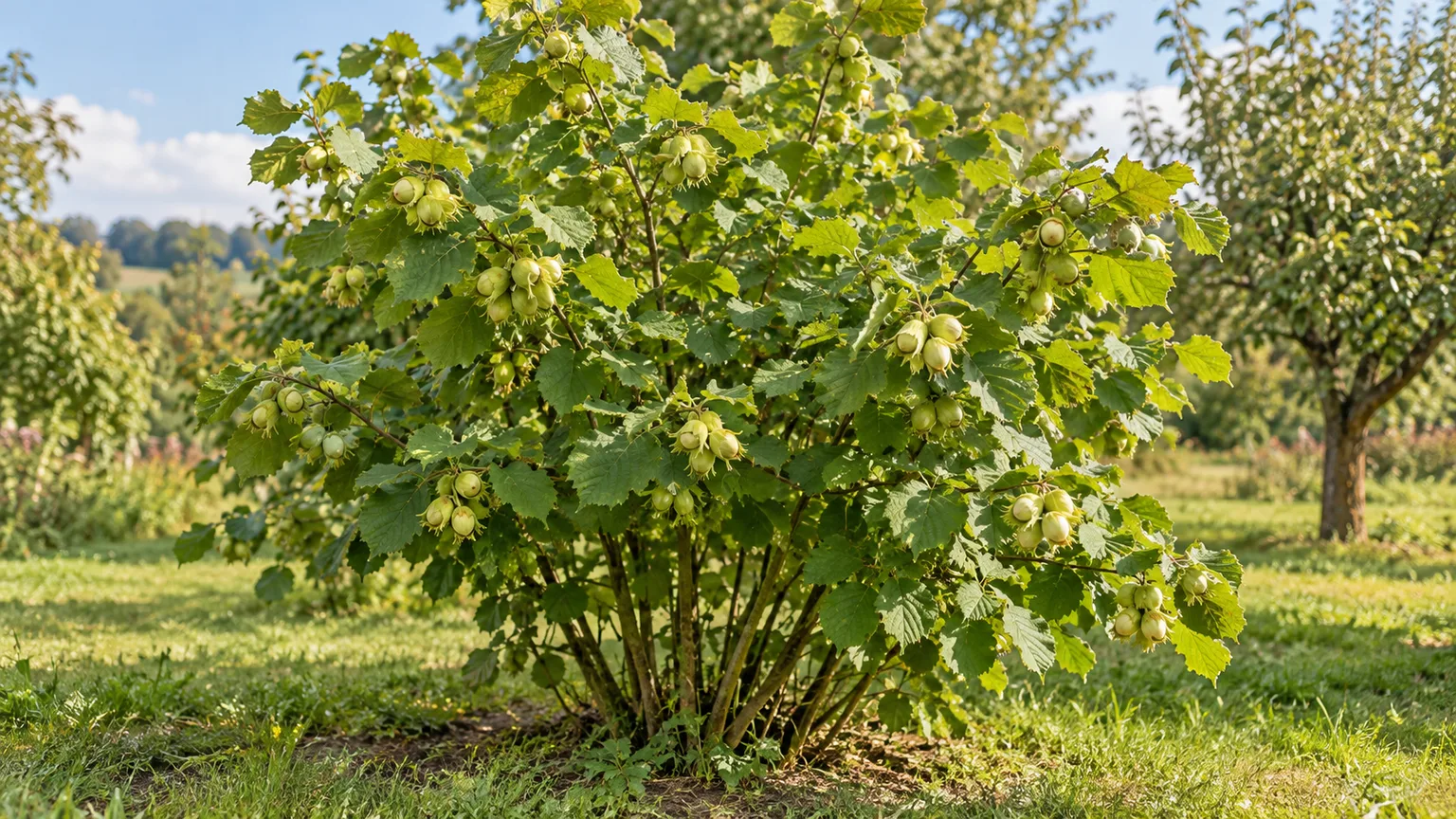
A hazelnut is usually not a tidy, single-trunk tree. Most Corylus grow as large, deciduous shrubs with several stems rising from the base, and that habit affects where you plant, how you prune, and how easy it is to collect nuts. More important, a shrub can flower heavily and still produce little if it lacks a compatible pollen partner.
For a dependable backyard crop, start by choosing a hazelnut type suited to your climate, then buy two compatible cultivars whose pollen and flowers overlap. Give them sun and soil that drains, decide whether you want a natural thicket or a managed clump, and protect the crop from squirrels before the first nuts ripen. This guide focuses on the choices that make the difference between an attractive hazel and a productive one.
Hazelnut Tree Care at a Glance
| Growing factor | Practical target | Why it matters |
|---|---|---|
| Sun | Full sun for best nut production; light shade is tolerated | Less light usually means fewer flowers and a smaller crop |
| Soil | Fertile, moisture-retentive soil that drains freely | Roots struggle in standing water and compacted ground |
| Pollination | Two compatible cultivars with overlapping bloom | A second tree of an incompatible selection may not solve poor set |
| Spacing | Often 15–20 feet for open-grown shrubs; confirm cultivar size | Mature canopies need light and airflow, and harvesters need access |
| Water | Deep watering while young and during prolonged dry spells | Moisture stress can limit nut filling |
| Pruning | Remove dead or crowded wood and manage basal suckers | The natural thicket can shade its center and make harvesting difficult |
| Harvest | Late summer into fall, depending on cultivar and climate | Husk color and looseness are more reliable than a calendar date |
| Major disease | Eastern filbert blight in susceptible cultivars and regions | A canker can girdle a branch and lead to dieback |
Hazelnuts suit gardeners who have room for a broad shrub and patience for a crop that improves as plants mature. If your main goal is one low-maintenance ornamental specimen, a single hazel is still worthwhile; just do not treat its flowers as a guarantee of nuts.
Choose the Right Kind of Hazelnut
“Hazelnut” can mean several species in the genus Corylus. European hazel (Corylus avellana) is the species behind many commercial-quality cultivars and the focus of much nut production. American hazelnut (C. americana) is a native, thicket-forming shrub across eastern North America; it is notably cold-hardy and can be a better fit for a naturalized planting, although its nuts are often smaller and can be harder to harvest from the husks. Beaked hazelnut (C. cornuta) is another North American native worth considering where it is locally adapted.
The species distinction matters most when you compare hardiness and disease risk. Better Homes & Gardens describes American hazelnut as hardy across USDA zones 4–9 and notes that nursery-grown plants can begin producing in about three years, while seed-grown plants can take much longer. Epic Gardening gives European hazelnuts a generally colder-climate range, but a named cultivar can differ from the species average. Use a local nursery or extension recommendation for the exact cultivar rather than relying on a generic zone number. (Better Homes & Gardens’ American hazelnut guide; Epic Gardening’s hazelnut growing guide)
European and American hazelnuts are not interchangeable
European hazels are typically selected for larger, familiar nut crops, but many cultivars are susceptible to Eastern filbert blight in parts of North America. American hazelnuts are native and generally better adapted to eastern conditions; Wisconsin Extension reports that the blight causes little significant damage on American hazelnut compared with the serious losses it can cause on European hazel. That does not mean every American plant is equally productive or that every European cultivar is doomed. It means species and cultivar should be part of your regional buying decision, not an afterthought. (University of Wisconsin–Madison Extension on Eastern filbert blight)
You will also see hybrid hazels and ornamental forms such as contorted filbert. A hybrid may offer a useful balance of hardiness and nut quality, but ask whether it is selected for your climate and whether its pollination partner is known. A contorted ornamental hazel is grown for twisted branches, not automatically for a reliable nut harvest; buy for the job you want it to do.
Pick a Sunny, Well-Drained Planting Site
Choose a spot with at least six hours of direct sun, and more is helpful when nut production is the priority. Hazelnuts can grow in partial shade, but a shaded shrub often produces fewer flowers and a lighter crop. Think about the canopy after ten years, not just the size of the nursery plant: common hazels can become broad, suckering shrubs that shade nearby beds.
Drainage is the non-negotiable soil feature. Hazelnuts prefer soil that holds some moisture and organic matter without staying waterlogged; a low pocket that puddles after rain is a poor site even if it gets full sun. If your soil is heavy clay, compacted, or poorly drained, choose a raised planting area or another location rather than digging a small amended “bathtub” hole that holds water around the roots.
A soil test is a better starting point than routine fertilizer or lime. Record pH and nutrient levels, then amend only when the test calls for it. A broad pH range is tolerated by hazelnuts, but the right correction depends on your soil and local advice; overcorrecting a planting bed can create new nutrient problems.
Allow room for 15 to 20 feet between open-grown shrubs as a useful home-garden starting point, then adjust for the mature size of the cultivar and your pruning plan. A hedge or wildlife thicket can be tighter, but crowding makes air circulation, pruning, and nut collection harder. Keep the site accessible from more than one side so you can lay a tarp, inspect branches, and reach the second cultivar without trampling the root zone.
Plan for Pollination Before You Buy
Hazelnut shrubs carry male and female flowers on the same plant. The familiar dangling yellow catkins are the male flowers; the tiny red styles at bud tips are female flowers. They usually appear on bare branches in late winter or early spring, before leaves obscure them. NC State Extension describes both flower types on European hazel, but a single plant having both does not guarantee it can fertilize itself. (NC State Extension’s European hazel profile)
Most fruiting selections need pollen from a different, compatible cultivar. Hazelnuts are wind-pollinated, and cultivars can differ in when they release pollen, when female flowers are receptive, and whether their pollen is genetically compatible. A pair that blooms at different times—or shares an incompatibility group—may perform like a single tree. Gardening references sometimes make cultivar choice sound like a simple “plant any two” rule; that is too loose for a crop where one partner is meant to provide the pollen.
Match cultivar compatibility and bloom timing
Before placing an order, ask the nursery for the cultivar’s recommended pollenizer, bloom timing, and local disease resistance. Many catalogs publish pollination charts; use those charts rather than guessing from a generic list of popular varieties. If you already have a hazel, identify its cultivar first, then ask for a proven partner whose pollen shed overlaps the female bloom.
Place the pollenizer within the same open garden or orchard area, not behind a solid wall or far across the property. There is no magic distance that applies to every yard, because wind exposure, barriers, and the layout of nearby hazels all affect pollen movement. If a compatible hazel grows next door, it may contribute pollen, but relying on an unknown neighbor plant leaves your crop dependent on something you cannot manage.
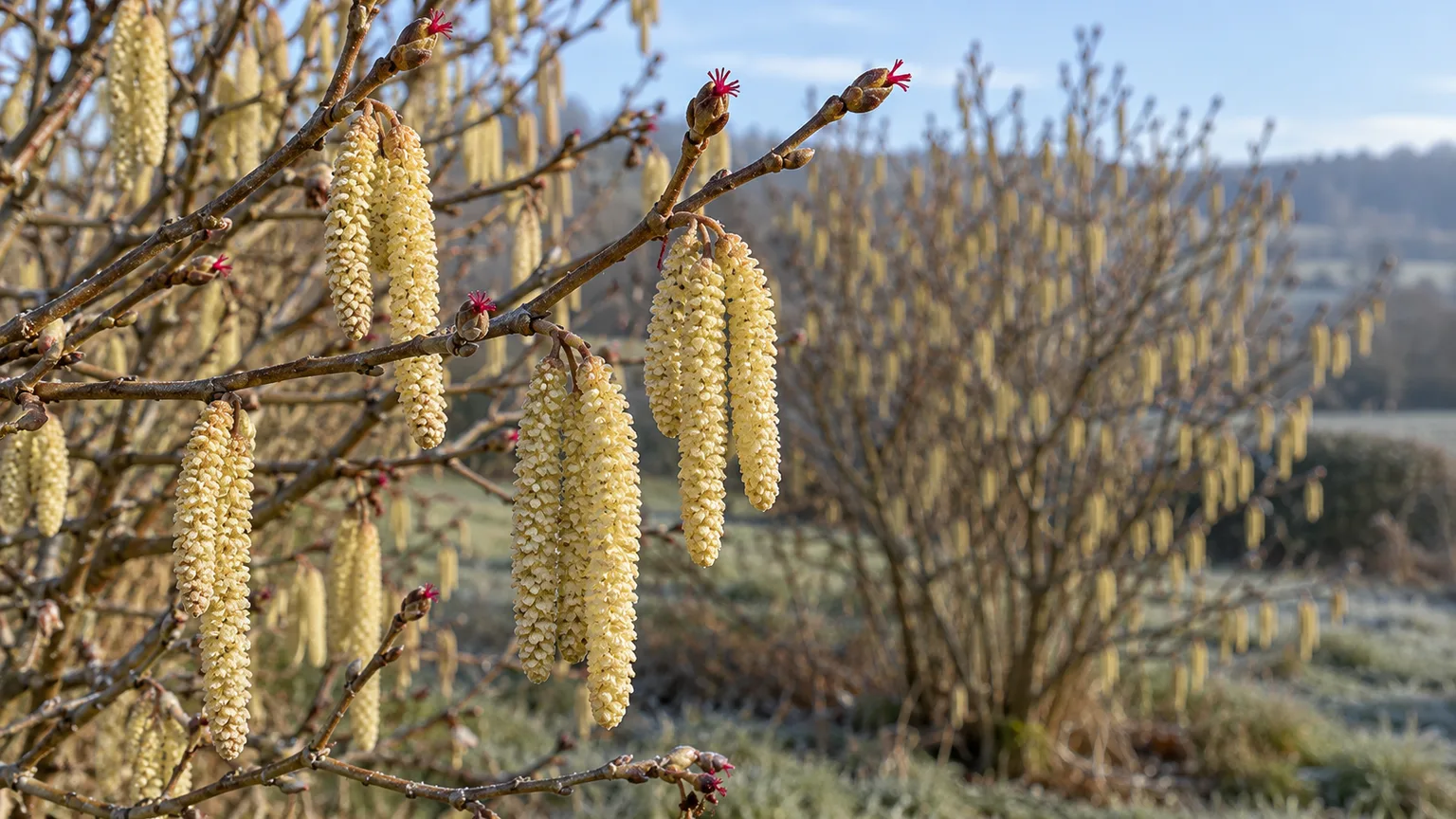
Do not prune away every catkin-covered branch because it looks untidy in winter. Those catkins are the pollen supply for the season, and cutting flowering branches just before pollen release can reduce the crop even when the shrub looks vigorous.
Plant Hazelnut Trees for Long-Term Access
Plant nursery stock while it is dormant—usually in fall after the soil cools or in early spring before strong growth begins. Avoid frozen ground, saturated soil, and hot, dry periods when a newly planted root system cannot keep up with leaf demand. Container-grown plants can be installed during a wider window, but they still need careful watering through their first growing season.
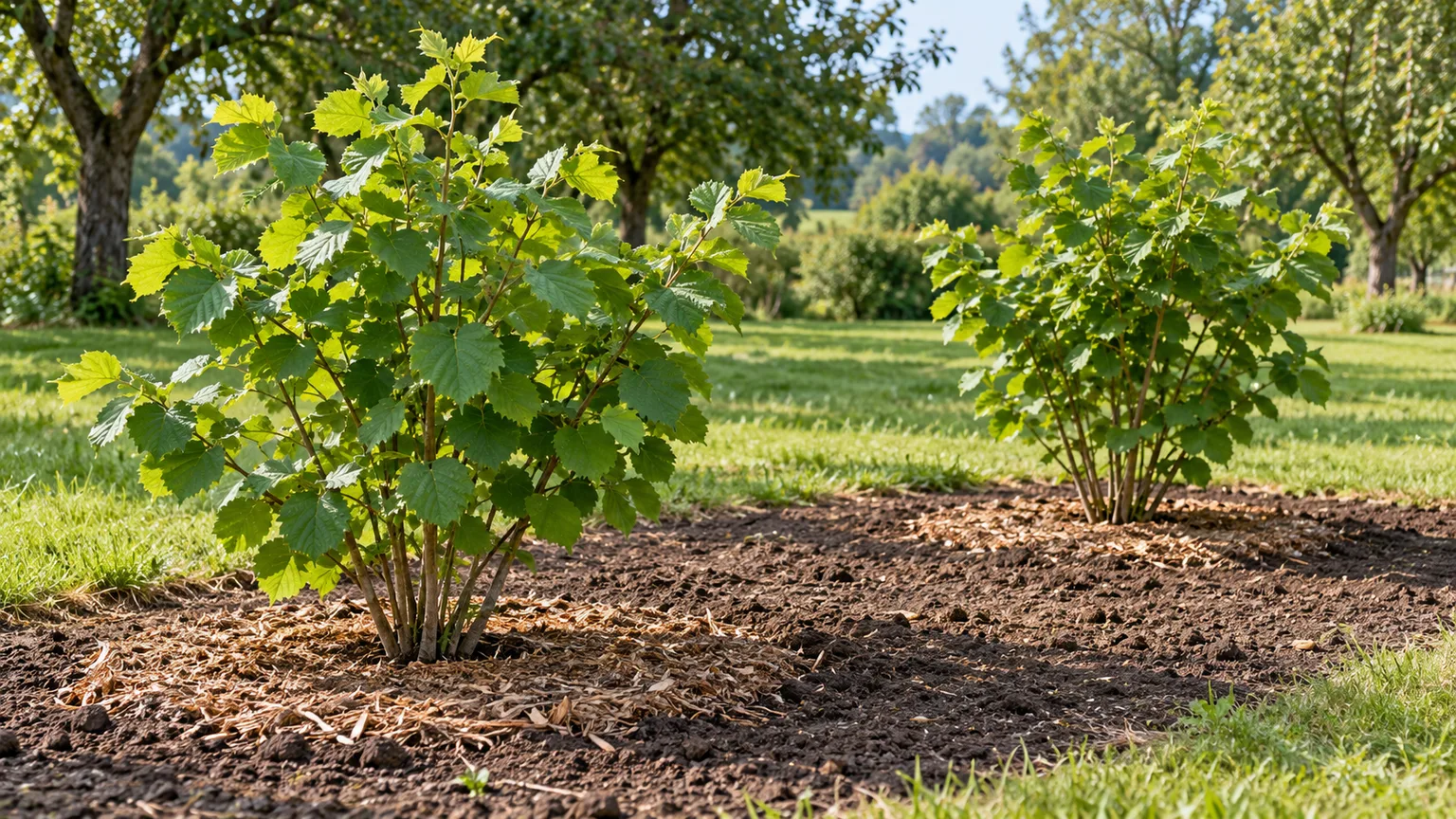
Dig a hole wider than the root ball and no deeper than the plant grew in its nursery container. Loosen circling roots on a container plant, fan bare roots out in the hole, and keep the root flare at or just above the finished soil level. Backfill with the native soil; do not bury the stem or pack a pocket of rich compost against the roots.
Water slowly after planting to settle soil around the roots, then spread a two- to three-inch layer of mulch over the root zone. Keep mulch a few inches away from the stems so the bark stays dry and visible. If you are planting a pair, measure the spacing before you dig the first hole; it is easier to correct the layout on paper than to move a rooted hazel a few years later.
Water and Mulch During Establishment
For the first year, check soil moisture every few days during warm or windy weather. Water deeply when the upper few inches of soil begin to dry, then let excess drain; do not keep the root zone constantly soggy. Frequency will vary with rainfall, soil texture, and plant size, so a weekly routine is only a reminder to inspect, not an automatic instruction to irrigate.
Established hazels tolerate ordinary weather better than newly planted shrubs, but prolonged summer drought can reduce nut fill. During a dry spell, water slowly over the root zone so moisture reaches the active roots instead of running off the surface. A wide mulch ring helps conserve moisture and suppress grass competition, but do not heap it against the stems or extend irrigation solely to keep the lawn green around a tree.
Wilting leaves in heat do not always mean the soil needs water. Check beneath the mulch before watering again: if the soil is damp and the shrub wilts repeatedly, investigate drainage or root damage instead of adding more water. Root stress is harder to see than a dry surface, and keeping a waterlogged planting site wet can turn a brief heat response into a longer decline.
Prune for a Productive, Manageable Clump
Hazelnuts naturally send up basal shoots, or suckers, and can spread into a thicket. That is useful if you want screening, habitat, or a naturalized patch, but a dense clump can shade its own center and hide ripe nuts. Decide what you want before pruning: keeping a few well-spaced stems creates easier access, while retaining more canes preserves the shrub’s informal look and wildlife cover.
Decide between a multi-stem shrub and a small tree
For a productive home shrub, keep several vigorous, well-spaced canes and remove dead, damaged, crossing, or badly placed stems. Take unwanted suckers close to the ground while they are small, and thin the oldest canes gradually rather than cutting the whole shrub back at once. A hazel can be trained to a small tree form, but that takes ongoing sucker removal and does not change its need for a compatible pollen partner.
Prune in dry weather when the shrub is dormant, but time the work with flowering in mind. Hazels bloom on bare branches; heavy pruning before catkins release pollen can remove this season’s male flowers. In a nut planting, make structural cuts after the flowering period where local conditions allow, and avoid severe rejuvenation in one year. Use clean, sharp tools, and remove diseased wood promptly using local extension guidance.
Do not confuse basal suckers with all low branches. A lateral branch that supports a healthy canopy can contribute both leaves and future flowers; removing every low branch may reduce the crop while creating a taller, harder-to-harvest form. Step back after each few cuts and preserve an open but leafy framework.
Fertilize Only When the Tree Needs It
A hazelnut that grows well in decent soil may need no routine fertilizer. Test the soil first, and look at the whole plant: weak growth can come from drought, shade, waterlogging, root competition, or disease, not only nutrient shortage. Adding nitrogen to a stressed tree can produce soft leafy growth without solving the cause of a poor crop.
If a soil test or local extension recommendation indicates a deficiency, use a product and rate intended for the plant and season, following its label. Spread granular material over the active root area rather than piling it against stems. Mulch with leaf mold or finished compost if the soil needs organic matter, but avoid burying the root flare under repeated layers.
Harvest Nuts When the Husks Release
The harvest window varies with species, cultivar, and climate, but many hazelnuts ripen from late summer into fall. Start watching when the husks begin to change from bright green toward yellow or brown and the nuts loosen from their clusters. A few fallen nuts are a useful cue, not a signal to wait several weeks: squirrels, jays, and other wildlife often find the crop first.
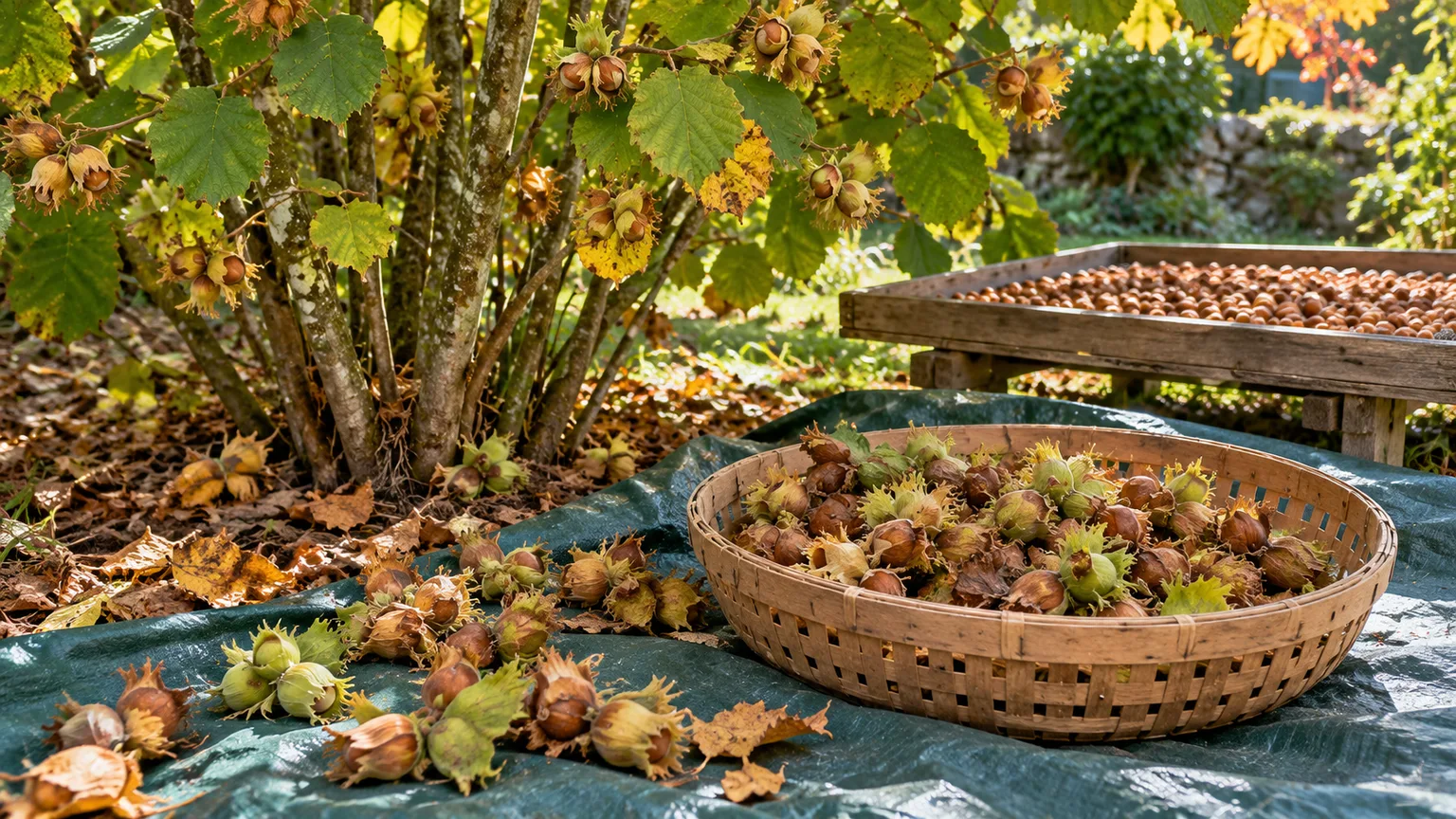
Spread a clean tarp beneath the canopy and check it regularly as the nuts ripen. Gather nuts promptly after they fall, or gently shake a branch over a container when the husks are mature and release easily. Better Homes & Gardens recommends watching the color of American hazelnuts and leaving nuts that are still firmly attached; its harvest timing also illustrates why local dates cannot replace ripeness cues. (Better Homes & Gardens)
If the crop arrives over several weeks, harvest in several passes rather than stripping green nuts from the entire shrub. Nuts picked too early may be smaller, less flavorful, and harder to cure. A ripe hazelnut may still be enclosed in a leafy husk, so sort at home rather than judging by shell color alone.
Dry, Sort, and Store the Crop
Remove leaves and loose debris, then spread the nuts in a single layer in a dry, shaded, well-ventilated place. Let them cure until the shells feel dry and the kernels no longer taste soft or green; depending on humidity and harvest condition, this can take days to a couple of weeks. Avoid a damp garage floor, sealed plastic bag, or hot direct sun, all of which can compromise drying.
Discard nuts with visible mold, cracked shells, insect holes, or an off smell. A water float test can help find some hollow nuts, but it is not definitive: a sound nut may float and a damaged nut may sink. When in doubt, crack a sample and inspect the kernel before storing the rest.
Keep well-dried nuts in their shells in an airtight container in a cool, dark place; refrigerate or freeze them if you want a longer storage window or live in a warm, humid climate. Shelled kernels lose quality faster, so crack only what you expect to use soon. BHG’s American hazelnut guide recommends drying the crop before storing and notes that refrigerated shell-on nuts can keep for up to a year, though actual quality depends on how thoroughly the nuts were dried. (Better Homes & Gardens)
Prevent and Recognize Eastern Filbert Blight
Eastern filbert blight is a serious fungal disease caused by Anisogramma anomala. It is especially damaging to susceptible European hazels; native American hazelnuts are much less affected in Wisconsin. The disease develops slowly, so a shrub may look healthy for a long time after infection. University of Wisconsin Extension notes that the cankers can appear 12–18 months after infection and can eventually girdle branches on European hazel. (University of Wisconsin–Madison Extension)
Inspect the woody stems in winter and during the growing season. Look for elongated, sunken or raised bark areas, black fruiting structures in rows, and branches that suddenly retain dead leaves or die back. These signs warrant a closer look, but other damage can resemble cankers; ask a local extension plant clinic to confirm an uncertain diagnosis before removing a mature shrub.
Cultivar resistance is a regional decision, not a lifetime guarantee. The Pacific Northwest Plant Disease Management Handbook reports that a new pathogen mutation detected in 2023 can overcome a resistance gene used in some popular cultivars in that region. Its 2026 guidance describes a life cycle with a long symptom-free period and recommends integrated local management, not reliance on one “resistant” label. (Pacific Northwest Plant Disease Management Handbook: Eastern filbert blight)
Buy from a reputable nursery, inspect the stems before planting, and check the cultivar against current local recommendations. If you find a suspected canker, photograph it and contact your extension office; treatment choices and removal recommendations depend on the species, cultivar, disease extent, and local rules. Do not apply a fungicide by guesswork, especially on a tree whose nuts you plan to eat.
Protect Nuts From Pests and Wildlife
Wildlife is often the most visible hazelnut “pest.” Squirrels, jays, and other animals may remove nuts before a gardener gets a full harvest, so collect ripe nuts frequently and use a tarp or mesh bags where practical. A bird or squirrel taking a few nuts is normal; a nearly empty crop usually means the harvest routine or timing needs to change.
Insect-damaged nuts may have small holes, empty kernels, or larvae inside. Open a sample from each harvest pass and discard damaged nuts rather than mixing them into storage. Filbert weevil and related nut-feeding insects vary by region; local extension guidance can help identify the pest before you choose a control.
Japanese beetles and leaf-feeding insects may chew foliage, but light damage does not automatically justify treatment. Check whether the shrub is still producing healthy new growth, identify the insect, and use the least disruptive locally recommended response. Avoid broad insecticide use around a crop without checking the label, pollinator exposure, harvest interval, and local regulations.
Troubleshoot a Weak Crop
A vigorous shrub with flowers but few nuts most often needs a pollination review. Confirm that a compatible second cultivar is close enough for wind to carry pollen and that its catkins release pollen while the female flowers are receptive. If the partner is unknown, do not assume that two hazels automatically make a pollinating pair; ask the nursery or a local hazelnut grower to identify a suitable pollenizer.
A hazel with few flowers may be too young, too shaded, over-pruned, or stressed by drought or poor drainage. Check the site and recent care before adding fertilizer. If the plant has been cut back repeatedly, give it time to rebuild flowering wood and avoid removing the winter catkins that will contribute to the next crop.
A crop that starts well but produces small or empty kernels points toward incomplete nut filling, premature harvest, pests, or environmental stress. Check for holes and kernel damage, compare ripeness across more than one harvest date, and note whether the shrub suffered a long dry spell. Keep a brief season log—flower date, watering, nut set, and first ripe nuts—to distinguish a one-year weather problem from a persistent cultivar or site mismatch.
Propagate Hazelnuts Without Losing a Named Cultivar
If you want a named nut cultivar, propagate from a rooted sucker or a nursery-grown plant of that cultivar, not from a random nut. Seedlings can differ from the parent and may not preserve nut size, flavor, hardiness, or pollination behavior. They can also take longer to bear, so seed is a patient experiment rather than a shortcut to an identical tree.
Hazelnuts can be layered or grown from rooted suckers. In the dormant season, identify a sucker with its own roots, separate it carefully from the parent, and transplant it into prepared soil. Keep it evenly moist while it establishes, and label it immediately so it does not get mixed up with a different cultivar in a two-tree planting.
Seed propagation is possible but requires patience and the correct chilling conditions for germination. Better Homes & Gardens notes that American hazelnuts grown from seed may take up to seven years to bear, compared with earlier crops from nursery stock. If you start seedlings, grow several and expect to select for performance rather than assuming the first one will match the mother shrub. (Better Homes & Gardens)
Grow Hazelnuts in Small Yards and Cold Climates
Hazelnuts are poor long-term container plants because they become broad, multi-stem shrubs with substantial root systems and a need for cross-pollination. A large pot can hold a young plant temporarily, but it restricts mature growth and makes water management harder. If you have only a patio, choose a different compact fruit crop or plant a hazel in the ground where it can spread.
In a small yard, a managed clump can work if you have space for two compatible cultivars and access to prune and harvest around both. Check mature width before purchase, keep the shrubs away from foundations and narrow walkways, and choose a compact selection only when its nut production and pollination partner are documented. A hedge may be attractive, but tight spacing can complicate air movement and disease monitoring.
Cold tolerance varies by species and cultivar, while late-winter flowering can be exposed to unusual warm-cold swings. Use a variety recommended for your region, avoid low frost pockets if spring frost is common, and do not assume that a hardiness-zone label describes pollination timing or disease resistance. If you are in an area with Eastern filbert blight, local cultivar advice matters just as much as cold hardiness.
Conclusion
Growing hazelnuts successfully starts before planting: choose a species and cultivar suited to your region, and secure a compatible pollen partner with overlapping bloom. Then give the shrubs sun, room, freely draining soil, and enough water while young; manage suckers according to whether you want a thicket or an accessible crop; and harvest when the husks loosen rather than waiting for every nut to fall.
Hazelnuts are a long-term food crop, not an instant yield. Buy healthy, correctly labeled stock, ask specific pollination and disease questions at the nursery, and keep a simple record of flowering and harvest. Those choices give you the best chance of turning a healthy hazel shrub into a harvest you can actually gather and store.