How to Grow and Care for Silver Birch Trees at Home
Silver birch needs room, cool roots, and reliable moisture while young. Learn how to plant, water, prune, and troubleshoot it in your climate.
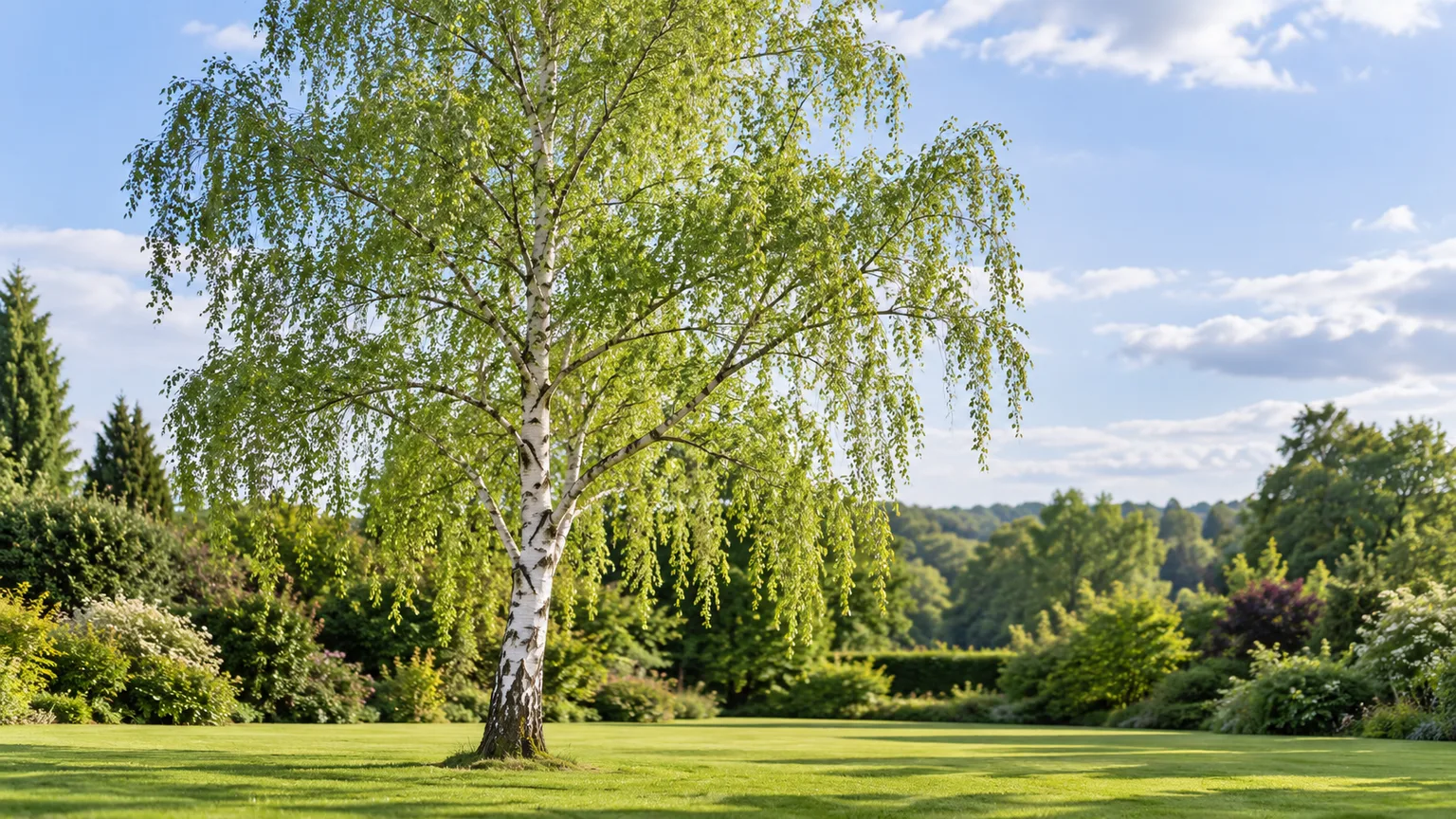
Silver birch (Betula pendula) is a tall, fast-growing deciduous tree with pale peeling bark, fine drooping twigs, spring catkins, and yellow autumn leaves. It earns its place where a light canopy and winter bark can be enjoyed from a distance, but it is a poor impulse buy for a hot, cramped, or chronically dry yard. Before choosing one, check the local planting guidance, the tree’s mature spread, your summer climate, and whether you can water it while its roots establish.
For a suitable site, care is straightforward: plant during dormancy in moist but well-drained soil, keep the root zone evenly moist through establishment and drought, mulch broadly without piling mulch against the trunk, and prune only when there is a clear reason. Silver birch is adaptable across a range of soils, but that does not make it a good fit for every climate or garden.
Silver Birch Care at a Glance
| Need | Practical guidance |
|---|---|
| Mature size | Often 30–50 feet (9–15 m) in North American landscape references; RHS describes trees reaching about 25 m (82 feet) and a spread over 8 m (26 feet). Use the named cultivar’s local nursery dimensions for planning. |
| Light | Full sun to partial shade. In a warm summer climate, afternoon shade can reduce heat stress. |
| Soil | Moist but well-drained loam, sand, or clay; it tolerates a broad pH range. Avoid sites that stay waterlogged. |
| Water | Deeply water a new tree when its root ball and surrounding soil begin to dry. Continue during dry weather while it establishes. |
| Pruning | Usually little is needed. Prune in early to midwinter before sap begins to rise; avoid late winter and spring cuts. |
| Main caution | Heat and drought stress can shorten the tree’s good performance and increase its vulnerability to bronze birch borer. |
The mature-size figures differ because sources describe trees grown in different regions and conditions. NC State Extension gives a 30–50-foot height range, while the Royal Horticultural Society lists silver birch as a tree that can exceed 12 meters and reach about 25 meters. For a permanent landscape decision, plan around the larger credible size or the exact cultivar’s local profile, not the height of a young nursery specimen. NC State Extension and the Royal Horticultural Society both describe Betula pendula as a substantial tree.
Is Silver Birch a Good Fit for Your Yard?
Silver birch suits cool-temperate gardens with enough open ground for a broad canopy and a root zone that does not bake dry. It can tolerate some soil variation, but it is less forgiving of prolonged heat and drought than its easy-to-grow reputation suggests. If your summers are hot and humid, or your only planting spot is beside sun-baked paving, compare native or locally adapted birches before committing.
Use this quick fit check. Plant it if your area has a climate in which silver birch is known to establish, the soil drains after rain, and you can keep a young tree watered through dry spells. Reconsider it if the site is permanently wet, compacted, exposed to intense reflected heat, or so small that you will eventually need to cut back major limbs. A tree that needs constant rescue irrigation is telling you the location is wrong, not asking for a more complicated schedule.
Use Mature Size to Choose the Site
Setbacks should be based on the expected crown, not on the plant’s shipping height. Leave room for branches to grow clear of buildings, wires, paths, driveways, and neighboring trees, and remember that birch roots often extend beyond the canopy. A broad planting bed or lawn edge is more practical than a narrow foundation strip where roots, paving, and dry soil compete.
The tree also changes how the ground beneath it can be used. Its light canopy allows dappled sun, but surface roots, shade, and water demand make turf and thirsty perennials harder to maintain directly under it. A mulch ring or shallow-rooted, shade-tolerant understory is usually easier than digging beds close to the trunk every year. If the layout only works by repeatedly cutting roots or topping the crown, choose a smaller tree now.
Check Local Climate and Planting Status
Hardiness zones tell you about winter cold, not whether a birch will enjoy your summer. NC State’s profile notes that European white birch is prone to heat and humidity stress and is not recommended for the warmer parts of its range; local performance can also shift with elevation, reflected heat, soil moisture, and cultivar. In a cooler region, full sun may produce the best foliage color. Where summers are hot, an east-facing exposure or afternoon shade can keep the root zone and trunk cooler.
Silver birch is native across western Eurasia, so it is non-native in much of North America. Its light, winged seeds disperse readily and help the species colonize open ground. Before planting, check the current invasive-plant list for your state, province, or region and ask a local extension office if status is unclear. If it is listed as invasive where you live, choose a native birch or another locally recommended tree instead of relying on routine seedling removal to contain it. EUFORGEN’s species profile describes its western Eurasian range and the dispersal traits of its seeds.
How to Identify Silver Birch
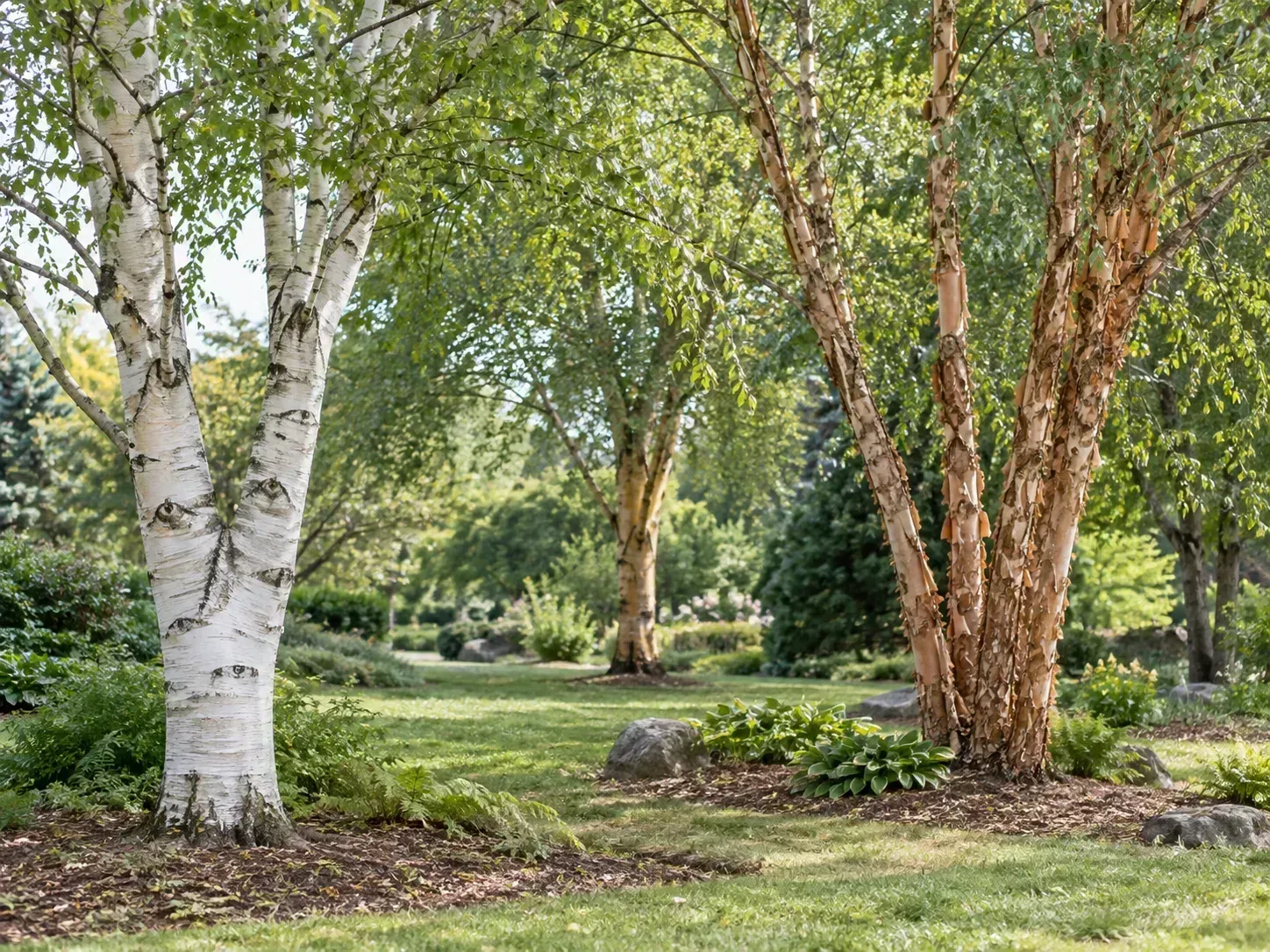
Silver birch is also sold as European white birch, common birch, or warty birch. Young trunks are darker; with age, the bark becomes pale and papery, while the base may grow darker and rougher. Slender twigs hang at the ends of a relatively open crown. The leaves are small, pointed, and toothed, then turn yellow in autumn; yellow-brown catkins appear in early spring.
Do not identify a tree from white bark alone. Paper birch (Betula papyrifera) is another white-barked species, and birch species can hybridize or vary in appearance. Silver birch typically has the fine, drooping branchlets reflected in its species name, while its bark can show dark, rough patches toward the base. If you need a confident identification for a planting or pest decision, compare the leaves, twigs, bark, and any catkins together rather than peeling the trunk to inspect it. The RHS profile describes the narrow crown, drooping twigs, white peeling bark, toothed leaves, and early catkins.
Choosing a Silver Birch Cultivar
The straight species is not a small tree. Some garden references describe it at 30–50 feet tall, while the RHS profile allows for trees around 25 meters; local conditions, age, and selection account for part of the difference. If you have a limited yard, ask the nursery for the mature height and spread of the cultivar on offer, how it is grafted, and how large it is expected to become in your region.
A weeping cultivar such as ‘Youngii’ forms a cascading crown and is often grown on a grafted trunk. Its final height depends on the graft, but its branches can occupy substantial horizontal space; a weeping form is not automatically a narrow tree. ‘Fastigiata’ has a more upright outline, yet it still grows into a tall tree. A purple-leaved or cut-leaf selection changes the foliage effect, not the species’ need for an appropriate climate, water, and room.
For a genuinely compact garden, do not rely on pruning to keep the straight species small. Repeatedly reducing large limbs creates wounds and an unnatural crown, and pollarding is a specialized system that must be started and maintained correctly. Choose a documented dwarf or weeping cultivar only if its mature dimensions fit, or select a naturally smaller local species. For the comparison set of other birches, see our guide to birch species and cultivars.
How to Plant Silver Birch
Plant while the tree is dormant, usually in fall after leaf drop or in early spring before vigorous growth begins. This gives the roots time to start growing before summer heat raises water demand. Avoid planting into frozen ground, saturated soil, or a heat wave; if conditions are unfavorable, keep the nursery tree shaded and watered until the next suitable window rather than letting its root ball dry out.
Silver birch is not a good candidate for moving once established. Buy a young tree with a healthy root system, handle the root ball rather than lifting by the trunk, and choose the permanent site before digging. An overgrown nursery tree may look impressive on planting day but will be harder to establish and more difficult to keep supplied with water.
Planting a Container or Bare-Root Tree
First locate the root flare, where the trunk widens into the main roots. Remove excess soil from the top of a container root ball if necessary, and tease out circling roots without shredding the root system. For a bare-root tree, keep roots covered and moist until planting and spread them naturally over the bottom of the hole.
Dig a hole two to three times wider than the root ball but no deeper than its root depth. Set the root flare level with or slightly above the surrounding grade so the settled tree will not be buried. Backfill with the excavated soil, firm it gently, then water slowly to settle the soil around roots. Do not place fertilizer, compost, or a thick layer of amended soil under the root ball; the priority is contact with the existing soil, not a rich pocket that can hold excess water or discourage roots from moving outward.
Apply a 2–3-inch (5–8 cm) layer of organic mulch over the planting area, keeping it several inches clear of the trunk. Remove stakes and trunk ties once the tree is stable, generally by the end of the first year unless a local arborist recommends a longer period. Check the root flare again after settling and after the first growing season; correcting planting depth early is easier than dealing with a buried trunk later.
How Much Water Does Silver Birch Need?
Keep a newly planted silver birch evenly moist, not saturated. During the first growing season, check the root ball and nearby soil every few days in hot or windy weather and less often after rain. When the upper few inches are dry, apply water slowly over the root ball and just beyond it so moisture moves downward instead of running off the surface. A hose on a gentle trickle, drip line, or soaker hose is easier to use well than a quick spray at the trunk.
Watering frequency depends on rainfall, soil texture, tree size, and temperature, so a fixed calendar is a poor guide. Sandy soil drains quickly and may need more frequent checks; clay can stay wet longer even when the surface looks dry. Probe the root-ball edge with a finger or narrow trowel before watering, and pause if water remains pooled or the ground is still sticky and saturated. Moist soil should feel cool and hold together lightly; it should not smell sour or stay waterlogged.
Continue regular checks through the second growing season, then water deeply during extended drought. Grass competition and pavement make drought stress more likely, so a tree in a lawn or beside a driveway may need help longer than one planted in an open bed. The goal is a broad, hydrated root zone—not a permanently wet trunk base. Brown leaf margins, dull gray-green foliage, premature leaf drop, or tip dieback can follow drought; water the soil first and compare the pattern with the borer signs below before deciding that insects are responsible.
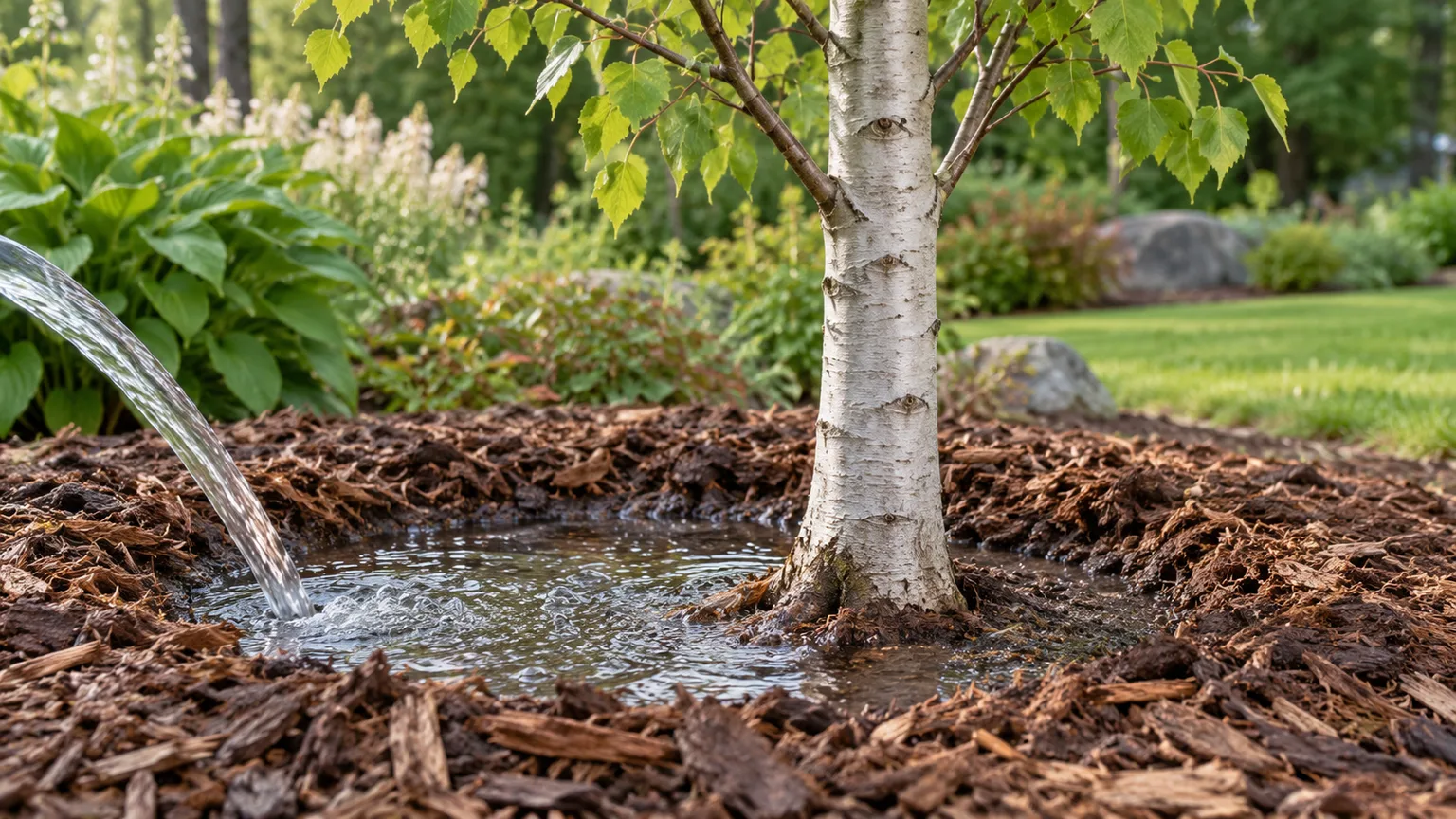
Water slowly over the root zone, then let excess water drain; do not keep the soil saturated.
Soil, Mulch, and Fertilizer
Silver birch grows in a wide range of soil types as long as the roots can access moisture and excess water can drain away. The RHS lists chalk, clay, loam, and sand, with conditions ranging from acid to alkaline; NC State describes moist, well-drained loam and notes that the tree can tolerate some dry soil. The useful middle ground for a new planting is soil that stays cool and damp but does not remain saturated after rain. Do not assume that “birch likes water” means a bog or a permanently flooded hole is suitable.
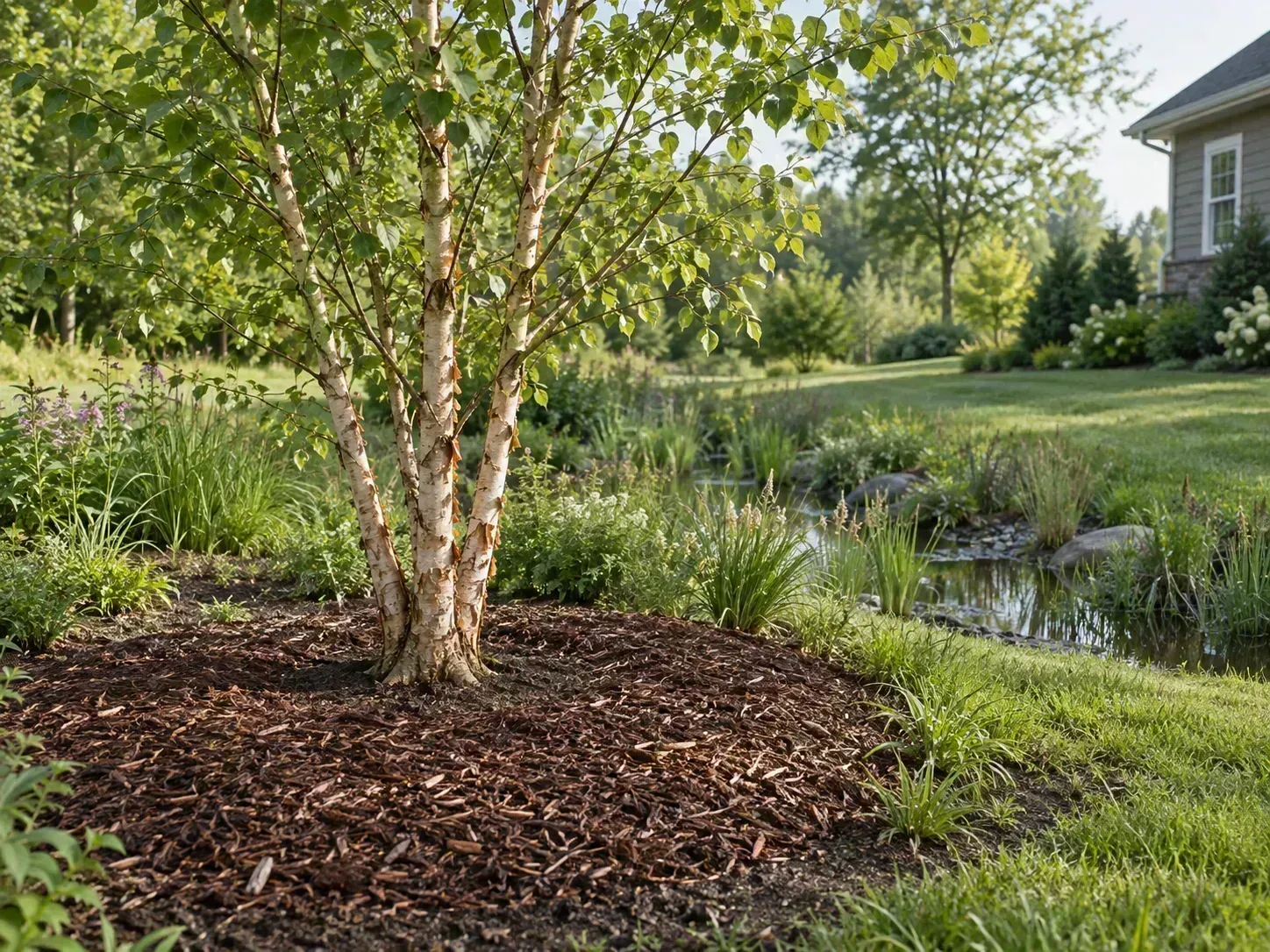
Mulch helps by reducing evaporation and moderating soil temperature, especially where lawn grass would otherwise compete with shallow roots. Extend it outward as the tree grows, refresh it when it thins, and keep the trunk flare visible. Avoid a mulch volcano: bark kept constantly damp against a trunk can conceal the flare and invite decay. A broad, thin mulch ring is more useful than a deep pile at the base.
Do not fertilize automatically to make the tree grow faster or produce more catkins. If growth is weak, first check planting depth, drainage, root competition, and water; a soil test can tell you whether nutrients are actually deficient. Excess nitrogen can push soft growth without fixing heat or moisture stress. Silver birch is naturally a quick starter in favorable conditions and generally needs no routine feeding in a reasonably fertile garden soil.
Pruning Silver Birch Without Sap Bleeding
A well-sited silver birch usually needs little pruning. Remove dead, damaged, crossing, or poorly attached branches, and keep the natural open crown instead of trying to reshape it every year. Make clean cuts just outside the branch collar; do not leave long stubs or cut flush against the trunk. If a large limb is overhead or the tree is close to a building, have a qualified arborist assess and prune it.
Timing matters because birch sap can flow heavily as the tree comes out of dormancy. Prune in early to midwinter after leaf fall but before late-winter and spring sap rise, choosing a frost-free period. BBC Gardeners’ World includes birches among woody plants that can “bleed” when cut late, and recommends finishing their pruning earlier in winter. Do not follow a generic “prune all trees in late winter” calendar for birch; local conditions shift the date when sap flow starts. See the Gardeners’ World year-round pruning guide.
If a small cut starts dripping sap, do not seal it with paint or make more cuts to “balance” the canopy. Stop, leave the wound open, and wait for a more suitable window. A brief flow of sap is not proof that the whole tree is sick, but large or repeated wounds should be avoided because they add stress and can create entry points for decay. Disinfect tools between trees if you are removing diseased branches.
Catkins, Seeds, and Propagation
Silver birch flowers are catkins, not showy petals. Male catkins are longer and pendulous; female catkins are shorter and upright. Both occur on the same tree, and pollination is mainly by wind. Catkins form before or with the leaves in spring, while the female catkins mature into small cone-like clusters that release tiny winged seeds. This natural cycle brings spring interest and food for wildlife, but it also means seed and catkin litter beneath the tree.
You cannot make a healthy tree produce more catkins by adding liquid fertilizer. Flowering depends on the tree’s maturity, cultivar, light, and general health; drought stress can reduce growth and flowering. If a newly planted tree has few catkins, give it time to establish rather than forcing growth with fertilizer. If seedling cleanup is unacceptable, choose a different tree or be prepared to pull small seedlings while they are easy to remove.
RHS lists seed, softwood cuttings, and grafting as propagation methods. Seed is the simplest route for a gardener, but seedlings will not reliably copy a named cultivar’s habit or color. For a cultivar, buy a correctly labeled nursery tree or use specialist propagation advice rather than expecting seed from ‘Youngii’ or a purple-leaved selection to come true.
Growing Silver Birch From Seed
Collect seed when the female catkins have dried and begun to break apart, then separate the very small winged seed from the cone scales. Sow fresh seed shallowly in a clean tray of free-draining seed compost and keep it evenly moist in a bright, sheltered place; do not bury it deeply or let the surface dry hard. Keep the tray protected from birds and rodents, and label it with the species and collection date.
Germination can vary with seed maturity, storage, and conditions, so avoid promising a fixed number of weeks or an obligatory six-month refrigerator treatment for every batch. If the seed is old or from an unknown source, follow the supplier’s germination directions or ask a local native-plant nursery. Pot seedlings individually once they are sturdy enough to handle, grow them on outdoors in a protected position, and plant out while small and dormant. Because silver birch is fast-growing and difficult to transplant once established, do not keep a seedling in a small pot for several years.
Seasonal Care and Normal Bark Changes
In spring, watch for new growth and check the soil around young trees before the weather turns dry. Catkins and winged seed are normal; so are some small fallen twigs. Young leaves may be damaged by a late frost, but a tree that leafs out unevenly can recover if branches remain alive. Wait to prune questionable twigs until you can see which sections resume growth.
During summer, prioritize deep watering when rainfall is scarce and keep grass trimmed back from the mulch ring. A silver birch in a cool, moist site may need little attention, while one beside paving can heat up and dry out quickly. Avoid routine insecticide spraying; inspect first and identify a specific pest or symptom. In autumn, the foliage turns yellow and drops, so rake leaves from paths and drains but leave healthy leaves to compost if practical.
The bark naturally changes as the trunk matures and may peel in thin sheets. Do not strip it to make the trunk look whiter: removing attached bark injures the tree and creates wounds. In a dry winter, water the root zone on a mild day when the ground is unfrozen. Established trees do not usually need trunk wrapping; if you are concerned about a newly planted tree in a harsh exposure, ask a local arborist about the specific risk rather than wrapping automatically.
Silver Birch Problems: What to Check First
Start by recording where a symptom appears and how quickly it is spreading. Browning across the whole crown after a hot dry period points first to water stress; dieback that begins at the top and moves down, especially with bark ridges or exit holes, calls for a closer borer inspection. Leaf spots, chewed or mined patches, and aphid activity have different patterns, so take clear photos of both sides of affected leaves and the trunk before treating.
Birch trees can shed inner leaves or small twigs as conditions change, and a few damaged leaves do not automatically mean a lethal disease. But progressive canopy thinning, branch death, or trunk wounds deserve a prompt assessment. Do not peel bark off a living trunk or apply a pesticide based on a single symptom; contact a local extension office, municipal tree service, or qualified arborist if decline is advancing.
Bronze Birch Borer
Bronze birch borer (Agrilus anxius) is a serious pest of white-barked birches, including European white birch. Its larvae feed under the bark and disrupt the tissues that move water and sugars. Early warning signs can include sparse foliage and dying upper branches; raised ridges or bumps on branches and trunk, D-shaped exit holes, and winding galleries under loose bark provide stronger evidence. Purdue Extension describes the galleries as sawdust-packed tunnels, while University of Minnesota Extension notes that dieback commonly starts at the top of the canopy and progresses downward.
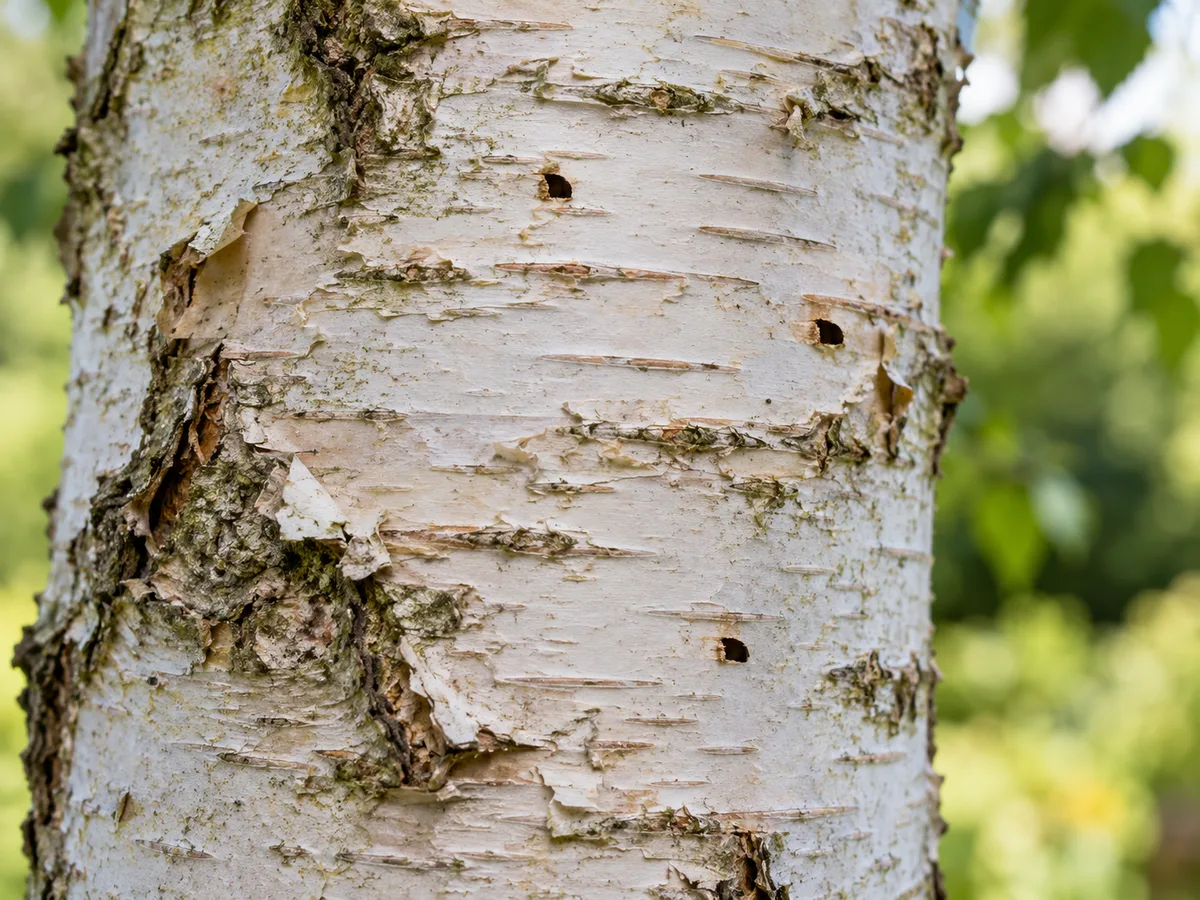
Small holes alone do not confirm bronze birch borer; consider them alongside progressive canopy decline and raised bark ridges.
Keep the tree vigorous by choosing a suitable climate, watering during drought, avoiding trunk wounds, and preventing severe competition from dry turf. A stressed tree is more vulnerable, but healthy care is prevention rather than a cure once larvae have girdled major branches. If you see progressive dieback and trunk signs, ask an arborist or local extension service to confirm the problem. Insecticide choices and timing depend on local registration, tree size, pest stage, and label directions; do not treat a mature tree with a broad-spectrum product on guesswork. Purdue Extension’s bronze birch borer guidance and the University of Minnesota’s birch diagnostic guide explain the symptoms and why maintaining tree vigor matters.
Leafminers, Aphids, Leaf Spots, and Early Leaf Drop
Birch leafminers feed within leaf tissue and may leave pale or brown blotches; aphids cluster on soft growth and can leave sticky honeydew. Leaf spots tend to appear as discrete lesions rather than a whole-crown wilt. These problems can look similar from a distance, so inspect the leaf surface and underside, note whether new or old foliage is affected, and check whether damage is concentrated on one branch or spread across the canopy.
If only a small share of the leaves is affected and the tree is growing normally, monitor it and clear fallen diseased leaves rather than spraying by default. If damage is widespread, recurring, or paired with dieback, ask a local diagnostic service to identify the pest or disease; the right treatment depends on the organism, its life stage, and local rules. An early summer leaf drop after dry weather should prompt a root-zone moisture check, but if the decline begins in the crown or the trunk shows raised ridges or holes, investigate borer damage too.
Conclusion
Silver birch is easiest to grow when its site suits it from the start: cool enough for the tree, moist but drained, and large enough for a tall crown and spreading roots. Check local invasive-plant guidance, confirm the cultivar’s mature dimensions, and plant during dormancy with the root flare at grade. Those choices matter more than trying to correct an unsuitable site with extra fertilizer or constant pruning.
For the first seasons, water deeply when the root zone begins to dry, maintain a broad mulch ring, and keep the trunk free of mulch piles and wounds. Prune only when needed and finish before late-winter sap flow. If the upper crown thins or dies back and the trunk develops ridges or D-shaped holes, seek a local diagnosis early. In a cool, spacious yard, silver birch can offer an airy canopy, spring catkins, yellow autumn leaves, and pale winter bark for decades.