Eastern Red Cedar Care: Planting and Pruning Guide
Eastern red cedar care starts with fit: compare mature sizes, choose an upright or compact cultivar, plant for drainage, water new trees, and manage rust.
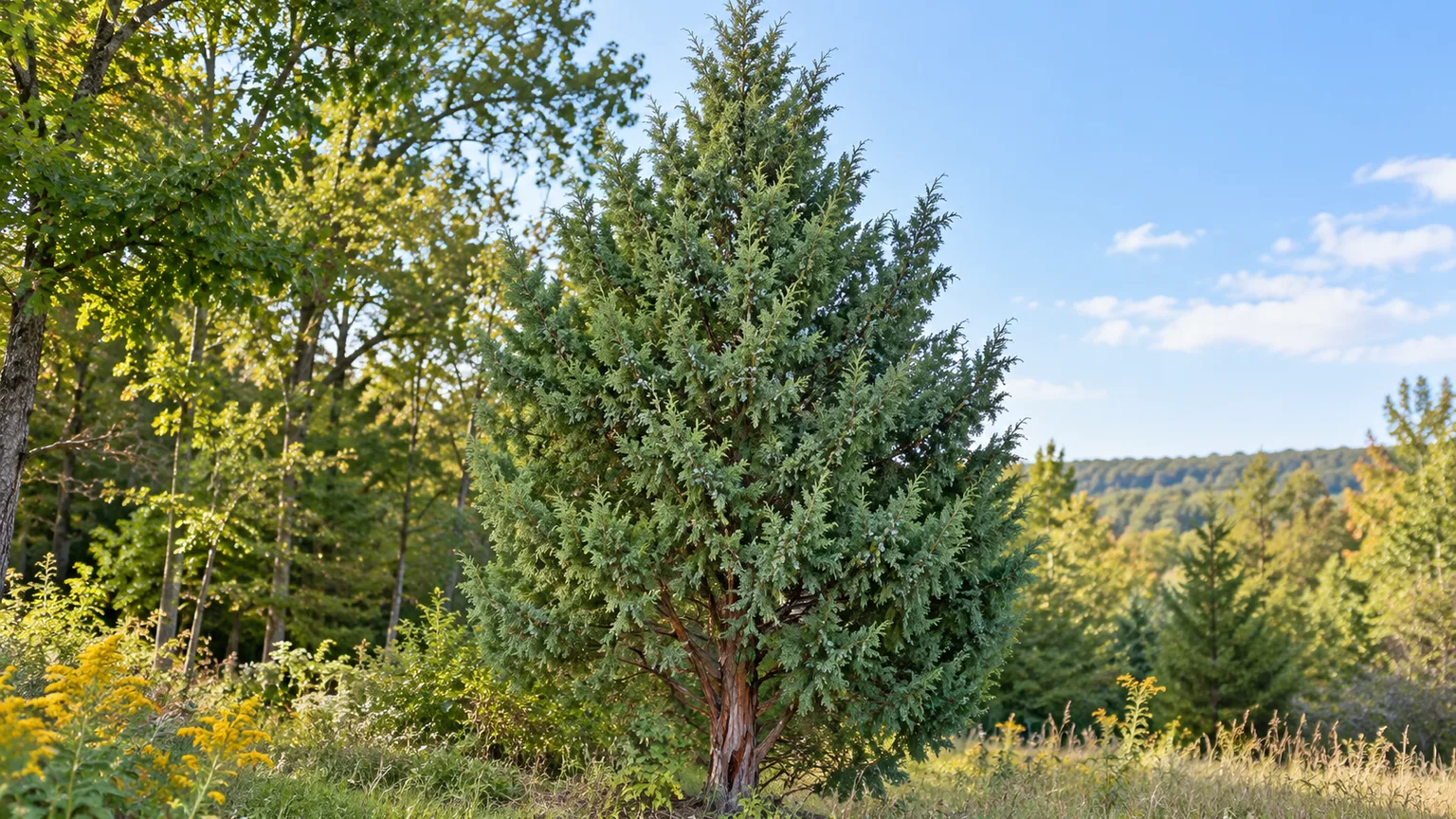
Eastern red cedar is a tough native evergreen, but its ability to survive poor conditions can make it easy to plant in the wrong place. A seedling that looks like a neat, narrow tree at the nursery can mature into a large, broad-crowned juniper, produce blue cones, and seed itself into nearby ground. The best care begins with a more important question than “How often should I water?”: does the species, or a selected cultivar, fit the site and the job?
Once planted well, Juniperus virginiana needs little routine attention. It prefers sun and drainage, needs regular checks while its roots establish, and generally does not need fertilizer. The exceptions worth planning for are its eventual size, natural seed spread, local wildfire or grassland concerns, and cedar-apple rust when susceptible apples or crabapples grow in the wider area.
Eastern Red Cedar at a Glance
| Trait | What to expect |
|---|---|
| Botanical name | Juniperus virginiana |
| Plant type | Native evergreen conifer in the cypress family, Cupressaceae |
| Typical landscape size | Often about 30–40 feet tall and 10–20 feet wide; size varies with site and selection |
| Light | Full sun for the densest, most upright growth; young trees tolerate some shade |
| Soil | Adaptable to clay, loam, sand, and rocky soils if water drains away |
| Water | Keep a new planting evenly moist while it establishes; established trees handle dry spells better |
| Cones | Female plants may carry blue, berry-like cones; they are cones, not true berries |
| Main planning issues | Mature spread, seedlings, flammability in some settings, and cedar-apple rust near susceptible apple-family trees |
Sources differ on exact mature size because eastern red cedar is variable across its range and includes many selected forms. NC State Extension describes a typical garden tree at roughly 30 to 40 feet tall and 10 to 20 feet wide, while Oklahoma State University’s profile notes that larger trees can reach about 60 feet. Treat these as planning ranges, not a promise; check the mature dimensions of the exact plant you buy in NC State Extension’s eastern redcedar profile and Oklahoma State University Extension’s profile.
Is Eastern Red Cedar Right for Your Site?
This tree makes sense when you want a hardy, year-round screen, windbreak, specimen, or wildlife shelter and can give it room to mature. It is native across much of eastern North America, tolerates a broad range of soils, and provides winter cover and cone food for birds and small mammals. Its ability to grow on rough sites is useful, but it is not a reason to ignore the surrounding landscape.
Choose another tree if the planting space is narrow, shaded for most of the day, or persistently wet. A mature species tree is difficult to keep small with pruning, and chronic shade can leave it open on one side instead of producing the dense, upright form many people expect. The roots also need oxygen: a low spot that stays saturated after rain is a poor site even if the tree can tolerate occasional wet conditions.
Before buying, sketch the tree at its expected mature width and look up from the planting point. Include the space needed for branches, nearby paths, building access, overhead lines, neighboring plants, and room to maintain the tree without shearing it into a smaller shape. If you are planting for privacy, measure the gap you want to screen and compare it with the cultivar’s mature width rather than the size of a nursery pot.
Identify the Tree Before You Plant
Despite its common name, eastern red cedar is a juniper, not a true cedar. Its botanical name is Juniperus virginiana, and it belongs to Cupressaceae, the cypress family. The species occurs naturally from eastern Canada through much of the eastern United States and west into parts of the Great Plains; local climate and site conditions affect how it performs.
Mature foliage consists of small, overlapping scale-like leaves, while young shoots can carry sharper, awl-shaped leaves. The reddish-brown bark peels in narrow strips, and female trees may produce small blue, wax-coated cones that look like berries. These details are useful when identifying a volunteer seedling, but a nursery label and cultivar name are more reliable when you are buying for a specific shape.
Eastern red cedars are usually dioecious: male and female reproductive structures are on separate plants. Male plants produce pollen; pollinated female plants can bear the blue cones that birds eat and disperse. If you do not want fruit or seedlings, ask the nursery whether the named selection is male, female, or a clone with a known sex rather than assuming every tree will produce cones. NC State Extension’s species profile describes the foliage, bark, cones, and wildlife value in more detail.
Choose a Form That Fits the Job
The wild species can become a substantial tree with a broad crown, while named cultivars are selected for traits such as narrower shape, foliage color, or compact growth. That distinction matters more than a small difference in the label’s height estimate. Decide whether you need vertical screening, a specimen with berries, a compact accent, or simply a resilient native evergreen, then confirm the mature dimensions and sex of the specific cultivar with the grower.
Upright Forms for Screens
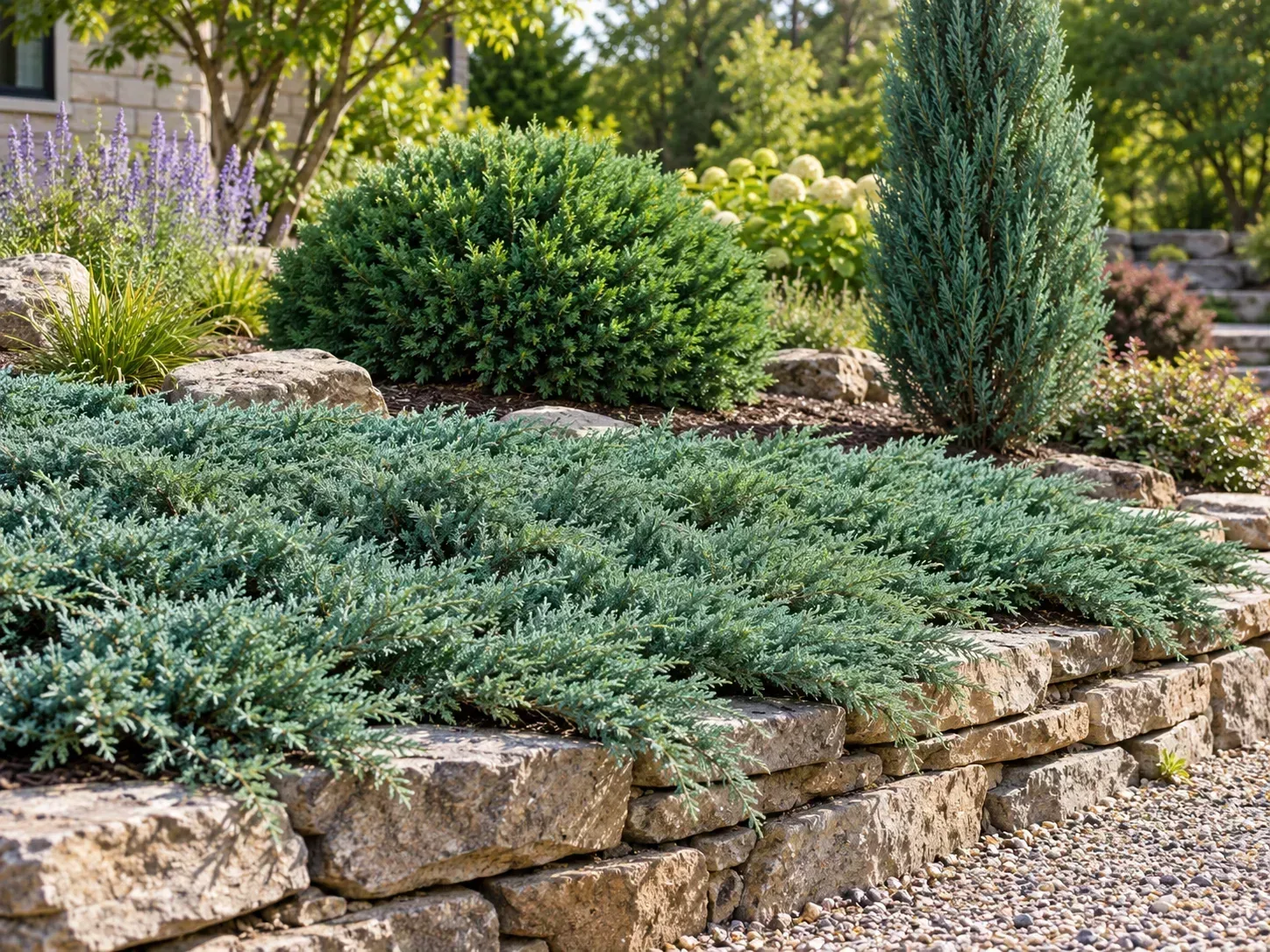
If a narrow screen is the goal, look for a named upright selection and compare its mature width with the planting interval recommended by the nursery. ‘Taylor’ is a narrow, columnar selection listed by NC State Extension; it uses less lateral space than a broad species tree but still needs enough room for its mature height and root zone. Planting several trees too close to force an instant wall can create crowded foliage, difficult access, and a screen that needs repeated corrective pruning.
‘Canaertii’ is a denser pyramidal form with blue-white cones and a reported mature height in the 20- to 35-foot range. It works better as a strong vertical specimen or a looser screen than as a clipped hedge. If winter privacy is important, inspect the actual nursery stock and ask how the selected cultivar behaves in your region; photographs can make young specimens look much narrower than they become.
Compact and Spreading Selections
For a smaller bed, patio edge, or low evergreen layer, choose a compact or spreading selection rather than planting the full species and trying to hold it back. NC State Extension lists selections such as ‘Grey Owl’ and ‘Glauca Compacta’ for distinctive compact or silvery foliage. Their appearance, mature size, and growth rate differ, so check the label for the exact cultivar and buy from a nursery that can confirm the plant identity.
Do not use an unfamiliar dwarf label as a substitute for a measured size. “Compact” is relative: a plant that stays small compared with a 40-foot species tree may still outgrow a foundation bed. The NC State cultivar list is a useful starting point. Compare the listed mature width with the available space, and leave enough room for light and airflow around the crown.
Where to Plant It
Full sun is the simplest route to dense, balanced growth. NC State Extension and Oklahoma State University Extension both list full sun as a preferred exposure. A young tree can tolerate some shade, but a tree grown in deep shade or crowded by taller neighbors is more likely to stretch, thin, or lean toward light; moving a mature tree later is not a realistic correction.
Eastern red cedar tolerates a wide range of soil textures and pH, from rocky ground to clay, as long as the site is not continuously waterlogged. It can handle dry conditions once established, but the combination of full sun and good drainage is the reliable landscape formula. If the soil stays wet for days after ordinary rain, use a raised planting area only if it can drain broadly into the surrounding ground; a small amended pocket in a wet hole will not solve the underlying site problem.
Reserve enough space for airflow and maintenance as well as branches. For a screen, measure cultivar spacing from the mature width and avoid planting so tightly that neighboring crowns will be forced into a solid wall. If the tree will stand near a driveway or sidewalk, consider the width of lower branches and the possibility of blue cones dropping onto paving.
A few site conflicts deserve attention before planting. Avoid placing a female, fruiting selection directly beside susceptible apple or crabapple trees if cedar-apple rust would be costly to manage. In wildfire-prone places, eastern red cedar’s dense, resinous foliage can be a significant fuel; consult local defensible-space guidance and keep any tree clear of buildings as local rules require. The ecological value of a native tree does not cancel out those location-specific risks.
How to Plant a Nursery Tree
Plant in early spring or fall when the ground is workable and temperatures are mild, rather than during a heat wave or drought. Choose a healthy, correctly labeled young tree with a straight trunk, evenly distributed branches, and a root ball that does not circle tightly around the container. Smaller nursery stock often establishes more readily than an oversized tree because it has less canopy to support while its roots expand.
Before digging, find the root flare, where the trunk widens into the first structural roots. If it is buried in the potting mix, gently remove excess medium until the flare is visible. Dig a broad hole no deeper than the root ball; loosen the sides so roots can move outward, but do not make a deep, soft pocket that settles and buries the trunk.
Set the tree with the root flare at or slightly above the finished soil grade. Backfill with the excavated soil, breaking up large clods but avoiding heavy amendment of the hole; roots need to move into the native soil rather than remain in a different-textured pocket. Water slowly as you backfill to settle soil around the roots, then check that the trunk has not sunk below grade.
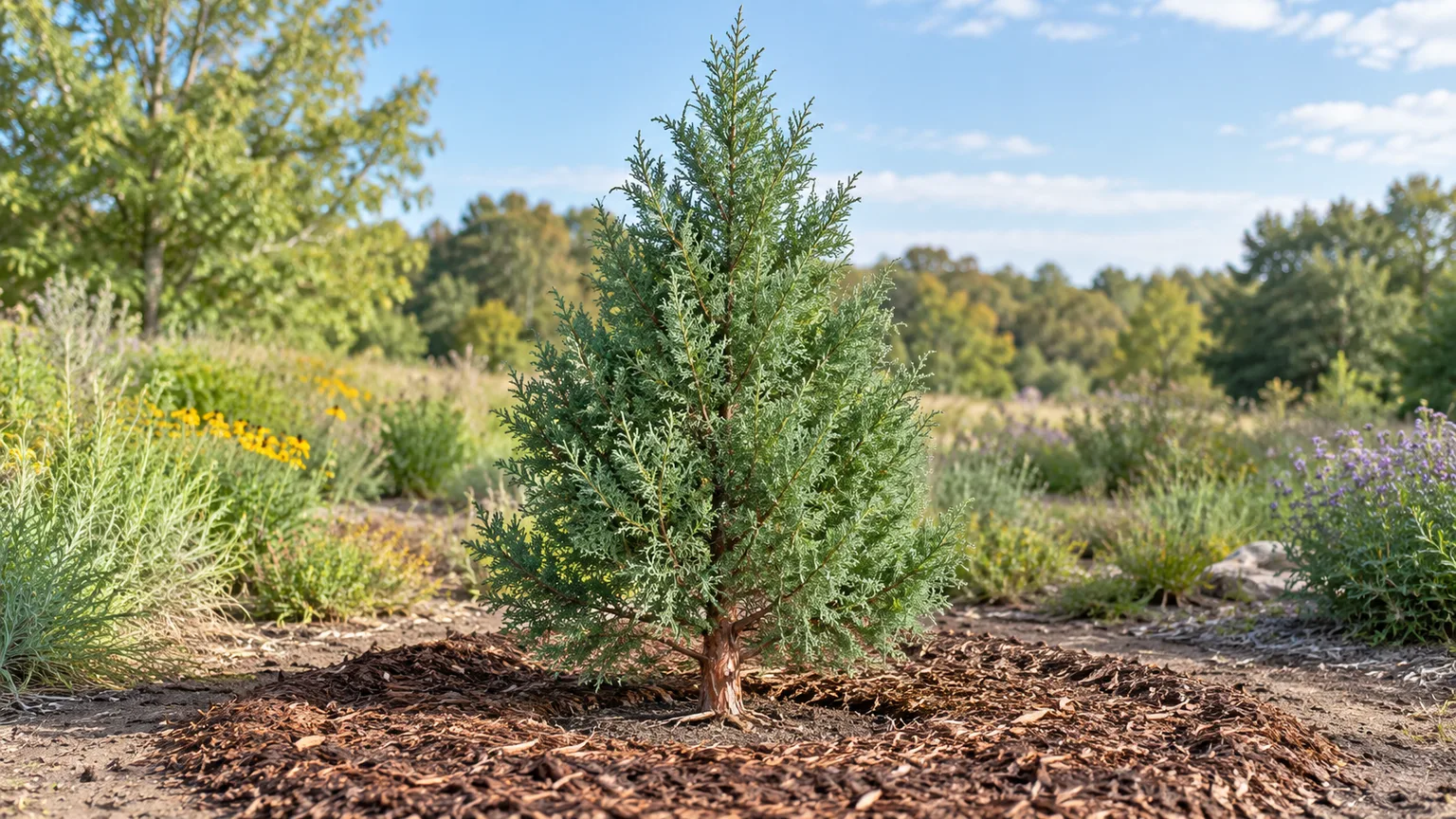
Spread a shallow layer of organic mulch over the root zone, extending it outward as the tree grows, and keep mulch away from the trunk. Do not bury the root flare under a mulch volcano. Stake only if the root ball moves in wind or the site is unusually exposed, and remove the support once the tree can stand firmly on its own. A stable root flare and open, well-drained soil give the new roots room to move outward as the tree establishes.
Watering Through Establishment
A new tree needs attention even though an established eastern red cedar can tolerate drought. For the first growing season, check both the original root ball and nearby soil every few days during hot, windy, or rainless weather. Water when the root ball begins to dry, applying water slowly enough to soak the full root mass rather than wetting only the surface.
Do not water on a rigid weekly schedule without checking the soil. Sandy soil may dry quickly, while heavy soil can remain wet much longer; rain falling on the lawn may not have penetrated a dense root ball inside a container-grown tree. Push a finger or small trowel into the root zone, feel beneath the mulch, and water only when the soil there is starting to dry.
Keep checking through the second growing season, especially during prolonged heat or drought. As new roots move into surrounding ground, the tree becomes less dependent on you, but it does not become immune to a long dry spell. If water runs off the surface, apply it in several slow passes or use a temporary soaker hose around the root zone rather than flooding the trunk.
Overwatering is the other common failure. If the ground stays saturated, foliage may yellow or decline even though the tree has received plenty of water; adding more water or fertilizer will make the underlying problem worse. Atlanta Arbor’s species-specific care guidance also emphasizes drainage and avoiding oversimplified calendar watering. After the tree is established, irrigate during extended drought only when the root zone is dry.
Soil, Mulch, and Fertilizer
Eastern red cedar does not need rich, acidic soil to survive. NC State Extension describes it as adaptable to clay, loam, sand, and shallow rocky soils, including dry to moist, well-drained conditions; Oklahoma State Extension likewise notes its tolerance for varied soils and preference for drainage. Choose the site for drainage and sunlight rather than trying to correct the soil to a narrow pH target.
Mulch helps the young tree by reducing soil temperature swings and competition from turf. Keep the layer broad and shallow and leave a clear gap around the trunk so bark stays dry and the flare remains visible. Expand the ring as the crown grows instead of piling more material against the base.
Skip routine fertilizer unless a soil test or a local extension recommendation identifies a real nutrient need. Eastern red cedar is adapted to lean sites, and extra nitrogen will not repair waterlogged soil, shade, root damage, or a poorly chosen cultivar. If growth looks weak, first check whether the crown receives enough sun, whether the root ball dries too quickly or stays wet, and whether the trunk was planted too deeply.
Pruning Without Bare Patches
The safest pruning is light and deliberate. Remove dead, broken, or crossing branches and preserve the tree’s natural outline; do not shear the whole crown just because it has grown beyond the space you gave it. Junipers often have a foliage-free interior, so a cut that goes back beyond the green foliage may leave a brown section that will not fill in.
Shorten a live branch only to another live side branch or a point that still carries green foliage. If you must remove a whole limb, cut just outside the branch collar without leaving a long stub. Avoid topping the leader or cutting across the crown to reduce height: the tree cannot reliably rebuild its natural pointed shape from a bare cut.
Late winter or early spring is a practical window for shaping because the structure is visible and new growth will soon begin, but the key rule is to avoid cutting into old bare wood. For a young tree, correct a weak crossing branch early with a small cut rather than waiting until removing it would leave a large gap. Atlanta Arbor’s pruning notes for eastern red cedar highlight the same dead-zone limitation that applies to junipers generally.
Cedar-Apple Rust: What the Orange Galls Mean
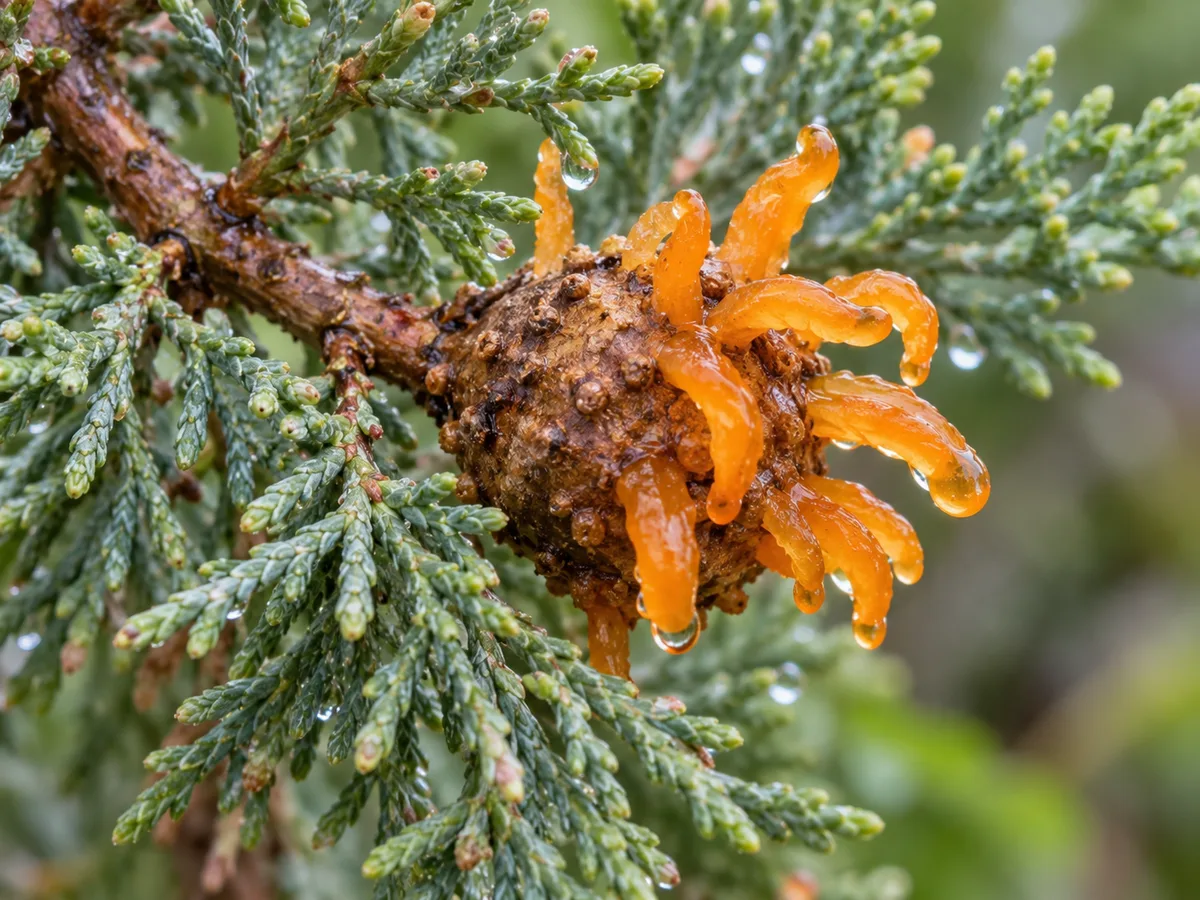
Orange, gelatinous horns that swell from a woody gall after spring rain are a familiar stage of cedar-apple rust. The fungus Gymnosporangium juniperi-virginianae requires both a susceptible juniper and an apple-family host, such as apple or crabapple, to complete its two-year life cycle. The fungus overwinters in galls on the juniper; spring moisture triggers spore-bearing horns, and wind carries spores to young apple leaves and fruit.
On eastern red cedar, the galls and orange horns are usually more alarming in appearance than harmful to the tree. The larger concern is damage to susceptible apples: lesions can affect leaves and fruit, and severe infection may cause premature defoliation. NC State Extension’s cedar-apple rust factsheet explains the host cycle and notes that apple infection risk can extend miles from an alternate host.
That distance changes the decision. Removing every nearby cedar or juniper is not a practical guarantee of protection, and pruning a large red cedar heavily to remove visible galls can damage its shape without stopping spores arriving from other trees. K-State Research and Extension’s guidance, republished by KSAL, likewise cautions that extensive pruning is not effective control and that spores can travel several miles.
For a home landscape, do not spray the red cedar with copper simply because orange galls appear. The cedar is the alternate host, not the crop that suffers the main leaf and fruit injury; when fungicide is warranted, timing and product choice concern the susceptible apple or crabapple and must follow current local extension advice and the product label. If you are planning an orchard, choose resistant apple cultivars and discuss disease management with a local extension office before relying on tree spacing alone.
If a gall is small and reachable, removing it before it produces orange horns may reduce spores from that single gall, but it will not erase neighborhood disease pressure. Avoid aggressive pruning or climbing to reach high branches. If orange growth appears on an apple leaf rather than on a juniper gall, ask an extension office to distinguish cedar-apple rust from similar rust diseases before treating the tree.
Other Pests and Browning Problems
Eastern red cedar is generally resilient, but it can host bagworms, scale insects, mites, and twig blights. Inspect the tree when you see a change rather than applying a preventive pesticide by default. Bagworms make conspicuous spindle-shaped cases attached to branches; a few reachable cases can be removed and destroyed, while a heavy infestation on a mature tree is a job for local extension or an arborist who can identify the pest and the safest timing.
Scale insects are small and often remain unnoticed until foliage yellows or branches thin. Mites can cause a dull, stippled look, especially in hot, dry weather. Before applying any treatment, confirm the pest with a close inspection or a local diagnostic service; broad-spectrum insecticides can harm beneficial insects and may not solve a problem that is actually drought, winter bronzing, or a root issue. NC State Extension’s eastern redcedar profile lists common pest and disease susceptibilities.
Color change is not automatically disease. Eastern red cedar foliage may bronze or turn yellow-brown in winter, and interior foliage can shed as a tree grows; compare the new outer growth and the overall pattern before intervening. If browning spreads from branch tips, check whether the root ball is dry; if the soil is soggy, stop irrigation and evaluate drainage; if one branch dies while the rest looks normal, inspect for mechanical injury or a localized pest before pruning.
Keeping Seedlings and Fire Risk in Check
Blue cones are part of the tree’s wildlife value, but birds also move seeds beyond the planting bed. If a seedling appears where you do not want a tree, pull or cut it while it is small and the soil is moist, removing the root before the stem becomes woody. Check fence lines, mulched beds, and the edges of open ground periodically rather than waiting for a volunteer to become a sapling.
Eastern red cedar is native, so “invasive” is not a useful one-size label across its entire range. In some landscapes it is considered weedy or an aggressive colonizer, especially where open grassland is being lost to woody encroachment; Oklahoma State University Extension notes its prevalence in Oklahoma and the role of fire suppression. The right question is whether it belongs in your local ecosystem and whether seedlings threaten a managed habitat, pasture, or prairie. Check county extension or natural-resource guidance for local control recommendations before planting near conservation land.
Dense evergreen foliage can also carry substantial fire in wildfire-prone regions. NC State Extension flags high flammability for the species, so do not use a dense row of red cedars as an unexamined foundation planting beside a home in a fire zone. Follow local defensible-space rules, keep dead material cleared, and consult fire authorities about planting distances and species choices.
Propagation: Seed vs. Cuttings
For a predictable landscape tree, buy a nursery-grown specimen. Seedlings vary in shape, sex, and growth habit, and the time from seed to a useful-sized tree is long. Birds often do the dispersal for you, which is why an existing tree may produce unexpected volunteer seedlings nearby.
Growing from seed is possible, but germination can be uneven and seeds need a period of cold treatment; a harvested cone may contain seeds that do not sprout. Collect mature blue cones, clean and sow more seed than you need, and be prepared to wait and thin seedlings. Gardening Know How’s eastern red cedar propagation article describes both seed and cutting methods, but a seedling will not necessarily reproduce the parent’s ornamental form.
Cuttings are the better route when you want to preserve a named cultivar, though rooting junipers takes patience and controlled humidity. Take healthy current-season material, use a clean medium and gentle bottom heat or a protected propagation setup, and expect losses rather than assuming every cutting will root. For a yard tree, the cost of a correctly identified nursery plant is usually lower than the years spent raising an uncertain seedling.
Seasonal Care and Long-Term Outlook
In spring, inspect for winter injury, remove only dead or broken wood, and note whether any rust galls are swelling after rain. During the growing season, keep up establishment watering and watch for bagworm cases before they become numerous. In fall, check mulch depth, remove unwanted seedlings, and avoid late-season pruning that would encourage soft new growth in regions with freezing winters.
Established trees usually need no feeding or routine irrigation, but their low-maintenance reputation depends on getting the site right. A mature tree cannot be made smaller by cutting it back into bare wood, and no watering schedule can compensate for chronic saturation. If you see repeated canopy dieback, trunk damage, or a large tree near a structure, an arborist can assess structural risk and identify whether the cause is disease, insects, drought, or a site problem.
Think of eastern red cedar as a long-lived landscape commitment, not a disposable screen. Choose the species where its natural height, width, seed production, wildlife value, and fire behavior work for your property; choose a cultivar when a specific silhouette matters; and give either one enough space to grow without repeated shearing. Once it is rooted into suitable soil, the best care is mostly restraint.
Conclusion
Eastern red cedar grows well when its site is sunny, drainable, and large enough for the chosen plant to mature. Select a cultivar by its full dimensions and intended job, plant with the root flare at grade, and use soil moisture—not the calendar—to guide watering through establishment. Skip routine fertilizer, prune only within green foliage, and treat orange cedar-apple rust galls as a disease-cycle clue rather than a reason to spray the cedar.
The tree’s toughness is a real advantage, but so are the reasons to plan before planting: birds spread its cones, some regions manage it as a colonizer, and dense foliage can be a fire concern. A thoughtful site choice turns a hardy native juniper into an enduring screen or wildlife tree instead of a recurring pruning and seedling problem.