Japanese Maple Bonsai Care: Light, Water & Pruning
Learn Japanese maple bonsai care by season: outdoor placement, watering, soil, pruning, wiring, root work, and winter protection for a healthy tree.
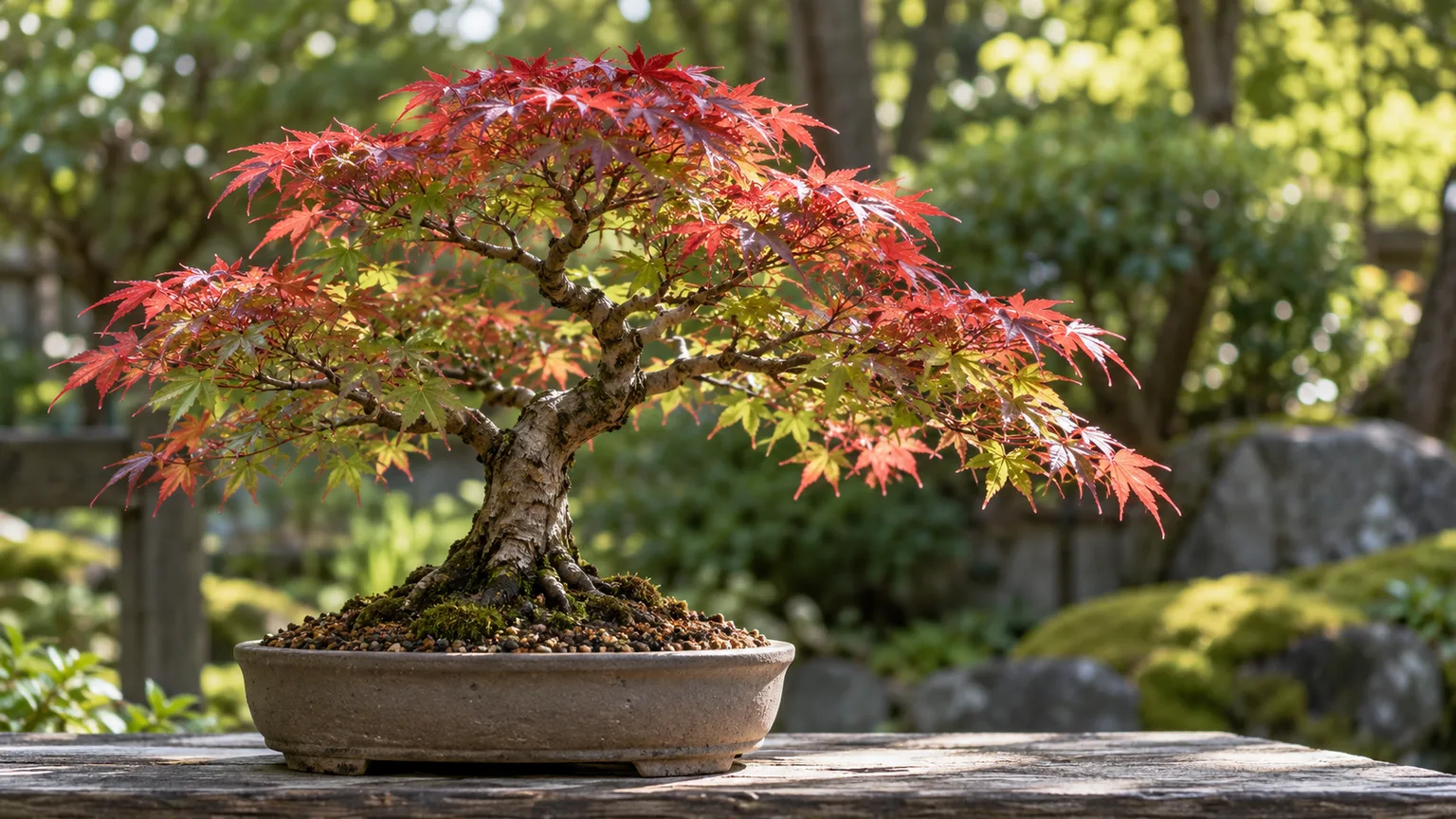
A Japanese maple bonsai is an outdoor deciduous tree, not a miniature houseplant. Its shallow container can dry in a day of heat and wind, while its roots are more exposed to winter cold than a maple planted in the ground. Care gets easier when you treat watering, pruning, and repotting as responses to the tree’s condition and local weather rather than tasks on a fixed calendar.
The species is Acer palmatum. Its palmate leaves, fine branching, seasonal color, and ability to produce dense twigs make it rewarding to train, but “beginner-friendly” needs a qualification: the tree is adaptable, yet a small pot magnifies mistakes. Start by choosing sound material, giving it a protected outdoor position, and building a healthy root system. Styling can follow.
Choose a tree for your goal, not just its leaf color
A nursery maple with a beautiful red leaf is not automatically the best bonsai starting point. Look first for a healthy trunk that tapers rather than remaining the same thickness from base to tip, branches placed where you can use them, no swollen wounds, and a root base that spreads outward. A tree with a modest canopy and a promising trunk is often more useful than a dense crown hiding a weak or badly grafted base.
Decide whether you want to develop a tree or maintain a finished one. A pre-bonsai is young material intended for years of trunk and branch development; it usually belongs in a roomy training pot or even a larger container. A refined bonsai already has a compact root pad, developed branching, and a shallow pot, so its growth is managed more tightly. Trying to refine a thin-trunked sapling in a tiny display pot slows development and makes watering harder.
Japanese maple is a good species for a grower who can provide an outdoor spot and monitor moisture closely. It is a poor choice for someone who wants a tree to live permanently on a desk. The Royal Horticultural Society includes Japanese maple among suitable bonsai trees, while its general bonsai guidance treats temperate deciduous trees as outdoor plants that need seasonal conditions. (RHS bonsai guidance)
Understand cultivars, seedlings, and grafts
There is no single “best” Japanese maple cultivar for every bonsai. Smaller leaves and short spaces between buds help a tree look proportionate at a compact scale, but trunk movement, branch placement, health, and the design you want matter just as much. Fine-leaved dwarf cultivars can suit small compositions; a more vigorous green-leaved seedling may be a better project if your priority is building a thicker trunk.
Choose for a trait you value, then inspect the whole tree. ‘Deshojo’ is known for vivid red spring foliage that later changes color; it is frequently grafted because seedlings do not reliably preserve the named cultivar’s traits. ‘Arakawa’ is selected for rough, corky bark, which can add character but may make fine twigging and a refined texture more challenging. These are different design choices, not a simple ranking of quality. (Bonsaï Galinou’s cultivar discussion; Valavanis Bonsai Blog on ‘Arakawa’)
A graft is not inherently a health problem, but it can affect the trunk line. Many named cultivars are grafted onto vigorous rootstock so their distinctive foliage is reproduced consistently. Look near the base for an abrupt change in bark, a bulge, or a visible diagonal scar. If the union sits where it disrupts the intended trunk, you can choose another tree; correcting a conspicuous graft later can mean air-layering above it, a more advanced project.
Seed-grown maples are useful if you enjoy selecting variation and developing trees over time. They will not reliably come true to a named cultivar, and seedlings may vary in leaf color, shape, and vigor. So “you can grow a maple from seed” and “seed will reproduce this cultivar” are different claims. Bonsaify’s grower account illustrates the variation among seedlings from red-leaved parent trees. (Bonsaify on Japanese maple seedlings)
Keep Japanese maple bonsai outdoors
Give the tree bright outdoor light with shelter from drying wind. In a cool or mild climate, a position with morning sun and some later sun can build strong growth; in hot summers, dappled light or morning sun followed by afternoon shade helps protect delicate leaves. Avoid a dark corner and avoid a south- or west-facing spot that reflects heat from a wall, paving, or glass. The right balance depends on climate, cultivar, and how gradually the tree was acclimated.
A Japanese maple bonsai should not live indoors year-round. It needs the seasonal changes and winter dormancy of a temperate tree. You can bring it inside briefly for display, but return it outdoors after a short viewing period; a warm room is not a substitute for a cool, protected winter rest. If your home is the only available location, choose a tropical species such as ficus instead.
New spring leaves can be more vulnerable than hardened summer foliage. When a late frost is forecast after the tree has leafed out, move it temporarily to a sheltered outdoor location. Do not respond to leaf scorch by keeping the tree in deep shade all season: insufficient light weakens growth and can reduce the quality of the next flush. The aim is bright light with protection from extremes, not permanent darkness.
North Carolina State Extension describes A. palmatum as preferring dappled shade, evenly moist well-drained soil, and protection from drying winds; excess sun, wind, or drought can scorch leaves. A bonsai pot heats and dries faster than garden soil, so use that species guidance as a starting point and adjust to the more exposed root system. (NC State Extension Plant Toolbox)
Choose a training pot before a display pot
A shallow ceramic pot is part of the finished composition, but it is not the best place to grow every young tree. While you are developing trunk thickness, branch placement, or a stronger root base, use a training pot deep enough to hold a healthy root pad and stable moisture. A larger container does not make a tree a bonsai by itself; regular pruning and design decisions create the miniature tree form.
Move toward a shallower display pot only when the trunk and main branches are close to the design you want. That smaller soil volume dries faster and leaves less room for recovery after root work. It may also require more frequent inspection during heat waves. If your schedule or climate makes that unreliable, keep the tree in a somewhat deeper bonsai container rather than forcing a narrow pot for appearance.
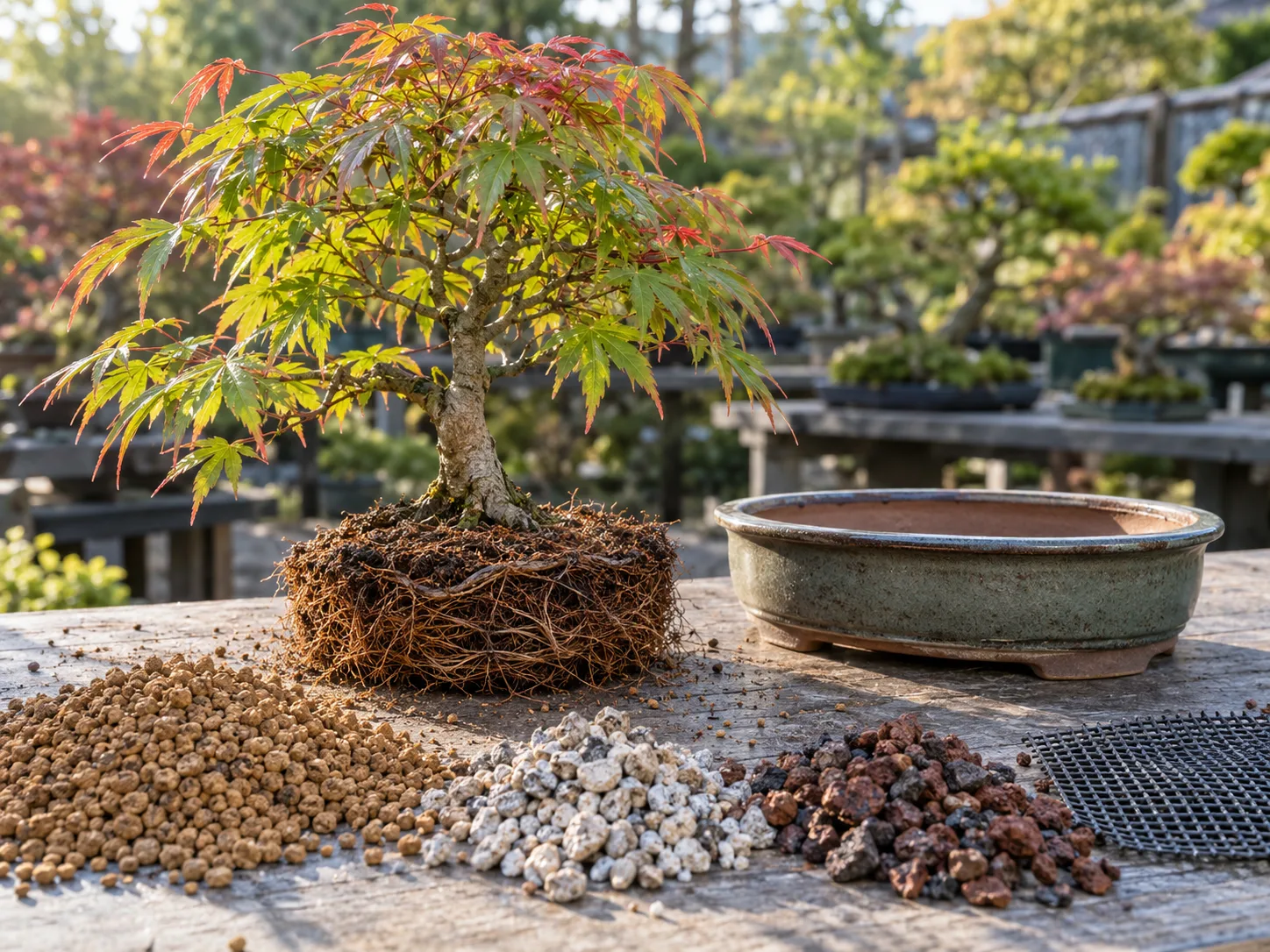
Any bonsai pot needs open drainage holes and a screen to keep substrate from washing out. Secure the tree with tie-down wire so wind does not rock it and damage fine new roots. Virginia Cooperative Extension’s bonsai guidance emphasizes drainage and coarse, porous substrate as basic root-health measures. (Virginia Cooperative Extension, “The Art of Bonsai”)
Use coarse, open soil that drains evenly
Use a granular bonsai substrate that holds enough water for roots while leaving air spaces after watering. Common components include akadama or another fired clay, pumice, and lava rock. The exact proportions can vary with climate, particle size, pot depth, and how often you can water; a hot, windy balcony may call for a mix with more moisture retention than a cool, sheltered bench.
Avoid compact, fine garden soil in a shallow bonsai pot. It can stay saturated around the roots even when the surface looks dry, and the small volume makes poor aeration difficult to correct. Conversely, a coarse mix that is too large for the root system or too fast-draining for your climate can dry before the tree absorbs enough water. Choose a stable particle size, sift out fine dust, and watch how quickly water enters and exits the pot.
After watering, water should pass through the surface rather than pool or run off the sides. If the mix has become dense and water repeatedly beads or channels down one edge, check whether the substrate has broken down or roots have filled the pot. Do not solve slow drainage by adding a layer of gravel to the bottom; the whole root zone needs an open structure.
Water the rootball by observation
Check the soil surface every day during active growth and more than once on very hot, dry, or windy days. Water when the upper layer is beginning to dry, then soak the entire rootball until water drains freely from the holes. A small pot may need water daily in midsummer, but a cool rainy week can change that completely; no weekly schedule can account for those shifts.
Water slowly across the whole surface. If a dry mix initially repels water, apply a first pass, wait briefly, then water again so the inner rootball gets wet instead of letting water escape along the pot edges. Let the pot drain fully and remove any catch tray water. The goal is a thorough wetting followed by drainage, not a constant bath.
A wooden chopstick inserted near the edge can help you learn the root zone: remove it and check whether it is cool and damp or nearly dry. Pot weight is another useful cue; compare it just after watering with its weight before the next watering. These methods work better than waiting for leaves to droop, because a maple can suffer root stress before the canopy gives a clear warning.
Winter watering is still necessary when the potting mix dries, even though a leafless tree uses less water. Check on mild days and water when the root zone is no longer moist; do not leave the pot frozen in a tray or keep it wet through prolonged cold. Bonsai Empire likewise recommends watering Japanese maple by observation rather than letting the soil dry completely or following a rigid interval. (Bonsai Empire Japanese maple guide)
Feed according to growth stage
Fertilizer supports growth; it does not compensate for poor light, unhealthy roots, or a tree that is repeatedly drying out. During active growth, apply a balanced bonsai fertilizer at the label rate. Organic pellets release more gradually, while liquid fertilizer lets you adjust with each application. Either can work if you use the product directions and avoid repeated heavy doses.
A tree being developed for a thicker trunk needs more extension growth than a refined tree whose short internodes and fine branches you are trying to preserve. Feed the developing tree consistently through its active season; feed a refined tree more moderately and judge the result by shoot length and vigor. Strong fertilizer cannot guarantee smaller leaves or tight branching. Those are results of genetics, light, growth control, and years of selective pruning.
Pause feeding when the tree is dormant and after repotting until it has resumed healthy growth. Do not fertilize a severely stressed or newly dried tree as a rescue measure. If the leaf margins are browning, correct watering, heat, wind, root health, or salt buildup before increasing nutrients.
Prune for structure and fine branching
Pruning has two different jobs: structural pruning changes the trunk and main branches, while maintenance pruning keeps established shoots compact and lets light into the canopy. Keep those jobs separate when possible. If you cut back several large limbs, repot, and defoliate in one season, the combined loss of foliage and roots can leave the tree unable to recover well.
For major cuts, study the branch structure first and remove only what prevents the design from developing. Japanese maples can bleed sap from poorly timed cuts, so avoid hard pruning as buds are swelling or leaves are opening. The RHS recommends hard pruning in autumn or early winter rather than spring; local climate and the tree’s growth stage still matter, and large wounds may benefit from appropriate bonsai wound sealant. (RHS bonsai pruning guidance)
During the growing season, let new shoots extend enough to strengthen the tree, then shorten vigorous shoots to one or two pairs of leaves where you want finer branching. Do not pinch every tip automatically. A branch you need to thicken should be allowed to grow longer; a branch already at the desired length can be shortened to control its silhouette. This is how you manage growth without turning the canopy into a clipped ball.
Look for crossing branches, two shoots emerging from the same point in a tight fork, and long internodes that make the tree look coarse. Remove a branch only when you are confident about the replacement structure. A bare section of branch may not reliably produce a useful new shoot, so avoid cutting behind the last healthy buds simply to make the outline smaller.
Wire carefully and inspect for bite
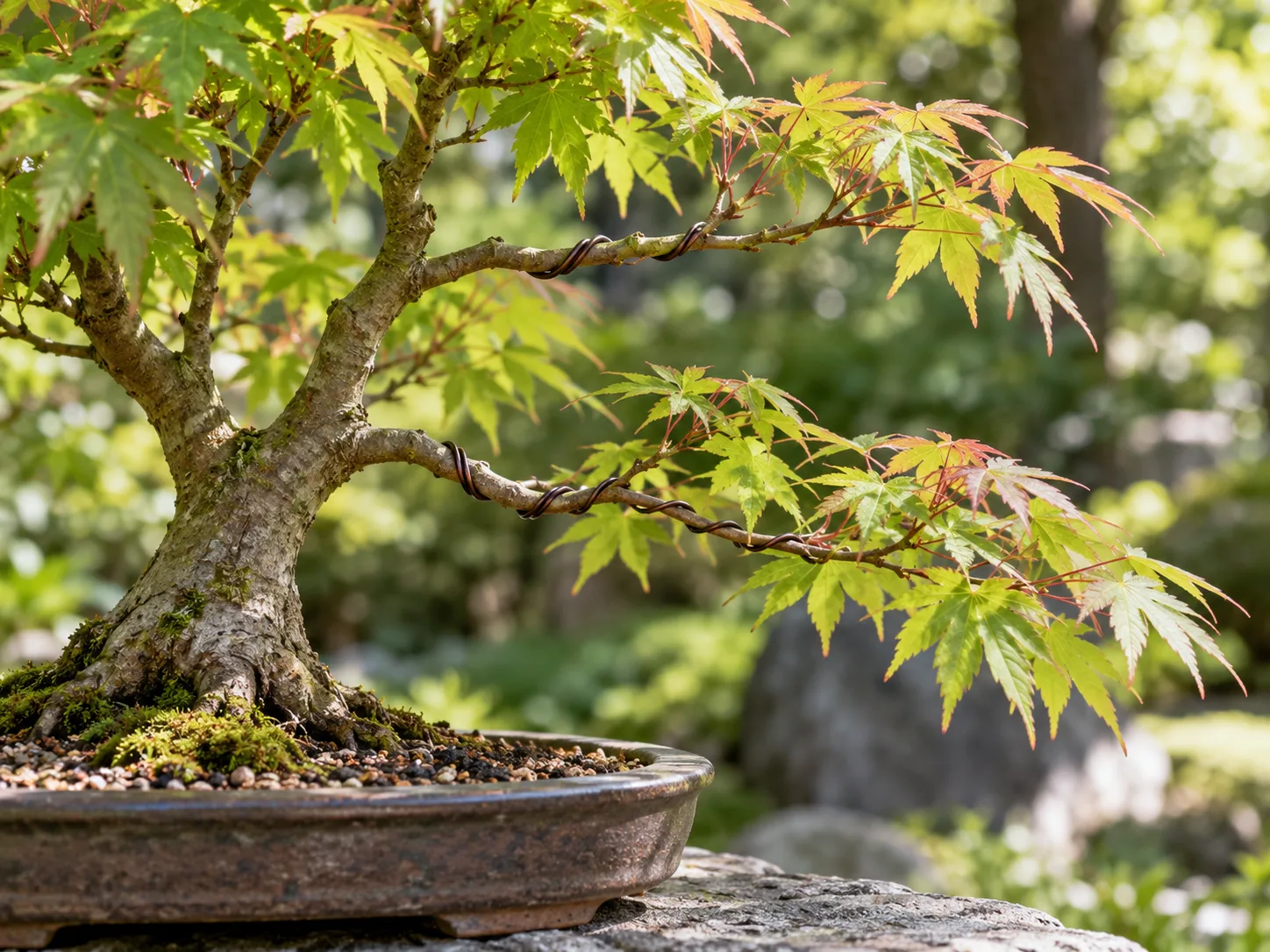
Wiring can guide a flexible branch into position, but Japanese maple bark and twigs mark quickly as the tree thickens. Use appropriately sized aluminum wire for most training, anchor it securely, and bend a branch gradually rather than forcing a sharp turn. If a branch resists, use a gentler curve, a guy wire, or staged movement over time.
Check wired branches at least weekly during rapid spring growth and more often when shoots are extending quickly. Remove the wire as soon as it begins to press into the bark; do not assume a wire can stay on for a fixed number of months. Unwind it carefully if the branch allows that, or cut it off turn by turn so you do not tear bark while pulling a spiral loose. The Cheshire Bonsai Society notes that wire marks develop much faster on maples than on conifers and favors softer aluminum for the job. (Cheshire Bonsai Society maple guidance)
Avoid heavy wiring when the tree is weak, newly repotted, or carrying tender spring growth. Winter branches can be brittle, and after leaf fall you may not see how quickly the wire is biting. If you train in that season, work gently and inspect as soon as growth resumes.
Repot at bud swell, not by the calendar
For most Japanese maple bonsai, the useful repotting window is early spring when buds are swelling but before the leaves have expanded and begun using substantial water. The exact date moves with local weather and cultivar. A calendar date from another region is less reliable than watching the buds. The Cheshire Bonsai Society describes bud swell and the first push of leaves as the target stage and warns that waiting until extension growth is underway makes the operation too late for its usual window. (Cheshire Bonsai Society)
Repot because the tree needs it, not because a set number of years has passed. Roots emerging from drainage holes, a root pad packed so tightly that water will not enter, sluggish growth despite sound light and feeding, or a mix that stays wet and drains poorly are useful signs. Young trees in active development may need attention more often than mature trees, but age alone cannot determine the interval.
Work with a healthy tree and prepare the pot, drainage screen, tie-down wire, and fresh mix before lifting it. Gently loosen the outer roots and remove enough to fit the root pad into the new container while preserving a dense network of fine feeder roots. Do not automatically remove one-third of the root system; the safe amount depends on vigor, root condition, season, and the work done in previous years. If the tree is weak or you are uncertain, reduce the scope of the work and seek help from an experienced bonsai grower.
After repotting, secure the tree, water thoroughly, and keep it outdoors in a sheltered position protected from strong wind and harsh sun while roots re-establish. Keep the mix evenly moist, not saturated. Delay strong fertilizer, heavy pruning, and leaf removal until the tree shows healthy new growth. The RHS and Virginia Cooperative Extension both place repotting of deciduous bonsai in spring before active growth resumes and emphasize care with the root system and drainage. (RHS; Virginia Cooperative Extension)
Follow a seasonal care rhythm
Spring: Watch bud swell, protect tender new leaves from late frost, and repot only if the tree needs it and is healthy. As shoots extend, decide which need to grow for structure and which can be shortened to build finer branching. Begin feeding once active growth is underway, not while the tree is dormant.
Summer: Check moisture daily, especially in small pots exposed to wind or reflected heat. Provide afternoon protection during hot spells, but keep the tree in bright outdoor light. Inspect wire for bite, thin only where needed, and avoid combining major root work with heavy canopy reduction. If a heat wave is forecast, move the pot to a cooler sheltered place before leaves wilt.
Autumn: Let the tree slow naturally and enjoy its color. After leaf fall, study the silhouette and remove only clearly unnecessary growth if you have a reason to make structural cuts. Reduce feeding as growth slows. Before hard freezes, plan where the pot can stay cold while the rootball is shielded from severe temperature swings and drying wind.
Winter: Keep the tree dormant outdoors in a protected location. Depending on local winter lows and the cultivar, protection may mean sheltering the pot against a wall, placing it in an unheated cold frame, or insulating or partially burying the container. Avoid a heated room; it can break dormancy too early and leave tender growth exposed when the tree returns outside. Check soil moisture during mild spells and water if the rootball dries.
A maple planted in the ground can tolerate conditions that would freeze a shallow pot solid. USDA hardiness zone information describes landscape performance, not a guarantee that exposed bonsai roots will withstand the same minimum temperature. Protect the container according to your local climate, the cultivar, and the duration of cold rather than using a universal temperature threshold.
Keep leaves healthy and proportional
Japanese maple leaves naturally vary by cultivar and by the strength of a shoot. A small bonsai does not need every leaf to be tiny; proportion comes from the balance of leaves, branches, trunk, and pot. Repeatedly removing healthy foliage to force smaller leaves can weaken the very branch structure you are trying to refine.
Start with ordinary shoot control and good light. Shorten a vigorous shoot after it has extended enough to strengthen the branch, and remove congested growth so interior buds receive light. Leaf thinning—removing selected leaves while leaving others—can improve light and air penetration on a dense, established canopy. It is a refinement technique, not a rescue for weak growth.
Full defoliation is stressful and should not be a routine annual task. Consider it only for a vigorous, established tree with a specific reason, and never in the same year as repotting or on a tree recovering from heat, drought, pests, or major pruning. Some maple practitioners caution against repeating it in consecutive years, and weaker red-leaved cultivars may tolerate it less well. The Bonsai Society of Australia discusses partial thinning as a way to open a mature canopy while preserving more strength than removing every leaf. (Bonsai Society of Australia on leaf thinning)
Diagnose scorch, pests, and decline
Brown leaf edges are a symptom, not a diagnosis. Dry soil, hot wind, reflected heat, sudden exposure to stronger sun, salt buildup, and damaged roots can all limit the water reaching leaves. Check the moisture through the rootball, inspect whether the burn is concentrated on the hot or windy side, and consider whether the tree was recently repotted or moved. Do not respond to every brown leaf with extra water if the substrate is already wet.
Japanese maples can also host aphids, scale, leafhoppers, and leaf-spot problems. Inspect new shoots and the undersides of leaves before treating. If you find aphids, first confirm that insects are present rather than mistaking scorch for a pest; for disease or persistent branch dieback, improve airflow, remove dead material with clean tools, and identify the problem before choosing a treatment. Extension references list aphids and scale among possible pests and note that scorch can result from sun, wind, drought, or root damage. (NC State Extension; UF/IFAS Japanese maple guidance)
A few scorched leaves after an unusually hot or windy day do not necessarily mean the tree is dying. Protect it from the stressor, maintain sensible moisture, and wait for the next growth cycle rather than stripping off every damaged leaf or repotting immediately. Progressive dieback, a sour-smelling waterlogged root zone, or repeated failure to leaf out deserves closer inspection and, if needed, help from a local bonsai society or extension service.
Conclusion
Grow Japanese maple bonsai outdoors, protect the rootball from extremes, and let the tree’s condition guide the work. Choose healthy material with a usable trunk, keep a developing tree in a training pot until its structure is ready, water the whole rootball when it begins to dry, and repot near bud swell only when roots or soil call for it.
The most damaging shortcuts are predictable: keeping a temperate maple indoors, using a rigid watering calendar, hard-pruning as buds open, leaving wire until it scars, or combining heavy root and canopy work. A steady routine of observation and small, well-timed decisions gives the tree time to build the fine branching and seasonal character that make Japanese maple bonsai worth growing.



