How to Grow Cup-and-Saucer Vine
Learn when to sow cup-and-saucer vine, how to support its vigorous stems, why flowering can be late, and how to overwinter it in frost-free conditions.
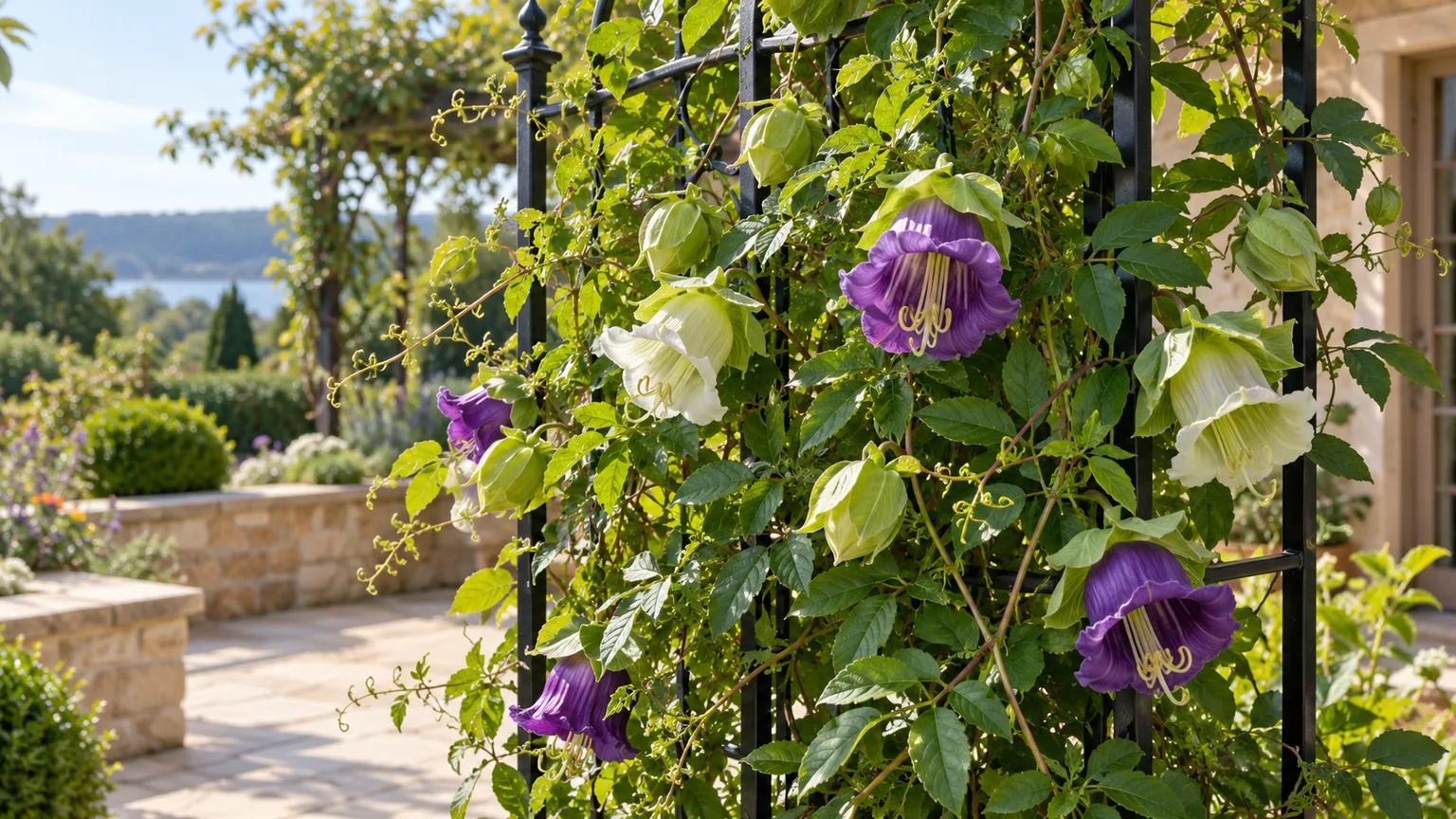
Cup-and-saucer vine (Cobaea scandens), also called cathedral bells or monastery bells, is a fast-growing climber with curling tendrils and large bell-shaped flowers. Each bloom opens a pale greenish-white, then deepens toward purple; the green calyx beneath it gives the flower its “cup and saucer” look. It can make a dramatic summer screen, but two details shape whether it succeeds: it needs a substantial support, and in places with frost it usually behaves as a one-season annual rather than a permanent vine.
Plan for foliage first and flowers later. The vine often spends its early growth building stems and leaves before it produces buds, so the best results come from sowing early enough, choosing a bright site, and installing the trellis before the stems start reaching. The North Carolina State Extension plant profile describes it as a tender subtropical perennial that can grow 10 to 20 feet in a season in ordinary garden conditions; in a frost-free native climate it can climb much higher.
Understand the vine’s growth habit
Cobaea scandens is a member of the phlox family, Polemoniaceae, and is native to Mexico and tropical South America. It climbs with branching tendrils rather than by twining its entire stem around a post. This matters when you choose a support: a fine grid, netting, taut wires, or a trellis with reachable crosspieces gives the tendrils something to catch, while a smooth, bare wall does not.
The Royal Horticultural Society describes it as a perennial climber that is usually grown as an annual, with pinnate leaves and fragrant flowers that change from greenish-white to purple. The Cambridge University Botanic Garden profile likewise notes that this woody or semi-woody perennial is commonly treated as an annual in the United Kingdom. In a warm, frost-free climate it may persist; in a cold winter, the top growth is usually lost and the roots may not survive outdoors. Check your local winter lows rather than assuming a particular hardiness-zone boundary.
Its scale is easy to underestimate from a small seedling. Extension and horticultural references report mature seasonal growth in the range of roughly 10 to 20 feet, with some plants extending farther in long, warm seasons. Give it a location where a lush wall of foliage is welcome and where you can still reach the base for watering, pruning, or pest checks. It is better suited to covering a fence or climbing frame than to being tucked among delicate neighboring plants.
Choose the right spot and support
Choose a sheltered location with as much direct sun as your climate allows. Full sun supports the best flowering; a very hot site can benefit from light afternoon shade, especially while the plant is young or when roots sit in a baking container. The RHS plant profile recommends a sunny, sheltered wall or trellis and moist but well-drained soil, while North Carolina State Extension advises some afternoon shade in especially hot summer climates.
Soil pH is usually a lower priority than drainage. The RHS lists the vine for acidic, neutral, or alkaline soils and several soil textures; the practical goal is soil that holds enough moisture for rapid leafy growth but does not stay saturated. If water pools after rain, improve the bed’s drainage or choose a raised site. A layer of compost can improve structure, but avoid turning the planting hole into a rich, wet pocket that stays soggy around the roots.
Set the support before planting
Build or anchor the support before you set out seedlings. A mature vine becomes heavy when covered in wet foliage, and a temporary bamboo stick may not be enough for a long screen. Use a firmly anchored trellis, fence mesh, garden netting, or wires stretched between secure posts; plan to guide the first few stems onto it while they are still flexible. A planting gap of about 2 to 3 feet between vines is a reasonable starting point for a screen, but a single plant can cover a modest trellis on its own.
At first, direct new growth toward the support with loose ties or by laying it against the mesh. The tendrils will do much of the later attachment themselves, but they can miss a structure if the first stems point away from it. Keep access behind the screen in mind: an exceptionally dense vine may hide a fence, but it can also shade neighboring plants and make inspection harder.
Start seeds indoors for earlier flowers
Starting from seed is usually the simplest way to get several plants. In a short-season climate, sow indoors about 6 to 8 weeks before the last expected frost; some gardeners start earlier because the plant needs time to make a substantial framework before flowering. The University of Illinois Extension entry recommends February sowing for transplanting in May in its local calendar, while Sarah Raven’s grower advice lists under-cover sowing from January through March. Use those as regional examples, not fixed dates: count backward from when nights are reliably frost-free where you garden.
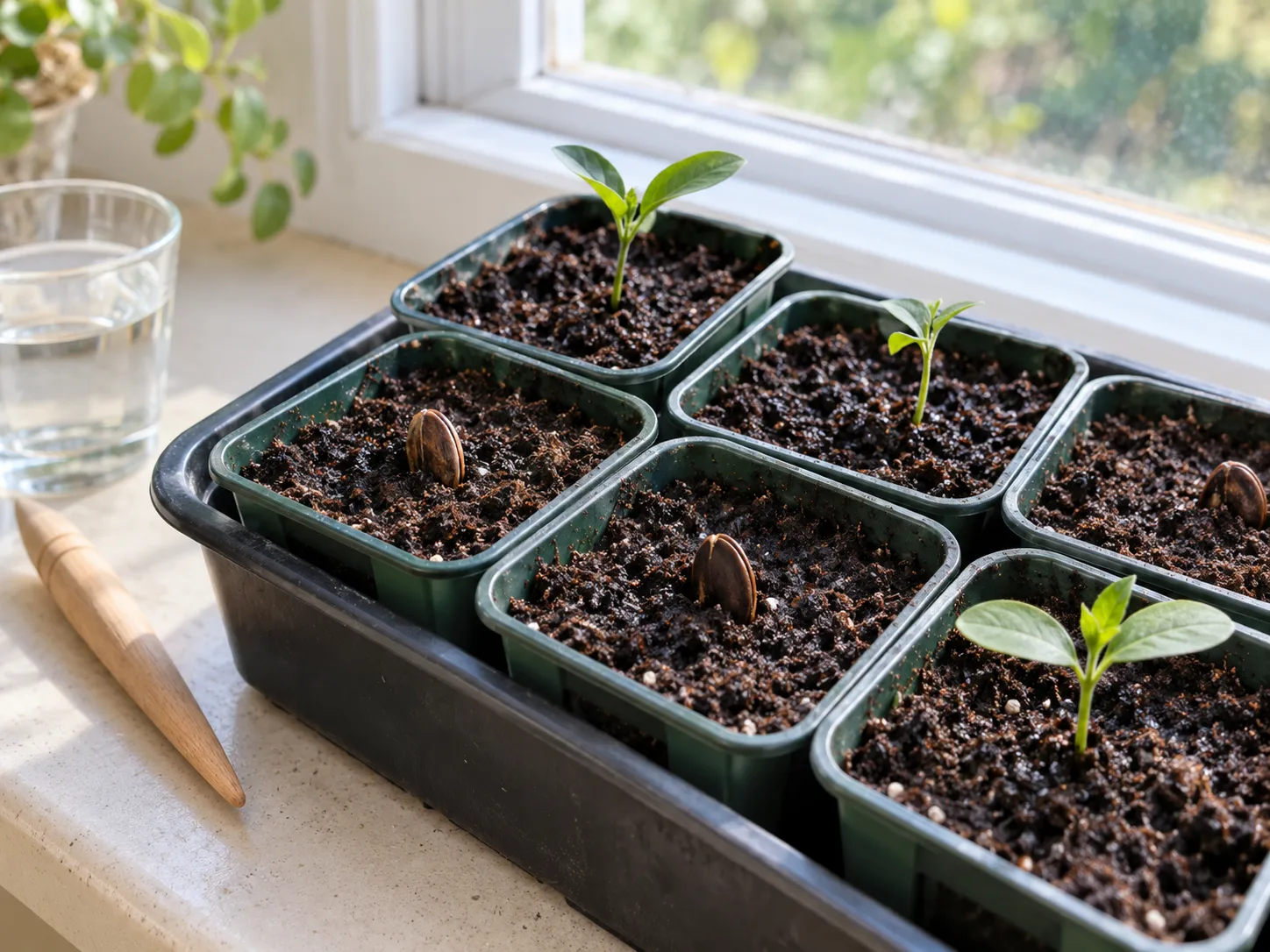
Start each seed in its own pot so you can move the seedling without separating a tangle of roots and stems. A deep 3- to 4-inch pot is more useful than a shallow cell once the vine begins climbing. Fill it with fresh, free-draining seed-starting mix, moisten the mix before sowing, and place the pot somewhere warm and bright. Provide a slim support as soon as the seedling begins to extend; these vines can start grabbing neighboring seedlings surprisingly early.
Soak, sow, and germinate
The seeds are broad and flat. A reliable specialist-supplier method is to soak them for about two hours, drain them, then sow each one on its edge and cover it lightly with mix. Chiltern Seeds’ instructions recommend this orientation, a warm 18–24°C (64–75°F) germination range, and an expected 21–30 days to germination. North Carolina State Extension reports sprouting in about 14 days when pots are kept at 68–72°F (20–22°C). Those are different estimates, not a reason to discard a pot after two weeks: temperature, seed freshness, moisture, and supplier lots all vary.
Keep the medium evenly damp, never waterlogged. If you cover a pot to retain warmth and moisture, uncover it as soon as seedlings emerge and give the plants bright light with gentle air movement. A clear cover left on in warm sun can overheat the pot or keep the surface wet enough to invite rot. If nothing has emerged after about four weeks, check that the mix stayed warm and moist rather than saturated; sow a fresh seed alongside the first attempt if you have enough seed.
The N.C. State Extension profile reports germination without specifying a pre-soak, while the seed supplier recommends a brief soak; treat it as optional rather than a requirement. A longer soak is not a substitute for fresh seed or warm, oxygenated mix. Avoid scraping or cutting the seed coat unless a supplier specifically advises it. For the first attempt, follow one simple method consistently—brief soak, seed on edge, light cover, warm conditions—so you can tell whether the limiting factor was temperature, moisture, or seed viability.
Pot up, harden off, and plant out
Once seedlings have several true leaves and roots are holding the potting mix together, move each plant into a larger pot if it is becoming root-bound or drying out rapidly. Handle the root ball gently and add a narrow stake or small trellis to keep the vine upright. Do not let it wind through neighboring pots: separating intertwined young vines later can snap tender stems and set them back.
Before planting outdoors, acclimate the vine over roughly a week to 10 days. Begin with a few hours in a sheltered, shaded spot, then gradually increase outdoor time and sunlight. Bring it inside if a cold night or frost threatens. This step reduces the shock of moving a warm-grown seedling straight into wind and bright sun, and it gives you time to catch cold damage before the plant is committed to a garden bed.
Plant out only when frost danger has passed and nights have warmed. The roots and new growth are tender; an early cold snap can stall the vine for weeks or kill it. Set the root ball at the same depth it grew in its pot, water thoroughly, and direct the first stems toward the support. In places with a long growing season, direct sowing after the soil warms is possible, but indoor starts give the plant more time to climb and bloom before fall.
Plant in the ground or a container
In a garden bed, space the plant where its mature reach will be useful rather than where its seedling size seems convenient. Set it a short distance from the trellis so the root crown is not pressed against a hot wall, but close enough that the new shoots can find the mesh. Water the planting hole, then spread a light mulch around the root zone to slow surface drying; keep mulch pulled back from the stem base.
A container works when you want to move the plant, screen a patio, or keep the root zone more manageable. Use a pot with drainage holes and a volume of at least 3 gallons; a larger, heavier pot is more stable if you plan to train the vine high. The N.C. State Extension profile suggests a 3-gallon container, but a bigger container will generally give the roots more room and the mix more water-holding capacity. Install the support in the pot at planting time so you do not drive stakes through established roots later.
Container vines need closer attention than in-ground plants. A full-sun pot can dry in a day during hot, windy weather, while a large, shaded container may remain wet for several days. Check the mix with a finger rather than watering on a fixed schedule, and do not let water stand in a saucer. If you cannot check a pot through a heat wave, choose a larger container, add mulch to the surface, or move it where it gets morning sun and some afternoon protection.
Water for steady growth
Aim for evenly moist soil while the vine is actively growing. Water slowly at the root zone until the surrounding soil is damp several inches down, then let excess drain. Do not keep the bed constantly muddy; oxygen-starved roots can stall even while the leaves look limp. Conversely, repeated drying at the root zone can slow stem extension and cause a container vine to wilt before evening.
The right interval changes with weather and container size. Test the soil near the plant rather than relying on a universal “once a week” rule: sandy beds and small pots need water sooner than loamy beds and large tubs. During a hot spell, check containers daily. In cooler, rainy weather, wait until the top layer begins to dry before watering again. Once cool weather slows growth, reduce watering, but do not let a sheltered overwintered plant dry to dust.
Directing water onto the soil instead of repeatedly wetting dense foliage helps limit mildew, especially in humid conditions. Give the vine enough spacing and air movement that leaves do not remain pressed into a damp wall. If lower leaves yellow after a wet week, inspect drainage before adding fertilizer; excess water and low root oxygen are more plausible first checks than an immediate nutrient shortage.
Feed lightly and prune with a goal
Prepare the bed with compost, then wait to see how the plant grows before adding a fertilizer. North Carolina State Extension cautions that excess fertilizer can produce foliage at the expense of flowers. If the vine is already producing long, lush stems and healthy leaves, more feeding is unlikely to solve a flowering delay. For container plants in a lean potting mix, use a balanced or bloom-oriented liquid fertilizer at the label rate once growth is established, and stop if the vine becomes excessively leafy.
Pruning is mainly for direction and size control. When a stem reaches the top of its support, cut it back to a side shoot or a pair of leaves to encourage branching within the area you want covered. Remove broken, diseased, or frost-damaged growth with clean pruners. If you are growing it as an annual, do not wait until the vine has swallowed the fence to decide how tall it may get; occasional early trimming is easier than removing a wall of tangled stems at season’s end.
Pinching versus trimming
Pinching out the tip of a young, vigorous shoot can encourage branching and a fuller screen, but it also pauses that stem’s upward extension. Use it early if lateral coverage matters more than height. If your goal is a quick climb to an arbor or overhead pergola, leave the leading stem intact and guide it upward instead. There is no need to deadhead every flower for the plant to remain attractive; remove spent blooms if you want a tidier look or are collecting seed pods.
Why blooms arrive late and what to expect
A slow start to flowering is common, particularly when seeds were sown late or the first weeks were cool. The vine can make a striking amount of foliage before the first buds appear; judge it by whether new stems are extending and leaves remain healthy, not only by whether it has flowered by midsummer. In a short-season area, early indoor sowing gives the plant more time to establish before autumn frost ends the display.
Check the conditions in this order if a mature-looking vine has no buds: Is it receiving several hours of direct sun? Was it planted outside early enough to build growth before fall? Is the soil rich in nitrogen or has it been fed frequently? Has cool weather or a recent transplant paused growth? Correct the limiting condition you can change, then give the plant time to respond. Heavy pruning late in summer may remove developing shoots and delay blooms further.
Flowers begin pale green or cream and darken as they mature; white forms are also sold. The change in color means the same plant can carry buds and older purple bells at once. The flowers become fragrant as they open, but fragrance and flowering dates vary with weather and cultivar. A University of Bristol study describes Cobaea scandens as a bat-pollinated plant in its native range (research record). That ecological relationship is not a garden-care requirement: the vine can grow and flower in temperate gardens where those native pollinating bats do not occur, although successful seed production may be less dependable than flowering.
Keep it through winter only in suitable conditions
In a frost-prone garden, plan to treat cup-and-saucer vine as an annual: enjoy its summer growth, collect mature seed if pods form, and remove the plant after frost. It is technically perennial, but the word “perennial” does not mean that it can endure a freeze. The BBC Gardeners’ World plant guide notes that it is not hardy outdoors in cool climates and can be kept as a conservatory plant if moved inside before cold weather.
To try overwintering a container specimen, move it to a bright, frost-free room or conservatory before the first cold nights. Keep it cool rather than hot—Gardeners’ World gives about 7°C (45°F) as a winter target—and water sparingly while growth is slow. Do not set it in a dark, heated room and expect it to remain vigorous; warmth plus low winter light can produce weak, stretched stems and invite pests. If space is limited, starting new seed next season may be simpler than storing a large vine.
For a plant kept alive through winter, remove dead or diseased material and shorten unruly stems when active growth is low. The RHS lists pruning after flowering, while extension guidance suggests late-winter shaping for evergreen plants; the sensible timing depends on whether your local plant is finishing its outdoor season or being held in a protected space. Keep the main framework if you want it to resprout, and do not cut into a stem that is still carrying healthy leaves unless you need to reduce its size.
Solve common growing problems
Lots of leaves, few flowers: Check light first, then the seed-start date and fertilizer history. Shaded vines and plants fed heavily with nitrogen are more likely to favor leafy growth; shift a container into brighter light if possible and stop routine feeding. If the season is already near its end, it may be too late for a meaningful fix this year, so sow earlier next spring.
Seed has not germinated: Confirm that the pot stayed in the warm range recommended by the supplier, with damp—not saturated—mix. Allow up to about four weeks because sources give different germination windows. If seeds were stored warm or damp for a long time, viability may be poor; sow another seed in fresh mix instead of keeping a waterlogged pot indefinitely.
Vine wilts in the afternoon: Check the root zone before watering. If the soil is dry several inches down, water deeply; if it is wet and the container drains poorly, more water may worsen the problem. A small pot in hot sun can overheat and dry quickly, so increase pot size or provide afternoon shade rather than simply adding fertilizer.
Stems grow into nearby plants: Redirect shoots while they are young and flexible, and trim back wayward tips before they weave through neighboring plants. Keep the base clear enough to inspect. The vine’s speed is an asset on a bare fence but can shade smaller plants and hide aphid colonies when it is allowed to sprawl without a boundary.
Aphids, spider mites, and mildew
Aphids may cluster on tender shoot tips, while spider mites are more likely during hot, dry weather. Inspect the undersides of leaves and the newest growth. For a small infestation, rinse pests off with a firm stream of water and check again after a few days; repeat if needed. If you use insecticidal soap, follow the product label, test a small area first, and avoid spraying in direct hot sun or when pollinators are visiting flowers.
Powdery mildew is more likely when foliage is dense and air circulation is poor. Give plants room, avoid frequent overhead watering, and remove heavily affected leaves rather than trying to compensate with extra fertilizer. Extension guidance reports no major disease problems overall, but notes that humid conditions can raise mildew risk. If the vine’s leaves look healthy and pests are absent, slow flowering by itself is not evidence of disease.
Conclusion
Cup-and-saucer vine rewards a little advance planning: sow warm and early enough for your local season, move seedlings outside only after frost danger passes, and give the tendrils a strong structure before they take off. Keep the root zone moist but draining, feed conservatively, and expect flowers to follow the early rush of foliage rather than appear immediately.
If winter freezes where you live, grow it as a seasonal screen and start fresh seed next year. If you have a bright, frost-free place to store a container, you can try keeping it as a perennial. Either way, the most useful first step is the same: choose the support and location before planting, so a vigorous vine grows where you want it instead of where it can reach.



