How to Grow Cantaloupe: Planting, Care, and Harvest
Practical cantaloupe care: choose a cultivar for your season, prevent poor fruit set, water consistently, and harvest at full slip with troubleshooting tips.
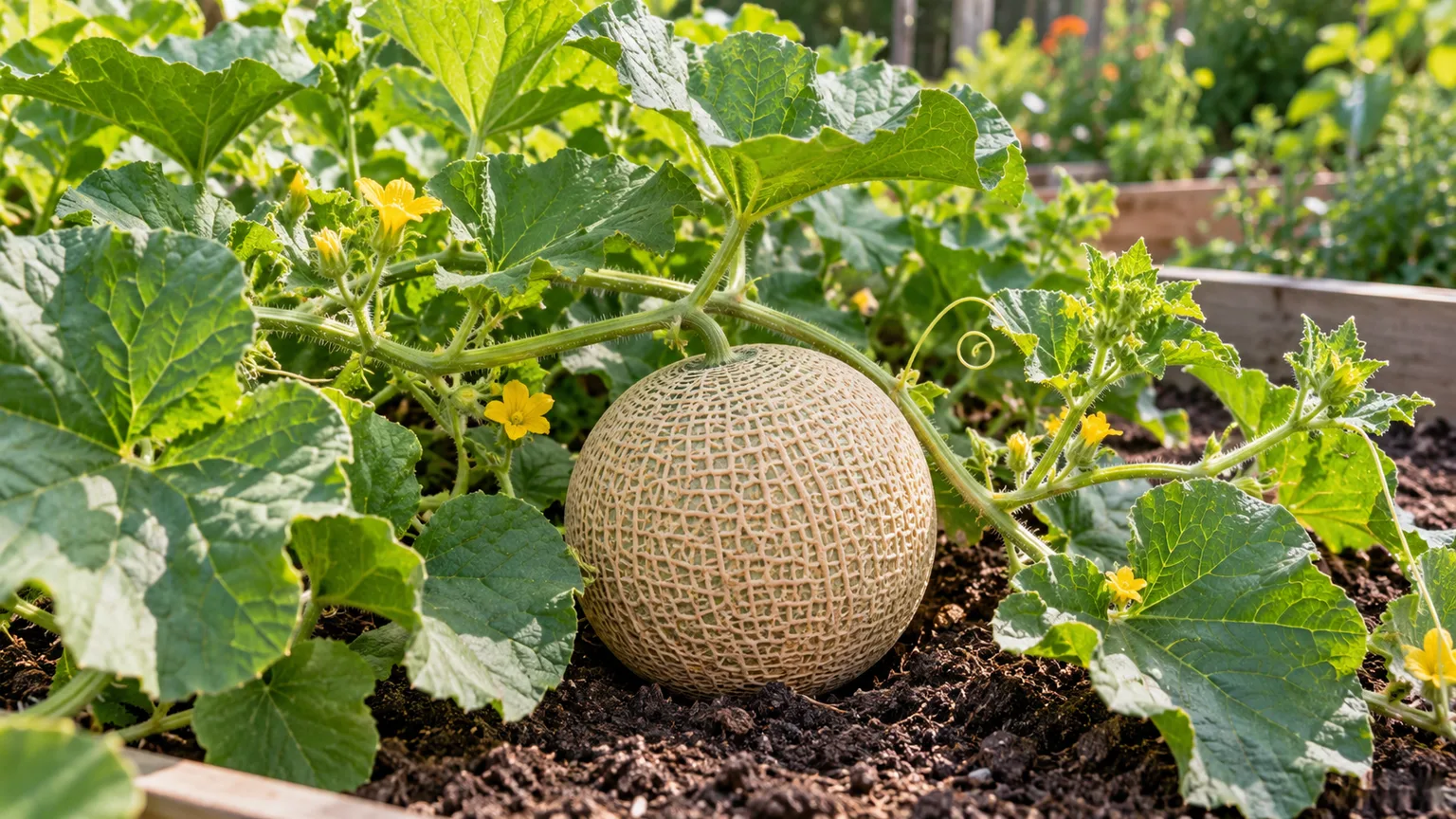
A cantaloupe vine can look vigorous yet produce no ripe melons if its roots sit in cold soil, bees miss the female flowers, or the chosen variety needs more warm days than your garden has. The reliable route is to choose a cultivar that can finish before frost, wait for warm soil, give the vine sun and room, keep moisture steady, and harvest only when the fruit is ready to slip from the stem.
The short version: what a cantaloupe needs
Cantaloupe is a frost-sensitive, warm-season vine. Give it a sunny spot with soil that drains well, and do not plant outdoors until frost danger has passed and the soil is roughly 60–65°F or warmer; warmer soil near 70°F is even more dependable for quick establishment. A thermometer in the bed is more useful than a calendar date because exposed soil warms at different rates from year to year.
Plant a variety whose days-to-maturity estimate fits the time between planting and your first fall frost, with some extra time for cool spells. Keep the root zone evenly moist while vines flower and fruits size up, leave open flowers accessible to bees, and check fruit daily as it approaches ripeness. These few decisions prevent more common failures than elaborate pruning or frequent feeding.
What counts as a cantaloupe, and which variety should you grow?
In everyday U.S. seed catalogs and grocery stores, “cantaloupe” usually means a netted muskmelon, Cucumis melo var. reticulatus. Botanically, true cantaloupes are a different group with ribbed, generally smooth skin, but home gardeners often see both names used loosely. Check the fruit description, vine habit, disease resistance, and maturity estimate on the packet rather than relying on the common name alone.
Cantaloupe plants are annuals in the cucurbit family. They grow long, trailing stems with tendrils, broad leaves, and separate male and female flowers on the same plant; the female flower has a tiny melon-shaped swelling at its base. The mature vine can cover a broad patch, so the cultivar’s size and your available growing space should guide your choice.
Choose a cultivar that fits your frost-free season
The days-to-maturity number on a seed packet is a planning estimate, not a guarantee. It may be counted from sowing or transplanting, and cool nights, cloudy weather, late planting, or disease can add time. If your summer is short, pick an early cultivar and a smaller-fruited type, then start plants indoors only if that genuinely gives them a safe head start.
In a long, hot summer, you have more flexibility to choose a larger or later variety for flavor, storage, or disease resistance. When available, choose a variety with resistance to the diseases common in your region, especially powdery mildew or Fusarium wilt. The Penn State Extension guide for home gardeners emphasizes matching days to harvest to the local season; its broader cantaloupe production guide also describes how temperature and drainage affect crop development.
Time planting from soil warmth and frost dates
Use two conditions together: the last spring frost must be behind you, and the soil must be warm enough for a heat-loving crop. Iowa State University Extension recommends waiting until frost danger has passed and the soil is 60–70°F; Penn State Extension suggests 65°F or warmer for direct sowing and notes that even a light frost can injure cantaloupe. For home gardeners, treat about 65°F as a practical minimum and wait closer to 70°F when the bed is cool or wet. Iowa State University Extension Penn State Extension
Measure the soil a few inches below the surface in the morning for several days, not just once on a sunny afternoon. If you plant in cold, damp ground, seeds can rot or sit for a long time, and transplants may stop growing while they wait for warmth. A low raised bed, dark mulch laid down before planting, or a sunny sheltered site can warm sooner, but none makes a frost-sensitive vine safe from a freeze.
Work backward from the first fall frost as well. If the variety needs 80–90 days and your area usually has only 90 warm days after soil finally warms, there is little margin for a cool stretch or late fruit set; choose a faster cultivar or start seedlings in individual pots. Do not gamble on an early planting date if the soil is still cold: a healthy plant started later often catches up with one that spent weeks stalled.
Start from seed or transplant without stalling the vine
Direct sowing is usually simplest where summers are long and the garden soil warms early. It avoids disturbing the roots, and the plant can grow in place as soon as conditions suit it. Indoor starts are useful in short-season regions, but they only help if you transplant them while they are young and outdoor nights have warmed.
Direct sowing in a warm bed
Sow two or three seeds about 1 inch deep at each planting station, then thin to the strongest seedling after true leaves appear. Penn State Extension describes sowing several seeds in a group and thinning after emergence; for a small garden, keeping one vine per station is easier to space and tend than allowing a cluster to compete. If your seed packet calls for traditional hills, follow its hill spacing and thinning directions because some cultivars are selected for that system.
Keep the seed zone lightly moist, not waterlogged, until seedlings emerge. Once the plants have true leaves—the first leaves with the recognizable lobed shape—snip weaker seedlings at soil level with clean scissors instead of pulling them out beside the plant you are keeping. Pulling can loosen or tear the remaining seedling’s young roots.
Starting seeds indoors for a short season
Sow indoors about four to six weeks before the last average frost in individual pots with drainage and seed-starting mix. Melons dislike root disturbance, so avoid sowing them in a shared tray where roots will tangle before transplanting. Keep the mix warm and just moist; soggy medium can rot the seed, while a stretched, pale seedling usually needs more light rather than more fertilizer.
Thin each pot to its strongest seedling by snipping the extra at the soil line. Harden the plant off over about a week by gradually exposing it to outdoor sun and wind, then transplant when frost danger has passed, soil is warm, and night temperatures are consistently above about 50°F. Penn State Extension recommends moving established seedlings outdoors at this stage and setting supports at planting if the vine will climb. Handle the root ball gently and avoid setting a leggy, root-bound transplant outdoors as a shortcut.
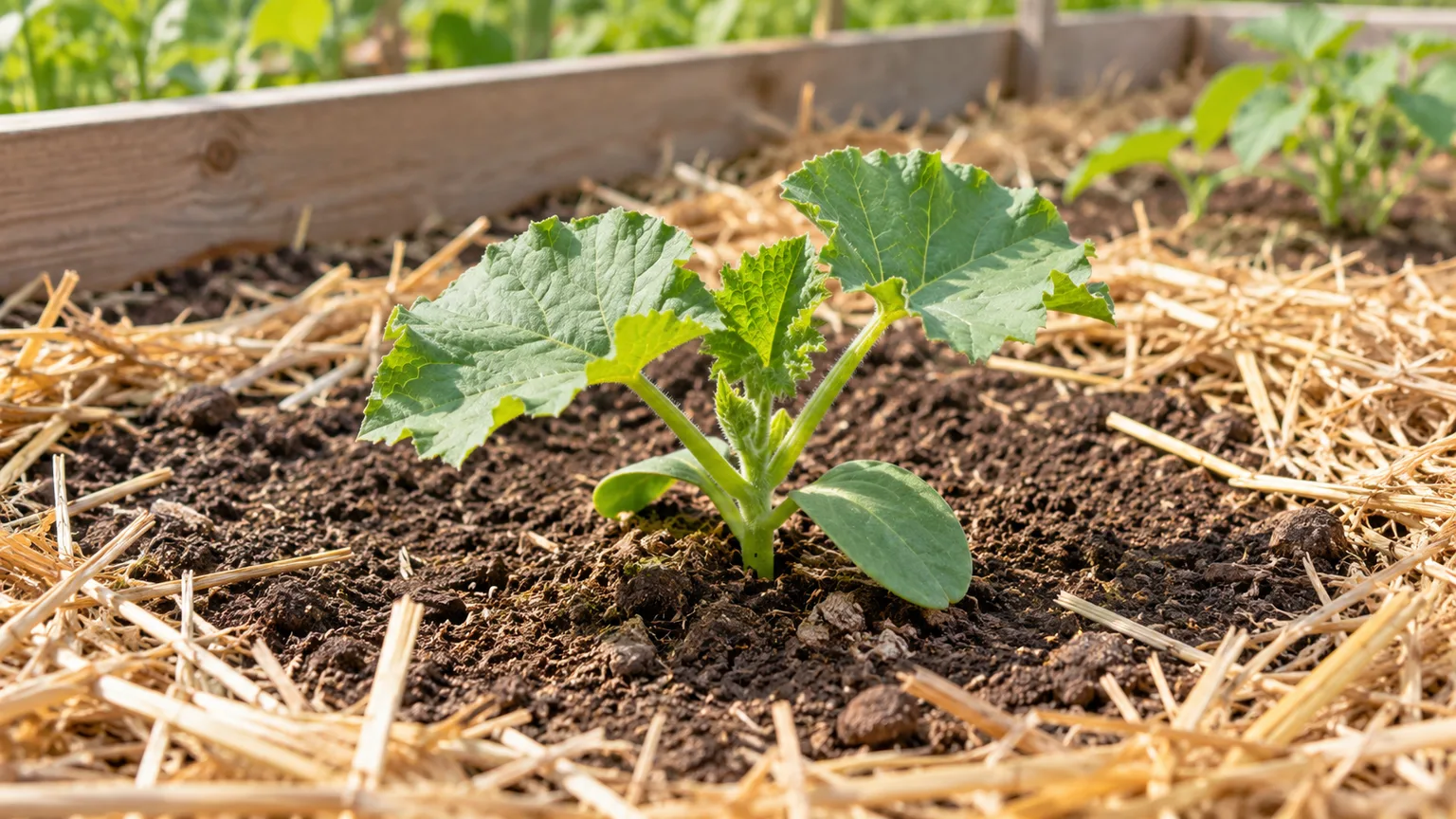
Wait for warm soil before setting out seedlings or sowing cantaloupe seed.
Prepare a sunny site with loose, well-drained soil
Choose a site that receives at least six hours of direct sun; eight or more hours is better for a fruiting vine. Cantaloupe needs warmth and airflow, so do not tuck it under a tree, beside a damp wall, or where runoff collects. In a small yard, let the runners extend along a sunny path or bed edge rather than into a shaded, crowded corner.
The soil should hold enough moisture for growth but drain after rain. Penn State Extension gives a pH range of 5.8–6.6 for production and recommends basing fertility on soil-test results; use your local extension lab’s interpretation for home-garden adjustments rather than adding lime or fertilizer by guesswork. Work finished compost into poor soil, but do not bury fresh manure around the roots or create a rich pocket that encourages leafy growth at the expense of fruit.
In heavy clay, improve the bed over time with organic matter or grow on a modest raised bed so water does not sit around the crown. In very sandy soil, organic matter helps hold moisture, but you will still need to check the bed more often during hot weather. A soil test before planting is especially useful if the garden has repeatedly produced large vines and few fruits.
Give vines enough room: ground, trellis, or container
For single vines on the ground, a practical starting point is about 3 feet between plants and 5–6 feet between rows, adjusted for the cultivar and whether runners can spread into open space. GrowVeg lists roughly 3 feet as minimum spacing, while Penn State Extension’s hill method gives large vines more room; compact bush types may fit closer than full-size runners. Good spacing makes fruit easier to find, keeps leaves drier, and improves airflow.
Vertical growing saves ground space but does not shrink the roots or the fruit. Use a firm trellis anchored to the ground or a bed frame, and select a smaller-fruited variety if possible. Harvest to Table’s melon guide describes trellising and sling supports as a way to keep fruit off the soil; Penn State Extension likewise recommends supporting each developing melon so it cannot pull free and split.
A container is possible if the plant gets full sun, a large volume of well-drained mix, a strong support, and frequent moisture checks. Pick a compact cultivar and use the largest pot you can manage—roughly 15 gallons or larger is a more forgiving starting point for one vigorous vine than a small decorative pot. Container soil heats and dries faster than a garden bed, and one plant can quickly occupy the whole trellis, so expect more frequent watering and potentially fewer fruits than an open-ground plant.
Train a trellised vine and support each melon
Install the trellis when you plant so you do not drive stakes through a developed root zone later. Guide the young vine toward the support and loosely tie it with soft plant ties; tendrils will grip the mesh or netting as growth continues. Avoid pulling a mature runner tight, since it can kink or snap where it joins the main stem.
The frame must carry the vine and the weight of its fruit, especially when wind or rain loads the foliage. Once a melon is large enough to sag, cradle it in a breathable mesh sling or a strip of fabric attached to the trellis. Put the support in place while the fruit is still small and check it as the melon grows; do not wait until the stem is already stretched.
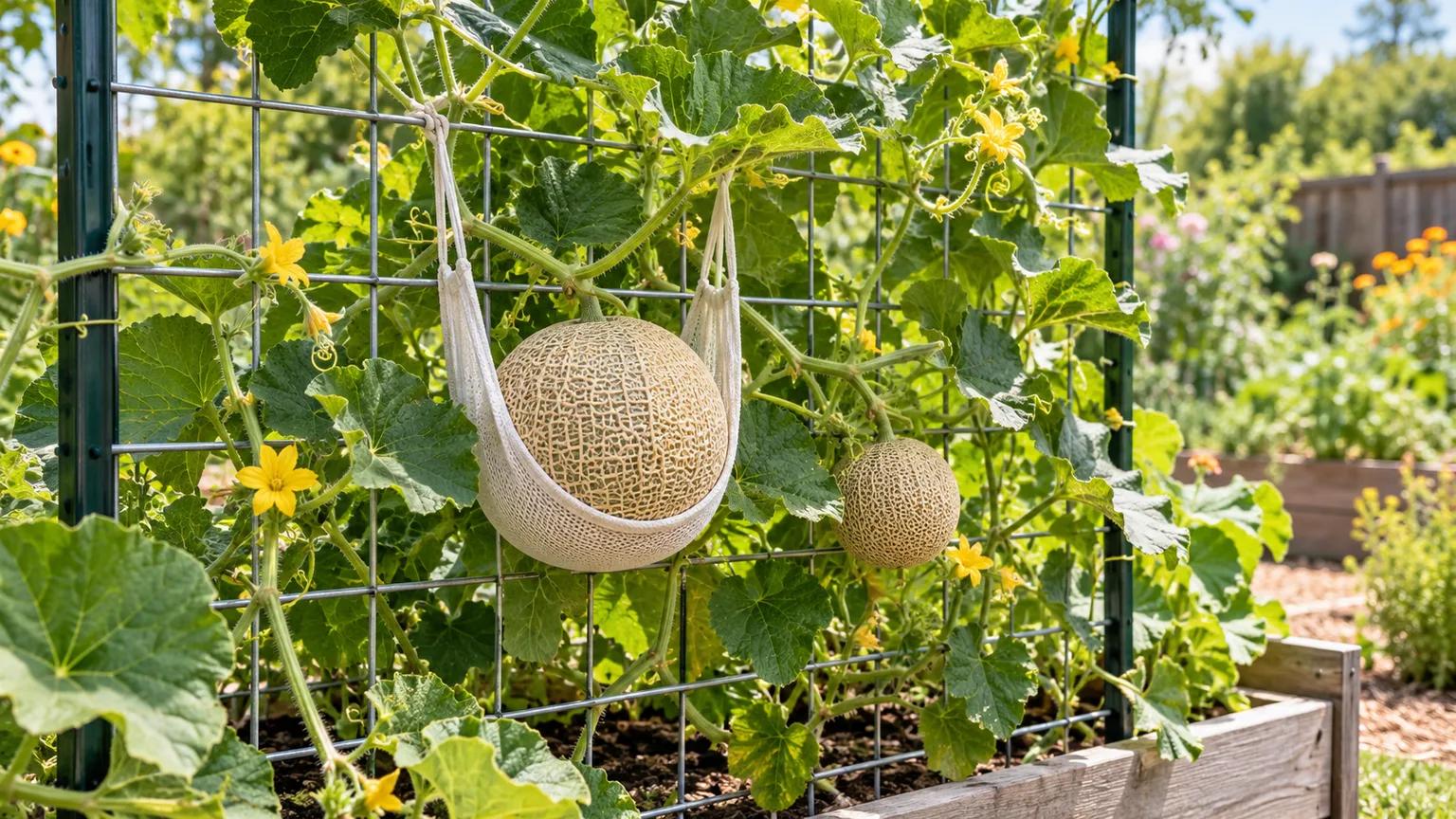
A sturdy trellis and breathable sling keep a developing melon from pulling on its stem.
Water for steady growth and fruit sizing
Aim for evenly moist soil, not a fixed number of watering days. Rainfall, heat, soil texture, and pot size all change how often the plant needs water, so check the root zone before irrigating. A brief sprinkle may wet the surface without reaching the roots; Penn State Extension advises watering deeply enough to moisten roughly 6 inches of soil.
Water at the base or use drip irrigation so leaves dry quickly. Wet foliage overnight, dense growth, and poor airflow all favor disease. In hot weather, check sandy beds and containers more often than clay beds, and water early enough that the plant is not left dry through the hottest part of the day.
Keep moisture steady while flowers open and young fruits enlarge. A long dry spell followed by heavy watering can stress roots and contribute to cracking as fruit approaches maturity. Penn State notes that excess water near maturity can split melons; if the bed has stayed wet, ease back gradually, but do not deliberately wilt the vine to “sweeten” the fruit. The goal is to avoid extremes, not to force drought stress.
Feed lightly and mulch after the soil warms
Start with a soil test and finished compost if the bed needs organic matter. If nutrients are already adequate, extra fertilizer will not make the fruit sweeter or ripen it faster. Excess nitrogen can push the plant toward large leaves and long vines while delaying flowers and fruit, so avoid repeated high-nitrogen applications without a diagnosed need.
If your soil test shows a deficiency, use the recommended amendment at the stated rate and keep fertilizer away from the stem. A balanced, labeled garden fertilizer may be appropriate in low-fertility soil, but follow its instructions and do not guess at a heavy dose. Container plants may need nutrients sooner because watering flushes nutrients from the pot, yet they still benefit from restrained feeding rather than a strong, frequent dose.
Apply a thin layer of clean straw or another suitable mulch after the soil has warmed and seedlings are established. Mulch reduces weeds and helps moisture stay even, while a barrier under the developing melon keeps it off wet soil. Leave a gap around the crown so the stem does not stay damp and rot.
Support pollination and diagnose poor fruit set
Cantaloupe flowers need pollen to move from a male flower to a female flower. Bees do most of the work, so open flowers need access to pollinators. A floating row cover can shield young plants from some insects and cold wind, but remove it as soon as flowers appear; GrowVeg’s cantaloupe growing guide also recommends uncovering plants at bloom.
A male flower has a plain stem behind it. A female flower has a small round swelling that resembles a miniature melon between the flower and the vine; that ovary enlarges only after successful pollination. Male flowers often appear first, so a few flowers that drop without a fruit are normal. If you see female flowers opening but their tiny fruits yellow and shrivel, check bee activity, wet or windy weather, and whether row cover is still blocking access.
If pollinators are scarce, hand-pollinate in the morning when fresh flowers are open. Pick a newly opened male flower, remove its petals to expose the pollen-bearing center, then gently brush that center against the middle of a female flower; repeat with another male flower if pollen coverage is light. A small soft brush works too, but use one that has not been used for paint or chemicals.
Do not spray insecticides on open flowers, and do not assume every dropped flower means the crop has failed. The Penn State Extension production guide notes the importance of active bees for complete pollination and fruit set; if weather is very hot or cold, flowering may continue without a reliable fruit set until conditions improve. The first step is to confirm that the flowers are female and that pollinators can reach them.
Prune only when there is a clear reason
Routine pruning is not necessary for most home-garden cantaloupe plants. Healthy leaves feed the growing fruit, and cutting off vine tips or blossoms on a calendar can remove flowers that would have set later. Let the plant establish and set fruit before deciding whether the vine is truly taking over a space.
Remove dead or diseased leaves with clean shears, and redirect runners that are blocking paths or growing into neighboring crops. If frost is approaching and the plant has several fruits, you may remove tiny late-set fruit that has no realistic chance to mature; keep the healthy foliage around the larger fruit. This is a season-length decision, not a requirement for every vine.
Prevent pests and diseases before they spread
Check leaf undersides and new growth regularly for cucumber beetles and aphids. Cucumber beetles chew leaves and flowers and can spread bacterial wilt, which can cause a vine to collapse; Penn State Extension notes that plants infected with bacterial wilt do not recover. Row covers can protect young seedlings, but remove them at bloom so pollination can happen.
If a vine wilts, check the soil before adding water. A plant that wilts on a hot afternoon but recovers by evening may be reacting to heat; one that remains limp in moist soil, especially with cucumber beetles nearby, needs closer inspection and may have disease or root damage. Do not assume that every wilted vine is thirsty.
Powdery mildew often appears as pale, dusty patches on leaves later in summer, while other leaf diseases can produce yellowing, spots, or rapid decline. Give plants space, water the soil rather than the leaves, rotate cucurbits to a different bed for about three years when possible, and remove severely diseased material rather than composting it. Penn State Extension recommends crop rotation, disease-resistant cultivars, and airflow as prevention; use local extension diagnostics before deciding whether a treatment is appropriate.
Harvest by fruit cues, not by calendar alone
Many cantaloupes mature about 35–45 days after pollination, but the variety and summer temperatures change the timing. Start checking the seed packet’s maturity range when the fruit begins to form, then watch the individual melon rather than harvesting every fruit on a set date. Penn State Extension says peak flavor is reached at full slip, when the fruit separates easily from the stem.
Look for the ground color to shift from green toward tan or yellow, the netting to become raised and corky, and a sweet aroma near the stem end. At full slip, the stem attachment develops a crack and the melon releases with a gentle twist; if it resists, leave it for another day or two and check again. Some varieties differ in how cleanly they slip, so use the packet’s specific harvest notes as well.
Check ripe-looking fruits daily because one can move from ripe to overripe quickly in hot weather. Cut or gently twist the fruit without tugging on a neighboring runner that still carries developing melons. A cantaloupe does not become sweeter after harvest, so picking early will not be corrected by leaving it on the counter.
Store ripe melons and handle them safely
Keep an uncut melon cool after harvest and refrigerate it if you are not eating it soon. Variety and growing conditions affect storage life, so inspect the fruit for soft or damaged spots and use it before the flesh turns watery. Once cut, store pieces in a covered container in the refrigerator and use them within several days.
Wash the whole rind under cool running water and scrub it with a clean produce brush before cutting. Bacteria on the outside can transfer to the flesh through a knife, even though the rind is not eaten. Penn State Extension recommends washing the melon before slicing and keeping cut fruit refrigerated; wash hands, the cutting board, and the knife as well.
Save seed and reset the bed for next year
Cantaloupe is an annual, so the vine finishes its life cycle in one growing season and must be replanted. If you want to save seed, choose a fully ripe, healthy fruit from an open-pollinated variety and let the seeds dry thoroughly before storing them in a labeled envelope in a cool, dry place. Seed saved from a hybrid may not produce plants or fruit that match the parent.
Different Cucumis melo varieties can cross-pollinate, so seed saved from a garden where several melon types flower together may not grow true to type. For predictable results, buy fresh seed or isolate the flowers before pollination and label the saved seed. Rotate cantaloupe away from cucumbers, squash, pumpkins, and other cucurbits for several seasons when space allows; this lowers the chance that soilborne diseases build up around the same family of crops.
Conclusion
Grow cantaloupe by matching the variety to your frost-free window, then plant only after the bed is warm and the forecast is safe. Give the vine sun, loose soil, room to spread or a sturdy supported trellis, and regular root-zone moisture; protect young plants from pests without blocking bees when flowers open.
The last step is patience at harvest. Wait for the fruit’s color, aroma, netting, and full-slip cues instead of picking by size or calendar alone, then chill and handle it cleanly. Those decisions make a homegrown melon more likely to ripen fully on the vine and taste the way you hoped.



