How to Grow and Care for Rose Bushes
Learn how to choose, plant, water, feed, prune, and protect rose bushes with advice that adjusts to rose type, climate, and the season.
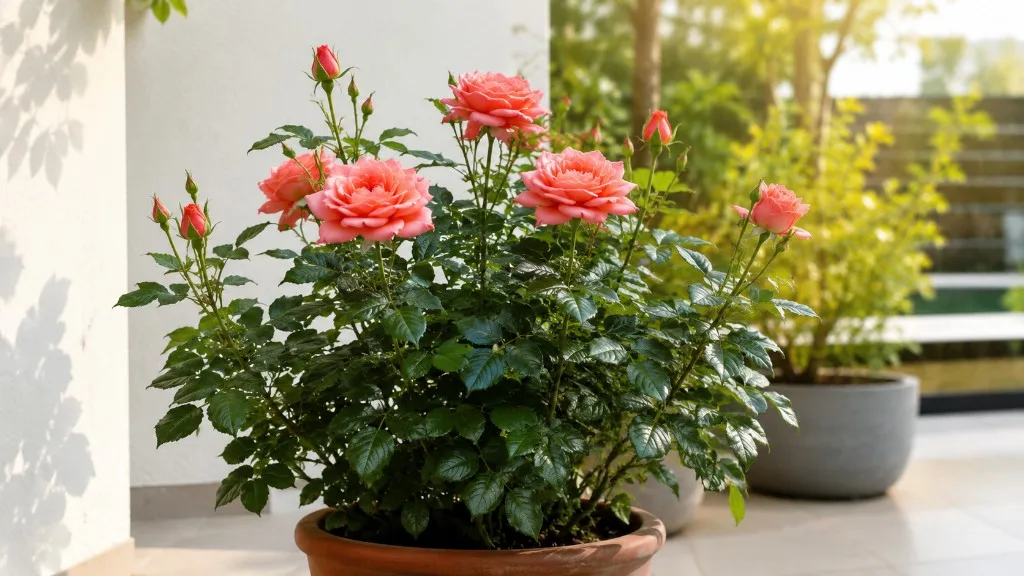
A healthy rose is easier to grow when you match its type to the space, give it sun and drainage, and prune according to when it flowers. Many rose problems blamed on “fussy” plants start with a mismatch: a vigorous rambler in a small bed, a grafted rose planted at the wrong depth for local winters, or a repeat-blooming bush pruned as if it were a once-flowering shrub.
The care basics are manageable. Roses usually need several hours of direct sun, soil that holds moisture without staying waterlogged, deep watering while roots establish, and a yearly cleanup or pruning suited to the cultivar. There is no single watering interval, fertilizer schedule, or graft depth that fits every rose and climate, so use the checks below rather than treating a calendar as a rule.
Rose Care at a Glance
| Need | Practical starting point | What changes the answer |
|---|---|---|
| Light | Aim for at least six hours of direct sun | Heat, reflected light, and cultivar shade tolerance |
| Soil | Fertile, moisture-retentive, well drained | Heavy clay, sand, slope, and drainage |
| Water | Soak the root zone when it begins to dry | Plant age, container size, rainfall, wind, and temperature |
| Pruning | Remove dead wood and shape at the right season | Rose class and whether it blooms on old or new growth |
| Feeding | Start with soil and plant condition; follow a rose-feed label | Soil test, growth, reblooming, and frost timing |
| Disease prevention | Sun, spacing, clean-up, and dry foliage | Local humidity and the cultivar’s disease resistance |
Use this as a baseline, not an automatic recipe. The RHS rose-growing guide describes roses as sun-loving plants that do best in rich, moist but well-drained soil, while extension recommendations show how planting and feeding details shift with regional conditions. If a local extension service gives a different seasonal date or planting depth for your climate, follow the local advice.
Choose a Rose That Fits Your Space and Routine
“Rose bush” covers plants with different sizes, flowering cycles, and cane habits. A compact patio rose can fit a large container; a shrub rose may fill a border; a hybrid tea usually produces large individual flowers on upright stems; and a floribunda bears clusters. A climber needs a durable structure and long-term training, while a rambler can be much more vigorous and may flower in one large flush rather than repeatedly.
Before buying, read the full cultivar name and check mature height and width, hardiness, flowering pattern, fragrance, and disease notes. Ask a local nursery or rose society which cultivars stay healthy nearby: performance in a dry region does not predict performance in a humid garden where foliage stays wet. Disease-resistant is a useful comparative trait, not a promise that the bush will never develop black spot or mildew.
Choose by the job you want the plant to do. For cut flowers, look for long stems and the bloom form you like; for continuous color, prioritize repeat bloom; for a fence, confirm both the eventual height and whether the canes can be trained; for a small patio, select a compact cultivar rather than relying on severe pruning to keep a large rose small. Also decide whether you want rose hips. Deadheading every flower removes the developing fruit, which can be attractive on some species and older shrub roses.
Give Roses the Right Site
Most garden roses flower best with about six or more hours of direct sun a day. Morning sun has an additional benefit in humid areas: it helps dry dew from leaves. UC IPM recommends at least six to eight hours of sun, open spacing, and pruning for air circulation as steps that reduce black-spot pressure (UC Statewide IPM Program). Some cultivars tolerate partial shade, but expect fewer flowers in a deeply shaded position.
Leave room for the rose’s mature width, not the width of its nursery pot. Air should move around the canes, and you need enough access to remove dead stems and pick up fallen leaves. Avoid a low, soggy pocket or a site crowded by tree roots that compete for water. In a hot climate, a west-facing wall or paving can reflect intense afternoon heat; a spot with morning sun and some late-day relief may protect blooms and reduce stress if the cultivar and local guidance support that choice.
Improve Soil Without Creating a Bathtub
Roses want moisture available to their roots but also need oxygen in the soil. If a planting area remains saturated after rain, adding a rich mix only to the bottom of a deep hole can make a basin that holds water around the roots. Choose a better-drained spot, raise the bed, or correct compaction across a wider area before planting.
Work mature compost or other well-rotted organic matter into the bed when the native soil needs better structure, rather than filling a narrow hole with a sharply different potting mix. In sandy ground, organic matter can help retain moisture; in heavy ground, broad bed preparation and drainage matter more than simply adding a little sand to one hole. A soil test is a better reason to adjust pH or nutrients than a generic recipe. Avoid piling manure or fertilizer against canes or the graft union.
Roses can adapt to a range of soils if drainage and moisture are reasonable. If the garden is very alkaline, saline, compacted, or prone to standing water, get local advice before planting a prized cultivar. Fixing the site first is usually easier than trying to compensate later with more water or fertilizer.
Plant Bare-Root and Container Roses Correctly
Plant when the soil is workable and the rose has a good chance to establish before extreme heat or cold. Dormant bare-root roses are typically sold during the cool season; container-grown roses have a longer planting window, but a new root ball can dry quickly in hot weather. The calendar differs across regions: BBC Gardeners’ World Magazine notes autumn as a useful planting time in its climate, while Colorado State recommends spring planting for bare-root roses in its colder setting (Colorado State University Extension).
Spread Bare Roots and Keep Potted Roots Intact
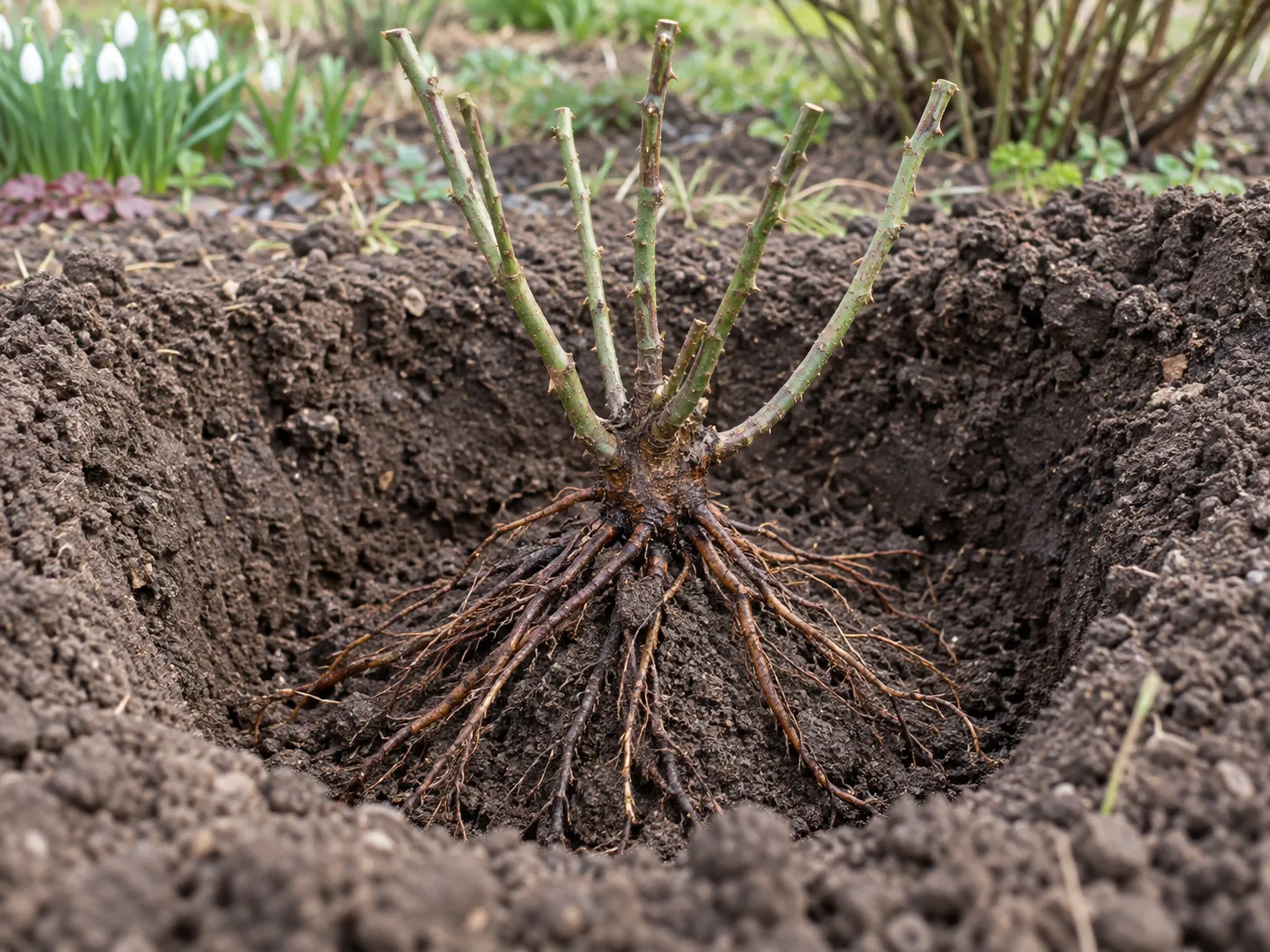
Keep bare roots covered and moist until you are ready to plant. Dig a hole wide enough for roots to spread naturally without folding or bending them sharply. Make a low mound of soil in the center, set the plant over it, and fan the roots down and outward. Backfill in stages, firming gently so large air pockets close, then water thoroughly to settle the soil.
For a container-grown rose, water the pot before planting if the root ball is dry. Slide it out carefully and loosen only roots that are circling tightly around the outside; avoid tearing apart a root system that is already growing well. Set the root ball at the depth appropriate for its graft status and region, backfill with native soil, and water slowly. Remove dead or broken stems, but avoid a severe haircut unless the plant label or regional planting instructions call for it.
Set the Graft Union for Your Climate
On a grafted rose, the swollen bud or graft union joins the named flowering cultivar to a rootstock. Its planting depth matters because cold can injure the union, but advice varies by climate. Clemson Cooperative Extension advises South Carolina gardeners to set the union just above soil level; Colorado State recommends placing grafted roses several inches below the soil line in its colder climate. Those are regional recommendations, not contradictory universal rules (Clemson Cooperative Extension; Colorado State University Extension).
Ask your local extension service or nursery for the depth used in your area. In colder regions, burying the union can protect it from winter injury; in milder, humid regions, keeping it above soil may reduce problems associated with a buried graft. Own-root roses have no graft union, so set their crown according to the nursery label and local advice. Once planted, water deeply and add mulch while keeping it a few inches away from the stems.
Water by Root Zone, Not by Calendar
A newly planted rose needs consistent moisture while its roots spread into surrounding soil. Check the soil several inches below the surface near the root zone; if it feels dry, water slowly at the base until the soil is moist through the active roots. If it is still cool and damp, wait and check again. Rainfall, temperature, wind, soil texture, and plant size all change how quickly that zone dries, so “twice a week” can be too much in a cool wet spell and too little in heat or fast-draining soil.
Established roses usually need less frequent attention than new plants, but they still benefit from deep watering during extended dry periods. A slow soak encourages water to move down rather than wetting only the top layer. In containers, check more often: sun and wind can dry a pot quickly, and a root-bound plant may need water more frequently than a rose in a deep, well-mulched bed. Empty standing water from saucers so roots do not remain saturated.
Aim water at the soil rather than regularly wetting foliage, especially late in the day. This does not mean a little rain or an occasional rinse will doom a rose; it means avoid creating long periods of leaf wetness when you control the watering. A soaker hose or drip line is useful in a crowded bed because it delivers water to roots while keeping leaves drier. If leaves yellow and droop while the soil is wet, do not add more water until you check drainage and root-zone moisture.
Mulch and Feed for Steady Growth
A two- to three-inch layer of organic mulch helps moderate soil temperature, reduce evaporation, and limit weeds. Keep the mulch pulled back from the canes rather than piling it against the plant. Refresh it as it decomposes, and remove diseased leaves from the bed before adding clean mulch over the soil surface.
Do not assume that more fertilizer means more flowers. A rose growing in fertile soil may need little; a plant in a container or repeatedly flowering through a long season may use nutrients faster. If growth is weak or leaves are pale, first check sunlight, drainage, watering, and pests. A soil test can distinguish a nutrient issue from an environmental one. When feeding is appropriate, use a product labeled for roses or flowering shrubs, apply only at its label rate, and water it in as directed.
Avoid applying granular fertilizer to dry soil or letting it touch the canes; concentrated salts can injure roots and stems. Newly planted roses should establish before you push strong top growth with fertilizer. In cold-winter regions, stop routine feeding early enough that the plant can slow down before frost; do not force tender growth late in the season. Compost is useful as a soil amendment and mulch, but it is not a precise substitute for a diagnosed nutrient need.
Prune for the Way Your Rose Flowers
Pruning has three practical jobs: remove dead or diseased wood, keep the plant within its space, and encourage a healthy framework. Use clean, sharp bypass pruners for small canes and loppers for thicker ones. Remove dead or damaged sections back to sound tissue, then cut just above a healthy bud that points in the direction you want the new shoot to grow. An open center and non-crossing canes improve access and airflow.
Timing depends more on rose type and flowering habit than on a single date. In many cold-winter areas, major pruning waits until late winter or early spring, after the harshest freezes; mild climates can prune earlier. The RHS pruning guide recommends checking the specific rose group because late-winter timing is not right for every rose. If you do not know the cultivar, observe when it blooms for a season before making hard cuts.

Repeat-Flowering Bushes Versus Once-Flowering Roses
Many hybrid teas, floribundas, and repeat-flowering shrub roses bloom on new growth made during the current season. These can usually be shaped during the dormant or early-spring window recommended locally, removing weak or inward-growing stems and shortening remaining canes to suit the variety and desired size. A hard prune produces vigorous regrowth; a lighter trim retains a larger framework and usually less vigorous shoots. Neither is a universal requirement for every shrub rose.
Many species roses and older cultivars flower mainly on wood made the previous year. If you cut them back hard in early spring, you may remove the shoots that would have carried this year’s flowers. After flowering, remove a portion of the oldest canes at ground level if the shrub is congested, then leave the new growth that will mature for the next bloom cycle. Check the cultivar or wait to see its pattern before making a major renovation cut.
Climbers and Ramblers Need Different Cuts
A climbing rose usually has a framework of long main canes tied to a wall, fence, or trellis, with shorter side shoots that carry flowers. Preserve the main framework and train flexible canes outward or closer to horizontal where the plant and support allow; this spreads flowering growth instead of leaving all blooms at the top. Prune side shoots according to the cultivar’s instructions, and avoid removing a healthy framework just to make the plant resemble a bush.
Ramblers are often more vigorous and many flower once on the previous season’s growth. They are commonly pruned soon after flowering, when you can remove some of the oldest canes and tie in replacement growth. A rambler cut back like a repeat-flowering shrub in early spring may lose much of its bloom. The RHS and Gardeners’ World both distinguish climbers from ramblers because their growth and pruning cycles differ; identify the rose before choosing the cut.
Deadhead Only When It Serves Your Goal
For a repeat-flowering rose, removing faded flowers before they form hips can encourage another flush and keeps the plant tidy. Snip the flower stem back to a healthy leaf or bud at the height that suits the plant; the familiar “five-leaflet leaf” can be a useful visual landmark on many modern bush roses, but it is not a law for every species or cultivar. A clean cut matters more than counting leaflets precisely.
Stop deadheading if you want hips for autumn color, wildlife value, or seed collection, or if the rose is a once-flowering type where the next season’s growth is already developing. Deadheading will not force a rose to rebloom if its genetics give it one annual flush. If a repeat-blooming bush pauses, check for drought, deep shade, recent severe pruning, or heavy pest pressure before adding fertilizer.
Prevent Pests and Disease Before Reaching for Sprays
Inspect new leaves and buds when you water. Aphids often gather on tender shoot tips; a small population on a vigorous bush may be controlled by pinching off an infested tip or washing insects away with a focused stream of water. Avoid spraying broad-spectrum insecticides by default: they can harm beneficial insects that feed on pests or visit flowers. If a treatment is needed, use a product labeled for the specific pest and rose, follow the label, and avoid spraying open blooms or pollinators.
Black spot is a common fungal disease. Look for dark round or irregular lesions on leaves, often with yellow tissue around them, followed by early leaf drop. UC IPM explains that spores spread by splashing water and infection occurs when foliage remains wet for an extended period; its cultural recommendations include morning irrigation, open spacing, pruning for airflow, removing infected debris, and choosing resistant varieties (UC IPM black-spot guidance).
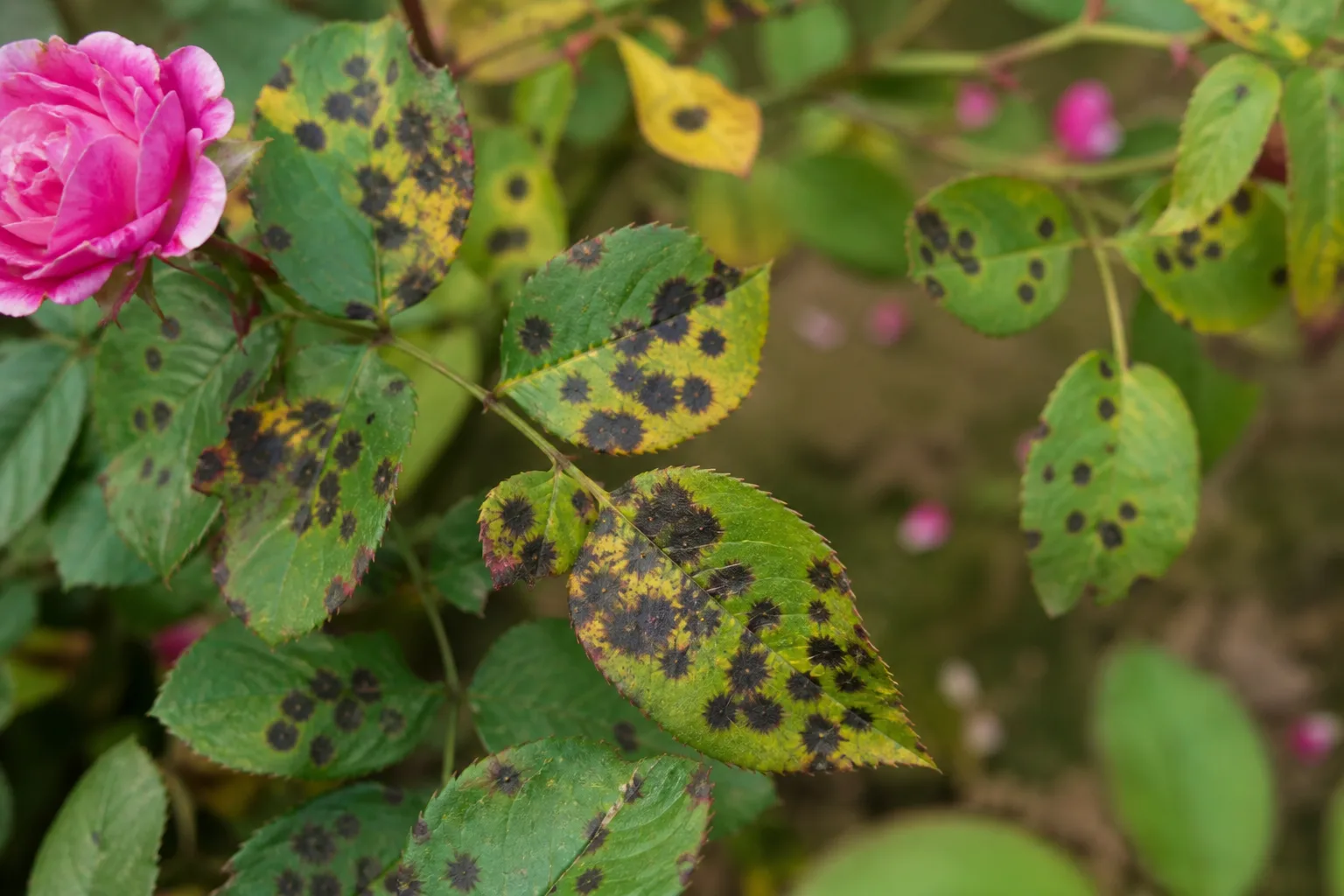
Start with the measures you can control: water at soil level, avoid crowding, remove badly affected leaves and fallen debris, and keep the plant vigorous without overfeeding. Powdery mildew looks more like a white surface coating; rust may show orange pustules, often underneath leaves. If the symptom pattern is unclear or the plant declines despite correcting care, take clear photos to your local extension office or diagnostic clinic before treating.
Fungicides are not a way to erase existing black marks. They may protect new growth when disease pressure is high, but products differ by region and label, and repeated spraying has environmental and resistance trade-offs. Do not make a homemade pesticide from dish soap or mix products by guesswork. Use only a product legally labeled for roses and the problem in your location, and follow its directions exactly. For many home gardens, cultivar selection, dry foliage, and cleanup are the better first investments.
Troubleshoot Weak Growth, Yellow Leaves, and Few Flowers
When a rose looks unhealthy, check conditions in a useful order instead of changing several things at once. Start with the soil, then light, then foliage and canes. A plant that is wilting in dry soil needs water; one wilting in wet soil may have damaged roots or poor drainage, and more water can worsen the problem.
| Symptom | Check first | Practical next step |
|---|---|---|
| Few flowers, healthy leaves | Direct sun, cultivar bloom cycle, recent pruning | Improve light if practical; confirm whether it blooms once or repeats |
| Yellow lower leaves | Soil moisture, drainage, leaf spots, natural older-leaf loss | Correct wet or dry conditions; inspect for black-spot lesions before feeding |
| Black spots with yellow halos | Lower leaves, prolonged wetness, nearby fallen foliage | Remove affected debris, water at the base, and open crowded growth |
| Long, weak shoots | Shade, excess nitrogen, overcrowding | Measure sun; reduce unnecessary feeding and improve spacing |
| Brown or dead cane tips | Winter injury, recent pruning damage, cane dieback | Cut back to healthy tissue and watch whether discoloration continues |
| Buds form but fail to open | Weather, thrips or other pests, cultivar response | Inspect buds closely and seek local diagnosis if damage is widespread |
Change one factor and watch the new growth. Old yellow leaves or black lesions do not turn green again after conditions improve; judge recovery by the next leaves and shoots. If symptoms spread quickly, the canes die back repeatedly, or the grafted top declines while rootstock shoots appear, photograph the plant and ask a local extension diagnostic service rather than assuming the issue is fertilizer deficiency.
Prepare Roses for Winter in Your Climate
Winter care depends on hardiness, the rose’s graft status, exposure, and how cold your garden becomes. A hardy shrub rose selected for a cold region may need little more than steady moisture before the ground freezes and a clean bed. A tender hybrid tea or a grafted rose exposed to repeated freeze-thaw cycles may need additional protection around the crown. Use the cultivar’s hardiness information and local extension advice rather than a one-size “wrap every rose” rule.
In fall, avoid major shaping cuts that stimulate tender growth or remove canes needed for winter protection. Remove dead, diseased, or broken material, and secure tall canes that whip in wind. After the ground begins to freeze, apply mulch or soil mounding if recommended locally; keeping mulch away from the stems during warm weather reduces the chance of holding excess moisture against the crown. In severe climates, specialized methods such as laying a tender rose into a trench are options only when the cultivar and local conditions warrant them.
Do not let roses dry completely during a prolonged winter drought, especially in exposed, windy locations. But do not water frozen ground or keep a dormant plant saturated. In spring, remove winter protection gradually once the risk of severe cold has passed, then assess canes for live tissue before pruning. A cane that looks dark after winter is not necessarily dead all the way to its base; make test cuts progressively until the pith is healthy.
Propagate a Rose From a Cutting
If you want another plant from a rose you already grow, take a healthy stem cutting and root it in an airy, clean medium. Roses vary in how readily they root, so start with several cuttings rather than expecting every one to succeed. Remove the flower and lower leaves, keep at least one or two nodes in the medium, and maintain even moisture and high humidity without leaving the mix waterlogged. Bright indirect light is safer than hot direct sun while roots are forming.
A cutting from a grafted rose grows on its own roots, so it will not carry the original rootstock’s traits. That may be fine for a home garden, but it can change vigor or winter performance. Some named cultivars may also be protected by plant patents or other propagation rights; check the label and local rules before propagating for sale. For a full method, including seasonal cutting types and aftercare, see our rose-cutting propagation guide.
Conclusion
The most reliable rose-care plan starts with the cultivar and the conditions you can provide. Choose a rose that fits its mature space, plant it at the right depth for its graft and climate, and keep the root zone evenly moist without leaving it saturated. Sun, airflow, and clean soil around the bush prevent many recurring problems before they become a spray schedule.
Prune by flowering habit: repeat-blooming bushes, once-flowering roses, climbers, and ramblers do not all respond to the same cut. Feed only when the plant and soil need it, deadhead when another flush is the goal, and preserve hips when you want fruit. When a rose struggles, read the soil and new growth before making multiple changes; that sequence helps you correct the cause instead of adding a new one.



