How to Grow and Care for Forest Pansy Redbud Trees
Grow Forest Pansy redbud with the right light, drainage, planting depth, watering, and pruning. See which leaf-color changes are normal and when to act.
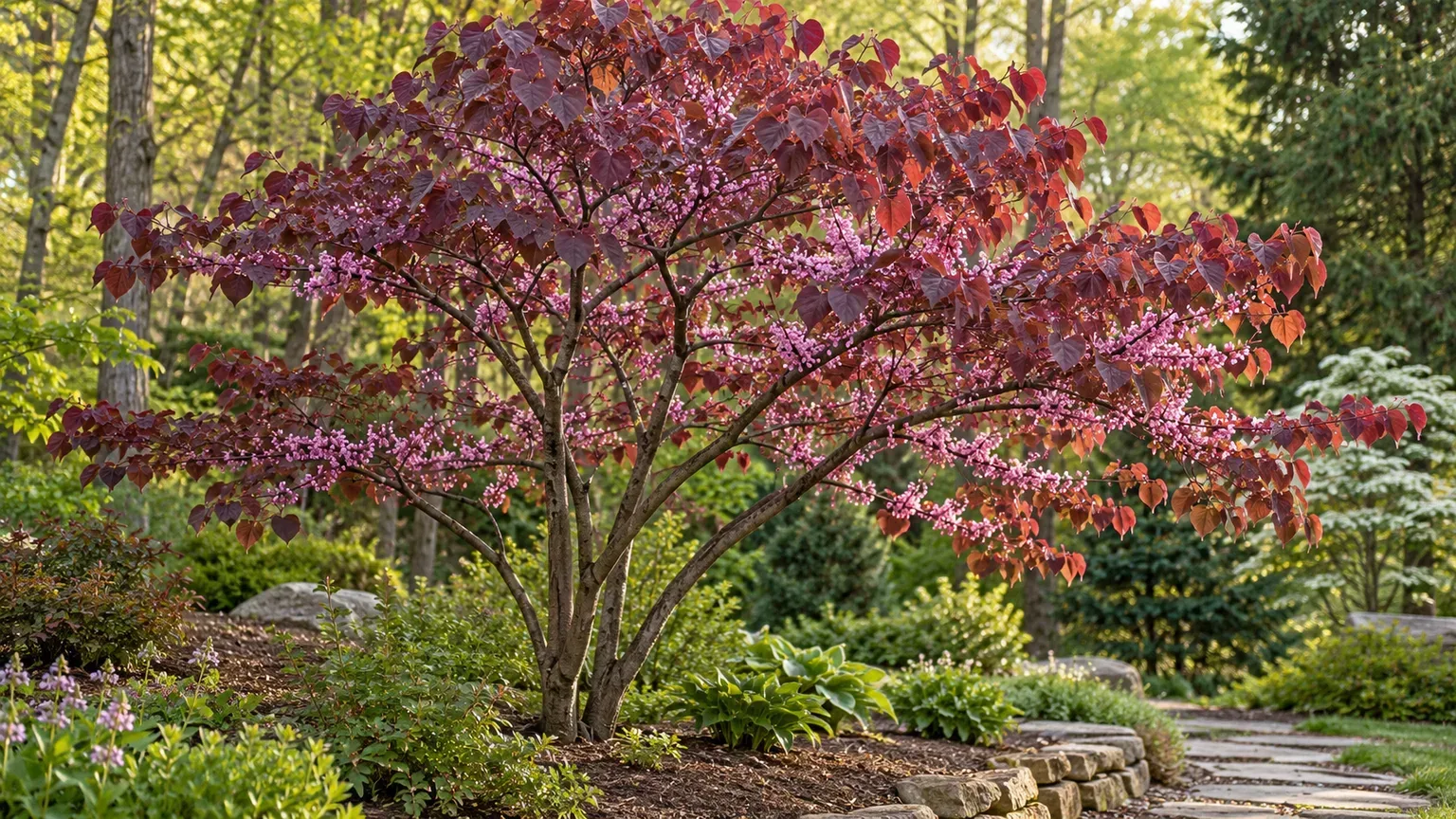
Forest Pansy redbud (Cercis canadensis ‘Forest Pansy’) earns its place as a specimen tree with two distinct displays: rosy-purple flowers on bare branches in early spring, followed by glossy, heart-shaped leaves that emerge red-purple. The foliage usually shifts toward maroon, purple-green, or dark green as summer advances, then may turn red-orange in fall. That seasonal change is normal; a site that suits the tree matters more than trying to preserve one exact leaf color.
The most important care decision happens before planting. Give this cultivar room for a broad canopy, soil that drains after rain, and enough sun for flowering without punishing it with reflected afternoon heat in a hot-summer climate. Once established, it needs little routine feeding, but it does not like root disturbance, prolonged drought, or a persistently soggy planting spot.
Forest Pansy redbud at a glance
Forest Pansy is a deciduous cultivar of the eastern redbud, a small flowering tree in the legume family. It is selected for its colored foliage and darker spring flowers, not because it stays purple from spring to leaf drop. NC State Extension describes it as a purple-leaved form with red-orange fall color, early spring flowers, and a preference for regular moisture and good drainage (NC State Extension).
| Feature | What to plan for |
|---|---|
| Botanical name | Cercis canadensis ‘Forest Pansy’ |
| Mature size | About 20–30 feet tall and 25–35 feet wide |
| Habit | Rounded to vase-shaped; often multi-stemmed |
| Flowers | Rosy purple to pink, appearing in early spring before most leaves |
| Foliage | Red-purple when young, usually darker or greener in summer, with fall color that can include red and orange |
| Light | Full sun to partial shade; afternoon shade can help in hot summers |
| Soil | Adaptable, including clay, if drainage is adequate and moisture is available |
| Hardiness | Commonly listed for Zones 5–9; reports differ at the coldest edge |
Size and color reports vary somewhat by reference and climate. NC State lists a mature spread of 25–35 feet, while Oregon State University’s profile describes a tree around 20 feet tall and 25 feet wide; use the larger range when laying out a permanent site (NC State Extension, Oregon State University Landscape Plants).
Why the foliage changes color through the year
The color sequence is one of the cultivar’s defining features, but “purple-leaf redbud” does not mean purple leaves all summer in every region. New leaves are typically glossy red-purple; older leaves deepen toward maroon, then can become purple-green or dark green during summer. In fall, red, orange, and green can appear together rather than forming a uniform scarlet canopy.
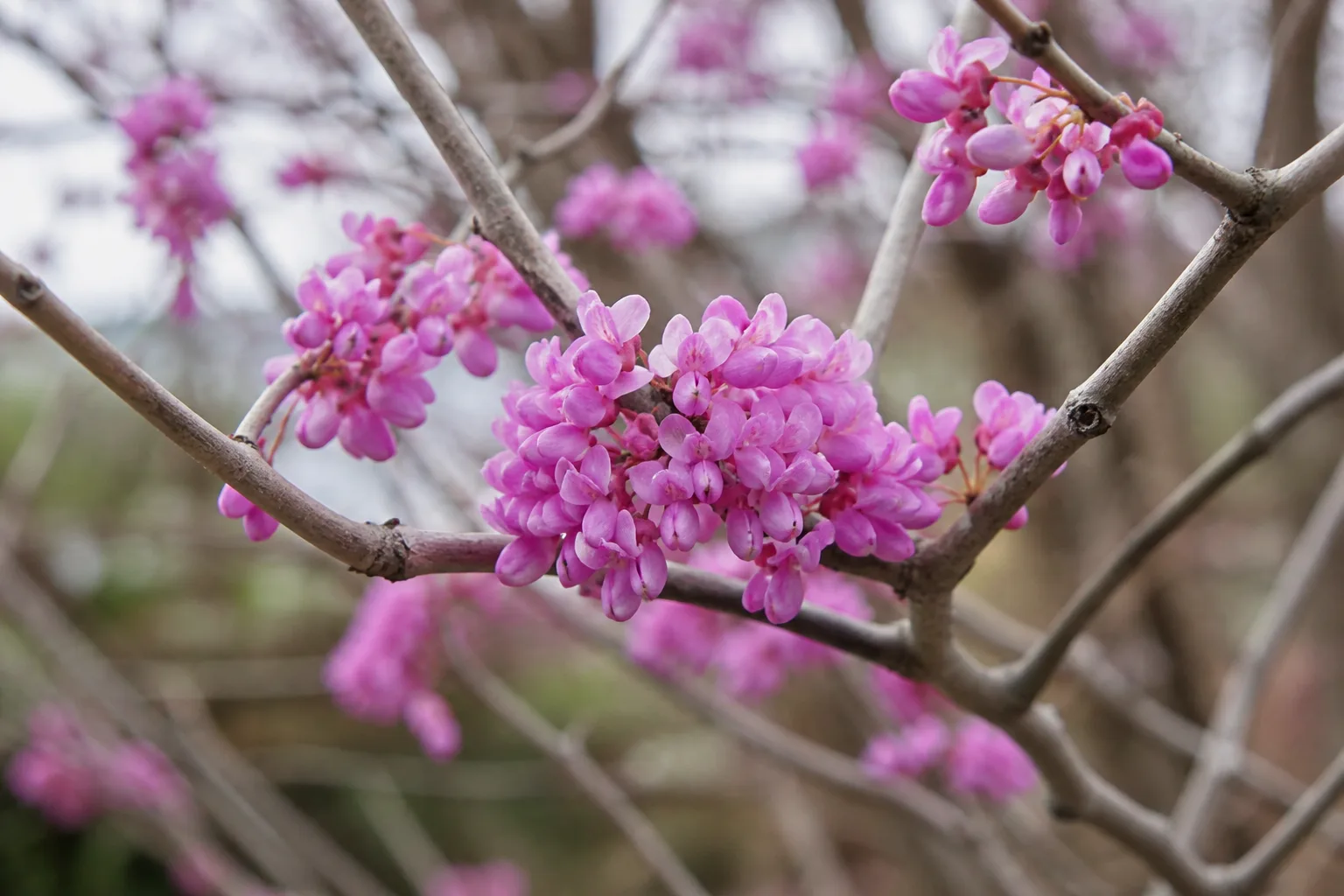
Local conditions affect how long the purple tone lasts. Oregon State notes that the color may persist later into summer in western Oregon, while warmer parts of the Southeast and southern Plains can lose the intense purple earlier. That is useful when you are comparing nursery photographs with your own garden: a greenish summer canopy alone does not mean the tree has reverted or is sick (Oregon State University Landscape Plants).
For the strongest contrast, give the tree enough light to develop good color and flowers, while protecting it from excessive heat and water stress. Avoid feeding it heavily to “bring back” purple leaves; fertilizer cannot override the cultivar’s seasonal response, and unnecessary nitrogen may encourage soft leafy growth rather than solve the cause of poor appearance.
Mature size and the space it needs
Treat Forest Pansy as a medium-sized ornamental tree, not a compact shrub that can be held in bounds with annual shearing. Its branches form a rounded or vase-shaped crown, often with several main stems, and the mature canopy may spread 25–35 feet. Measure from the trunk to the nearest wall, path, fence, or overhead obstruction before buying; a 12-foot-wide nursery tree can eventually need more than twice that space.
The cultivar works well as a lawn specimen, at an open woodland edge, or where its spring flowers can be viewed from a patio or window. It can also be planted near hardscape if the canopy has room, but a narrow strip beside a building is a poor fit if you expect to keep cutting away branches to preserve clearance. NC State lists 24–60 feet of available planting space for the cultivar, so let the expected width—not the pot size—guide placement (NC State Extension).
Redbuds can be multistemmed and their wood can be vulnerable to breakage, especially at weak branch junctions. Choose a relatively sheltered location away from strong prevailing winds and places where snow slides off a roof; avoid building the landscape around a canopy you will have to repeatedly top or force into a narrow outline. Wisconsin Extension also cautions that redbuds are short-lived compared with many large shade trees, particularly when stressed, so think of Forest Pansy as a long-lived garden feature rather than a permanent canopy tree (University of Wisconsin Extension).
Choose a site with the right light, soil, and shelter
Match the site to your summer climate rather than treating “full sun” as a universal rule. A spot with morning sun and some afternoon relief can preserve good spring bloom while reducing heat load on the leaves in hot regions. In cooler or mild-summer climates, more direct sun is usually easier to provide without stressing the tree.
Sunlight: balance spring bloom and summer heat
Forest Pansy grows in full sun or part shade. Full sun generally supports heavier flowering and a more compact crown, while partial shade is useful where afternoons are hot; in deep shade, expect fewer flowers and a canopy that reaches outward toward light. NC State Extension specifically recommends afternoon shade in hot-summer areas, and Gardening Know How gives the same practical distinction between sunny locations in mild climates and partial shade in hot ones (NC State Extension, Gardening Know How).
Watch the site through a summer day if you can. A west-facing wall, light-colored paving, or a narrow courtyard can create hotter conditions than the regional forecast suggests; if the ground dries rapidly and leaves brown at the edges each summer, morning sun with dappled or late-day shade may be a better compromise than an exposed western position.
Soil and drainage: keep roots moist, not waterlogged
The tree tolerates different soil textures, including clay, but it should not sit in waterlogged ground. After a heavy rain, check whether the future planting area drains or remains saturated for hours; if water routinely pools there, choose a higher spot rather than trying to fix a wet planting hole with a layer of gravel. A small pocket of rich soil cannot correct poor drainage around the full root zone.
Aim for soil that holds some moisture between rains but drains enough to keep roots supplied with air. Add compost across a broad planting area only if the native soil needs organic matter; do not create an isolated “pot” of soft amended soil in heavy clay. A wind-sheltered spot and a wide mulch ring help stabilize moisture without keeping the trunk wet. NC State and Gardening Know How both emphasize regular moisture with adequate drainage, not constant saturation (NC State Extension, Gardening Know How).
Plant it once, at the right depth
Choose the permanent location before planting because established redbuds do not tolerate being dug up and moved well. Spring or fall is usually the easiest planting window: the soil is workable and the tree has time to begin rooting before intense summer heat. Avoid planting into frozen ground, a heat wave, or a period when you cannot keep the root ball moist.
Dig a hole two to three times wider than the root ball, but no deeper than the root ball’s height. Find the root flare—the point where the trunk broadens into the first main roots—and set it level with or slightly above the surrounding soil; burying the flare can keep bark persistently wet and make establishment harder. Backfill with the soil you removed, water slowly to settle it, and check that the trunk has not sunk below grade.
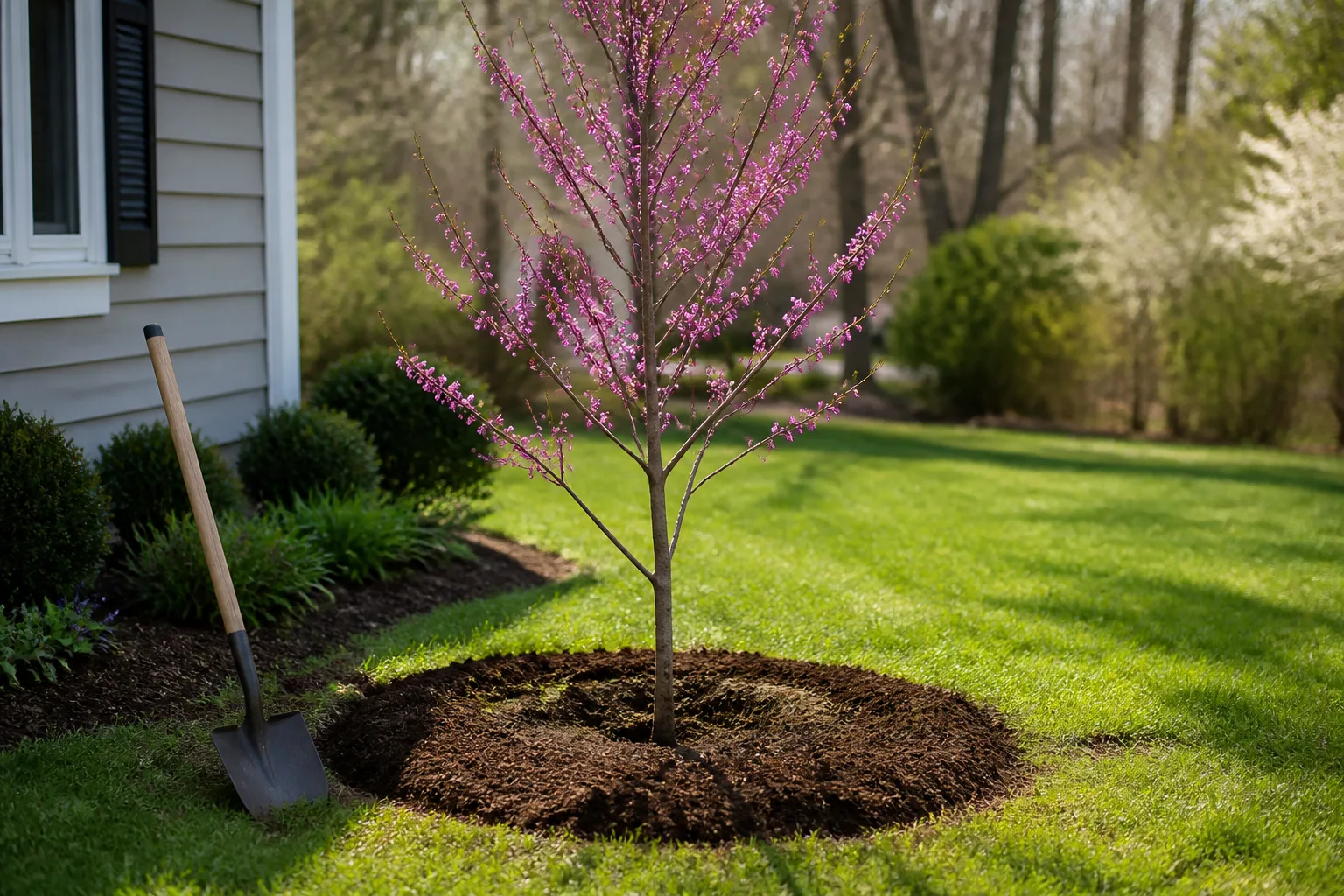
Spread mulch over a wide, shallow ring rather than piling it against the trunk. Keep several inches clear around the bark, and leave the root flare visible. If a container tree has circling roots, gently loosen or redirect them before planting; do not tear apart a compact root ball or aggressively disturb a bare-root tree. Once planted, avoid moving it again simply because it grows more slowly or blooms lightly in its first season; first check moisture, light, and root flare depth (Epic Gardening, University of Wisconsin Extension).
Watering by establishment stage
Forest Pansy redbud needs dependable moisture while it is establishing, but a fixed schedule can overwater clay and underwater sandy soil. Check the soil under the mulch at the root ball and just beyond it rather than judging from the dry surface. When the root zone is dry a few inches down, water slowly enough to soak the root ball and surrounding soil; if it remains moist, wait and check again.
Water the root ball closely while the tree establishes
During the first growing season, pay particular attention to the original nursery root ball because it can dry at a different rate from the surrounding soil. Slow, deep watering encourages roots to grow outward; a quick sprinkle over the lawn may wet only the surface and leave the roots dry. Adjust how often you water for rainfall, temperature, soil texture, and the size of the tree rather than applying the same number of gallons every week.
In hot, dry weather, check more often and water before leaves wilt or curl. A soaker hose or drip line placed over the root zone is practical, but move or extend it as the root system grows; watering only next to the trunk does not reach the expanding canopy area. Epic Gardening recommends watering at the soil surface and keeping the root area evenly moist, while Gardening Know How notes the tree can decline in wet soil (Epic Gardening, Gardening Know How).
Ease back as roots spread into the surrounding soil
After establishment, reduce supplemental watering when regular rainfall keeps the root zone moist, but do not treat drought tolerance as immunity to dry spells. During a prolonged hot period, give the tree a slow soak if the soil below the mulch is dry. Watering less often and more deeply is usually more useful than frequent shallow sprinkling, which encourages roots to stay near the surface.
Avoid repeated overhead irrigation late in the day. Keeping foliage wet for long periods can favor leaf diseases, and it does nothing to correct a thirsty root ball. If the tree wilts despite moist soil, stop adding water and inspect drainage, root flare depth, and signs of branch or root disease before assuming it needs more irrigation.
Mulch and fertilizer: what helps and what does not
A 2- to 3-inch layer of organic mulch over a broad root zone moderates soil temperature, slows evaporation, and reduces the chance of mower or string-trimmer injury. Extend the ring as the tree grows, but do not make a mulch volcano; piled mulch against bark holds moisture at the trunk and hides the root flare. Keep grass from competing directly with the young tree while its roots are spreading.
Do not fertilize by calendar just because the tree is growing slowly or has fewer flowers than expected. Start with a soil test if growth is poor, leaves are unusually pale, or a diagnosed deficiency is suspected; otherwise, compost or the natural nutrient cycle is usually enough. Extra nitrogen can push foliage at the expense of balanced growth and cannot keep the leaves purple after the cultivar naturally matures them. Avoid adding fertilizer to the planting hole unless a soil test and local guidance call for it.
Prune for structure instead of trying to control its size
Redbud’s naturally spreading crown is part of its appeal, but young trees benefit from selective structural pruning. First decide whether you want a multi-stem specimen or a single-trunk tree. Neither form is automatically better; the right choice depends on clearance, nearby paths, and the kind of silhouette you want in the yard.
Remove dead, damaged, crossing, or sharply crowded branches with clean, appropriately sized tools. Preserve branches with strong attachment angles and avoid leaving stubs; make cuts just outside the branch collar rather than flush with the trunk. Do not top the tree, strip out the interior, or remove large portions of live crown to make a too-small site work. If a limb is large, overhead, split, or close to a structure, ask a certified arborist to assess it rather than climbing or making a risky cut yourself.
Choose a natural multi-stem or trained single-trunk form
Many Forest Pansy trees naturally develop several trunks. Keep that form if there is room for it, and remove only competing leaders or narrow crotches that are likely to rub, split, or trap debris. If you prefer one trunk, select the strongest central leader while the tree is young and gradually remove lower or competing stems over several seasons; trying to convert a large multi-stem tree all at once creates large wounds and can ruin its shape.
Redbud limbs can be brittle, and Wisconsin Extension notes that splitting at branch crotches and wind or snow breakage are common structural concerns. Do not wait for a young branch to become too large to remove cleanly. A few small corrective cuts made while the tree is young are easier on the tree than repeated heavy thinning later (University of Wisconsin Extension).
Time cuts around spring flowering and tree health
If preserving the spring flower display matters, do most shape pruning soon after flowering. Redbuds bloom before leaf-out on branches and sometimes older wood, so pruning in late winter can remove some of the buds you are waiting to see. The exact timing varies with local bloom; wait until flowers have faded, then make only the cuts needed to improve structure or clearance.
Dead, broken, or clearly hazardous branches are a separate case and should not be left in place just to protect next spring’s flowers. Remove damaged wood promptly when it is safe to do so, and get a professional diagnosis if an expanding sunken area or progressive dieback suggests canker. Epic Gardening likewise recommends restrained pruning and warns that excessive cuts can diminish the display (Epic Gardening).
Seasonal care through the year
In late winter, inspect the framework while the leaves are off. Identify rubbing branches, weak forks, broken tips, and any dead wood you can safely reach; if you plan to shape the tree, remember that dormant cuts may remove flower buds. As spring flowers fade, make small structure cuts and replenish mulch if the ring has thinned.
During summer, keep an eye on soil moisture and leaf edges, especially in a hot or windy site. Purple foliage gradually darkening or becoming more green is expected, while crispy margins paired with very dry soil suggest heat or drought stress. In fall, allow the tree to drop its leaves naturally, remove diseased debris if leaf spots or canker were present, and continue watering young trees when dry weather persists until the soil cools.
Diagnose fading color, scorch, and weak flowering
Use the pattern and timing of symptoms before changing care. If the leaves gradually shift from red-purple to maroon, purple-green, or dark green as summer warms, that is normal cultivar behavior. Oregon State documents strong regional variation in how long the purple color lasts, so do not prune or fertilize a healthy tree simply because its June canopy looks greener than its April canopy (Oregon State University Landscape Plants).
If leaves develop crisp brown edges after a hot dry spell, check moisture several inches below the mulch and look for reflected heat from paving or walls. Water slowly if the root zone is dry, widen the mulch ring, and consider whether some afternoon shade would reduce the next year’s stress. If scorch appears while the soil is wet, more water is the wrong response; inspect for poor drainage and root stress instead.
Light flowering may follow deep shade, drought stress, or pruning that removed flower-bearing branches. Before blaming fertilizer or disease, check how many hours of direct light reach the canopy, whether the tree was pruned before bloom, and whether its root zone dried during the previous summer. If one section of the canopy declines while the rest remains healthy, inspect that branch for breakage or a sunken lesion rather than changing the whole tree’s routine.
Pests, canker, and branch decline
NC State Extension lists Japanese beetles, treehoppers, leafhoppers, caterpillars, borers, webworms, and scale among potential pests of Forest Pansy redbud. A few chewed leaves or insects do not automatically justify a spray; identify the pest and determine whether the damage is serious or spreading before taking action. Protect pollinators visiting the spring flowers, and follow local extension guidance and product labels if treatment is actually needed (NC State Extension).
Canker and dieback deserve more attention because branch decline can progress. Look for dead tips or a sunken lesion on a branch; Epic Gardening describes redbud canker as depressed areas on stems, trunks, or branches (Epic Gardening). Remove dead or broken branches back to an appropriate live junction when the cut is small and safe, but do not scrape at lesions or apply a general-purpose fungicide as a cure. Cankers can enter through damaged tissue, so prevent mower wounds, avoid unnecessary cuts, and have a certified arborist inspect trunk lesions or decline that continues after dead wood is removed.
Wet, poorly drained soil can also contribute to root stress and diseases such as Verticillium wilt. If leaves wilt while the ground is wet, several limbs decline at once, or dieback continues despite reasonable care, ask a local extension office or arborist to diagnose the tree before removing it or treating it. NC State Extension and Wisconsin Extension both identify canker, wilt, leaf spots, and dieback among redbud concerns, while also emphasizing proper siting and maintenance (NC State Extension, University of Wisconsin Extension).
Hardiness and regional caveats
Many horticultural references list Forest Pansy in USDA Zones 5–9, while Oregon State notes it as hardy to Zone 4 or 5 and Gardening Know How gives a narrower Zones 6–8 range. NC State lists Zones 5a–9b for its regional profile. Because references differ at the cold edge, a gardener in Zone 4 or a cold, exposed part of Zone 5 should buy from a nursery that can confirm local performance and choose a sheltered microclimate rather than relying on the broadest number (Oregon State University Landscape Plants, Gardening Know How, NC State Extension).
Hardiness zones describe average annual extreme winter minimums; they do not predict summer heat, humidity, rainfall, or reflected pavement heat. A tree can survive winter in a listed zone and still struggle in a hot, dry, poorly drained, or windy yard. If your climate is outside the eastern United States, compare local equivalents for winter cold and summer heat rather than treating a USDA label as a complete suitability guarantee.
Conclusion
Forest Pansy redbud is a strong choice when you want early spring flowers and changing foliage in a small-to-medium ornamental tree. Give it permanent space for a canopy roughly 25–35 feet wide, a well-drained site with dependable moisture, and light that balances flowering with summer heat; then mulch, water by soil condition, and prune selectively while the structure is young.
Expect the leaves to become greener as summer advances, and do not try to force a constant purple color with heavy fertilizer or pruning. The biggest preventable problems are choosing a wet or cramped location, letting a young root ball dry repeatedly, and allowing weak branch structure or trunk injuries to go unchecked. Get those choices right at planting and the tree’s seasonal changes become part of its appeal rather than a care mystery.