10 Beech Tree Varieties: Which One Fits Your Yard?
Compare 10 beech tree species and European cultivars by native range, foliage, landscape fit, size, and rarity before choosing one for your landscape.
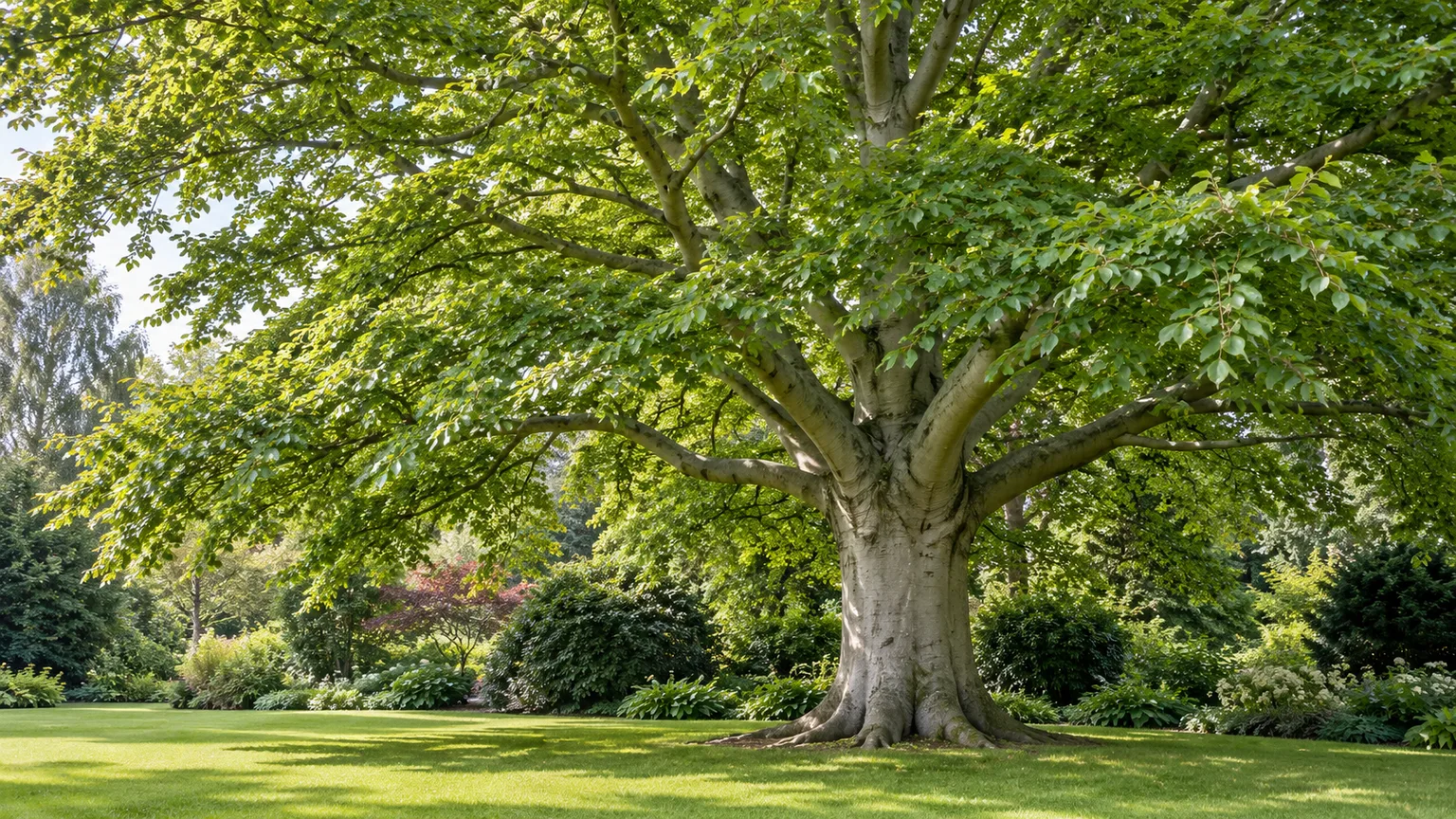
Beech trees are known for smooth gray bark, a broad crown, and leaves that can turn bronze or gold in fall. But “10 varieties” is not quite the same as “10 species”: this list includes eight botanical species and two named cultivars of European beech. That distinction matters when you compare a locally native shade tree with a purple-leaved ornamental or a species that is mostly grown in arboreta.
The genus Fagus contains beeches native across temperate parts of the Northern Hemisphere, extending into Mexico. Within that range, species are adapted to different climates and landscapes; several Asian and Mexican beeches are uncommon in ordinary garden centers. The comparison below starts with identity and native range, then translates those differences into a practical choice: which tree might fit your yard, and which one is better treated as a specialist specimen. Plants of the World Online at Kew recognizes the genus and tracks accepted species names and distributions.
First, what does “variety” mean?
In everyday nursery language, “variety” can mean any recognizable kind of plant. Botanically, though, a species is a distinct taxon, while a cultivar is a selected plant form maintained for a trait such as purple leaves, weeping branches, or a columnar crown. This article uses “variety” in the familiar broad sense but labels each tree accurately so a buyer does not mistake a cultivar for a separate wild species.
American beech, Japanese beech, and Oriental beech are species in the genus Fagus. Copper beech and tricolor beech are forms of European beech, Fagus sylvatica. Copper beech may be treated as a purple-leaved form or sold under a cultivar name such as ‘Purpurea’; the precise label can vary among nurseries and taxonomic references. Tricolor beech is also sold under names including ‘Purpurea Tricolor’ and ‘Roseomarginata.’ Its leaf pattern is a horticultural selection, not evidence that it belongs to a separate species; Trees and Shrubs Online’s European beech profile documents the range of cultivated foliage forms and naming history.
A second source of confusion is the common name. “Japanese beech” usually refers to F. crenata, while “Japanese blue beech” refers to F. japonica. Both are native to Japan, but they are different species with distinct botanical names. If the label omits the Latin name, ask the seller to confirm it before you buy.
Compare 10 beech trees at a glance
| Beech | Botanical identity | Native range | What stands out | Landscape reality |
|---|---|---|---|---|
| American beech | Fagus grandifolia | Eastern Canada and the central/eastern United States | Broad green leaves, smooth gray trunk, native wildlife value | Large shade tree; best considered in its native region |
| Mexican beech | Fagus mexicana | Northeastern to central Mexico | A Mexican highland relative of American beech | Uncommon specialist tree, not a routine landscape purchase |
| European beech | Fagus sylvatica | Europe | Dense crown, classic bronze fall color, many cultivars | Widely cultivated where climate and space suit it |
| Copper beech | F. sylvatica ‘Purpurea’ or related purple form | Cultivated form of European beech | Purple to copper foliage | A large ornamental; color and mature form depend on selection and site |
| Tricolor beech | F. sylvatica ‘Purpurea Tricolor’ / ‘Roseomarginata’ | Cultivated form of European beech | Pink, cream, and green leaf margins | More of a specimen accent; protect variegated leaves from harsh exposure |
| Japanese beech | Fagus crenata | Japan | Native forest beech with green leaves and yellow fall color | Uncommon outside specialist collections and suitable cool climates |
| Japanese blue beech | Fagus japonica | Japan | A separate Japanese species; often develops multiple stems | Specialty tree, not a blue-foliage cultivar |
| Chinese or Engler’s beech | Fagus engleriana | Central and southeastern China | Chinese woodland species | Limited availability in many regions; verify identity and local fit |
| Oriental beech | Fagus orientalis | Southeastern Europe to northern/central Türkiye | Western Eurasian beech with a broad native range | Large species, more often a collection tree beyond its native region |
| Taiwan beech | Fagus hayatae | Northern Taiwan | Distinctive montane beech with a highly restricted wild range | Botanical interest rather than an everyday garden recommendation |
Kew’s species profile for American beech, European beech, and profiles for the Japanese, Japanese blue, Chinese, Oriental, Mexican, and Taiwan beeches confirm the species identities and native ranges used here. A range tells you where a tree evolved; it does not by itself guarantee that the tree will thrive in a garden with a different summer climate, soil, or growing season.
North American beeches
These two beeches are related, but their natural settings are far apart. American beech is a familiar eastern North American forest tree, while Mexican beech belongs to mountain forests much farther south; shared ancestry does not make them interchangeable landscape plants.
American beech (Fagus grandifolia)
American beech is the beech most likely to be a meaningful native choice for a yard in the eastern half of North America. It develops a broad, dense canopy and pale gray bark that often stays strikingly smooth, especially on younger trunks. Its leaves are oval with toothed edges and prominent parallel veins, and they shift from green to golden bronze in fall. The NC State Extension profile lists American beech as a large tree, commonly reaching about 60 to 80 feet tall with a wide crown; that scale rules it out for many small residential lots.
The tree’s strongest case is a spacious site where a native canopy can provide shade and seasonal beechnuts for wildlife. It is not a good choice merely because it is native if the planting spot is compacted, chronically dry, waterlogged, or crowded by pavement and structures. Local forests and extension recommendations can help you decide whether the species is appropriate in your county, especially where beech leaf disease has been reported. The canopy also casts deep shade, and the shallow spreading roots make a lawn or elaborate planting bed beneath a mature tree difficult to maintain.
Mexican beech (Fagus mexicana)
Mexican beech is native to a limited region of Mexico, from Tamaulipas toward Hidalgo and Puebla, according to Kew’s accepted species record. Its natural habitat is not the same as the colder temperate forest setting associated with American beech. Some references classify it as Fagus grandifolia subsp. mexicana, while Kew currently accepts F. mexicana as a species; that is why you may see different scientific names in older or regional material.
For a typical North American home landscape, this is a name to recognize rather than a tree to assume you can readily buy. It is a regionally specialized species, and a generic hardiness-zone number cannot capture its mountain-forest climate or conservation context. If a nursery offers it, ask for the botanical source, propagation method, mature dimensions, and provenance, then check with a local botanical garden or extension service before planting. Do not collect wild material or treat this rare tree as a substitute for a locally appropriate shade species.
European beech and its garden cultivars
Most of the ornamental forms in this list descend from European beech. They share the same broad questions—space, drainage, and climate—but their foliage color, crown shape, and ability to fit a particular design differ. For reliable identification, use the cultivar name on the tag rather than buying from a vague label such as “purple beech.” For planting and hedge care after you have settled on this species, see our European beech growing guide.
European beech (Fagus sylvatica)
European beech is the classic landscape species behind copper and tricolor forms. It has a dense, rounded crown, smooth gray bark, oval leaves with wavy margins, and small bristly fruiting capsules. The RHS profile describes a large, vigorous tree that can reach around 30 meters, with a broad crown; it should be treated as a long-term structural tree rather than a quick screen that stays small.
The species is native to Europe and widely cultivated in suitable regions. It can also be clipped into a hedge, which is a different commitment from planting a specimen: a hedge requires regular shaping and a sufficiently wide strip of soil. Gardeners’ World notes that beech hedges often retain dry leaves into winter and that the tree tolerates clipping, but also cautions against hot, dry sites and waterlogged ground in its growing guide. In the United States, do not assume European beech will tolerate every climate where it survives winter; heat, drought, humidity, and drainage all affect performance.
Copper beech (Fagus sylvatica ‘Purpurea’)
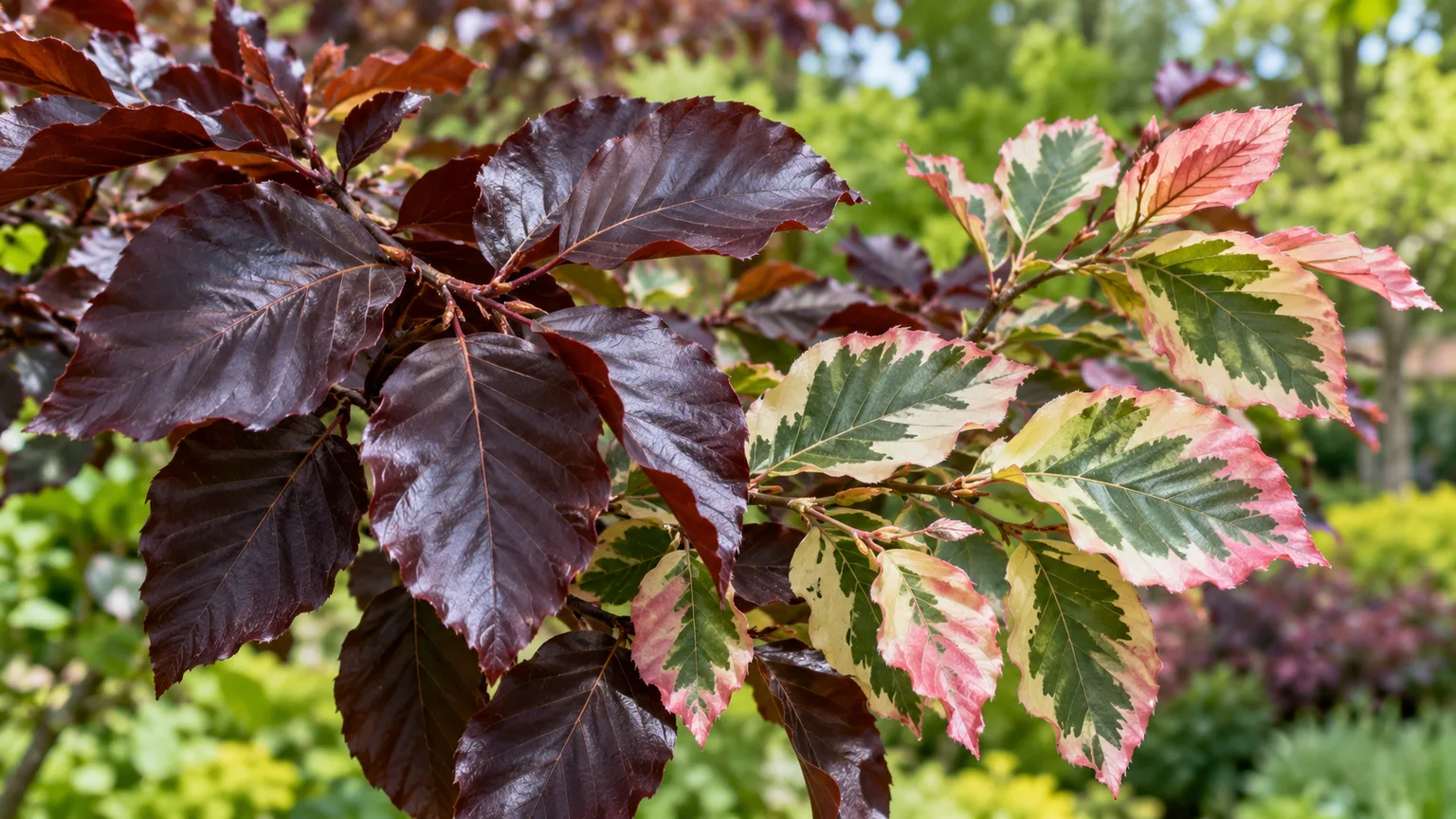
Copper beech is a purple- or bronze-leaved form of European beech, often sold as ‘Purpurea’ or with a related named selection. Its spring growth can look wine-red or purple, then darken toward coppery bronze; fall color often shifts further into warm red-brown tones. The exact intensity changes with light, season, and cultivar, so a nursery photo taken in spring may not represent the tree’s foliage all year.
This is still a large beech, not a compact purple shrub. It works best where the mature crown has room and the site suits European beech; a colored leaf does not remove the species’ need for dependable drainage and adequate soil moisture. Purple forms generally need enough light for their color to show well, but avoid interpreting that as a license to plant a stressed tree in hot reflected afternoon sun. Ask the seller for the exact selection, expected mature spread, and whether it is suitable for your region.
Tricolor beech (Fagus sylvatica ‘Purpurea Tricolor’)
Tricolor beech is one of the most distinctive foliage forms: leaves combine green centers with cream or pink margins, and the new growth can carry stronger pink tones. The cultivar is also sold under names such as ‘Roseomarginata,’ so compare the botanical label and expected color pattern before purchase. It is often slower and more delicate in appearance than a standard green beech, but it is not automatically a dwarf tree; mature size depends on the specific selection and conditions.
Because variegated leaf tissue has less chlorophyll, exposed margins may be more vulnerable to scorch in intense heat and sun; treat this as a site-planning precaution and follow local cultivar guidance. Choose a site with gentle morning light or dappled shade in a hot-summer climate, while avoiding deep shade if you want the color to remain visible. Do not respond to scorched leaf edges by immediately increasing water or fertilizer: first check soil moisture, drainage, and recent heat. Tricolor beech is best treated as a focal specimen with a named, verifiable cultivar rather than a mass planting chosen from a generic “variegated beech” label.
Asian beech species
Beeches in Japan and China can be fascinating choices for arboreta and specialist gardens, but most are not as readily available as European beech cultivars. Their common names also overlap, so compare the Latin names and native ranges instead of relying on a tag that says only “Japanese” or “blue.”
Japanese beech (Fagus crenata)
Japanese beech, sometimes called Siebold’s beech, is a species native to Japan, not a purple-leaved form of European beech. Kew recognizes F. crenata as an accepted species native to Japan. In a suitable landscape it develops a broad deciduous crown and green foliage that changes to yellow or bronze in autumn; its natural role is in Japanese temperate forests, where local climate and elevation shape its growth.
This is a large forest tree, reaching about 30 meters in the botanical description compiled by Trees and Shrubs Online, but it is rare in cultivation outside specialist collections. Its leaves are often broader below the middle and turn yellowish-brown in autumn, although identification can overlap with related species. Before choosing one, confirm the actual species, local summer suitability, mature dimensions, and whether nursery stock has been propagated for horticulture.
Japanese blue beech (Fagus japonica)
Japanese blue beech is a separate Japanese species, not the same plant as Fagus crenata. Kew’s record for F. japonica places its native range in central and southern Japan. The common name can be misleading: it does not mean the tree carries blue leaves. Its foliage is green, often with a gray-green underside, and Trees and Shrubs Online describes it as usually multi-stemmed and rare in cultivation outside specialist collections.
Use it when you want a botanical specimen with a more naturally multi-stemmed outline and can find a correctly identified plant. Because the name is less familiar to general nurseries, verify the Latin label and ask whether the stock is a seedling or selected form. A multi-stem habit can suit a woodland edge, but it still requires a site sized for the mature tree rather than the young plant in its container.
Chinese or Engler’s beech (Fagus engleriana)
Chinese beech, also called Engler’s beech, is native to central and southeastern China, according to Kew’s accepted profile. Its foliage is green through the growing season, with yellow autumn color; descriptions often note a leaf blade that is more oval than sharply pointed. In its native habitat it is a forest tree, not a compact ornamental selected for a small yard.
The practical limitation is availability and regional fit. Trees and Shrubs Online describes a tree that can reach about 25 meters, is often multi-stemmed, and has pale green leaves with a gray-green underside; it also notes that this species remains underused in cultivation. You may find it through a specialist nursery or arboretum rather than a typical retail garden center. Treat it as a botanical or collector’s choice unless a reputable regional source can confirm that it is propagated, climate-suited, and appropriate for your landscape.
Oriental beech (Fagus orientalis)
Oriental beech is a western Eurasian species native from southeastern Bulgaria through parts of the Balkans and Türkiye. Kew currently recognizes F. orientalis as a species, while older horticultural and botanical references sometimes discuss it under F. sylvatica or as a closely related form. That taxonomic history explains why an older label may not match a current reference exactly; it does not mean the tree is a cultivar of European beech.
The two species can resemble one another, and their ranges approach or overlap in parts of southeastern Europe and western Asia. In those contact areas, hybridization and classification debates complicate simple visual identification. Trees and Shrubs Online cautions that many visual distinctions overlap; leaves, buds, nuts, and geographic origin should be considered together rather than relying on one broad leaf or common name. Outside its native region, Oriental beech is best treated as a large collection tree, with mature dimensions and climate suitability confirmed before planting.
Taiwan beech (Fagus hayatae)
Taiwan beech is native to northern Taiwan, where it grows in high-elevation forest. Kew’s species page lists northern Taiwan as its native range, and a peer-reviewed study of F. hayatae forests describes known stands in northeastern Taiwan’s mountains. Trees and Shrubs Online notes that taxonomic treatments differ over whether some mainland Chinese populations belong under this name, so range statements depend partly on how the species is circumscribed. Its restricted wild habitat and specialized sourcing make it a botanical interest, not a casual landscape purchase.
The species is rarely a standard nursery item, and a label alone does not establish that a plant was lawfully propagated or suited to your climate. If you encounter one for sale, ask for documentation of nursery propagation and provenance, consult a botanical institution, and avoid collecting plants, seeds, or cuttings from the wild. Its value in this list is that it shows how geographically specific beech diversity can be; it is not necessarily a practical recommendation for a garden far from its native habitat.
Choose a beech by space, color, and region
Start with your site rather than the prettiest leaf photo. If you have room for a large canopy and live within the native range of American beech, compare locally recommended native trees and current disease reports. If you want a familiar ornamental form and can support its mature footprint, European beech offers the broadest mix of green, copper, weeping, columnar, and variegated selections, but cultivar names and final dimensions still need verification.
For a smaller property, do not infer “small” from a columnar label, a slow-growth description, or a young specimen’s size. Narrow forms may remain tall, weeping forms can spread broadly, and a hedge uses less vertical space but demands more maintenance and root-zone width than people expect. Ask the nursery for the mature height and width of the specific named cultivar, not just the dimensions of the plant in the pot. Compare those figures with the available planting strip, utilities, paving, and nearby buildings.
Color is a secondary filter. Purple-leaved copper forms offer strong contrast but remain large trees; tricolor foliage is more delicate and can scorch in harsh exposure. A blue-beech common name does not indicate blue foliage. If the tree is intended to provide dependable shade or habitat, a well-suited green-leaved native species may be a better fit than a rare, high-maintenance color form.
Finally, be realistic about access. A tree can be botanically interesting yet difficult to source and hard to grow well outside its natural climate. Mexican, Chinese, Japanese, Oriental, and Taiwan beeches may require specialist knowledge or sourcing, while the European species and its familiar cultivars are more likely to be offered by mainstream tree nurseries in suitable regions.
Site and care limits to check before planting
Most beeches need a site with room for their eventual crown and roots, adequate moisture, and soil that drains rather than staying saturated. European beech grows in sun or partial shade and tolerates a range of soils when drainage is good, according to the RHS profile. Gardeners’ World likewise advises avoiding waterlogged ground and hot, dry locations; its guidance is useful for that species and should not be treated as a universal prescription for every beech native to a different climate.
A mature beech can be difficult to underplant because the dense canopy cuts light and shallow roots compete for water. That does not make the roots categorically “aggressive,” but it does mean patios, lawns, underground services, and foundation setbacks deserve thought before planting. Do not cut a large surface root to make room for edging, trench through a root zone, or pile soil against the trunk; get an arborist’s advice if a mature tree conflicts with construction or hardscape.
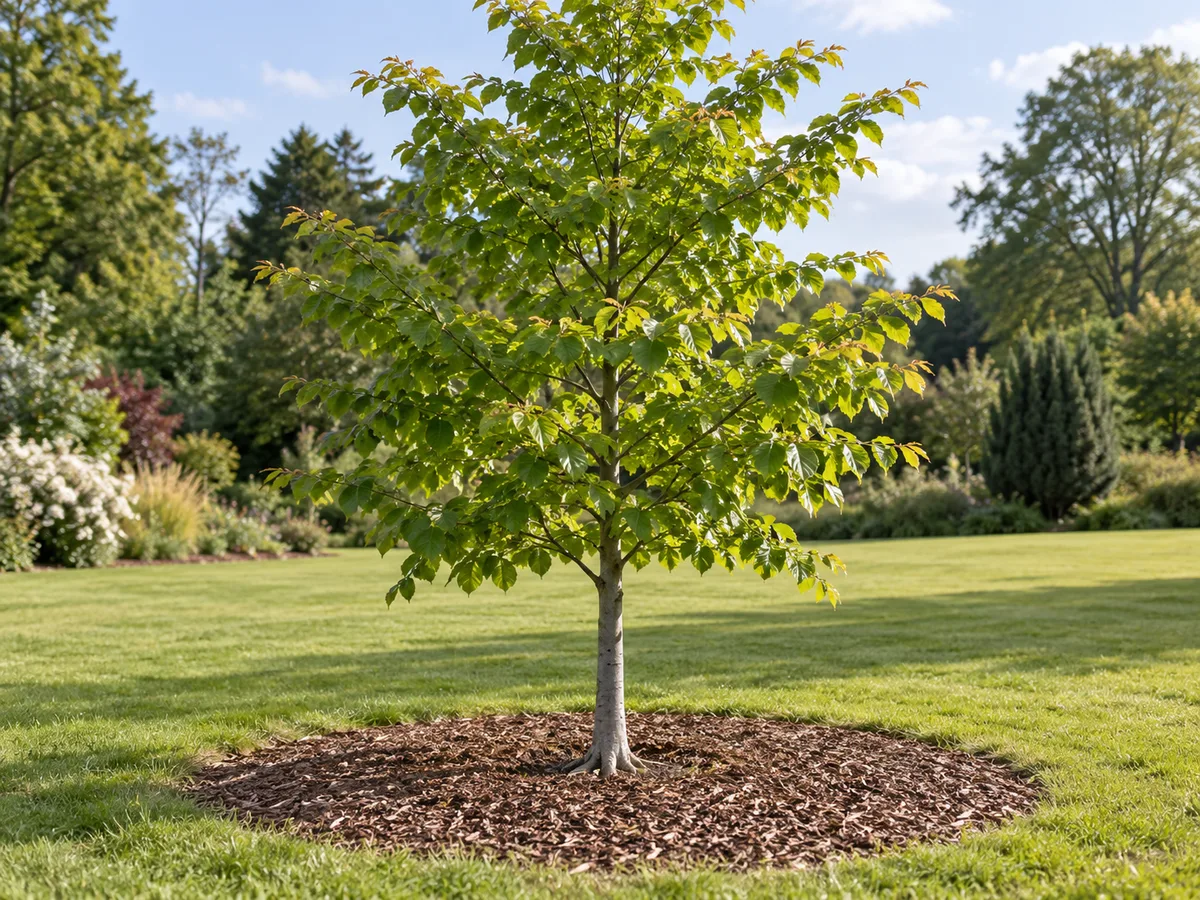
Newly planted trees need regular checks during establishment, especially through dry spells. Water the root ball and adjacent soil deeply when they begin to dry; frequent shallow watering can leave the deeper roots dry, while constantly saturated soil deprives roots of oxygen. Maintain a broad, shallow mulch layer over the rooting area, keeping it off the trunk, and avoid heavy fertilizing to compensate for a poor site. Correct drainage, space, and climate fit matter more than feeding a tree that is struggling in the wrong place.
Disease is another regional filter, not a reason to assume every beech will decline. Beech leaf disease has affected beech species in parts of North America, and state agencies update local monitoring information as the disease spreads; consult your extension service or forest-health office before you buy or diagnose symptoms. The Maine Forest Service overview illustrates why local reports matter. If an established beech develops banded or distorted leaves and progressive canopy thinning, photograph the symptoms and ask a local plant clinic or qualified arborist for identification before treating it.
Conclusion
The useful way to compare beech tree varieties is to separate species from cultivars, then match the tree to its region, mature footprint, and foliage preference. American beech is the obvious native candidate in much of eastern North America; European beech and its copper and tricolor forms provide the most familiar ornamental choices; the Japanese, Chinese, Oriental, Mexican, and Taiwan species are more specialized trees whose availability and climate fit deserve closer checking.
Before buying, read the full botanical name, ask for the selected form’s mature width and height, and confirm that your soil and climate suit that tree—not simply the genus. A beech is a long-term landscape decision, and a correct label plus a well-chosen site will matter more than an impressive nursery photo.