Does Diatomaceous Earth Kill Spiders? Safety and Limits
Find out whether diatomaceous earth works on spiders, which products are labeled for them, and how to avoid breathing dust or harming helpful insects.
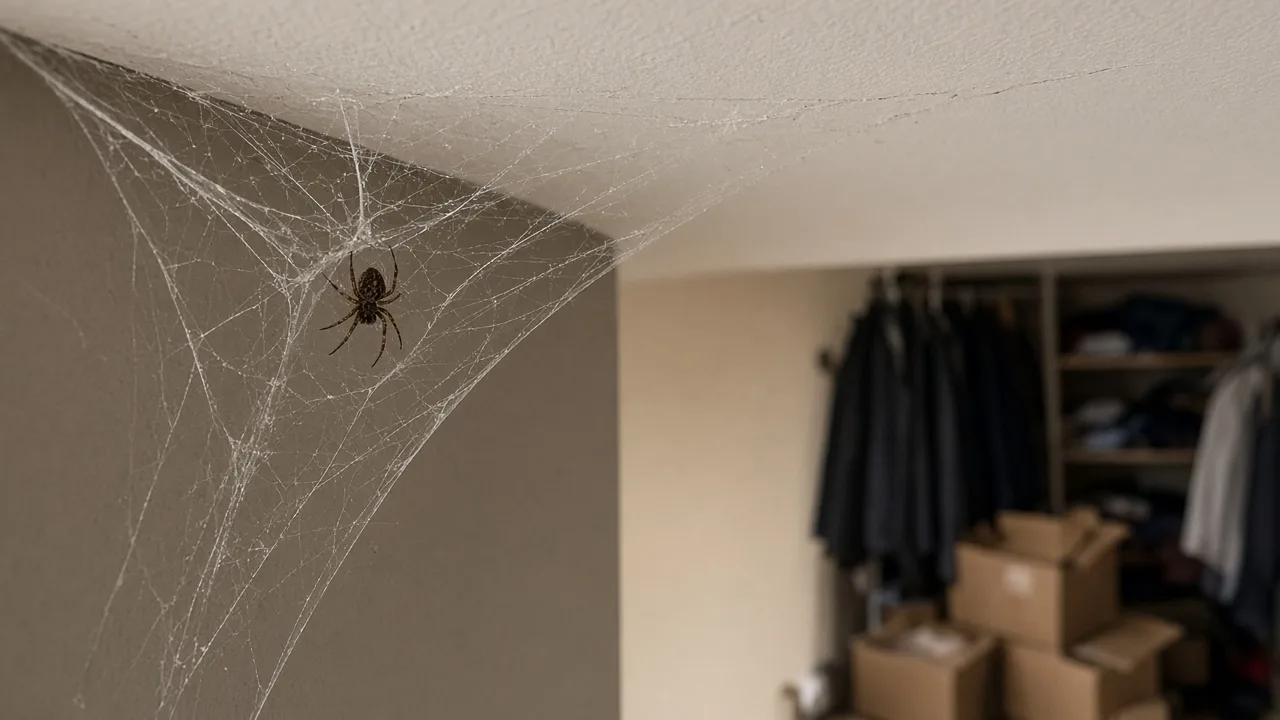
Diatomaceous earth (DE) can be part of spider control only when the exact pesticide product is labeled for spiders and the site you want to treat. It is not a dependable all-purpose spider repellent, and a bag marked “food grade” does not automatically qualify for pest control or make airborne dust harmless. The National Pesticide Information Center (NPIC) lists spiders among pests covered by some registered DE products, while also stressing that people should follow the directions on the product they actually have (NPIC’s diatomaceous earth fact sheet).
The practical answer is therefore narrower than “sprinkle it around the house.” First decide whether the spider needs to be removed at all. If it does, identify where it is living, remove webs or the individual spider, and close the entry route. Consider pesticide only when those steps do not fit the situation and the label authorizes the target and placement. That approach avoids unnecessary exposure and usually addresses the reason spiders keep appearing.
The accurate answer: sometimes, not reliably
Some products containing diatomaceous earth are registered for spider control, so the answer is not a universal no. But that does not mean any DE product will reliably kill any spider. A product has to be intended for the pest and treatment site, the spider has to contact it, and the conditions have to let the product work. A food, feed, or pool-filter product may have a very different purpose from a pesticide product.
There is also a difference between a material that can affect a pest under certain conditions and a useful home treatment. Spiders may stay in webs, retreat into small shelters, or travel along routes that never cross a powder deposit. A dust line does not lure them in, remove egg sacs, seal a gap, or reduce the insects they hunt. Even when contact occurs, the label—not an online rule such as “reapply every week”—sets where and how the product may be used.
If you have seen one spider, you may not need DE or another pesticide. UC IPM notes that most spiders are beneficial predators of insects and that pesticides are generally unnecessary for routine spider management; removal of webs and hiding places is often more useful (UC IPM’s spider guidance). A repeated problem, a medically significant species, or an inaccessible nest may call for a different plan.
How diatomaceous earth works—and what that says about spiders
Diatomaceous earth is a silica-rich powder made from fossilized diatoms. NPIC explains that DE pesticide products work on insects by absorbing oils and fats from the insect’s outer cuticle, with abrasive particles speeding up the drying process. It is a contact desiccant: a target has to encounter the material while it remains dry and undisturbed. That is different from a bait that attracts a pest or a residual spray that is intended for a particular surface.
The mechanism helps explain why claims about “sharp edges cutting bugs” are incomplete. Abrasion is part of the picture, but a visible pile is not necessarily more effective than a very thin deposit, and a wet or frequently disturbed area may not perform as expected. More importantly, the insect mechanism does not prove that every consumer DE powder controls spiders. UC IPM discusses certain sorptive dusts used for spiders, including silica-gel products, but that specific guidance should not be treated as approval for every DE formulation. Use the target and site listed on the product label rather than translating one dust’s evidence to another.
Spiders are arachnids, not insects
Spiders belong to the arachnids, a group that also includes mites and ticks; insects are a separate group. Their bodies, movement, and hunting behavior differ from the insects commonly used to explain DE. Some spiders build webs and wait for prey, while others roam or hunt on vegetation. Either way, a spider will not die from a powder it never touches.
That distinction matters because many popular DE explanations describe a generic crawling insect crossing a treated floor. A spider may be suspended in a web above the floor, tucked behind a shelf, or living outdoors in a sheltered corner. Even a product that lists spiders on its label cannot treat a pest that stays outside the treated route. If you do not know what species you have or whether the spider is a concern, a photo and a local extension identification service are safer starting points than applying powder broadly.
Choose a product that is actually labeled for spiders
The first check is not the front of a package; it is the full product label. Look for the active ingredient, the specific pests listed, allowed indoor or outdoor sites, application directions, required protective equipment, and first-aid instructions. If spiders are not included as a target, do not assume that a label for ants or beetles covers them. A product can contain DE and still be unsuitable for the job you have.
The label also answers questions a general article cannot answer for every formulation: whether use is allowed in a crack, a wall void, a garden, a pet area, or a food-handling space; how much product to apply; and when to keep people and animals away. NPIC says pesticide labels explain correct and legal use, hazards, personal protective equipment, and first aid. It also cautions users not to apply a pesticide in a way that is not listed on its label (NPIC’s guide to reading pesticide labels).
Food-grade, pest-labeled, and pool-filter products are different
“Food grade” describes a product intended to meet particular food or feed uses; it is not proof that the product is registered for spider control, effective against spiders, or safe to breathe. NPIC notes that food-grade products may be used for certain feed or beverage-processing purposes, while DE pesticide products have their own registered uses. Treat those as separate claims. If your bag has no pest-control label, do not improvise an indoor spider treatment with it.
Pool- or filter-grade DE is a different category again. It is made for filtration, not household pest control, and it should never be substituted for a labeled pesticide. Horticultural guidance from Epic Gardening and Gardening Know How also distinguishes pool-filter material from food-grade or pest-control DE and warns that inhaling fine powder can irritate the airways. For a spider problem, skip any filter media and choose a product only if its label names the pest and site.
Do not judge safety from words such as “natural,” “organic,” or “food grade.” A mineral dust can still irritate the nose, eyes, and skin, and products may differ in how they are processed or formulated. The useful question is whether this specific product is labeled for the use you have in mind and whether you can apply it without creating airborne dust or leaving it where people or animals will contact it.
Why a dry powder can still miss the target
DE loses its desiccant value when it gets wet; NPIC says it remains effective while it is dry and undisturbed. Rain, irrigation, damp basements, condensation, sweeping, or foot traffic can make a powder deposit ineffective or move it out of the place where you intended it to stay. The label determines whether and when reapplication is allowed. Do not automatically put down more after a week or after rain.
Dryness alone is not enough. The spider has to cross the treated area, and a thick white line may be avoided, blown into the air, or tracked through a room. A web-building spider might be catching prey above the floor rather than walking over a baseboard. A hunting spider may enter through a door one time and never return by the same route. DE is not a repellent that directs spiders away, and broad application can create exposure without changing those conditions.
Outdoor placement brings additional limits: wind can move fine powder, moisture can disrupt it, and dust on flowers or plant surfaces can contact insects other than the target. Epic Gardening’s gardening guidance discusses dry contact and notes the risk that DE can affect beneficial insects. If a product label does allow outdoor use, avoid spreading it across vegetation or flowering areas; use the narrowest label-approved site and consider whether exclusion or habitat changes solve the problem with less residue.
Is diatomaceous earth safe to use indoors?
Do not treat indoor DE as harmless just because it is sold for pest control or labeled food grade. The main avoidable concern during application is breathing suspended dust, but particles can also irritate eyes and dry or irritate skin. NPIC reports that inhaled DE can irritate the nose and nasal passages; a very large inhaled amount can cause coughing or shortness of breath. It also notes that DE can irritate eyes because of its abrasive nature (NPIC’s fact sheet).
For most homeowners, open-room dusting is a poor tradeoff for a spider that can be caught, vacuumed, or deterred from entering. Do not sprinkle DE across a bedroom floor, bedding, a mattress, carpet, a child’s play area, pet bedding, food-preparation surfaces, or near HVAC returns as a general spider remedy. If the label does not explicitly allow the site, do not use it there. If a label-authorized crack or crevice treatment would still be reachable, disturbed, or likely to become airborne, choose another control or consult a licensed pest professional.
Airborne dust is the main avoidable exposure
Dust is easiest to inhale while pouring, puffing, brushing, sweeping, or walking through a treated area. Avoid methods that make a cloud. Follow the label’s protective-equipment directions rather than assuming that a cloth face covering or any generic mask is sufficient. NPIC recommends keeping children and pets away during application and following label directions for protective clothing, equipment, ventilation, re-entry, and cleanup (NPIC’s exposure-minimization guidance).
If dust becomes airborne, leave the area and keep other people and animals away until it settles. Do not dry-sweep or use a cleanup method that kicks the powder back into the air. Check the product label for cleanup and disposal instructions; NPIC specifically advises cleaning visible excess according to the label. If anyone has breathing difficulty or a significant exposure, follow the first-aid directions and contact Poison Control in the United States at 1-800-222-1222 or NPIC at 1-800-858-7378 for pesticide-specific advice.
The type of silica matters too. Most DE is amorphous silica, but products can contain small amounts of crystalline silica. NPIC explains that long-term inhalation of crystalline silica is associated with more serious respiratory disease, while amorphous DE is associated with milder, reversible lung inflammation. That is a reason to prevent dust exposure, not a reason to panic after ordinary contact. Product details vary, so do not infer an individual bag’s composition from its color or from a “natural” claim.
Decide whether the spider needs control
Start with what you are seeing rather than treating every spider as a household infestation. One web in a garage corner is different from repeated spiders in a bed, a child’s room, or a location where someone might accidentally put a hand into a hidden space. UC IPM notes that most spiders are beneficial predators and that many species commonly found in homes are unlikely to bite people. Their recommendations put removal of webs and hiding places ahead of routine pesticide use.
If a spider looks potentially medically significant, do not handle it or reach into the web to apply powder. Spider identification is local: a name such as “brown recluse” is often applied to unrelated brown spiders, and distributions differ by region. Take a clear photo from a safe distance and ask a local extension office or qualified pest professional to identify it. If someone may have been bitten and has severe or unusual symptoms, seek medical advice rather than trying to identify the spider from the bite alone.
Read the location and pattern before treating
Make a quick map of sightings. Are spiders near a window, porch light, door gap, basement storage, or an exterior wall? Are the webs occupied and maintained, or dusty and old? Are you seeing one wandering spider, repeated webs in one place, or many small insects that may be attracting predators? These details point to different fixes and help you avoid putting a product where no spider travels.
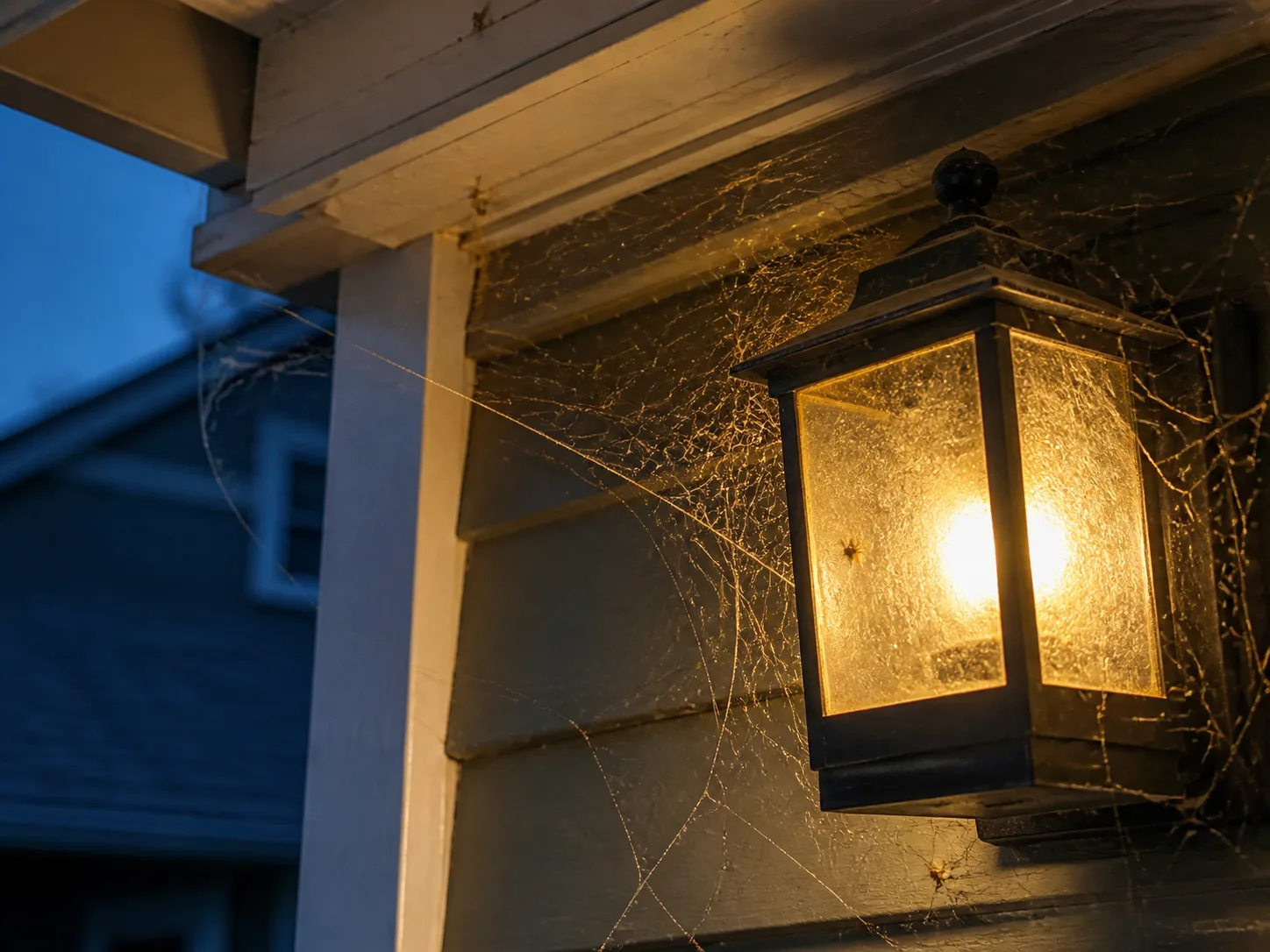
A cluster near a porch light may reflect insect prey gathering around the light. Spiders in a storage corner may be using boxes or clutter as shelter. A spider appearing at a door may be entering through a gap rather than living indoors. None of those patterns is fixed by dusting the whole baseboard. Address the specific condition—light, open screen, clutter, insects, or a gap—and then monitor whether sightings decline.
A lower-risk spider-control sequence
For a typical household sighting, use this order: identify the situation, remove the individual spider or web if needed, correct shelter or entry conditions, and monitor. Use pesticide only if a clear problem remains and a product label authorizes that exact pest and site. UC IPM recommends sealing openings, maintaining screens, reducing clutter, and regular sweeping or vacuuming as core spider-management steps.
This sequence also protects spiders that are outside doing useful work. Avoid treating shrubs, flowering plants, or broad foundation bands simply because a spider web is visible. Outdoor spiders are often part of the garden’s natural pest-predator community. If webs on a porch or window are the concern, regular physical removal and changes to nearby insect-attracting conditions are more targeted than a perimeter pesticide application.
For more nonchemical steps, see our guide to getting rid of spiders around the home.
Remove individual spiders and webs
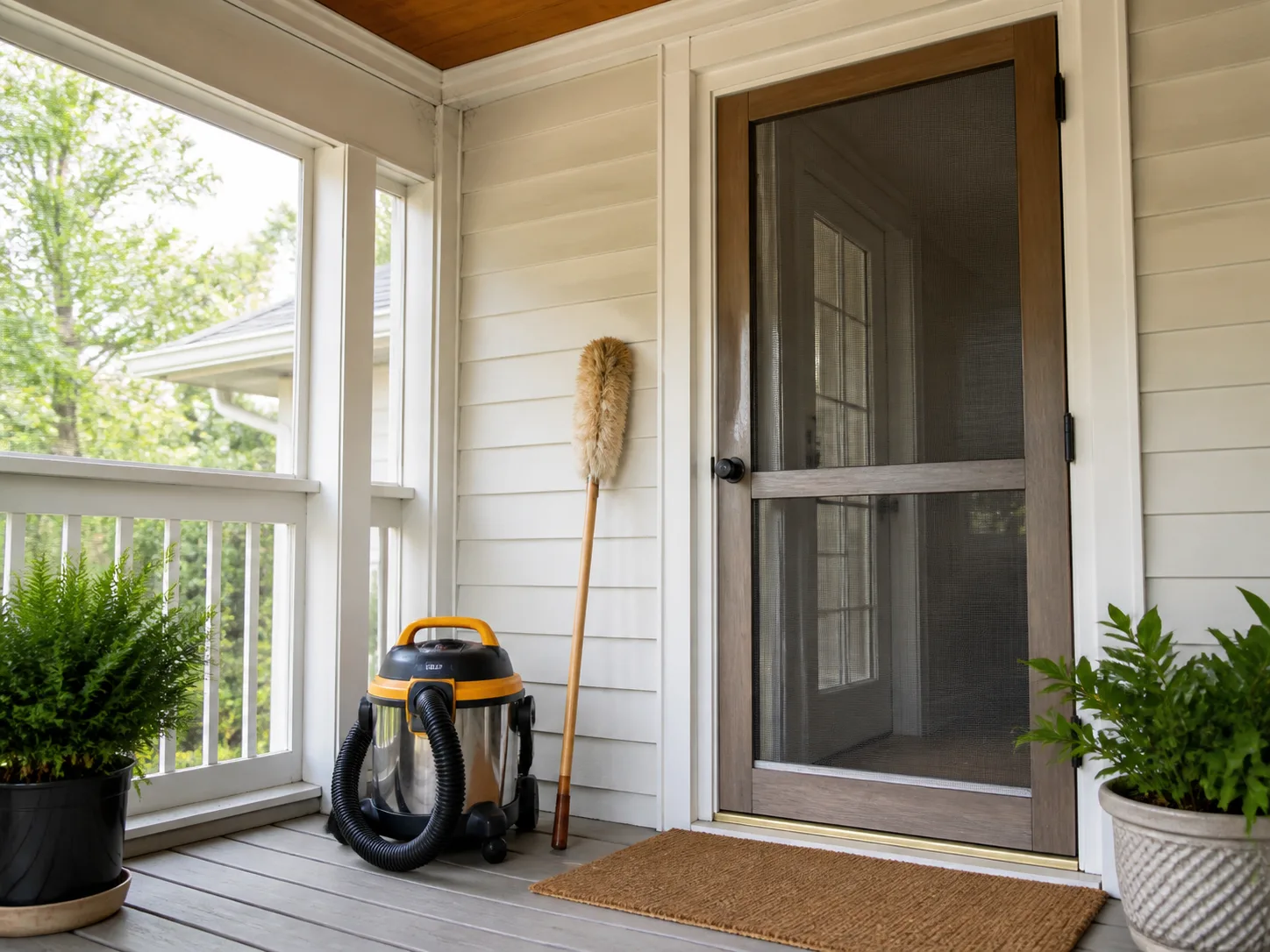
If the spider is not a safety concern, capture it with a clear container and stiff paper, then move it outside if that is appropriate for your region and setting. For a spider you want removed, vacuuming can remove the spider, web, and visible egg sac; empty or dispose of the vacuum contents safely according to the vacuum instructions. Do not handle a spider or egg sac directly if you cannot identify it or if you must reach into a dark, cluttered space.
Webs that repeatedly reappear in an unused corner tell you where to inspect, not necessarily where to spray. Remove the web with a broom, cloth, or vacuum attachment, then clean nearby storage and check for gaps or insect prey. An old, dusty web may not be occupied, so inspect before using a pesticide. UC IPM describes sweeping, mopping, and vacuuming as useful indoor measures and recommends routine web removal outside as well.
Seal entry points and reduce prey
Repair torn screens and add weatherstripping or a door sweep where daylight shows under a door. Seal small openings around pipes, window frames, and the foundation with materials suited to that surface. Move stored boxes off the floor and away from walls when practical, and reduce clutter in basements, garages, and sheds so there are fewer protected retreats. UC IPM specifically recommends sealing gaps and keeping screens in good repair.
If spiders cluster around exterior lights, consider a fixture or bulb that attracts fewer insects, move lighting away from doorways where feasible, or switch lights off when they are not needed. Trim dense vegetation away from the wall and keep leaf litter and stored materials from accumulating directly against the foundation. The goal is not to make a yard sterile; it is to make the threshold less attractive and keep access points closed.
If you are considering a labeled DE product
A labeled DE product may be one option when a spider problem persists, the label specifically includes spiders and the intended site, and you can prevent exposure. It is not the automatic next step after seeing a web. If a nonchemical method addresses the problem, use that first. If the spider is in a difficult location, or a medically significant species may be present, ask a qualified professional to inspect before disturbing the area.
Do not apply a homemade wet mixture unless the product label allows that form and method. A wet paste is not automatically equivalent to a registered spray or a dry dust; formulation, target pest, surface, and directions matter. Nor should you apply extra product to compensate for uncertain efficacy. More dust may create more exposure and may be less useful if the target walks around it.
Read the full label before buying and using
Before purchase, confirm that “spiders” or the applicable target group appears on the label and that the indoor or outdoor location is listed. Check the mixing or ready-to-use directions, placement, personal protective equipment, ventilation, re-entry, first aid, storage, and disposal. Keep the label attached to the container. In the United States, NPIC states that using a pesticide in a way not listed on its label is against the law, and its label guide explains how to check that a product is intended for the use you have.
Follow the label exactly, even if a blog, video, or product review recommends a different amount or wider application. Never use pool-filter material, unlabeled DE, or a product labeled for another site as a substitute. If the package is missing directions or the use is unclear, do not guess. Contact the manufacturer, NPIC, or a licensed applicator before proceeding.
Protect people, pets, and non-target insects
Before any authorized application, remove or cover food, toys, pet dishes, and bedding from the area if the label directs it; close doors to unaffected rooms and avoid air returns or drafts that can carry dust. Wear only the protective equipment specified on the label. Keep children, pets, and people with respiratory sensitivity away during application and for the label’s stated interval. Do not place loose dust where a child or animal can touch, track, lick, or breathe it.
Outdoor use needs the same care for non-target organisms. DE does not distinguish a pest spider from other arthropods that touch a deposit. Do not dust flowers or flowering plants, and do not broadcast powder through a garden to target a spider web. Check environmental restrictions on the label and keep dust from drifting into drains, ponds, or neighboring areas. When a narrow, label-approved placement is not possible, choose a different control.
Why DE may fail or seem not to work
The most common mismatch is assuming a spider will cross a product it does not encounter. A web-bound spider, one hiding in an unserved void, or a visitor entering through another gap may never contact the dust. Another mismatch is using a product whose label does not include spiders or applying it at a site not listed. In both cases, more powder does not solve the real problem.
Moisture and disturbance are another reason for poor performance. DE that has been wetted, swept away, covered, or tracked through a room may not remain as a dry deposit. A product may also have different directions for the material or site than general gardening articles describe. Re-read the label before reapplication; do not schedule weekly treatment unless that is what the label says.
Finally, a decrease in visible spiders does not prove that DE controlled them. Seasonal movement, prey availability, web removal, weather, and exclusion can all change what you see. Monitor the original location for a week or two after physical cleanup and sealing. If spiders return, look for a missed gap or shelter rather than extending a dust line across more surfaces.
When a pest professional is the better choice
Call a qualified pest professional if spiders keep appearing despite sealing and cleanup, if the likely species may pose a health concern, or if treatment would require working inside a wall void or another inaccessible area. A professional can identify the pest, determine whether pesticide is needed, and choose a labeled site-specific method while limiting dust exposure. Ask what product and target pest are on the label, where it will be applied, and how long people and pets should stay away.
Use extra caution around stored firewood, shoes, boxes, and rarely moved items where spiders may hide. Wear gloves when moving storage, inspect before putting on shoes or clothing left on the floor, and avoid reaching blindly into dark corners. For a possible bite with severe pain, spreading symptoms, or a concerning reaction, seek medical care; do not rely on pesticide or online spider identification to assess a health problem.
Conclusion
Diatomaceous earth can kill spiders in some circumstances, but only a product labeled for that pest and site is a reasonable pesticide choice—and even then, the spider must encounter the dry product. Food-grade status is not a spider-control claim, pool-filter DE is not a substitute, and airborne dust is not risk-free. A broad indoor sprinkle is not a safe shortcut.
Start with the spider’s location and whether removal is needed. Remove an individual spider or web, seal the gap, reduce clutter and insect prey, then monitor. If you still need a pesticide, read the entire label and use only the specific product and placement it authorizes; if identification or application is uncertain, ask a local extension service or pest professional.