How to Grow and Care for a Dawn Redwood
Learn how to site, plant, water, and prune a dawn redwood, plus what its seasonal needle drop, mature size, and occasional problems mean for your yard.
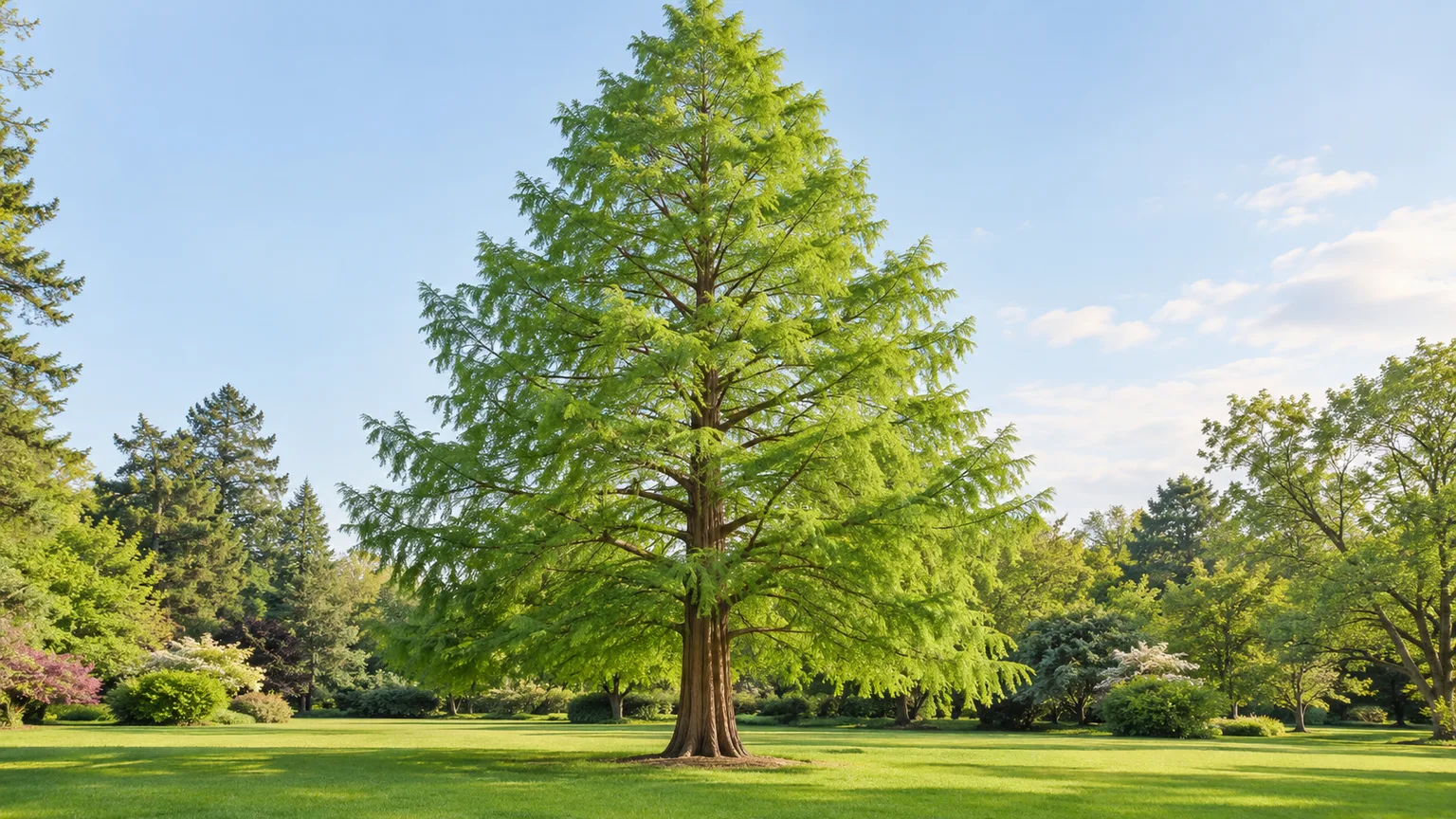
Dawn redwood (Metasequoia glyptostroboides) looks like an evergreen conifer for much of the year, but it drops its soft needles every fall. The bigger decision comes before you plant: this fast-growing tree can reach roughly 75 to 100 feet tall and 20 to 25 feet wide, so it belongs where a large canopy and an expanding root zone can stay for decades. If you have that space and can keep a young tree watered while it establishes, care is straightforward: give it full sun, soil that stays reasonably moist without remaining airless, and room to grow into its natural shape.
Dawn Redwood at a Glance
| Feature | What to expect |
|---|---|
| Botanical name | Metasequoia glyptostroboides |
| Type | Deciduous conifer in the cypress family (Cupressaceae) |
| Mature size | Commonly listed around 75–100 feet tall and 20–25 feet wide; site and age matter |
| Light | Full sun |
| Soil | Deep, moist, well-drained soil is a reliable target; tolerance varies by site |
| Seasonal look | Soft green foliage in spring and summer, coppery or tawny foliage in fall, bare branches in winter |
| Maintenance | Low once established; regular pruning is not needed |
Dawn redwood is a long-lived landscape tree, not a compact specimen that can be kept small with annual shearing. Virginia Cooperative Extension describes it as a fast-growing, large deciduous conifer, about 75 feet tall and 20 feet wide in its profile; North Carolina State Extension gives potential dimensions up to 100 by 25 feet. Treat those numbers as a realistic planning range, not a promise that your tree will stop at the smaller figure (Virginia Cooperative Extension; North Carolina Extension Plant Toolbox).
Identify the Tree and Its Redwood Relatives
The species name is Metasequoia glyptostroboides. It is native to central China and belongs to Cupressaceae, the cypress family. Dawn redwood was known to botanists through fossils before living trees were identified in China in the 1940s; that history explains the “living fossil” nickname, but it does not mean the tree is a relic that needs special care. The Arnold Arboretum documents the discovery and the subsequent sharing of seed among botanical collections (Arnold Arboretum of Harvard University).
Look for soft, narrow leaflets arranged in opposite pairs along flattened, feathery branchlets. The foliage is green during the growing season, then changes to bronze, brown, or copper before it falls. A bare dawn redwood in winter is not dying simply because it has no needles; annual leaf drop is part of its normal cycle. Its reddish-brown bark becomes more fissured with age, and its trunk base can develop a fluted, broad appearance.
The name can cause confusion with coast redwood (Sequoia sempervirens) and giant sequoia (Sequoiadendron giganteum), which are evergreen California trees. Dawn redwood is a different genus and a deciduous conifer. It is also easy to confuse with bald cypress (Taxodium distichum), another deciduous member of the cypress family; the leaflets of dawn redwood are opposite on the stem, while bald cypress foliage is arranged alternately. Oregon State University’s landscape profile describes the opposite needle pairs and the tree’s cone-bearing habit (Oregon State University Landscape Plants).
Decide Whether a Full-Size Dawn Redwood Fits Your Property
A useful first test is to mark a circle about 25 feet across on a site plan, centered on the proposed trunk. That is a planning visualization based on the upper end of published crown-width estimates, not a guarantee about the eventual root spread. Ask whether the tree could occupy that much overhead space without colliding with a roof, a tight driveway, a neighboring property, or overhead utility lines. Then consider what lies underground: tree roots are not confined to the drip line, and nearby turf, paving, and utility corridors can compete for or constrain the space roots need.
This is usually a better choice for a park-like lawn, campus, estate, farm, or large public space than for a small suburban garden. University and arboretum profiles repeatedly frame it as a specimen for spacious landscapes; Virginia Tech notes that the tree needs an area able to accommodate its large size, and North Carolina State recommends large sites such as parks and grounds (Virginia Tech; NC State Extension). It can be dramatic as a single specimen or in a broad allée, but an allée needs enough spacing for mature crowns rather than a narrow row of crowded young trees.

Do not plant one beside a house on the assumption that frequent pruning will hold it away from the structure. Before digging, check overhead wires and have local utility lines marked. If the only available location is squeezed between paving and infrastructure, or if you need reliable evergreen screening year-round, choose a better-sized or evergreen species now rather than trying to retrofit the site after the tree gains height.
Choose a Sunny Site With Room Above and Below Ground
Dawn redwood grows best in full sun. Choose a spot with direct light for most of the day and enough vertical clearance for a tall pyramidal crown. A little afternoon shade is not automatically fatal, but shade tends to weaken the tree’s strong upright form and reduces the even canopy that makes it an effective specimen.
Moisture and drainage both matter. The species tolerates wet periods and can work near a pond or in a rain garden with ample space, but a tree’s ability to tolerate wet soil does not make every permanently flooded or compacted site suitable. NC State describes its preference for moist, deep, well-drained soil and tolerance of occasional wet soil; Oregon State likewise recommends moist, well-drained soil. If water stands for long periods because the site has no drainage, ask a local arborist or extension office to assess it before planting (NC State Extension; Oregon State University).
Avoid a frost pocket if your area has early autumn freezes. Dawn redwood may continue active growth late enough that a sudden early freeze damages tender growth, particularly near the colder edge of its range. A gentle slope with good air drainage is often a safer location than a low hollow where cold air settles; do not choose a windy, exposed position simply to get sun if young trees in your area commonly suffer winter or storm damage.
Hardiness-zone labels differ among reputable references: Oregon State lists the species hardy to USDA Zone 4, while Virginia Tech and Illinois Extension list Zones 5 to 8. That disagreement is a reason to check local experience and the nursery’s provenance rather than assuming every plant will behave identically in every Zone 4 garden. Even where the roots survive winter, a site prone to early fall freezes can damage new growth (Oregon State University; University of Illinois Extension).
Plant the Root Ball at the Correct Depth
Plant during a locally suitable cool season, commonly fall after growth slows or early spring before the tree leafs out. Horticulture guides offer different seasonal windows because climate and nursery stock differ; Epic Gardening lists both fall and spring as options, while local frost dates and soil conditions should determine which is safer in your garden (Epic Gardening’s dawn redwood guide). Avoid planting into hot, dry weather if you cannot keep the root ball from drying. Select a nursery tree with a straight, stable leader, healthy buds, and roots that are not tightly circling the container. A smaller, well-rooted tree is often easier to establish than a much larger specimen whose root system has been heavily cut back.
Dig a broad hole rather than a deep one. Utah State University Extension recommends a hole roughly two to three times the root ball’s width, with the root collar at or just above the surrounding soil grade; most landscape-tree roots grow laterally and relatively shallowly. Find the point where the trunk widens into the first structural roots, since nursery potting mix may cover it. Set the root flare at grade, not several inches below it, and do not loosen the soil beneath a heavy root ball where settling could bury the trunk (Utah State University Extension).
Backfill with the soil you removed unless a soil test or a specific local condition calls for a change. A pocket of rich potting mix or fertilizer in the hole does not make the surrounding soil better for new roots and can create an abrupt boundary where water behaves differently. Remove container material, ropes, and twine that could constrict the trunk or root collar, then water slowly to settle the soil around the root ball without packing it hard.
Spread organic mulch broadly over the root zone, about 2 to 3 inches deep, while leaving a clear gap around the trunk and visible root flare. Keep lawn grass away from the trunk as the tree establishes; turf competes for water and makes it easier to injure bark with a mower or string trimmer. University of Minnesota Extension recommends mulch around the wider establishment area but warns against burying the root flare or piling mulch against the trunk (University of Minnesota Extension).
Water Deeply While Roots Establish
A newly planted dawn redwood needs regular attention even if the species is described as tolerant of moist or wet soil. Transplanting removes much of a tree’s fine absorbing roots, so the root ball can dry out before the canopy shows obvious stress. Water the root ball and the surrounding backfill slowly enough to wet the root zone, then check the soil several inches down before watering again. The goal is damp soil with oxygen spaces, not a permanently saturated planting hole.
Do not rely on a universal schedule such as “one inch every week” for every tree and climate. Sandy soil, heat, wind, rainfall, root-ball size, and planting season all change how quickly moisture is lost. Utah State Extension advises keeping the soil moist down to about a foot while roots establish and notes that overwatering is possible in poorly drained soils; Minnesota Extension offers its own weather- and caliper-based schedule for local conditions. Use those regional schedules as starting points, then adapt to what the root ball and surrounding soil actually feel like (Utah State University Extension; University of Minnesota Extension).
For the first growing season, check more frequently during hot or windy spells and after a long period without rain. Push a finger or narrow trowel into soil near the outer root ball: if it is dry several inches down, water; if it is cool and wet, wait and recheck. Expand the watered area as the tree grows so roots are encouraged to move outward instead of remaining concentrated at the trunk. As the tree establishes over the next seasons, reduce routine watering but irrigate during prolonged drought, especially if the soil is sandy or the tree shows early stress.
A dawn redwood near a pond may still need supplemental water if its nursery root ball sits in dry soil above the water table. Conversely, a slow-draining clay hollow may stay wet long after rain. Check the moisture where the fine roots are, not just the soil surface, and do not read brown fall foliage as a request for more water until you first check the season and the soil.
Keep Soil Moist, but Do Not Chase a pH Number
The most reliable soil target is deep, moisture-retentive but aerated soil. Dawn redwood performs well in loam and can grow in clay when it is not chronically compacted and airless. Organic matter helps soil hold moisture, but adding large amounts of compost to a planting hole is not a substitute for improving the broader site.
Slightly acidic to neutral soil is often recommended, but pH advice is not perfectly uniform. North Carolina State and Morton Arboretum emphasize moist, slightly acidic conditions; the RHS lists the species for acid, neutral, and alkaline soils and notes it can tolerate chalky ground, albeit with slower growth in dry or chalky conditions (Morton Arboretum; RHS plant profile). That variation means a gardener should not automatically pour acidifier around a healthy tree because its soil is not acidic.
If growth is weak and the leaves look pale, test the soil before changing its pH or applying iron. Do not put fertilizer into the planting hole: Utah State University Extension notes that fertilizer at planting has not been shown to improve root growth and can push the crown ahead of the recovering root system. Once the tree has recovered from transplanting, fertilize only when a soil test or a diagnosed deficiency calls for it (Utah State University Extension). A soil test can distinguish high pH from poor drainage, root stress, or a nutrient imbalance, and the right amendment depends on both the test and the soil’s buffering capacity. In a compacted, dry, or waterlogged site, fixing the root environment is more useful than treating a number in isolation.
Follow the Tree Through Four Seasons
Spring brings fresh, soft foliage and new extension growth. The branchlets look finely divided rather than stiff and prickly; their opposite arrangement is a useful identification clue. Some trees also produce small pollen and seed cones, but the display is generally subtle compared with the foliage and trunk.
Summer is when the canopy is full and green. The tree’s fast growth can be a benefit when a large property needs a young specimen to gain stature, but it is also why you should revisit clearance around roofs, lines, paths, and neighboring trees before the crown becomes difficult to manage. Keep watering the establishment zone when rainfall is scarce; a large, healthy-looking crown can conceal a dry root ball in a newly planted tree.
In autumn, foliage shifts toward tawny brown, copper, or bronze and then drops. Color intensity and timing vary with weather, location, and cultivar, so do not expect the same bright red show every year. This predictable leaf fall is the answer to the common question about whether a dawn redwood is “evergreen”: it is a conifer that sheds its foliage annually.

Winter exposes the tree’s outline and reddish, furrowed bark. The fallen foliage can be left as a light natural mulch where it does not smother smaller plants or clog drains, or raked from paths for safety. In colder climates, pay more attention to early-autumn freeze damage than to the normal loss of needles after the season changes; timing and the condition of the buds and twigs help distinguish the two.
Prune Lightly; Do Not Top It to Fit a Small Yard
A well-sited dawn redwood usually needs little pruning. Its natural form is a strong central leader with a pyramidal crown, and the simplest maintenance is to remove a branch only when it is dead, broken, rubbing, or clearly interfering with safe access. The Royal Horticultural Society says no pruning is required, and Morton Arboretum likewise describes the tree as needing very little pruning (RHS; Morton Arboretum).
If a young tree has two competing leaders or a branch that needs structural correction, make a small, well-placed cut while the problem is still minor. Do not strip all lower branches to expose a tall trunk, shear the canopy into a hedge, or cut the top off to limit height. Topping does not convert a 75-foot tree into a small one; it removes the natural crown and can leave large wounds and weakly attached replacement growth.
For a mature tree, large limbs, storm damage, or work near wires, hire an insured arborist—ideally one with ISA credentials. The height and weight of branches make climbing or ladder pruning hazardous, and a professional can assess whether a limb should be removed, supported, or left alone. If the tree is already too large for its location, consult an arborist about options; repeated heavy pruning is not a sustainable substitute for adequate space.
Watch for Stress Without Treating Normal Needle Drop
Most dawn redwoods have few serious pest or disease problems. The North Carolina Extension Plant Toolbox notes that Japanese beetles may feed on the foliage; Morton Arboretum says canker diseases can occur but are not common serious problems; the RHS also flags possible honey fungus susceptibility (NC State Extension; Morton Arboretum; RHS). Inspect the tree rather than treating it on a calendar. A few chewed leaflets are not automatically a reason to spray, and an isolated brown patch does not identify a particular fungus.
Use the timing and pattern of browning as clues. Uniform color change across the canopy late in the growing season followed by leaf drop is normal. Browning that begins during summer, affects one branch or one side, or accompanies wilting deserves closer inspection: check whether the root ball is dry or waterlogged, look for trunk or branch wounds, and note whether the affected twigs still have live buds.
Canker cankers are localized dead or sunken areas on stems or branches; do not remove major limbs or apply fungicide solely from a photo or a guess. If dieback is progressing, a canker encircles a trunk or main stem, the tree leans, or the root plate moves, ask a certified arborist to assess it. For small dead twigs that are clearly within reach, use clean sharp tools and cut back to a healthy branch union; never leave a long stub or make a flush cut into the trunk.
Propagate by Cuttings or Seed
The easiest and most predictable route for most landscapes is to buy a healthy nursery tree. Propagation is useful if you have access to a healthy, correctly identified parent and enjoy raising trees, but seedlings and cuttings need time and protected care before they become landscape specimens. The RHS lists both seed and cuttings as propagation methods; NC State Extension also notes propagation by seed or stem cuttings (RHS; NC State Extension).
Root a Cutting From Young Growth
A semi-ripe cutting taken in late summer is a practical option when a healthy parent is available; Harvest to Table also lists late summer as a useful time to take dawn redwood cuttings (Harvest to Table). Choose a firm, nonflowering shoot, cut it with clean pruners, remove lower foliage, and place it in a free-draining propagation medium under bright indirect light. Keep the medium evenly moist and humid while roots form, then pot up only when the cutting resists a gentle tug and has a small but functional root system.
Exact rooting time varies with the maturity of the shoot, temperature, and humidity, so do not assume a cutting has rooted after a fixed number of weeks. Protect a new rooted cutting from drying and severe cold, and let it develop a substantial root ball before planting it outdoors. Because dawn redwood grows large, the reward for propagation is a tree that needs a suitable permanent site; it is not a good candidate to keep indefinitely in a small patio pot.
Grow From Seed Only if You Can Wait
Seed-grown dawn redwood can be rewarding, but germination and early growth are less predictable than buying a young tree. Sow more than one seed in a clean seed-starting mix, follow the supplier or arboretum’s species-specific pretreatment directions, and keep the medium moist rather than saturated. Move seedlings into individual containers when they can be handled without damaging their roots, and grow them on until they are sturdy enough to tolerate outdoor conditions.
Do not rely on a single germination percentage copied from another garden: seed age, storage, provenance, and pretreatment all affect the result. Forest Research classifies dawn redwood seed as shallowly dormant and says pretreatment is generally effective for live seed, while noting that individual seed lots can differ; that is a better reason to use several seeds and follow reliable lot-specific instructions than to assume a universal 5 percent germination rate (Forest Research seed-storage database). If the goal is a particular named cultivar, use a reputable nursery or vegetative propagation from a true-to-type parent rather than assuming seed will reproduce the cultivar. For ordinary home planting, the extra years and uncertainty usually make a nursery sapling the more practical choice.
Consider Cultivars and More Manageable Alternatives
Cultivars change the tree’s color or habit, but they do not erase its eventual scale. ‘Gold Rush’ (also sold as ‘Ogon’) is valued for golden foliage and a narrower outline, yet Morton Arboretum lists it at about 50 feet tall and 20 feet wide. That is smaller than the species in some sites, but still too large for many small lots. A narrow cultivar can solve a modest width constraint; it cannot solve a lack of vertical clearance or root room (Morton Arboretum).
The cultivar ‘National’ is listed as narrower by Illinois Extension, while ‘Miss Grace’ is a weeping form that may need staking when young to create a small upright tree; its growth habit is a design choice, not a shortcut to a standard pyramidal dawn redwood (University of Illinois Extension; Oregon State University). Confirm the mature dimensions of the exact cultivar with the grower, since trade descriptions and local performance can differ.
If the appeal is a deciduous conifer for a damp site, compare bald cypress, but remember it is also a substantial tree and can develop woody “knees” in wet conditions. If the appeal is fall interest rather than the conifer silhouette, a regionally appropriate smaller tree such as a serviceberry or redbud may fit a residential yard better. If you want a narrow vertical accent, compare locally proven columnar trees, but check their mature spread and soil needs rather than selecting from a label that says “compact.”
Dawn redwood can be trained as bonsai, but bonsai culture involves repeated root work, carefully managed watering, and ongoing pruning in a shallow container. That specialized practice should not be confused with growing a landscape tree in a pot; a young tree in a nursery container is temporary, and its roots need a permanent home with space.
Conclusion
Plant a dawn redwood when you can give it the room of a small park tree: full sun, a wide rooting area, dependable moisture while it establishes, and clearance for a tall mature crown. Set the root flare at grade, mulch broadly without touching the trunk, and check soil moisture rather than following a fixed watering calendar.
After establishment, let the tree keep its natural form. Its fine green foliage, coppery autumn color, bare winter branches, and fluted bark provide several seasons of interest, but the annual needle drop is normal and the mature size is not negotiable. If your site cannot accommodate that scale, select a smaller tree now; the best care decision for a dawn redwood is often deciding not to plant it in the wrong place.



