Compost vs. Fertilizer: What's the Difference?
Learn how compost and fertilizer differ, when a soil test should guide your choice, and how to use both without adding nutrients your garden does not need.

Compost and fertilizer both contribute to plant growth, but they are not interchangeable products. Compost is mainly used to improve soil with decomposed organic matter; fertilizer is chosen to supply one or more plant nutrients at a specified concentration. Compost contains nutrients, and some organic fertilizers add organic material, so the line is not absolute. The useful distinction is the job you need done.
If the bed is low in organic matter, crusts after rain, or dries too quickly, compost may help improve its physical condition over time. If a soil test or crop-specific recommendation identifies a nutrient need, a fertilizer can supply that nutrient more deliberately. If neither a soil problem nor a nutrient need is established, adding either just because it is spring may do little good.
The safest decision starts with the soil and the crop, not the color of a leaf or a promise on a bag. Use compost to address soil-building goals, fertilizer to meet a documented or well-supported nutrient requirement, and both only when their combined nutrients make sense.
The practical difference is the job each one does
Think of compost as a material that changes the soil environment, and fertilizer as a product whose nutrient analysis helps you calculate what you are supplying. Compost adds organic matter and can support better aggregation, water movement, and moisture retention. Fertilizer delivers nutrients such as nitrogen, phosphorus, and potassium, often in a more concentrated and measurable form. The soil itself still determines how available those nutrients are to roots.
That means a gardener asking “Which is better?” is usually asking two different questions at once: “How do I improve this soil?” and “Does this crop need more of a particular nutrient?” A bag of fertilizer cannot reliably loosen dense soil or add lasting organic matter. A scoop of compost cannot reliably correct a specific deficiency because its nutrient content depends on what went into it and how it was made.
There is overlap. Compost can contribute nutrients as it decomposes, and manure-based or plant-based fertilizers can contain carbon-rich material. Yet the label and intended rate differ. Compost is generally applied as a soil amendment by volume, while a fertilizer rate is based on a nutrient analysis, crop need, and application area. A useful comparison is not “natural versus chemical”; it is soil conditioning versus targeted nutrient supply. Epic Gardening’s comparison of compost and fertilizer also treats them as different tools; the measured rate still needs to come from the product analysis, crop, and soil conditions.
What compost contributes to a garden
Finished compost is decomposed organic material. Mixed into or spread over garden soil, it adds organic matter that can improve soil structure and help sandy soils retain water and nutrients. In heavier soils, organic matter can support aggregation and create a more workable root zone; it does not magically turn clay into sand or fix poor drainage caused by a high water table, compaction, or a hardpan.
Compost also supports biological activity as organisms continue to break down organic residues. That activity contributes to nutrient cycling, but it is not a guarantee that every crop receives the right amount of every nutrient at the right time. Penn State Extension describes compost as a soil conditioner and emphasizes that its use and amount should be managed rather than assumed to be harmless in unlimited quantities. See its guidance on how to make compost and how much to use.
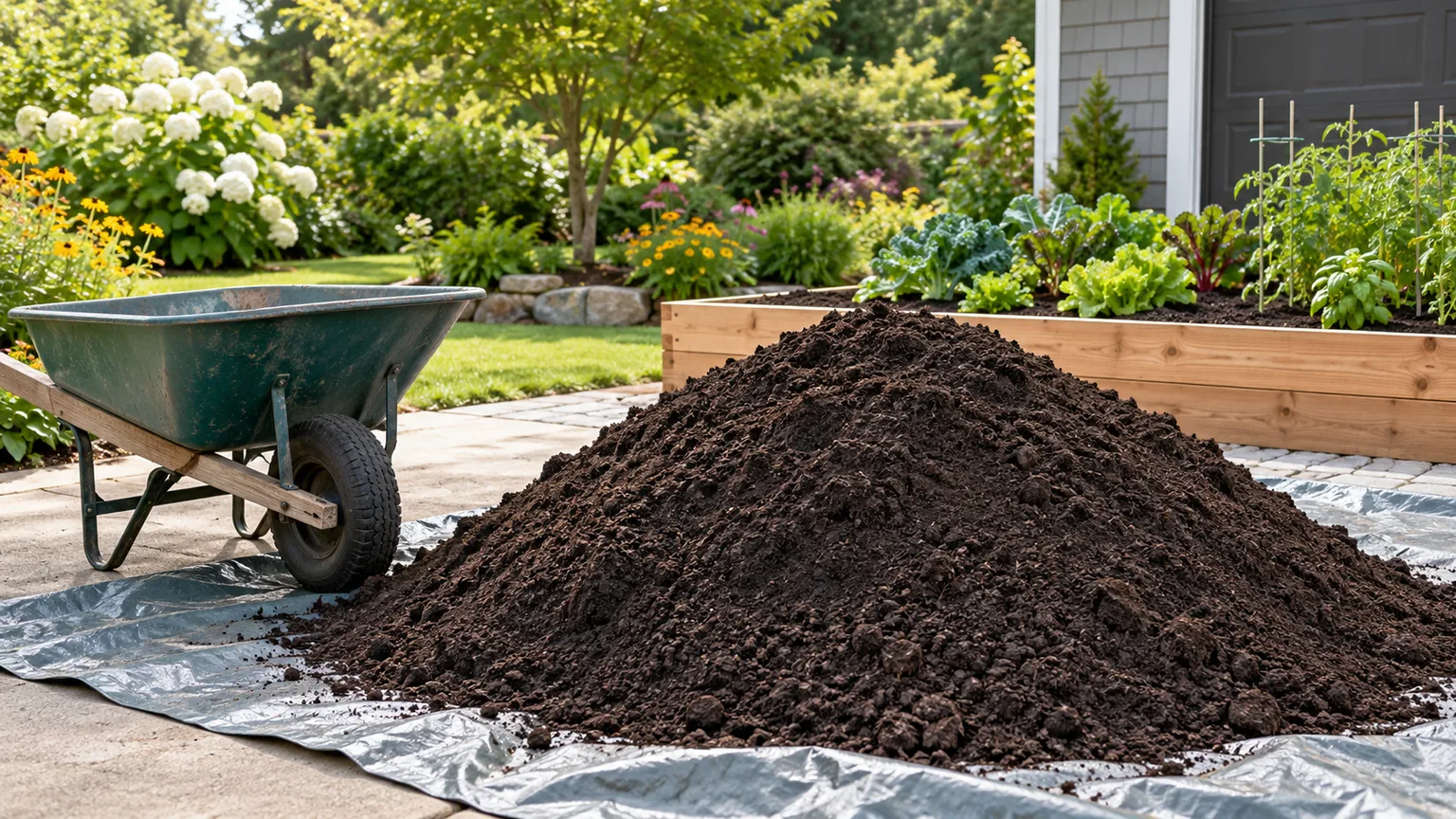
In practice, compost is most useful when the goal is to build organic matter, improve tilth, or return organic residues to a bed. It may also supply nutrients, but the contribution is secondary unless you know the material’s analysis and have planned around it. If you are starting a new bed with poor soil, compost can be part of a broader plan; it is not a substitute for correcting the wrong pH, choosing suitable plants, or solving drainage problems.
Why compost does not have a predictable fertilizer analysis
Two finished composts can look similar and still differ in nutrient content. Feedstocks matter: leaves, food scraps, yard trimmings, manure, and bedding do not contribute identical amounts or proportions of nitrogen, phosphorus, potassium, or salts. Moisture content and the stage of decomposition also affect what a volume of compost weighs and how its nutrients become available.
So a shovel-full is not a standardized dose of plant food. Compost can provide meaningful nutrients, particularly when manure is an ingredient, but it may not provide enough of one nutrient while supplying more than needed of another. That is why repeated, heavy applications can gradually raise phosphorus or soluble salts in some soils even when the gardener is trying to “feed the soil.” Penn State’s recommendations caution users to consider nutrient content and application amount, especially when compost is used repeatedly.
If a particular compost will be applied at scale, ask the supplier for an analysis. For a small home bed, a routine soil test can show whether the bed already has elevated phosphorus or salts and can inform future applications. Do not treat every compost as a complete, balanced fertilizer or assume that homemade compost has a fixed N-P-K ratio.
What fertilizer contributes
Fertilizer supplies nutrients in a form and concentration meant to support plant growth. Product labels show guaranteed analyses; the familiar three numbers refer to nitrogen, phosphate, and soluble potash expressed in the fertilizer-label convention. A fertilizer can provide a complete blend, a single nutrient, or a particular ratio. That precision lets a gardener match an input to a soil-test recommendation or crop program more closely than an unknown volume of compost.
“More concentrated” does not mean “better.” A fertilizer is useful only when its nutrients are needed, applied at an appropriate rate, and available in the soil conditions where roots can use them. Excess can injure roots, create salt stress, encourage unwanted leafy growth, or move in runoff or leaching water. Excess phosphorus is particularly difficult to correct by adding more amendments; the better response is to stop adding it and follow local soil-test guidance.
Fertilizer is a broad category, not one specific substance. It includes dry granules, soluble products, controlled-release products, and organic materials sold with nutrient analyses. For a deeper explanation of the label numbers, see how to read fertilizer N-P-K. This guide focuses on deciding whether fertilizer is called for at all.
Organic and synthetic describe the source, not the job
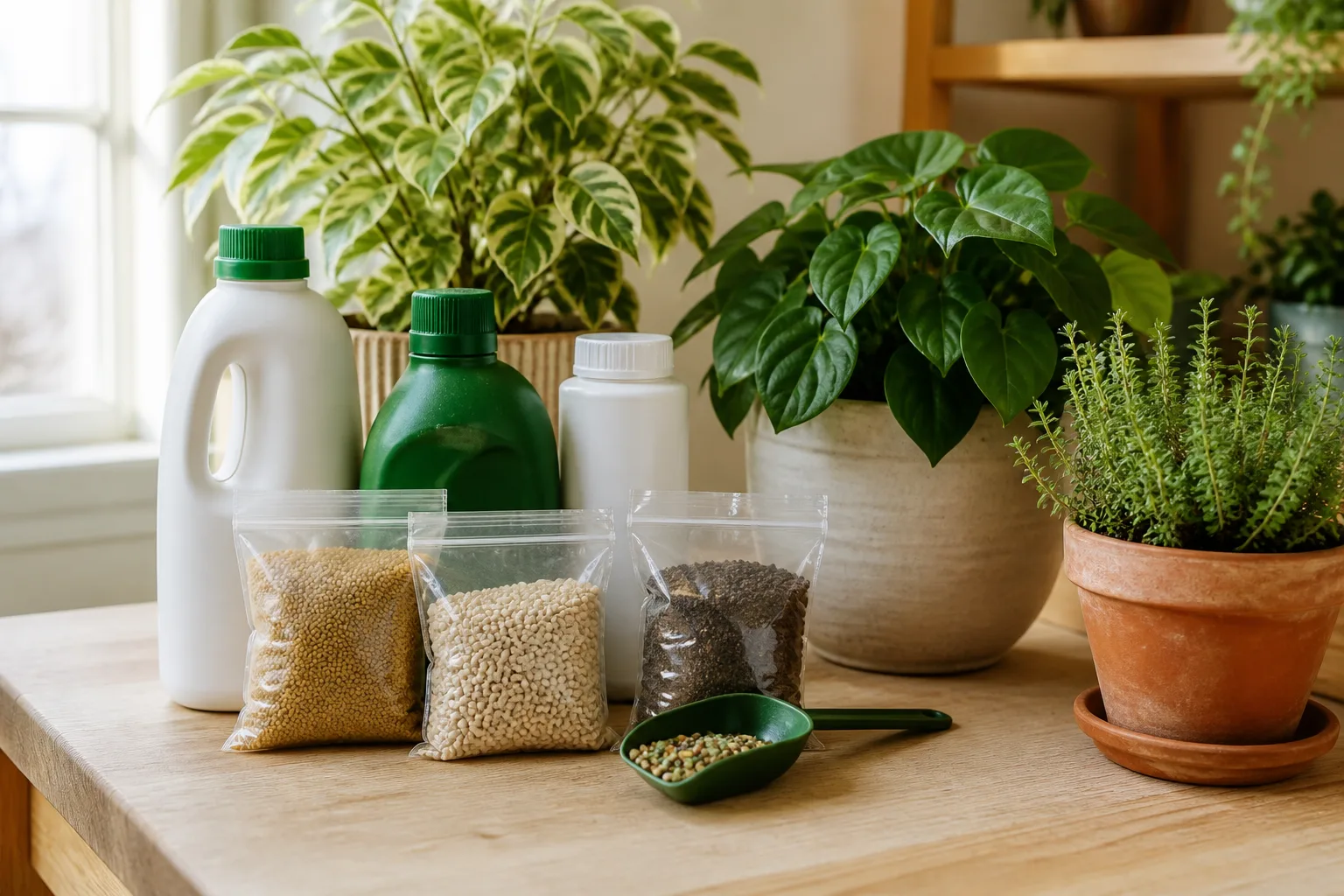
Organic and synthetic fertilizer are different source categories; they do not describe different plant nutrient requirements. Plants use nutrient ions in forms they can absorb. Organic fertilizers are derived from plant, animal, or other natural materials; depending on the product and nutrient, soil organisms may need to break down some materials before nutrients become available. Synthetic or inorganic fertilizers are manufactured or mined and may supply nutrients in readily soluble or controlled-release forms. Products within both categories vary.
An organic fertilizer can be concentrated, and overuse can still harm plants or contribute to nutrient loss. A synthetic fertilizer used at a soil-test-based rate is not automatically destructive to soil. Conversely, choosing an organic product does not guarantee that its nutrient ratio matches your bed. UF/IFAS Extension’s review of fertilizers and soil amendments explains that nutrient content, release pattern, crop need, and existing soil levels all matter. For practical examples of organic fertilizer sources, Fine Gardening’s overview is useful, but the product analysis and your soil still set the rate.
Compost vs. fertilizer at a glance
| Question | Compost | Fertilizer |
|---|---|---|
| Main job | Add organic matter and improve soil condition over time | Supply specified plant nutrients |
| How it is measured | Often by volume or a soil-test-based amendment rate | By nutrient analysis, crop, area, and label rate |
| Nutrient content | Present but variable unless tested | Declared on the label, though availability and release vary |
| Best starting point | Soil structure, organic matter, and bed-building goals | A documented nutrient need or crop-specific feeding plan |
| Main risk of excess | Nutrient or salt accumulation, especially with repeated heavy use | Root injury, imbalanced growth, runoff, or leaching |
| Does it replace the other? | Not reliably for a specific nutrient target | Not for organic matter or soil structure |
The table describes typical roles, not strict boundaries. Compost can supply nutrients, and fertilizers differ in whether they include organic matter. A bag labeled “organic fertilizer” is still a fertilizer if its purpose and analysis are to deliver nutrients. A compost product may list an analysis, but its rate and contribution should still be considered in context.
Choose compost when the soil needs conditioning
Compost is the better fit when your goal is to add organic matter and support soil structure, especially in a bed that has little organic residue and has been tested or observed to need improvement. You might top-dress an established perennial bed with a modest layer, incorporate finished compost into an empty vegetable bed when preparing it, or use it as one ingredient in rebuilding a depleted planting area. The amount depends on the soil, crop, compost, and local recommendations.
The expected benefit is gradual. Compost does not instantly repair compaction below the cultivated layer, and it does not guarantee better drainage if water has nowhere to move. Avoid working any amendment into saturated soil, because tilling or digging when wet can make compaction worse. Where soil structure is already good or phosphorus is high, routine large additions may be unnecessary or counterproductive.
Compost is also a poor shortcut for a precise nutrient correction. If a test calls for a measured amount of potassium and recommends no phosphorus, adding a compost whose phosphorus content is unknown may conflict with that recommendation. Choose an input whose analysis and rate can meet the specific need, or ask the testing laboratory or local Extension service how to account for compost.
Choose fertilizer when a nutrient need is established
Use fertilizer when a soil test, crop recommendation, or well-understood growing system indicates a particular nutrient input. A test may show that phosphorus or potassium is below the locally recommended range; a crop guide may recommend supplemental nitrogen at a certain growth stage; or a container product label may specify how to maintain nutrition in a soilless mix. In each case, match the product and rate to that context instead of choosing a “balanced” blend by habit.
A soil test is especially valuable before applying phosphorus, potassium, lime, or sulfur to an in-ground bed. But some labs do not use a simple home-garden soil-test result to prescribe nitrogen for every crop, because nitrogen availability changes quickly and crop demands vary. Follow the local laboratory’s crop-specific instructions for nitrogen, and do not assume a missing value means the soil has none.
Fertilizer also makes sense when plants are grown in a limited volume of potting mix or when a crop has a known feeding schedule, but the schedule is product- and crop-specific. Do not transplant a field-garden rate to a container. The smaller root zone can concentrate salts, and watering can wash nutrients out; use a container-appropriate fertilizer exactly as directed. If the crop is a heavy feeder, see the specific guide to fertilizing a vegetable garden rather than extrapolating from a general garden blend.
Let a soil test answer the nutrient question
A plant symptom is a clue, not a diagnosis. Yellow leaves, slow growth, weak flowering, or poor fruiting can result from water stress, root damage, shade, pests, disease, pH, cold soil, or nutrient imbalance. Applying fertilizer to a plant with waterlogged roots may add stress without solving the cause. The same symptom can also reflect different nutrient problems, so appearance alone rarely tells you which product or dose to use.
For an in-ground bed, sample the area you manage consistently and follow the laboratory’s instructions for depth, number of subsamples, timing, and packaging. Separate beds with different histories or crops rather than mixing them into one average. Ask for the recommendations appropriate to your crop and location. A soil report generally helps interpret pH and selected nutrient levels; it is not a live meter of every nutrient moving through a root today.
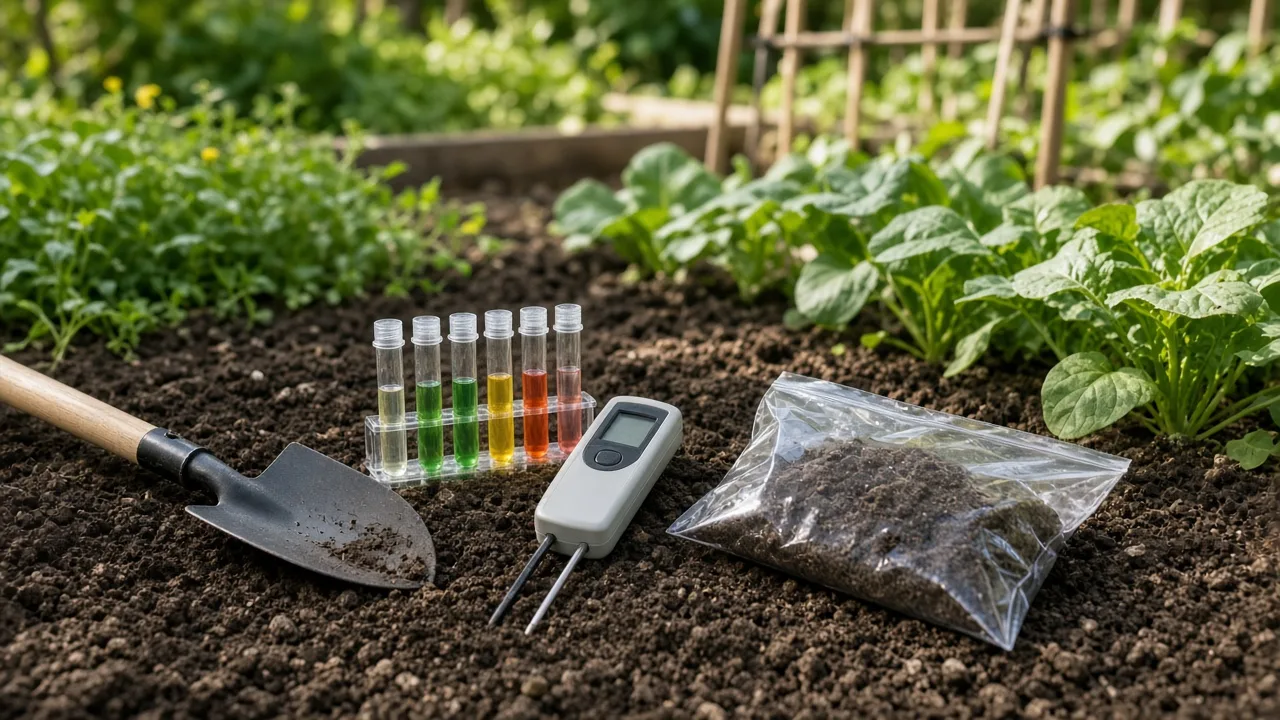
Penn State Extension’s soil fertility guide explains how pH and nutrient levels affect fertility and why recommendations should be based on a test. Extension testing services and extraction methods differ by region, so use the instructions from the lab serving your area rather than comparing numbers from unrelated kits. If your test recommends no phosphorus, avoid products that add phosphorus simply because the package says “all purpose.”
Can compost and fertilizer be used together?
Yes, if they solve separate needs and the combined nutrient load is accounted for. For example, a bed may benefit from compost to build organic matter while the crop plan calls for a measured nitrogen application. Applying both is not automatically wrong, and it is not automatically better. The compost’s nutrient contribution, particularly when manure-based, should be considered before adding fertilizer.
Start with the soil report, crop, and compost source. If the compost has an analysis, use it to estimate the amount of nutrients being added; where calculations are uncertain, ask the lab or Extension office how to account for it. If you do not know the compost’s analysis, avoid assuming it contributes zero nutrients when applying a fertilizer that includes the same elements. A moderate amendment rate may be appropriate for soil conditioning, but that does not make an unrestricted fertilizer rate safe.
Follow each product’s directions about incorporation, watering, and timing. Some granular fertilizers should not touch stems or roots; some soluble products are applied in irrigation water; finished compost is generally spread or mixed into soil as an amendment. There is no universal rule that compost must always go first. The correct sequence depends on whether you are preparing a bed, planting, top-dressing, or maintaining a crop already in growth.
Account for both inputs before applying either
Write down what has already been added to the bed in the current season: compost, manure, granular fertilizer, liquid feed, and even nutrient-rich irrigation or amendments. Then compare those inputs with the soil-test recommendations and crop guidance. This simple record prevents a common mistake: adding fertilizer because the plant looks pale after the bed has already received a substantial nutrient-rich compost application.
If a test shows high phosphorus or salts, pause compost and fertilizer inputs that could worsen the issue and follow the lab’s recommendation. If the soil needs organic matter but also has a specific nutrient deficiency, use a low-nutrient compost rate suitable for the soil goal and a fertilizer that targets the deficiency; confirm with local guidance where possible. Re-test at the interval recommended by the lab, not after every small application.
What changes in raised beds and containers?
Raised beds filled with a soil-compost blend can begin with more organic matter and nutrients than native ground, but their fertility changes as plants grow, compost decomposes, and water moves through the bed. A raised bed is not a reason to add fertilizer automatically each month. Start with the mix history, crop, and a test suited to raised-bed soil, then apply only what the recommendation calls for.
Containers are different because roots occupy a small, finite amount of growing medium. Potting mixes may contain starter fertilizer, compost, or slow-release nutrients that last for a limited period. Frequent watering can leach soluble nutrients, while repeated feeding can build salts if drainage is poor. Before adding compost, consider whether the container mix has room for it and whether the plant is due for repotting; a thick layer of compost can alter the surface and hold excess moisture without fixing a depleted root zone.
For a container, follow the potting mix and fertilizer labels and the needs of the plant species. If growth slows, check light, watering, root crowding, temperature, and pests before feeding. If a product schedule says to feed at a reduced strength or during active growth, follow that specific instruction rather than stacking it with another fertilizer. Compost may be one component of a fresh mix or a light top-dressing, but it does not automatically replace a container fertilizer program.
Why a struggling plant may not need fertilizer
Plants cannot use nutrients well when roots are short of oxygen, water, or appropriate pH. Waterlogged soil can damage roots; drought can limit nutrient uptake; a pH outside the plant’s preferred range can make existing nutrients less available. In those cases, fertilizer adds nutrients to a system the roots cannot use effectively. Improving drainage, adjusting watering, correcting pH from a test, or addressing root disease may be the real fix.
Likewise, yellow leaves are not a universal nitrogen signal. Older leaves may yellow naturally, a plant may be shading its own inner foliage, or a pest or disease may be involved. If the pattern is new or worsening, inspect the whole plant and growing conditions: which leaves are affected, whether symptoms follow watering, and whether roots look healthy. Use a reliable diagnostic source or local Extension office if the cause is unclear.
Do not use a fertilizer as a general “tonic” after transplanting, pruning, heat stress, or pest damage unless the plant’s care guidance calls for it. A stressed root system may be more vulnerable to salts. Stabilize water, light, and temperature first; fertilize only after you have a reason and the plant is actively able to use the nutrients.
Common mistakes that waste inputs or harm soil
- Treating compost as a complete fertilizer. Its nutrient profile varies, and it may not supply a particular element in the amount your crop needs.
- Treating all compost as nutrient-free. Manure-rich or repeatedly applied compost can add substantial nutrients, so its contribution should not be ignored.
- Using a fertilizer blend because the numbers look balanced. A blend can add a nutrient the bed already has in excess. Match the test and crop need instead.
- Assuming organic means impossible to overapply. Organic fertilizers and compost can still add excess nutrients or salts.
- Adding compost every year at the same rate without checking the soil. Repeated additions may raise phosphorus or soluble salts even as the material improves organic matter.
- Reading yellow foliage as proof of deficiency. Water, roots, pH, light, pests, and normal leaf aging can look similar.
- Using an in-ground recommendation in a pot. The smaller soil volume and different watering pattern can change how concentrated nutrients become.
- Applying before reading the label. Product concentration, timing, placement, protective equipment, and restrictions vary. The label’s directions are part of safe use.
Avoid combining fertilizer products unless their labels and crop recommendations make the total rate clear. A slow-release product may continue supplying nutrients while a liquid feed is added; those inputs can overlap even if each seems modest by itself.
A simple decision path for your next application
- Name the problem. Are you trying to improve structure or organic matter, supply a nutrient, or troubleshoot a symptom? If you cannot name the problem, pause before adding anything.
- Check the setting. Is this an in-ground bed, a raised bed, or a potting mix? Identify the crop and how it is planted, because a seedling, mature vegetable, lawn, and perennial do not share one schedule.
- Look for evidence. Use soil texture and history for soil-conditioning decisions. For nutrient corrections, use a soil test or a crop-specific recommendation. Investigate water, roots, pH, light, and pests when symptoms are involved.
- Choose the input for the job. Use finished compost when organic matter or soil structure is the goal. Use a fertilizer with the right analysis when a nutrient is needed. Use both only when their combined additions have been considered.
- Apply the measured amount. Follow the test recommendation and product label. Keep fertilizer off sensitive plant tissue unless directions say otherwise, and do not apply before heavy rain or to saturated ground.
- Record and reassess. Note product, amount, date, bed, and crop. Observe new growth over an appropriate interval; do not keep adding material because an old leaf has not recovered.
This sequence is deliberately slower than grabbing a bag, but it often prevents buying or applying something the soil did not need. If the test result is confusing, send the report to the lab that issued it or your local Extension service and ask how to interpret it for the crop you are growing.
How to apply either material responsibly
Use mature, finished compost for planting beds rather than fresh, actively heating material. Spread it evenly at the rate appropriate for the soil and crop, and avoid piling it against stems or crowns. If you are using compost primarily as a soil amendment, mix it only as deeply as your bed-preparation plan requires; repeated deep tillage can disrupt soil structure and roots. Penn State Extension’s compost guidance is a helpful reminder to select a method and amount suited to the intended use, not to assume that every pile should be spread at the same depth.
For fertilizer, read the guaranteed analysis and application directions before opening the bag. Calculate the treated area and avoid estimating by handfuls, especially with concentrated products. Use a spreader if the product requires an even broadcast rate, calibrate it as the label explains, and sweep granules off driveways and sidewalks so they do not wash into storm drains. Do not apply when rain is likely to carry nutrients away, and keep products stored in their original containers away from children and pets.
Do not combine a fertilizer with lime, sulfur, or another amendment unless the test and product directions support that plan. These materials address different conditions, and one can change nutrient availability or soil pH. If a soil report recommends several corrections, follow its order and rate, and ask for help rather than improvising a larger blend. For more on amendment choices beyond compost, see the site’s guide to soil amendments.
The most useful garden record is simple: what went in, how much, where, and what grew afterward. Over time, that history makes it easier to recognize a real response and avoid repeating a treatment that did not help. Compost and fertilizer are both valuable tools; precision comes from matching the input to the soil and crop rather than using one as a default remedy.
Conclusion
Compost and fertilizer have different primary jobs. Compost adds organic matter and can improve soil condition, while fertilizer supplies specific nutrients at a more measurable concentration. Compost may contribute nutrients, but its nutrient content varies; fertilizer may add organic material, but it is not a substitute for building soil structure.
Choose compost when the soil needs organic matter or conditioning. Choose fertilizer when a soil test or crop recommendation identifies a nutrient need. Use both when the soil-building goal and nutrient plan are compatible, and account for the nutrients already supplied by compost before adding fertilizer. If a plant looks unhealthy, diagnose water, roots, pH, light, and pests before assuming it needs food. A test-informed, measured application is usually more useful than adding more of either product by habit.