Identifying 9 Common Lawn Weeds by Leaf and Season
Identify nine common lawn weeds by leaf shape, flower, growth habit, season, and site—then choose a proportionate next step for your turf.
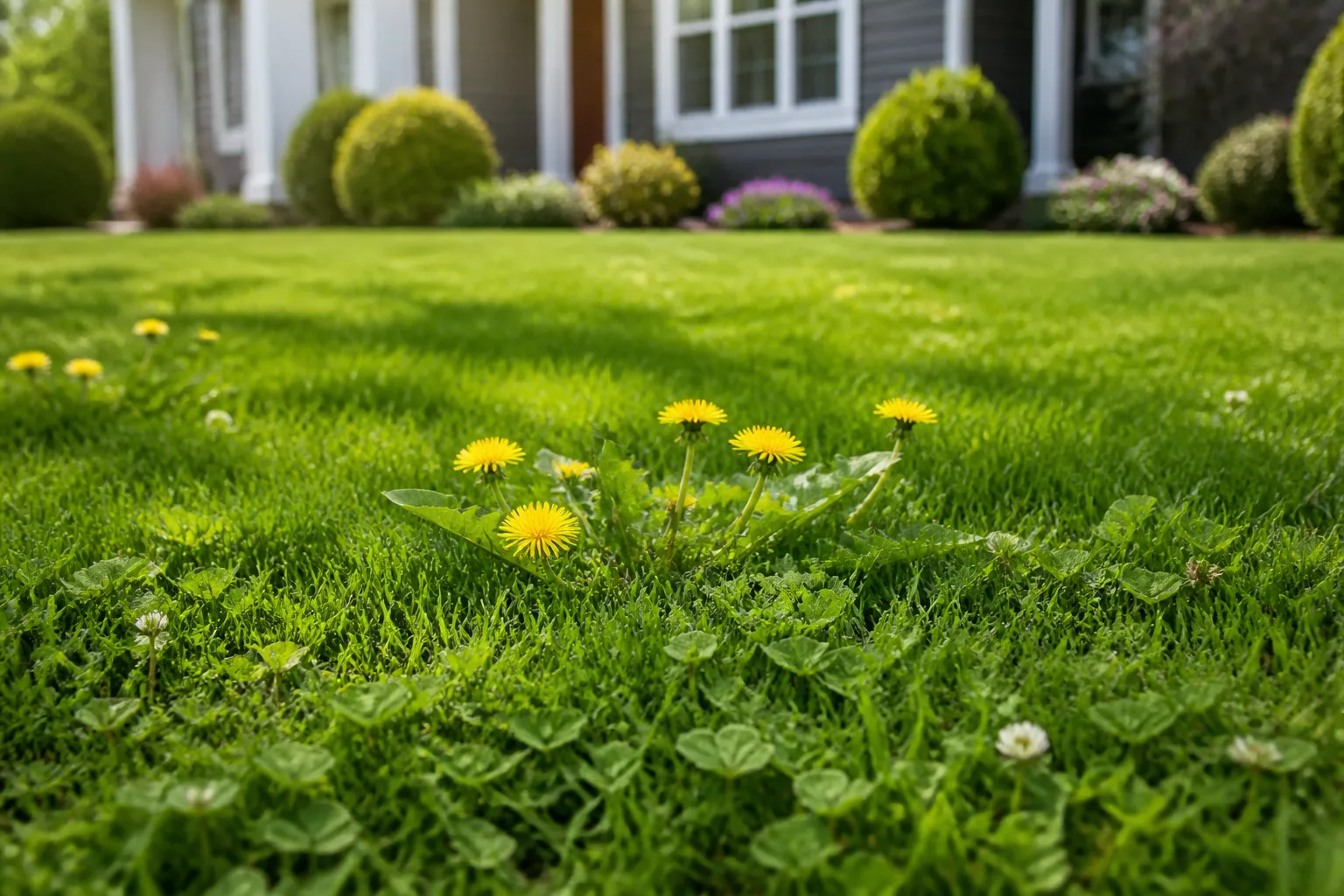
A weed in the lawn is simply a plant growing where you do not want it. Whether to remove it is a separate choice from identifying it: clover may belong in a pollinator-friendly lawn, while crabgrass can thin turf and scatter seed. The first useful step is to identify the plant well enough to understand its growth habit and decide what matters in your yard.
Use several clues together. Start with the way the plant grows—flat mat, creeping runner, upright stalk, or a low rosette—then examine leaf shape and attachment. Flowers, seedheads, season, and the spot where it appears can confirm or challenge your first guess. A single clue, such as “three leaves” or “yellow flower,” rarely settles an identification on its own.
Use this lawn weed field key before you pull
Walk to the plant and look at an intact specimen rather than only the mowed leaves. If you can, photograph the whole plant, a close-up of a leaf, and any flower or seedhead; include a coin or ruler for scale. Mowing can remove the most useful evidence, and several weeds look alike when they are small.
Use this quick field key to narrow the choices:
| What you notice first | Check next | Likely match |
|---|---|---|
| A single low rosette with deeply notched leaves | Yellow flower on a leafless stalk; later a white puffball | Dandelion |
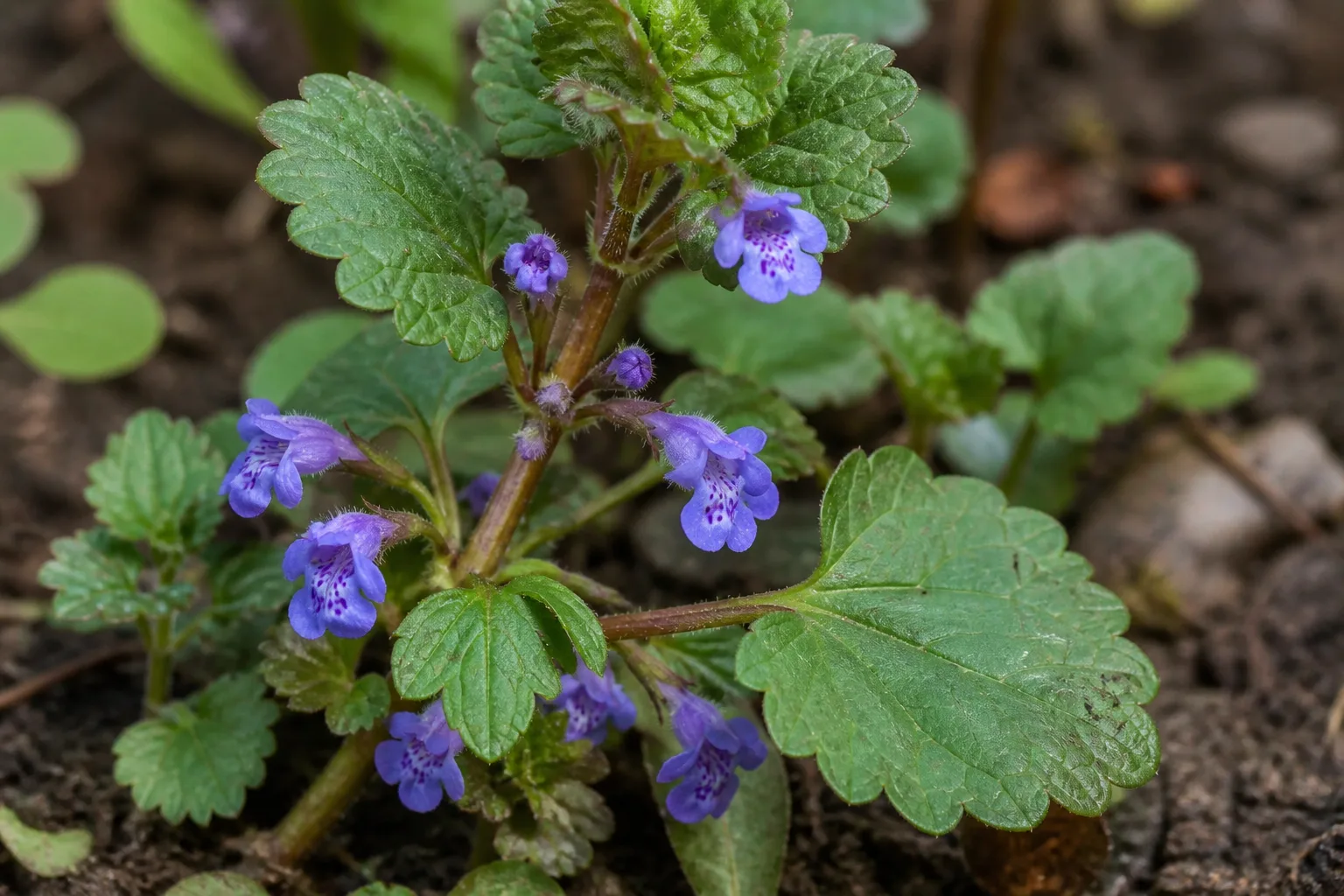
| Creeping stems with rounded, scalloped leaves | Opposite leaf pairs, small purple flowers, mint-family scent when crushed | Creeping Charlie |
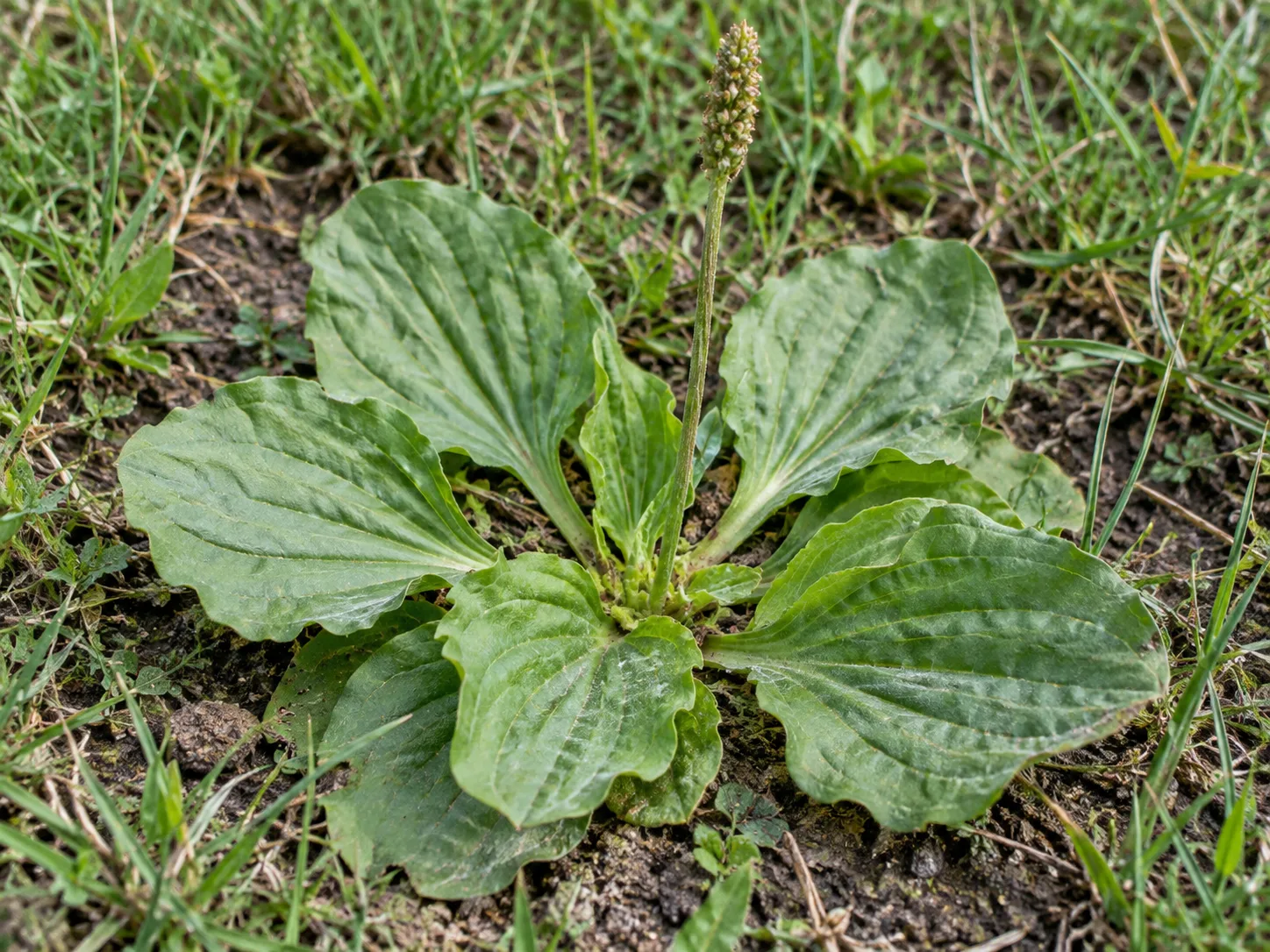
| Broad leaves radiating from one crown | Several strong ribs run lengthwise through each leaf; a thin flower spike rises from the center | Broadleaf plantain |
| A low, fleshy mat with smooth leaves and red stems | Yellow flowers or small seed capsules; often found in hot, open, thin turf | Common purslane |
| A low mat with three leaflets | Round leaflets and white or red flower heads indicate clover; heart-shaped leaflets and yellow flowers suggest oxalis instead | Clover or oxalis |
| A heart-leaved groundcover in shade | Purple or white flowers and persistent spreading growth | Wild violet |
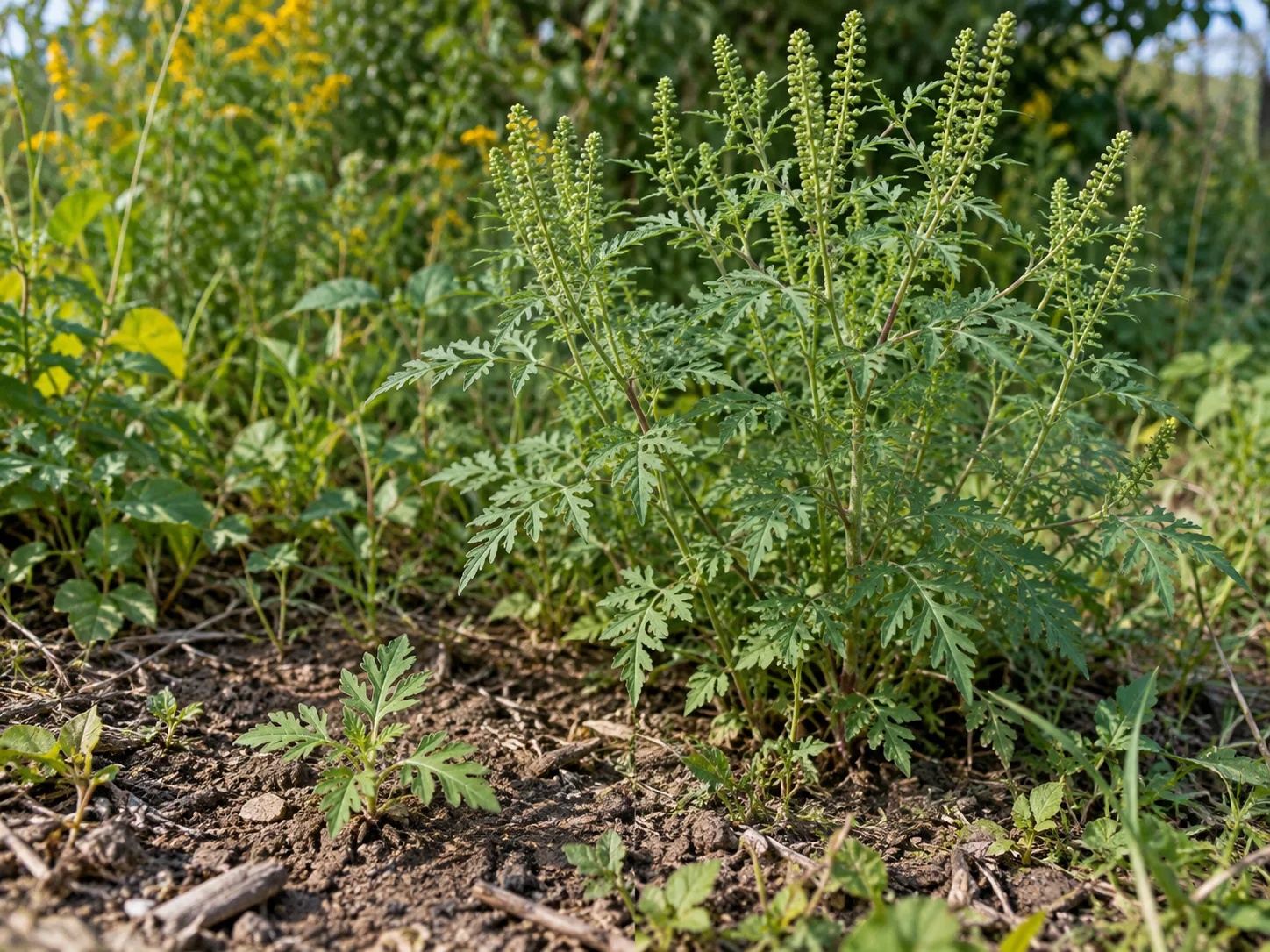
| A tall annual with finely divided, fernlike foliage | Upright flower clusters later in the season; do not identify by a vague “ragged leaf” impression alone | Common ragweed |
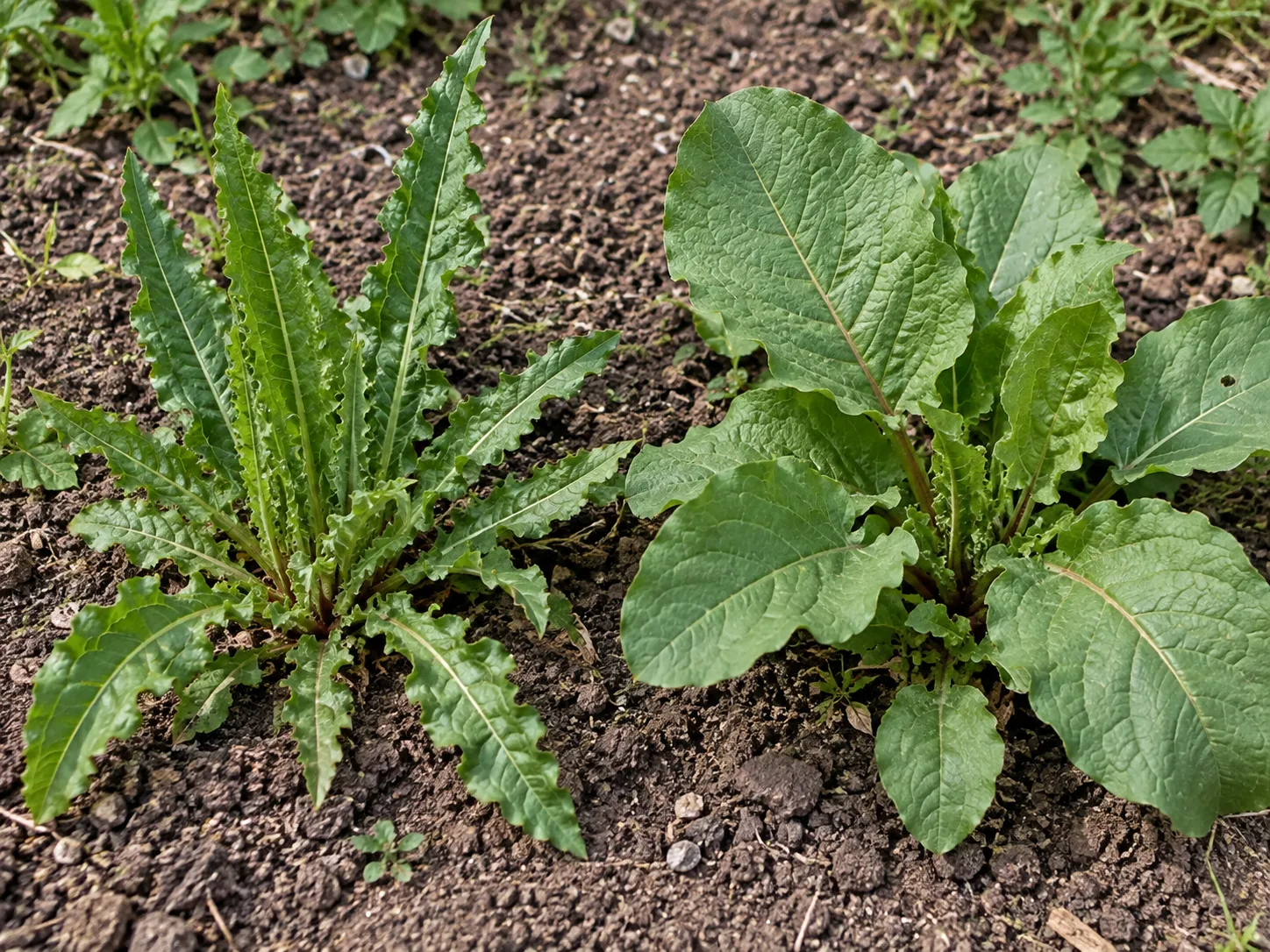
| An upright rosette with long, wavy leaf edges | A tall stalk with clusters of rusty-brown seeds later in the season | Curly dock |
| A coarse grass spreading from a low crown in sunny, thin patches | Finger-like seed branches; it appears in the warm part of the growing season | Crabgrass |
The table is a shortcut, not a botanical key for every region. Mature flowers and seed structures are often more diagnostic than a seedling’s first leaves. NC State Extension recommends considering life cycle, propagation, and plant features together; the same principle prevents a quick visual guess from becoming a mistaken treatment decision.
Read growth habit, season, and lawn location
A rosette is a circle of leaves radiating from a compact crown at ground level. Dandelion, plantain, and young dock can all start this way, so “rosette” narrows the possibilities but does not identify the plant. Compare the leaf margins, veins, and the later flower stalk before you act.
A runner travels horizontally above the soil and can root at points along its length. Creeping Charlie uses runners, while crabgrass expands outward from a low crown and can root where stems touch soil. A mat may also be made of many seedlings rather than one spreading perennial; gently trace the stems back to see whether they connect.
Season and location add context. A new grassy weed showing up as the soil warms in late spring or summer may be crabgrass, especially beside pavement or in thin sunny turf. A dense groundcover under a tree is more consistent with shade-tolerant violets or ground ivy. These are likelihoods, not proof: mowing, irrigation, regional climate, and the kind of turf all change when weeds appear.
The NC State Extension weed biology and identification chapter describes annuals as plants that complete a life cycle in one season and perennials as plants that persist through crowns, roots, or other structures. That difference matters because an annual’s seedhead and a perennial’s underground growth tell you what to look for next. Record the date and exact lawn location with your photos; repeated observations are more useful than trying to infer soil condition from one plant.
Identify the nine common lawn weeds
1. Dandelion (Taraxacum officinale)
Dandelions form a flat rosette of long leaves with irregular, deep teeth. On many plants the teeth point back toward the crown, giving the leaf a jagged outline. A hollow-looking, leafless stalk carries a bright yellow flower; after flowering, it becomes the familiar round head of wind-dispersed seeds. The taproot is thick and pale inside, which is why a plant can return after its leaves are cut off.
Dandelions often stand out in open lawn during cool-season growth, but they tolerate a wide range of conditions. Purdue Turfgrass Science notes that they commonly reappear from established roots early in spring and may also germinate later in the growing season; its timing is Indiana-specific, so use the plant stage rather than a calendar date elsewhere. The university also distinguishes dandelion from chicory: chicory leaves tend to be rougher and its flowers blue, while dandelion flowers are yellow. See Purdue’s dandelion identification notes for the full comparison.
If you want to remove an isolated plant, loosen the soil and lift as much of the taproot as possible; a clipped crown may resprout. If the flowers are acceptable, you can leave them and prevent seed dispersal by cutting the flower stalks before the heads open. For lawn-wide methods, see how to get rid of weeds in your lawn.
2. Creeping Charlie (Glechoma hederacea)
Creeping Charlie, also called ground ivy, makes a low mat rather than a single rosette. Its soft, rounded or kidney-shaped leaves sit in opposite pairs on creeping stems and have scalloped edges. Small blue-purple flowers appear at the leaf joints in spring. The leaves may release a mint-like scent when crushed or mowed, but do not use scent alone as an identification test.
Look first in damp, shaded parts of a lawn, such as beneath trees, beside buildings, or where grass is sparse. LawnStarter’s account, which includes field guidance from a North Carolina State University horticulture extension agent, describes the characteristic scalloped leaves and above-ground runners; it also notes the plant’s association with shade and moist soil. These habitat patterns help explain where to check, but a shady lawn can contain several unrelated groundcovers.
A small patch can be lifted carefully by tracing runners and removing rooted nodes, then checking for regrowth. Avoid scalping nearby grass to make the area brighter; if tree shade is the underlying condition, a shade-adapted planting or a different lawn expectation may be more realistic. Treatment options depend on turf species, so use the dedicated creeping Charlie control guide if you decide the patch must go.
3. Broadleaf plantain (Plantago major)
Broadleaf plantain forms a low, ground-hugging rosette of broad, oval leaves. The most useful clue is the set of conspicuous parallel ribs that run from the leaf base toward its tip. If the plant is flowering, look for a slender stalk rising above the leaves and ending in a narrow, dense spike of tiny flowers and seeds.
Plantain commonly occupies compacted or regularly trampled turf, including paths, play areas, and lawn edges. A flat rosette can be confused with young dandelion or dock, but the prominent lengthwise ribs and rounded, unlobed blade are different from dandelion’s toothed leaves and dock’s wavier margins. The broad leaves also differ from buckhorn plantain, a close relative with narrower, lance-shaped leaves; Purdue’s weed-identification index lists both as separate plants.
When only a few plants are present, loosen the soil around the crown and remove the whole root system before seed spikes mature. Repeatedly mowing the leaves is not a reliable identification or removal method because the crown remains close to the ground. Better Homes & Gardens’ weed identification guide also describes the broad-leaved rosette form; local extension photos can help confirm a plant that has not yet flowered.
4. Common ragweed (Ambrosia artemisiifolia)
Common ragweed begins as a seedling and becomes an upright, branching annual. Its leaves are divided into fine, fernlike lobes, especially compared with the simple, straplike leaves of turf. Later in the season, inconspicuous greenish flower clusters form near the ends of branches. The flowers are easy to overlook if the plant grows among taller weeds.
Ragweed can show up in disturbed, bare, sunny, or thin areas, then become more noticeable as it grows taller. Do not confuse it with goldenrod merely because both can flower around the same late-season period: ragweed’s foliage is finely divided and its flowers are modest, while goldenrod has conspicuous yellow flower clusters and simpler leaves. Clemson Extension’s comparison explains those visual differences and notes that the plants have different pollination strategies.
Small plants are easiest to remove before flowers mature. If pollen is a concern, avoid shaking or mowing flowering plants and seek local guidance on timing; the main goal in an ordinary lawn is to prevent seed production without spreading the plant through careless handling. Wear gloves if you are sensitive to plant sap or pollen, and do not burn yard waste.
5. Common purslane (Portulaca oleracea)
Common purslane hugs the ground and spreads from a central crown into a broad, low mat. Look for smooth, fleshy leaves and thick reddish stems; the leaves are usually rounded at the tip rather than sharply toothed. Small yellow flowers may appear, but they can be easy to miss because they open briefly. Its succulent texture is the quickest clue that this is not ordinary turf.
Purslane is most likely in hot, sunny, dry or disturbed places: pavement margins, thin lawns, and spots where soil is exposed. Purdue describes it as a summer annual that can reproduce by seed and by stem fragments. That biology matters in a small removal job: collect pieces rather than chopping or leaving stems on damp soil.
The closest common lookalike is prostrate spurge. Spurge tends to have smaller leaves in a more consistently opposite arrangement, and a broken stem may exude milky sap; purslane has plumper leaves and no milky latex. Do not eat a lawn plant based on a casual identification. Even a correctly identified edible species may be contaminated by lawn treatments or roadside pollutants. For more detail, use Purdue’s common purslane identification page.
6. Curly dock or yellow dock (Rumex crispus)
Curly dock starts as a basal rosette. The long leaves have wavy or crinkled edges, often with a prominent midrib; this is a different outline from plantain’s broad, smoother oval leaves. As the plant matures, a tall flowering stalk rises above the rosette, and its seed clusters turn rusty brown. Those dry clusters may remain visible after the green leaves have faded.
Check sunny or partly shaded lawn edges, disturbed ground, and fence lines, especially where a taller plant can escape regular mowing. The seed stalk is a strong confirmation clue, but young dock may be easy to misidentify as another broadleaf rosette. Wait for more features or photograph the plant from several angles before selecting a treatment.
Dock is a perennial with a substantial root, so cutting the leaves at the mower deck usually leaves the crown alive. Lift a small plant while the soil is moist if you can remove the root; otherwise, prevent seedheads from maturing and monitor for regrowth. Better Homes & Gardens describes the wavy leaf edges and brown seed clusters in its lawn and garden weed guide.
7. White or red clover (Trifolium spp.)
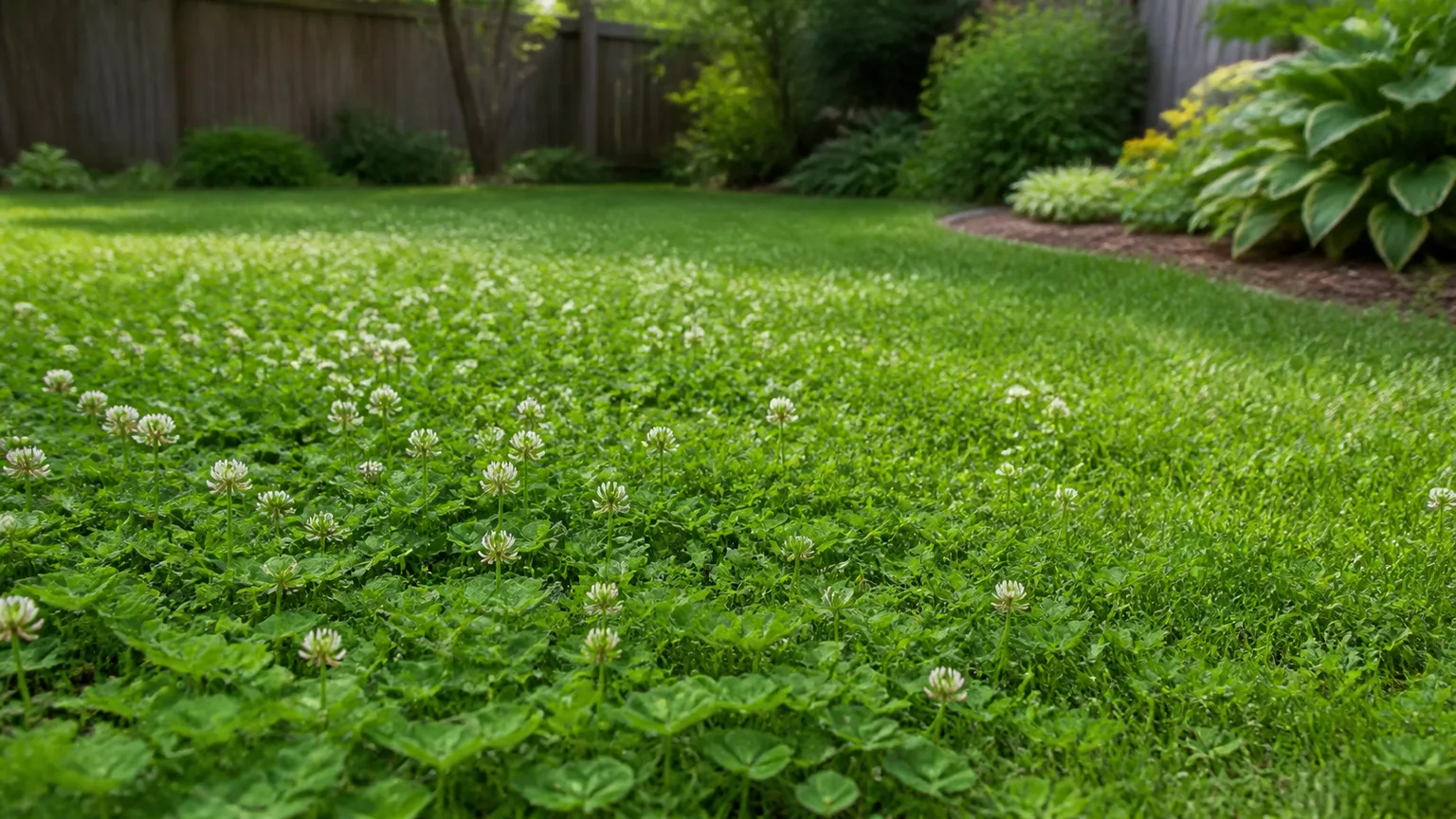
Clover is easiest to recognize by three leaflets attached to one leaf stalk and rounded flower heads. White clover usually stays low and spreads with creeping stems; its flower heads are white and may age pinkish. Red clover is taller, with larger leaves and pink to red flower heads. A faint pale marking may appear on each leaflet, but markings vary and should not be your only clue.
Clover commonly grows through open turf in spring and summer, especially where grass is thin. It is a legume, not automatically a problem that needs eradication. Some homeowners keep it for flowers and a less uniform lawn; others remove it because they want continuous turf or have concerns about bee activity where children walk barefoot. Decide based on the use of the space, not the word “weed.” LawnStarter’s field overview of lawn weeds discusses clover’s benefits and how it can coexist with lawn grass.
If you choose to reduce it, first determine whether the lawn is thin, drought-stressed, or otherwise struggling; clover’s presence by itself does not prove a specific nutrient deficiency. Avoid adding fertilizer or lime without a soil test. For a few unwanted plants, remove them selectively and reseed bare spots with a grass suited to your region. A broader control plan is in our lawn weed guide.
8. Wild violets (Viola spp.)
Wild violets form a low, leafy patch in lawns, often beneath trees or along shaded edges. The leaves are usually heart-shaped, with a notch where the leaf stalk attaches, and the flowers may be purple, blue-purple, or white depending on the species. A patch can remain recognizable even when flowers are absent because the rounded leaves emerge from a persistent crown and spreading underground stems.
The combination of heart-shaped leaves and a violet-like flower separates violets from most turf weeds, but not from oxalis, whose leaves also have three heart-shaped leaflets. Oxalis flowers are typically yellow and each leaf is divided into three distinct leaflets; violet leaves are single blades. Flowers may be seasonal, so verify leaf structure and growth pattern too.
Violets are not necessarily a lawn emergency. If you like the spring flowers or can accept a mixed lawn, leave them alone. If a patch is unwanted, hand removal needs to address the crown and spreading parts, and repeated follow-up may be needed. Better Homes & Gardens notes the heart-shaped leaves, shade preference, and spring flowers in its weed identification reference.

9. Crabgrass (Digitaria spp.)
Crabgrass is a warm-season annual grass, not a broadleaf weed. It germinates from seed as the soil warms, grows quickly in summer, and dies after frost; bare patches then reveal why it was able to establish. Mature plants can spread flat from a central point, with coarse light-green blades and seed branches that radiate like fingers. Large crabgrass may have hairs on its leaves and stems, while smooth crabgrass is less hairy.
Look for it along sunny pavement edges, compacted paths, and thin or newly seeded turf. It can be mistaken for a desirable grass when young, and a tall fescue clump can also appear coarse. Check whether the suspicious plant spreads outward from a low crown, whether surrounding turf is thin, and whether a finger-like seedhead appears. Purdue Turfgrass Science describes common lawn crabgrasses as summer annuals that fill bare or thin areas; the exact germination calendar varies with local soil and weather. See Purdue’s crabgrass field guide.
Because crabgrass is a grass, a broadleaf weed treatment will not solve the problem. Remove small plants before seedheads mature if practical, and repair the thin turf that exposed soil. If you use a product, check that its label lists your turf species and intended crabgrass use; pre-emergent timing follows local soil warming, not a universal calendar date. Our lawn weed control guide explains how to choose a general approach safely.

Check these lookalikes before choosing a control
Several common mistakes come from seeing a leaf shape and stopping there. First, compare clover and oxalis: both may have three leaflets, but clover leaflets are usually rounded or oval, while oxalis leaflets are distinctly heart-shaped; clover has rounded white or pink flower heads, whereas oxalis flowers are typically yellow. A yellow flower is a clue, not a complete identification, so inspect the leaves and growth habit as well.
Second, distinguish purslane from prostrate spurge by checking the stem and leaf. Purslane has fleshy, succulent growth and smooth, thicker leaves; spurge tends to have smaller leaves, and a snapped stem can release milky sap. If you are uncertain, do not use sap contact as your only test—take a clear photo and compare it with an extension identification page.
Third, compare broadleaf and buckhorn plantain. Broadleaf plantain has oval blades with strong ribs radiating from the crown, while buckhorn plantain has narrow, upright leaves. Dandelion is also a rosette, but its deeply toothed leaves and yellow flower stalk provide different clues. Purdue’s entry for dandelion discusses chicory as a further lookalike: chicory’s blue flowers and rougher foliage distinguish it when mature.
Finally, do not classify every coarse grass as crabgrass. Crabgrass tends to spread low and outward, while a turfgrass clump may grow upright from a denser base. A seedling without a mature seedhead can be genuinely difficult to identify. Waiting a few days for more growth or asking an extension service is better than applying a product that may damage the turf you want to keep.
Use season and location as supporting clues
Season can rule possibilities in or out, but only when you account for your region. Crabgrass is a warm-season annual, so it becomes noticeable after warm weather and soil temperatures encourage germination; the date shifts by latitude, elevation, soil exposure, and the year’s weather. Common ragweed often grows taller through summer and forms flowers later, while dandelions may bloom in spring and again during favorable conditions. Those patterns are broad cues, not a schedule.
The lawn itself provides another clue. Ground ivy and violets often tolerate shade better than many turfgrasses, so their patches may concentrate under trees or along north-facing walls. Crabgrass and purslane are more likely in sunny, exposed or thin spots. Plantain may persist where feet repeatedly compress soil. But no plant can diagnose a lawn by itself: a weed can grow outside its usual preference, and multiple causes can create the same bare patch.
Avoid treating a weed as a soil-test result. Clover is sometimes associated with low-nitrogen turf, and plantain may appear in compacted ground, but neither observation proves the condition or tells you a safe amendment rate. If you are considering lime, fertilizer, or a major irrigation change, test the soil and identify the turf grass first. The better lesson from a recurring patch is usually to inspect what is happening there—shade, foot traffic, water pooling, mowing height, or thin coverage.
Choose a next step after identification
Once the ID is credible, decide whether the plant actually conflicts with your lawn’s purpose. One dandelion in a child’s play lawn, a patch of clover in a pollinator-friendly yard, and crabgrass spreading through a sports-turf area call for different choices. Tolerance is a legitimate option when the plant is not unsafe, invasive in the setting, or interfering with how you use the space.
For removal, match the method to growth habit: lift taprooted rosettes with as much root as possible, trace and remove rooted runners, collect succulent purslane stems rather than chopping them, and prevent annuals from setting seed. A post-emergent lawn product may harm desired grass if the target, turf type, weather, or application site is wrong. Follow the product label and your local regulations. For a broader decision sequence, see how to get rid of weeds in your lawn and our weed management overview.
Take one final photo before removing the plant if you may need to identify it again. Note whether it appeared in a patch, along an edge, under shade, or in a high-traffic strip. That small record makes it easier to see whether the weed returned from a persistent root, arrived from new seed, or simply filled a gap after turf thinned.
When to ask for a local identification
Ask a local extension office, horticulture hotline, or qualified lawn professional when the plant does not match the descriptions, the lawn is in a region with different species, or the correct choice depends on distinguishing a desirable grass from a weed. Send clear images of the whole plant, leaf attachment, stem, flower or seedhead, and lawn setting. Include your county or region and the date; these details make an identification more reliable.
A young plant may not yet show the feature that separates it from a close relative. If it is not causing an immediate problem, let it grow long enough to reveal another clue, while preventing it from flowering or spreading if you already know it is unwanted. Never eat a lawn plant based on a quick web match, especially if the area may have been treated with herbicide or pesticide.
Conclusion
Start with growth habit, not a vague color impression. Rosettes, runners, mats, and upright annuals lead you toward different candidates; leaf margins, veins, flower structures, season, and location help confirm them. A simple field key can narrow a lawn weed to one of these nine familiar species, but an immature plant or local lookalike may still need an expert check.
After identification, decide whether removal is necessary and choose a response that fits the plant and your grass. Many lawn weeds point to a location worth inspecting, but they do not diagnose soil by themselves. A few careful observations can prevent a mistaken treatment and make the next step clearer.