Brown Spots on Pothos Leaves: Causes and Fast Fixes
Diagnose brown spots on pothos leaves with a quick pattern and soil check. Get practical fixes for sunburn, cold injury, root trouble, pests, and leaf disease.
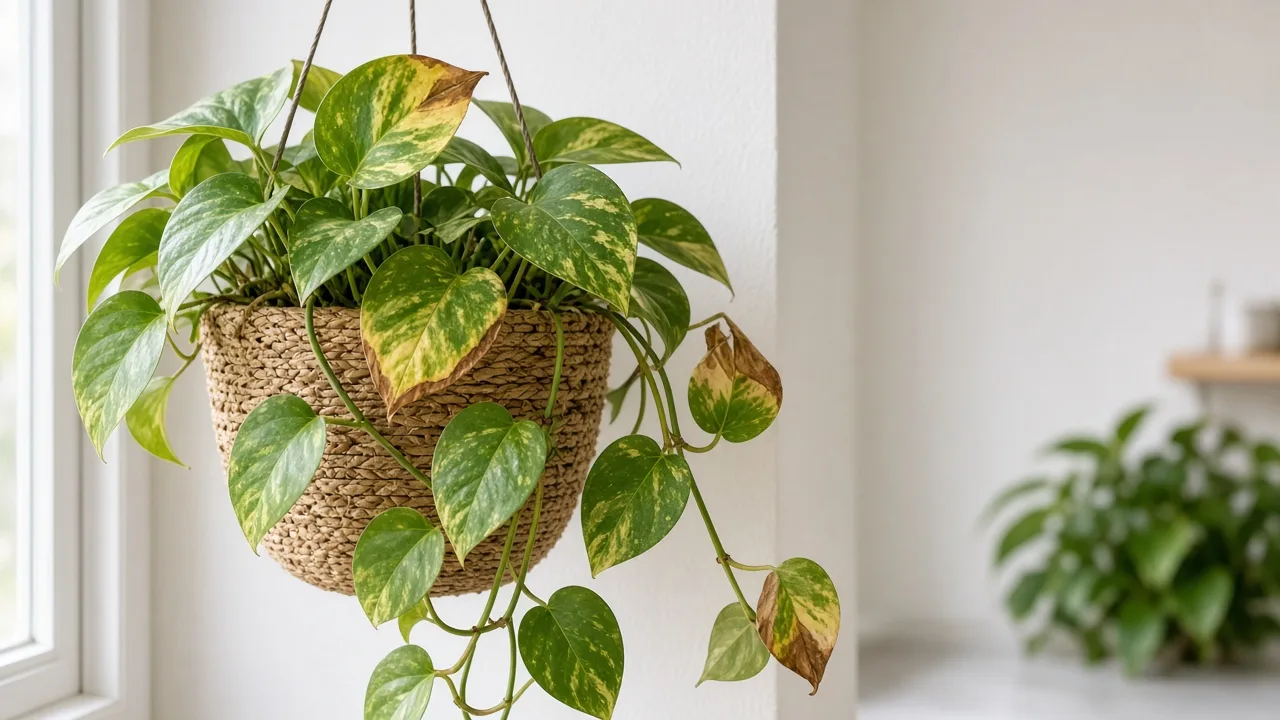
Brown spots are a symptom, not a diagnosis. On pothos, they can follow a sharp change in sun or temperature, a soggy or bone-dry root ball, excess fertilizer salts, pests, or a genuine plant disease. The quickest useful fix is to match the pattern on the leaf with what changed around the plant, then correct one likely cause at a time.
Start by checking whether the damaged tissue is dry or soft, whether spots cluster on the side facing a window, whether the potting mix is staying wet, and whether new spots are appearing. A brown patch will not heal back to green, so success means healthy new growth and no spread of the damage.
Diagnose the most likely cause at a glance
| What you see | Check first | First response |
|---|---|---|
| Pale tan or crispy patch on the window-facing side | Direct sun or a recent move into stronger light | Pull the plant back into bright, indirect light |
| Several leaves yellowing with brown areas; mix remains wet | Drainage, standing water, and roots | Empty the cachepot and let the mix dry somewhat before watering again |
| Dry, curled leaves and a very light pot | A dry root ball, not just the surface | Rehydrate thoroughly, then drain the pot |
| Scattered brown patches after a cold night or move | Draft, cold glass, air conditioner, or temperature swing | Move to a stable, draft-free location |
| Brown margins or tips plus crust on the mix | Fertilizer or dissolved mineral accumulation | Pause feeding; consider a careful flush only if drainage and roots are sound |
| Dark, wet-looking spots that expand or appear on nearby leaves | Possible disease, especially if foliage stays wet | Isolate, keep leaves dry, and remove badly affected tissue with clean shears |
Treat this table as a shortlist, not a lab diagnosis. Several problems can occur together: for example, a plant with damaged roots may also dry unevenly, while a single older leaf may naturally decline as the rest of the vine stays healthy. The University of Wisconsin-Madison Extension notes that pothos leaf-edge or tip browning can result from too much or too little water or excess fertilizer, and that cold or abrupt temperature changes can create scattered brown patches.
What brown spots look like on pothos
Look at the spot’s shape, texture, position, and age rather than relying on color alone. Sun injury often appears on the most exposed leaves; water stress can affect several leaves while the potting mix gives you supporting evidence; and a spreading, wet-looking lesion deserves more caution than one dry mark on an old leaf.
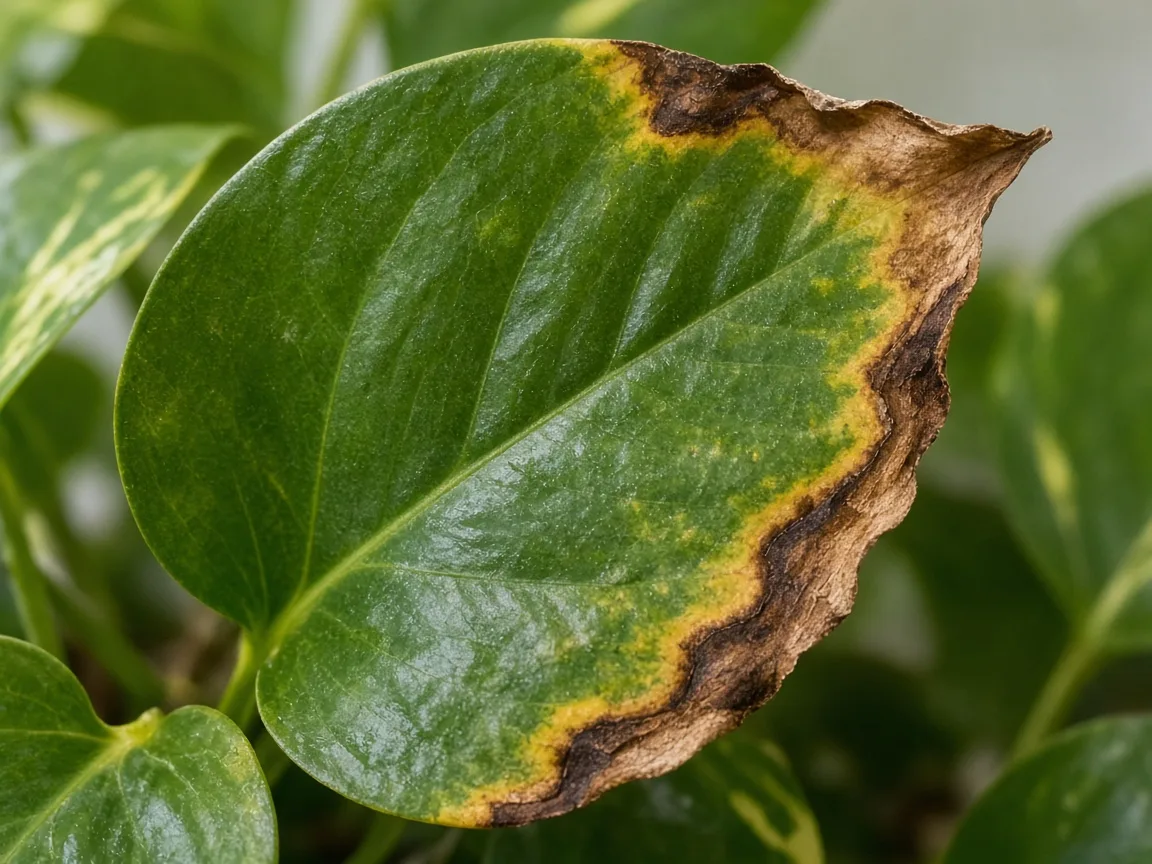
A close look helps you compare a dry leaf-edge patch with the newer, spreading lesions that need closer inspection.
Brown tips are not the same as round or irregular spots. Dry tips and margins commonly point to inconsistent moisture, accumulated salts, or low humidity around the plant; discrete patches in the center of leaves can follow cold injury, while sharply bleached or tan areas may reflect direct sun. The pattern is a clue that tells you what to inspect next, not proof of a single cause.
Note whether the marks are on one leaf, the newest growth, or multiple leaves across the vine. One or two old leaves with stable damage are less concerning than lesions that enlarge over several days, appear on previously healthy leaves, or coincide with stem decline.
A five-minute inspection before you change care
First, photograph the affected leaves and mark the date. This gives you a baseline because brown tissue itself cannot recover; without a record, it is easy to mistake old marks for new ones or to change several care habits at once.
Next, turn the plant slowly and check which leaves face the window, heater, air conditioner, or exterior door. Ask what changed in the last two weeks: a move, a sunny day, a cold snap, repotting, a fertilizer dose, or several missed waterings can all explain a sudden pattern.
Finally, test the potting mix below the surface with a finger or wooden skewer, check that the container drains, and look under leaves and along stems for pests. Do not pull the plant from its pot just because you see brown leaves. Inspect the roots only when persistent wet mix, sour odor, soft stems, or widespread yellowing makes root damage plausible.
Overwatering and root trouble
Too much water usually means that the potting mix stays wet long enough to deprive roots of air, not simply that you watered one day too soon. If the mix remains damp for many days, the pot has no drainage hole, or water collects inside a decorative cachepot, roots can weaken and foliage may yellow, wilt, or develop brown and black areas.
Check moisture several centimeters below the surface and lift the nursery pot out of any cover pot. Empty standing water; then let the upper mix dry before watering again. The Wisconsin Extension recommends an aerated growing medium and allowing pothos to dry slightly, rather than keeping it constantly wet.
If the plant is declining and the soil smells sour, inspect the root ball gently. Healthy roots are generally firm; dead or rotting roots are often brown, soft, or missing. Trim only roots that are clearly dead, use a clean pot with open drainage, and repot into fresh, airy houseplant mix if the remaining roots can support recovery. A minor surface spot with firm roots does not call for an emergency repot.

Persistent wet mix plus yellowing foliage is a stronger reason to inspect drainage and roots than a single dry brown spot.
Avoid responding to suspected overwatering by withholding water until the entire root ball becomes hard and dry. Once the mix has returned to a suitable moisture level, water evenly when the top layer has dried and the pot feels lighter, then let excess drain away. A schedule such as “every Sunday” ignores changes in light, pot size, season, and room conditions.
Underwatering and a dried-out root ball
Underwatering more often produces limp or curled leaves, dry crispy edges, and a lightweight pot than dark, spreading spots. The top may look dry while the deeper root ball is still moist, so check more than the surface before watering.
If the mix is dry through the pot, water slowly and evenly until it drains from the bottom. A very dry peat-based mix can shrink from the pot wall and repel water; in that case, water in several passes or briefly set the pot in a shallow basin so the root ball can rehydrate, then remove it and let it drain fully.
Do not keep adding small sips every day. That can wet only part of the mix and leave other roots dry, while making it harder to judge whether the plant needs water. Return to a check-the-soil approach and use the pot’s weight as a second clue.
Sun scorch and sudden light changes
Direct sun can bleach or scorch leaves, especially when a pothos is moved from a dimmer room to a bright south- or west-facing window without an adjustment period. Damage often concentrates on the side facing the glass and may look tan, pale, papery, or crispy; the rest of the plant can remain firm and green.
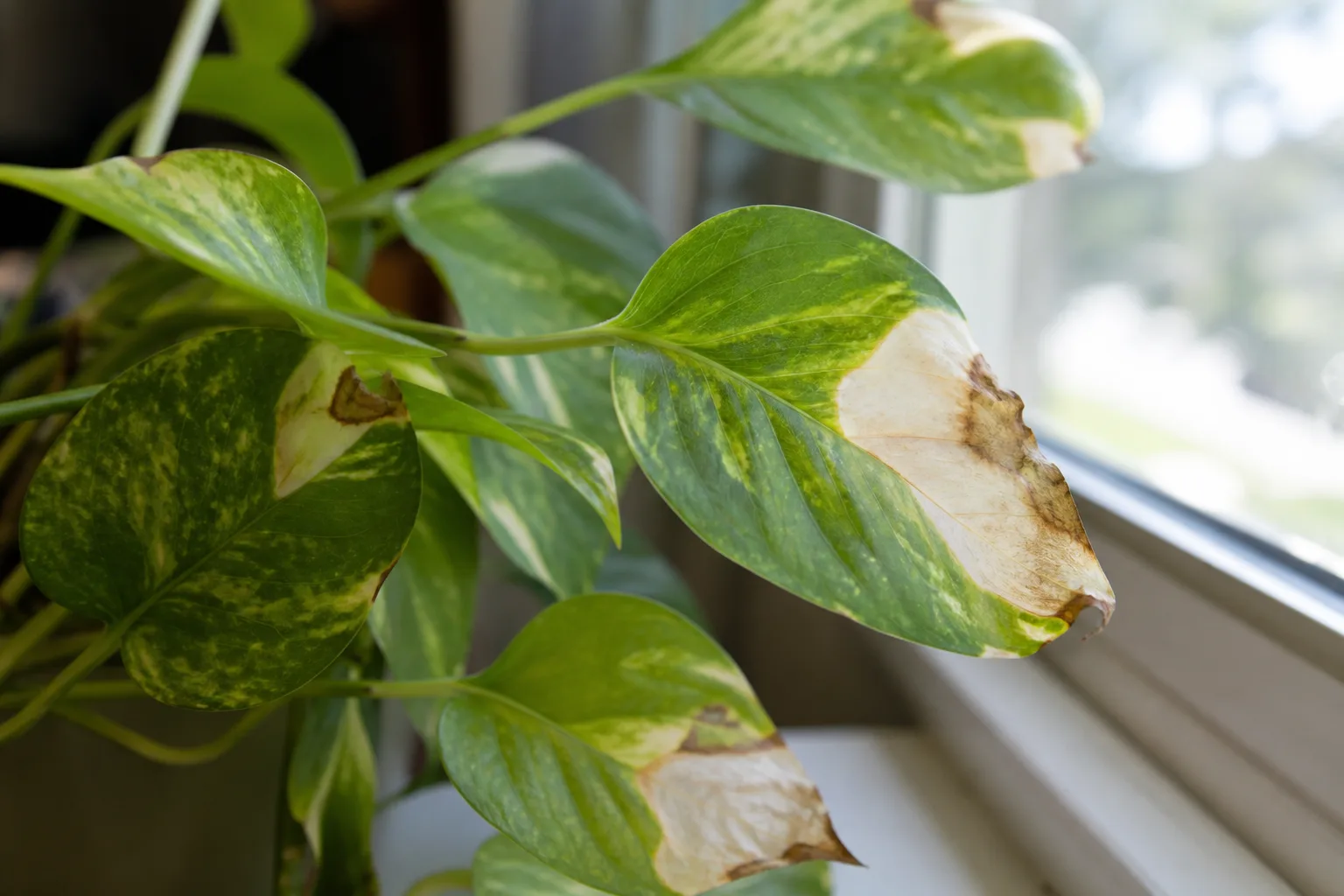
Pale, dry patches on the most exposed leaves suggest light injury; move the plant gradually rather than stripping all damaged foliage.
Move the pot a few feet back from harsh afternoon sun or filter the light with a sheer curtain. Pothos still needs usable ambient light; placing it in a dark corner to avoid sunburn can slow growth and reduce variegation. The North Carolina State Extension Plant Toolbox describes pothos as suited to filtered or shaded conditions and notes the value of good drainage.
The University of Wisconsin-Madison Extension pothos guide and The Sill’s pothos care guide both recommend bright or filtered light while warning against prolonged harsh direct sun. If the plant was recently moved, make future changes in stages over several days; already scorched tissue will remain marked, but new leaves should form without the same pale patches.
Cold drafts, heat, and abrupt temperature shifts
Pothos can show scattered brown patches after chilling or a sudden temperature swing, particularly if a vine touches cold window glass or sits in the path of an air conditioner. A central brown patch on an otherwise intact leaf after a cold night is different from a pattern of dry tips on a plant that has been chronically underwatered.
Move the pot away from exterior doors, drafty windows, heating vents, and direct air-conditioning flow. A warm room is not automatically better: hot dry air can increase water loss, while cold glass and drafts can injure leaves even when the room feels comfortable elsewhere.
The University of Wisconsin-Madison Extension specifically notes that low temperatures or abrupt changes can produce scattered brown patches on pothos. This is a reason to review the plant’s recent location history before labeling spots as fungal disease. Damaged leaves will not recover, but stable conditions give new growth a better chance.
Fertilizer and mineral-salt buildup
Excess fertilizer can leave brown or black tips and margins, sometimes with a pale crust on the mix or pot rim. Hard water and repeated feeding can also contribute to soluble mineral buildup, but a browned leaf alone cannot tell you whether fertilizer is the culprit.
If you recently fed the plant, pause fertilizing while it recovers and review the product label before resuming at an appropriate rate. If there is visible crust and the pot has good drainage and healthy roots, a thorough watering that runs freely through the mix can help carry some salts out; do not flush a plant whose container holds water or whose roots are already soft.
For ordinary indoor growth, pothos rarely needs aggressive feeding. Follow the fertilizer label, avoid stacking several products, and do not fertilize a plant that is severely stressed or waterlogged. If only one older leaf has a brown margin and there is no crust or recent feeding, investigate moisture and light before blaming salts.
Leaf disease and why spots can be misleading
Disease becomes more plausible when spots are water-soaked, dark, irregular, enlarging, or appearing on new leaves and nearby plants, especially when foliage stays wet and air movement is poor. Even then, a photo or color description is not enough to identify a pathogen with certainty.
The UF/IFAS Extension guide to pothos diseases describes Phytophthora root rot as beginning in roots and causing dark brown to black leaves as infection progresses. It also emphasizes that cultural injury can resemble disease and that accurate diagnosis depends on examining plant material for a pathogen. Its treatment recommendations are written for commercial greenhouse production, so do not copy a greenhouse fungicide program onto a household plant.
If spots are actively spreading, separate the plant from other houseplants, avoid splashing water between leaves, and keep foliage dry. Remove badly affected leaves with clean shears, bag the debris, wash your hands, and sanitize the cutting tool before using it on another plant. Leave sound stems and healthy leaves in place; cutting back every vine will not eliminate a root pathogen.
The Epic Gardening review of pothos diseases is useful for seeing how rot and leaf problems may present, but treat it as a practical overview rather than a home diagnostic test. If the plant is valuable, symptoms continue to spread, or roots and stems are deteriorating, ask a local Extension office or plant diagnostic clinic whether a sample can be evaluated.
Pests that can leave brown or stippled patches
Brown marks may also follow sap-feeding pests, but look for the insects and their feeding clues before treating. Fine pale speckling, webbing on leaf undersides, cottony deposits in leaf joints, hard bumps on stems, sticky honeydew, or black sooty growth can point toward spider mites, mealybugs, or scale rather than a watering problem.
Inspect the undersides of leaves, nodes, and the newest growth with good light. Isolate a plant with visible pests; wipe or rinse foliage where practical, and identify the pest before choosing any control. Follow the product label if a treatment is necessary, and keep it away from children and pets according to its directions.
Pest feeding often creates many tiny pale or bronze marks rather than one large sun-facing scorch patch. It can overlap with leaf decline, so correct the pest issue and the plant’s growing conditions separately instead of applying a fungicide or extra fertilizer to unexplained spots.
How to fix pothos brown spots step by step
- Separate old marks from new ones. Photograph the leaves today, then look again in several days. A stable old patch needs a different response than expanding lesions.
- Use the pattern to choose one likely cause. Window-facing scorch, cold exposure, wet soil, dry roots, fertilizer crust, or visible pests each call for a different correction.
- Correct the environment first. Adjust harsh light or drafts, empty standing water, or rehydrate a genuinely dry root ball. Avoid changing watering, light, fertilizer, and potting mix all at once.
- Prune only tissue that is dead, badly damaged, or potentially infectious. Keep healthy foliage so the plant can continue photosynthesis.
- Track new growth. If fresh spots keep appearing despite the correction, reassess the diagnosis and inspect roots, stems, and leaf undersides.
This sequence prevents a common cascade: a plant is suspected of overwatering, repotted immediately, watered again to settle the new mix, then moved into stronger light and loses more leaves. A stable plant is easier to diagnose than one subjected to several stressful changes in a day.
When to repot a pothos with brown leaves
Repot only when the container or root system needs it: roots are rotting, the mix has broken down and stays wet, drainage is blocked, or the root ball is badly crowded. Brown spots on foliage alone do not prove that the pot is too small or the soil is “bad.”
Choose a container with drainage holes only modestly larger than the root ball, and use fresh, airy indoor potting mix. A very large pot holds more wet mix around the roots and may dry slowly. After repotting, water to settle the mix, let it drain, and wait until the upper layer dries before watering again.
If root damage is extensive, remove only mushy roots and keep any viable firm roots. A plant with few healthy roots may take time to reestablish; avoid feeding it heavily or keeping it continuously wet in an attempt to force new growth.
Should you remove spotted leaves?
Remove a leaf when most of it is dead, it is collapsing, or you need to eliminate confirmed or strongly suspected infectious tissue. Otherwise, a partly green leaf still contributes energy, and there is no need to cut it off solely because it looks imperfect.
Use clean, sharp scissors and cut the leaf stalk near the vine without nicking the stem. If disease seems possible, clean the blade before moving to a healthy plant and dispose of affected foliage rather than leaving it in the pot. Do not remove every spotted leaf at once if that would leave the vine nearly bare.
Pruning cannot erase a cause that is still present. If new leaves continue to spot after you trim old ones, return to the inspection sequence and look for wet roots, a draft, sun exposure, pests, or spread between leaves.
What recovery looks like and how long to watch
Existing brown tissue stays brown. The realistic signs of recovery are that no new spots form, the plant stops losing healthy leaves, stems remain firm, and the next leaves open without the same damage.
Watch the plant over its next few weeks of active growth, but do not judge recovery by a fixed calendar. Light, season, root condition, and how much damage occurred all change the pace; in low-light winter conditions, new leaves may take longer to appear.
If a few old leaves remain marked while the rest of the plant is stable, continue normal, measured care. If brown patches keep spreading, stems soften, or several leaves yellow rapidly, reconsider the initial cause rather than increasing fertilizer or watering by default.
Prevent brown spots from returning
Give pothos bright, indirect or filtered light, stable temperatures, and a potting mix that drains. Keep the pot away from cold windowpanes, doors, heating vents, and direct air-conditioning; rotate the plant occasionally if light exposure is uneven.
Water based on the mix, not the calendar. Check the upper few centimeters and the pot’s weight, water thoroughly when the plant is ready, and let excess drain. Use a pot with open drainage, and do not leave a nursery pot standing in water inside a decorative cover.
Feed modestly and only when the plant is growing. Inspect new plants before placing them with a collection, keep leaves from staying wet, remove dead debris from the pot surface, and check leaf undersides when you water. These habits reduce common stress and make a developing pest or disease easier to notice early.
When to isolate the plant or ask for help
Isolate the pothos if spots are wet-looking and spreading, several plants develop similar lesions, you see pests, or stem and root tissue is deteriorating. This is a sensible precaution while you investigate; a single stable dry patch does not mean the plant is contagious.
Seek a diagnosis from a university Extension office or plant clinic when the damage keeps advancing, the plant has high value, or the possible cause would lead you to discard it or apply a pesticide. Provide clear photos of both leaf surfaces, stems, the soil line, and the whole plant, along with watering and location history.
The UF/IFAS pothos disease publication focuses on commercial greenhouse pathogens and explains why lab examination may be needed to tell a disease from a lookalike disorder. That distinction matters at home too: avoiding an unnecessary treatment is often safer than guessing from one brown mark.
Conclusion
Brown spots on pothos leaves can come from different problems, so start with the pattern and the plant’s recent conditions. Check light and temperature, feel the soil below the surface, make sure water drains, and look for pests or spots that are actively spreading before you repot or prune.
Correct the likeliest cause gently and change one variable at a time. The old spots will remain, but clean new leaves and stable stems are good evidence that the fix is working; ongoing spread means it is time to reassess or get a plant sample diagnosed.