How to Grow and Care for Bloodgood Japanese Maple
Learn how to grow Bloodgood Japanese maple with climate-smart light, planting depth, watering, mulch, pruning, winter protection, and fixes for scorched leaves.
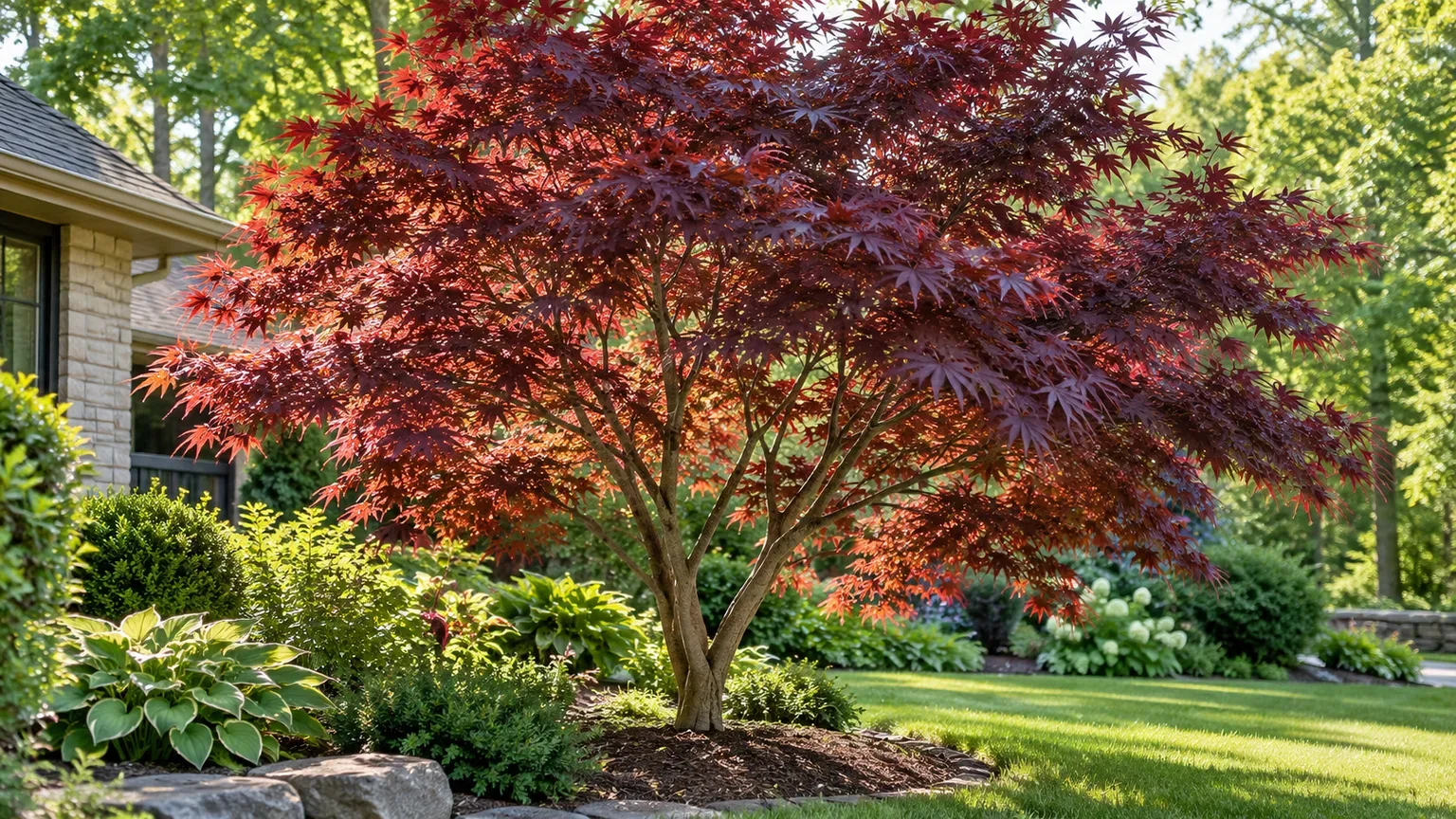
Bloodgood Japanese maple is a small, deciduous ornamental tree chosen for deep red foliage and a sculptural branch structure. It is also more substantial than a nursery tag may suggest: given time, it can reach about 15 to 20 feet tall and nearly as wide. Pick a place that can hold that canopy, protect it from punishing afternoon heat and drying wind, then keep its root zone evenly moist and well drained.
The cultivar is Acer palmatum ‘Bloodgood’, a red-leaved Japanese maple with a broad, upright-to-rounded habit. The leaves are palm-shaped, not finely cut like those of laceleaf cultivars such as ‘Crimson Queen’. That distinction affects both the look of the mature tree and the space it needs. North Carolina Extension describes Bloodgood as slow to moderately growing, hardy in zones 5a through 8b, and capable of reaching 20 feet in both height and width. North Carolina Extension’s Bloodgood profile is a useful reference, but your nursery’s cultivar tag and local climate should guide the final placement.
Bloodgood at a glance
| Need | Practical target |
|---|---|
| Mature footprint | About 15–20 feet tall and 12–20 feet wide |
| Light | Sun in cooler regions; morning sun and afternoon shade in hotter regions |
| Soil | Moist, organic, and well drained; avoid persistent saturation |
| Water | Check the root ball during establishment; water deeply when it begins to dry |
| Feeding | Little or none in the ground unless a soil test or weak growth indicates a need |
| Pruning | Minimal; remove dead, damaged, crossing, or badly placed growth |
| Hardiness | Commonly listed for USDA zones 5a–8b; wind and spring frost still matter |
Think of the table as a starting point, not a promise that the tree will perform the same in every yard. A hot wall, dry wind, compacted clay, or a small pot can change its needs more than a calendar does.
Know its mature size and natural shape
A Bloodgood may be sold as a compact young tree, but it is not a permanently miniature selection. Extension sources put the eventual height around 15 to 20 feet, with a broad canopy that can approach the same width. Growth is usually slow to moderate, so the tree may look comfortably small for years before its branches begin to occupy the space around it.
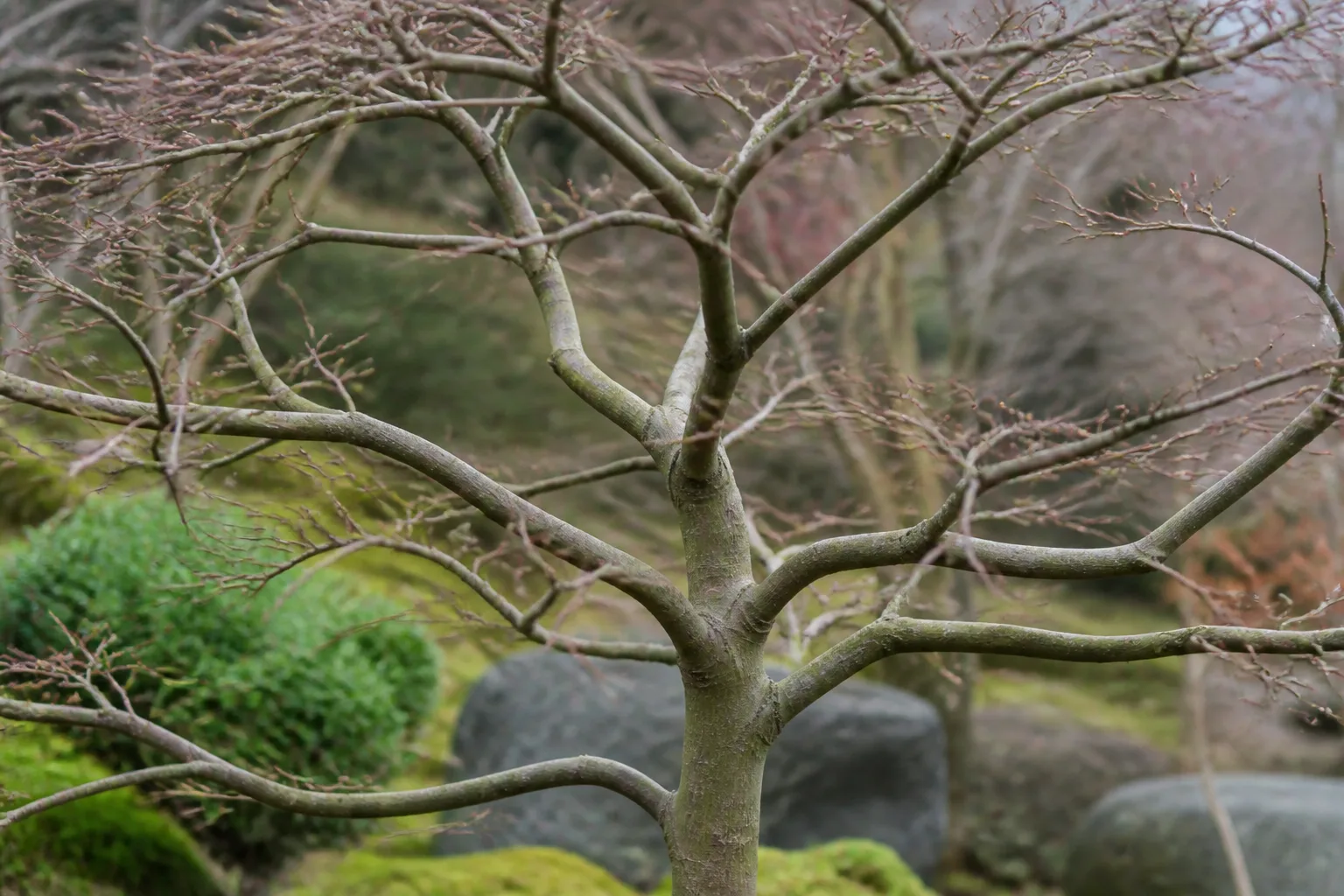
Its upright-to-rounded crown makes Bloodgood useful as a specimen, a focal point near a patio, or a small canopy tree at the edge of a woodland-style planting. The layered branches and dark red leaves have winter and fall interest too. The University of Connecticut Plant Database notes that the cultivar was selected for red color retention; foliage typically emerges rosy, deepens to burgundy in summer, and turns crimson to reddish orange in fall. A hot, dry summer can reduce that color, so “red-leaved” is a tendency, not a guarantee under stress. UConn’s Japanese maple profile describes the cultivar’s color and mature habit.
Before buying, look at the tree’s framework, not just the leaf color in the pot. Favor an evenly branched specimen with a healthy trunk, firm buds, and no dry, brown leaf margins. Ask whether it is grafted and, if possible, where the graft union sits. Leave enough room for both canopy and access; do not plan to keep an oversized tree narrow by shearing it every year.
Choose a site that fits your climate
The best location is sheltered, has open soil rather than pavement heat reflected onto the foliage, and receives light appropriate to your summer climate. Bloodgood tolerates more sun in cooler northern areas than in hot, dry southern regions. North Carolina Extension recommends partial shade in the South to limit summer scorch, while UConn describes Japanese maples more broadly as understory trees that dislike hot, dry exposures. UConn’s plant database and North Carolina Extension help explain why advice that says simply “full sun” or “shade” can mislead.
Site it away from strong prevailing winds, especially if your winters are cold or your summer winds are dry. Wind increases water loss from leaves and can dry the soil faster. Avoid a low pocket where water collects after rain, and be cautious near south- or west-facing walls, reflective paving, or dark stone that releases heat into the canopy. A bright woodland edge or a courtyard with morning sun and afternoon protection is often easier to manage than an exposed lawn.
Plan house clearance from the tree’s mature canopy, not the small nursery pot. With a 15- to 20-foot spread, half the expected width is about 8 to 10 feet from trunk to branch edge; add more room for roof overhangs, paths, or access, so a 12- to 15-foot setback may be more practical where the property allows.
Balance color, sun, and heat
Red foliage needs enough light to hold its richest color, but more direct sun is not automatically better. In a cool-summer climate, a Bloodgood can often take several hours of sun, and an open site may deepen the red tones. In a hotter region, strong late-day sun can cook the leaf edges even when the soil looks moist. Start with morning sun and dappled or filtered afternoon shade if summers are hot, then observe the tree through its first full warm season.
A useful site test is to watch the planting spot on a clear summer day before you dig. Note when direct sun reaches it, whether nearby walls or paving add reflected heat, and whether the soil stays damp after a normal rain. If the spot gets harsh afternoon sun and the soil dries quickly, choose a more protected position rather than hoping daily watering will compensate for a poor microclimate.
Give it soil that drains but does not dry quickly
Bloodgood does best in soil that holds some moisture and air around the roots. North Carolina Extension describes a preference for well-drained, organic soil and notes that heavy clay can be managed by planting slightly high or using a raised bed. The Royal Horticultural Society likewise recommends a sheltered position and humus-rich, well-drained soil. The RHS Japanese maple growing guide emphasizes drainage and organic matter rather than a narrow soil recipe.
Do not dig a small pocket and fill it with rich potting mix inside dense clay. Water can move through the amended pocket differently from the surrounding ground and collect at the boundary. Instead, test drainage across the planting area; if water remains for a long time after rain, move the tree to a raised position or improve the wider bed. Where the soil drains freely and is low in organic matter, a surface mulch is usually safer than heavily amending only the planting hole.
A slightly acidic soil is suitable, but pH alone is rarely the first problem to solve. If the tree grows weakly or shows persistent symptoms, test the soil before adding sulfur, lime, or fertilizer. Bloodgood needs moisture without standing water: a root zone that stays wet and oxygen-poor is not improved by adding more water.
Plant it at the right depth
Fall is a good planting season in many temperate regions because the weather is cooler and roots can begin settling before summer heat returns. The RHS planting window is autumn through winter where the ground is workable. In cold regions, avoid planting just before hard freeze; in warm regions, avoid planting during the hottest, driest part of the year. A spring planting can work if you can water reliably through the first summer.
Set the tree so the top of the root ball and the root flare sit at or just above the surrounding soil grade. Japanese maple roots are relatively shallow; the RHS advises covering the main roots with no more than about an inch of soil. Remove wire, twine, and excess wrapping from the upper part of the root ball, and gently loosen circling roots before planting. Keep any graft union above soil level so the rootstock does not take over.
Make the planting hole wider than the root ball but no deeper than its root flare. Backfill with the soil you removed unless a local soil test or drainage correction gives you a reason to do otherwise. Water slowly to settle soil around the roots, and check that the tree has not sunk after watering. Stake only if the trunk or root ball rocks in wind; a tree that can move slightly often develops a stronger trunk, so remove supports once it is stable.
Water by establishment stage, not by habit
A newly planted Bloodgood needs closer attention than an established tree, but “water twice or three times every week” is not a reliable schedule for every soil and season. Water slowly enough to wet the root ball and nearby soil, then check the moisture a few inches down before watering again. The soil should feel cool and slightly moist, not saturated or dusty dry. During hot, windy weather, check more often; after cool rain, skip watering if the root zone is already wet.
The first season is the critical one because roots have not yet spread far beyond the nursery root ball. A common failure is wetting the surrounding mulch while the original container mix stays dry, or watering only the trunk area while the outer root ball dries. Probe the root ball itself in two or three places. If it is dry below the surface, apply a slow soak near the canopy edge and around the ball.
Once established, water during a prolonged dry spell, especially if the tree is planted in sandy soil, competes with lawn roots, or sits near hot paving. Do not react to a single curled leaf by flooding the bed. Check moisture first; chronic saturation starves roots of oxygen and can contribute to root decline. A drip line or soaker hose can deliver water evenly, but still inspect the soil so the system does not keep a poorly drained site wet.
Mulch the root zone without burying the trunk
Mulch buffers soil temperature, slows evaporation, and reduces competition from turf. Spread a 2- to 3-inch layer of shredded bark, leaf mold, or another coarse organic mulch over the root zone, extending toward the canopy drip line as space allows. Keep the material several inches away from the trunk and do not pile it against the root flare. The root zone of a Japanese maple is shallow, so a wide, thin mulch ring is more useful than a deep mound at the base.
Refresh mulch when it has decomposed or thinned, usually once a year after checking the depth. If the soil stays consistently wet, pull mulch back and improve drainage rather than adding more organic material. In winter, a mulch layer moderates freeze-thaw swings around young roots, but it cannot protect branches exposed to severe wind or late frost.
Fertilize only when the tree needs it
An established Bloodgood growing in reasonably fertile soil usually needs little supplemental fertilizer. North Carolina Extension notes that the tree requires minimal nutrients, and RHS guidance says in-ground Japanese maples generally do not need feeding. Excess nitrogen can push soft, rapid growth that is more vulnerable to heat, frost, or wind damage; fertilizer will not correct scorched leaves caused by sun exposure or dry roots.
If the tree has weak growth despite sound light, moisture, and drainage, test the soil before feeding. Follow the test’s recommendation and use a measured dose in the season when the tree can use it, typically as growth resumes in spring. Do not fertilize a drought-stressed or newly planted tree to force it to establish faster. A container-grown maple is different because nutrients wash out of the potting mix; use a modest, labeled slow-release feed in spring only if the product is suitable for woody container plants.
Prune lightly to preserve its framework
Bloodgood is valued for its natural branching pattern, so annual shearing usually makes it look worse and creates repeated maintenance. Prune to remove dead, broken, crossing, or rubbing branches, or to keep a branch from interfering with a path. If a branch is alive, healthy, and has enough room, leaving it alone is often the best choice.
Timing recommendations vary with climate because maples can bleed sap as the season warms. North Carolina Extension lists February as a dormant pruning window, while the RHS and Savvy Gardening recommend pruning Japanese maples from summer or autumn through midwinter and avoiding late winter or spring sap flow. The RHS guide and Savvy Gardening’s pruning guide both stress restrained pruning. Use your local extension’s timing if it differs; the practical rule is to make structural cuts while the tree is dormant but before sap begins rising, then stop once buds swell. Dead or hazardous wood can be removed when needed.
Start by viewing the tree from all sides and identifying the branch you want to correct. Follow it back to a well-placed lateral or the branch collar and make a clean cut just outside the collar; do not leave a stub or cut flush against the trunk. Use sharp, clean tools sized to the branch; Gardening Know How’s Japanese maple pruning guide also stresses clean blades and selective cuts. Avoid topping, hedge shears, and removing a large share of live canopy in one session. If the tree needs major structural correction or is near wires, consult an arborist rather than trying to make several large cuts yourself.
Protect the roots and new leaves through winter and spring
A Bloodgood is commonly rated for USDA zones 5a through 8b, but a zone rating describes average winter lows; it does not guarantee that tender spring leaves will escape a late freeze or that exposed branches will tolerate every winter wind. Because the tree can leaf out early, a sudden frost may brown fresh growth. If this happens, wait until new growth resumes before deciding a branch is dead. Frost-burned leaves often look dramatic but do not necessarily mean the tree itself is lost.
Choose a site sheltered from drying winter winds. Keep a moderate mulch layer over the root zone and continue watering during a dry autumn before the ground freezes. Do not wrap the whole canopy as routine care; that can trap moisture and damage branches. Instead, protect the root zone and avoid planting in a wind tunnel or exposed corner.
Container roots are more vulnerable to cold than roots in the ground. Move a potted tree to a sheltered, unheated location, group pots, or insulate the container before severe freezes, while preserving its dormant winter cycle. A heated room is not a suitable winter home for a deciduous outdoor tree.
Grow Bloodgood in a container with realistic expectations
Bloodgood can grow in a container, but a pot does not permanently cap an otherwise large tree at its current nursery size. Choose a heavy container with generous drainage holes and enough room for the existing root ball plus several years of growth. Position it where the canopy receives suitable light but the pot does not bake on a reflective patio. Container soil dries much faster than garden soil, especially in wind and heat, so check it frequently and water thoroughly when the mix begins to dry.
Use a well-draining potting medium formulated for woody plants, and never leave the pot sitting in a saucer of water. Repot into a slightly larger container as roots fill the space; avoid jumping to a very large pot, where unused mix can stay wet too long. Long-term container trees may eventually need expert root pruning or a smaller cultivar better suited to restricted roots. Protect the pot itself during winter because cold can reach the root ball from every side.
A container is most useful when you want to move a young tree out of hot afternoon sun or place it on a patio with good drainage. It is not a shortcut for keeping a mature 15- to 20-foot cultivar tiny without recurring root and canopy work.
Troubleshoot leaf color and leaf damage
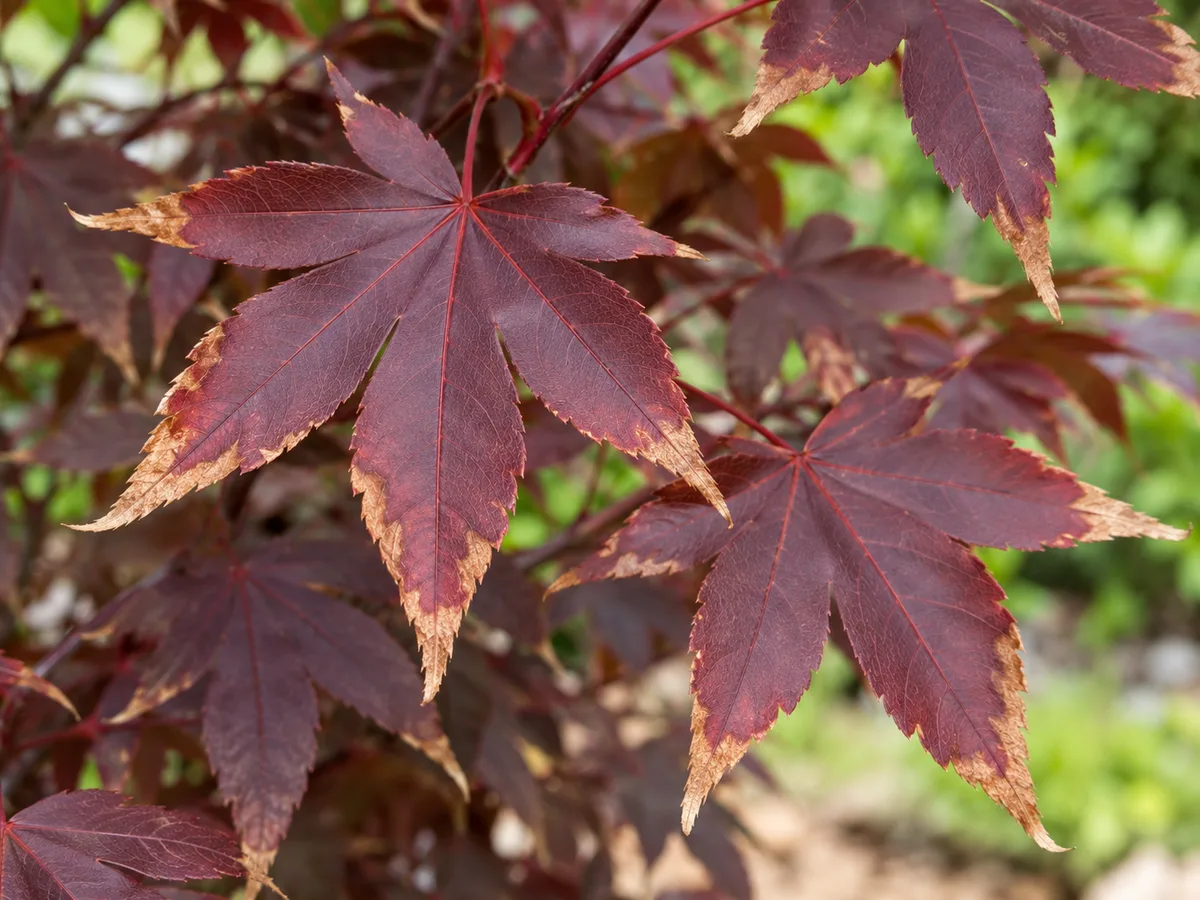
A red-leaved maple changing tone does not always mean it is sick. Bloodgood leaves emerge rosy, deepen to burgundy as they mature, and shift again in autumn; shade, heat, and drought can all affect how intense the color looks. Diagnose a pattern and check the site before applying fertilizer or pesticide.
Tell scorch, drought, and waterlogging apart
Leaf scorch often begins as crisp tan or brown edges and tips on the sun- or wind-exposed side of the canopy, especially during hot, dry weather. If the root zone is dry, water slowly and deeply, then add mulch if it is thin. If the soil is already moist, do not keep watering: reduce afternoon exposure if possible, check for reflected heat, and wait for fresh growth rather than cutting every browned leaf off immediately.
Drought and waterlogging can both cause curling or wilting, which is why a symptom alone is not a watering instruction. Probe the soil in the original root ball and the surrounding bed. A dry root ball calls for a deep soak; a wet, sour-smelling bed calls for better drainage and less irrigation. Correcting the cause helps new leaves; damaged leaf tissue will not turn green again.
Yellowing can follow a wet root zone, drought, natural autumn color change, or nutrient imbalance. Check whether discoloration affects one branch, one side, or the entire canopy and note the time of year. Avoid treating chlorosis with iron or general fertilizer unless a soil test and symptom pattern support that diagnosis.
Sudden wilt, progressive branch dieback, or a whole section failing while nearby branches remain healthy deserves closer inspection. Poor drainage can predispose Japanese maples to root problems, and Verticillium wilt is a serious possibility in some soils, but many other causes look similar. Photograph the affected branch, check recent watering and injury, and ask a local extension diagnostic service before applying fungicide or removing large parts of the tree.
Watch for pests and disease without overreacting
Aphids, scale insects, mites, borers, and leaf-feeding insects can affect Japanese maples, but a few insects do not automatically require treatment. Inspect leaf undersides, twigs, and the trunk. Sticky honeydew, fixed scale-like bumps, fine stippling, or holes can help distinguish feeding damage from heat scorch. Keep the tree watered appropriately and avoid unnecessary broad-spectrum insecticides that can harm beneficial insects.
North Carolina Extension lists Japanese maple scale and other maple insects among potential problems for Bloodgood. If you find a pest, identify it before acting; scale and mites need different approaches, and pesticide labels and timing matter. For large trees or persistent outbreaks, consult a local extension office or certified arborist. Also check for animal browsing and mechanical trunk injury, which are easy to mistake for disease.
Propagate the cultivar carefully
Seeds from a Bloodgood may germinate, but the seedlings will not reliably have the same foliage color, habit, or growth rate as the named cultivar. Horticultural cultivars are commonly propagated by grafting or selected cuttings, methods that preserve the desired plant more reliably than seed. North Carolina Extension’s cultivar profile lists grafting and stem cuttings as propagation methods.
For most home gardeners, buying a healthy, correctly labeled nursery tree is the dependable option. If a shoot appears from below the graft union, compare its leaves with the upper canopy; it may be rootstock growth rather than Bloodgood. Remove a confirmed rootstock sucker close to its origin while it is small, and do not mistake a normal branch emerging above the graft for a problem.
Avoid the mistakes that shorten its good years
The common care errors are usually site and root problems, not a failure to fertilize. Planting where hot afternoon sun reflects off a wall, setting the root flare too deep, keeping the soil constantly wet, or letting a new root ball dry out can all create stress that looks like a disease.
Do not use pruning as a substitute for choosing a tree with enough room. Do not add fertilizer to treat every yellow or scorched leaf. Do not plant a Bloodgood from seed expecting the parent’s color, and do not assume a hardiness-zone label protects new leaves from late frost. Check the planting depth, soil moisture, light pattern, and canopy shape before taking corrective action.
Conclusion
Bloodgood Japanese maple is a durable small landscape tree when its roots stay cool and aerated and its canopy is matched to local summer conditions. Give it a sheltered site with suitable sun, moist but well-drained soil, a wide mulch ring, and enough room for a canopy that may reach 15 to 20 feet across. Water the root ball based on soil checks while it establishes, feed sparingly, and prune only to preserve a sound natural framework.
If leaf edges brown, begin with the weather and root-zone moisture; if soil stays wet or dieback spreads, seek a diagnosis before treating. Those few decisions—site, planting depth, moisture, and restraint—matter far more than a complicated maintenance calendar.