10 Best Varieties of Heuchera for Garden Beds and Pots
Find coral bells for your garden by matching foliage color to sun, shade, heat, and soil drainage. See 10 heuchera varieties and practical planting tips.
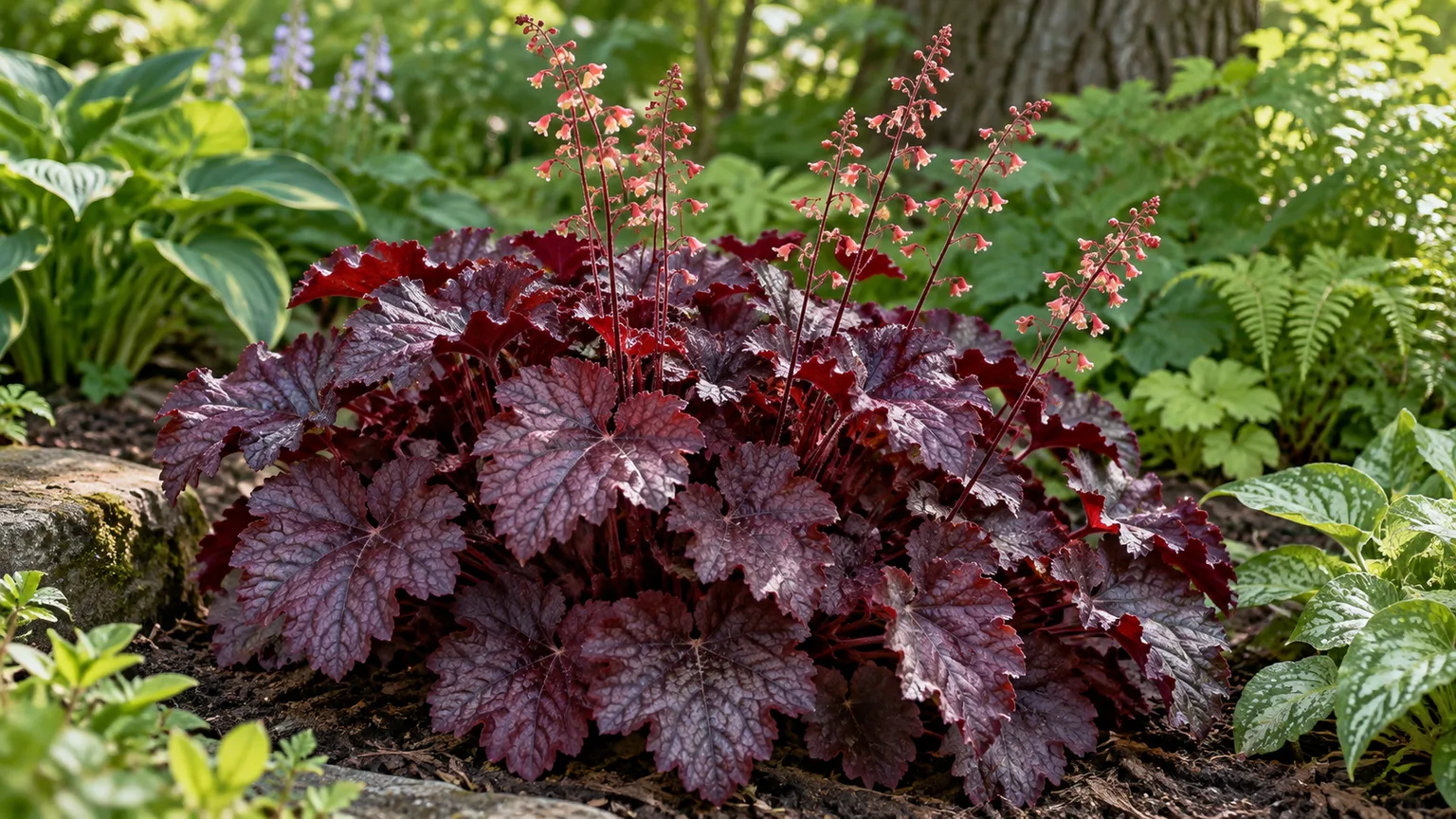
The best heuchera is the one that keeps its foliage attractive in your light, soil, and summer weather. For a shady bed, ‘Lime Marmalade’ and ‘Electra’ brighten the foreground; for warm, changing tones, ‘Caramel’ and ‘Amber Waves’ are stronger picks; for dark contrast, try ‘Melting Fire’ or ‘Midnight Rose’. A container gives you more control over moisture and lets you bring the leaves close enough to appreciate their patterns.
Heuchera, commonly called coral bells or alumroot, is grown mainly for low mounds of patterned leaves, with delicate flower wands rising above them in spring or summer. The genus includes many species and named selections and hybrids, so exposure, mature size, flower color, and hardiness should be checked by cultivar rather than assumed from the common name. NC State Extension’s profile of the genus documents this diversity and lists cultivars with markedly different foliage and flower traits.
Best Heuchera Varieties at a Glance
| Variety | Foliage and flowers | Best fit | Watch for |
|---|---|---|---|
| ‘Melting Fire’ | Ruffled red-burgundy leaves; pale flower wands | A dark front edge or container | Strong afternoon sun can scorch dark leaves |
| ‘Lime Marmalade’ | Bright chartreuse foliage | Brightening shade and pairing with purple leaves | Color may wash out in harsh sun |
| ‘Electra’ | Lime leaves with contrasting red veins | A focal clump near a path | Keep its foliage from drying in heat |
| ‘Venus’ | Silvery leaves with dark veining | Moon gardens and cool-toned shade beds | Silver foliage is vulnerable to bleaching and scorch |
| ‘Caramel’ | Peach, amber, and rust tones | Woodland edges and warm-color containers | Best color depends on light and season |
| ‘Can Can’ | Ruffled purple-silver leaves with contrasting undersides | Texture and foliage contrast | Use sparingly beside other busy patterns |
| ‘Amber Waves’ | Pink new growth maturing to rusty gold | A warm accent in a part-shade border | Too much sun can fade or burn leaves |
| ‘Midnight Rose’ | Deep purple leaves dotted with magenta | A close-up accent or container | Speckles are most visible when leaves are healthy |
| ‘Delta Dawn’ | Green-gold leaves with red veining and pale edges | Morning-sun borders | Avoid strong afternoon sun in hot weather |
| ‘Zipper’ | Strong orange, red, and purple tones | One vivid accent among calmer foliage | Too many bright colors together can look noisy |
The table is a shortlist, not a promise of identical results in every garden. Foliage color shifts with maturity, light, temperature, and water, and nurseries may carry different stock from year to year. Treat cultivar photos as a preview, then confirm the plant’s mature spread and regional hardiness on the current label.
What Makes One Heuchera Better for Your Site?
A heuchera label usually names a cultivar, not a single wild species. Modern coral bells often descend from crosses among species such as H. americana, H. sanguinea, H. villosa, and H. micrantha. That matters because parentage influences leaf size, flowering, tolerance of heat and humidity, and winter performance; two plants sold under the same genus name can need different conditions. Terra Nova Nurseries’ overview of heuchera breeding describes how crossing species expanded both foliage colors and garden performance.
For a dependable starting point, look for a site with morning sun or dappled light, afternoon protection, and soil that stays lightly moist but drains freely. Many cultivars tolerate more sun when they receive enough water, but a “full sun” label does not mean they will enjoy hot reflected light beside paving in a dry summer. Oklahoma State University Extension notes that part shade suits coral bells broadly, while cultivar and foliage color affect how much sun is practical; light foliage benefits from shelter from hot rays, and dark-leaved forms generally take more light. (Oklahoma State University Extension’s coral bells guidance)
Choose foliage for a job. A chartreuse or silver plant catches the eye in shade, a purple cultivar makes a strong anchor against green ferns, and amber tones warm a cool woodland edge. Think in repeated clumps rather than one of every color: two or three cultivars repeated along a border usually read more clearly than a row of unrelated single plants.
10 Heuchera Varieties Worth Growing
These ten cultivars offer different colors and textures, but none is a universal winner. Choose the one whose strongest feature suits your bed, then place it where its leaves can stay clean and hydrated.
1. ‘Melting Fire’
‘Melting Fire’ is a good choice when you want dark foliage with a lively outline. Its ruffled leaves make a dark, textured mound; the color may read burgundy, purple, or brownish depending on light and season. Pale flower stalks rise above it without obscuring the foliage. The plant reads well at the front of a border, beside a pale stone path, or in a container where the leaf texture is easy to see.
Give it morning sun or bright partial shade, with protection from hot afternoon exposure in warm climates. Dark leaves can still scorch when heat and dry soil arrive together, so don’t use its dark color as proof that the plant is drought-proof. Terra Nova Nurseries notes that ‘Melting Fire’ was introduced as a ruffled dark-leaved strain; the foliage effect is the reason to choose it, not a claim that every plant will hold the same red through the season. (Terra Nova’s heuchera overview)
2. ‘Lime Marmalade’
For the brightest chartreuse mound in the list, choose ‘Lime Marmalade’. Its luminous leaves make a shaded bed look less flat and contrast strongly with dark foliage, hosta, or green ferns. Plant it where you see it from a window or path; the leaf color makes more impact at close range than the small, airy blooms.
Bright foliage needs a gentler site than its color suggests. Use dappled light, morning sun, or bright shade, and avoid the hottest afternoon rays in regions with strong summer sun. If you want chartreuse plus conspicuous red veining, ‘Electra’ is the better match; choose ‘Lime Marmalade’ when an even field of bright foliage is the goal.
3. ‘Electra’
‘Electra’ is a standout for leaf pattern: lime-green blades are traced with deep red veins. The contrast is visible from a few feet away, which makes this cultivar useful near a walkway or at the front of a mixed border where the leaves won’t disappear behind taller plants. NC State Extension lists the cultivar with its bright green foliage and red veins, a more diagnostic description than a generic “colorful coral bells” label. (NC State Extension’s Heuchera profile)
Plant ‘Electra’ in partial shade or gentle morning light, especially in a hot or dry garden. Its bright leaf surface can look tired quickly if exposed to harsh afternoon sun without steady root moisture. Pair it with a calmer, broad green leaf such as a hosta instead of several other strongly veined plants; that makes the red lines easy to notice.
4. ‘Venus’
Choose ‘Venus’ for a cool, silvery accent. The rounded leaves have a metallic cast with dark veins, a combination that catches the soft light in a moon garden or under deciduous trees. It pairs well with purple foliage, white flowers, or deep green ferns because the silver bridges bright and dark colors without adding another saturated hue.
Treat silver foliage as a reason to give the plant a protected spot, not as permission to plant it in blazing sun. A little morning light can sharpen the pattern, while a hot west-facing bed may bleach or burn the leaves. If the site is deeply shaded and the color looks muted, move a new plant gradually toward more ambient light rather than shifting it suddenly into full sun.
5. ‘Caramel’
‘Caramel’ earns its place for warm foliage that changes from peach to amber and rust as leaves mature. The shades look natural beside bark, stone, and woodland plants, and the cultivar can warm a border where flowers are not the main display. It also works well in containers, where the soft orange tones can be viewed against a dark pot or evergreen background.
It is a flexible choice for gardeners who want seasonal color without a bright red or purple focal point. Better Homes & Gardens describes young peach leaves maturing to amber and warns that too much direct sun can burn them, so favor morning light and afternoon shade in hot regions. (Better Homes & Gardens’ coral bells guide) Water newly planted ‘Caramel’ regularly while roots establish; do not let the root ball dry repeatedly just because the cultivar is often selected for warm climates.
6. ‘Can Can’
‘Can Can’ adds texture as much as color. Its puckered, ruffled leaves mix dusky purple, silver, and mauve, with contrasting undersides that show when the foliage lifts or moves in a breeze. Use it as a tactile accent near a path, where visitors can notice the leaf shape, or combine it with simple green groundcovers to let the ruffles stand out.
The trade-off is visual intensity: ruffling plus metallic color plus dark undersides can compete with other patterned plants. A single group of three is more effective than scattering it between bright-veined companions. Give it partial shade and a well-drained bed, and remove only damaged leaves rather than cutting the whole mound down for tidiness.
7. ‘Amber Waves’
‘Amber Waves’ is the pick for a changing warm palette. Its young foliage begins pink or salmon and deepens into rusty gold, with wavy leaf edges that keep the mound interesting when it is not flowering. It can bridge spring and autumn colors, especially beside blue-green foliage or a burgundy cultivar.
The color shift is part of the appeal, so don’t expect every leaf to remain the same orange. Better Homes & Gardens describes the young leaves as salmon-pink and mature foliage as rusty gold with lavender overtones, while Oklahoma State includes the cultivar among its coral bells collection. (Better Homes & Gardens’ variety notes) Give it bright partial shade or mild morning sun; in dry heat, afternoon protection helps foliage avoid bleaching and brown margins.
8. ‘Midnight Rose’
‘Midnight Rose’ has deep wine-purple leaves marked by scattered magenta speckles. The effect is strongest when the plant is viewed close up, so use it beside a path, patio, or garden bench rather than at the back of a large bed. It can also provide a dark visual anchor among brighter lime, silver, or cream foliage.
Use the speckled leaves as a focal point instead of expecting them to carry an entire mixed border. The dark background gives the pink marks contrast, but drought stress and leaf scorch can make the foliage look dull or ragged. Grow it in partial shade with evenly moist, well-drained soil, and keep a little space around the mound so the unusual markings are not hidden by neighboring leaves.
9. ‘Delta Dawn’
‘Delta Dawn’ is suited to gardeners who like a precise leaf pattern rather than a solid-color mound. The green leaves carry warm red veining and pale edging, so the plant reads as a bright accent without being as intense as a fully chartreuse cultivar. A half-day of gentle light, especially in the morning, helps bring out the pattern while avoiding the worst heat of late afternoon.
Use it along a shaded path or in a border with dark green leaves as a backdrop. Leave enough room for its mature mound instead of squeezing it between aggressive groundcovers, which can cover the foliage and compete for moisture. ‘Delta Dawn’ is a better choice for dappled light than for a dry, exposed bed beside hot stone.
10. ‘Zipper’
‘Zipper’ is the most energetic color choice here, with orange, red, and purple tones that make a compact mound feel almost electric. Use it as one deliberate accent in a container or small border rather than repeating it among several similarly vivid plants. A silver or plain green companion gives the eye a resting place and makes the cultivar’s mixed colors look intentional.
This is not the easiest choice for a quiet, naturalistic palette, and its color may shift with season and exposure. Give it morning sun or partial shade and keep water available during dry spells. If you are unsure how bold it will look in your bed, start with one plant or a container before committing to a repeated mass.
Choose by Sun Exposure and Local Climate
Light tolerance depends on the cultivar and the heat load, not just the number of sun hours. Three hours of morning light in a cool climate is different from three hours of late-afternoon sun reflecting off a wall. Oklahoma State Extension says many coral bells tolerate full sun if properly watered, but light-leaved cultivars are better protected from hot rays, and dark-leaved forms often handle more exposure. Kansas State Extension also cautions that hot, dry conditions can cause leaf scorch in full sun. (Kansas State University Extension’s Heuchera notes)
Use this simple placement rule:
- Hot summers or west-facing exposure: choose bright shade or morning sun; shelter chartreuse, silver, and peach foliage from late-day heat.
- Cooler summers or northern beds: more sun may improve color, but check the cultivar label and keep roots from drying.
- Humid regions: prioritize drainage and air movement; a shady site that stays wet can be harder on crowns than a brighter, well-drained bed.
- Deep shade: expect fewer flower spikes and sometimes less vivid foliage. If the leaves stretch or lose color, increase ambient light gradually.
A nursery may list a plant for a broad hardiness range, but that range describes winter survival, not how well the foliage will look in summer. A cultivar suited to cold winters can still scorch in a hot, dry microclimate. As one example of cultivar-specific guidance, Gardenia’s profile for ‘Pink Panther’ says it can grow in full sun only if soil remains consistently moist; that should not be generalized to every coral bells cultivar. (Gardenia’s ‘Pink Panther’ profile)
Choose by Color and Companion Plants
Start with the color already doing the most work in the bed. If the area feels dark, a chartreuse selection such as ‘Lime Marmalade’ adds contrast; if the bed feels too bright or busy, a purple mound such as ‘Melting Fire’ gives it a visual anchor. ‘Caramel’ and ‘Amber Waves’ bring warmth, while ‘Venus’ and ‘Can Can’ add silver and texture without relying on bright flowers.
Repeat a color two or three times so the planting feels connected. A useful combination is chartreuse coral bells with a dark purple heuchera and a broad green hosta; another is ‘Caramel’ with ferns and blue-green foliage for a softer woodland palette. Keep strongly veined or speckled varieties near a simple background, and avoid pairing several similarly busy leaf patterns side by side.

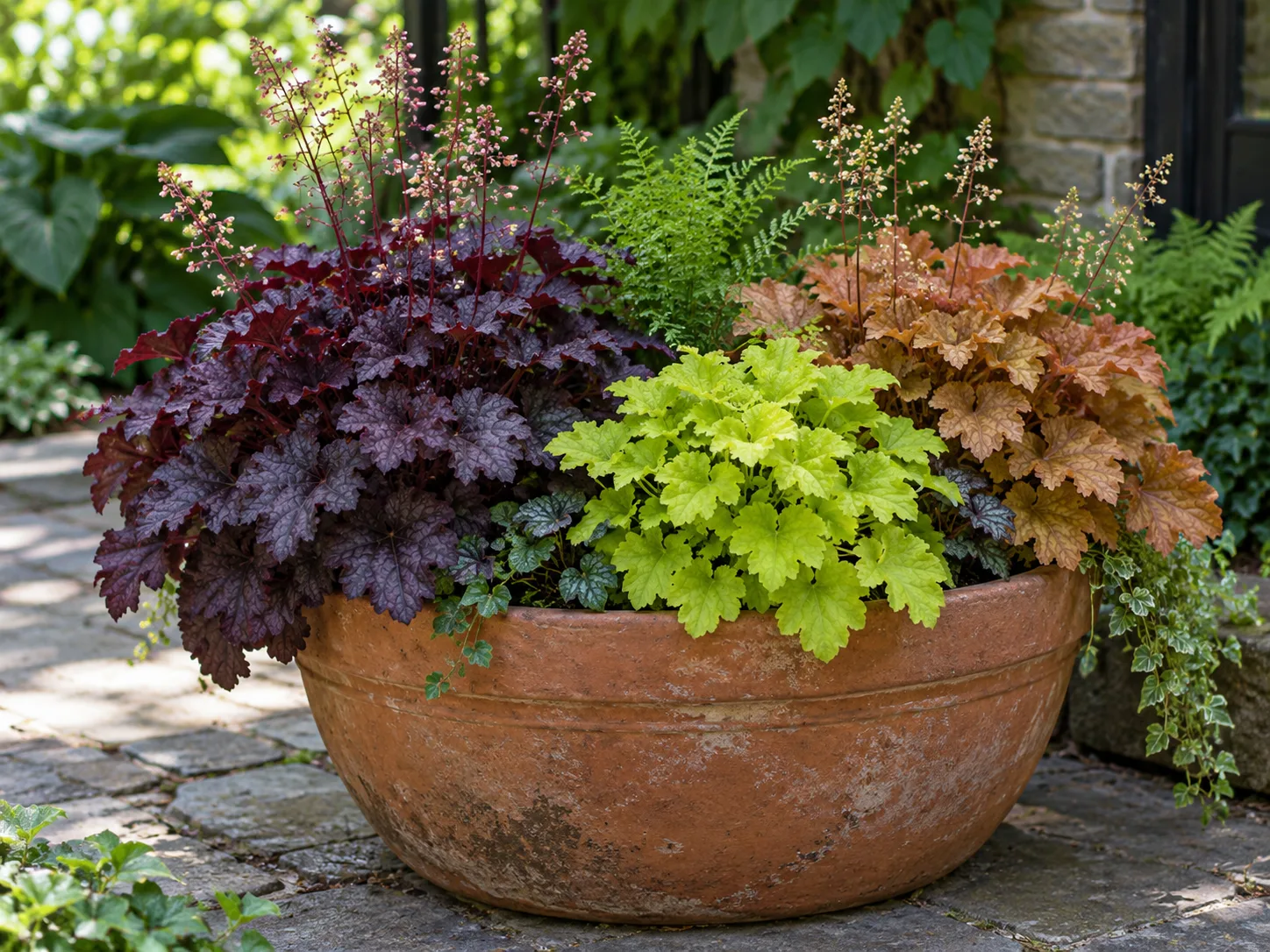
For a small patio, use one heuchera as the centerpiece of a container and add a trailing or fine-textured companion around the edge. Use a pot with drainage holes and a moisture-retentive but open potting mix; containers dry faster than garden soil, so check them more often during hot weather. A wide pot also gives the foliage mound room to spread without hiding the contrasting colors.
Plant Heuchera So the Crowns Stay Healthy
Set heuchera in spring or early fall, when the soil is workable and temperatures are moderate. Choose a place with the right afternoon light first, then check that water drains away after rain; improving drainage is more useful than digging a deep planting hole in compacted clay and filling it with a different soil that may hold water like a bowl.
Blend compost into the planting area if the soil is poor in organic matter, but do not make the planting pocket excessively rich or wet. Set the root ball so the crown—the point where leaves emerge—rests at or just above the soil surface. Burying the crown encourages rot, while leaving the whole root ball high and exposed makes drying and frost heaving more likely.
Water thoroughly after planting and keep the root zone evenly moist during establishment. Once the plant is rooted, many heucheras tolerate short dry periods, but their shallow roots can dry quickly in a sunny bed or container. Water the soil rather than spraying the leaves, and reduce watering when cool weather slows growth.
If you are planting several cultivars, use the mature width on the label to space them. A close carpet may look full sooner, but crowded leaves trap moisture, obscure each plant’s shape, and make it harder to remove damaged foliage. Allowing airflow also helps reduce the chance of powdery mildew in susceptible varieties.
Care for Coral Bells Through the Year
Keep the routine light. A thin layer of compost in spring is usually enough for an established bed; excessive fertilizer can push soft foliage and reduce flowering. Remove dead or badly scorched leaves as they appear, and cut flower stems at the base after the display if you prefer a tidy mound. Leave healthy leaves in place, especially in autumn, rather than shearing the crown down to the soil.
Heuchera may be evergreen or semi-evergreen depending on the cultivar and winter conditions. In cold climates, freeze-thaw cycles can push shallow crowns upward. After the ground begins to freeze, add a light layer of mulch around the base without burying the crown; check in early spring and gently reset an exposed plant as the soil thaws. Oklahoma State Extension also recommends light mulch against frost heaving and cautions against wet, soggy soil, particularly in winter. (Oklahoma State University Extension’s coral bells guidance)
Older clumps sometimes develop a bare or woody center while newer rosettes form around the edge. Divide only when the mound is thinning, the crown is rising, or the plant needs more room; healthy clumps do not need to be disturbed on a rigid schedule. Kansas State and Better Homes & Gardens both describe division every three to four years as a useful renewal interval, but the plant’s condition is a better trigger than the calendar. (Kansas State University Extension’s division guidance)
To renew a clump, lift it in spring or fall, separate healthy rooted offsets from the older center, and replant each division with its crown level with the soil surface. Water the divisions well and keep them from drying while new roots establish. If a plant browns after a hot spell, first check exposure and root moisture; moving it or correcting drainage is more likely to help than adding fertilizer.
What to Check on the Nursery Label
Before you buy, confirm the cultivar name, mature width, hardiness range, and light guidance on the tag or nursery listing. If you are gardening in a hot or humid region, look for a cultivar with documented regional performance or a heat-tolerant parentage, and ask the nursery how it performs locally. Do not compare plants only by the printed height: flower stalks may rise well above the foliage mound, and a compact mound can still spread wide.
Check the plant itself for a firm crown and several healthy leaves, not just the brightest color in the display. Avoid a pot where the crown is buried, the root ball sits in standing water, or leaves show widespread crispy margins. A few damaged outer leaves are usually less important than a root system that smells sour or a crown that has softened.
Cultivar names and stock can change from one season to the next. If a specific variety is unavailable, ask for a substitute that matches the job—chartreuse for bright shade, amber for warmth, silver for cool contrast, or dark purple for a visual anchor—then verify its light and hardiness needs separately. For the broader growing routine after you choose, see our coral bells growing guide.
Conclusion
The strongest heuchera varieties give you a distinct leaf color or texture and still fit the real conditions of your garden. Start with the site: morning versus afternoon sun, summer heat, drainage, and how often you can water. Then choose from chartreuse ‘Lime Marmalade’ or veined ‘Electra’ for brightness, ‘Caramel’ or ‘Amber Waves’ for warmth, or ‘Melting Fire’ and ‘Midnight Rose’ for dark contrast.
Plant the crown at soil level, keep roots moist but never waterlogged, and protect foliage that scorches in hot afternoon sun. When a clump becomes thin or woody, divide its healthy offsets and replant them. That site-first approach will give your coral bells a better chance to keep their color and shape than choosing by a catalog photo alone.