12 Best Evergreen Flowering Plants for Gardens
Choose evergreen flowering plants for shade, sun, or ground cover. See which stay leafy in your zone, when they bloom, and how to avoid soil and pruning mistakes.
A flowering evergreen can do two jobs in a border: hold its leaves through the season when many neighboring plants are bare, then make a distinct flower display at its own time of year. That combination is useful for foundation beds, woodland edges, paths, and small gardens where each plant needs to earn its space.
The key qualification is that evergreen describes the foliage, not the flower schedule. These plants do not all bloom continuously, and some are only evergreen in climates that suit them. Use the list as a shortlist: verify the species or cultivar on its plant label, then match its hardiness, light, soil, and mature size to your garden.
| Plant | Typical bloom window | Best starting point | Foliage caveat |
|---|---|---|---|
| Japanese camellia | Late winter to spring; cultivar-dependent | Sheltered part shade, acidic soil | Evergreen in its suitable climate |
| Rhododendron | Spring, depending on species | Dappled shade, moist acidic soil | The genus includes deciduous plants |
| Evergreen azalea | Spring | Part shade and acidic soil | Many azaleas are deciduous |
| Mountain laurel | Late spring to early summer | Cool, moist, well-drained acidic soil | Evergreen broadleaf shrub |
| Japanese pieris | Early spring | Part shade and acidic soil | Evergreen leaves; buds form ahead of bloom |
| Winter heath | Winter to early spring, cultivar-dependent | Sun and sharply drained soil | Low evergreen foliage |
| Winter daphne | Late winter to early spring | Sheltered site and excellent drainage | Cold-sensitive at range edges |
| Chinese fringe flower | Spring | Sun to part shade in mild climates | Can be semi-evergreen after cold winters |
| Candytuft | Early to late spring | Full sun and fast drainage | Can be semi-evergreen in cold regions |
| Lenten rose | Late winter to spring | Cool shade and well-drained soil | Evergreen mainly in mild climates |
| Creeping phlox | Spring | Sunny, open, well-drained spot | Better described as semi-evergreen |
| Creeping myrtle | Spring into summer | Shade or part shade | Evergreen, but invasive in some regions |
Start by matching foliage, bloom, and climate
An evergreen keeps foliage through winter in the conditions it is adapted to; it does not mean every leaf remains unchanged forever. Plants replace older leaves gradually, and severe cold, drying wind, drought, or heat can cause bronzing, scorch, or leaf drop. Horticultural descriptions sometimes use “semi-evergreen” for plants that retain most leaves in mild winters but lose more in colder ones. The Royal Horticultural Society’s evergreen foliage guide treats persistent foliage as year-round structure, a useful way to think about the plant’s role even when its flowers are seasonal.
Bloom dates also move with latitude, elevation, winter temperatures, and cultivar. A camellia that flowers in late fall in a warm coastal garden may flower in winter or early spring farther north, while a late freeze can damage buds without killing the shrub. Treat “winter-blooming” and “spring-blooming” as a planning window, not a guaranteed calendar date.
1. Japanese camellia
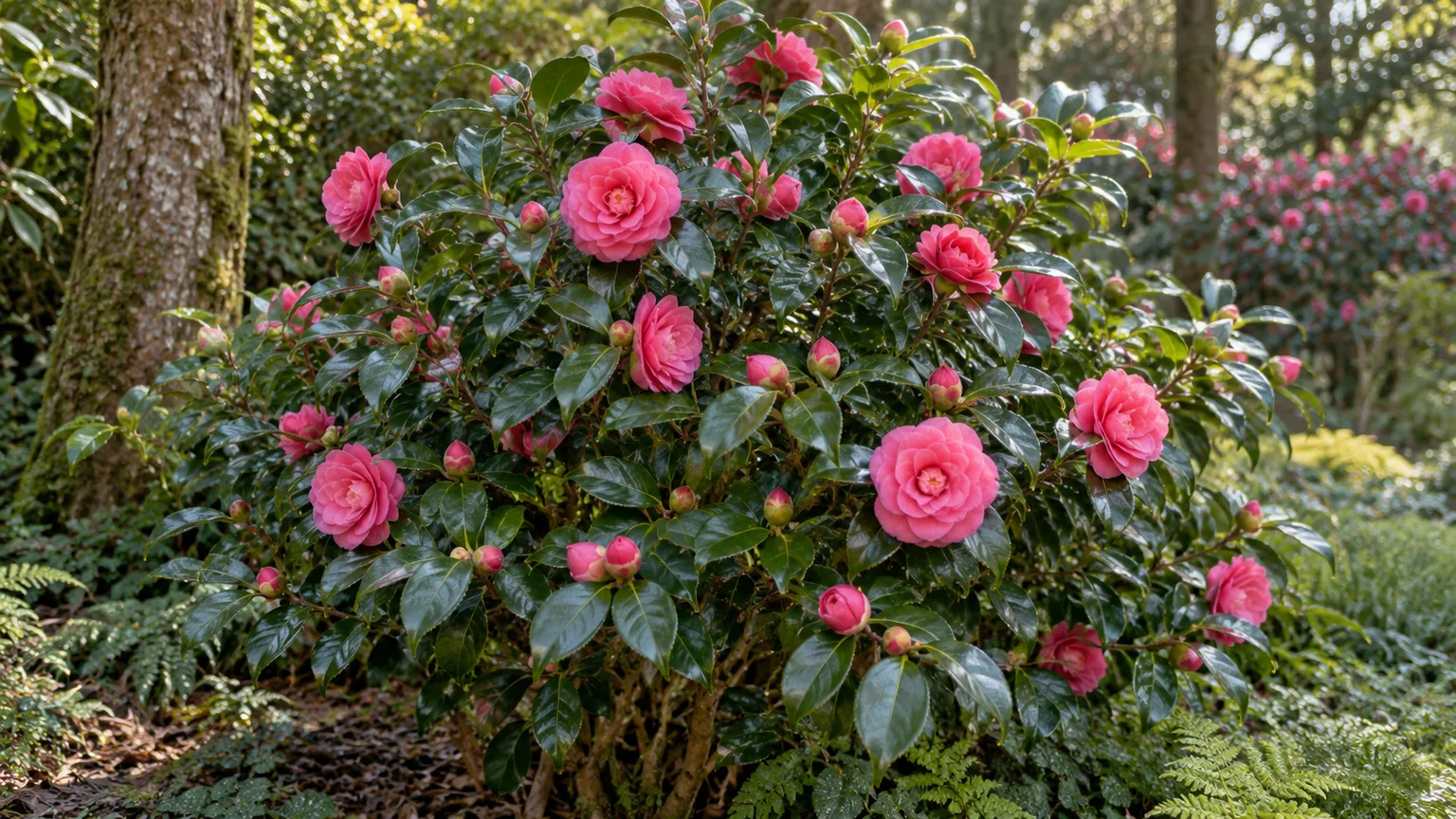
Japanese camellia, Camellia japonica, is one of the strongest choices when you want substantial evergreen leaves and large flowers in the quiet part of the year. Depending on variety and climate, blooms may open in late winter or early spring; some cultivars begin much earlier. Colors range from white through pink to red, and the glossy foliage gives the shrub value after each flower has fallen. The NC State Extension Plant Toolbox profile describes camellia as an evergreen shrub or small tree and notes that flowering time varies by variety.
Give it shelter from drying winter winds, bright shade or part shade, and moist but well-drained acidic soil. Buds can drop after a dry late summer or when watering swings between drought and saturation. Camellias bloom on older growth, so prune just after flowering if shaping is needed; a late-season cut can remove the buds already forming for next year. Cold tolerance depends on cultivar and exposure, so a sheltered site and a locally rated variety matter more than the species name alone.
2. Rhododendron
Rhododendrons bring broad evergreen leaves and spring flower trusses, but “rhododendron” is a large genus with both evergreen and deciduous species. Choose a named evergreen species or cultivar rather than assuming every nursery rhododendron will keep its leaves. Size ranges widely too: check mature dimensions before placing a plant under a window or beside a path.
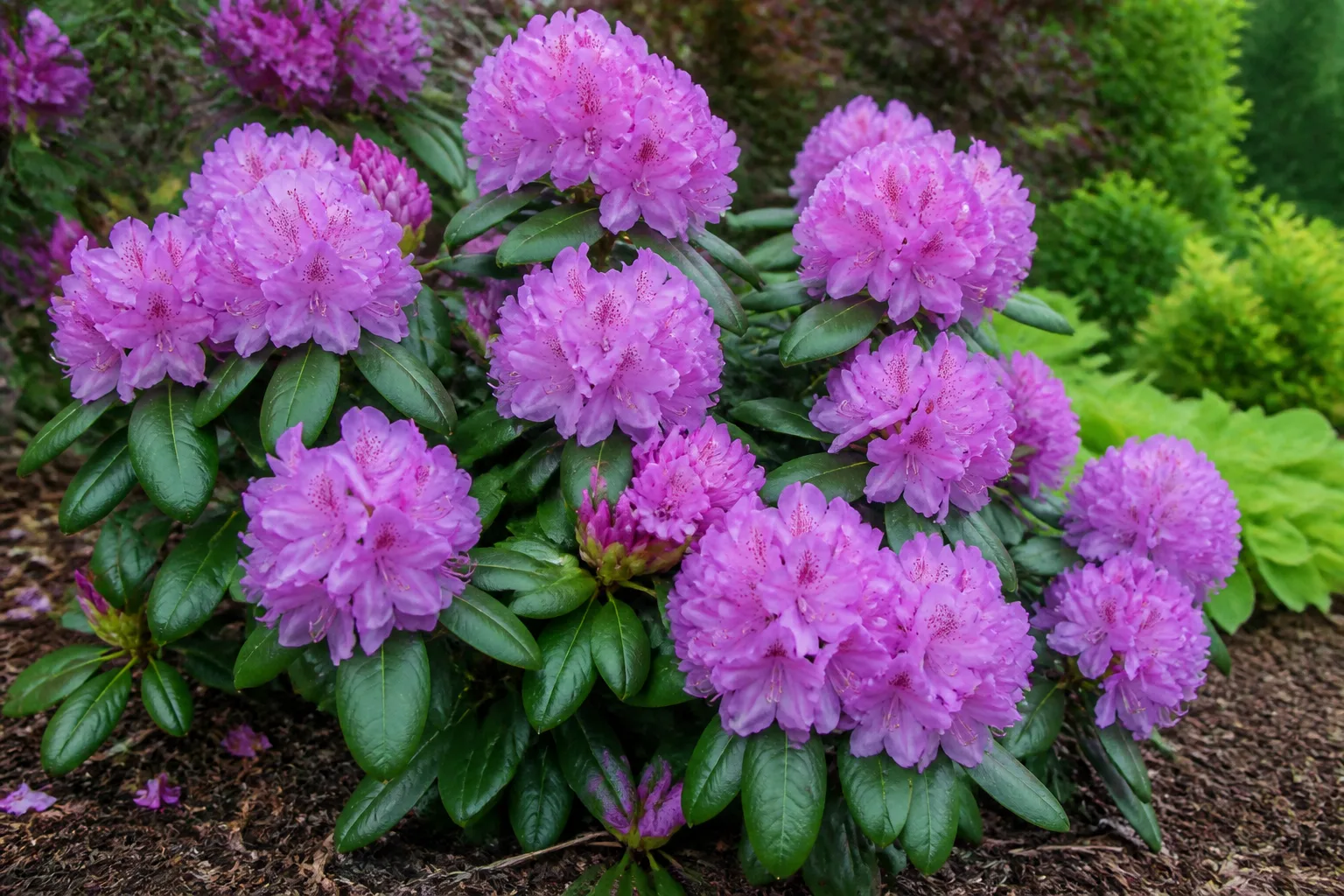
Most garden types prefer dappled light, moisture-retentive but well-drained acidic soil, and protection from hot afternoon sun. Their shallow roots need consistent moisture, but waterlogged soil can cause root problems. The NC State profile for rhododendrons and azaleas notes that leaf habit varies and calls for moist, well-drained, acidic soil. If your site has dense clay or stays wet after rain, do not try to fix a small planting hole with a pocket of compost; choose a better-drained location or build a broad raised bed.
3. Evergreen azalea
Azaleas are rhododendrons botanically, but gardeners often use the name for compact plants with smaller leaves and a mass of spring flowers. Many Japanese azaleas are evergreen, yet the group also includes deciduous and semi-evergreen types. Ask for the cultivar name and check the seller’s hardiness and leaf-retention notes rather than choosing by flower color alone.
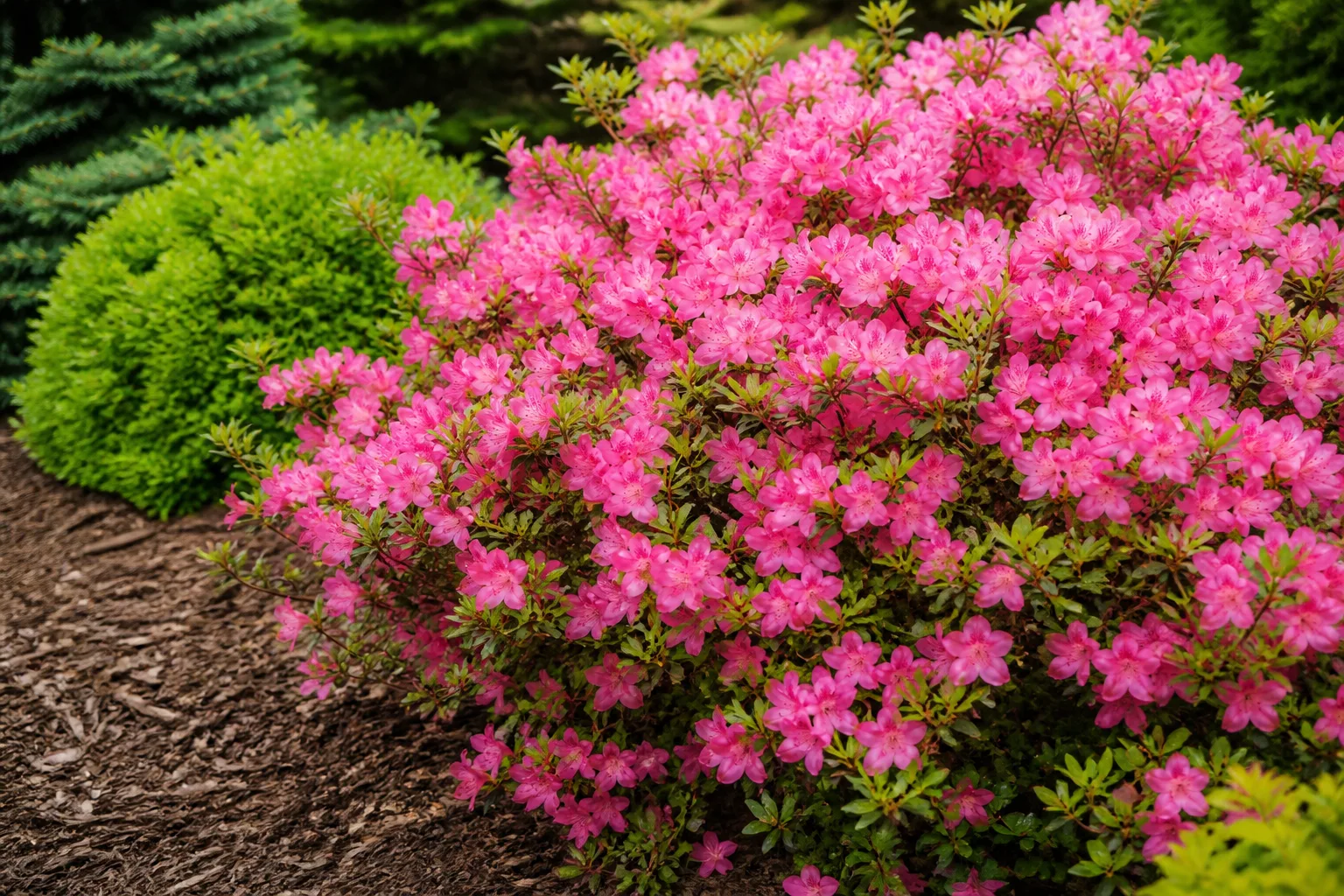
An evergreen azalea is a useful fit for a smaller shaded bed, a woodland edge, or a large container with an acidic growing medium. Give it bright shade or morning sun, even moisture, and excellent drainage; hot afternoon exposure can scorch leaves and shorten flower quality. BBC Gardeners’ World describes Japanese azaleas as compact, spring-flowering evergreen shrubs for damp, shady, acidic sites in its evergreen shrub selection. In colder climates, expect foliage color to shift and verify whether the cultivar is truly evergreen where you live.
4. Mountain laurel
Mountain laurel, Kalmia latifolia, is a North American native with evergreen leaves and clusters of spring flowers whose buds often look as decorative as the open blooms. It is a woodland shrub rather than a plant for a hot, exposed foundation strip. In suitable conditions it can grow into a substantial shrub, so reserve room for its mature spread instead of planning to shear it into a small formal shape.

The NC State Extension profile recommends cool, moist, acidic, humus-rich, well-drained soil and partial shade for best growth. Heavy, wet soil is a poor match; a raised planting can help only if it creates reliable drainage across a wide root zone. Mountain laurel is poisonous if eaten, so avoid it where children, pets, or livestock are likely to chew leaves or flowers, and confirm plant-safety choices for your household before buying.
5. Japanese pieris
Japanese pieris, Pieris japonica, is an evergreen shrub with white or pinkish urn-shaped flower clusters in early spring. Its red or bronze new growth and winter flower buds add interest outside the bloom period, which makes it useful in a sheltered shade border. Cultivars differ in mature size and new-leaf color, so compare the tag rather than expecting every variety to have the same fiery flush.
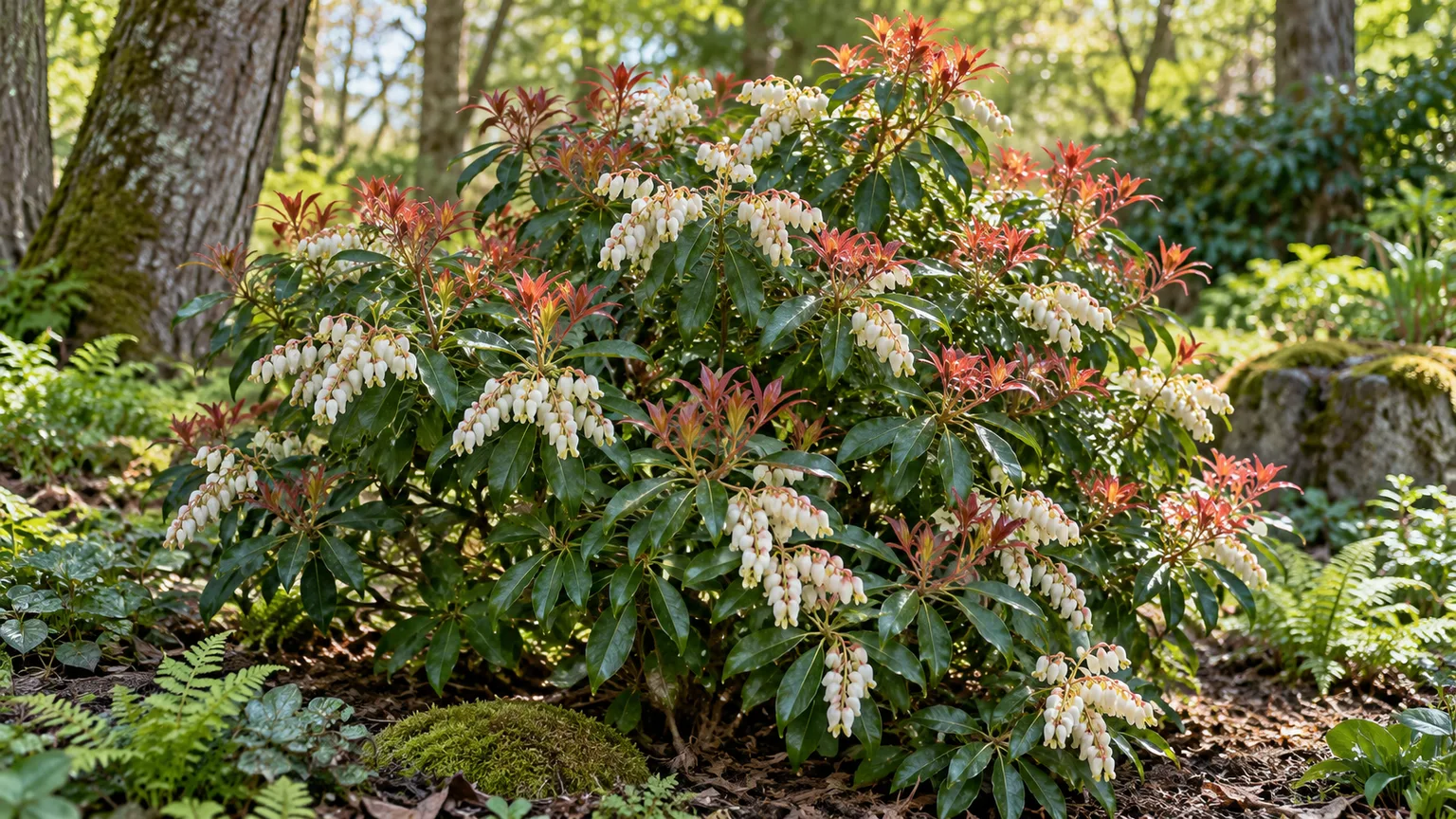
Plant pieris in partial shade with acidic, moisture-retentive but well-drained soil. Full hot sun can scorch leaves, while poor drainage invites root trouble. The NC State profile for Japanese pieris describes its early-spring flowers and evergreen foliage; the plant is also poisonous if ingested. If children or pets spend time in the garden, place it out of reach and check a trusted veterinary or poison-control source for household-specific safety guidance.
6. Winter heath
Winter heath, Erica carnea, is a low, spreading evergreen for a sunny edge, rock garden, or the front of a border. It gives small flowers in winter or early spring, depending on cultivar and local weather, when many deciduous plants are dormant. Its scale is useful where a large evergreen shrub would overwhelm the space, and the fine foliage makes an even carpet rather than a tall screen.
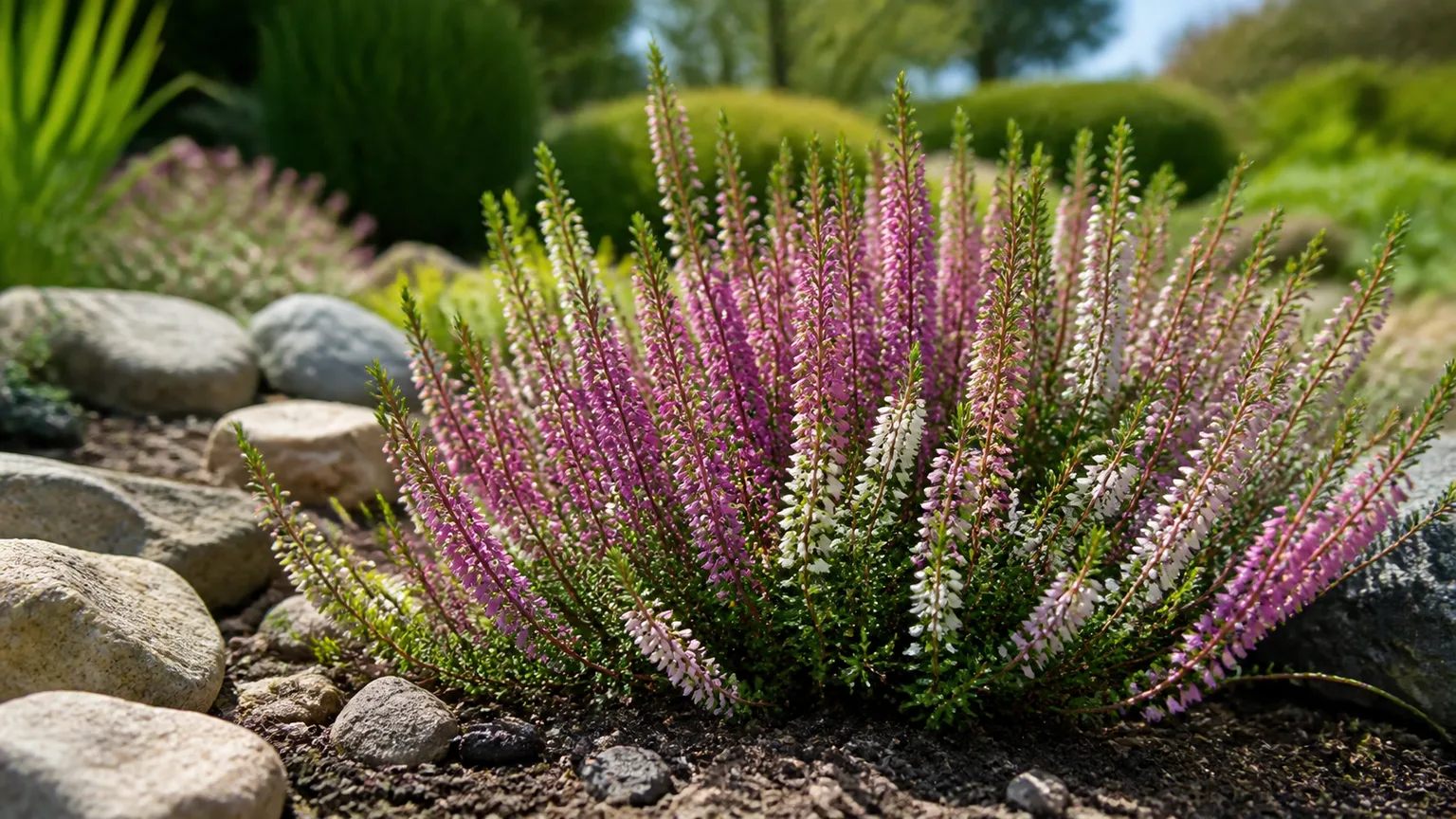
Choose a sunny site with sharply drained soil; winter heath struggles in wet, heavy ground even if the soil is acidic. The NC State Extension profile for Erica carnea notes its evergreen, low-growing habit and drainage needs. Water new plants while they establish, then avoid routinely soaking the crown. Trim lightly soon after flowering to keep the mound compact, but do not cut deep into old bare stems because new growth may not fill them.
7. Winter daphne
Winter daphne, Daphne odora, is prized for small clusters of intensely fragrant flowers in late winter or early spring and a neat evergreen outline. It suits a path, sheltered entrance, or patio where the scent can be noticed without placing it in the center of heavy foot traffic. It is a relatively small shrub, but it does not reward repeated relocation or harsh pruning.
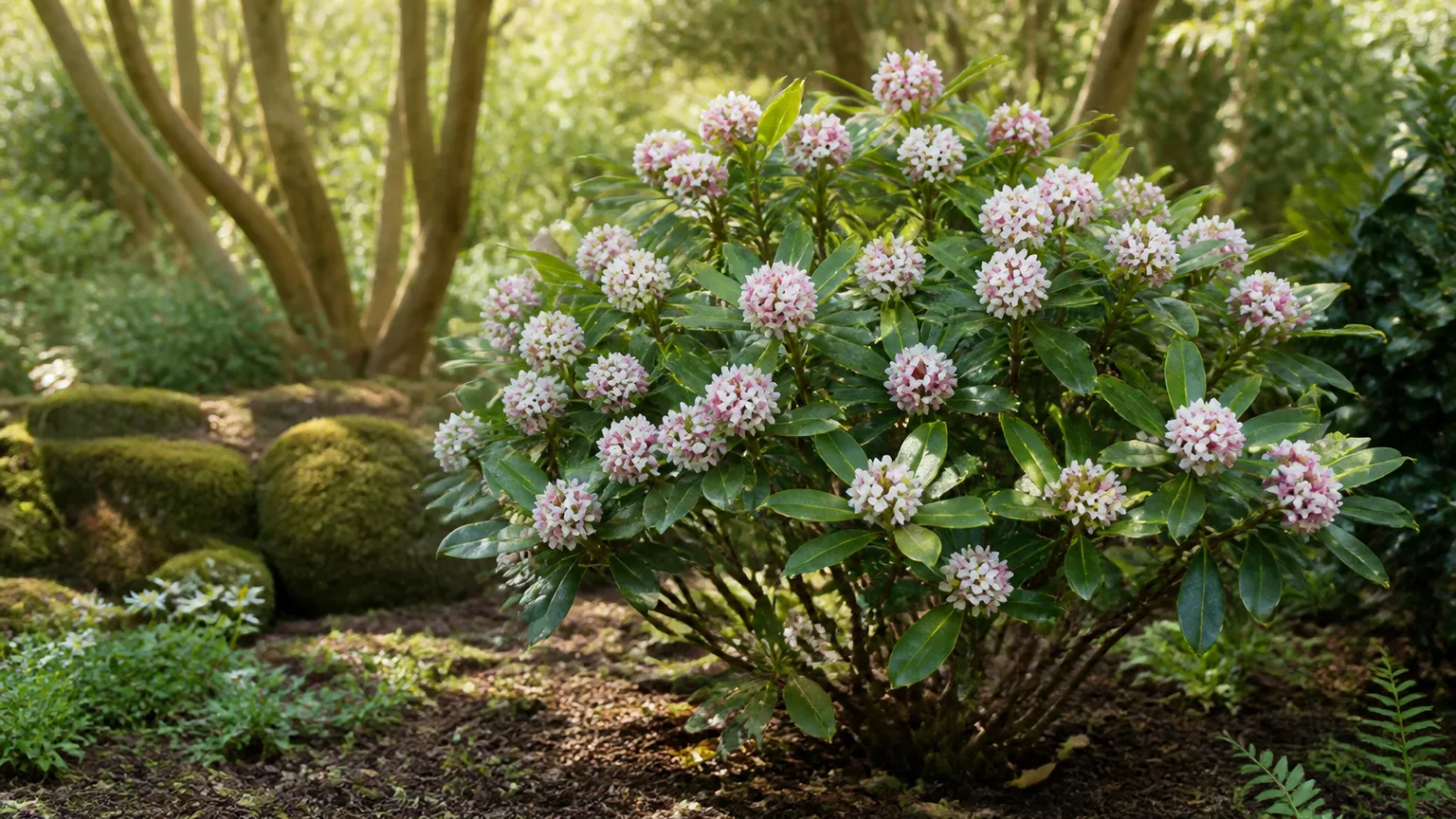
Give it a sheltered site in sun or part shade and soil that stays moderately moist but drains freely. It is best suited to mild-winter regions; cold exposure can damage it, and its foliage may not stay evergreen at the cold edge of its range. The NC State Extension profile for fragrant daphne identifies winter-to-spring fragrant bloom and a limited hardiness range. Daphne is poisonous if eaten, so choose another shrub if plant chewing is a realistic household risk.
8. Chinese fringe flower
Chinese fringe flower, Loropetalum chinense, pairs ribbon-like flowers with colorful foliage, often burgundy or purple in popular cultivars. It can function as a flowering hedge or specimen shrub in mild-winter gardens, and the darker leaves remain useful between bloom flushes. The species flowers mainly in spring; some cultivars repeat sporadically, but it should not be sold to yourself as a year-round flowering plant.
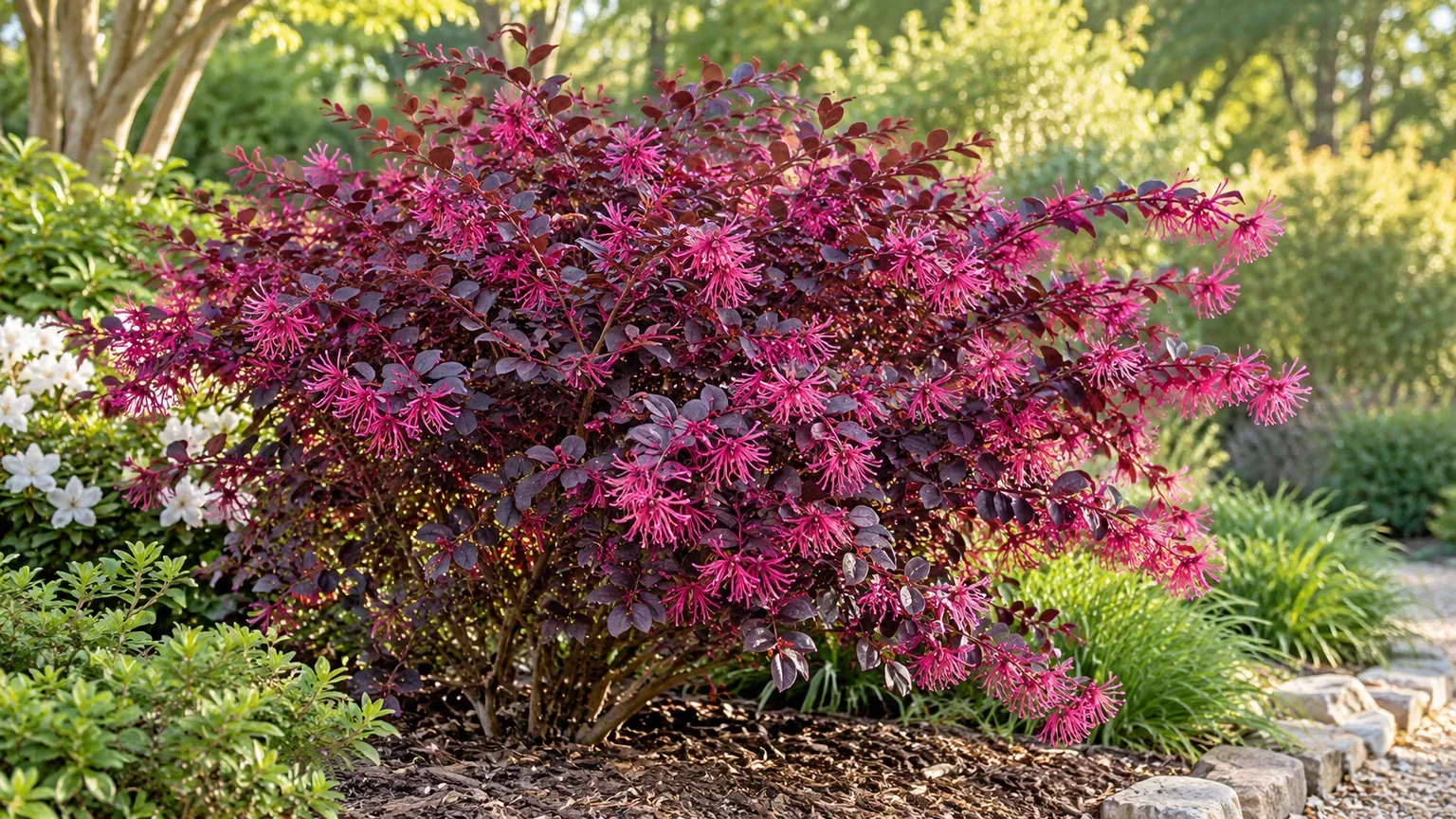
This shrub is most dependable where winters are mild. NC State lists it for warm zones and notes that it can be evergreen or semi-evergreen, so cold snaps may cause leaf loss. Give it sun to part shade and well-drained soil; more sun generally helps maintain foliage color, while afternoon shade can reduce heat stress in hot regions. The NC State profile for Chinese fringe flower is a useful reminder to check the cultivar and region before using it as a year-round screen.
9. Candytuft
Evergreen candytuft, Iberis sempervirens, is a compact groundcover or edging plant that can be almost hidden beneath its white flower clusters in spring. It is especially effective spilling over a low wall or filling a sunny bed edge where a short, tidy mound is more useful than a tall shrub. The leaves are narrow and dark, and the plant can spread gradually where stems touch soil.
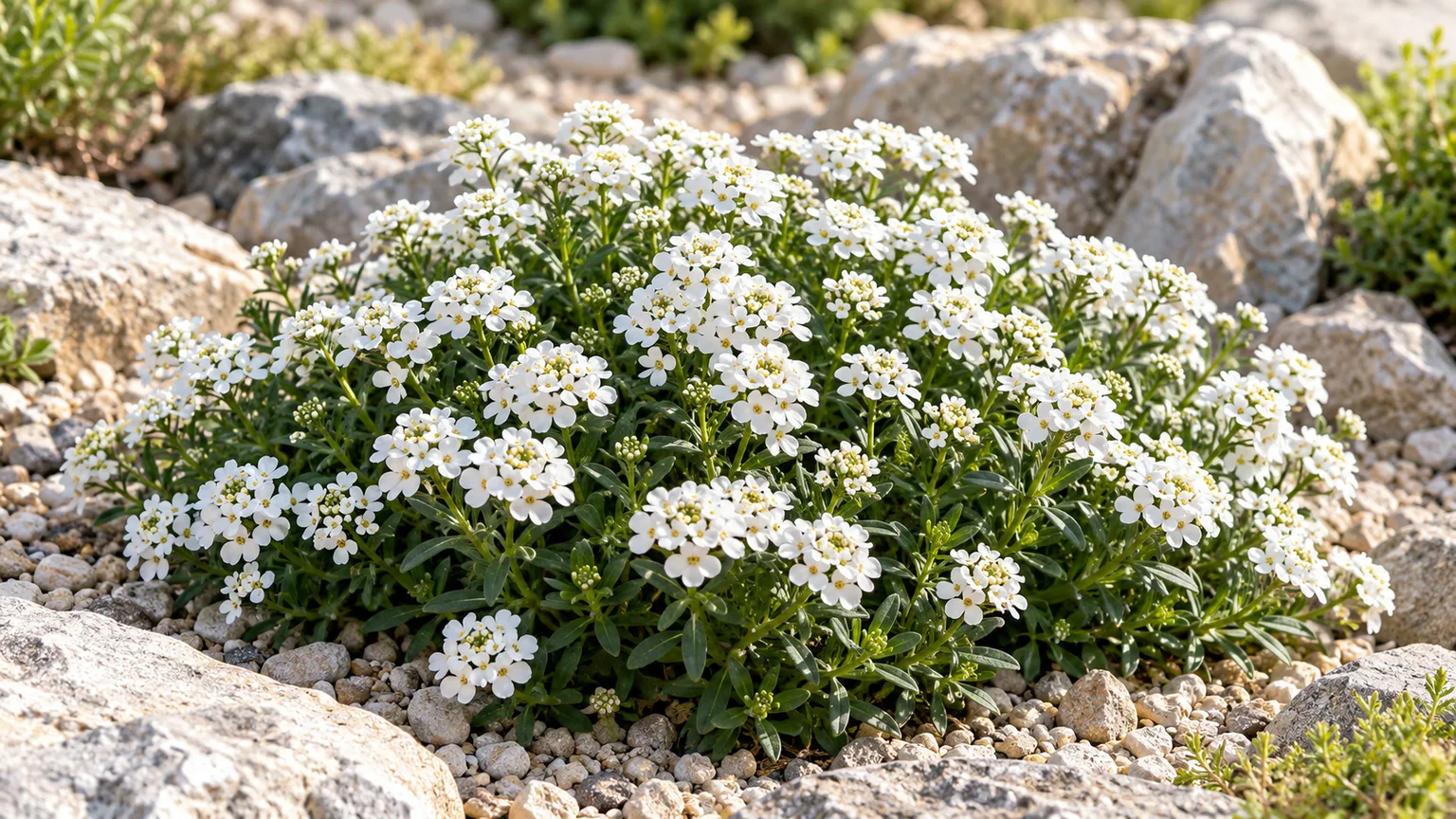
Candytuft needs sun for the fullest flowering and soil that drains quickly. It may be evergreen in a mild region and semi-evergreen where winters are colder; mulch can reduce winter injury without turning a marginal site into a suitable one. The NC State Extension profile for evergreen candytuft advises cutting it back after bloom to encourage fresh growth. Keep that pruning light enough to retain the low woody framework.
10. Lenten rose
Lenten rose, Helleborus orientalis and its hybrids, is a clumping perennial that can hold glossy foliage through winter in mild climates and flower from late winter into spring. The blooms are long-lasting sepals rather than short-lived petals, so the display can remain attractive as the flowers mature. In cold climates, leaves may be damaged or die back; treat evergreen behavior as regional, not universal.

Plant hellebores in dappled shade and moist but well-drained soil. They work beneath deciduous trees because they can use winter and early-spring light before the canopy fills in. The NC State profile for Lenten rose notes its late-winter-to-spring bloom and that foliage retention varies with climate. The plant can irritate or harm people if ingested; wear gloves if handling causes skin irritation and keep plant parts away from children and animals.
11. Creeping phlox
Creeping phlox, Phlox subulata, is a spring-flowering mat that works well on a sunny bank, between stones, or at the edge of a retaining wall. It is an excellent flowering groundcover, but its leaves are best described as semi-evergreen rather than reliably green in every winter. In mild climates it can remain leafy; harsher exposure may brown the foliage even when the crown survives and flowers again.
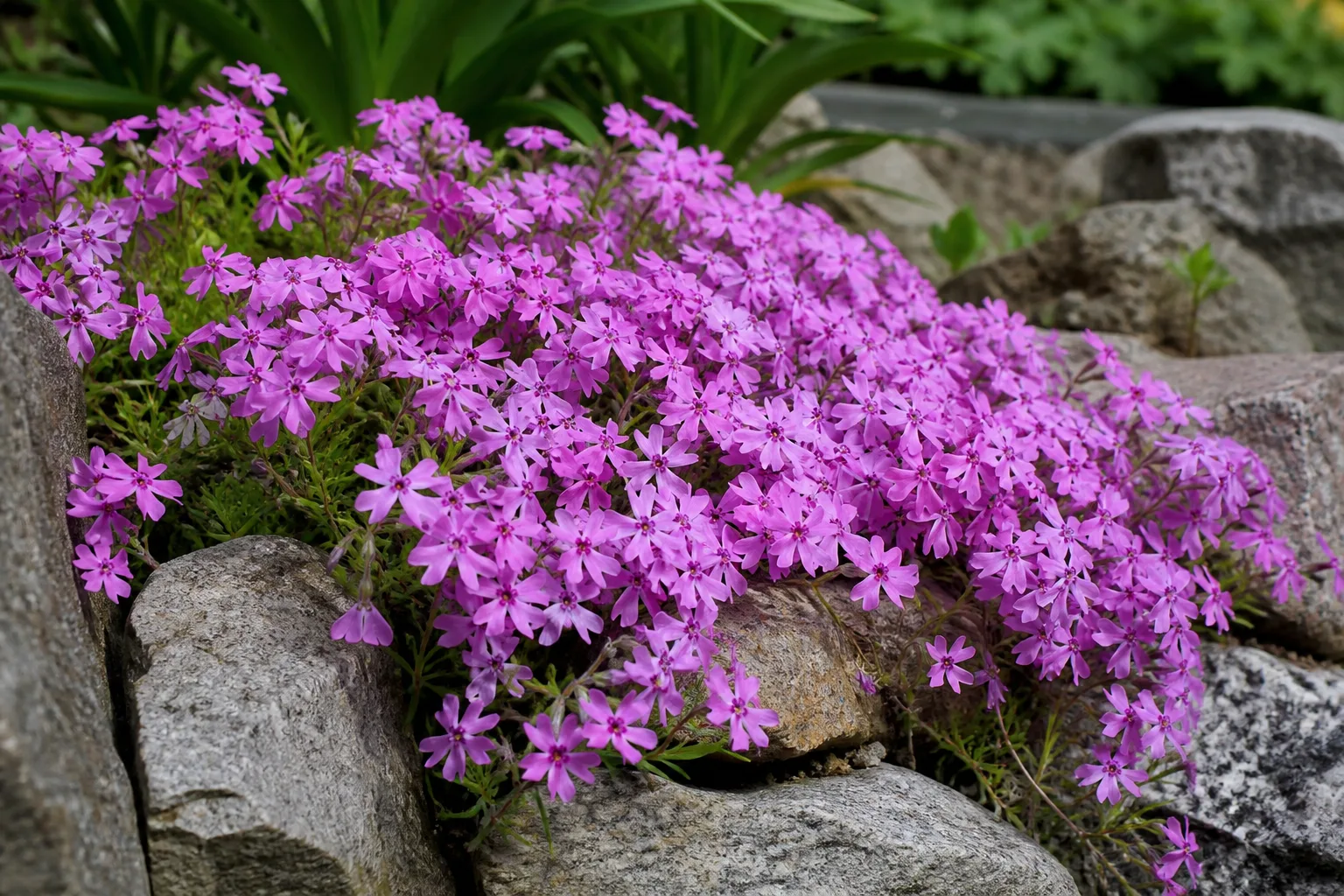
Give it sun and fast drainage. It does not need a rich, constantly wet bed, and airflow around the mat helps prevent it from becoming a damp, tangled patch. The NC State Extension profile for moss phlox classifies it as semi-evergreen, a useful distinction if your main goal is reliable winter foliage. Use it for a spring carpet and groundcover function, not as a substitute for a true evergreen shrub.
12. Creeping myrtle
Creeping myrtle, or lesser periwinkle (Vinca minor), has glossy evergreen leaves and small blue, purple, or white flowers in spring, often with scattered flowers later. It fills shade and can cover slopes or difficult ground where turf struggles. The trade-off is vigorous rooting stems: once established, it can move beyond its intended border and crowd nearby plants.
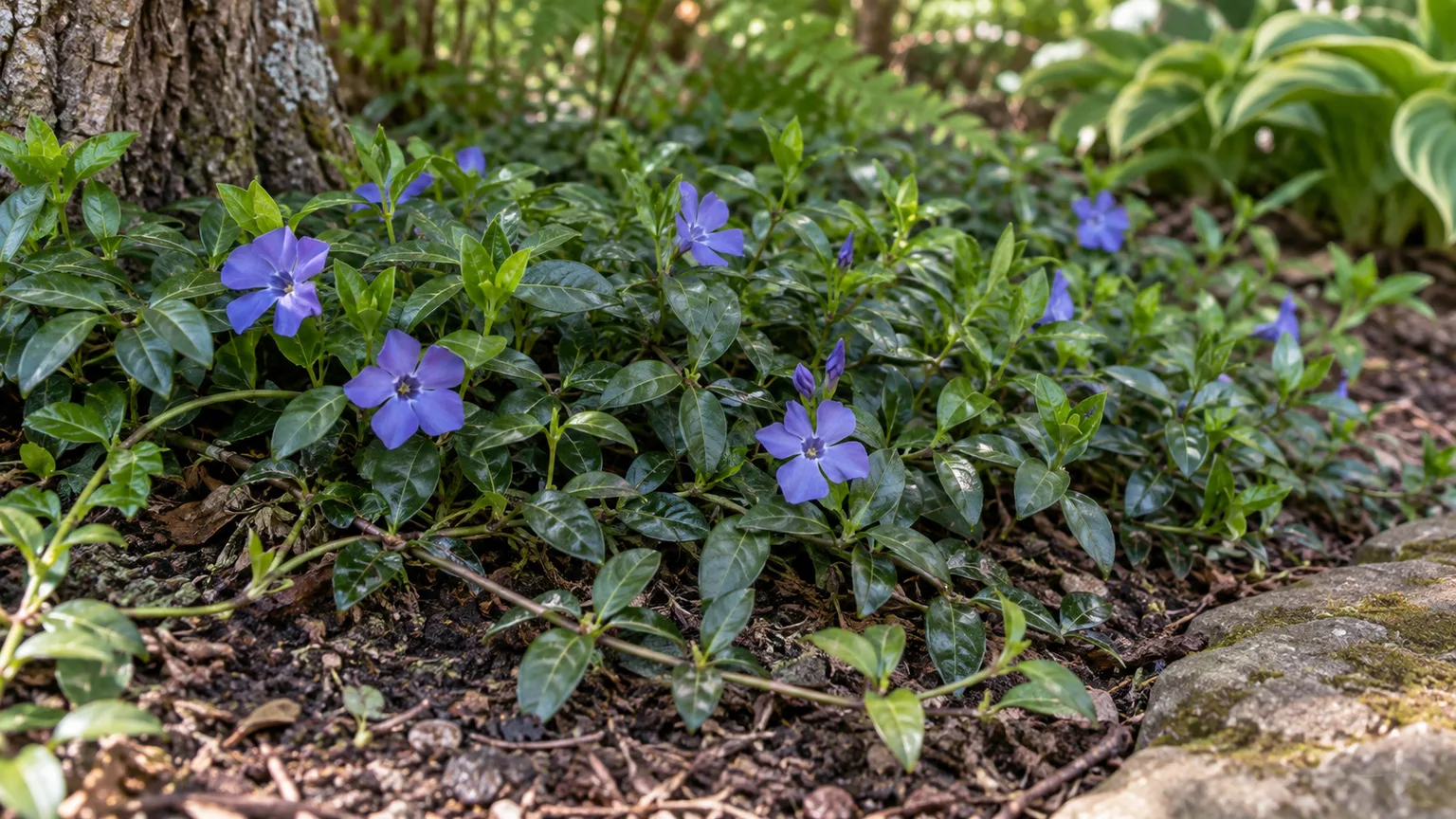
Check your state or regional invasive-plant list before planting it. Some jurisdictions classify Vinca minor as invasive or discourage its use because fragments and runners can spread into natural areas. The NC State Extension profile for lesser periwinkle describes its evergreen groundcover habit; the responsible choice depends on local ecology, not simply whether it grows easily in your yard. If the plant is invasive in your area, choose a native or non-spreading alternative and keep clippings out of natural areas.
How to choose plants for your site
Start with winter, not flower color. Check your USDA hardiness zone, then look up the exact species or cultivar because a genus may include plants with very different cold tolerance. A zone describes average annual extreme minimum temperature; it does not predict summer heat, wind exposure, late frosts, drainage, or how long flowers last. The RHS evergreen shrub guide and BBC Gardeners’ World’s evergreen shrub overview both frame evergreens as permanent structure, while flower displays remain seasonal.
Next, match the site. For part shade and acidic soil, compare camellia, evergreen azalea, rhododendron, and pieris, but rule out spots that stay waterlogged. For bright shade, hellebore can supply winter-to-spring flowers at the front of a bed. For sun and fast drainage, consider winter heath, candytuft, or creeping phlox. Loropetalum and winter daphne make sense only when local winters suit them. Creeping myrtle is a conditional choice because it can spread aggressively.
Finally, measure the planting space and read the mature width as carefully as height. A shrub that is repeatedly sheared to fit a narrow gap may lose flower buds, develop a bare interior, or need more maintenance than expected. In a small garden, one compact evergreen shrub and a groundcover that stays inside its boundary can solve more problems than a row of oversized shrubs.
Planting and care that protect flowers and foliage
Plant in a season that gives roots time to establish before severe heat or cold. BBC Gardeners’ World recommends spring or autumn for many evergreens, and its flowering-evergreen planting guide emphasizes soaking the root ball, loosening circling roots, and settling the plant into its final position. Avoid planting too deep: set the top of the root ball level with or slightly above surrounding grade, especially where drainage is marginal.
Water deeply during establishment, then let the plant’s needs and the weather guide the schedule. An evergreen still loses water through leaves in winter, so newly planted shrubs can dry out during cold, windy spells even when the soil surface looks damp. A few inches of organic mulch helps keep roots cool and soil moisture steadier, but keep mulch away from stems and the crown. Do not apply acidifying fertilizer or amendments blindly; test soil first and follow local extension guidance.
Pruning time depends on where a plant sets its buds. Many spring-flowering shrubs bloom on older wood, so pruning after flowers fade gives the plant time to set next year’s buds. Camellia and mountain laurel are examples where late pruning can remove the following season’s display. Remove dead, damaged, or crossing wood when needed, but do not shear everything into the same shape if you chose the plant for natural flowers and form.
Build a longer bloom sequence
A garden can have color for many months by combining plants that flower at different times, not by expecting one evergreen to bloom continuously. In a mild climate, winter daphne or winter heath may lead; hellebores and some camellias can follow in late winter; pieris, azaleas, and rhododendrons take over in spring; mountain laurel extends the display toward early summer. Local weather can compress, delay, or shift that sequence.
Let foliage carry the garden between those windows. Combine a reliable broadleaf evergreen with one seasonal groundcover, then add a flowering shrub only if its light and soil requirements match the same bed. This avoids the common mistake of packing together plants that all want acidic soil but differ in sun, drainage, or winter tolerance. Place the flowers where you will see or smell them, and use the evergreen structure to hold the composition together after the blooms are gone.
Conclusion
The best evergreen flowering plants are the ones whose leaves, bloom season, and site requirements fit your climate. Camellias, evergreen azaleas, rhododendrons, pieris, and mountain laurel can anchor many suitable shade gardens; winter heath, candytuft, and creeping phlox offer lower-growing options for sunnier, better-drained spaces. Winter daphne and Chinese fringe flower bring fragrance or foliage color in mild regions, while hellebores and creeping myrtle have specific climate or spread caveats.
Before buying, confirm the exact cultivar, winter rating, mature size, and expected bloom window with a local nursery or extension plant profile. If your priority is year-round foliage, favor plants explicitly described as evergreen for your region and treat semi-evergreen choices as seasonal groundcovers. You will get a more dependable garden by choosing for the whole year, even though each plant’s flowers arrive for only part of it.