Bamboo vs. Hardwood Flooring: Pros, Cons, and Costs
Compare bamboo and hardwood flooring for durability, moisture, installation, price, refinishing, and sourcing, then choose with a practical checklist.

Bamboo and hardwood can both give a room a warm, natural surface, but choosing by the material name alone is a poor shortcut. Bamboo is a grass turned into a manufactured plank; hardwood can mean dozens of tree species, in solid or engineered form.
The useful comparison is not “bamboo or wood” in the abstract. It is the exact plank you can buy, matched to the room and subfloor where it will be installed. Start with construction and warranty, then compare hardness and finish, moisture requirements, whole-project cost, and the evidence behind any environmental claims.
The short answer: the product matters more than the label
Choose bamboo when you like its distinctive grain, find a clearly specified product that fits your budget, and can meet its moisture, subfloor, and installation requirements. Choose hardwood when you want a wider choice of species and natural grain, or when the ability to renew a substantial solid-wood wear layer matters more than a narrow first-cost comparison. Neither label guarantees a harder, drier, easier-to-refinish, or more sustainable floor.
For a high-traffic room, compare the actual wear surface and finish rather than assuming bamboo wins because some products are very hard. For a slab or a room with variable humidity, first eliminate products whose instructions do not approve those conditions; a compatible engineered plank may be a better technical fit than a solid plank of either material. If you expect to keep the floor for decades, compare its top-layer thickness and repair path now, not after the finish wears through.
What are bamboo and hardwood flooring, exactly?
“Hardwood” is a botanical category for wood from flowering trees, not a promise that every species is hard. Flooring choices range from softer species to dense woods such as hickory, and their natural grain, color, and response to dents differ. The same word also hides an important construction choice: a plank may be solid wood from top to bottom or engineered with a real wood surface over a layered core.
Bamboo flooring starts with a grass culm, but a finished plank is not simply a strip of stalk laid on the subfloor. Manufacturers cut, split, orient, press, and bond bamboo into a stable floor product. The result can look like a narrow-striped plant material, a flatter linear grain, or a dense woven pattern, depending on the construction.
Bamboo: grass fibers bonded into planks
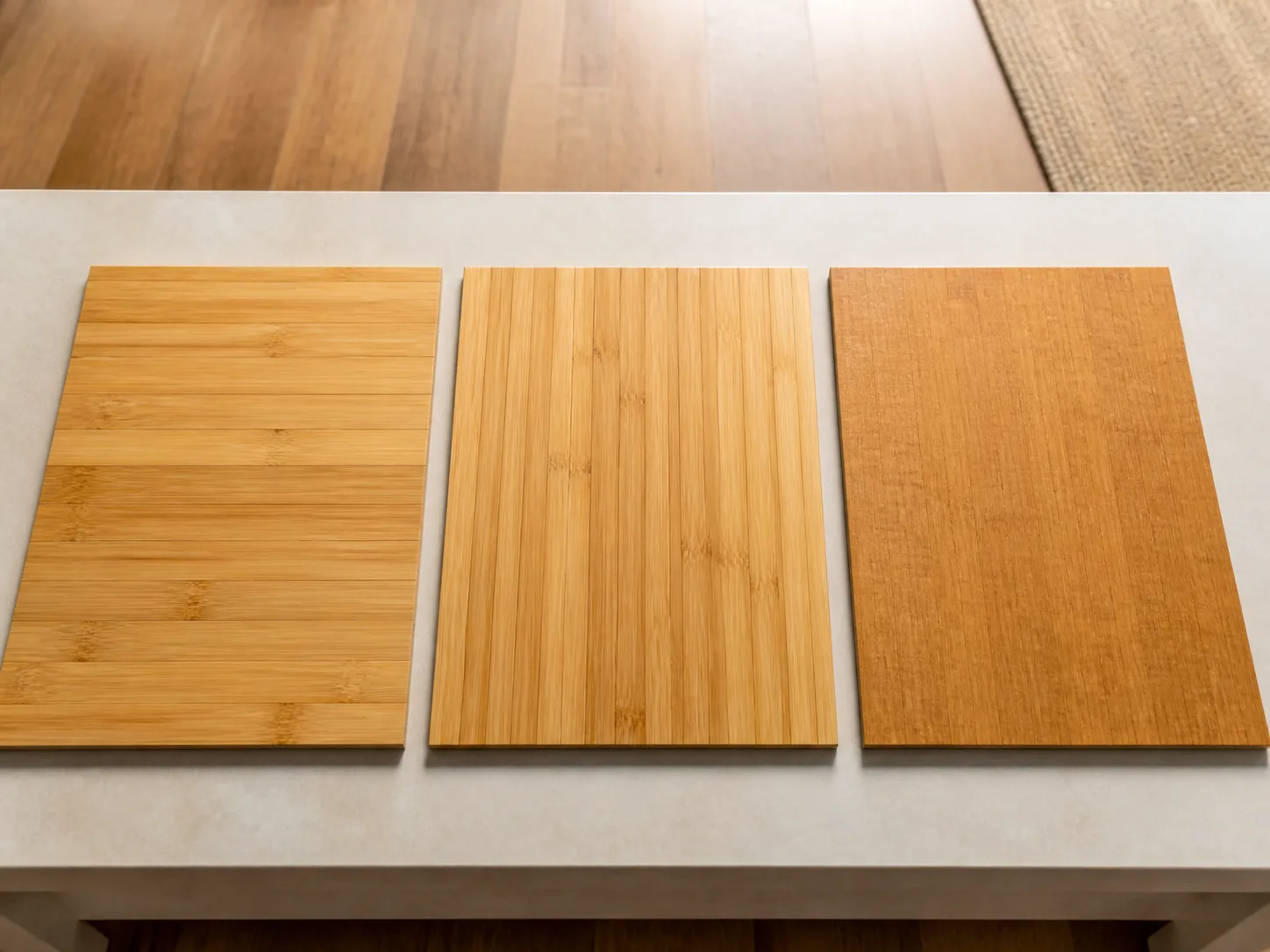
Most bamboo floors are made by bonding prepared strips or fibers, so adhesives, pressure, treatment, and surface finish are part of the product story. Horizontal or flat-grain construction presents the wider face of strips and often makes bamboo nodes visible. Vertical-grain construction sets narrower strips on edge for a more linear, finely striped look. Strand-woven flooring compresses bamboo fibers into a dense, visually varied surface; it is not interchangeable with a plank made from uncompressed strips.
Some manufacturers heat-treat or carbonize bamboo to produce darker color. That process can change the material’s physical properties, so do not infer strength from a dark finish or assume two colors are the same product with only a stain difference. A recent flooring comparison of bamboo constructions also points out how much product quality can vary; use an editorial overview as a prompt to ask for the product specification, not as a substitute for one.
Hardwood: species, solid planks, or engineered construction
A solid hardwood plank is milled from one piece of wood. An engineered hardwood plank has a real wood wear layer attached to a layered core, which may make it suitable for installation methods or locations where a solid board is not approved. Engineered does not mean imitation wood: the top is actual hardwood, but its thickness controls how much sanding and refinishing may be possible.
Species add another layer of variation. Oak has a recognizable open grain and broad range of stains; maple tends toward a tighter, quieter pattern; hickory can show more contrast and is generally a denser option. These are tendencies, not guarantees about every grade or finish. A floor made from a chosen species can look natural, but it may also contain knots, color variation, and boards that look different from a small sample.
The National Wood Flooring Association (NWFA) maintains separate technical publications on wood species, installation, moisture, and sanding and finishing. That separation reflects a useful principle for buyers: performance depends on the wood species and the complete flooring system, not simply on whether the face is called hardwood (NWFA technical guidelines).
Appearance: a repeated pattern versus natural variation
If you want a quieter, more consistent linear look, some vertical or strand-woven bamboo products may suit a contemporary room. Horizontal bamboo shows more obvious nodes; strand-woven bamboo can have a mottled, small-scale pattern. The range of available colors has expanded, but the pattern still reads differently from oak, walnut, or maple. When the room has strong cabinetry or stone, a calmer bamboo grain can help; if the floor should supply character, a species with visible grain or knots gives you more choice.
Hardwood offers more variation because species, cut, grade, stain, plank width, and finish all change the result. That flexibility is useful when you are matching old floors or coordinating adjoining rooms, but it also means “oak” is not a complete description. One red-oak sample, one white-oak sample, and two finishes can look more different from one another than a light bamboo board and a dark bamboo board.
Do not choose from a thumbnail or a three-inch showroom chip. Borrow full-length samples, lay them beside cabinets and trim, and check them in daylight and evening light. Look at the same sample from several angles: a glossy topcoat reflects windows and can make dust or pet hair stand out, while a matte or brushed surface may soften the look of everyday marks. If you are replacing only one room, also view the sample against the floor in the hall, because undertones become obvious at the threshold.
Durability: compare construction, wear layer, and finish
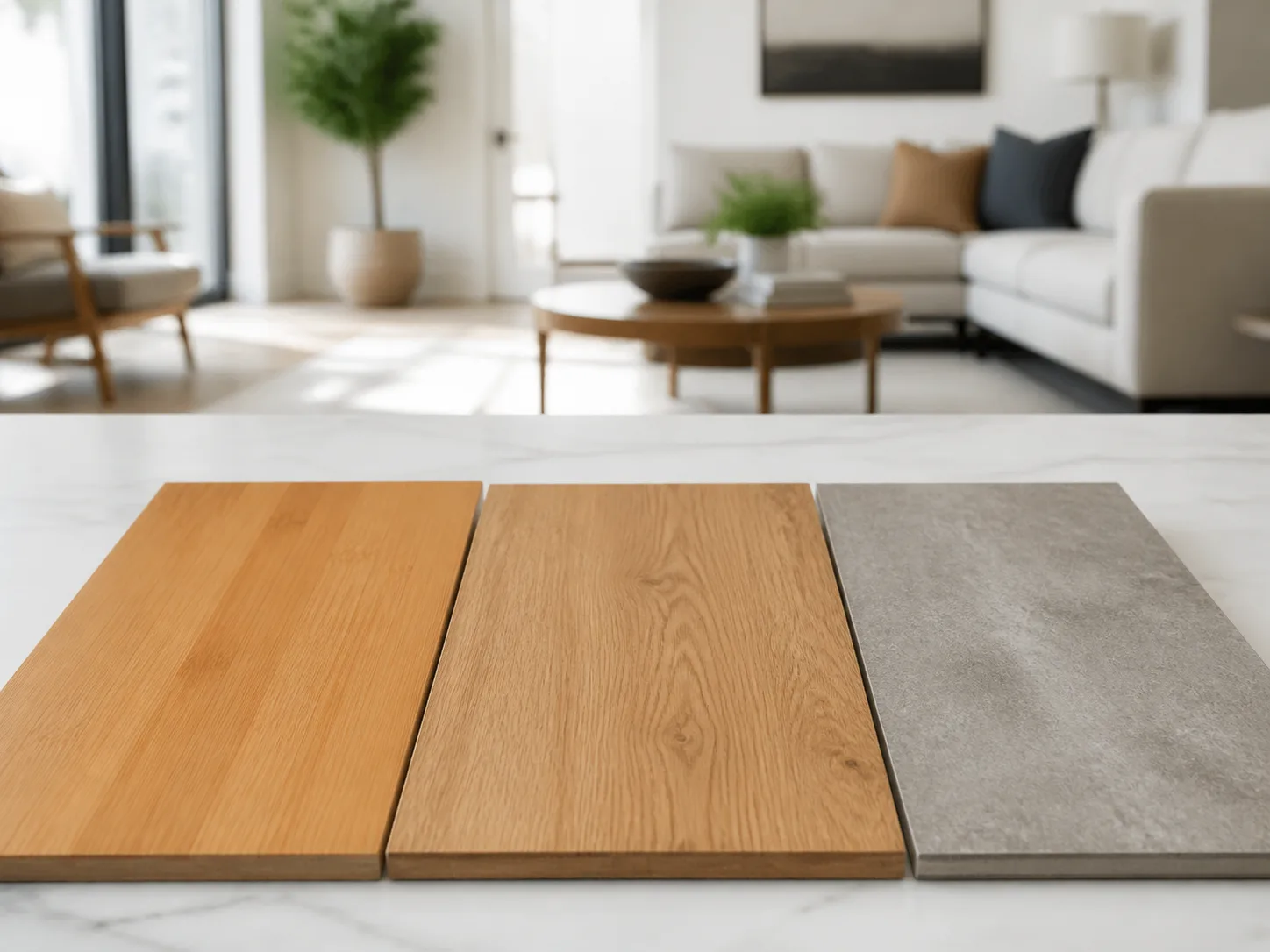
There is no reliable winner based on the word “bamboo” or “hardwood.” A dense strand-woven product may resist indentation better than some common wood species, while a soft wood species or a thin bamboo wear surface may be a poor fit for rolling chairs and dropped cookware. A finish can delay surface wear, but it does not prevent a heavy point load from denting the plank beneath it. A hard surface can still scratch when grit is dragged across it.
Separate three kinds of damage when you compare samples. Dents are compression marks from furniture legs, heels, or dropped objects. Scratches are cuts or abrasions through the finish or into the surface, often caused by sand, grit, pet claws, or furniture movement. Finish wear is a dull or thin traffic lane that may not be a deep scratch at all. A single hardness score says little about the finish’s abrasion resistance, the quality of factory coating, or how visible a mark will look against a glossy, dark plank.
Ask the manufacturer for the product-specific test data, finish system, wear-layer thickness, and warranty exclusions. Then inspect samples at a low angle and, if possible, ask the retailer whether a display board can be tested with a key or chair caster. Do not damage a sale sample, but do see the product under ordinary showroom handling. A demonstration is not a lab test; it simply helps you compare how two actual finishes look after the same treatment.
What Janka hardness can—and cannot—tell you
The Janka hardness test is a useful comparison for a material’s resistance to indentation, but it is not a universal durability grade. Hardwood values vary by species, and bamboo values vary with how the material was pressed, bonded, and treated. A number is useful only when it belongs to the exact construction or species in the quote and the manufacturer identifies the test method. A generic chart that says “bamboo” beside “oak” can conceal more variation than it resolves.
Use the rating to screen out obviously soft choices for a high-traffic use, then check the factors it does not answer: finish wear, surface texture, edge quality, water exposure, and whether a damaged board can be replaced. If a household has large dogs, for example, claws are more likely to mark a finish than to neatly dent the center of every plank. A matte, textured, mid-tone finish may hide small scratches better than a glossy, very dark floor, regardless of whether the core material is bamboo or oak.
Do not assume carbonized bamboo is automatically weak, or that strand-woven bamboo is immune to damage. Heat treatment and fiber compression change the product, but the range is manufacturer-specific. Compare test data, warranty language, and the exact sample rather than relying on a single number from a category overview.
Refinishing depends on the usable surface
The ability to sand and refinish a floor depends on how much material can safely be removed before reaching the core, tongue, or a structural layer. Solid hardwood often offers the greatest renewal potential because the plank is wood through its thickness. Even then, the number of future sandings depends on the board’s thickness above the tongue, the existing wear, previous refinishes, and the condition of the subfloor and fasteners.
Engineered hardwood may be refinishable if its real-wood wear layer is thick enough and the manufacturer allows sanding. Some engineered products are designed for a single screen-and-recoat rather than a full sanding. Bamboo is similarly product-specific: construction, wear surface, coating, and plank profile decide whether a board can be sanded, not its label. A very hard strand-woven product can also be more demanding to sand with ordinary equipment.
Before buying for long-term repairability, ask for a written answer to three questions: Can this exact SKU be screened and recoated? Can it be sanded to bare material, and how many times? Is there a matching replacement plank available if one board is gouged or water-damaged? A product that cannot be refinished can still be a sensible choice, but its shorter repair path should be reflected in the price and your expectations.
Moisture and room fit: where each can work
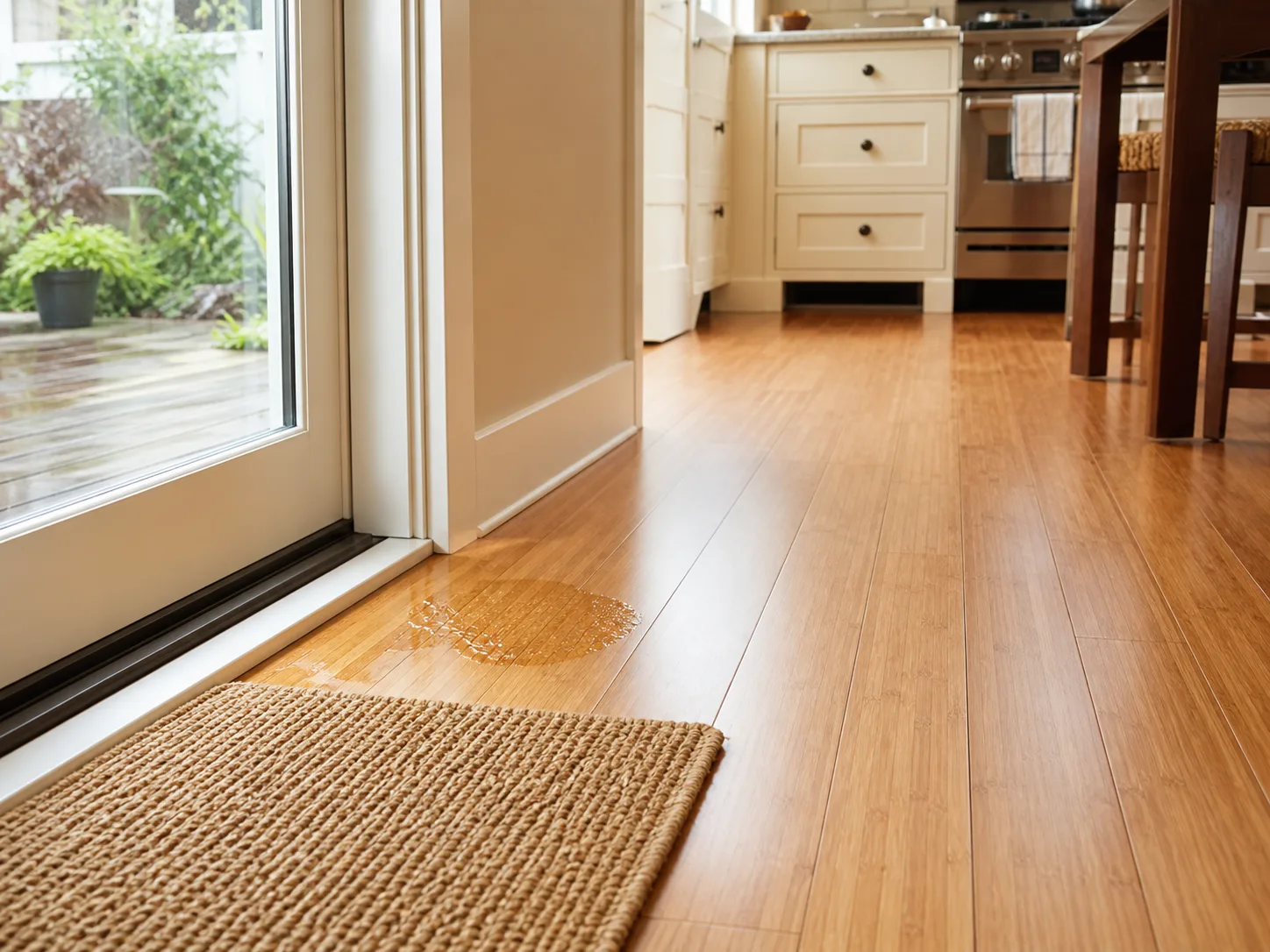
Neither bamboo nor hardwood is waterproof. Both can swell, cup, gap, discolor, or lose finish adhesion when moisture sits on the surface or enters from the subfloor. “Grass grows in wet places” does not make a bamboo plank water-resistant after it has been split, dried, bonded, and coated. A well-sealed surface buys time to wipe a spill; it does not make standing water harmless.
In a kitchen, bamboo or hardwood can work if the manufacturer approves the product for that setting and you can clean spills promptly. Put a mat near the sink only if its backing will not trap moisture, and lift it regularly to check the floor underneath. A dishwasher leak or a wet dog bowl left on a seam is a different exposure from a few drops that are wiped up immediately. For bathrooms, laundry rooms, or homes where leaks are likely, consider whether a water-tolerant material would be a better choice than trying to make a wood-based floor behave like tile.
For a basement or a concrete slab, do not rely on a general claim that engineered flooring is “more stable.” Check the exact product’s approved grade, slab moisture limits, vapor retarder or adhesive requirements, and warranty. The slab may be dry at the surface yet transmit moisture through the concrete. An installer should test the substrate with the method specified by the manufacturer and resolve moisture problems before covering it. NWFA’s technical resources treat moisture and installation as separate planning questions for wood flooring; bamboo buyers should apply the same discipline and use the bamboo maker’s own instructions.
Climate matters after installation too. Wood-based floors expand and contract as indoor humidity changes. Keep indoor conditions within the range on the product’s instructions, run ventilation in damp rooms, and avoid large uncorrected seasonal swings. A floor that is suitable for one room in a dry, conditioned home may be unsuitable for the same room above a damp crawlspace or in a house that is closed up for long humid seasons.
Price: compare the full installed job
Bamboo is often marketed as a low-cost alternative, but the gap can disappear when you compare similar construction, finish, and installation. Hardwood prices also range widely by species and grade: a basic engineered oak product can cost less than a premium strand-woven bamboo line, while a rare or wide-plank species can raise a wood estimate substantially. Product discounts and local labor prices change quickly, so an old national square-foot range is not a sound basis for a current renovation budget.
A 2026 flooring roundup gives an example of a click-together engineered bamboo product priced under $2 per square foot for material. That is one listed product, not the installed cost for your room; it does not include removal, floor preparation, trims, delivery, or labor. A recent bamboo-versus-hardwood cost overview likewise illustrates that estimated prices vary by construction and installation method, so treat any published range as a starting point rather than a quote.
For a fair comparison, obtain bids for the same measured area and installation conditions. One quote may include removal and leveling while another includes only labor and plank, making its “per-square-foot” number look cheaper. Add the costs of underlayment or adhesive, moisture mitigation, transitions, stair noses, door undercuts, disposal, furniture moving, and extra material for cuts. If one option requires subfloor repair or a more expensive adhesive system, count it as part of the floor decision.
A fair quote checklist
Ask each retailer or installer to put the same details in writing:
- Exact product name, construction, finish, plank thickness, and wear-layer or veneer thickness.
- Material price and the number of cartons, including the planned waste allowance.
- Subfloor testing and preparation, moisture control, underlayment or adhesive, and installation method.
- Removal and disposal of the existing floor; transitions, trims, stair parts, and door work.
- Who handles acclimation or conditioning, and which product instructions govern it.
- Warranty coverage for wear, finish, moisture, installation, and approved room types.
Then compare total project cost, not just the plank. For a long-term floor, also compare the likely repair or replacement cost. If one product is cheaper by a small amount but cannot be refinished and the other has a meaningful wear layer, the lower initial quote may not be the lower cost per year. Conversely, paying extra for solid wood makes little sense if the product is being installed in an unapproved moisture zone.
Installation: the subfloor decides more than the label
The installation method follows the product construction and the substrate. Solid hardwood is commonly nailed or stapled to an approved wood subfloor; it is not interchangeable with a floating click floor. Engineered hardwood may be nailed, glued, or floated when its instructions allow that method. Bamboo products also vary: one may be designed for a floating installation, another for adhesive, and another for fastening. Do not assume a bamboo floor can be installed with any method simply because the planks click together.
Before work begins, ask the installer to record subfloor type, flatness, moisture readings, and the room’s temperature and humidity. The manufacturer may require a specific moisture test, moisture barrier, or adhesive. “Acclimate it for three days” is not a universal rule; follow the current instructions for the selected product and the measured site conditions. Some materials need conditioning to reach equilibrium, while other manufacturers specify delivery and installation conditions differently. The correct goal is a stable relationship among the plank, the subfloor, and the lived-in room.
Make sure the quote states who is responsible if the test fails. If a concrete slab exceeds the product’s limits, the answer is not to install first and wait for the floor to move. The site may need drying, a moisture mitigation system, a different product, or a different floor covering. If you are installing over radiant heat, check the temperature limits, sensor placement, acceptable species or product, and the rate at which the system can be raised after installation. Product warranties can exclude failures caused by an unapproved substrate or heating setup.
The NWFA publishes distinct wood-floor installation, moisture, and sanding-and-finishing references for trade use, which is a useful reminder that preparation and the finishing system affect the outcome as much as the selected species. For bamboo, get the equivalent instructions directly from the flooring manufacturer and keep them with the warranty.
Daily care, repairs, and expected ownership
Both surfaces stay in better condition when you keep abrasive grit off them and limit water. Sweep or vacuum regularly using a hard-floor setting or attachment; a rotating beater bar can mark some finishes. Wipe spills when they happen, use the cleaner approved for the exact finish, and avoid steam mops, soaking wet mops, wax, or household cleaners unless the manufacturer explicitly approves them.
Place felt protectors under chairs and tables, replace them when grit embeds in the pad, and use entry mats that let the floor dry. Use a chair mat with a hard-floor-safe surface under rolling office chairs; otherwise, casters can concentrate wear in one path. If sunlight reaches the same area every day, rotate rugs and furniture when practical. Natural wood and bamboo color can change with light, and the exposed area may not match a spot that was covered for years. A current bamboo-floor care example also recommends prompt spill cleanup, felt pads, and regular sweeping—habits that help either surface by reducing grit and prolonged moisture.
Repairs differ by construction. A scratched factory finish may need a screen-and-recoat rather than a full sanding, but compatibility matters; a new topcoat may not adhere to an unknown finish. A damaged floating plank may be replaceable from an edge or with a repair technique, but replacement can be difficult in the middle of a room. A nailed solid hardwood plank may be easier to spot repair if matching stock is available, while engineered boards and bamboo vary. Save leftover cartons and photograph the product label before the line is discontinued.
Think about expected ownership in practical terms: How much wear is acceptable? Would you hire a floor professional to restore it? Is the same finish or color available later? A durable product is not just one that resists a first dent. It is one whose damage can be managed at a cost and effort you can live with.
Sustainability and indoor emissions: ask for documentation
Bamboo’s fast growth is a genuine material advantage, but it does not answer the full environmental question. A flooring plank must be harvested, processed, bonded, finished, packaged, and shipped. Its service life and what happens at end of life matter too. Hardwood is not automatically wasteful: responsibly sourced wood can store biogenic carbon during the product’s life, but the outcome depends on forest management, manufacturing, transport, how long the floor lasts, and replacement needs.
A peer-reviewed study in Forests modeled the carbon footprint of a particular bamboo scrimber flooring made for outdoor use in China. Its accounting included transport, production energy, and additives such as glue; the authors’ result depended on those boundaries and that specific product. It is not a direct lifecycle comparison of every interior bamboo floor with every oak or maple plank. The useful lesson is to compare documented products with compatible system boundaries, not to treat “rapidly renewable” as a complete environmental score (Gu et al., Forests, 2019).
Ask whether the manufacturer has a current environmental product declaration (EPD), what product it covers, and whether a third party verified it. The NWFA publishes EPDs for solid and engineered wood flooring, explaining that an EPD is intended to quantify impacts across a product’s life cycle. That provides a starting document for wood, not proof that every wood floor has a smaller footprint than every bamboo floor. Compare declared units, service-life assumptions, manufacturing region, and end-of-life scenarios before drawing a conclusion (NWFA environmental product declarations).
Use product-specific evidence, not a fast-growth claim
For wood, ask for the species and its sourcing documentation. For bamboo, ask where the bamboo was harvested and processed, what binders or coatings the product uses, and whether the claim refers to the particular product rather than the crop in general. Chain-of-custody certification can help document responsible sourcing, but it is not the same thing as a full environmental assessment. A low price or a green-colored product description is not evidence by itself.
Indoor emissions deserve a specific question because bonded products can contain composite wood components. The current U.S. formaldehyde rule applies to covered composite wood products even when they are components of a finished good, but the standard depends on the material category. Ask the seller for the compliance label or documentation applicable to the exact product and its components; do not infer emissions performance from the words “bamboo,” “natural,” or “low VOC.” The regulation’s scope and limits are set out in 40 CFR § 770.10.
If sustainability and indoor air quality are top priorities, request the EPD, sourcing documentation, emissions certifications, and product construction in writing before ordering. That paper trail also makes two products easier to compare than a single marketing claim does.
Choose by household and room
Use these conditions to turn the comparison into a decision:
- You want a distinct, consistent linear look and a lower material price: Put bamboo on the shortlist, especially if you find a well-documented engineered click product. Confirm that the product’s finish, core, and installation method suit the traffic and subfloor.
- You want natural grain variety or a floor that can be renewed: Compare solid hardwood species first, then check engineered hardwood if you need an approved slab or floating installation. A solid plank gives you more material to work with, but only if the room and installation meet the manufacturer’s conditions.
- The room has a concrete slab, damp crawlspace, or below-grade location: Start with the substrate and moisture report, not a color sample. Choose only a product whose installation instructions explicitly approve that grade and moisture condition. If every wood-based option is marginal, use a different flooring category.
- You have pets, children, or frequent furniture movement: Compare finish appearance, plank texture, species or bamboo construction, and the warranty’s scratch exclusions. Put pads under furniture, keep grit down, and choose a sample that will hide ordinary marks. Hardness alone cannot promise a scratch-free floor.
- You care most about sustainability: Ask both brands for product-specific environmental information and source documentation. If one has an EPD and the other only says “renewable,” the documented product gives you a better basis for comparison. Check the expected service life too; a floor that needs replacement early can erase part of a raw-material advantage.
Before you place an order, make a one-page comparison with these columns: SKU, bamboo or species, solid or engineered construction, finish, wear-layer thickness, hardness data and test method, approved room/grade, install method, moisture limits, refinishing rules, warranty, material cost, full installed quote, emissions documents, and sourcing evidence. A blank in one column is a question to resolve, not an invitation to guess. Bring the sheet to the installer so the product selected at the showroom is the same one priced and installed.
Conclusion
There is no universal winner in the bamboo-versus-hardwood flooring comparison. Bamboo can offer a distinctive look and competitive price, but its construction, wear surface, adhesives, and installation instructions vary by product. Hardwood can give you far more choice in species and, in solid planks, a substantial surface to renew, but an engineered product’s veneer and the room’s moisture conditions still set limits.
Compare the exact products, not the category names. Read the installation and refinishing instructions, verify the room and subfloor are approved, price the complete project, and request product-specific environmental and emissions documents. When those checks are complete, choose the floor whose appearance, repair path, and upkeep match how you actually use the room.