10 Azalea Varieties for Color, Size, and Hardiness
Compare 10 azalea varieties by flower color, bloom season, mature size, and foliage. Learn which cultivars suit cold winters, compact beds, or repeat bloom.
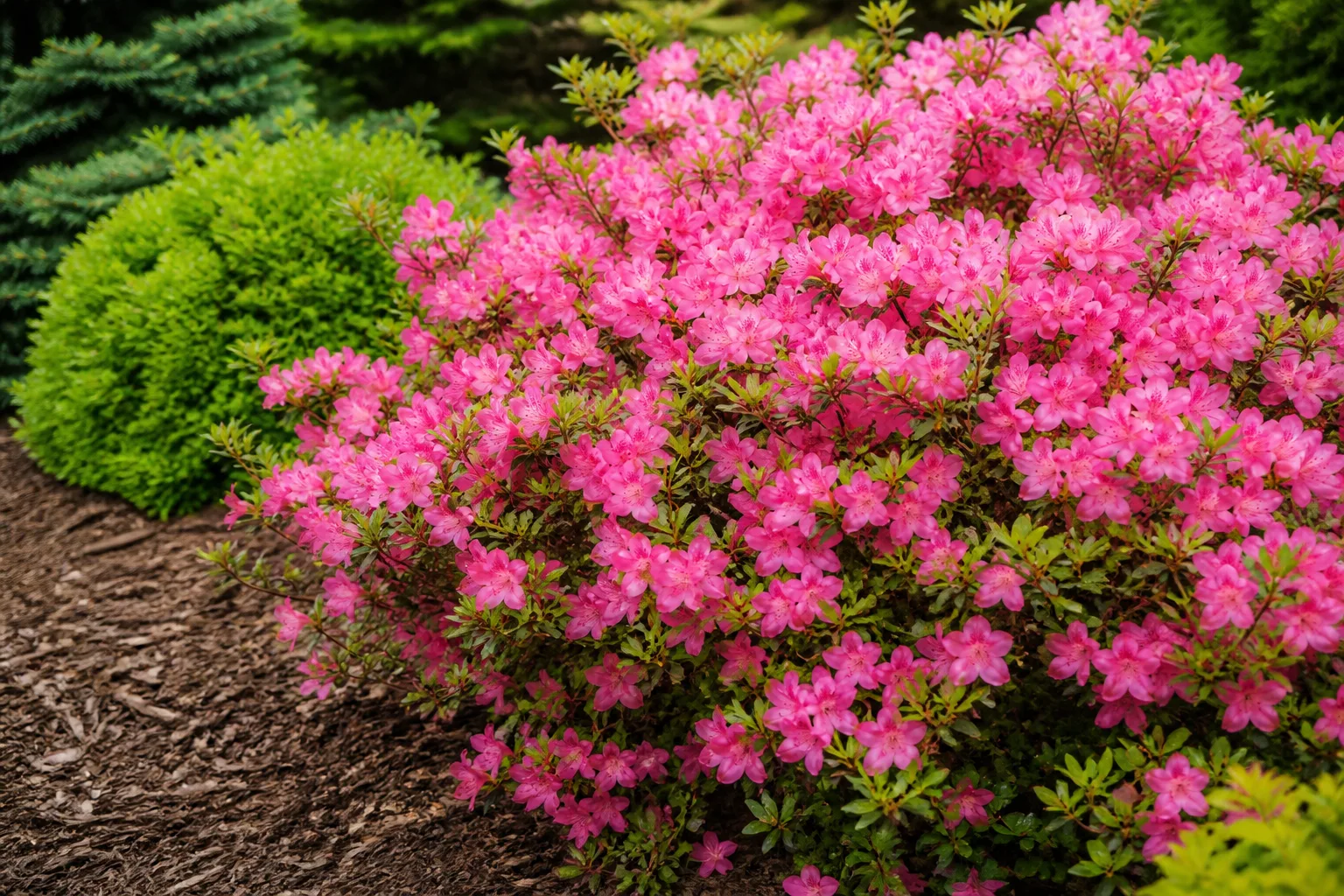
Azalea labels can make a shrub sound like a simple color choice. In practice, the name on the tag can tell you whether you are buying a compact evergreen for a sheltered border, a deciduous shrub bred for cold winters, or a rebloomer that needs a longer growing season and enough light to flower again.
The ten selections below are not interchangeable. Compare their likely mature footprint, foliage habit, bloom window, and local hardiness before choosing a color. Those details help prevent the two most common disappointments: a shrub that outgrows its spot and one that survives winter but rarely flowers well.
How to choose an azalea before you buy
Start with the cultivar name, not the flower color. “Azalea” describes a large and varied group within Rhododendron; named cultivars can differ substantially in size, leaf retention, bloom season, and cold tolerance. The Minnesota-bred Lights series, for example, consists of deciduous hybrids selected for colder climates, while many traditional garden azaleas are evergreen Asian hybrids. Arnold Arboretum’s account of deciduous azalea breeding explains why those breeding goals matter and why cold hardiness does not automatically prove tolerance of every other stress.
Use the plant tag or the grower’s cultivar-specific page to check four things: mature height, mature width, approximate hardiness range, and bloom period. A nursery plant in a one-gallon pot may look small enough for a foundation bed, yet its mature width can be several times the pot’s current footprint. If a listing gives a range instead of a single number, plan for the larger end unless you are willing to prune regularly.
Then look at the site. Azaleas generally do best in acidic soil that stays evenly moist but drains freely, with morning sun or filtered light and some protection from harsh afternoon heat. A zone number does not account for soggy clay, hot reflected light, winter wind, or a late frost that damages open flowers. The RHS plant profiles and the Missouri Botanical Garden’s cultivar records are useful reminders that the preferred soil, light, and exposure can vary by group and site. (RHS azalea guidance, Missouri Botanical Garden cultivar profile)
A quick comparison of bloom, size, and foliage
The table is a starting point, not a guarantee. Measurements and zone ranges come from published cultivar records and nursery references, which do not always agree; use the current tag for the plant sold in your region and allow space for the upper end of the mature range.
| Variety | Typical flower and season | Foliage habit | Approximate mature size | Reported hardiness | Selection note | |---|---|---|---|---| | ‘Northern Hi-Lights’ | Cream-white with yellow markings, spring | Deciduous | About 4–8 ft tall × 4–5 ft wide in one horticultural reference | Zones 3–9 reported; verify locally | Minnesota-bred cold-climate option | | ‘Lemon Lights’ | Fragrant lemon yellow, mid-to-late spring | Deciduous | About 4–5 ft × 3–4 ft | Zones 4–8 in horticultural references | Cold-hardy yellow selection; may give a light later flush | | Encore® ‘Autumn Amethyst’ | Dark lavender, spring with repeat summer-to-fall flushes | Evergreen | About 4 ft × 4 ft | Zones 6a–10b from breeder | Best where the season and light support rebloom | | Girard’s ‘Hot Shot’ | Reddish orange, usually May | Evergreen | About 2–3 ft × 3–4 ft | Zones 5–8 at Missouri Botanical Garden | Compact mound; protect from hot afternoon sun | | Girard’s ‘Variegated Gem’ | Pink and red, spring | Evergreen | Often listed around 2–3 ft × 2–3 ft | Zones 5a–8b in one plant record | White-edged foliage adds interest outside bloom | | ‘Fireball’ | Orange-red, late spring | Deciduous | About 4–6 ft × 4–5 ft | Zones 5–8 in horticultural references | Upright, larger shrub with bronze new growth | | Girard’s ‘Fashion’ | Coral-red to red, spring | Evergreen | About 2–4 ft × 3–5 ft | Zones 6–9 in grower profile | Low border shrub; allow for its width | | ‘Mandarin Lights’ | Rusty orange, spring | Deciduous | Roughly 4–5 ft tall × 3–4 ft wide in a nursery profile | Zones 3–7 in a regional listing | Cold-climate selection; flowers can precede leaves | | ‘Snow’ (Kurume) | White, spring | Evergreen or semi-evergreen in colder sites | Listings range from about 3–5 ft high and wide | Zones 6–9 in one nursery listing; confirm locally | Confirm local winter performance and the exact selection | | Korean azalea | Fragrant rose-purple, mid-spring | Deciduous to semi-evergreen | About 3–6 ft tall × 6–12 ft wide | Zones 4–9 in botanical-garden record | Broad, spreading shrub; reserve lateral room |
The cultivar-specific size, hardiness, and flowering notes below draw on the Missouri Botanical Garden, the Encore® plant profile, Fine Gardening, Gardener’s Path, Epic Gardening, and regional grower references. Treat these as planning ranges, not precise limits.
‘Northern Hi-Lights’
‘Northern Hi-Lights’ is a deciduous University of Minnesota hybrid bred for cold-climate gardens. Its spring clusters are cream to white with yellow markings, a gentler palette than the saturated red or orange of many spring azaleas. The flowers arrive before or as leaves emerge, so the shrub’s bare branching is part of the early display rather than a year-round evergreen screen.
Size listings vary: one horticultural reference places it around 4–8 feet tall and 4–5 feet wide, while smaller figures appear in some nursery descriptions. That reference gives a broad zone range of 3–9; treat the lower end as evidence of cold breeding, not proof that every plant performs across every climate inside the band. Use the local cultivar label, plan for a broad shrub rather than a dwarf edging plant, and ask about regional trials at the zone edges. Warm, dry summers or poor drainage can undermine a plant that is hardy to winter cold. (Fine Gardening, Arnold Arboretum)
‘Lemon Lights’
‘Lemon Lights’ offers soft yellow flowers with a light fragrance and autumn foliage that can turn burgundy or purple before it drops. It belongs to the deciduous Lights group, which gives northern gardeners a choice beyond evergreen varieties that may lose buds or suffer winter burn in colder exposures. Expect its main bloom in mid-to-late spring; reports of a light autumn rebloom are not a promise of a second full floral show.
Plan for a medium-to-large shrub, commonly listed around 4–5 feet tall and 3–4 feet wide, with references placing it in zones 4–8. It is more useful as a back-of-border accent or repeated in a loose group than squeezed beneath a low window. In hot-summer regions, give it protection from intense late-day sun and monitor root moisture through dry spells. Gardener’s Path describes its bloom, fragrance, dimensions, and zone range; Epic Gardening notes the deciduous leaves and seasonal color.
Encore® ‘Autumn Amethyst’
‘Autumn Amethyst’ is sold under the Encore® brand and carries the cultivar name ‘Conlee’. Its dark lavender flowers appear in spring and may return in later flushes through summer and fall. The breeder lists a mature size of about 4 feet tall and wide and zones 6a–10b; its glossy leaves can take on purple winter color. This makes it a strong option for a longer, relatively mild season, but it is a poor default for a garden whose winters fall below its listed range.
Rebloom depends on the plant establishing well, receiving adequate light, and not being cut back after it begins forming new growth. The brand recommends roughly four to six hours of direct sun for best flowering, with shade from harsh afternoon sun in hot climates. Do not translate “reblooming” into flowers every month: expect a major spring display and possible later waves, whose timing and intensity vary with local weather. (Encore® cultivar profile)
Girard’s ‘Hot Shot’
‘Hot Shot’ is a compact evergreen Girard hybrid with reddish-orange flowers marked in darker red. The Missouri Botanical Garden lists it at 2–3 feet tall by 3–4 feet wide, hardy in zones 5–8, and blooming in May in the St. Louis region. The “May” date is a regional reference: a cooler spring may push flowering later, while a warmer site can bring it earlier.
Choose it for a low border or small shrub group where evergreen foliage is useful after flowering. Its dense shape can make it tempting to shear into a tight ball, but repeated shearing removes flower-bearing branch tips and creates a thick outer shell. Give it part shade, a wind-sheltered position, and well-drained acidic soil; the botanical garden warns that wet roots can lead to root rot. (Missouri Botanical Garden cultivar profile)
Girard’s ‘Variegated Gem’
This selection earns its place through its foliage as well as spring flowers: pink-to-red blooms are set against green leaves edged or marked with white. It is evergreen, so the pale foliage can brighten a shaded border when it is not in flower. Plantlust’s plant record lists a compact mature size of about 2–3 feet tall and wide, while nursery descriptions may show broader dimensions; confirm the exact clone and current nursery tag before setting a tight spacing plan.
Use it where the leaf pattern is visible from a path or patio, not behind a larger shrub that will hide its main feature. White-edged leaves may be more noticeable in brighter filtered light, but hot direct sun can scorch azalea foliage. Plantlust lists zones 5a–8b and a compact 2–3-foot height and spread; other nursery descriptions may differ, so confirm the stock you are buying. Give it consistent moisture and excellent drainage rather than planting it against a walkway or wall. (Plantlust cultivar record)
‘Fireball’
‘Fireball’ is an Exbury hybrid for a larger, deciduous shrub with orange-red flowers and bronzy young leaves. Its blooms are generally described as a late-spring display, and the foliage can deepen to bronze, purple, or red in autumn. That combination gives it more than one season of interest, but it also means the shrub will have a bare winter outline; pair it with an evergreen background if you need structure year-round.
Allow roughly 4–6 feet in height and 4–5 feet in width; horticultural listings commonly place it in zones 5–8. A space that appears open when the plant is a small nursery specimen can become crowded once the branches mature, so measure from the shrub’s center to paths, foundations, and neighboring plants. ‘Fireball’ suits dappled shade or a site with some sun and evenly moist, acidic soil; do not use the “cold-hardy deciduous” label to overlook drainage. Gardener’s Path and Epic Gardening describe its flame-colored flowers and seasonal foliage.
Girard’s ‘Fashion’
‘Fashion’ is an evergreen Girard azalea with coral-red to red spring flowers and a compact, rounded habit. A grower profile lists it at about 2–4 feet tall and 3–5 feet wide, with a zone range of 6–9. It is therefore a better fit for a broad low border than for a narrow strip. Its winter leaves add continuity in mild areas, but evergreen foliage can be exposed to drying winds and winter sun when the ground is frozen.
Give it partial sun or shade, even moisture, and soil that drains freely. If the plant is happy but produces few flowers, check whether deep shade is limiting buds before adding fertilizer. A thick layer of mulch can conserve moisture, but keep it from piling against stems. The nursery’s cultivar page gives a useful cultivar-specific size and zone reference; in a colder garden, verify hardiness with a locally experienced grower before using it as a foundation evergreen. (Plant Addicts cultivar profile)
‘Mandarin Lights’
‘Mandarin Lights’ is a Minnesota-bred deciduous hybrid selected for cold climates. Its ruffled orange flowers can open before the leaves, making the shrub visible from a distance in spring. This is a good choice when you want a warm color in a northern garden without relying on an evergreen type that may be at the edge of its winter range.
A regional grower profile gives a ten-year size of about 4–5 feet tall by 3–4 feet wide and USDA zones 3–7; an American Rhododendron Society cultivar record describes an upright, rounded plant about 90 centimeters tall at ten years. Those differences are a reminder to use the tag on the plant in your market rather than treating one measurement as universal. If orange matters more than winter foliage, the seasonal tradeoff is straightforward: vivid spring flowers and autumn color, followed by a leafless shrub. (American Rhododendron Society cultivar profile, regional nursery profile)
‘Snow’ (Kurume hybrid)
‘Snow’ is a white-flowered Kurume azalea, a group of compact evergreen or semi-evergreen spring bloomers. A nursery record for the named selection lists it at roughly 3–5 feet high and wide and zones 6–9; other descriptions give smaller dimensions, so ask whether the plant is a true ‘Snow’ and how it performs in your area. Flowering is in spring, but the exact week depends on winter temperatures and the start of warm weather.
Its white flowers can brighten a shaded bed, but do not select it solely because a photograph shows a small, tidy mound. The group’s plants can broaden as they mature, and winter leaf retention becomes less reliable in colder or windier sites. Give it acidic soil that stays moist but does not remain saturated, and place it where morning light or filtered sun reaches the plant. The nursery profile for Kurume ‘Snow’ provides a named-cultivar reference; check local availability and mature size before planting near a walk.
Korean azalea
Korean azalea is a species form, listed as Rhododendron yedoense var. poukhanense by some references and Rhododendron yedoense f. poukhanense by NC State. It produces fragrant rose-purple flowers in mid-spring and grows wider than many gardeners expect: botanical records list a mature height around 3–6 feet and a spread that can reach 6–12 feet, with one record placing it in zones 4–9. It is deciduous to semi-evergreen, retaining more leaves in mild winters and dropping them in colder climates.
That broad, low habit can work as a woodland edge, informal hedge, or wide shrub border, but it is not a narrow foundation plant. Site it in partial to full shade with acidic, humus-rich soil that stays moist yet drains well. The botanical records note that poor drainage can cause root problems and that the shallow roots benefit from mulch. The NC State Plant Toolbox, Missouri Botanical Garden profile, and RHS profile agree on its spreading habit and climate-dependent foliage.
Sequence flowers across spring and fall
A mixed planting can extend azalea color without relying on any one shrub to rebloom. Choose cultivars whose local bloom windows overlap in succession: an early Kurume type, mid-spring evergreen Girard selections, then later deciduous Exbury or Lights hybrids. In warmer climates, a reblooming Encore can add later flowers; in a short northern summer, make the spring display the plan and treat any second flush as a bonus.
Do not assume that “early,” “mid,” and “late” mean fixed calendar dates. Flowering follows accumulated warmth and local exposure, so an azalea against a south-facing wall can open before the same cultivar on a cool north side. When shopping, ask a local nursery which varieties bloom first and last in that specific region, then choose two or three cultivars rather than buying several that flower at the same moment.
Evergreen, deciduous, or semi-evergreen?
Evergreen azaleas retain leaves through winter in suitable climates, giving a bed structure when most flowering shrubs are bare. They are often compact and useful in foundations, but they can be more vulnerable to winter burn or flower-bud injury in cold, exposed areas. Semi-evergreen plants may hold some leaves through a mild winter and shed most of them when temperatures drop.
Deciduous azaleas lose their leaves in fall. Many cold-region gardeners value them for winter survival, spring flowers, and autumn color, but they do not provide a leafy winter screen. The botanical identity alone does not always settle the question: the Korean azalea, for example, is listed as deciduous to semi-evergreen, with leaf retention changing by climate. The Fine Gardening comparison and RHS evergreen trial show why habit should be checked at the cultivar level rather than inferred from the word “azalea.” (Fine Gardening, RHS)
Match a cultivar to your site and climate
USDA hardiness zones describe the average annual extreme minimum temperature, not the whole growing environment. A cultivar labeled zone 6 may survive a zone 6 winter yet flower poorly if its buds are exposed to late frosts; a shrub at the warm edge of its listed range can struggle with humidity, reflected heat, or inadequate winter dormancy. Choose a named plant with local trial or nursery experience, especially if you are near the edge of a published range.
Check the soil before planting. Azaleas have fine, shallow roots that need both air and steady moisture. Use a soil test to learn whether the bed is acidic enough; don’t add sulfur or acidifying fertilizer by guesswork, since the right correction depends on the soil and local test recommendation. If the bed is heavy clay, compacted, or stays wet after rain, solve drainage across a broad planting area or choose a suitable raised bed before planting. A small pocket of loose mix inside clay can collect water rather than drain.
Light is the next test. Many evergreen cultivars perform well in morning sun and afternoon shade or bright dappled light. Dense shade can reduce flowering, while hot afternoon sun can scorch leaves and dry the shallow root zone. Cold-region deciduous cultivars may tolerate more sun in a cool summer, but don’t transfer that exposure recommendation automatically to a hot-summer garden. Watch the site through the day and consider both seasonal sun angle and nearby pavement or walls.

Plant and prune to protect next spring’s flowers
Plant when the soil is workable and conditions are mild, usually in fall or early spring according to local guidance. Set the root ball at the soil surface or slightly above grade rather than burying the crown. The shrub’s roots spread shallowly, so loosen the surrounding soil over a wide area instead of digging a deep, narrow hole. Water the root ball thoroughly after planting and keep it from drying while new roots establish.
Add a few inches of organic mulch over the root zone to moderate temperature and conserve moisture, keeping the material away from stems. Do not cultivate around an established azalea; shallow roots can be damaged by routine digging. Water during extended dry spells, checking the soil rather than watering by calendar. The goal is evenly moist soil, not a saturated bed. A wilted plant in wet soil may have a drainage problem, and more water would make it worse.
Prune only when there is a clear reason, such as removing a dead branch or correcting a crossing stem. For most spring-flowering azaleas, shape right after the flowers fade; pruning later in summer can remove buds already forming for the next spring. Encore types need extra care because late shaping can also remove developing rebloom growth. If a plant has grown far beyond its space, replacing it with a smaller cultivar is often kinder than repeated severe shearing.
Troubleshoot the common no-bloom problem
If an azalea grows leaves but produces few flowers, first check light and pruning history. Deep shade can limit flower formation, and pruning after midsummer may remove buds that would have opened the following spring. For reblooming cultivars, a hard late-season cut can also remove the growth needed for later flowers.
Next, consider winter injury and spring frost. A shrub may survive a cold spell while buds are damaged, particularly if the cultivar is near its hardiness limit or planted in a wind tunnel or frost pocket. Move future plants to a more sheltered site or choose a locally proven cultivar rather than trying to force a less suitable type. Do not fertilize heavily in response to one weak bloom year; excess growth does not replace flower buds lost to shade, frost, or pruning.
Yellow leaves can indicate several problems, including high soil pH, poor drainage, drought, or damaged roots. Test before correcting the chemistry and inspect moisture at root depth. If the soil is wet for long periods, improve drainage before adding water or fertilizer. When the shrub is otherwise healthy, wait through a full growing cycle after changing the site or pruning routine; azaleas do not respond instantly to every correction.
Conclusion
Choose azaleas by cultivar, mature width, foliage habit, local hardiness, and bloom timing—not color alone. The deciduous Lights series is a useful starting point for cold climates; evergreen Girard and Kurume selections provide compact spring color where winters are suitable; ‘Autumn Amethyst’ adds possible later flushes in a longer season; and Korean azalea needs room to spread.
Before you plant, verify the exact cultivar on the tag, compare the mature dimensions with the bed, and check soil acidity and drainage. A well-matched azalea can settle into the right place for years; a poorly matched one may survive but never give the flowers or shape you expected.