Black Spots on Black Pepper: Causes, Checks & Fixes
Quick answer
On Black Pepper (Piper nigrum), round black lesions with yellow halos usually mean anthracnose leaf spot in humid, still air—not generic houseplant stress. First step: remove the wettest spotted leaves with clean shears, water soil only, and improve airflow along the climbing vine before any spray.
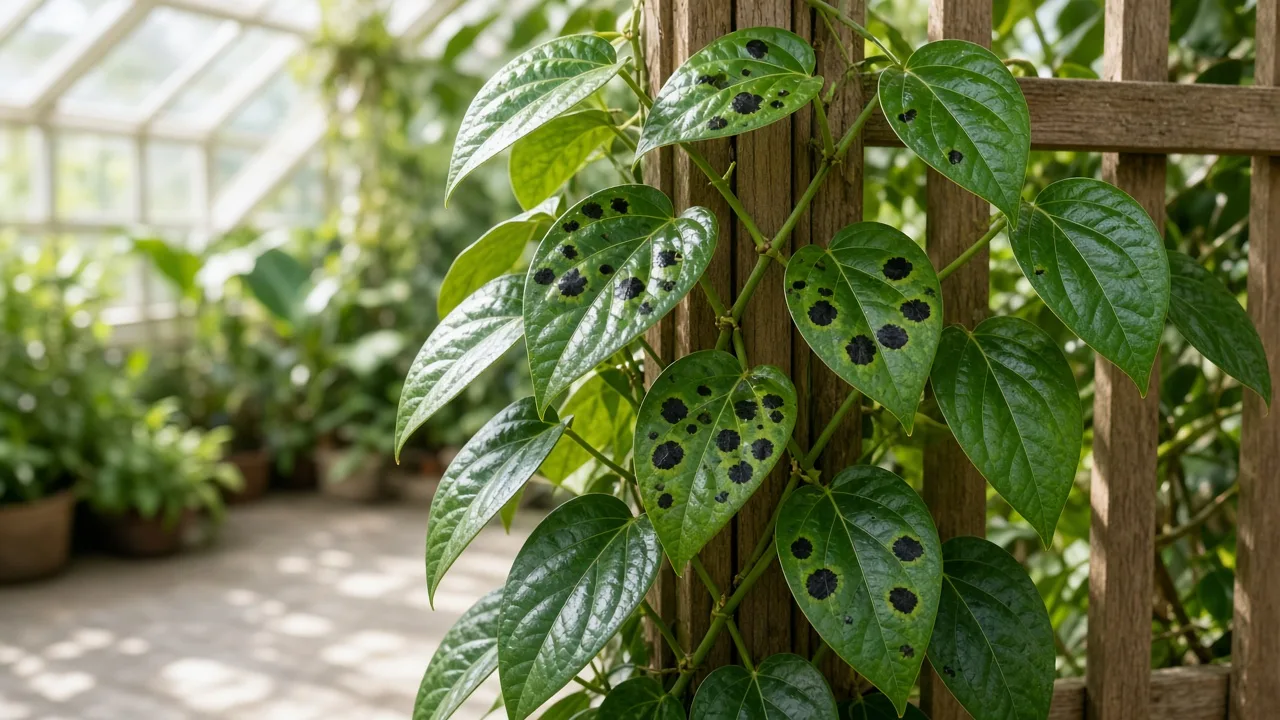
Black Spots on Black Pepper: Causes, Checks & Fixes
This guide covers black spots on Black Pepper. See also the general Black Spots guide, watering, and light pages for this plant.
Black Spots on Black Pepper: Causes, Checks & Fixes
Quick answer
Black spots on Black Pepper (Piper nigrum)—the glossy pepper vine grown for eventual peppercorn spikes—most often mean anthracnose leaf spot when you see round black or brown lesions with yellow halos that can later fall out as shot-holes. For general black-spot mechanics on houseplants, see our black spots guide. On this warm, humid climber, the pattern usually follows leaves that stay wet against a trellis or crowded canopy—not drought stress on a succulent.
First step: remove the most heavily spotted leaves with clean shears, then water the soil only and open airflow along the vine. Do not mist foliage or stack fungicide, repot, and hard prune on the same day.
Black Pepper needs bright filtered light and evenly moist mix without waterlogging. When damp leaves, stagnant inner canopy, and saturated soil overlap, leaf spot fungi and Phytophthora foot rot both worsen—match the pattern before treating.
When to use this page vs other Black Pepper guides
- Holes in leaves — chewing or shot-holes from advanced anthracnose; confirm halo pattern first
- Brown leaves — wide marginal browning from sun, drought, or salt stress
- Yellow leaves — whole-blade yellowing from roots, nitrogen, or collar failure
- Wilting — soft vine collapse when roots or stem base are failing, not isolated spots
- Overwatering — chronically wet mix that feeds foot rot and greasy leaf rot
- Root rot — collar softening and sour soil when Phytophthora attacks the base
- Spider mites — fine stippling and webbing, not expanding black circles
What black spots look like on Black Pepper
Healthy pepper vines carry glossy, oval to heart-shaped leaves on firm green stems that climb a pole, trellis, or support. Black-spot problems break that look in predictable ways on Piper nigrum.
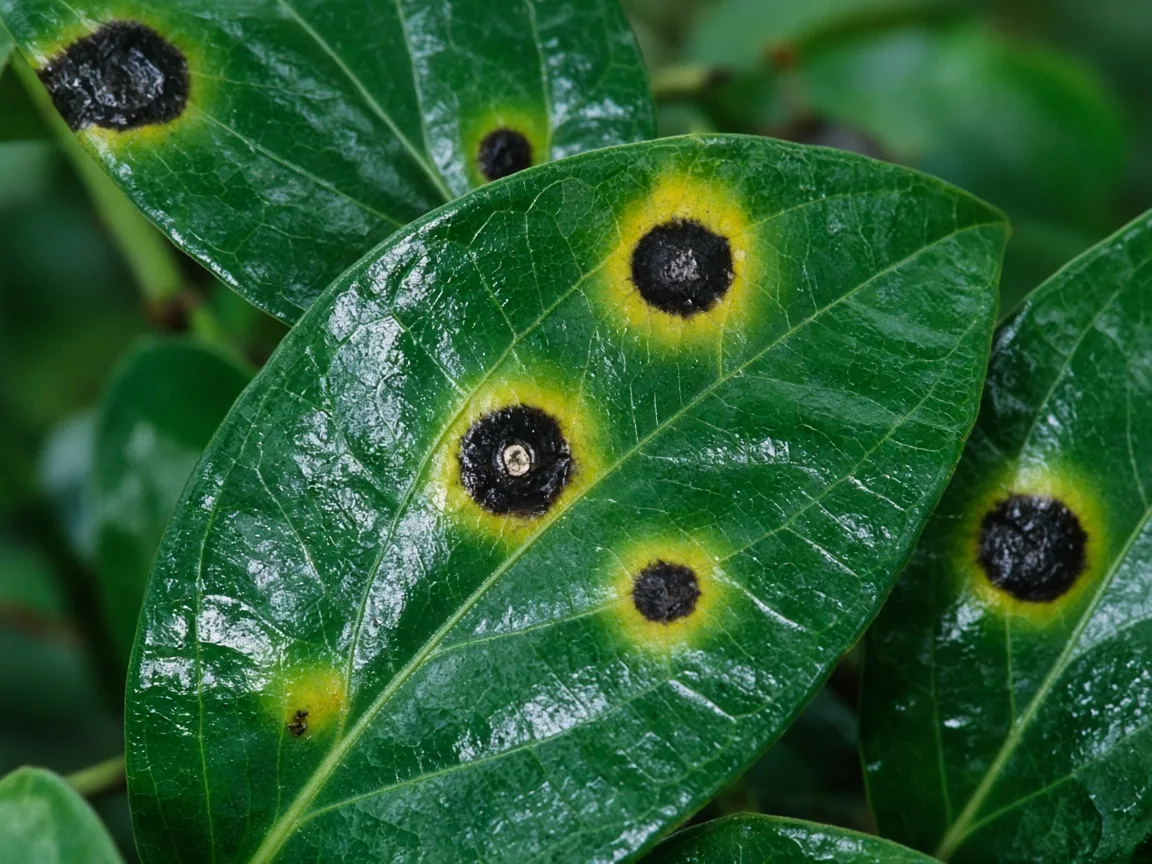
Anthracnose on pepper vines often shows dark round spots with a yellow halo; older lesions may develop a shot-hole center—compare with healthy tissue on the same stem.
Anthracnose (most common black-spot pattern)
Field and nursery surveys on Piper nigrum describe dark black or brown spots surrounded by a yellow halo that can progress to shot-holes on leaves. Cameroon field work noted circular or angular water-soaked lesions that become sunken, with centers turning orange-brown then black while the surrounding tissue stays lighter. On container vines you usually see:
- Dry to slightly sunken black centers with a yellow or pale ring on upper leaf surfaces
- Expanding spots that may leave a hole when the center drops out
- Scattered lesions on mid-canopy leaves in humid, still corners
- Stem spotting only in advanced cases—often after weeks of wet foliage
This matches classic fungal leaf spot behavior: spores germinate on wet leaf tissue and create expanding necrotic lesions.
Cercospora leaf spot (grey-centered brown rings)
The same pepper disease survey described brownish circular spots with light-grey centres and reddish-brown margins on pepper leaves—typical of Cercospora-type leaf spot. Indoors this can look like:
- Tan to brown disks with a ashy grey middle, not a sharp yellow halo
- More uniform spotting across older leaves lower on the vine
- Slower shot-hole formation than anthracnose
If halos are yellow and centers jet black, think anthracnose first; if centres look dusty grey, consider Cercospora and still fix humidity and leaf wetness.
Phytophthora foot rot and collar blackening (base, not blotches)
Kerala pepper research identifies Phytophthora capsici foot rot as the most destructive black pepper disease, usually after prolonged wet soil—not as random leaf freckles. Watch for:
- Blackening and softening at the collar where the vine meets the mix
- Sudden wilt on one side of the plant while soil is wet
- Greasy brown leaf patches low on the vine when splash carries spores upward
If the collar is firm and only upper leaves show dry rings, stay on the leaf-spot path. If the base turns black and soft, pivot to root rot and overwatering care.
Bacterial leaf spot (angular, water-soaked)
Bacterial pathogens on Piper crops can show tiny water-soaked specks with yellow halos that enlarge into angular necrotic patches bounded by veins. Less common than anthracnose indoors, but worth separating:
- Angular, vein-limited lesions instead of round concentric rings
- Soft, greasy margins that spread faster than dry fungal spots
- Often follows overhead watering or pruning in rain
Sun scorch and handling marks (not disease)
Black Pepper belongs in bright filtered or dappled light—not harsh midday sun. Flat black or brown patches on the sun-facing side of one or two upper leaves, without yellow halos or rings, are usually scorch from a sudden move to west glass. A single dry black edge on a leaf bruised against a trellis cord is cosmetic—not a reason to spray.
Black spots on spike catkins vs foliage
Container Black Pepper is often grown foliage-first; when the vine is old enough, slender spike catkins form at nodes. Disease shows differently on each tissue:
- Leaf anthracnose — spots on glossy blades, often with yellow halos and shot-holes
- Spike or stem lesions — dark sunken patches on young catkins or nodes after long wet spells; can abort peppercorn set
- Healthy catkins — firm green spikes with no water-soaked tip rot
If only leaves spot while new catkins stay clean, environmental leaf-spot correction is usually enough. If catkins blacken and soften while the collar is wet, treat foot-rot risk before worrying about fruit loss.
Why humid pepper-vine setups get black spots
Piper nigrum evolved as a warm, humid understory climber in tropical production regions. Indoors you recreate part of that—high humidity, organic mix, frequent watering—which keeps leaves glossy but also extends hours leaf surfaces stay wet.
Three pepper-vine-specific drivers:
- Broad glossy leaves catch splash and mist. Watering overhead or evening misting lets spores germinate on blades that never dry before night.
- Vines climb tight against trellis cord or moss poles. Inner leaves pressed to damp support stay shaded and stagnant—ideal for splash-borne Colletotrichum.
- Fast node extension in warm weather. Soft new leaves at the growing tip are colonized first when airflow lags behind vine length.
Chronic wet mix without drainage adds Phytophthora pressure at the collar—the same culture that favors leaf anthracnose.
Trellis wraps and node moisture traps
Unlike rosette houseplants, Black Pepper spends its life wrapped around a vertical support. Black spots often cluster where:
- Jute or coir trellis cord stays damp for days
- Inner leaves are pinned between stem and pole with no air gap
- Runoff from the pot splashes lowest leaves on the saucer
First cultural fix after removing spotted leaves: loosen the vine slightly off the support, trim the worst inner blades, and water so the soil surface—not the foliage— receives moisture. Rotate the pot weekly so one face of the vine is not permanently against a wall.
How to confirm the cause
Work through these checks in order:
- Spot texture — Dry black ring with yellow halo = anthracnose likely. Grey-centered brown disk = Cercospora likely. Soft water-soaked brown = Phytophthora or bacterial.
- Height on the vine — Mid-canopy scattered spots in a humid room = fungal splash. Lowest leaves + wet soil = foot rot or splash rot.
- Collar firmness — Firm green stem at soil line supports leaf-spot focus. Soft black collar = root rot workflow.
- Leaf undersides at nodes — Rule out scale, aphids, and sticky honeydew that mimics spreading lesions.
- Soil moisture at 2–4 cm — Match the finger-test rhythm; mix that stays wet 5+ days weakens leaves even when spots look purely fungal.
- New growth test — After sanitation and dry leaves, the next two node flushes should open without fresh spots if your fix matched the cause.
First fix for Black Pepper
Remove the wettest, most heavily spotted leaves with sterilized shears, bag them, and stop wetting foliage when you water.
That single step cuts inoculum and dries the leaf surface—the two levers that matter most on pepper vines before any product.
- Water at the soil line only, early in the day, per the black pepper watering guide
- Space the vine away from walls and other plants; run a fan on low if humidity stays above 70%
- Pick up fallen leaves from the pot surface—they harbor fungal spores
- Do not mist until new growth stays clean for two weeks
Wait 10–14 days and judge the next two leaves at the growing tip. If fresh black rings still appear, move to targeted treatment—not before.
Step-by-step recovery
After the first fix:
- Sanitize tools between cuts; pepper vines bruise at nodes if shears are dull.
- Thin crowded inner leaves against the trellis so air reaches glossy blades.
- Adjust watering to pot weight — Mix should stay evenly moist but never waterlogged; empty cachepot water within 30 minutes.
- Raise light without scorch — Bright filtered east light or shade cloth if the vine was in deep gloom (weak light slows recovery but does not create concentric yellow halos).
- Optional fungicide — When environmental correction fails, a copper or sulfur product labeled for leaf spot on herbs may protect new tissue; fungicides do not erase old necrotic centers. Observe label intervals if you harvest peppercorns.
If the collar blackens and softens or the whole vine wilts on wet soil, shift to foot-rot salvage—leaf sprays alone will not save the base.
Recovery timeline
Expect cleaner new leaves within two to four weeks once foliage stays dry and spotted debris is gone. The next two node flushes should open without fresh halos before you call the problem controlled.
Old black centers do not green up—success is measured on new glossy leaves climbing the support. Severely spotted blades can be trimmed after the vine stabilizes.
If greasy rot spreads on saturated mix despite dry upper leaves, inspect roots within a week. Phytophthora can move from soil to collar faster than anthracnose alone.
Lookalike symptoms
| What you see | Likely cause | Where to go |
|---|---|---|
| Round dry black spots with yellow halos, possible shot-holes | Anthracnose | This page |
| Brown spots with grey centers, reddish margins | Cercospora leaf spot | This page (cultural + fungicide if needed) |
| Soft black collar, wilt on wet soil | Phytophthora foot rot | Root rot, overwatering |
| Angular water-soaked specks between veins | Bacterial leaf spot | Black spots hub |
| Flat black patch on sun-facing leaf only | Sun scorch | Light guide |
| Irregular holes, no halos | Chewing pests | Holes in leaves |
| Fine stippling, webbing | Spider mites | Spider mites |
Mistakes to avoid
Do not mist a spotted pepper vine to “boost humidity”—Piper nigrum wants humid air, not wet leaves. Use a pebble tray or humidifier instead of foliar water.
Do not apply heavy fungicide on every spotted leaf before removing debris and fixing airflow. Fungicides protect new tissue; they do not reverse established black necrosis.
Do not confuse healthy dark green glossy leaves with disease—worry when raised black rings girdle nodes or halos spread on new flushes.
Do not harvest leaves or green peppercorns while treating with chemicals not labeled for edible spices.
Do not repot on day one unless mix is sour or roots are brown—transplant stress on a diseased vine spreads spotting before recovery.
Black Pepper care cross-check
Black spots rarely exist in isolation on this species:
- Watering — Water when the top 2–4 cm dries; soggy mix feeds foot rot alongside leaf pathogens.
- Soil — Fertile, well-draining organic mix with perlite; waterlogged culture is a leaf-rot trap.
- Light — Filtered light or part shade; harsh sun causes black patches that mimic disease.
- Humidity — Target 60–80% air moisture without wetting blades; low humidity browns tips but does not create concentric rings.
- Fertilizer — Hold feed until new growth is clean for two weeks; fertilizer on stressed vines burns roots when uptake is weak.
How to prevent black spots on Black Pepper
Water soil early so incidental splash dries before evening. Keep inner leaves thinned against trellises each month during fast summer growth.
Quarantine new pepper cuttings until two clean flushes pass—nursery surveys report anthracnose and collar rot as common seedling diseases when vines crowd together.
Rotate the pot weekly so one side is not permanently pressed against a damp wall. Sanitize shears when trimming per the pruning guide.
Avoid overhead irrigation habits copied from outdoor monsoon fields; container vines need root-zone moisture, not foliar showers.
When to worry
Isolated spots on one older leaf after a humid week are manageable. Act within days when:
- New leaves open already spotted for two flushes running
- Stem collar blackens and softens at the soil line
- More than one-third of leaves show merging lesions
- Greasy rot spreads on saturated mix despite dry upper foliage
- Whole vine wilts while soil is wet—see wilting and root inspection
At that stage, salvage healthy tip cuttings above clean nodes before the base fails—see propagation for stem-cutting basics.
Related Black Pepper guides
- Black Pepper overview — species baseline and care hub
- Black Pepper problems — full symptom index for this vine
- Watering — dry-down checks that prevent foot rot
- Light — filtered placement that avoids scorch mimics
- Soil — drainage mix for moist-but-not-soggy roots
- Root rot — when collar softening follows wet culture
- Overwatering — saturated mix paired with leaf and collar rot
Related tool
Use the Plant Problem Diagnosis Tool to narrow causes for black spots on this plant before changing multiple variables at once.