How to Grow and Care for Zebra Grass
Zebra grass (Miscanthus sinensis 'Zebrinus') needs full sun and late-winter cutback. Learn planting, division, invasive risk, and safer alternatives.
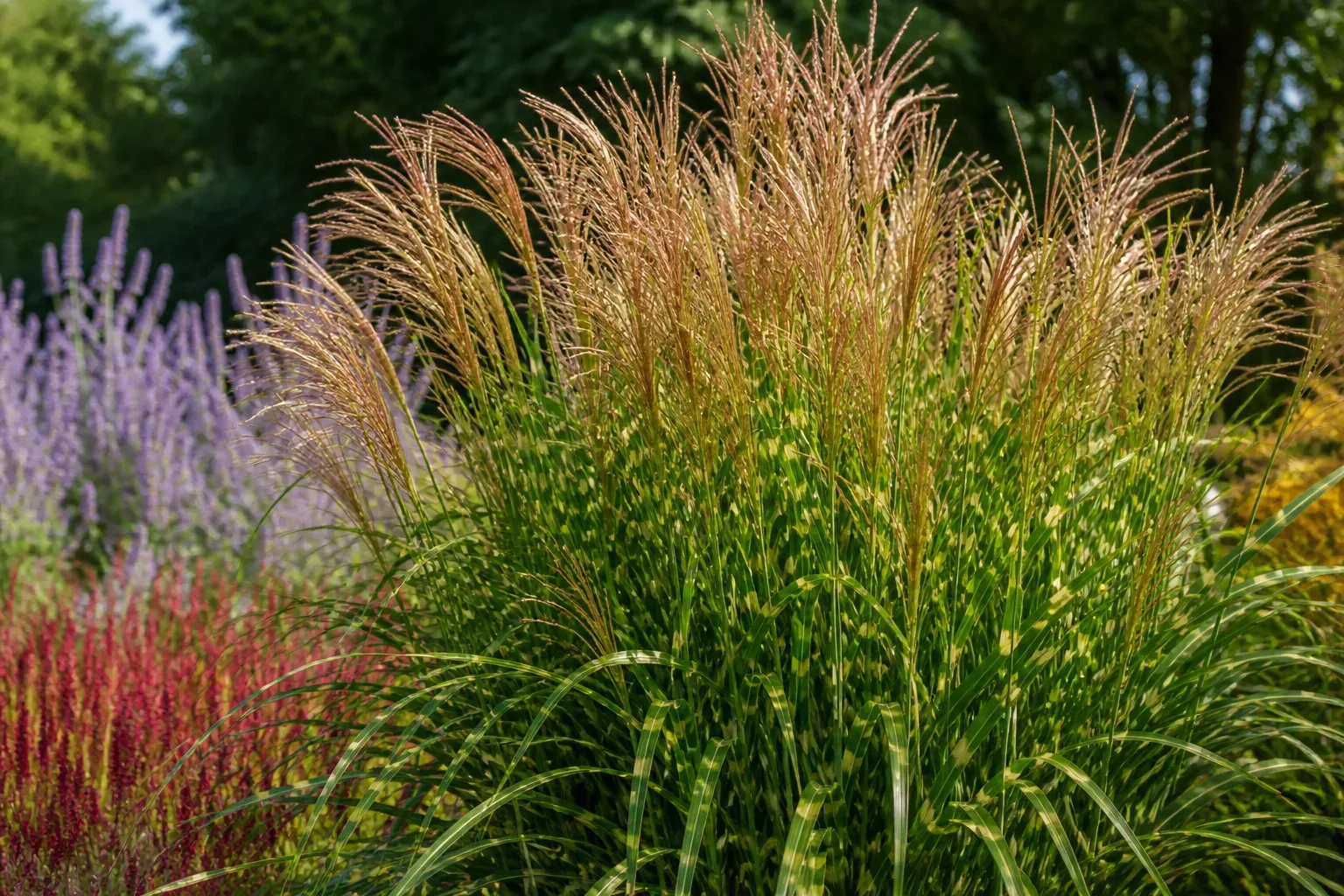
Zebra grass (Miscanthus sinensis ‘Zebrinus’) is the striped cultivar of Chinese silvergrass most gardeners picture when they want height, movement, and bold foliage in a sunny border. Horizontal golden bands across arching green blades read clearly from across the yard, and copper-tinted plumes in late summer add another season of interest. The catch is that the same traits that make it popular — fast growth, drought tolerance once established, and prolific seed set in many cultivars — also make the species problematic in large parts of the United States.
This guide covers how to grow ‘Zebrinus’ well when it is appropriate for your site, when to choose a different plant entirely, and the maintenance habits that keep clumps upright, healthy, and contained.
Why Zebra Grass Earns Attention — and Scrutiny
Zebrinus is a warm-season ornamental grass: it waits for soil temperatures to warm in spring before pushing new blades, then builds most of its height through summer. Missouri Botanical Garden describes the cultivar as forming a rounded, fountain-like foliage clump typically 4 to 6 feet tall, with flower stalks rising another 2 feet above that for a total height near 6 to 8 feet when blooming (Missouri Botanical Garden: Miscanthus sinensis ‘Zebrinus’). The horizontal yellow banding is irregular — some leaves carry more stripes than others — which is part of the plant’s charm.
What separates a good zebra grass year from a frustrating one is almost always siting. Full sun, adequate moisture during establishment, and room for the clump to arch without crowding are non-negotiable. Skimp on light and you get weak, leggy growth that sprawls across paths. Ignore the species’ seeding habit in the eastern U.S. and you may be fighting volunteers in beds and along fence lines for years.
NC State Extension lists maidengrass as invasive in North Carolina, highly flammable, and difficult to remove once rhizomes anchor in place (NC State Extension: Miscanthus sinensis). That does not mean ‘Zebrinus’ never belongs in a garden — but it does mean you should verify local guidance before you dig.
Zebra Grass at a Glance
| Feature | Details |
|---|---|
| Common names | Zebra grass, Chinese silvergrass (species) |
| Botanical name | Miscanthus sinensis ‘Zebrinus’ |
| Plant type | Warm-season perennial ornamental grass |
| Mature size | 5–8 ft tall (including plumes), 4–6 ft wide |
| Sun | Full sun; tolerates light shade with reduced vigor |
| Soil | Average to moist, well-drained; tolerates clay and sand |
| Soil pH | Roughly neutral (about 6.0–7.0) |
| Bloom time | Late summer into fall |
| Flower color | Pinkish copper aging to silvery white plumes |
| Hardiness | USDA zones 5–9 |
| Native range | Cultivar; species native to East Asia |
| Deer resistance | Generally deer resistant |
| Main cautions | Invasive reseeding in many regions; high fire risk when dry |
Quick ID: look for broad green blades with transverse yellow bands, an arching clump habit, and tassel-like plumes held above the foliage in autumn. Foliage often turns gold to tan after frost and can persist through winter for structure and snow catch.

Should You Plant Zebra Grass? Invasive Risk and Regional Rules
Before you buy a pot at the nursery, answer two questions: Is Miscanthus sinensis considered invasive where you garden? And do you have the space and maintenance commitment to manage seedlings?
The Invasive Plant Atlas of the United States notes that Chinese silvergrass escapes from ornamental plantings, forms large clumps along roadsides and disturbed areas, displaces native vegetation, and increases fire risk in invaded sites (Invasive Plant Atlas: Miscanthus sinensis). It spreads by wind-dispersed seed and rhizomes. Missouri Botanical Garden warns that the species reseeds aggressively enough to be considered invasive in some areas and recommends checking local invasive-plant resources before planting (Missouri Botanical Garden: Miscanthus sinensis ‘Zebrinus’).
Where Miscanthus sinensis Becomes a Problem
Problem reports cluster in the eastern and central United States, where mild winters and disturbed edges favor seedling establishment. States frequently cited include Alabama, Connecticut, Georgia, Kentucky, Maryland, Pennsylvania, Rhode Island, South Carolina, Tennessee, Virginia, and West Virginia, though the plant has been documented in more than 25 states. Even where it is not legally banned, planting fertile miscanthus near prairies, woodland openings, or unmanaged meadows can export seed into high-quality habitat.
If you live in a regulated state or near natural areas, treat fertile miscanthus as a high-risk choice. Deadheading plumes before seeds mature and heavy mulch to suppress seedlings help only partially — they are not substitutes for choosing a lower-risk plant.
Sterile Cultivars and Native Alternatives
NC State Extension recommends looking for cultivars bred for reduced fertility, including ‘Scout’ (a sterile UGA introduction), My Fair Maiden™ ‘NCMS1’, and Bandwidth™ ‘NCMS2B’ (NC State Extension: Miscanthus sinensis). ‘Zebrinus’ itself is listed with low seed set relative to some siblings, but low is not zero — do not assume it is safe near wild land just because banding is showy.
For similar height and movement without the invasive baggage, consider native warm-season grasses:
- Switchgrass (Panicum virgatum) — upright to arching, excellent for sun and erosion control
- Indian grass (Sorghastrum nutans) — golden summer color, strong fall hue
- Little bluestem (Schizachyrium scoparium) — smaller scale, outstanding autumn color
These support regional pollinators and birds without the miscanthus baggage. If you want variegation, dwarf miscanthus ‘Little Zebra’ offers banded leaves at roughly 4 feet tall with better phytophthora resistance per NC State cultivar notes.
Choosing the Right Site: Light, Soil, and Spacing
Site selection determines whether your zebra grass looks like a deliberate focal point or a floppy mess leaning on its neighbors.
Sun Requirements and Why Shade Makes It Flop
Zebrinus performs best in full sun — at least six hours of direct light daily. Missouri Botanical Garden notes that too much shade reduces vigor, decreases flowering, and causes stems to flop (Missouri Botanical Garden: Miscanthus sinensis ‘Zebrinus’). The yellow banding also develops more strongly in warm, bright conditions; cool spring growth may look nearly solid green until summer heat intensifies the pattern.
In hot southern climates, light afternoon shade can reduce leaf scorch on exposed sites, but deep shade is a poor long-term choice. If your only open bed is along a north-facing wall, pick a shade-tolerant grass instead.
Soil, Drainage, and pH
This grass tolerates a wide soil range — sandy, loamy, or clay — as long as water does not sit on the crown for days after rain. It prefers moist soils and even handles riparian edges, yet established clumps withstand drought better than most perennials. Aim for neutral pH near 6.5 to 7.0; extreme acidity or alkalinity rarely kills the plant but can yellow foliage over time.
Spacing: Allow 3 to 5 feet between clump centers at planting. A mature ‘Zebrinus’ arch can easily reach 4 to 6 feet across; crowding encourages fungal issues and makes division harder later.
Planting Zebra Grass Step by Step
Best timing: Plant in spring after the last hard frost in cold zones so roots establish through summer. Early fall works in mild climates if you can keep soil moist until dormancy. Avoid planting into baked, dry midsummer soil unless you can irrigate consistently.
- Prepare the hole twice as wide as the root ball and the same depth. Loosen heavy clay with compost, not fine peat that holds water against the crown.
- Set the plant so the crown sits level with or slightly above grade — burying too deep invites rot.
- Backfill and firm gently to remove air pockets without compacting clay into concrete.
- Water deeply at planting and mulch 2 to 3 inches, keeping mulch off the crown.
- Stake only if needed on windy sites the first season; remove stakes once roots anchor.
Container-grown plants often fit a #2 or #3 nursery pot; bare-root divisions from a neighbor should go in immediately with crowns barely covered. In USDA zone 5 and the northern edge of zone 6, spring planting gives a full growing season before the first hard winter. Southern gardeners can plant in early fall if soil stays workable and you water through autumn dry spells — just avoid planting into heat-stressed August soil without irrigation backup.
If your nursery pot is root-bound, tease circling roots outward or make shallow vertical cuts before backfilling. Warm-season grasses sit quietly for weeks after planting while soil warms; resist the urge to overwater cool, wet soil in early spring.
Watering, Mulching, and Fertilizing
First year: Water deeply once or twice weekly if rain delivers less than about an inch. The goal is moist soil to roughly 6 inches down, not constant sogginess. Roots that dry out repeatedly in year one produce smaller, weaker clumps forever.
Established plants: Irrigate during extended drought or when foliage curls and browns at the tips. Mulch preserves moisture and suppresses miscanthus seedlings — a double benefit in fertile cultivars. A 2- to 3-inch organic mulch layer also moderates soil temperature around the crown, which matters on exposed slopes where summer heat can stress shallow roots.
Fertilizer: Light feeding is plenty. Scatter compost around the base in early spring, or apply a balanced slow-release fertilizer once as new growth emerges. Excess nitrogen pushes soft, floppy blades and can delay the banding that makes the plant worth growing. Organic options like composted manure or fish emulsion at half label strength work well on lean soils. If a soil test shows high phosphorus, skip bloom-booster products — grasses rarely need heavy P and excess can tie up micronutrients.
Pruning and Seasonal Cleanup
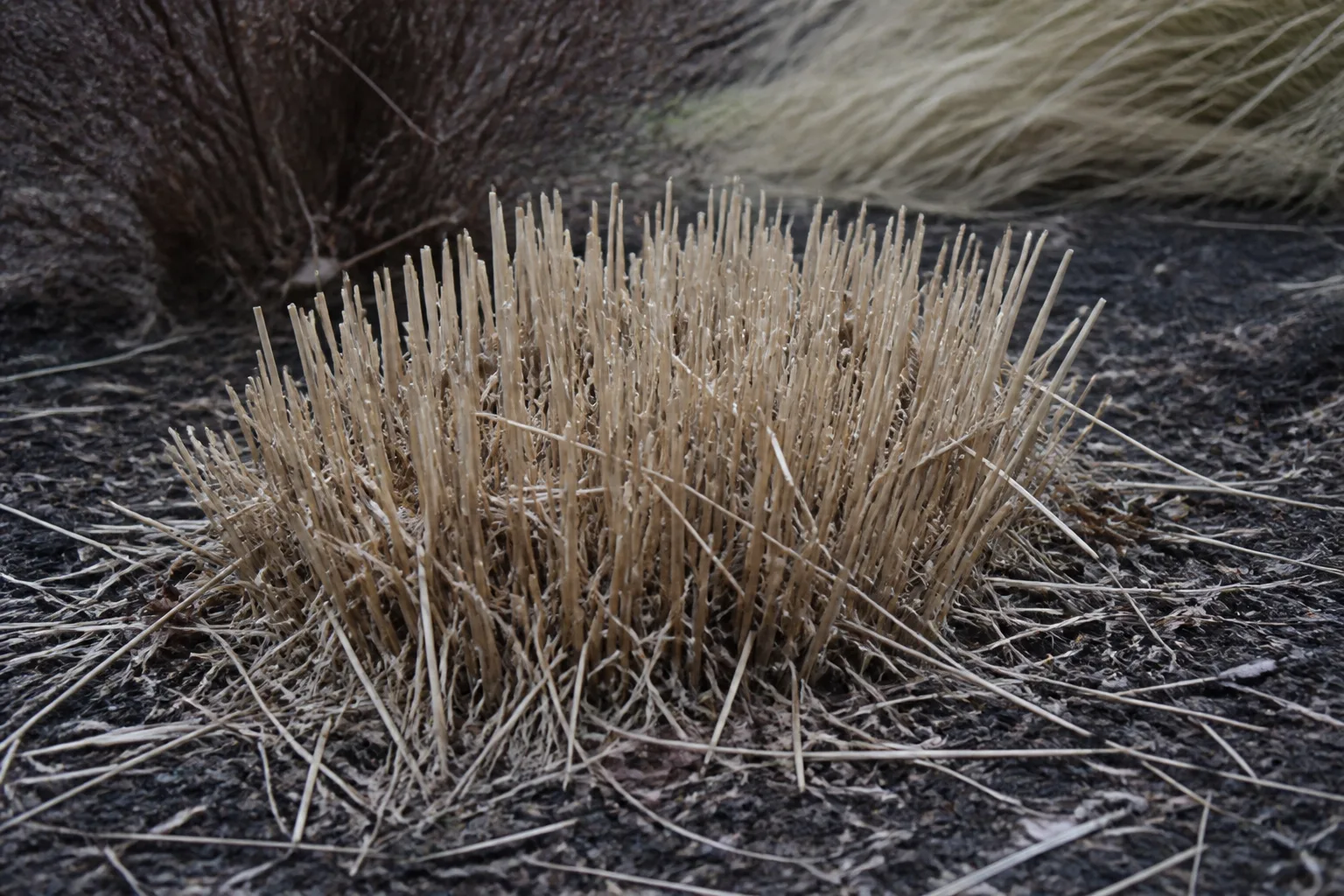
Ornamental grasses repay you for one annual haircut. Leave standing foliage through winter for structure, wildlife cover, and crown protection, then cut back in late winter or early spring before new shoots appear. Missouri Botanical Garden recommends cutting close to the ground at that window (Missouri Botanical Garden: Miscanthus sinensis ‘Zebrinus’).
Use sharp hedge shears, loppers, or a serrated knife on large clumps. Wear gloves — leaf margins are serrated. Bundle and tie stems before cutting if you want easier cleanup. Remove cut material from beds to reduce overwintering pest habitat.
Do not prune in fall unless you live in a fire-prone area and local guidance recommends removing dry grass within defensible space around structures. NC State rates maidengrass high flammability and advises against planting it in the home ignition zone (NC State Extension: Miscanthus sinensis).
Dividing and Propagating Zebra Grass
Divide every three to five years — or when the center dies out and only a ring of healthy growth remains. Early spring, just as new shoots poke through, is the easiest window. Late summer division also works if you keep divisions watered.
- Cut foliage back to about 12 inches for easier handling.
- Dig the entire clump with a spade, keeping as much root mass as possible.
- Rinse soil from roots if you need to inspect for damage or pests.
- Split the crown with a spade, saw, or two forks back-to-back — quarters are manageable on large clumps.
- Trim damaged roots and discard woody center tissue that shows no buds.
- Replant divisions at the same depth, water thoroughly, and mulch.
Divisions taken from healthy clumps establish faster than seed, which is inconsistent for variegation anyway. Replant the largest divisions where you want immediate impact and pot up smaller sections to give away — miscanthus divisions are heavy, so enlist help moving big clumps.
If you are removing unwanted miscanthus, NC State describes a retreatment approach: allow regrowth to 12 inches, spray new foliage with 1% glyphosate plus surfactant, cut back when it dies, and repeat until regeneration stops (NC State Extension: Miscanthus sinensis). That is labor-intensive — another reason to think before you plant.
Growing Zebra Grass in Containers
Containers corral rhizome spread and work on patios where in-ground miscanthus would be irresponsible near wild areas. Choose a pot at least 18 to 24 inches wide and deep with drainage holes. Use a well-draining potting mix amended with perlite or coarse sand.
Potted zebra grass needs more frequent watering than in-ground plants — often daily in summer heat. Expect to divide or upsize the pot every two to three years because warm-season grasses fill containers quickly. A single specimen can anchor a mixed container if you accept that it will dominate by midsummer.
Overwintering Potted Zebra Grass
In USDA zone 5 and colder, container roots freeze harder than in-ground crowns. Options include sinking the pot to the rim in the garden for winter, moving it to an unheated garage after the plant goes dormant, or insulating the pot with bubble wrap and straw bales in a sheltered corner. Keep soil barely moist, not wet, through dormancy.
Do not bring the pot indoors to heated living space — warm air pushes weak winter growth. Wait until late winter to cut back and resume watering as outdoor temperatures rise.
Using Zebra Grass in the Landscape
Privacy Screens, Borders, and Erosion Control
Massed ‘Zebrinus’ makes a summer-through-winter screen along property lines when you have the width to spare. Single specimens work as focal points behind lower perennials like sedum, Russian sage, or black-eyed Susan, where the stripe pattern reads against simpler foliage.
The deep root system stabilizes slopes and embankments once established. Pair with stone or timber edging if you need to keep arching leaves off walkways. Avoid planting where plumes will shed seed into storm drains or natural waterways.

Pests, Diseases, and Common Growth Problems
Flopping: Almost always too little sun, too much nitrogen, or overcrowding. Staking is a bandage — move or divide instead if flop returns yearly.
Miscanthus mealybug: Tiny pests live inside stems, causing stunted, distorted growth. Infested clumps are hard to clean; removal is often more practical than spraying into tight sheaths.
Miscanthus blight: Fungal disease affecting blades and sheaths; improve air circulation and avoid overhead irrigation on dense plantings.
Powdery mildew and leaf rust: More common in humid summers with poor airflow. Thin neighboring shrubs and skip high-nitrogen feeds.
Winter collapse: Heavy wet snow can flatten arching clumps. Missouri Botanical Garden notes ‘Zebrinus’ may need staking and is susceptible to collapsing under snow load (Missouri Botanical Garden: Miscanthus sinensis ‘Zebrinus’). Cut damaged stems in spring regardless.
Deer generally pass miscanthus by, which is one honest advantage in suburban plantings.
Zebra Grass vs. Porcupine Grass and Related Cultivars
Naming trips up even experienced gardeners. Zebra grass is Miscanthus sinensis ‘Zebrinus’ — arching, rounded, often floppy without full sun. Porcupine grass is M. sinensis ‘Strictus’ — narrower upright blades with similar horizontal bands and a more columnar habit that rarely needs staking. Hoffman Nursery contrasts the arching zebra form with the erect porcupine form when both are grown in full sun (Hoffman Nursery: Miscanthus sinensis ‘Zebrinus’).
Other useful comparisons:
- ‘Gracillimus’ — fine-textured maiden grass, copper plumes, low seed set
- ‘Flamingo’ — rose-pink plumes fading to silver
- ‘Silberfeder’ — taller, silvery plumes in late summer
- ‘Little Zebra’ — dwarf banded cultivar for smaller beds
Choose based on habit (arching vs upright), mature height, and fertility rating — not banding alone, since several cultivars stripe.
Conclusion
Zebra grass rewards gardeners who want a tall, striped warm-season grass in a sunny, well-drained site — and who understand the species’ baggage. Give ‘Zebrinus’ six hours of sun, three to five feet of elbow room, a late-winter cutback, and division every few years, and you get a dramatic plant that carries the border from summer plumes through winter silhouette.
Skip it if local invasive lists, fire-risk maps, or your proximity to wild habitat make seeding irresponsible. In those cases, sterile miscanthus cultivars or native switchgrass and Indian grass deliver movement without the cleanup. Decide that first, then plant — not the other way around.