When to Fertilize Bulbs That Bloom in Spring: Timing Guide
Find when to fertilize bulbs that bloom in spring. Compare fall planting and early shoot windows, avoid excess phosphorus, and protect next year’s flowers.

Quick answer: feed by growth stage, not by a fixed date
For most hardy spring-flowering bulbs, the best time to fertilize is either when you prepare the bed in fall or as the first shoots emerge in early spring. Which window makes sense depends on the soil test, the fertilizer label, and whether the bulbs are new or already established. If your soil is fertile and the bulbs flower reliably, you may not need to add fertilizer at all.
Do not treat spring bulbs like a lawn that needs a routine dose every few weeks. Rutgers Cooperative Extension and Kansas State University Extension both place the most useful feeding window around planting or early shoot growth, when roots can use nutrients; they caution that feeding during bloom or after roots begin to die back can be wasted. Rutgers’ spring-bulb guidance and Kansas State’s timing and soil-test recommendations are useful starting points.
The simple rule is: test first, feed only if the bed needs nutrients, and target the root-active period before flowers open. After bloom, protect the leaves until they yellow naturally; that step usually matters more than adding another scoop of fertilizer.
First, define spring-blooming bulbs
This guide focuses on hardy bulbs planted in fall and blooming after winter, including tulips, daffodils, crocuses, hyacinths, alliums, and snowdrops. Some are true bulbs and some are technically corms, but they share a seasonal cycle: they store energy underground, grow roots in cool soil, send up leaves and flowers, then return to dormancy after the foliage dies back.
That cycle is different from spring-planted summer-flowering bulbs such as dahlias or gladiolus. Those plants grow during warm weather and need a different feeding schedule. If you bought a potted bulb already in flower for indoor display, it also has a different immediate need from a permanent outdoor bed.
Most spring bulbs arrive with enough stored energy to make their first leaves and flowers. Fertilizer is mainly a soil-building and future-growth decision, not a way to force a dormant bulb to bloom faster this week. This is why a bulb can flower well in its first spring even if the soil is not ideal, then decline later if it cannot replenish reserves or if conditions are poor.
Why the plant’s stage matters more than the calendar
“Fall” and “spring” are broad labels, not precise instructions. In a cold region, bulbs may be planted months before they emerge; in a mild climate, the window can be shorter. Use the visible stage of the plant and the condition of the ground instead of applying fertilizer on the same date each year.
After planting, roots begin developing while the bulb is still below ground. Once foliage emerges, the roots are active and can take up nutrients. When flowers open, the bulb’s seasonal growth cycle is already well advanced, and some extension guidance says a feed at that point is poorly timed.
Soil also changes the answer. A bed with low fertility may benefit from measured fertilizer, while a bed with adequate phosphorus and potassium can accumulate excess nutrients if you continue to apply a bulb formula by habit. A soil test turns “feed in fall and again in spring” into a decision based on actual need.
The two useful fertilizing windows
There are two practical opportunities: prepare the soil at fall planting, or feed lightly when shoots appear in spring. You do not automatically need both. A new planting in a deficient bed may need a preplant amendment, while an established bed that was tested and amended recently may need no additional feed this year.

At fall planting, if the soil needs nutrients
If a soil test recommends fertilizer or an amendment, incorporate it into the wider planting bed before you set bulbs in place. Phosphorus moves slowly through soil, so when a test shows a need, it is more useful to mix the recommended amount through the root zone than to scatter it on the surface and expect it to travel downward.
Do not put a concentrated handful of fertilizer or bone meal directly under or against a bulb. A product that touches the bulb, roots, or emerging basal plate can cause injury, and excessive nutrients can be counterproductive. Follow the product’s label and your soil-test report; the correct amount depends on the fertilizer analysis, the area being treated, and the soil’s existing nutrient levels.
If the bed does not need more phosphorus, skip bone meal. UMass Extension specifically advises against applying bone meal or another phosphorus source to spring bulbs unless a soil test indicates a need. Compost can improve soil structure and organic matter, but it should not be treated as a precise substitute for a laboratory nutrient recommendation.
When shoots first emerge in spring
For an established bed that needs feeding, apply the soil-test-recommended fertilizer as the first shoots emerge, before the flowers open. At that stage, the plant is resuming growth and its roots can take up the nutrients. UMass Extension and Kansas State both identify new spring growth as the practical application point; Savvy Gardening’s bulb-feeding guide gives the same stage-based advice for gardeners maintaining naturalized beds.
Spread granules evenly over the bed at the label rate rather than piling them around individual stems. Keep the product off leaves and flowers, and water it in only as directed by the label. If the ground is frozen, waterlogged, or too dry to absorb the product, wait until conditions improve rather than applying a concentrated dose to stressed plants.
In a mixed border, avoid treating every plant as if it has the same fertilizer requirement. A high-nitrogen lawn or perennial fertilizer may not be appropriate for a bulb bed, and a broad broadcast treatment can reach nearby plants that do not need it. Use the smallest measured area and rate that match the soil test.
Should you fertilize after the flowers fade?
Some garden writers recommend a light feed just after the flowers fade, while the foliage is still green. Homes & Gardens describes that approach as a way to support the next season’s display, but extension sources are not unanimous: Rutgers and Kansas State advise feeding before flowering and caution that root activity declines around bloom.
That difference is why post-bloom fertilizer should not be presented as a universal rule. If your local extension service recommends a post-bloom application for your soil and bulb type, follow its rate and product guidance while leaves are green. If you have no such recommendation and no soil-test evidence of a deficiency, do not add fertilizer just because the petals have dropped.
Why post-bloom advice differs
Recommendations can vary because they address different climates, soil types, fertilizer products, and plant stages. A soluble product, a slow-release granule, and a soil amendment do not become available at the same speed. Advice for a deficient bed in one region cannot be turned into a fixed schedule for every garden.
The sources agree on two fundamentals: flowers should not be fed with an arbitrary high-nitrogen dose, and healthy foliage should remain in place after bloom. Use local extension advice when available, especially if it is based on a soil test. When recommendations conflict, prioritize the more specific evidence for your soil and avoid doubling up by applying both a fall and post-bloom feed.
Let the green leaves recharge the bulb
After petals fade, the leaves continue photosynthesizing and transfer stored energy back into the bulb. Leave them attached until they yellow and die naturally, which may take several weeks depending on species and weather. Rutgers Extension notes that removing or mowing foliage too early weakens the bulb over time; adding fertilizer cannot replace the energy lost when green leaves are cut off.
You can remove a spent flower head if you do not want the plant to set seed, but do not cut, braid, tie, or fold the leaves to make the bed look tidier. If fading foliage bothers you, interplant bulbs with later-emerging perennials or plant them where their leaves are less visible. The aim is to keep the leaves receiving light while allowing the bed to look intentional.
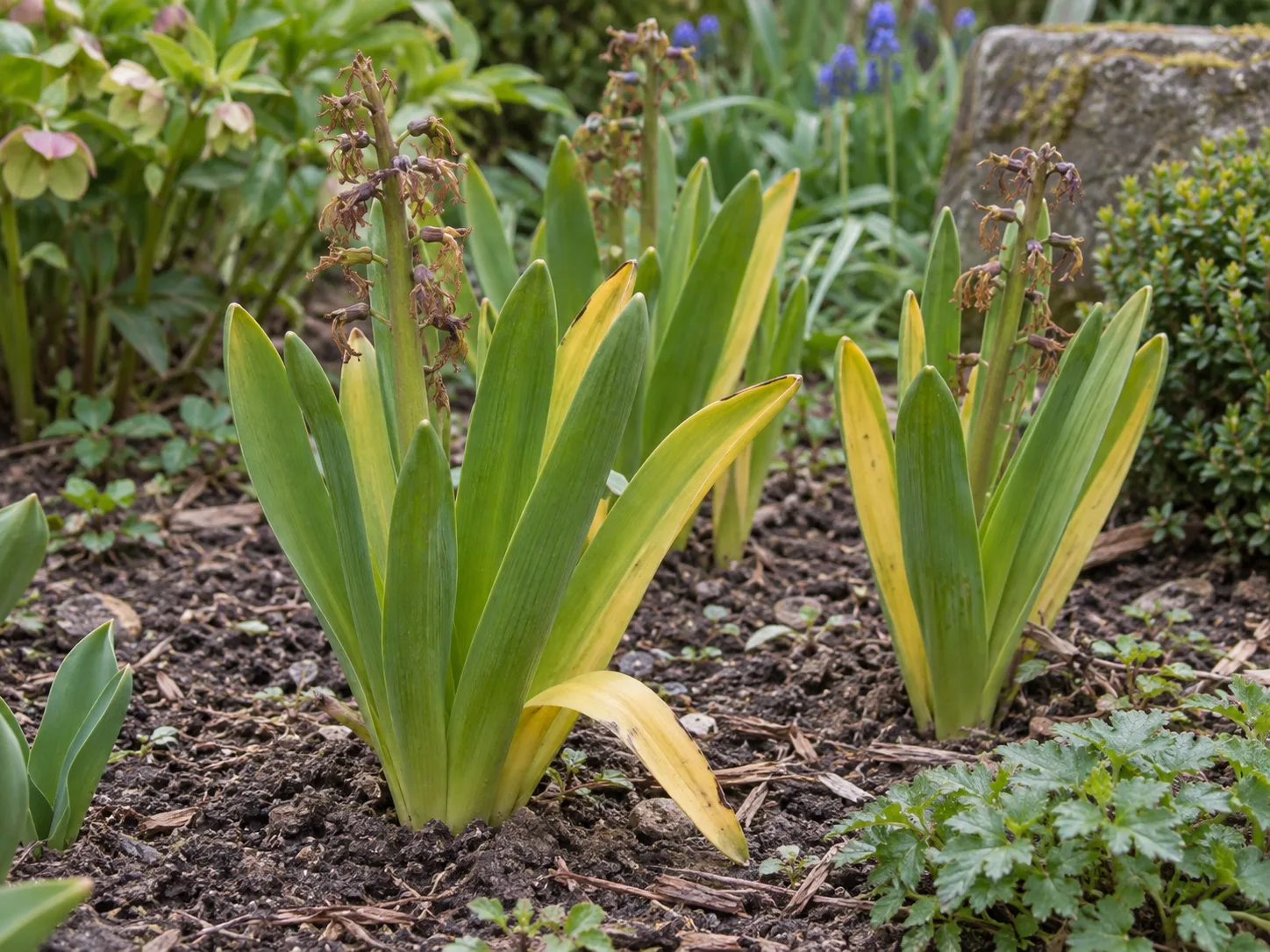
When leaves have died down, you can remove them, divide overcrowded clumps if needed, or mark the area before it disappears. Daffodils and many small bulbs can naturalize for years; some tulip cultivars are less dependable as perennials, particularly where summer soil stays warm or wet. If a short-lived cultivar stops returning, more fertilizer may not solve the underlying mismatch.
Choose a fertilizer from soil evidence
Start with a soil test if the bed has not been tested recently, if blooms have declined, or if you have been adding fertilizer regularly. Ask the lab or local extension service for recommendations for a flower bed or bulb planting, and keep the report with the date and products you used. A test can help distinguish a nutrient problem from poor drainage, unsuitable pH, or another cause of weak flowering.
Do not choose a product only because the label says “bulb food” or has a large middle number. N-P-K numbers describe nitrogen, phosphorus, and potassium, but they do not reveal whether your soil needs those nutrients. A product with extra phosphorus can be wasteful or harmful if the soil already has enough; UMass Extension’s guidance on fertilizing flower gardens without adding excess phosphorus makes this point directly.
A complete fertilizer may be appropriate when a soil test calls for multiple nutrients. If the test shows only a need for nitrogen, adding a phosphorus-heavy blend is unnecessary. If the test shows no shortage, use compost only when the soil needs organic matter, or simply leave the bed alone.
When a soil test shows a phosphorus need
Phosphorus supports root growth and is relatively immobile in soil, which is why Rutgers recommends incorporating a needed phosphorus source into the soil near the rooting area before planting. Use the amount the lab recommends, not a generic spoonful per bulb. Bone meal is one possible source, but it is not automatically required and does not replace soil testing.
Check the report for pH as well as nutrients. Rutgers describes a pH range around 6 to 7 for spring bulbs, but individual species and local soils vary. Do not add lime, sulfur, ash, or another pH-changing material unless the soil test recommends it for the bed.
Adjust the plan for new, established, or potted bulbs
New fall-planted bulbs are a chance to prepare a bed before roots and foliage appear. If the soil is poor or a test recommends nutrients, amend the full planting zone and correct drainage before planting; healthy bulbs in suitable soil generally need no extra dose simply because they are new.
Established naturalizing bulbs can be treated as a group. If they flower well and a recent test shows adequate nutrients, leave them alone; if a test identifies a deficiency, feed at emergence according to the report. Avoid repeating a fall application and spring application automatically, since accumulated nutrients do not become safer because they are marketed for bulbs.
Container bulbs need more careful judgment because nutrients in a small volume of potting mix can build up quickly or wash out through drainage. A forced indoor bulb that is already flowering usually does not need a heavy feed for that display; follow the grower’s or product’s instructions, and do not add concentrated fertilizer to a decorative cachepot. If you plan to keep a bulb after flowering, identify its species and follow a care plan suited to whether it can grow outdoors in your climate.
Apply fertilizer without injuring bulbs
Measure the bed and read the fertilizer label before opening the package. Use the rate for the product’s specific analysis and application method; a teaspoon of one fertilizer is not equivalent to a teaspoon of another. If the label and a soil-test recommendation differ, ask the extension office or soil lab how to reconcile them rather than estimating.
For an established bed, distribute granules around the plants rather than touching bulbs, stems, or leaves. If the ground is frozen or the bulbs are emerging through wet soil, wait; fertilizer can be carried away by runoff or concentrated around roots when the bed is saturated. Water after application only if the label calls for it and the soil drains freely.
Keep fertilizer out of storm drains, sidewalks, and paved areas, then sweep up spills. Never substitute a lawn product that also contains weed killer unless its label explicitly permits use around ornamental bulbs and the target plants. Avoid combining multiple products with overlapping nutrients, such as fertilizer plus bone meal plus composted manure, without a soil test.
When to skip fertilizer completely
Skip fertilizer when bulbs have strong foliage and flowers, the soil test shows adequate nutrients, or the bed was amended recently. Also wait if the plants are stressed by drought, waterlogging, recent transplanting, or root disturbance; correct the growing condition first. Nutrients cannot repair a bulb that is rotting in poorly drained soil or struggling in deep shade.
Do not fertilize during full bloom as a rescue attempt. By then, the flowers were formed and the plant is already using the resources stored in the bulb. A late feed may not change the current display and can be wasted if the active roots have begun to die back.
Avoid feeding solely to get larger flowers next year. Bulb size, cultivar, maturity, winter chilling, light, spacing, and post-bloom foliage all influence flowering. If plants are healthy, adding more fertilizer can create lush foliage without solving a different limitation.
Troubleshoot weak or missing blooms
If leaves appear but flowers do not, check the whole growing situation before reaching for fertilizer. Common causes include bulbs planted too shallowly or too late, insufficient light after nearby trees leaf out, overcrowded clumps, poor drainage, or bulbs that are too small or too young to flower. Some tulips also decline after a few seasons even when cared for correctly.
Inspect the foliage and planting area. Yellowing early in the season, soft bulbs, or a sour smell can point to excess moisture or rot; a fertilizer dose will not solve that problem. If the leaves are healthy but flowering is weak, compare the bed’s sun exposure and spacing with the needs of the species, then test the soil before making nutrient changes.
If bulbs bloom well for one year and then fade, note whether you removed their leaves early, allowed them to set seed, or mowed the bed before dormancy. Also consider whether the bulbs are varieties that reliably naturalize in your climate. Only after those checks should you use a test-based fertilizer recommendation.
Common timing mistakes to avoid
- Following a month instead of plant stage: In colder and warmer regions, “early spring” arrives at different times. Watch for the first shoots and follow local planting and soil-testing guidance.
- Applying every recommended window at once: Fall, early spring, and after-bloom advice may describe alternatives for different beds, not a three-dose program. Do not stack them.
- Assuming bone meal is harmless: It adds phosphorus whether or not the soil needs it. Use it only when the soil test supports the application.
- Feeding while flowers are open: A late application is unlikely to help the current flowers and may be poorly timed for root uptake.
- Cutting green leaves to tidy the bed: The bulb needs that foliage to store energy for its next cycle. Wait until it yellows and dies naturally.
- Diagnosing every weak bloom as hunger: Shade, crowding, excess moisture, bulb quality, and cultivar lifespan are common alternatives.
A practical seasonal checklist
Use this simple sequence to make the decision:
- At fall planting: Check the soil report. Amend the bed only for documented nutrient or pH needs, and mix required phosphorus through the root zone before planting.
- At first spring shoots: If the bed needs fertilizer and the report supports it, apply the recommended product at its labeled rate before flowers open.
- During bloom: Do not add an unplanned feed. Enjoy the flowers and avoid disturbing the bulbs.
- After petals fade: Remove spent flower heads if desired, but keep all healthy leaves in place until they yellow.
- After foliage dies back: Remove dead leaves, record bloom quality, and retest or divide only if there is a reason.
The timing is a growth-stage decision, not an annual chore. A good soil test and a note of what you applied will prevent accidental double-feeding and make next season’s choices easier.
Conclusion
For most spring-blooming bulbs, fertilize at fall planting only when the soil needs nutrients, or feed an established bed as the first shoots emerge in spring. Skip a routine application during bloom, and treat post-bloom feeding as a locally guided option rather than a universal requirement because extension recommendations differ on that stage.
Use a soil test before applying phosphorus or bone meal, follow the product label, and avoid piling fertilizer against bulbs or foliage. Most of all, let the green leaves finish their work after flowering; that is the bulb’s natural way to rebuild reserves for next year.