Sunburst Honey Locust Care: Size, Sun & Pruning
See if a Sunburst honey locust fits your yard: compare size and hardiness records, choose a site, water during establishment, and prevent branch problems.
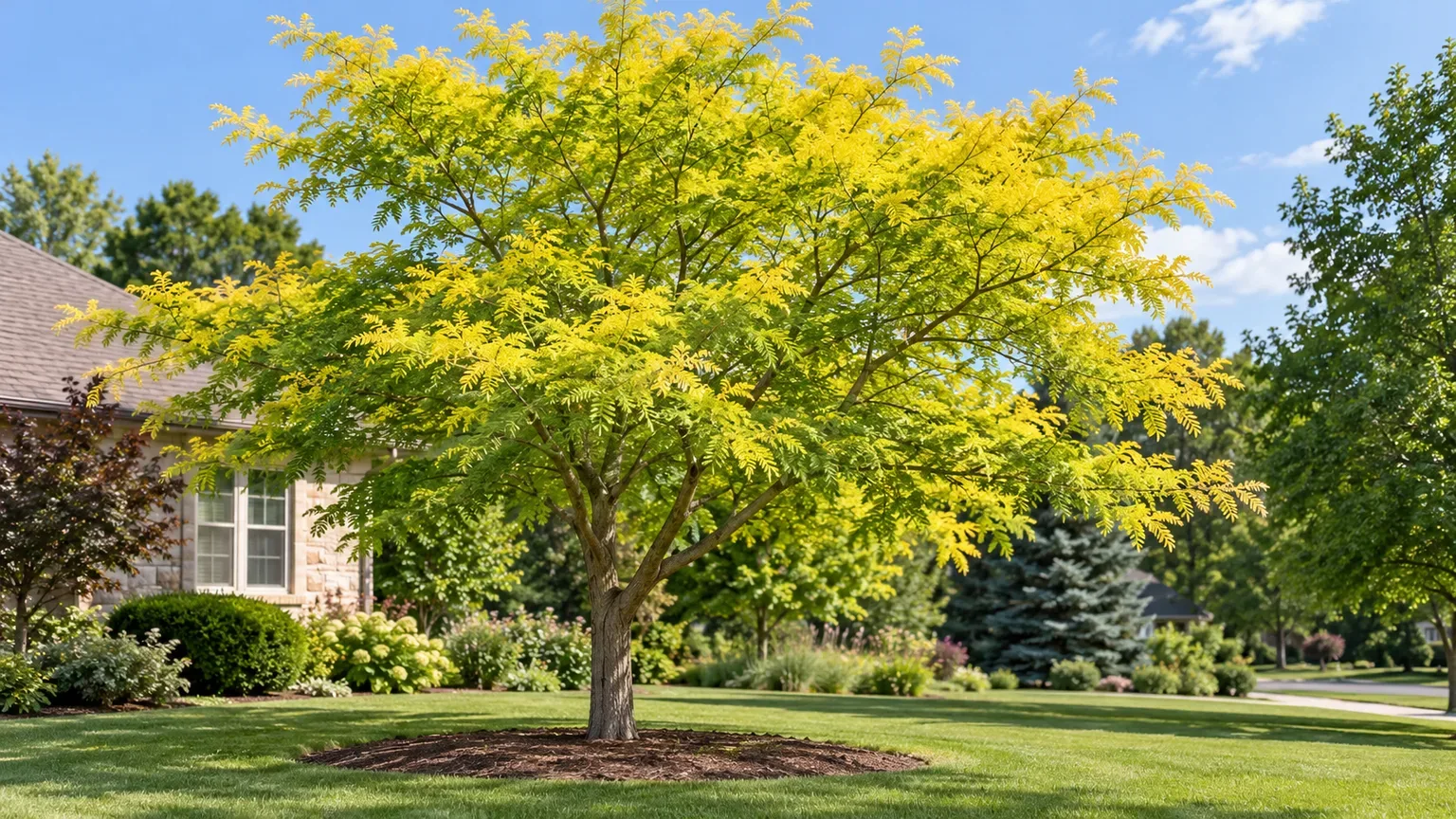
Sunburst honey locust is a named, thornless form of the North American honey locust, valued for bright yellow new leaves and the airy shade cast by its finely divided foliage. Its cultivar name is ‘Suncole’; the University of Illinois database identifies Sunburst® as its trademarked name.
The tree is not difficult to grow, but it can become much larger than a small-yard ornamental, and references disagree on its eventual height and cold hardiness. Check the label, plan for a broad canopy, and train the young structure early.
Know the cultivar behind the Sunburst name
The botanical name appears in references as Gleditsia triacanthos ‘Suncole’ or Gleditsia triacanthos var. inermis ‘Sunburst’. Both refer to the named selection marketed as Sunburst. Oregon State University describes an open, spreading, thornless, fruitless tree whose new leaves emerge golden and turn green.
The University of Illinois database identifies Sunburst® as the trademarked name for ‘Suncole’ and describes its habit as irregularly rounded. These are more useful distinctions than a generic care label for “honey locust.”
The foliage is the showiest feature. Fresh leaves can be vivid yellow or gold in spring, then mature toward yellow-green and eventually greener tones; fall color is usually yellow.
Because the canopy is open, the tree lets some light through rather than creating dense shade. That makes it attractive over a lawn, but it also means it is not the best choice when your goal is a dark, cool seating area.
Thornless and fruitless are cultivar traits, not species rules
The wild honey locust species can carry long, branched thorns on trunks and older limbs and produce large, twisted seedpods. Those traits are visible in Gardenia’s species profile, which describes the species rather than Sunburst.
Oregon State lists Sunburst as thornless and fruitless, while Gertens’ cultivar profile also calls the selection seedless. A thornless cultivar is not the same as the thorny wild type, and the name “honey locust” alone does not tell you which one a seller is offering.
If you want to avoid pods on a patio or driveway, confirm that the nursery label names ‘Suncole’ or Sunburst® and ask whether the plant is true to cultivar. Do not rely on a listing that says only “thornless honey locust”: other thornless selections can differ in size and may still make some pods. Inspect the trunk and main branches when the tree arrives, and ask the nursery about any unexpected thorny shoot rather than assuming every honey locust behaves alike.
Decide whether its mature size suits your yard
Sunburst works best where you have room for a medium-to-large shade tree and can live with a loose, changing canopy. It can suit a front lawn, parkway, or broad backyard when overhead clearance and underground rooting space are available. It is a poor fit directly beneath utility lines, beside a narrow path that must stay clear, or in a compact courtyard where branches would need repeated severe cutting to stay contained.
Plan for the mature tree before planting rather than trying to hold it to a small footprint later. A tree that grows quickly may look compact in a nursery container, but its permanent location should account for its crown, trunk, utilities, buildings, walks, and the amount of shade you want. If your yard cannot accommodate a tree with a spreading crown, choose a smaller species instead of relying on regular topping.
A range is more useful than a single height
Published numbers vary. The University of Illinois Woody Plants Database lists Sunburst at about 35 feet tall and notes its irregularly rounded form and weak, narrow branch angles. Oregon State University’s cultivar entry gives a much broader 30-to-70-foot range, while a nursery profile gives a typical mature height near 40 feet and a spread around 25 feet.
The different figures likely reflect source conventions, growing conditions, and which individuals were measured; they are not a promise that every tree stops at one height.
For layout, treat roughly 35 to 50 feet as a planning scale, then leave room for a larger specimen if your climate and soil support vigorous growth. Allow for a canopy at least several dozen feet wide, and do not plant where you will later need to cut off a large portion of the crown. A nursery tag is useful for comparing cultivars, but it should not replace clearance from power lines or a check against local mature-tree lists.
Sunburst is described as fast-growing, which can shorten the wait for filtered shade. Faster growth also makes early structure important: weak branch unions can become harder to correct as limbs thicken. The tree’s open texture reduces the visual weight of the canopy, but the trunk and branches still occupy substantial space at maturity.
Hardiness zones vary across references
Cold-zone listings are not consistent. Oregon State rates Sunburst hardy to USDA Zone 3, while Illinois lists Zone 4b. Such differences can result from regional experience and the particular plant material evaluated.
A zone number is a guide to average annual winter lows, not a guarantee against damage from a sudden freeze, exposed winter wind, drought before freeze-up, or a poorly established root system.
If you garden in Zone 4 or warmer, the published records suggest a wider margin, though local heat, rainfall, and soil still matter. In Zone 3, ask a regional extension office or reputable nursery whether Sunburst has performed reliably nearby, and look for locally grown stock rather than treating the coldest published figure as certain.
In hot or dry regions, cold hardiness does not solve summer water stress: Oregon State notes that Sunburst may defoliate in response to drought or temperature changes. Regional fit depends on both winter lows and summer conditions.
Choose full sun and a site with real root room
Choose a location with full sun for at least six hours on most days; a named-author honey locust growing guide gives a similar six-to-eight-hour range for honey locusts generally. Sunburst’s golden new growth is most visible in a bright site, and the tree’s naturally open habit is less likely to look sparse when it receives strong light. It can survive some shade, but deep shade is a poor bargain: you may get weaker growth and less of the spring color that distinguishes the cultivar.
Think beyond the planting hole. Tree roots extend beyond the trunk and often beyond the canopy edge, so a narrow strip hemmed in by paving and compacted soil is not a good long-term site even for an adaptable urban tree.
Favor a site where roots can explore unpaved soil and rainfall can soak in; avoid a low pocket that stays saturated after storms. If using it as a lawn tree, leave enough room to keep mowers and string trimmers away from the tender trunk.
Honey locusts are often selected for challenging streetscape conditions, but tolerance is not immunity. Salt, heat, compacted fill, drought, and restricted roots can add stress, and stressed trees are more likely to show leaf loss or pest damage. A broad open lawn, parkway with usable soil volume, or sunny backyard can work; a hot paving island with no water access may not.
Match soil and water to establishment needs
Sunburst tolerates a range of soil textures, including loam, sand, and clay, but drainage matters. Sandy soil can dry rapidly; heavy clay may hold water around roots; compacted urban soil may shed rain rather than absorb it. A quick test after rainfall helps: if water remains ponded or the planting area stays sticky and saturated for days, choose a better-drained location or correct drainage across a broad area before planting.
Do not “fix” a difficult planting hole by filling it with a sharply different potting mix. A rich pocket in dense native soil can hold water like a basin and limit root movement.
Loosen compacted soil across the planting area, keep the root ball’s soil close to the surrounding grade, and use a soil test if pH or nutrient problems are suspected. Honey locust is adaptable, but an adaptable tree still needs oxygen around its roots.
Use a moisture test instead of a weekly timer
Water newly planted trees deeply enough to wet the entire root ball and the soil immediately around it. The watering interval depends on rainfall, temperature, wind, soil texture, root-ball size, and whether the tree was planted in spring or fall.
Check moisture a few inches down at the edge of the root ball: if the soil is still damp and cool, wait; if it is becoming dry, soak slowly and thoroughly. A short daily sprinkle often wets only the surface and encourages shallow roots.
For the first growing season, check the soil several times a week during hot, rainless weather and water when the root zone begins to dry. During cooler or rainy periods, skip irrigation when the ground is already moist.
Continue checking through the next growing season, especially during extended drought; do not assume a tree is established just because it has pushed leaves. A named-author guide from Planet Natural likewise recommends deep watering for young honey locusts, while the useful adjustment is to water according to soil moisture rather than keeping every site continually wet.
Once established, a Sunburst honey locust generally needs less supplemental irrigation, but prolonged drought can still trigger premature leaf drop. Water slowly over a broad area near and just beyond the canopy rather than splashing the trunk.
If leaves suddenly yellow or fall during heat, check soil moisture first and look for the pest signs below before adding fertilizer or watering every day. Waterlogged soil can also cause decline, so wet roots are not a cure for drought-stressed leaves.
Plant at natural grade and keep mulch off the trunk
Plant when the soil is workable and the tree can be watered consistently through establishment. Find the root flare—the point where the trunk widens into the first structural roots—and set it at or slightly above surrounding grade. A tree planted too deeply can struggle even if its foliage looks healthy at first; remove extra soil or mulch covering the flare rather than burying the trunk base.
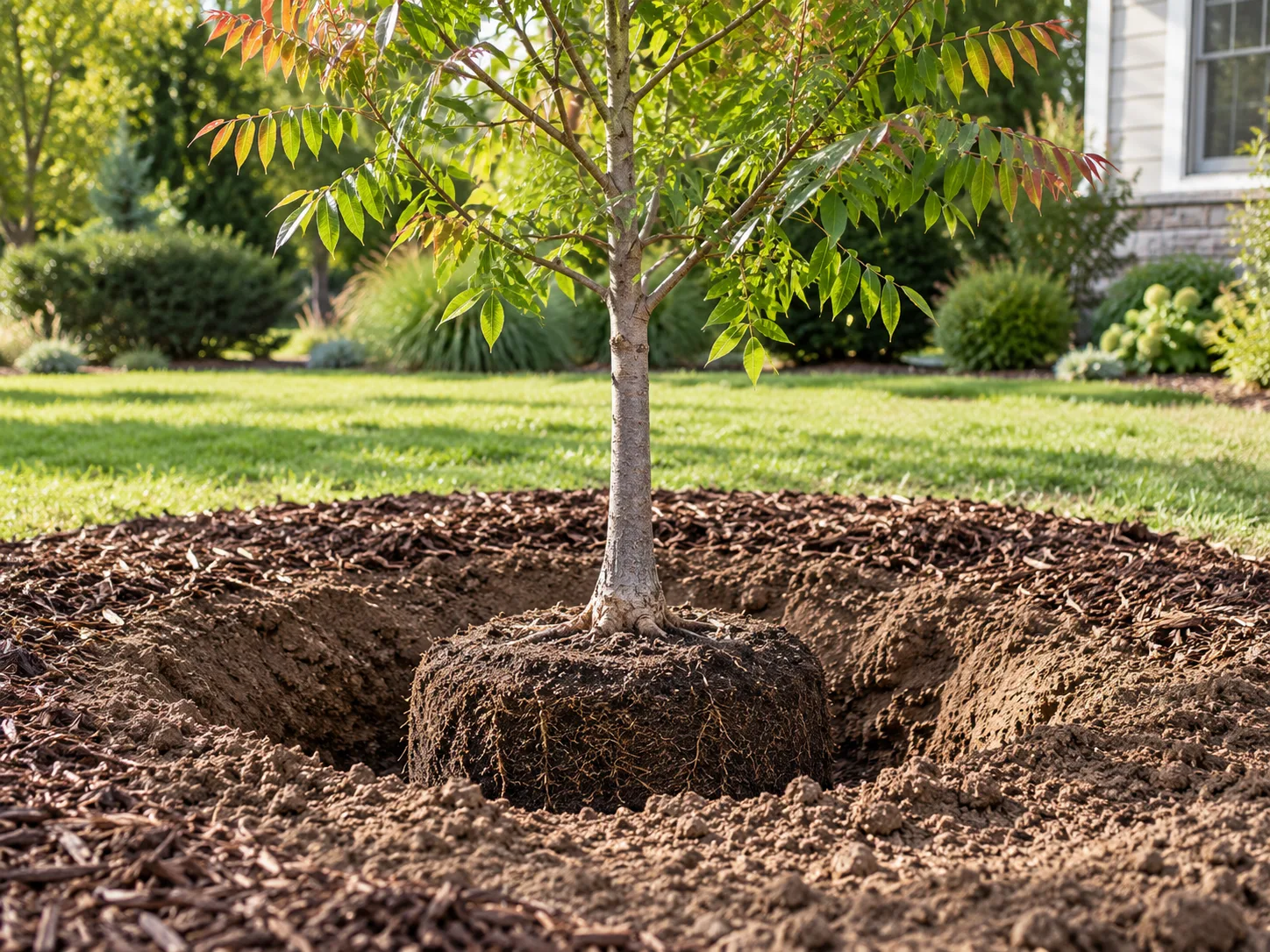
Spread organic mulch in a broad, even layer to reduce competing grass and slow moisture loss. Rutgers New Jersey Agricultural Experiment Station recommends that total mulch depth generally stay at or below three inches, with less on compacted or poorly drained soils; it also advises keeping mulch several inches away from young trunks and farther from mature trunks. Use those limits as a ceiling, not a target in a wet site, and never pile mulch into a volcano against the bark.
A wide mulched ring also keeps lawn equipment from repeatedly striking the trunk. That small change matters because bark damage can become an entry point for decay and borers. As the crown expands, enlarge the mulch area outward rather than thickening the layer against the trunk; leave the root flare visible and avoid burying it with topsoil.
Fertilize only if a test or growth problem justifies it
Do not add fertilizer automatically at planting. A newly transplanted tree needs stable moisture and time to replace disturbed roots; extra fertilizer does not repair a dry root ball, saturated soil, or a buried root flare. If the tree makes normal seasonal growth and the leaves look healthy, leave the soil alone.
If growth is unusually weak, leaves are persistently pale, or a soil test indicates a deficiency, diagnose the cause before applying nutrients. Drought, excess water, root injury, unsuitable pH, and pests can create symptoms that resemble nutrient shortage. Apply only the product and amount appropriate to the test result and label, and avoid high-nitrogen “growth boosters” that push tender shoots without correcting the underlying problem.
Build strong branch structure with selective pruning
Pruning is mainly about structure while the tree is young and removing dead, diseased, broken, or crossing branches as it matures. Do not heavily prune at planting: Wisconsin Horticulture Extension recommends leaving newly planted trees intact except for broken, diseased, or dead wood because foliage supports root establishment. Once a tree is established, select a small number of well-spaced scaffold limbs with broad attachments and remove competing or rubbing branches gradually.
Late fall through winter is a useful inspection and pruning window for deciduous trees because the branching pattern is visible. The University of Wisconsin also cautions that late spring and summer are generally poor times for routine pruning, when disease organisms may be active and wounds close more slowly. Local conditions and a specific pest or disease diagnosis can change timing, so follow regional extension advice if a problem requires prompt removal.
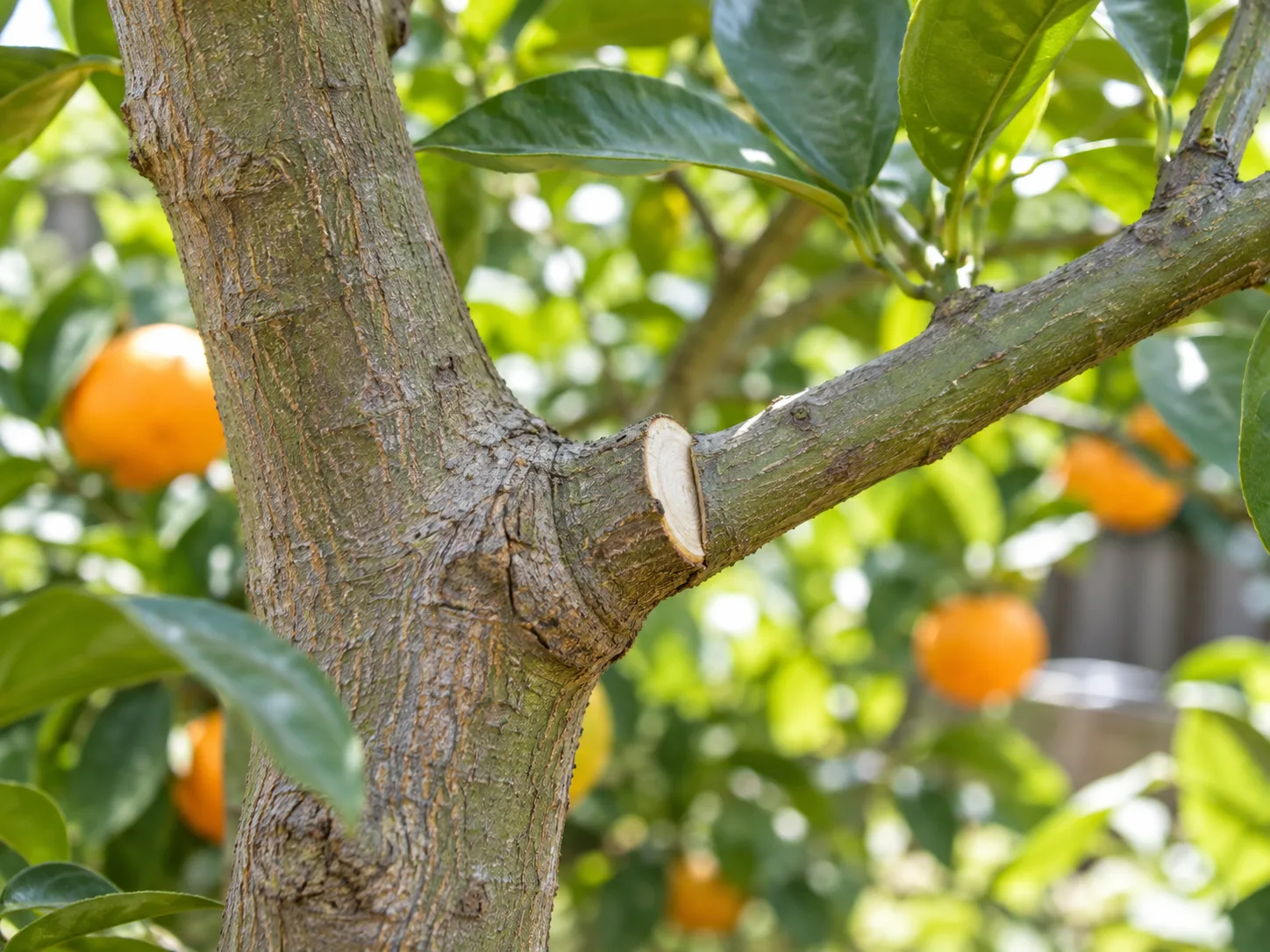
For a large limb, use the three-cut method: make a small undercut away from the trunk, remove the limb farther out with a top cut, then remove the remaining stub just outside the branch collar. This prevents the branch’s weight from tearing bark down the trunk. Leave the collar intact rather than cutting flush, and do not paint or seal the wound; Wisconsin Extension notes that wound dressings generally slow closure and encourage decay.
Work with weak crotches before they become failures
Sunburst deserves an early structure check because the University of Illinois database specifically describes narrow, weak branch angles. A tight V-shaped union or two leaders competing for the same top can split under wind, snow, or ice as the limbs gain weight. While branches are still small, a qualified arborist can decide which one to shorten or remove so the tree develops a durable framework without an oversized wound.
Do not try to correct a mature weak union by topping the tree. Topping removes large branches indiscriminately and often stimulates poorly attached shoots; it also creates a recurring maintenance problem rather than a sound crown.
Wisconsin Extension recommends against topping and advises using an arborist for large limbs, especially near buildings or power lines. If a limb is already cracking, hanging, or attached over a target, keep people away and arrange an arborist assessment rather than climbing into the canopy.
Identify pests and diseases before taking action
Many honey locust pest problems look dramatic but are not equally serious. First examine the leaves, twigs, and branch tips closely; note whether the damage is webbing, stippling, bronzing, sticky honeydew, galls, or dead bark.
Then check whether the damage is confined to a few branch tips or repeated across the crown, and whether the tree is losing vigor. A clear symptom makes it easier to decide whether to wait, prune, or get a local diagnosis.
Honey locust can be affected by leaf-feeding insects, sap-feeding insects, borers, and fungal problems. The University of Kentucky’s honey locust pest guide lists mimosa webworm, honey locust plant bug, calico scale, mites, borers, and pod gall midges. That list is useful for narrowing the possibilities, but it is not proof that any one of them is responsible for a particular leaf symptom.
Defoliators, sap feeders, gall midges, and cankers
Silken webbing at branch tips, with leaves tied together and chewed, points toward mimosa webworm. Kentucky’s guide notes that later-season feeding can be conspicuous and that Sunburst may be attractive to this insect; partial defoliation can look severe while having a smaller effect on a vigorous established tree than on a young, drought-stressed one.
Remove small webs by hand when practical, but avoid broad-spectrum insecticide sprays that can kill predators and other beneficial insects. Ask a local extension office to identify a heavy or recurring infestation before treating.
Tiny pale or yellow-green insects with distorted young leaves may be honey locust plant bugs; fine stippling and bronzing can indicate mites. Small pod-shaped galls on leaves as they expand may be honey locust pod gall midge.
These signs can be confused with drought or temperature stress, which Oregon State also associates with leaf drop in Sunburst. Photograph the damaged branch and check the undersides of leaves before choosing any control.
Sticky leaves, black sooty growth, or clusters of small bumps on twigs suggest a sap-feeding insect such as calico scale; Kentucky describes honeydew and sooty mold as signs of this scale. A general scale-management article from Horticulture magazine stresses identifying the scale and its vulnerable life stage before treatment. Do not apply an oil or insecticide on a guess: confirm the pest, read the current product label for the tree and target, and consider pollinators, natural enemies, temperature, and water stress.
Canker or root-collar trouble needs a different response from leaf chewing. Sunken, cracked, or dead patches of bark, repeated branch dieback, or decay around the trunk base can signal a more serious disease or injury. Oregon State notes that Sunburst may be susceptible to Nectria canker, while the Kentucky pest guide also records borers and other honey locust problems; on a stressed tree, several issues may overlap.
Cankers and root-collar trouble
Start with cultural corrections: keep the root flare uncovered, prevent mower wounds, water during prolonged dry weather, and remove only clearly dead or diseased branches with clean tools. Do not strip a tree of large amounts of live foliage or prune a cankered trunk without diagnosis. If cankers encircle a major limb, the trunk base is soft or decayed, or branch death is spreading, have a certified arborist or local plant clinic assess whether the tree can be managed safely.
A useful symptom sequence is: check soil moisture and recent weather; inspect both leaf surfaces and branch tips; look for visible insects, webs, galls, honeydew, or bark lesions; then compare photos with an extension diagnosis. This prevents a common mistake—treating drought symptoms with pesticide or treating insect feeding by adding fertilizer. If you do use a pesticide, the label is the law: use only a product labeled for the pest, tree, and site, and follow all safety and pollinator precautions.
Conclusion
Sunburst honey locust earns its place when you want golden spring foliage, a fast-growing tree, and light, filtered shade without the conspicuous thorns and pods of the typical honey locust species. It still needs a full-sun site, room for a broad mature crown, consistent establishment watering, and early attention to its branch structure. Do not choose it by a single nursery height or hardiness number: university records differ, so confirm the cultivar and compare local performance before planting in a marginal climate.
Plant it at the correct depth, keep mulch away from the trunk, and water according to root-zone moisture. Inspect young branch unions before they become large defects, and identify pests before reaching for a treatment. With those choices made early, this cultivar can be a useful lawn or landscape tree; without enough space or a plan for its structure, its rapid growth can become a maintenance burden.