Which Birch Gives the Best Fall Color? 6 Types to Know
Compare six birch trees by fall color, bark, mature size, and climate. Find the right birch for a cool yard, a wet site, or a small garden before you plant.
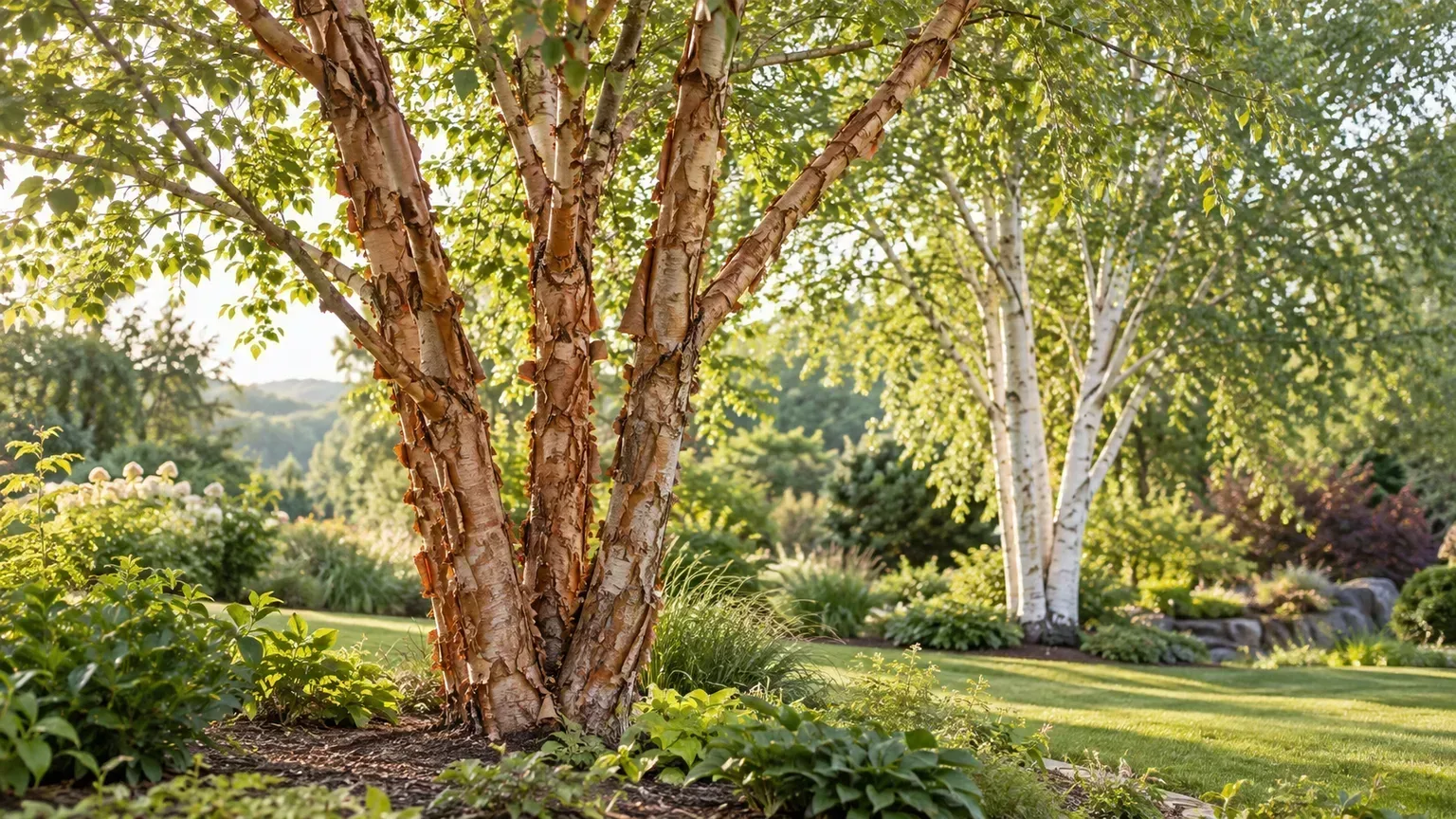
Most birch trees finish the growing season in shades of yellow, from soft lemon to clear gold; the Royal Horticultural Society’s birch guide likewise notes that birch leaves turn yellow in autumn. The best choice for your yard depends less on which bark looks brightest in a catalog and more on whether your summers are cool or hot, whether the soil stays moist, and how much room the mature canopy will need.
The six trees below share the birch family’s graceful leaves and seasonal color, but they are not interchangeable. River birch is the best fit of this group for many warm, humid regions; paper, yellow, and sweet birches are better suited to cooler places; and Young’s weeping birch is a small, shaped cultivar rather than a separate species. That distinction matters when you are buying a tree that may live in your landscape for decades.
What Fall Color to Expect From a Birch
Birch foliage usually turns yellow rather than scarlet or orange. As the season advances and chlorophyll breaks down, the yellow pigments already present in the leaves become more visible. A sunny exposure can help some species show stronger color, but a tree under drought or heat stress may turn dull, brown at the edges, or drop leaves before a clean display develops.
Timing varies with latitude, elevation, weather, and the individual tree. One birch may color while a nearby tree is still green, and a hard frost or dry late summer can shorten the show. If a reliable autumn statement is your main reason for planting, choose a species suited to your climate first; color is more likely to be satisfying when the tree is not struggling.
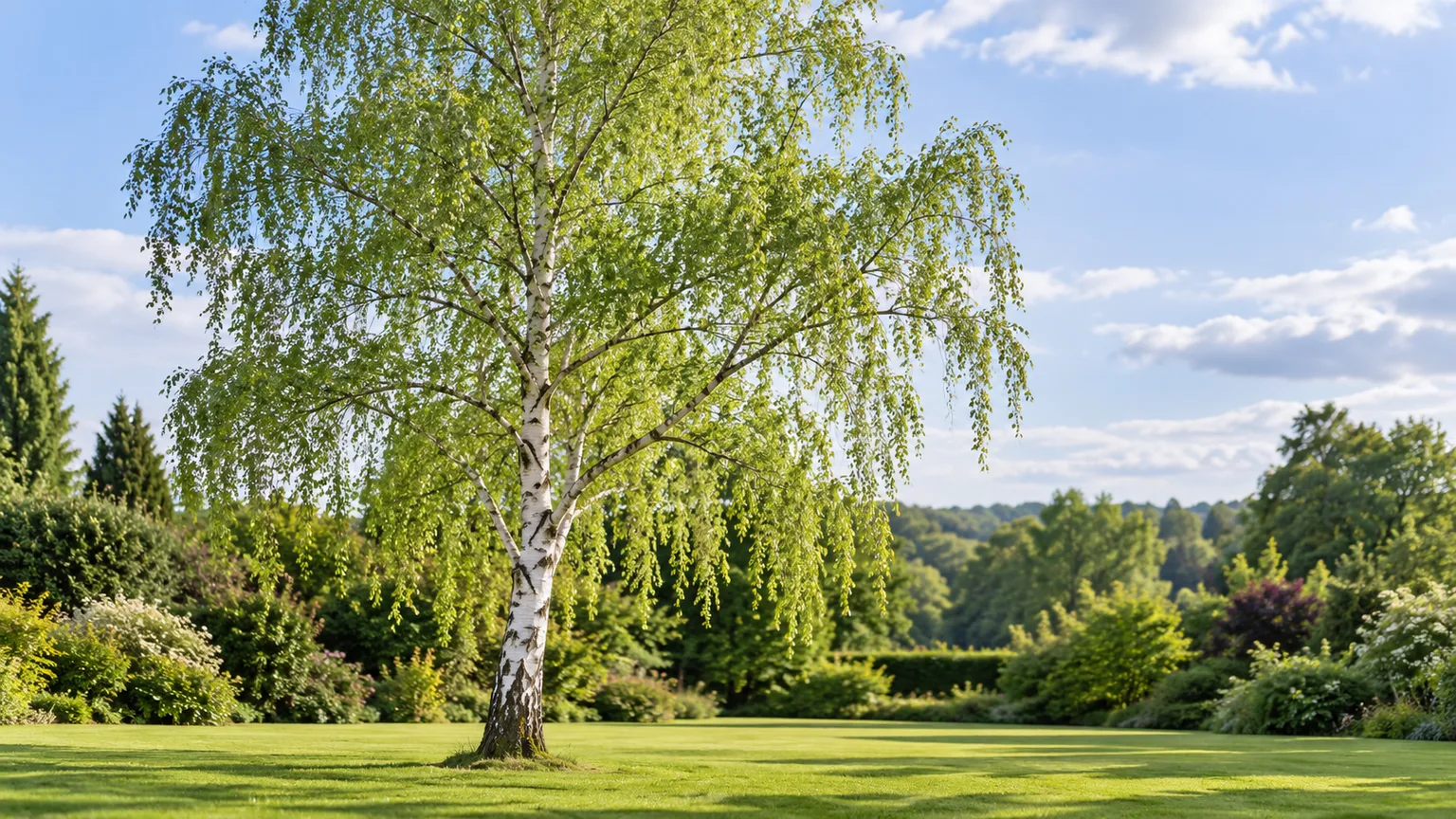
Bark extends a birch’s appeal beyond leaf season, but it is a separate trait. Paper birch is known for pale peeling bark, river birch for layered cinnamon or salmon tones, and yellow birch for bronze-gold bark. Common names can blur those differences: sources use “white birch” for more than one species, so use the botanical name on a nursery label when you need to confirm what you are buying. Britannica’s birch overview explains why common names overlap. A pale-barked European silver birch illustrates the family’s light canopy and fine, fluttering foliage; it is not the same form as a weeping cultivar.
Six Birch Trees to Know
The list includes five North American species and one selected form of European white birch. All six can produce yellow autumn leaves, but the right match depends on mature size, summer heat, water, and the look you want in winter. The profiles put that decision first, so you can compare the bark and leaf display with the conditions each tree actually needs.
River Birch
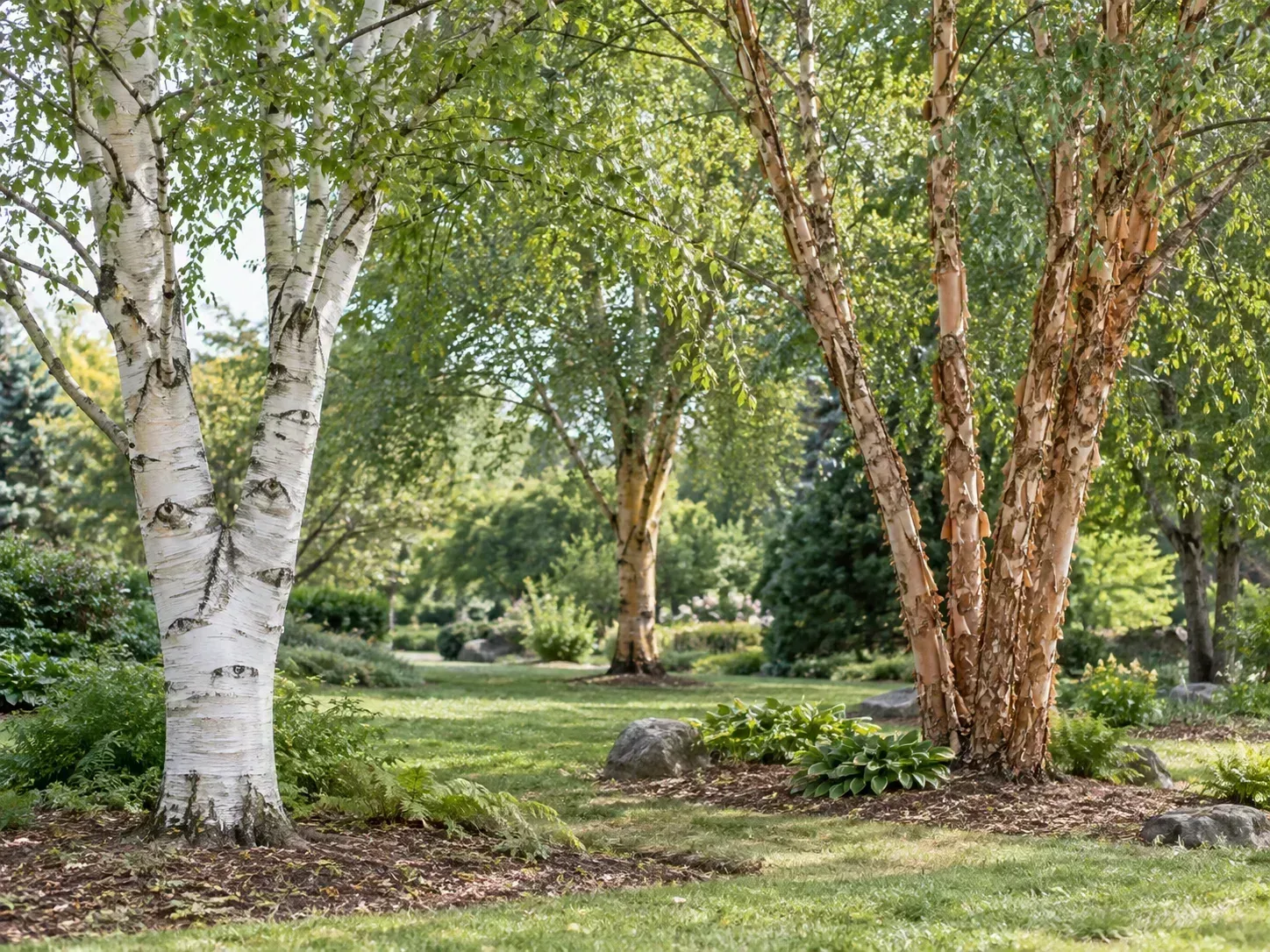
River birch (Betula nigra) is the most adaptable warm-climate choice here. Its yellow fall leaves are a bonus, while its peeling bark, which shifts through salmon, cinnamon, cream, and brown, carries the display through winter. The bark on a young tree can look quite different from that on a mature trunk, so do not expect every river birch to have the same shade or pattern.
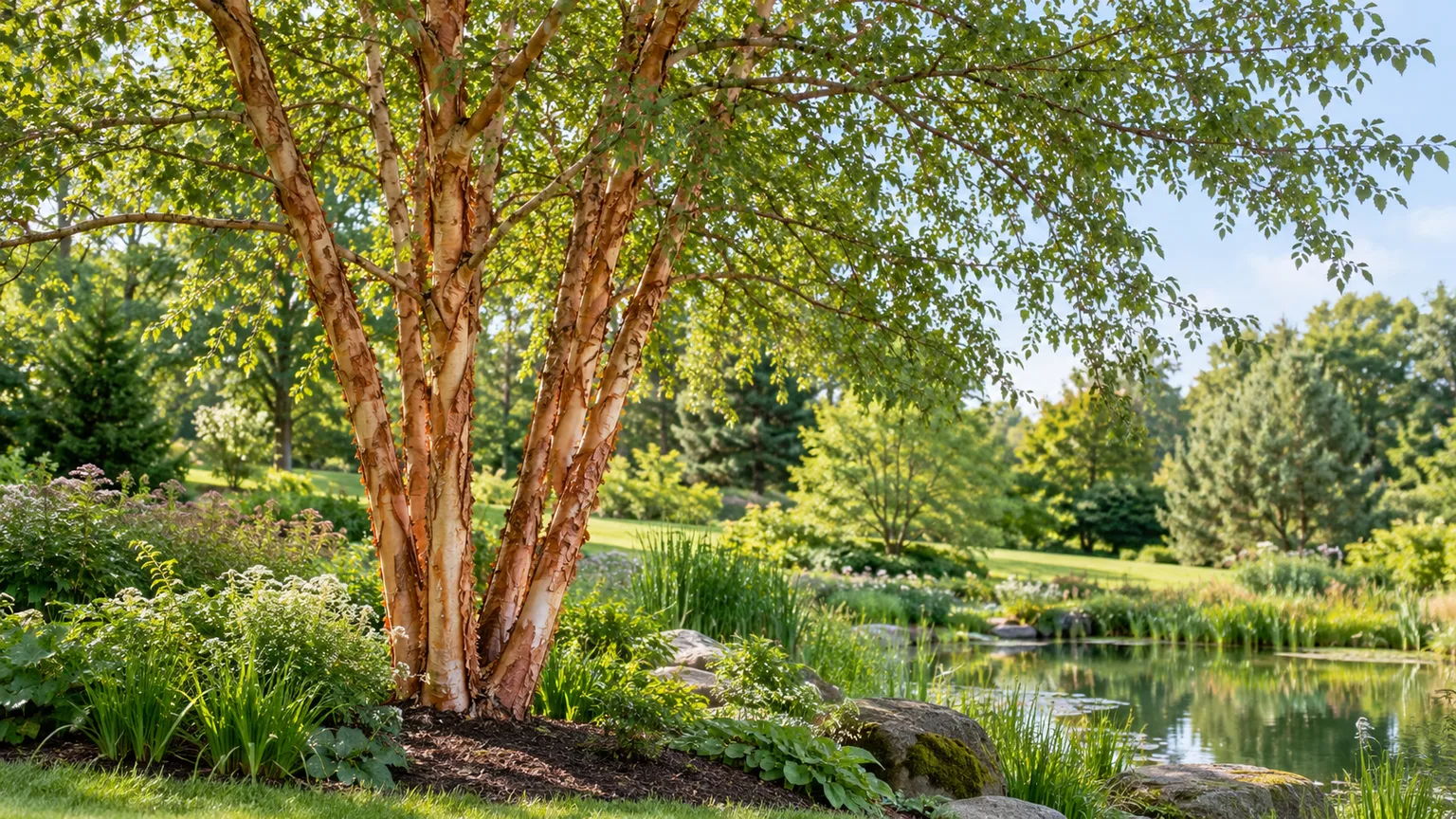
This native tree can grow 40 to 70 feet tall and is often sold with multiple trunks. It tolerates hotter summers better than most birches and can handle wet sites, which makes it useful beside a rain garden or low area. It is not drought proof: extension references describe stress, summer leaf drop, and twig shedding when moisture is insufficient. NC State Extension, Penn State Extension, and Wisconsin Horticulture at UW–Madison all emphasize the need to match river birch to a moist site.
Give it open space for its full canopy, and expect some twig litter. A compact cultivar may reduce the footprint, but it cannot make a large tree suitable for a narrow foundation strip; check the nursery’s mature width as carefully as its height. The Morton Arboretum’s river-birch profile lists compact and weeping cultivars and notes differences in heat and drought tolerance among them.
Paper Birch
Paper birch (Betula papyrifera) is the classic northern tree with chalky white bark that peels in horizontal sheets. Its leaves turn yellow in fall, and the bark supplies strong winter contrast after the leaves are gone. The exfoliating white bark is not a license to strip it: leave it attached so the tree can continue to grow normally.
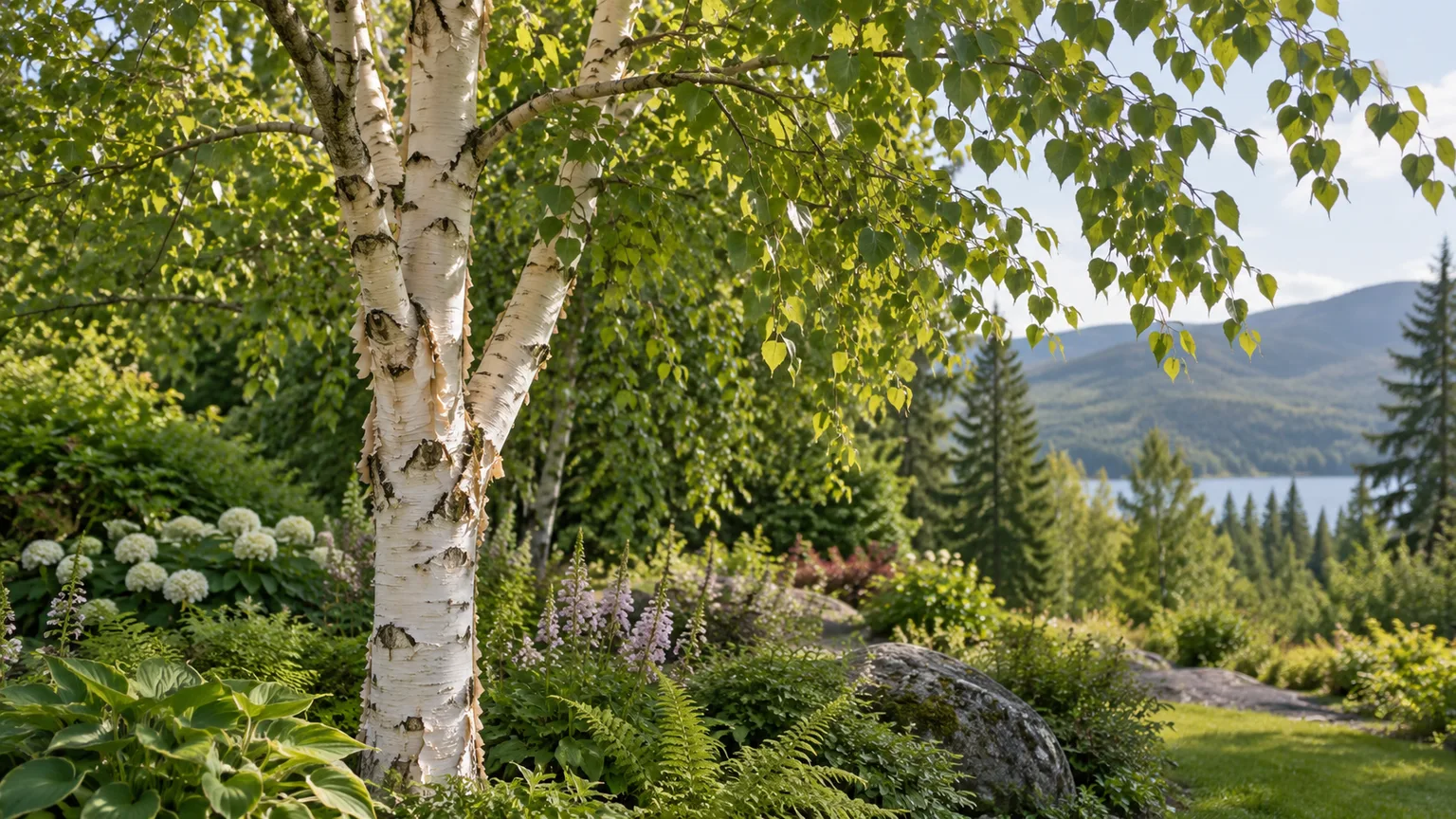
This is a better choice for a cool-summer site than for a hot, humid suburb. NC State Extension’s paper-birch profile describes the species as preferring moist, well-drained soil and northern conditions; summer heat and humidity can shorten its life, and the species has shallow roots. Plant it where the root zone can remain cool and moist, away from pavement that reflects intense heat. Gardenia’s paper-birch guide also identifies cool climate and moisture as central to its performance.
Paper birch often reaches 50 to 70 feet, so its refined white trunks still need room. It can be planted as a single specimen or in a loose group, but avoid packing several into a small lawn; their surface roots compete for moisture and can make the understory dry. In warmer locations, the attractive bark may tempt you to plant it anyway. Resist that impulse if the site has hot nights, dry soil, and reflected heat: a species with a better climate fit is more likely to retain healthy foliage and live longer.
Gray Birch
Gray birch (Betula populifolia) is a smaller, usually multi-trunk tree associated with northeastern North America. Its leaves turn yellow, and its pale gray-white bark has darker markings, but the bark does not peel into the broad, papery curls that make paper birch distinctive. Britannica’s gray-birch profile notes that it often grows in clusters on moist sites, has triangular leaves that flutter on slender stems, and is quick-growing but short-lived.
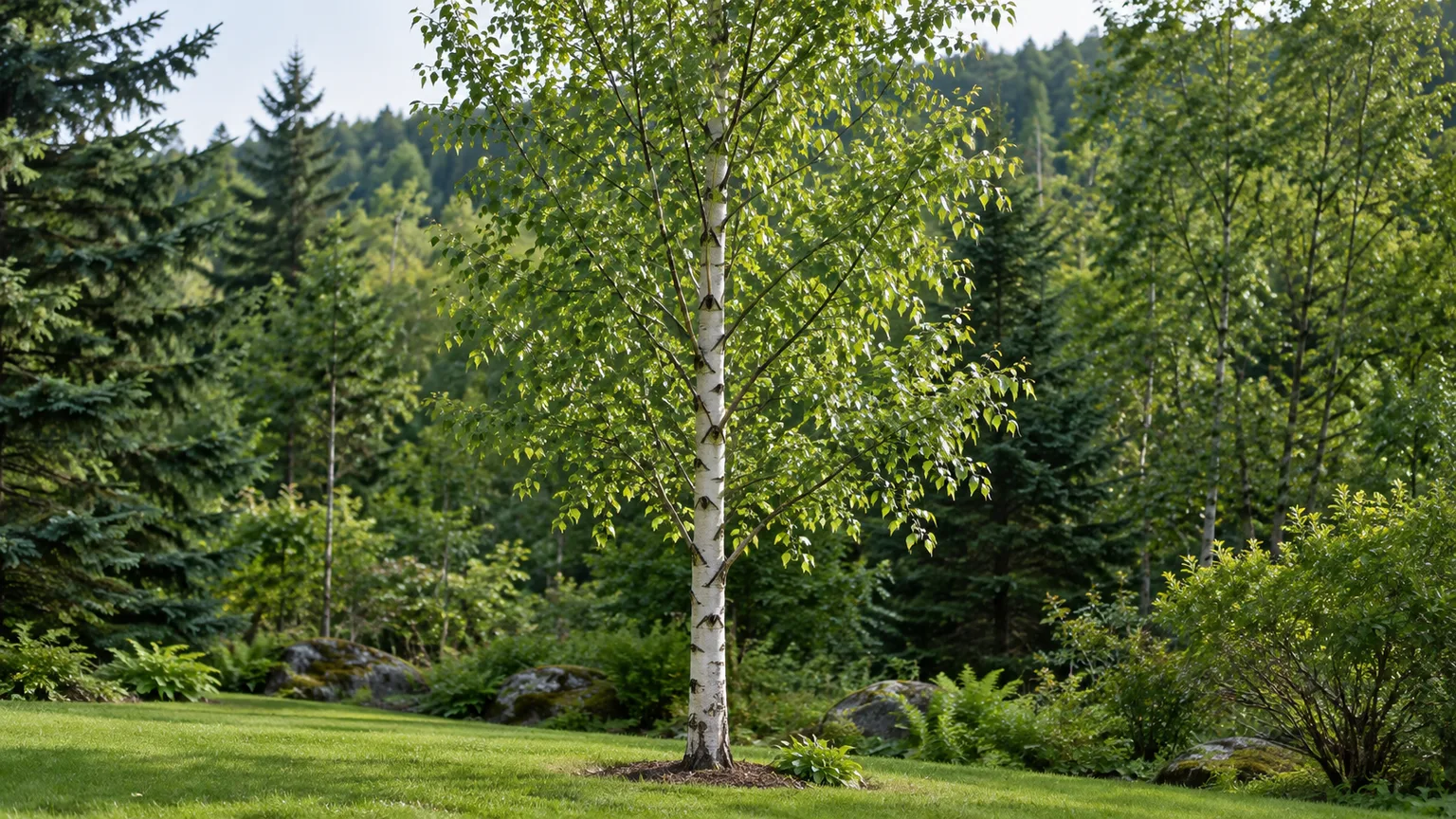
Think of gray birch as a light, informal tree for a naturalized edge or a cool woodland-style garden, not as a guaranteed white-bark centerpiece. It is quick-growing but relatively short-lived compared with long-lived shade trees, so it is a poor investment where you want a permanent, large structural anchor. In a northern yard with acidic, well-drained soil and enough sun, it can still bring a graceful silhouette and bright fall leaves without the bulk of yellow or paper birch.
Its modest footprint does not mean it belongs under power lines or tight against a wall. The crown needs room to branch, and a group of stems can spread wider than a single nursery whip suggests. Ask the local nursery for the mature dimensions of the form it sells and check that they match the planting distance you have available.
Young’s Weeping Birch
Young’s weeping birch is a cultivar of European white birch, Betula pendula, usually written B. pendula ‘Youngii’. It is not a separate birch species. The branches cascade from a high graft union, forming an umbrella-like crown, while the parent species is a full-sized tree with white bark and yellow fall leaves. Oregon State University’s profile of ‘Youngii’ describes it as a weeping cultivar; Van den Berk’s tree reference notes that its ultimate height depends on graft height and that its crown may spread broadly.
This is the strongest option in this group when you want a smaller focal tree and a deliberate weeping outline. “Small” is relative: the crown can spread broadly even if the trunk is grafted high, so measure the width of the planting bed and the distance to paths before you buy. If branches will block a walkway, choose another tree or plan to train the canopy while it is young rather than repeatedly cutting back a mature weeper.
The cultivar still needs a site that supports birch roots and foliage. It generally prefers sun and consistent moisture, and it is not a way to bypass the heat and drought limits of its parent species. Read the label for graft height, local hardiness, and expected spread; these details are more useful than a single height figure because nursery stock can differ.
Yellow Birch
Yellow birch (Betula alleghaniensis) is a large, long-lived tree for a cool, moist landscape. Its common name refers to the golden-bronze bark that peels in thin horizontal curls; its leaves also turn yellow in autumn. That combination gives it a quieter but extended season of interest, especially where a large tree has enough room to mature.
Yellow birch can reach roughly 70 to 80 feet in height and can develop a broad crown. NC State Extension describes yellow birch as slow growing, best in cool climates, and sensitive to heat, drought, and soil compaction. Those limits are more important than a hardiness-zone number alone: a tree can survive winter yet still decline in a hot, dry site during summer. Choose a northern or higher-elevation garden with moist, well-drained soil rather than a sunny parking-lot edge.
If the yard is too small for the mature tree, do not treat regular pruning as a solution. Cutting the top or repeatedly thinning major limbs changes the structure and adds maintenance without correcting the basic mismatch. Yellow birch is most rewarding where you can allow a full canopy to develop and enjoy the bark up close from a path or lawn.
Sweet Birch
Sweet birch (Betula lenta) is also called black birch or cherry birch, names that can cause confusion with river birch and other species. Its mature bark is dark rather than paper-white, and a broken twig or scraped inner bark has a wintergreen scent. The leaves shift to golden yellow, making sweet birch a strong choice when the goal is fall color plus a distinctive fragrance and darker trunk.
NC State Extension places it in eastern North American forests and recommends moist, acidic, well-drained soil; the profile also notes that it is sensitive to compacted soil. Its mature height can approach 60 to 70 feet, which is larger than many home gardeners expect from a tree sold as a young sapling. The Plant Native’s birch guide also describes sweet birch as a northeastern and Appalachian tree with bright yellow autumn color.
This is a better fit for a cool, wooded or spacious garden than for a hot, compact city lot. Give the roots room, avoid heavy soil compaction around the trunk, and do not assume the common name “black birch” means you are getting river birch (B. nigra). The botanical name resolves that mix-up. NC State Extension describes sweet birch as preferring moist, acidic, well-drained soil and notes its sensitivity to compacted ground; see its sweet-birch profile.
Choose by Climate and Site
Warm, Humid Summers
Start with river birch if your summers are long, humid, or warmer than the climates where paper, yellow, and sweet birches thrive. River birch is more heat tolerant than those northern species, but it still performs best when the root zone stays moist. A hot, dry lawn with reflected heat from paving is not a good site simply because river birch tolerates warmth better than its relatives.
In the hottest parts of the South, consider regionally recommended trees before choosing any birch. Even the most tolerant birch may shed leaves during drought, become stressed by heat, or make more cleanup than you want. The goal is not to find a birch that ignores climate; it is to choose one whose natural preferences overlap with your yard. Do not assume a tree that has survived several winters is established enough to manage a dry summer without help; new roots need time to extend into surrounding soil.
Cool Northern Gardens
Paper birch, yellow birch, and sweet birch are stronger candidates in cooler climates with moderate summers. Choose paper birch for its pale, peeling bark; sweet birch for dark bark and fragrant twigs; and yellow birch for a large tree with golden bark and a broad canopy. Gray birch can suit a naturalized area when you prefer a smaller, looser group of trunks.
In the West, elevation, summer heat, and rainfall can matter as much as latitude. A cool mountain garden may suit a species that struggles in a warm lowland town at the same USDA zone. Ask a local extension office or a reputable nursery which birches perform in your county, and confirm that the site can supply moisture during dry spells.
Small Yards and Front Gardens
For limited space, begin with the expected crown width, not the tree’s current nursery height. Young’s weeping birch is much smaller than a full-sized silver birch, but its branches can spread broadly; a compact river-birch cultivar may work where summers are warm and soil stays moist. Gray birch is another lighter option, though it is less dependable as a long-term specimen.
Do not plant any birch just because the trunk is narrow at purchase. A standard river, paper, yellow, or sweet birch can become a large shade tree. Check the mature height and spread, utility conflicts, distance from paving and buildings, and whether falling leaves or twigs will clog a gutter or land in a small pool.
Compare the Six at a Glance
| Birch | Fall foliage | Bark and form | Best fit | Main caution |
|---|---|---|---|---|
| River birch (B. nigra) | Yellow to gold | Peeling cinnamon, salmon, or cream; often multi-stem | Warmer regions, moist sites, rain gardens | Needs water in dry weather; drops twigs |
| Paper birch (B. papyrifera) | Yellow | White papery bark; upright, large tree | Cool northern gardens | Shallow roots; heat and humidity stress |
| Gray birch (B. populifolia) | Yellow | Pale gray-white bark; often clustered | Informal northern edges | Less permanent as a long-lived specimen |
| Young’s weeping birch (B. pendula ‘Youngii’) | Yellow | White trunk with cascading crown | Small focal point in a cool site | Crown spread depends on graft and pruning |
| Yellow birch (B. alleghaniensis) | Yellow to gold | Bronze-gold peeling bark; broad mature canopy | Cool, moist, spacious landscapes | Sensitive to heat, drought, and compaction |
| Sweet birch (B. lenta) | Golden yellow | Dark mature bark; upright tree | Cool eastern gardens with room | Large mature size; dislikes compacted soil |
Use this as a shortlist, not as a promise that each tree will perform the same way in every state. Sources give somewhat different mature dimensions and hardiness ranges because they describe different growing conditions, cultivars, and regional practices. Compare a local plant label with your site and use regional extension advice if you are near the edge of a species’ climate range. A zone map records average winter minimums; it does not tell you whether your summer is humid, how quickly your soil dries, or how much heat a paved yard reflects. Those summer conditions can decide whether a birch keeps healthy leaves into fall.
Site and Care Decisions That Protect Fall Foliage
Birches make their best autumn display when they have enough water through summer and are not forced to compete in a hot, compacted root zone. Before planting, loosen the soil across the root area rather than digging a narrow hole in hard ground, and set the root flare level with the surrounding grade. Do not bury the trunk or pile mulch against it; a broad, shallow mulch ring helps preserve moisture without covering the bark.
Water a newly planted birch deeply when the root zone begins to dry, then adjust frequency to rainfall, soil texture, and temperature. A river birch’s ability to tolerate wet ground does not mean every species can sit in waterlogged soil, and a drought-tolerant cultivar is not independent of irrigation during establishment. Check moisture several inches below the surface instead of responding to a dry-looking lawn or a single hot afternoon. A soaker hose or slow trickle gives water time to enter the root area; short, frequent surface sprinkling can leave deeper soil dry while making the lawn look wet. During a dry spell, check a few locations under the canopy rather than only at the trunk, since mature roots spread well beyond the base.
Site the tree where it receives the light recommended for that species. Full sun generally supports better fall color, but a paper birch in a warm area may benefit from afternoon shade; that shade cannot compensate for a climate that is persistently too hot. Keep construction traffic, lawn compaction, and grade changes away from the root zone, and avoid aggressive pruning when sap flow is active. The RHS birch guide notes that birches can bleed heavily after pruning and do not respond well to hard pruning, so remove only necessary damaged branches at a suitable dormant-season time. Since a birch’s bark is naturally ornamental, leave peeling layers in place rather than stripping them by hand.
Why a Birch May Turn Dull Brown or Drop Early
First ask whether the leaf drop is normal for the season in your area. If neighboring deciduous trees are coloring and the birch leaves are turning yellow evenly, the tree may simply be starting its autumn transition. If leaves brown at the margins, yellow unevenly in midsummer, or fall while nearby trees remain green, check the site before blaming the species.
The most useful first check is soil moisture. Birch roots spread near the surface, where lawn grass, paving, and shallow soil can compete for water; a long dry spell can cause leaves to yellow, brown, or drop early. Water slowly across the root zone and look for improvement in the next flush of healthy growth, but do not saturate heavy soil that drains poorly.
Next look for heat and root stress. Newly planted trees, trees with compacted soil, trees surrounded by reflective paving, and species placed outside their preferred climate are more likely to lose foliage early. Some river birches also shed shaded interior leaves and small twigs as part of their growth habit, but persistent canopy thinning, branch dieback, or recurring early browning warrants a closer diagnosis from a local arborist or extension service.
A color problem is not always solved by more fertilizer or more water. Fertilizer will not make a northern birch suited to a hot lowland yard, and standing water can damage roots that need oxygen. Match the remedy to the evidence: dry soil calls for a moisture plan, while compacted ground or a climate mismatch calls for a site or species rethink.
Conclusion
All six birches can bring yellow or golden fall leaves, but the most satisfying tree is the one suited to your climate and space. Choose river birch for a warmer, moist site; paper birch for cool summers and pale peeling bark; gray birch for a smaller informal group; Young’s weeping birch for a compact cascading shape; yellow birch for a large cool-climate canopy; and sweet birch for golden leaves with dark bark and fragrant twigs.
Before you order, compare the botanical name, mature spread, local hardiness guidance, and summer water needs. If you have room for the right birch and keep its root zone from drying out or overheating, the foliage can add a bright autumn layer while the bark continues to carry the garden through winter.