How to Grow and Care for Pawpaw Trees
Pawpaw tree care from planting to harvest: zones 5–8, cross-pollination rules, named cultivars, watering, pests, and why two trees beat one.
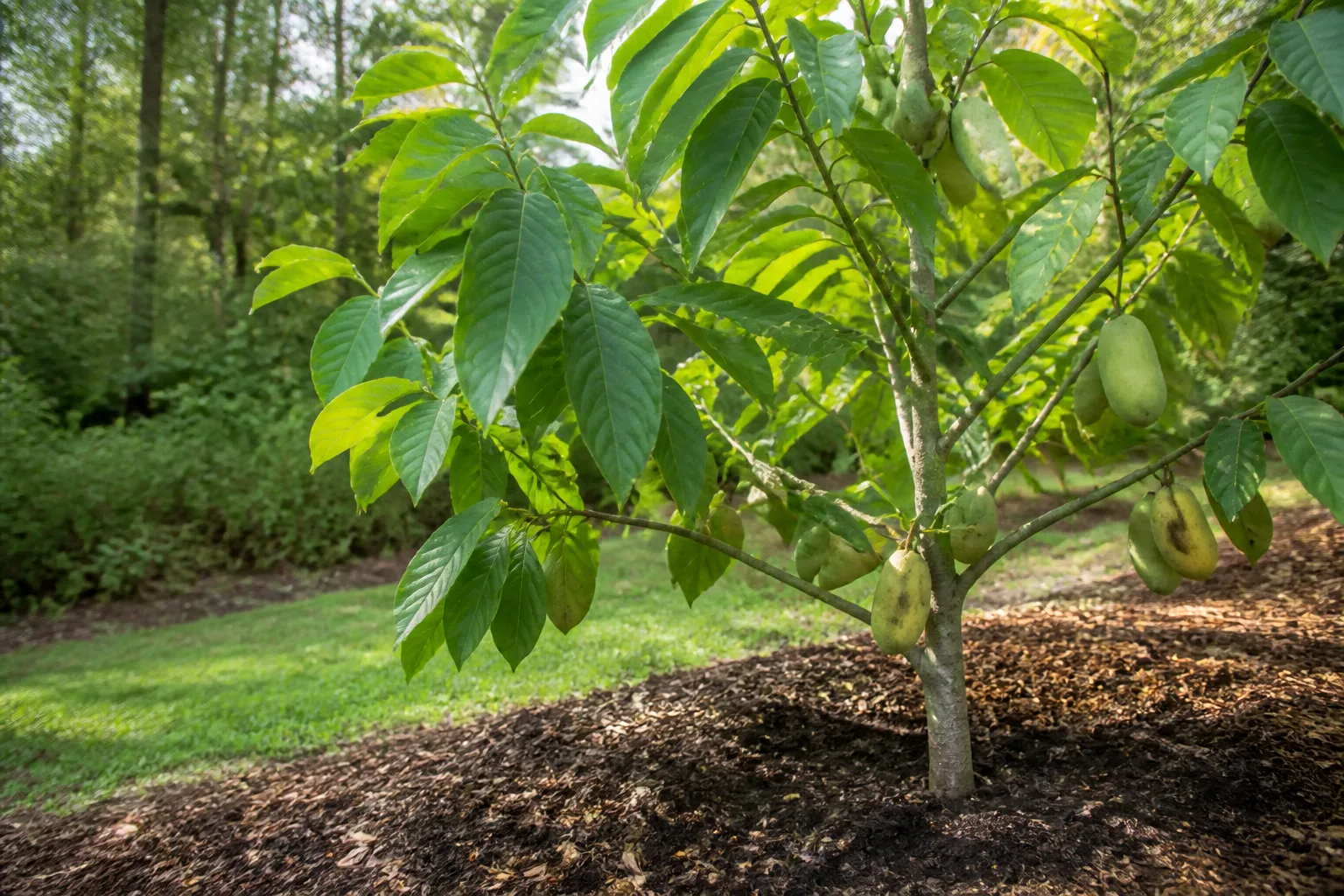
Pawpaw (Asimina triloba) is the largest tree fruit native to North America—a custard-soft, banana-mango pocket of flavor that rarely shows up in supermarkets because it ripens fast and bruises easily. In the home landscape, pawpaws double as a native ornamental with bold leaves, maroon spring flowers, and golden fall color. The catch is that pawpaws are not plug-and-play fruit trees. They need genetically different pollination partners, moist acidic soil, and patience through a multi-year juvenile phase. Get those three right and you can harvest fruit your neighbors have only heard about in folk songs.
What Pawpaw Trees Are—and Why Home Growers Plant Them
Pawpaw belongs to the custard-apple family (Annonaceae), the only temperate member of a mostly tropical clan. In the wild it grows as an understory tree along streams and in rich woodlands from Ontario south to Florida and west into Nebraska and Texas. Cultivated in open sun, it forms a small pyramidal tree typically 15 to 25 feet tall and about 15 feet wide, though exceptional specimens can grow taller on deep, fertile sites.
The fruit is a soft, oblong berry cluster—sometimes compared to a banana “hand”—with sweet custard flesh and large brown seeds. Flavor is intensely tropical: banana, mango, melon, and vanilla notes depending on cultivar and ripeness. NC State Extension notes that mature fruit tastes like banana custard, is highly nutritious, and ripens from late summer into fall.
Quick Plant Profile
| Trait | Pawpaw (Asimina triloba) |
|---|---|
| Type | Deciduous fruit tree / large shrub |
| Mature size | 15–25 ft tall × ~15 ft wide (can exceed in ideal sites) |
| Sun | Full sun for best fruit; young trees tolerate partial shade |
| Soil | Moist, fertile, slightly acidic, well-drained |
| Hardiness | USDA zones 5–8 (most cold-hardy Asimina species) |
| Pollination | Self-incompatible; needs genetically different partner |
| Years to fruit | Often 4–8 years from seedling; sooner on grafted stock |
| Wildlife value | Host for zebra swallowtail; fruit eaten by birds and mammals |
| Toxicity | Seeds and skin contain annonacin; fruit pulp edible with caution |
Is a Pawpaw Tree Right for Your Yard?
Before you order trees, decide whether you want ornamental native habitat or a reliable fruit crop. Pawpaws excel at both—but fruit production adds hard requirements: two compatible cultivars (or wild genetics), fly-friendly bloom season, and harvest vigilance before raccoons beat you to the crop.
Pawpaws fit gardeners who have moist, humus-rich soil, room for multiple trunks or a small grove, and tolerance for flowers that smell like fermenting fruit. They are a poor match for dry sandy sites, windy hilltops without shelter, or yards where you want a single self-fertile tree and instant harvest.
Hardiness, Size, and Climate Fit
Pawpaw is the most cold-hardy species in its genus. Oregon State Landscape Plants lists hardiness to USDA Zone 5, with native range extending across the eastern U.S. and into southern Ontario. Trees handle hot humid summers and cold winters well once established.
In low heat-unit climates—cool nights in the Pacific Northwest, for example—choose early-ripening cultivars such as PA-Golden, Shenandoah, or KSU-Benson. Late cultivars may never fully ripen where summers stay mild. In the warm end of zone 8, provide afternoon shade for newly planted saplings until they leaf out strongly.
Plan spacing for a small orchard block rather than a single specimen: 8 to 10 feet between trees in a row and 12 to 16 feet between rows is a common home scale. USDA ARS germplasm notes recommend roughly 2 meters within rows and 5.5 meters between rows for commercial plantings—translate that down for backyard groves but do not cram trees into foundation beds.
The Pollination Reality Check
Pawpaw flowers are perfect (each bloom has male and female parts) but self-incompatible. Pollen from one tree rarely fertilizes flowers on the same tree or on genetically identical suckers from the same root system. You need at least two different cultivars or wild-origin trees that are not clones of each other.
Flowers emerge before leaves in early spring, are maroon and foul-smelling, and attract flies and beetles—not honeybees. The odor is a feature, not a flaw: it evolved to pull carrion flies to understory blooms. If you are fruit-focused, plant three trees when space allows; two is the minimum.
The cultivar ‘Sunflower’ is often described as partially self-fertile and may set some fruit alone, but even growers who rely on it report heavier crops with a second cultivar nearby. Treat “self-fertile” labels as insurance, not a reason to skip a pollination partner.
Choosing Stock: Nursery Cultivars vs. Wild Seedlings
The fastest path to good fruit is a grafted, named cultivar from a specialty fruit nursery—not a seedling dug from a woodland patch. Wild pawpaws form thickets from root suckers; those suckers share the parent genotype and will not cross-pollinate each other. Transplanting wild suckers also fails often because dug plants lack feeder roots and suffer severe transplant shock. USDA ARS notes that containerized seedlings transplant far more successfully than field-dug wild stock.
Seed-grown trees are fine for experimentation, but fruit quality is unpredictable and the wait to first crop is longer. Modern cultivars come from decades of selection—revived in the 1970s–1990s by breeders including Neal Peterson working with Kentucky State University—to improve size, flavor, seed count, and disease resistance.
Named Cultivars Worth Planting
| Cultivar | Traits | Best for |
|---|---|---|
| ’Allegheny’ | Early ripening; rich, sweet flavor with citrus notes | Short-season / cool-summer sites |
| ’Shenandoah’ | Very large fruit; creamy texture | Fresh eating |
| ’Potomac’ | Among the largest fruits; high quality | Showy harvests |
| ’Overleese’ | Large yellow-orange fruit; few seeds | Processing and fresh use |
| ’Wabash’ | Large, sweet, productive | Reliable home orchard |
| ’Wells’ | Prolific; soft green fruit; creamy orange flesh | Canning and baking |
| ’Mango’ | Intense mango-like flavor | Flavor enthusiasts |
| ’Sunflower’ | Partial self-fertility; fewer seeds | Small yards (still plant a partner) |
| ‘Susquehanna’ | Large, late-ripening fruit | Long-season areas |
NC State Extension maintains cultivar pages for many of these selections. Buy from vendors who ship dormant bareroot or container trees with clear cultivar labels and compatible pollination pairings.
Site Selection, Soil Prep, and Planting
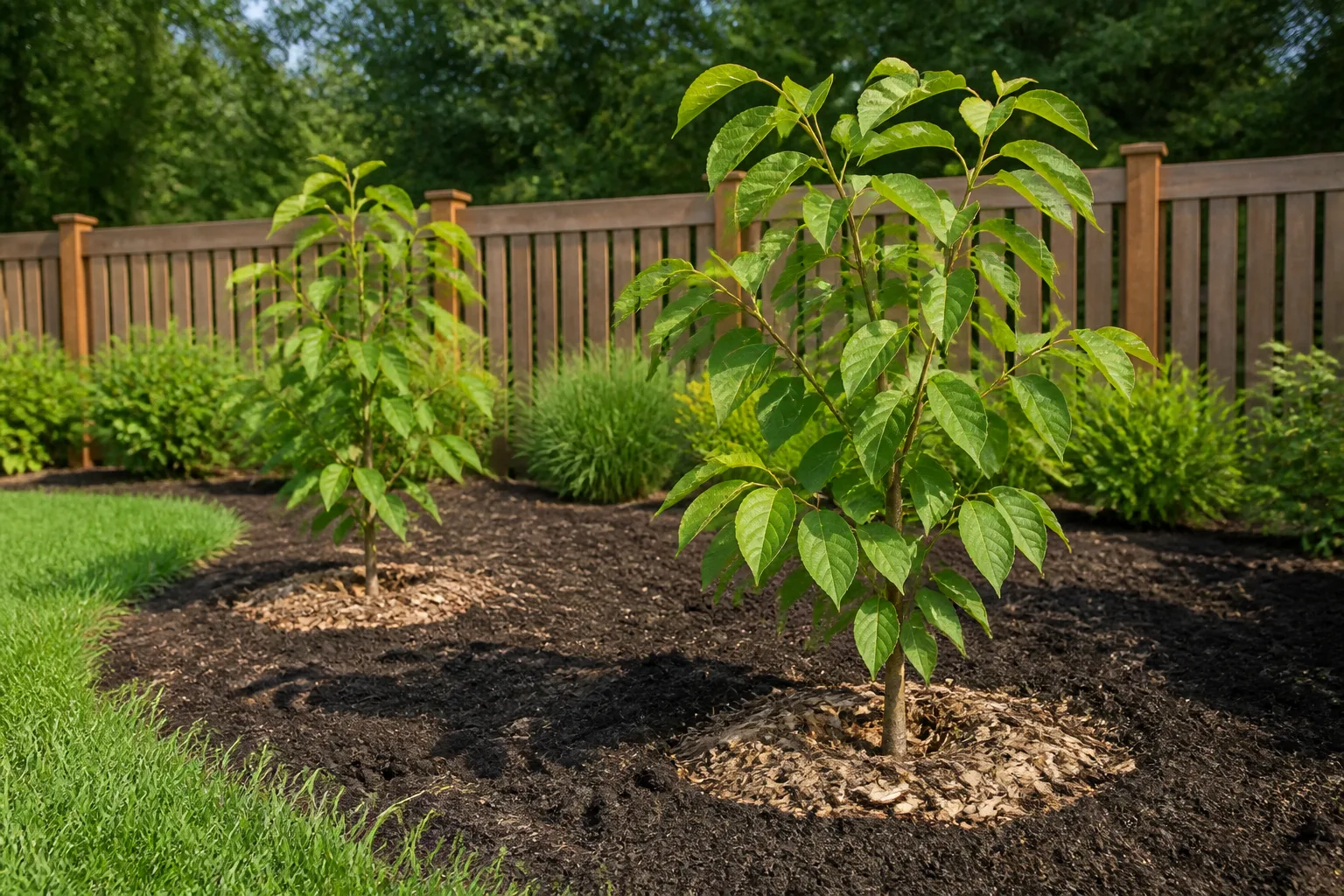
Pawpaws evolved in deep, moist, humus-rich forest soil. Replicate that—not lawn sand or builder’s fill—and you solve half the problems before they start.
Soil pH, Drainage, and Organic Matter
Target slightly acidic soil (roughly pH 5.5 to 7.0) that holds moisture but drains after heavy rain. Pawpaws tolerate brief wet periods but not permanently waterlogged roots. Run a soil test through your county extension office and amend with compost or leaf mold before planting.
Work organic matter into a wide planting zone, not just the backfill hole. A common failure is digging a small perfect pocket in heavy clay; water pools in the hole while the surrounding soil stays dry. Build a mounded bed or berm on marginal sites to improve drainage and aeration.
Light, Wind Shelter, and Spacing
Full sun produces the heaviest fruit crops, even though wild pawpaws grow in partial shade. The trade-off: young saplings are vulnerable to sunscald on bark and leaf scorch in hot afternoon sun. Plant in full sun but shade the trunk the first one to two summers with a sleeve, shade cloth, or temporary companion shrub on the west side.
Wind matters more than many guides admit. Research cited by horticulturists links strong wind to twisted, permanently damaged branches on pawpaws. Site trees near a fence, building, or windbreak hedge—not on an exposed ridge.
Planting steps:
- Dig a hole twice the width of the root ball and no deeper than the root crown.
- Set the tree so the graft union (if present) sits 2 to 3 inches above final grade.
- Backfill with native soil mixed with compost; tamp lightly to remove air pockets.
- Water deeply immediately; apply 3 to 4 inches of wood-chip mulch in a wide ring, keeping mulch off the trunk.
- Stake only if the site is windy; remove stakes after roots anchor.
Spring planting after budbreak is standard in cold climates; fall planting works in milder zones if the nursery ships dormant stock and you mulch well.
Watering, Mulch, and First-Year Nutrition
Young pawpaws have shallow, fibrous roots and cannot dry out in the first growing season. Water two to three times per week for the first three months after planting if rain is insufficient—deep soakings, not sprinkles. Established trees tolerate short droughts but fruit better with even moisture through summer.
Maintain a wood-chip or leaf mulch layer year-round. Mulch moderates soil temperature, preserves moisture, and feeds soil biology as it breaks down. Pawpaws in rich native soil often need little supplemental fertilizer once mature.
For first-year saplings, a light monthly application of balanced slow-release fertilizer or diluted liquid feed through spring and early summer can support establishment. Stop feeding by late summer so wood hardens before frost. Avoid heavy nitrogen late in the season—it pushes soft growth that winter-kills easily in zone 5.
In year two and three, shift from survival watering to fruit-oriented care: maintain mulch, water during drought weeks, and watch for the first flower buds. Remove flowers on very young whips if the trunk is still thinner than your thumb—letting a tree fruit too early can stall structural growth. Once the trunk calipers up and the canopy fills out, allow blooms and focus on pollination success.
Pollination Partners, Flies, and Hand-Pollinating

Plant pollinizers within 30 feet of each other—closer is better. A single tree across a large lot will bloom beautifully and set zero fruit.
Because flies do the work, some growers hang fish emulsion or compost bait near blooms during flowering week to increase fly traffic. Skip roadkill tricks in residential neighborhoods; they create odor and sanitation problems without guaranteed results.
Hand pollination rescues crops when fly pressure is low:
- Identify blooms on warm afternoons when flowers are receptive (pawpaw is protogynous—female parts mature before pollen sheds in the same flower).
- Use a small soft brush or cotton swab to collect yellow pollen from flowers on Tree A.
- Transfer pollen to receptive flowers on Tree B (and reciprocate A←B on alternate days).
- Repeat every two to three days through the bloom window.
Mark which cultivar is which at planting time—you cannot tell them apart from leaves alone. If you need a pollination primer for other fruit crops, our guide on getting apple trees to fruit walks through similar cross-pollination logic.
Timing matters for hand pollination. Pawpaw flowers are protogynous: the stigma is receptive before pollen from the same blossom sheds. Collect pollen from fully open flowers on warm afternoons (above 60°F) when anthers look dusty yellow. Store pollen in a labeled container in the refrigerator for same-day use if bloom peaks on different trees on staggered days. Cross-pollinate in both directions over a 10- to 14-day bloom window for best fruit set.
Pruning, Suckers, and Long-Term Shape
Pawpaws need minimal pruning. Remove dead, diseased, or crossing wood in late winter before budbreak. Trim low drooping branches only if they block paths or mowing.
The bigger maintenance issue is root suckers. Pawpaws naturally spread into thickets. Mow or cut suckers if you want a single-trunk tree; leave a ring of suckers if you are building a pawpaw patch for wildlife or informal fruit production—just remember suckers are clones and do not count as pollination partners.
Never remove more than one-third of live wood in a year. Hard renovation pruning shocks pawpaws and can skip a fruiting cycle.
Growing Pawpaw from Seed
Seed propagation is the classic homestead method—and the slowest route to named-fruit quality.
- Extract seeds from fully ripe fruit in fall. Wash away all pulp; pulp inhibits germination.
- Never let seeds dry out. Pawpaw seeds lose viability quickly when desiccated.
- Cold stratify 90 to 120 days at 34–41°F (1–5°C) in moist sand or peat in a sealed bag in the refrigerator.
- Sow in deep containers after stratification; pawpaws develop long taproots. Outdoor fall sowing in prepared beds also works—the winter provides natural stratification.
- Keep soil warm (77–86°F) for best emergence; seedlings may take weeks to break soil.
- Grow in part shade the first summer; transplant to final sites after one or two years when trunks are pencil-thick.
Seedlings from grocery or wild fruit are genetic lottery tickets. For predictable flavor and size, graft or buy cultivars. If you enjoy seedling experiments, our fast-growing fruit trees guide compares juvenile timelines across species—including pawpaw—for orchard planning.
Harvest Timing, Storage, and Safe Eating

Pawpaws are climacteric—they ripen quickly once maturity triggers. Harvest when fruit softens slightly on the tree, skin turns from green toward yellow or brown, and the aroma becomes strongly tropical. Clip with pruners, leaving a short stem; ripe fruit drops easily and bruises.
Ripeness cues differ by cultivar. Early types like Allegheny may yellow first; others stay greener on the skin while the flesh softens. Press gently near the stem end—ripe pawpaws give like a ripe peach. If fruit falls when you bump the branch, it is ready or slightly past peak. Harvest daily during ripening week; one warm rain can push an entire crop from firm to overripe in 48 hours.
Refrigerate ripe fruit promptly and use within about one to three weeks. Freeze pulp (seeds removed) for baking and smoothies.
Safety matters. Seeds, skin, and leaves contain annonacin and related compounds. Do not eat seeds or thick peel. NC State Extension classifies toxicity as low for ripe pulp but notes that some people experience stomach pain or skin irritation from fruit contact or consumption. Memorial Sloan Kettering’s integrative medicine summary cautions that concentrated pawpaw extracts are not clinically validated for treatment and that fruit may cause allergic or gastrointestinal reactions in sensitive individuals. Enjoy pulp in moderation until you know your tolerance.
Wear gloves when harvesting if your skin reacts to contact. This is excellent fruit—just not a eat-the-whole-fruit-like-an-apple situation.
Pests, Diseases, and Wildlife at Harvest
Established pawpaws are remarkably trouble-free compared with apples or peaches.
Pawpaw peduncle borer (Talponia plummeriana) is the main insect pest in eastern states. Its larvae bore into flower stalks and destroy blossoms before fruit sets. Monitor blooms; if you lose most flowers to borer damage two years running, consult your extension office for localized integrated pest management options.
Powdery mildew can coat leaves in humid summers. Improve air circulation through selective thinning and avoid overhead irrigation late in the day. Horticultural oils or copper sprays labeled for ornamentals may help on severe infections—always follow label directions. Mild infections on established trees rarely warrant spraying; focus on cultural fixes first.
Zebra swallowtail caterpillars feed on young leaves but rarely threaten tree health or fruit yield. Many growers consider them a welcome sign of a functioning native planting. The butterfly’s range overlaps pawpaw’s native belt—planting pawpaws supports a pollinator partnership that predates modern orchards.
The hardest “pest” is often wildlife. Squirrels, raccoons, opossums, and birds harvest ripe fruit overnight. Pick early when fruit first softens, or net small trees during ripening week.
Troubleshooting Yellow Leaves and Poor Fruit Set
Yellow leaves on pawpaws usually trace to water stress, poor drainage, or nutrient imbalance—not mysterious disease. Check whether soil stays soggy after rain (roots suffocate) or dries completely between waterings (young trees starve). A soil test clarifies nitrogen, iron, and pH issues in chronically yellow specimens.
No fruit despite two trees usually means:
- Both trees are genetically identical (suckers from one parent).
- Trees are too far apart for fly movement between canopies.
- Peduncle borer destroyed flowers.
- Trees are still juvenile—under four years for grafted stock, longer for seedlings.
- Bloom frosts killed flowers in a cold snap.
Work through that list in order before assuming you need a third cultivar. If flowers appear but no fruit forms, try hand pollination for one season to test compatibility.
Conclusion
Pawpaw trees reward patient growers with North America’s most unusual native fruit—if you respect their forest-soil roots, plant real cultivar pairs for pollination, and protect young trunks from sun and wind. Start with grafted stock from a reputable nursery, site trees in moist, acidic, well-drained soil in full sun with wind shelter, and plan on four to eight years to your first serious harvest unless you buy older field-grown specimens.
The payoff is a tree that feeds people and pollinators alike: maroon fly-pollinated flowers in spring, zebra swallowtails in summer, and custard-ripe fruit in early fall. Harvest carefully, eat pulp only, and you will understand why this tree survived from Native American cultivation through Lewis and Clark’s expeditions to today’s backyard orchard revival. For more compact fruit options while pawpaws mature, see our guides to dwarf fruit trees and fruit trees for cold climates.