How to Grow Purple Passionflower (Passiflora incarnata)
Grow purple passionflower with practical advice on sun, soil, support, root suckers, pruning, winter dieback, pollination, and how to harvest ripe maypop fruit.
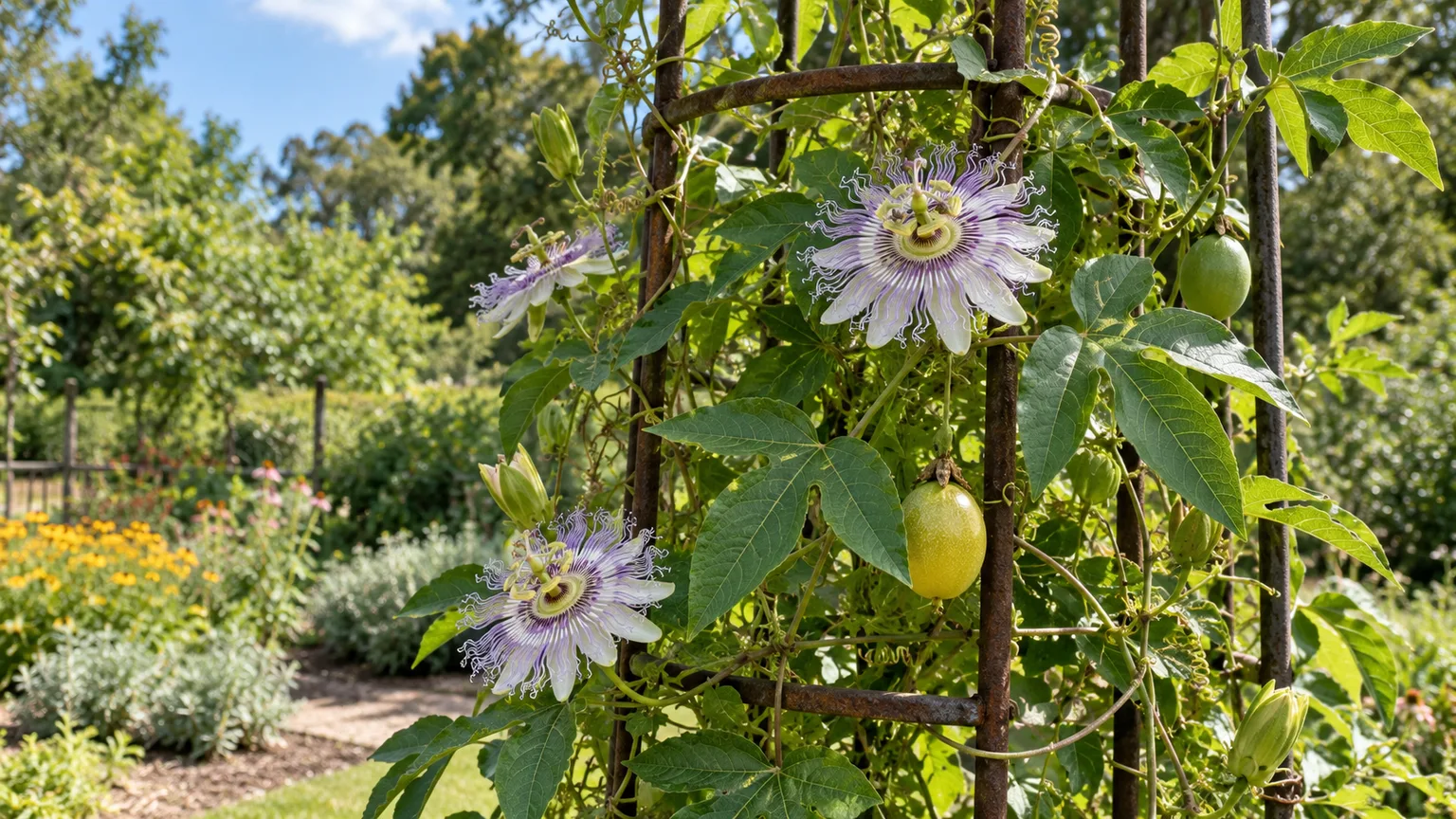
Purple passionflower (Passiflora incarnata), often called maypop, is a hardy North American vine with intricate lavender-and-white flowers, tendrils that grab a support, and egg-shaped fruit that yellows as it ripens. Give it sun, well-drained soil, a sturdy place to climb, and room for its roots to roam—or a deliberate plan to keep those roots in bounds.
The most useful expectation to set before planting is seasonal: in colder parts of its range, maypop is not an evergreen vine. Its top can die back after frost, then new shoots may appear late in spring from surviving roots. The same root system that helps it return also lets it spread, so the right site matters as much as the watering routine.
What Purple Passionflower Is—and What It Is Not
Maypop is a perennial, tendril-climbing vine native to the southeastern and south-central United States and Bermuda. It is one of the more cold-tolerant passionflowers, but its growth habit is often herbaceous: the aboveground stems can die in winter while the roots remain alive. In warm climates, stems may persist and become woody, but gardeners in colder areas should not expect evergreen foliage.
The name “passionflower” covers many Passiflora species. P. incarnata is not the same plant as tropical passionfruit (P. edulis) or blue passionflower (P. caerulea), and their fruit, winter tolerance, and care are not interchangeable. If edible fruit is part of your plan, buy a plant labeled Passiflora incarnata from a reliable nursery and keep the label; common names alone are not enough for safe identification.
The NC State Extension Plant Toolbox describes maypop as a fast-growing native vine that spreads by root suckers and tolerates full sun to partial shade. Its profile also notes that the plant has high flammability and should not be placed within a home’s defensible space. Those details make maypop a better fit for a planned trellis at a garden edge than for a wall or narrow foundation bed beside the house. (NC State Extension Plant Toolbox: Passiflora incarnata)
Quick Maypop Growing Profile
| Growing factor | What to expect |
|---|---|
| Botanical name | Passiflora incarnata |
| Common names | Maypop, purple passionflower, wild passionflower, apricot vine |
| Life cycle | Perennial vine; often dies back to the ground in cold climates |
| Native range | Southeastern and south-central United States, plus Bermuda |
| Light | Full sun to partial shade; stronger sun usually supports more flowers |
| Soil | Average to fertile, but well-drained; tolerates several soil textures |
| Water | Even moisture while establishing; more drought-tolerant once established |
| Growth and spread | Rapid vine growth; root suckers can spread beyond the crown |
| Bloom and fruit | Summer flowers; fruit may mature yellow in late summer or fall |
| Hardiness reference | NC State lists USDA Zones 5a–9b; local drainage and winter exposure still matter |
Use the profile as a planning range, not a guarantee for every yard. Tennessee Smart Yards, a University of Tennessee Extension program, notes that maypop can emerge late after winter and may take a long time to germinate from seed; that helps explain why a plant can look absent in April yet still return later. (Tennessee Smart Yards: Passiflora incarnata)
Choose a Site and Support Before Planting
Pick the location before you loosen the root ball. A maypop that has a sunny, well-drained spot and a dedicated support can be a beautiful screen; a vine placed beside delicate perennials, a small tree, or a walkway can become an ongoing removal job as its runners send up shoots in new places.
Allow a generous area for the canopy and check the soil beyond the planting hole for likely sucker paths. Avoid putting it in the defensible space next to a home, and do not let a mature vine disappear into shrubs where you cannot see or prune its edges. NC State lists maypop as highly flammable; local wildfire guidance should take precedence when planning near buildings or property boundaries.
Give Tendrils a Structure They Can Grip
Maypop climbs with tendrils that coil around slender objects. It needs a trellis, arbor, fence wires, or open lattice, not a broad, flat wall by itself. Install support before planting so you do not damage the new root system later, and anchor it firmly enough to hold a leafy vine in wind and rain.
Train a few stems sideways and upward instead of allowing every shoot to bunch in one corner. This distributes growth, makes flowers easier to see, and leaves you room to spot new suckers. A dedicated freestanding structure also makes it simpler to keep the vine away from trees and neighboring plants that it could overrun.
Get Light, Soil, and Water Right
Choose a site with at least several hours of direct sun. Maypop tolerates partial shade, especially where afternoons are hot, but deep shade can produce long leafy stems with fewer flowers. If flowering is the priority, give the upper part of the trellis a bright exposure rather than judging light only at ground level.
Well-drained soil matters more than a finely tuned pH or a specialized potting blend. NC State and Tennessee Smart Yards both describe the plant as adaptable to several soil textures, while NC State warns that wet soil—particularly in winter—can contribute to root rot. If water sits after rain, choose a raised or naturally drier position instead of trying to compensate with fertilizer or frequent cultivation.
Water a new planting deeply after setting it in and keep the root zone evenly moist while it establishes. Once the vine is established, it can tolerate short dry spells, but a long stretch of heat and drought can slow growth and reduce flowering or fruit development. Check the soil a couple of inches down; water when it is drying, not just because a certain number of days has passed.
A loose layer of mulch can reduce moisture swings and keep roots cooler. Keep the mulch a few inches from the crown, where tightly packed, wet material can hold moisture against stems. Gardening Know How’s maypop growing guidance also recommends mulch for root-zone moisture and a support to keep the vine from sprawling across the ground. (Gardening Know How: “Growing Maypop Passion Vines”)
Plant Maypop After Frost, Then Wait for Growth
In a cold-winter garden, plant nursery-grown maypop in spring after the last hard frost. That gives the root system a full warm season to establish before winter. In a mild climate, planting windows are broader, but spring still makes watering and early training easier to monitor.
Set the plant at the same depth it grew in its nursery pot, backfill with the garden soil, and water to settle the roots. Do not bury the crown or pack a planting hole with rich compost; the plant grows in average soil and needs drainage more than a heavily amended pocket. Add mulch after watering and direct the first flexible stems toward the support.
Do not assume a dormant crown has died just because shoots are absent when nearby perennials are already leafing out. University of Tennessee Extension notes that maypop emerges fairly late in spring after frost danger passes. Mark the planting spot, keep it from staying waterlogged, and wait until the local growing season is well underway before digging up a “missing” plant.
Manage Root Suckers Before They Escape
The vine’s underground runners are the main maintenance issue. They can send up new shoots away from the original plant, and a patch that looks tidy in year one may expand in year two or three. This is not evidence that the plant is invasive everywhere: maypop is native in parts of the United States, but a native plant can still spread aggressively in a garden or beyond its native range.
Walk the boundary during the growing season and remove unwanted shoots while they are small. Use a sharp spade to cut the sucker below the soil line, then pull or dig out the rooted section if it comes free without tearing up neighboring plants. Simply mowing the top may keep a shoot short for a while, but it does not reliably stop the runner that feeds it.
If you want a contained display, plant in a large pot on a hard surface so roots cannot escape through drainage holes into the ground. A buried barrier can help, but the vine may travel under or around it, so inspect the edges rather than treating a one-time installation as permanent control. Tennessee Smart Yards specifically recommends regularly removing suckers to manage spread. (University of Tennessee Extension, Tennessee Smart Yards)
Prune for a Clear Boundary and Future Flowers
Prune in late winter or early spring, but confirm the vine’s condition before cutting hard. In colder locations, stems can look dead for weeks before new growth emerges; wait until you can see which canes survived, then remove brittle or broken wood. If the top died back completely, cut dead stems near the crown without digging into it.
Use summer pruning to redirect stems and remove shoots that are leaving the support, not to shear the vine into a tight ball. New growth is where flowers form, so avoid stripping healthy tips just as the plant is beginning its bloom cycle. If fruit is your goal, leave flowers and developing fruit alone through the season and do major cleanup after the harvest window.
When training a young plant, pinching a long tip can encourage side branches and a fuller framework. Do not confuse pinching with controlling root suckers: a clipped vine tip will branch, while a shoot emerging several feet away is connected to the underground spread and needs to be cut at its source.
Understand the Flowers, Pollination, and Fruit Set
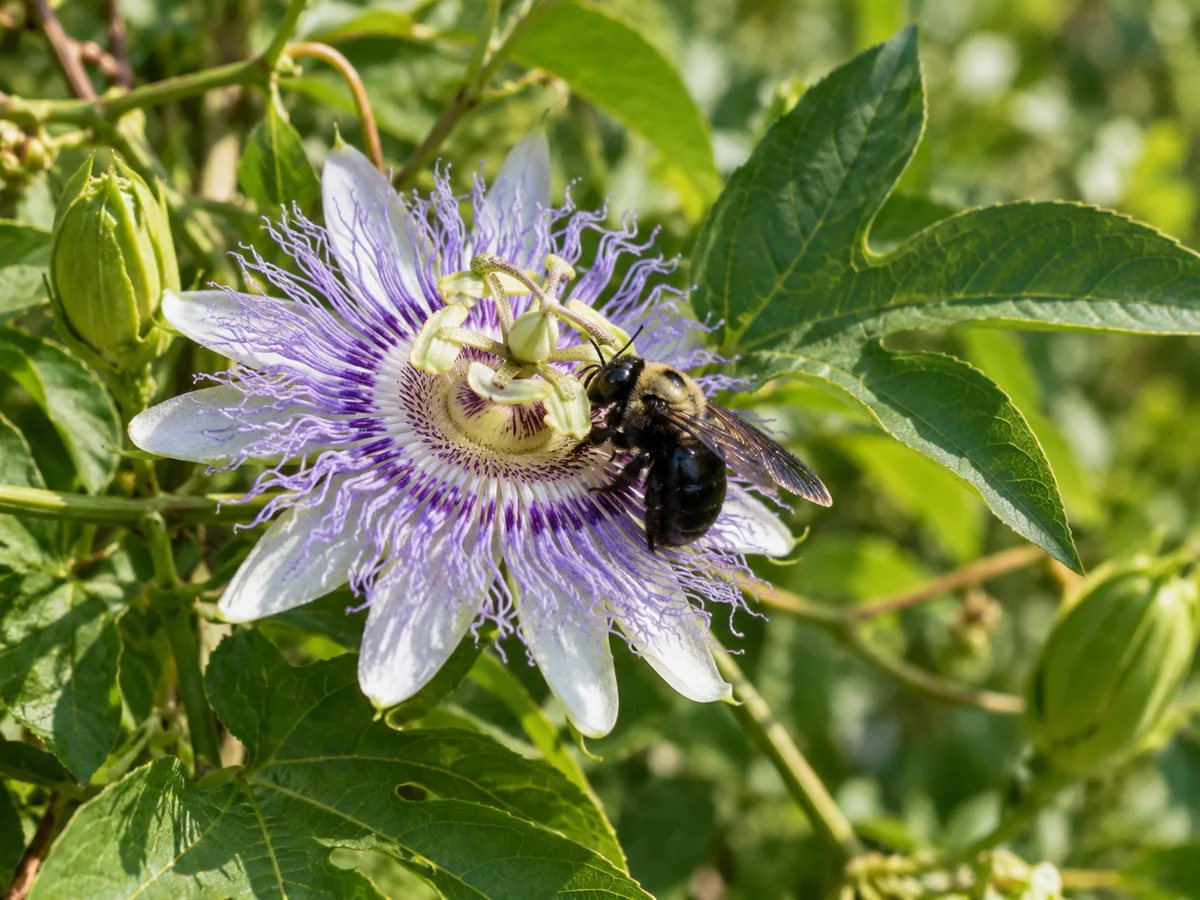
The flowers are the plant’s showpiece: white petals and sepals surround a fringe of purple filaments, with reproductive parts raised near the center. The blooms appear in warm months, and the vine can produce new flowers over a period even though each individual flower is short-lived. Give the plant light and a frame that lets you see blossoms rather than burying them in a dense tangle.
Maypop also supports wildlife. NC State identifies it as a nectar plant and larval host for several butterflies, including Gulf fritillary and variegated fritillary; Tennessee Smart Yards likewise highlights its value to butterflies and bees. Caterpillars feeding on the leaves are part of that relationship, so decide whether you want a pollinator host plant before treating every chewed leaf as a pest problem.
Diagnose Flowers That Do Not Become Fruit
Flowers without fruit usually point to timing, light, pollination, or a young vine—not a need for stronger fertilizer. A new plant may spend its first season building roots and stems, while shaded or drought-stressed growth may produce fewer viable flowers. Watch whether insects visit blossoms and whether small green fruits begin to swell after flowering.
If flowers open but no fruit forms, first improve the conditions you can verify: avoid excess shade, keep the root zone from drying hard during active growth, and protect pollinators from unnecessary broad-spectrum insecticides. A home grower’s guide from Homestead and Chill describes maypop as self-fertile but notes that pollen still has to move between flower parts, often with help from bees; hand transfer with a clean small brush is a reasonable trial when visits are scarce. Do it while the flower is open, then compare a few hand-pollinated blossoms with untouched ones rather than assuming one attempt guarantees a crop. (Homestead and Chill: “How to Grow Purple Passion Fruit vs. Maypops”)
Harvest Maypops Only When They Are Ripe
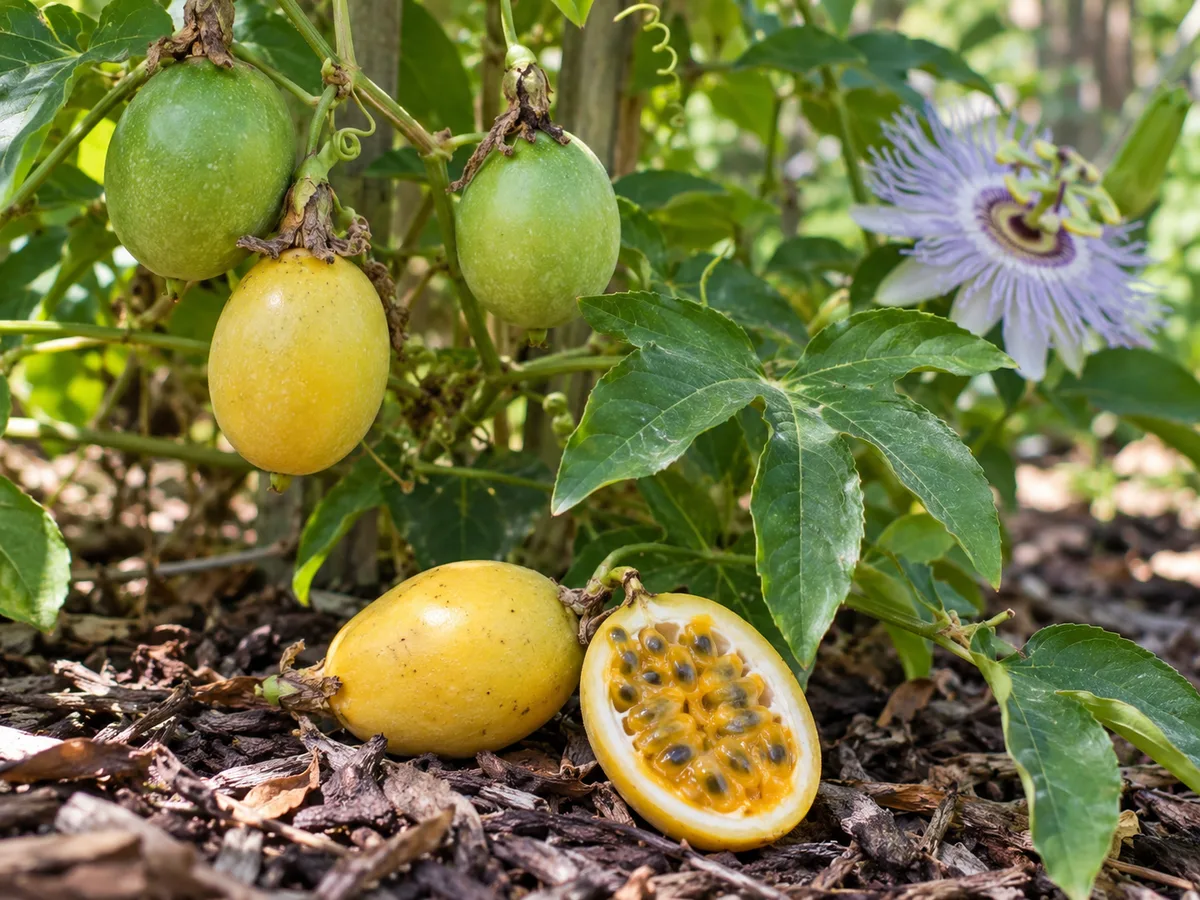
Maypop fruit develops after successful pollination and usually matures from green toward yellow as the season advances. It is smaller and usually less sweet than tropical passionfruit, so do not judge it by the large purple fruit sold in grocery stores. Depending on climate and flowering date, harvest may extend into late summer or fall.
NC State identifies ripe maypops as edible while also listing the species among plants with poisonous parts. Keep the distinction narrow: eat only fruit from a correctly identified P. incarnata plant once it has ripened; do not assume leaves, roots, stems, or unripe fruit are food. If the species is uncertain or anyone has eaten a plant part other than known ripe fruit, contact a medical professional or poison-control service rather than relying on a gardening article.
Read the Fruit, Not Just the Calendar
A mature maypop often turns yellowish, softens, or drops from the vine. Some fruits wrinkle as they finish ripening; a firm green fruit that is still tightly attached is more likely to taste sharply sour and have underdeveloped pulp. Check the ground under the vine as well as the canopy, because ripe fruit can fall before you notice it.
Wash collected fruit, cut it open, and inspect the pulp before eating or preserving it. If you are growing the vine mainly as an ornamental or pollinator plant, leave some fruit for wildlife and collect only what you can identify with confidence. Homestead and Chill’s grower notes describe yellowing and easy detachment as useful harvest cues; local timing can shift with heat, frost dates, and how early the flowers set. (Homestead and Chill, maypop harvest guidance)
Propagate by Division, Cutting, or Seed
Choose a propagation method based on what you want. A rooted sucker or division is the quickest route to a plant that behaves like the parent; a stem cutting takes more careful aftercare; seeds are useful for growing several plants but can be slow and unpredictable.
Choose the Method That Matches Your Goal
Divide a sucker: Find a healthy shoot attached to a visible rooted runner. In early fall, dig around it with a sharp spade, sever a section that has roots of its own, and move it promptly to prepared soil or a pot. Water well and keep it evenly moist while the roots reestablish. Because the plant is already prone to suckering, this method turns an unwanted shoot into a new plant rather than creating additional disturbance from seed.
Root a stem cutting: In late spring or early summer, take a 4- to 6-inch piece of healthy, nonflowering growth with at least one leaf node. Remove leaves from the lower portion, place a node in moist, free-draining propagation mix, and cover loosely with a clear bag or dome to limit drying. Keep it warm in bright indirect light, vent it if condensation stays heavy, and pot it on once gentle resistance and new growth suggest roots have formed.
Start from seed: Clean pulp from mature seed and label the sowing date. Maypop seed can germinate sporadically over a long period—University of Tennessee Extension notes it may take as much as two years—so use a shallow labeled tray and do not discard it after a few weeks. Some experienced growers use a period of moist cold stratification before sowing; if you try that, follow reputable seed-supplier directions and keep the medium damp rather than saturated. (Tennessee Smart Yards, propagation notes; Homestead and Chill, seed-starting notes)
Grow in a Container or Protect the Plant in Winter
Container growing can make the vine easier to move and can limit root spread, but it does not make maypop a compact plant. Choose a large, stable container with unobstructed drainage and set it on paving or another surface where roots cannot escape from the bottom. Add a support sized for the vine and check moisture more often than you would in the ground because pots dry faster.
In-ground plants may lose all top growth in winter and return from the roots when conditions suit them. A loose mulch layer can buffer the crown during cold spells, but do not pile wet material against the stems. NC State lists a broad hardiness range of Zones 5a–9b, while gardening references vary; that range should not be read as a promise that every plant will survive every winter, especially in waterlogged soil or an exposed microclimate.
Container roots are more exposed to freezing than roots in the ground. In a cold region, move a dormant potted vine to a sheltered, unheated space that stays above the container’s most severe outdoor temperatures, or insulate the pot against a protected wall. Water sparingly while growth is dormant, checking the mix so it does not remain wet for weeks or dry into a hard, shrunken root ball.
Troubleshoot Yellow Leaves, Weak Growth, and No Blooms
Yellow leaves: Check moisture first. A soggy root zone and a dry root ball can both cause yellowing, so feel the soil before changing the watering routine. If moisture is reasonable, consider cold injury, transplant stress, or whether the plant is shedding foliage as it enters seasonal dormancy.
No spring shoots: Maypop can emerge late, so mark the crown and wait until the frost danger has passed and the local growing season is established. A winter with prolonged saturated soil, a very exposed container, or repeated severe freezes makes root loss more likely; do not solve uncertainty by digging into the crown every week.
Leaves but few flowers: Check the light reaching the upper vine, then consider whether high-nitrogen fertilizer is pushing stems and leaves at the expense of flowering. Maypop tolerates average fertility; a strong feeding schedule is rarely the first fix. If the plant is young, give it time to establish and reassess after a full growing season.
Flowers but no fruit: Look for pollinator activity, adequate sun, and steady moisture through bloom. Hand-pollinate a few open blossoms as a test if bees are absent, and check whether fruits swell over the following weeks. Fruit set can also vary with weather and the vine’s maturity, so one poor season does not necessarily call for replacing the plant.
Chewed leaves: Identify what is feeding before acting. Fritillary caterpillars use passionflower as a host; if the vine is healthy enough to share foliage and you want a wildlife garden, leave some caterpillars in place. If damage threatens a young plant, inspect closely and choose the least disruptive response that fits your priorities.
Balance Wildlife Value With Household Safety
Purple passionflower is a strong choice for a native or pollinator planting where it naturally belongs, especially when it has a trellis and a boundary you can inspect. Its flowers provide nectar, and its leaves feed certain butterfly larvae; those benefits come with chewed foliage and a plant that may travel beyond its original crown. If you need a tidy, low-maintenance vine or have no space for suckers, choose a less vigorous species instead.
Place maypop well outside the defensible space around buildings, following local wildfire recommendations, because NC State rates it as highly flammable. Keep the plant labeled, supervise children around fruit, and do not use leaves or roots for home remedies. Those precautions do not erase the plant’s ecological value; they make the planting location and the edible-fruit decision clearer.
Conclusion
Grow maypop where sun, drainage, a sturdy support, and room for root suckers can all be managed. Plant in spring after frost, water regularly while it establishes, let the top die back naturally in cold weather, and wait patiently for late spring shoots before deciding it failed. Prune to maintain the boundary, protect the crown from winter wet, and harvest only correctly identified fruit after it turns yellow and softens.
The plant is easiest to enjoy when you plan for its two defining traits at the start: flowers that attract wildlife and roots that keep exploring. Give the vine a place where both are welcome, and its unusual blooms and seasonal maypops can return for years without surprising the rest of the garden.