How to Grow and Care for Persian Silk Trees
Learn how to plant, water, prune, and troubleshoot Persian silk trees—and check invasive risks, pet safety, seed pods, and weak branches before planting.
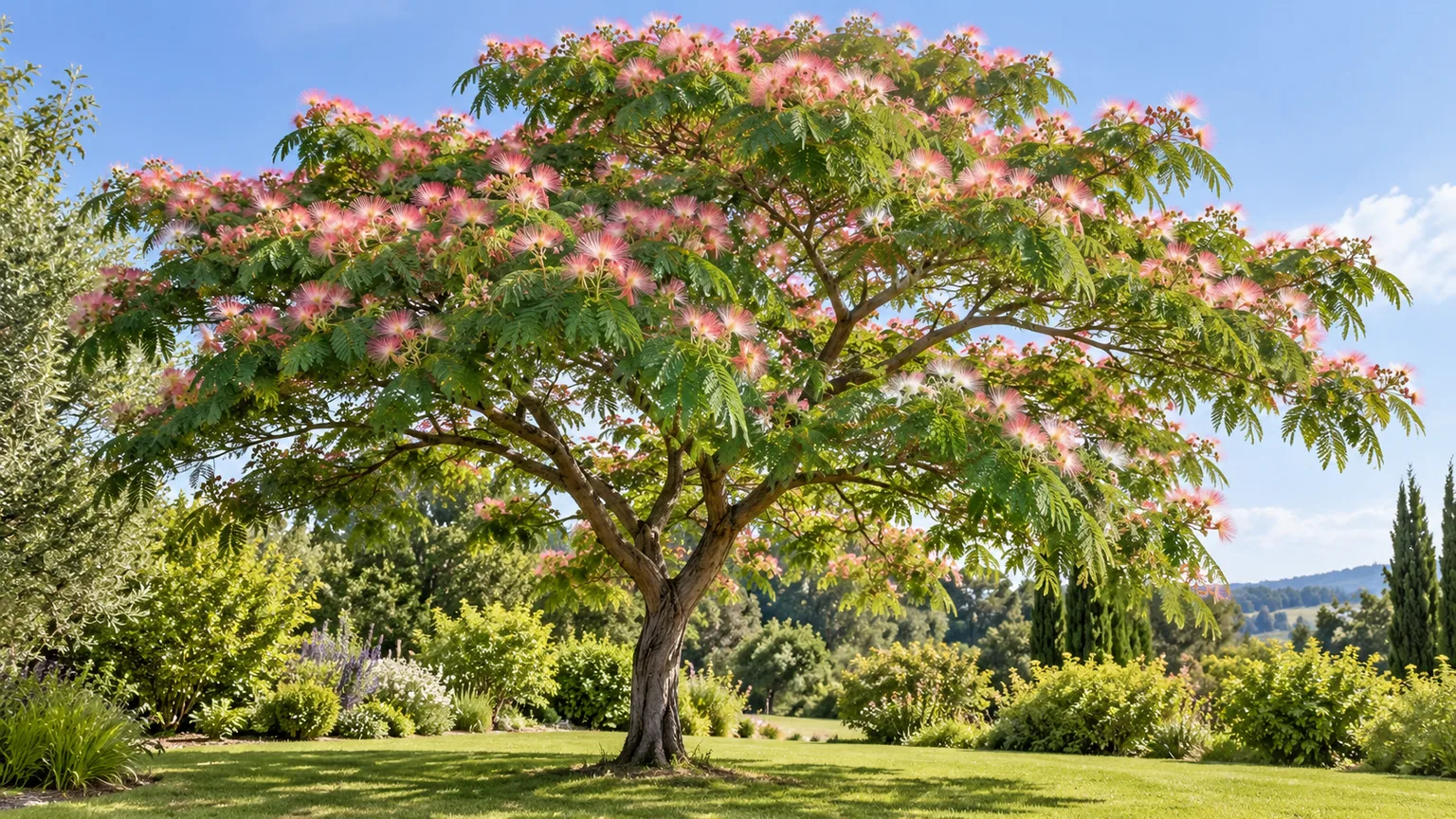
The Persian silk tree, Albizia julibrissin, can make a dramatic summer specimen: a broad, open canopy, fern-like leaves, and soft pink, threadlike flowers. It also drops leaves and long seed pods, develops brittle limbs, and spreads readily in some regions. Before looking for a planting spot, check whether local extension or invasive-plant authorities recommend growing it where you live.
That order matters. In North Carolina, NC State Extension lists the species as invasive and does not recommend it for landscapes; UF/IFAS classifies it as invasive in Florida and advises against any use there. Those assessments are regional, not a blanket legal ruling for every place, so check current state and local guidance before buying a tree. If the species is discouraged where you live, choose a locally recommended alternative rather than trying to solve seed spread with pruning.
Should You Plant a Persian Silk Tree?
This is a tree for gardeners who can accept both its ornamental display and its maintenance costs. Its flowers may draw pollinators, and its fine foliage gives light shade, but the crown can spread wider than many small-yard plans anticipate. Fallen flowers, foliage, and especially dry seed pods also create seasonal cleanup. NC State Extension describes the branches as weak and vulnerable to wind, snow, or ice damage, which is a serious consideration over a roof, driveway, play area, or path.
Use a simple decision rule. If local authorities discourage the tree, do not plant it. If it is allowed, proceed only if there is room for a wide canopy, you can collect pods before they disperse, and you can keep pets away from seeds. If any of those conditions is unrealistic, another ornamental tree is likely to be a better fit.
| A Persian silk tree may fit when… | Choose another tree when… |
|---|---|
| Your local invasive-plant guidance permits it. | Your state or municipality discourages or restricts it. |
| The site can hold a broad canopy and has open sun. | Branches would hang over a roof, utility line, parking space, or play area. |
| You can tolerate flower and pod litter. | A low-mess yard or seed-free surface is a priority. |
| You can inspect and collect pods and seedlings. | Dogs or livestock have unsupervised access to fallen seeds. |
In warm parts of the Southeast, extension programs often recommend avoiding this species and choosing regionally appropriate alternatives. UF/IFAS, for example, suggests sweet acacia, bottlebrush, or powderpuff for Florida gardeners seeking delicate foliage or fluffy flowers; those plants are not interchangeable across every climate, so verify a choice with your local extension office.
Identify the Tree Before You Buy
“Persian silk tree,” “silk tree,” “pink silk tree,” and “mimosa tree” are common names for Albizia julibrissin. The botanical name matters because “mimosa” can also refer to unrelated plants, including the small sensitive plant, Mimosa pudica, and in some countries to yellow-flowering wattles. A nursery tag with Albizia julibrissin is the reliable way to confirm which plant you are considering.
The tree is deciduous and usually develops a low-branched, spreading or umbrella-like crown. Its leaves are divided into many small leaflets, giving the canopy a feathery look; the leaflets commonly close at night and may fold when disturbed. In summer, fluffy pink flower clusters are made of many long stamens rather than broad petals. Later, flattened brown pods form and may persist into winter.
Published dimensions differ. NC State Extension gives a mature range of about 20 to 40 feet tall and 20 to 50 feet wide, while the UF/IFAS landscape profile lists 15 to 25 feet tall and 25 to 35 feet wide. The differences are a reminder to plan for the largest credible spread rather than treating a nursery’s young tree or a single cultivar as the final size. Both sources describe a fast-growing tree with a broad canopy. Lifespan estimates also vary: the UF/IFAS profile describes it as short-lived at 10 to 20 years, while NC State gives an average of 30 years. Treat those as published estimates rather than a promise for an individual tree; disease, storm damage, and site conditions can shorten its useful life.
Climate and Hardiness
UF/IFAS lists Persian silk tree for USDA hardiness zones 6B through 9B. That range is a useful starting point, not a guarantee that a young tree will thrive at every site within it. Winter lows, exposure to cold wind, soil drainage, summer heat, and the provenance or cultivar of a nursery tree can all shape performance. If your garden is near the cold edge of the range, ask a local nursery or extension office how established trees perform in your particular area.
The tree is widely adaptable once established, but it does best in full sun. It can grow in varied soils and tolerate dry periods, which also helps explain why it escapes into disturbed ground in regions where it is invasive. Adaptability is not the same as a reason to plant it everywhere: it can become a nuisance precisely because seedlings establish in open sites with little competition.
Do not choose the location by hardiness zone alone. A sheltered, sunny yard in a cold zone may suit a young specimen better than a low, waterlogged pocket in a warmer zone. Conversely, a tree exposed to strong prevailing winds may be a poor choice even where winters are mild because its wood is susceptible to breakage.
Choose a Site That Can Hold the Mature Crown
Give the tree full sun if you are planting it where permitted. UF/IFAS describes full sun as its light requirement, and growers report better flowering in open, bright sites. Partial shade may allow growth, but it can leave the crown less dense and reduce the show of flowers. If bloom matters, assess sunlight across the full summer day rather than judging a dormant tree in winter.
Measure the spread before digging. With a potential crown 25 to 50 feet wide, a small gap beside a house is not enough clearance. Consider overhead wires, roof edges, fences, pavement, parking, children’s play spaces, and neighboring property. UF/IFAS also notes that large surface roots may raise walks or patios as they enlarge, while larger trees transplant poorly. Plant only where the tree can stay; moving it after it becomes established is not a dependable rescue plan.
Choose a spot with well-drained soil, even though the species tolerates a range of textures and occasional moisture. Repeatedly saturated soil can injure roots and increase the risk of decline. Avoid low depressions that collect runoff and narrow tree pits surrounded by compacted pavement. Also avoid a windy or storm-exposed corner where a broad crown and brittle limbs could become a recurring hazard.
Planting for Good Root Establishment
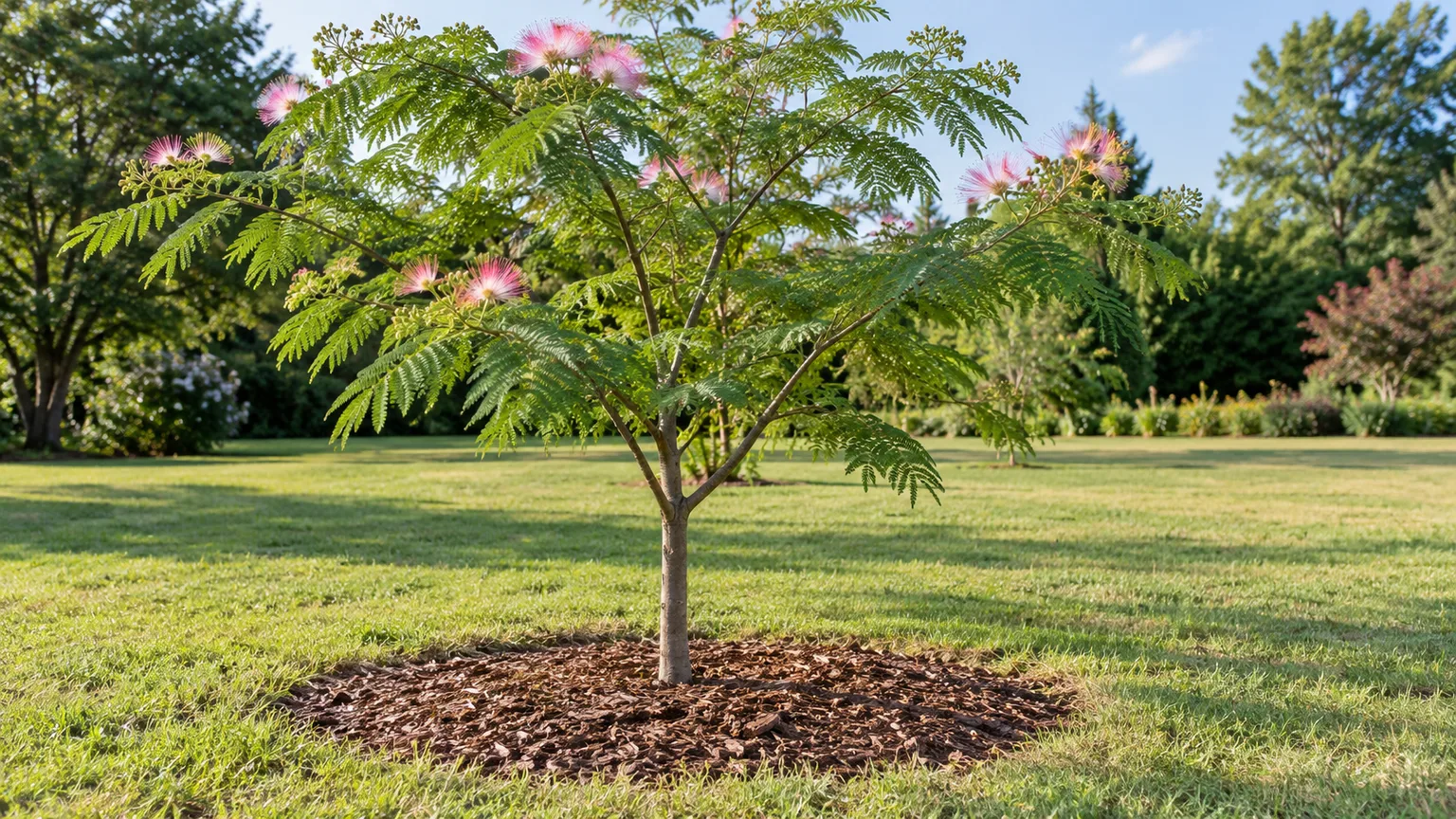
Plant a nursery-grown tree when the soil is workable and weather is moderate enough that you can keep the root ball moist. Spring after severe frost is a practical window in colder regions; in mild-winter areas, follow local tree-planting guidance and avoid planting into summer heat. A small, healthy nursery specimen is generally easier to establish and place correctly than a large tree. Because established Albizia trees transplant poorly, choose the permanent location before you start.
Prepare the site, not just a narrow hole. Remove turf in a broad circle to reduce competition for water, and check how quickly water drains after rain. If it remains pooled, choose a different location or seek local advice about improving the site; simply putting compost in the hole does not fix a high water table or compacted subsoil.
For a container-grown tree, use this sequence:
- Find the root flare, where the trunk widens into the first structural roots. Remove loose potting mix from the top of the root ball until you can see it.
- Dig a hole two or three times wider than the root ball but no deeper. The bottom should remain firm so the tree does not settle below grade.
- Set the flare level with the surrounding soil or just slightly above it. A tree planted too deeply can have a buried trunk, poor oxygen access, or persistent moisture around the bark.
- Turn the best side toward the view, backfill with the excavated soil, and water slowly so it settles around the roots. Do not stamp the soil hard.
- Spread a shallow layer of organic mulch across the root zone, keeping it several inches away from the trunk. Do not pile mulch against the bark.
This planting approach gives new roots access to surrounding soil instead of creating a rich pocket that can hold water differently from the surrounding ground. A wide mulched ring also makes it easier to monitor the original root ball and keep lawn competition away. A nursery care guide from Wilson Bros Gardens similarly emphasizes moisture around the root ball during establishment and keeping the planting area moist but not waterlogged.
Water During the First Two Seasons, Then Reassess
A new tree needs attention because its roots are still confined to the nursery root ball and nearby soil. Do not water by the calendar alone. Check the root ball and the soil just beyond it with a finger or narrow trowel. If the top few inches are dry and there has been little rain, give the tree a slow, thorough soak. If the ground is damp, wait; daily splashing keeps the surface wet without necessarily reaching the active roots.
How often you water depends on temperature, rainfall, soil texture, mulch, and drainage. Sandy soil dries faster than clay, while a newly planted tree near pavement can experience extra heat. A weekly check is more useful than a fixed weekly watering prescription. During hot, rainless stretches, a young tree may need a deep soak more often; after a soaking rain, it may need none. Aim to keep the root ball evenly moist, not continuously saturated.
Keep monitoring through at least the first two growing seasons, extending that period in dry climates or poor soils. The first growing season is not a hard cutoff: a tree that has not rooted beyond its original ball can still wilt in a later drought. UF/IFAS describes the tree as highly drought tolerant, but a prolonged dry spell can still cause leaf drop, weak growth, or stress. Water slowly over the root zone and check soil moisture before interpreting drooping leaves as thirst.
The most common watering mistake is responding to every yellow or drooping leaf with more water. Root rot and waterlogged soil can cause similar aboveground symptoms. Check whether the soil is dry several inches down, whether water drains after irrigation, and whether the symptoms affect one branch or the entire canopy before changing your routine.
Soil, Mulch, and Fertilizer
Persian silk tree tolerates clay, sand, loam, and a fairly broad pH range, but “tolerant” does not mean it grows best in every condition. Well-drained soil and adequate oxygen around the roots are more important than a precise pH target. If the tree grows poorly, test the soil before adding amendments. Do not acidify, lime, or enrich a planting hole based on a generic tree recipe.
Mulch is useful for moderating soil temperature, conserving moisture, and reducing grass competition. Keep it shallow and spread outward as the canopy grows, but leave an open ring around the trunk. Mulch touching bark traps moisture against the trunk and can conceal damage or rodents. Replenish only what has decomposed; a deep annual pile does not make a tree healthier.
Do not fertilize automatically. A mature tree in average soil may not need supplemental feeding, and a burst of leafy growth does not always mean it will flower more. Use a soil test and visible growth pattern to guide any application. If the tree has short, weak annual growth across the canopy, confirm moisture, root health, sun exposure, and soil conditions first; fertilizer cannot correct poor drainage, deep planting, or a disease.
Prune for Structure, Not a Flat Top
Pruning should make the framework safer and more stable, not force the crown into an artificial shape. Start while the tree is young, when competing trunks and poorly placed branches are small enough to remove cleanly. Choose whether you want a single trunk or a deliberately multi-stem form, then keep well-spaced branches with broad attachments. Avoid letting several stems crowd one narrow fork.
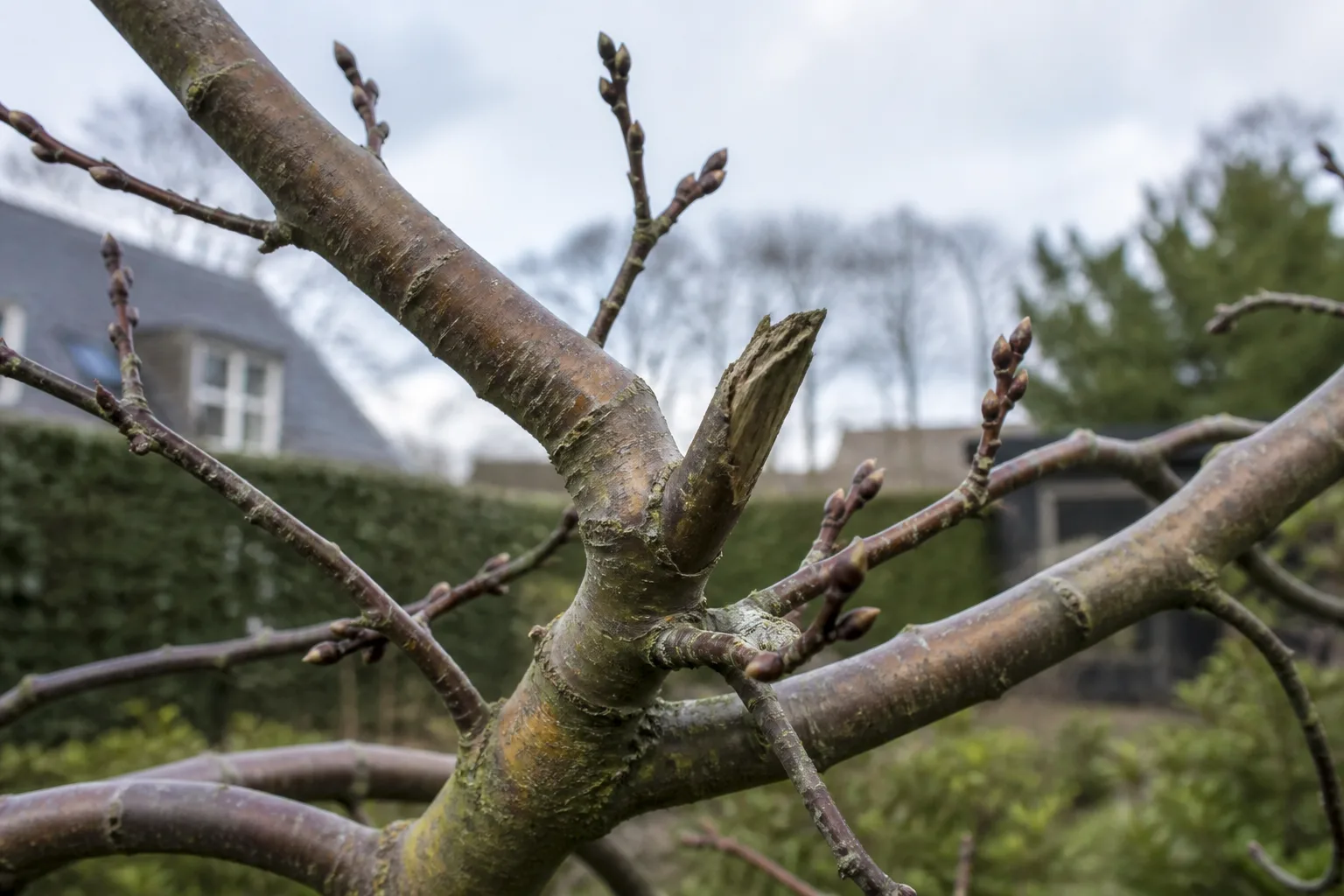
For planned structural pruning, late winter or very early spring is often the most practical time because the deciduous crown is easier to inspect before leaf-out. Remove dead, broken, or hazardous branches whenever the work can be done safely. Make each cut just outside the branch collar rather than flush to the trunk, and remove a whole branch at its origin instead of leaving a stub. BBC Gardeners’ World Magazine’s general pruning guide likewise recommends timing work around the plant’s growth cycle and avoiding pruning when frost is forecast.
Do not flatten the top or shear the outside of the canopy. Topping creates large wounds and a flush of vigorous shoots that may attach poorly; it does not make weak wood reliable. Make a few purposeful cuts, step back to check the shape, and avoid removing a large share of live canopy in one session. If a branch is large, high, cracked, over a target, or close to a utility line, hire a qualified arborist. A brittle-limbed tree is not a safe ladder-pruning project.
Understand Flowers, Pods, and Seasonal Cleanup
The flowers are part of the tree’s appeal, but their timing varies with climate. UF/IFAS describes abundant blooms from late April into early July in Florida; NC State describes summer flowering. A cooler location can flower later than a warm southern site, and a young or shaded tree may produce fewer blooms. Expect a show over part of the season, not a year-round floral display.
Flowers are soft pink clusters made up of fine, silky stamens, and they may attract bees, butterflies, and hummingbirds. After flowering, the tree forms long, flat pods containing seeds. These pods are the practical downside many planting guides understate: they can hang on the tree, fall through the season, and create both litter and a supply of new seedlings.
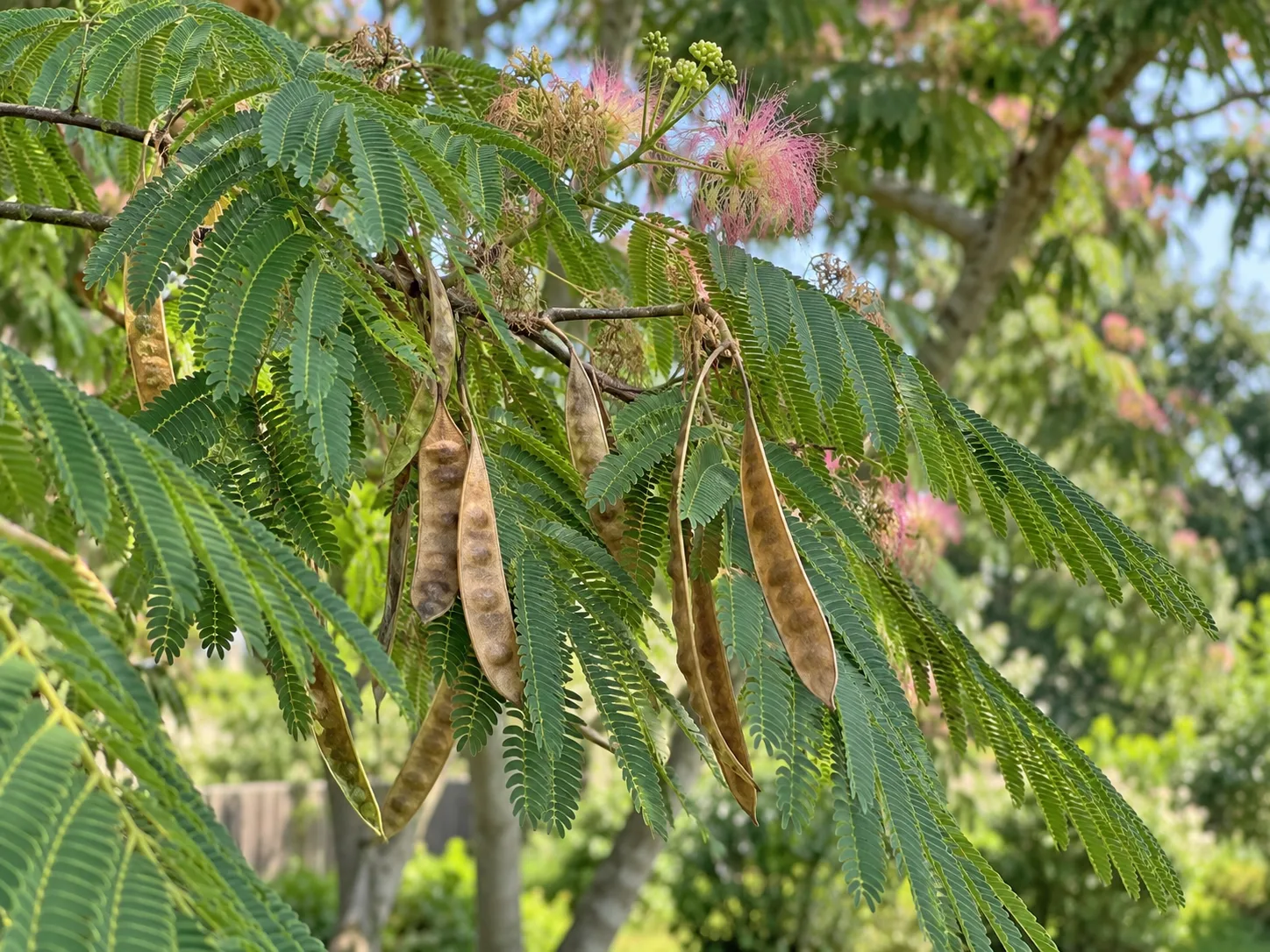
Plan cleanup before the pods mature, especially if the tree is growing where the species is permitted. Rake or collect fallen pods before they break apart, and dispose of them under local yard-waste rules rather than moving them to a natural area or stream edge. If you cannot safely reach high pods, do not climb or shake branches over people and pets. Preventing every seed is difficult on a large tree, so the decision to keep the tree should account for recurring cleanup rather than assuming one pruning session will solve it.
Reduce Seed Spread and Respond to Volunteer Seedlings
Persian silk tree seeds can be dispersed by wind, water, and animals. In Florida, UF/IFAS notes that seeds may remain dormant for years and that water can move them along rivers. NC State Extension likewise describes spread beyond cultivation and lists the plant as invasive in North Carolina. That is why site-level management matters: seedlings may appear some distance from the parent tree, and cutting the canopy does not erase the seed bank.
Look for seedlings after rain and pull them while small, when the soil is soft enough to remove the whole root. Check fence lines, garden edges, drains, and disturbed ground. If a seedling has a woody root or breaks off at the surface, dig out the remaining root rather than assuming it will die. For a mature tree that is producing unwanted seedlings, talk with local extension about legal disposal and removal options; it can resprout after cutting, so follow-up matters.
Treat seeds as a pet and livestock hazard. NC State Extension reports that the seeds contain a neurotoxin and can be toxic if ingested by dogs or livestock. This does not justify assuming every part of the tree presents the same risk, but it does justify keeping fallen pods out of places where animals chew or graze. If an animal may have eaten seeds, contact a veterinarian promptly and identify the plant.
Persian Silk Tree Cultivars: What the Names Do and Don’t Promise
Cultivars may differ in flower color, foliage, size, and growth habit, but the name on a tag does not erase the species’ site requirements. ‘Alba’ is selected for white flowers; ‘Rosea’ or ‘Ernest Wilson’ is commonly associated with brighter pink blooms and may be hardier than the species; ‘Summer Chocolate’ is grown for deep burgundy foliage. Availability and naming can vary by nursery, so look for a cultivar label rather than relying on a photo or common name.
NC State lists ‘Merlot Majik’ as a sterile cultivar with burgundy foliage and pink flowers. Sterility can reduce viable seed production, but it does not reverse a local restriction, make the tree’s branches stronger, eliminate dropped flowers or leaves, or turn a badly placed tree into a good fit. Ask the seller to confirm the cultivar identity and local suitability, and verify current invasive guidance independently. Do not buy a seedling labeled simply “mimosa” assuming it carries a sterile cultivar’s traits.
If you want the look rather than this species, ask your extension office for a noninvasive tree adapted to your region. UF/IFAS names sweet acacia, bottlebrush, and powderpuff as Florida alternatives for delicate foliage and showy flowers; other climates need different selections. Native or noninvasive flowering trees with a suitable mature size will usually be easier to manage.
Troubleshoot Pests, Wilt, and Yellow Leaves
Inspect leaves, twigs, and the trunk before deciding a tree needs treatment. NC State lists mimosa webworms, mites, shot-hole borers, cottony cushion scale, root rot, and Armillaria among possible problems. UF/IFAS also notes vascular wilt as a serious disease. A few damaged leaves do not identify the cause, and spraying an insecticide before finding an insect can harm beneficial species without solving the problem.
| What you notice | What to check first | Practical next step |
|---|---|---|
| Whole tree wilting during a dry spell | Soil several inches down and recent rainfall | If soil is dry, water the root zone slowly; reassess as leaves respond. |
| Yellow leaves with soggy soil | Drainage, planting depth, and irrigation | Stop adding water and seek local diagnosis if decline continues. |
| Chewed or webbed leaf clusters | Leaves and webbing for larvae | Remove a small affected cluster if practical; ask extension before treating a large tree. |
| White, cottony or scale-like bumps on twigs | Whether insects are present and where they cluster | Photograph the branches and get a local identification before applying a product. |
| One branch pales, droops, and begins to die back | Whether symptoms are advancing along that branch | Treat vascular wilt as a possibility and contact an extension office or arborist. |
Mimosa webworms can skeletonize or web foliage, while mites or scale may cause stippling, discoloration, or visible colonies. The correct response depends on identification, severity, tree size, and local product labels. For a large landscape tree, do not apply a pesticide by guesswork or use a household recipe. Photograph the damage and bring a sample to a county extension office or diagnostic clinic.
Recognizing Possible Mimosa Wilt
Mimosa wilt, commonly associated with Fusarium, is especially concerning because it can be fatal. UF/IFAS describes an early pattern of pale, drooping leaves on one branch, followed by yellowing, leaf drop, and dieback that progresses through other branches. A drought problem more often follows dry soil and may affect the whole exposed canopy; however, that contrast is not enough to diagnose a tree confidently.
Check soil moisture first, then record where symptoms began and how quickly they are spreading. If one branch continues to wilt despite moist, well-drained soil, or yellowing and dieback move through the crown, contact local extension or an arborist for identification. Avoid transferring soil or tools from a potentially infected tree to nearby mimosas until you get advice. Fertilizer, extra irrigation, and routine pruning do not cure vascular wilt; a laboratory or qualified local diagnosis can help you decide what to do next.
Can You Grow a Persian Silk Tree in a Container?
A young tree can be kept in a large, well-drained container temporarily, but that is not a simple way to keep a large landscape tree permanently small. The species grows quickly, forms a wide crown, and needs substantial root space. A container also dries faster than open ground, so you would need to monitor moisture frequently and increase pot size as roots fill the current container.
Do not move a container-grown tree indoors for winter as though it were a houseplant. It is a deciduous outdoor tree, and indoor light and space are poor substitutes for its normal growing cycle. If the aim is a compact patio specimen, select a tree or shrub bred for container culture in your climate rather than relying on repeated root pruning or topping.
Propagate Only Where Planting Is Appropriate
Persian silk trees can grow from seed, and the species may also resprout from roots or root cuttings. That ease is useful to know when seedlings appear, but it is also the reason casual propagation can create a spread problem. Do not collect and sow seeds in a state, county, or landscape where extension or invasive-plant authorities recommend against the tree.
Seed-grown plants may not reproduce the traits of a named cultivar, particularly flower color or foliage. A cultivar intended to be sterile should be purchased under its correct verified name rather than recreated from seed. If local rules permit growing Albizia and you have a deliberate purpose for propagation, seek region-specific instructions from an extension office; avoid distributing seeds or rooted pieces to other gardens.
A Year-Round Care Schedule
Late winter: Inspect the branch structure while the tree is leafless. Make only the structural cuts you can safely reach from the ground, and postpone pruning when a hard freeze is forecast. Remove damaged wood after storms only if the limb is stable and the job is within your skill and equipment.
Spring: Confirm the mulch ring is shallow and clear of the trunk. As new leaves emerge, check soil moisture around the original root ball and water when it is drying. Remove young seedlings elsewhere in the yard before their roots become woody. Do not apply fertilizer unless soil conditions or documented deficiency call for it.
Late spring through summer: Flowering may occur from late spring into summer, depending on climate. Keep watching the root zone during long dry spells, especially on a newly planted tree. Inspect foliage for webbing, scale, unusual yellowing, or branch dieback. After flowering, avoid turning routine maintenance into a drastic canopy reduction.
Late summer and fall: Watch for developing brown pods and plan collection before they split or fall. Rake fallen pods and leaves where they could be carried by water or reach pets and livestock. Walk the yard and nearby disturbed areas for seedlings after rain.
Winter: Check for broken limbs, exposed roots, and signs of damage from wind or ice. Water an established tree only if the soil is dry and the ground is not frozen; recently planted trees may need attention in a dry fall before winter dormancy. Reassess whether the tree still fits the site and whether its seed and branch maintenance remains manageable.
Conclusion
Persian silk tree care starts with choosing whether the species belongs in your landscape at all. Check local invasive-plant guidance, then weigh the tree’s pink summer flowers and light shade against its broad crown, brittle limbs, seed pods, cleanup, pet-access concerns, and relatively short lifespan. In North Carolina and Florida, extension sources recommend against planting it; local guidance elsewhere may differ.
Where it is permitted and suitable, give it full sun, generous room, well-drained soil, careful watering during establishment, and light structural pruning instead of topping. Monitor for seedlings and symptoms of vascular wilt, and get local help when decline or large branches raise safety questions. The best care plan is one that accounts for what the mature tree will require every year, not only how attractive it looks when it blooms.



