How to Grow and Care for Sea Holly
Sea holly (Eryngium planum) thrives in sun and sandy soil. Learn site prep, watering, varieties, seed stratification, and how to avoid taproot transplant shock.
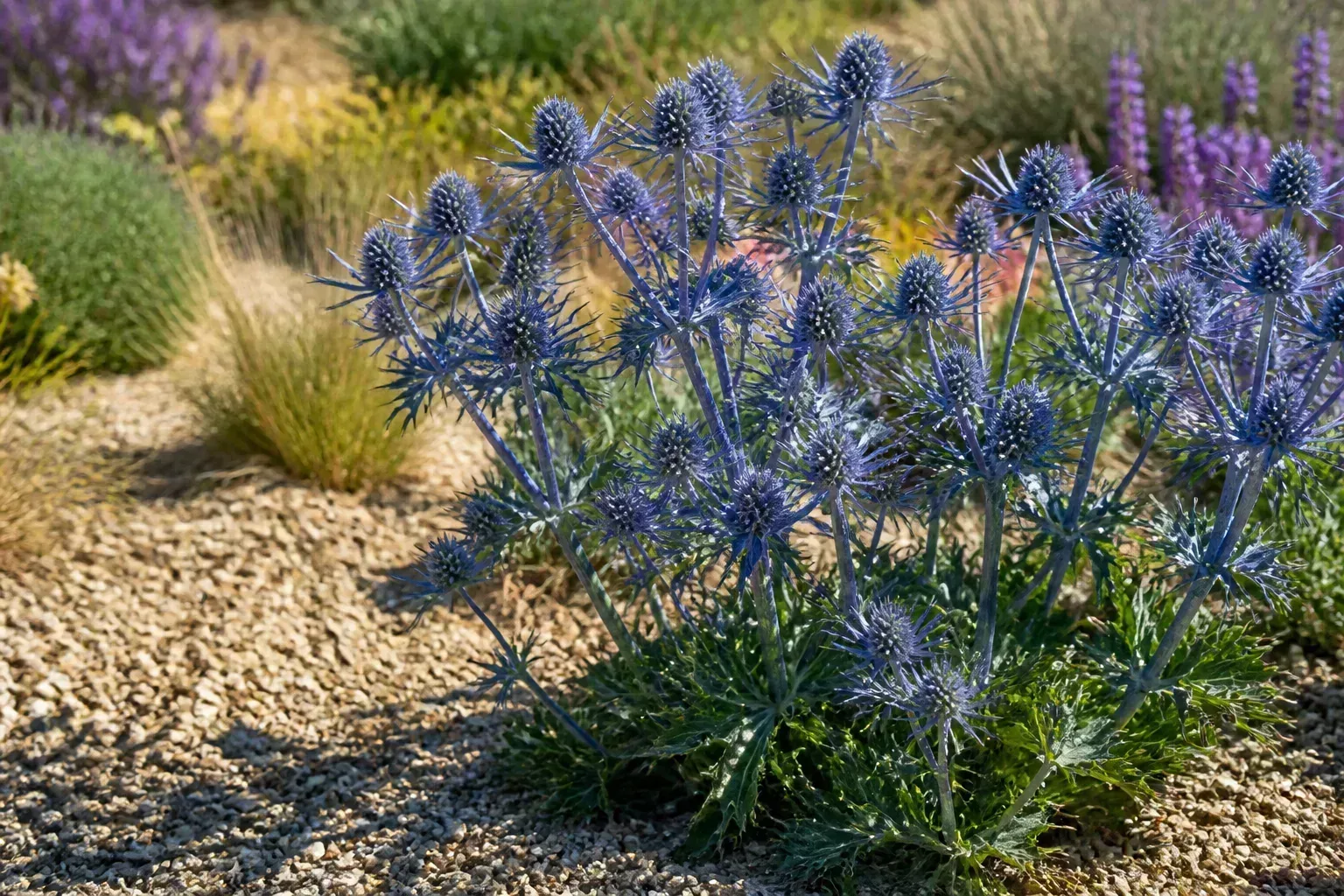
Sea holly (Eryngium planum) looks like a thistle dipped in metallic paint — steel-blue cones ringed with spiky bracts on stiff stems above a rosette of toothed green leaves. Give it eight hours of sun, sandy soil that drains fast, and a light hand with water and fertilizer, and it will bloom from midsummer into fall with almost no fuss. Plant it in a damp border or rich compost-heavy bed, and the same plant flops, rots, or disappears entirely.
That gap between the Instagram photo and the backyard reality is why this guide focuses on decisions: whether your site actually suits a taprooted perennial, how to plant without bending the root, and what to do when stems lean or crowns turn mushy.
Why Sea Holly Belongs in Hot, Dry Borders
Despite the common name, sea holly is not a true holly (Ilex). It belongs to the carrot family (Apiaceae) alongside parsley, dill, and Queen Anne’s lace. The genus name Eryngium comes from Greek references to spiny plants, and planum means flat — a nod to the relatively smooth, unarmed basal leaves on this species compared with spinier relatives.
Sea holly evolved for lean, sun-baked ground. NC State Extension describes E. planum as a stiff, erect clump 2 to 3 feet tall and 1 to 2 feet wide, blooming June through September with steel-blue flower heads useful for cutting or drying (NC State Extension: Eryngium planum). Missouri Botanical Garden notes the species tolerates poor soils, drought, and dry soil once established, but transplants poorly because of its taproot (Missouri Botanical Garden: Eryngium planum ‘Blue Glitter’).
Where sea holly shines is the part of the yard other perennials reject: the gravel strip along a driveway, the sandy rise above a retaining wall, the coastal bed that catches salt wind, or the south-facing hell strip that bakes all afternoon. Deer and rabbits usually leave the spiny foliage alone, bees and butterflies visit the flowers, and dried stems hold structure through winter if you skip the fall cleanup.

Eryngium planum at a Glance
| Feature | Details |
|---|---|
| Common names | Sea holly, blue sea holly, flat sea holly, blue eryngo |
| Botanical name | Eryngium planum |
| Family | Apiaceae |
| Type | Herbaceous perennial |
| Mature size | 2–3 ft tall, 1–2 ft wide |
| Sun | Full sun (6–8+ hours) |
| Soil | Sandy or loamy, well-drained, poor to moderately fertile |
| Soil pH | Acidic, neutral, or alkaline |
| Bloom time | June–September (midsummer peak) |
| Flower color | Steel blue, violet-blue |
| Hardiness | USDA zones 5–9 |
| Native range | Central Europe to Mongolia and western Himalaya |
| Wildlife | Bees, butterflies; deer and rabbit resistant |
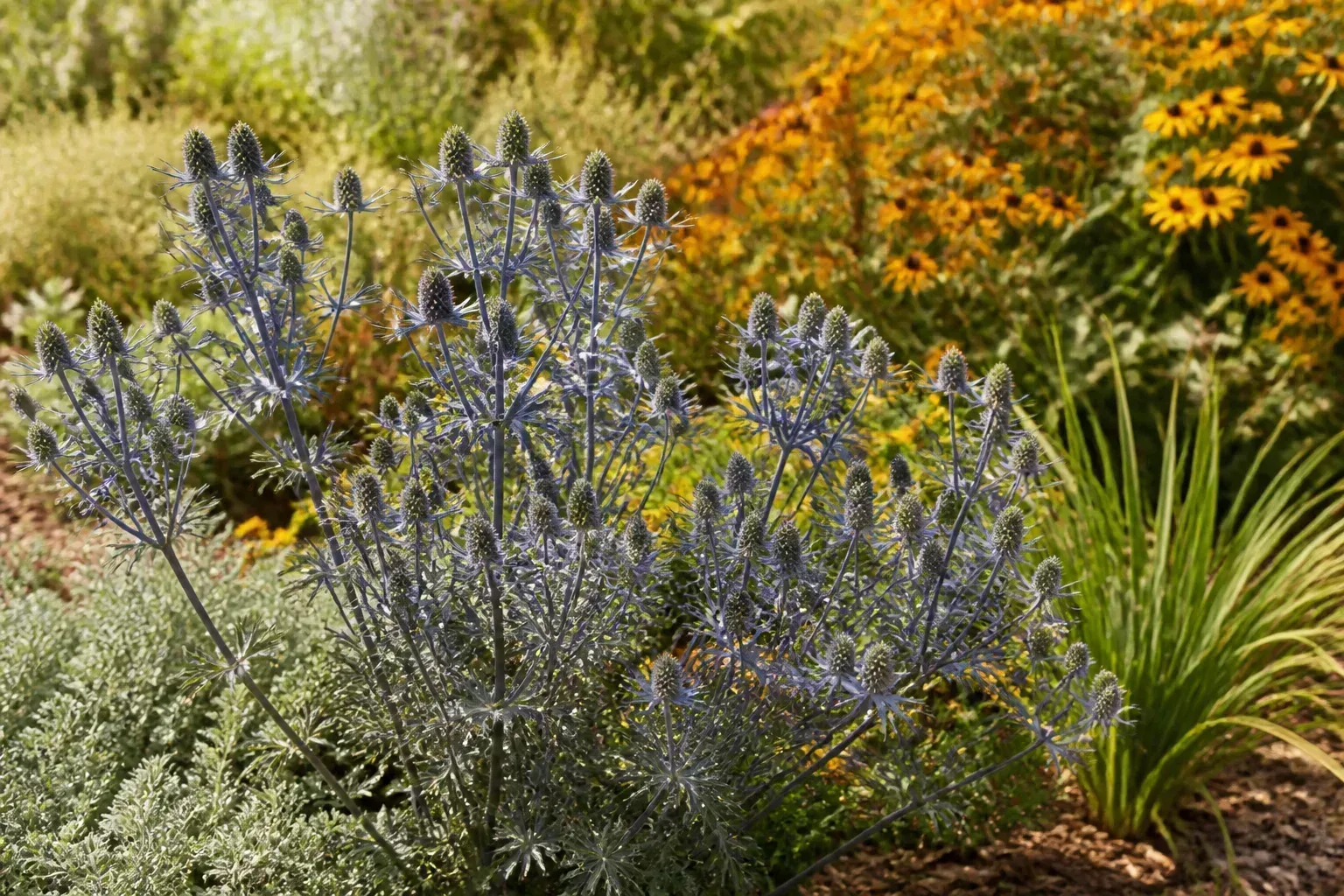
Quick ID: a basal rosette of heart-shaped, coarsely toothed leaves sends up branched stems topped by egg-shaped, thistle-like flower heads. Each head is a dense umbel of tiny blue flowers surrounded by a collar of spiny bracts with a painted metallic sheen. Stems may be green or silvery blue depending on cultivar.
One honest detail most catalogs skip: NC State Extension notes fresh flowers can smell slightly of manure. Up close, the scent is mild and pollinators do not mind — but do not plant sea holly right beside a patio dining table if fragrance sensitivity matters.
Is Sea Holly the Right Plant for Your Site?
Sea holly is low-maintenance only when the site matches its biology. Before you buy six pots, run a ten-minute site check.
When Conditions Favor Sea Holly
You are in good shape if the planting area gets at least six hours of direct sun (eight is better), water drains within a few hours after a heavy rain, and the soil is sandy, gravelly, or lean loam rather than compost-heavy vegetable-garden soil. Coastal exposure, rock gardens, gravel gardens, and drought-tolerant perennial borders are natural fits.
RHS lists E. planum for city courtyards, coastal gardens, cottage borders, gravel gardens, wildlife gardens, and flower beds — always in full sun on dry, well-drained soil with protection from winter wet (RHS: Eryngium planum).
When to Choose Something Else
Skip sea holly — or fix the site first — if you have heavy clay that stays soggy for days, a low spot where water pools after storms, or a shade border under trees. Rich, heavily fertilized beds also work against you: plants grow tall and sprawling instead of compact and intensely blue.
If you need a plant you can move every year, sea holly is a poor choice. The taproot resent disturbance, and mature clumps recover slowly after division. For a native U.S. alternative with similar spiky character, consider rattlesnake master (Eryngium yuccifolium), which NC State Extension lists as a native alternative to E. planum (NC State Extension: Eryngium planum).
Light, Soil, and Drainage Requirements
Light: Full sun is non-negotiable for strong stems and the deepest blue color. NC State Extension states more sun produces more intensely colored blue flowers. Partial shade is tolerated but stems weaken and may need staking when flower heads load up.
Soil texture: Sandy or gritty loam is ideal. Sea holly accepts poor fertility and dry conditions that would stress moisture-loving perennials.
Drainage: This is the line between a ten-year plant and a one-season disappointment. Missouri Botanical Garden warns to avoid overwatering and notes susceptibility to root rot in anything but dry soil. If a shovel of soil squeezed in your fist holds a tight ball that does not crumble, amend with coarse sand and fine gravel, or build a raised berm 6 to 8 inches high before planting.
pH: Anything from slightly acidic through alkaline is fine. Sea holly is not picky about pH — only about wet feet.
Salt: Coastal gardeners can use sea holly in beds that catch salt spray. Inland, the same drought tolerance applies without the salt factor.
Preparing Soil for the Taproot
Dig the planting hole deeper than you would for fibrous-rooted perennials — at least 12 to 18 inches in heavy soils — and twice as wide as the root ball. Mix native soil with coarse sand or fine gravel rather than bagged compost. Compost improves drainage in clay, but a 50-50 compost blend in already-loose sand creates the rich, moisture-retentive conditions that cause sprawling.
Before backfilling, perform a quick drainage test: fill the hole with water, let it drain, fill again. If the second fill has not drained within four hours, choose another spot or raise the bed.

How to Plant Sea Holly Without Shock
Best timing: Spring, after the last frost, when soil has warmed. Nursery plants often bloom their first season if roots are healthy. Fall planting can work in mild climates if drainage is excellent, but spring gives a full growing season to establish the taproot before winter wet.
Step-by-step:
- Water the pot thoroughly an hour before planting.
- Dig a hole deep enough to keep the taproot straight — never bent into a J-shape.
- Slide the plant out carefully. Tease only circling surface roots; do not aggressively wash the taproot bare.
- Set the crown at the same depth it grew in the pot, with the crown slightly above grade in heavy clay.
- Backfill with your amended soil mix, firm gently, and water once deeply.
- Apply a thin gravel mulch if slugs are common in your area — not moisture-holding bark mulch.
Bare-root plants are uncommon but appear in specialty catalogs. Soak roots in water for 30 to 60 minutes while you dig, then plant immediately with the taproot vertical.
What not to do: Do not divide or move established clumps unless necessary. If you must transplant, do it in early spring, take as much root depth as possible, and expect a bloom skip that year.
Spacing and Companion Pairings
Space plants 18 to 24 inches apart — 2 feet is safer for large cultivars. Sea holly looks best in odd-numbered groupings of three or five rather than a single dot in a lawn.
Pair the steely blue tones with warm colors for contrast: purple coneflower, black-eyed Susan, coreopsis, zinnia, and cosmos all share full-sun, well-drained preferences. Taller companions like coneflower can also provide light support if stems lean. For more spiky texture ideas, see our guide to spiky plants.
Avoid planting sea holly next to thirsty perennials that need daily irrigation — the extra moisture raises crown-rot risk.
Watering, Fertilizer, and Seasonal Care
Established sea holly is drought tolerant thanks to its deep taproot, but “drought tolerant” does not mean “never water.” Flowers still need moisture during bud formation.
Watering rule: Soak the root zone deeply, then let the top few inches of soil dry before watering again. Aim water at the base, not over the crown. Overhead sprinklers that keep foliage wet invite leaf spot and powdery mildew.
Fertilizer: Do not feed sea holly. Missouri Botanical Garden notes tall plants sprawl in overly fertile soils. NC State Extension lists rich soil as a cause of leggy, toppling plants. If your border gets annual compost top-dressing, plant sea holly at the lean edge of the bed.
Temperature: Within zones 5–9, no special humidity requirements exist. Plants handle heat well once roots are deep.
First-Year Establishment Schedule
| Period | Watering goal |
|---|---|
| Week 1 after planting | Water every 2–3 days if no rain (soak, don’t sprinkle) |
| Weeks 2–8 | Water weekly during dry spells; skip if rain exceeds 1 inch |
| Rest of year 1 | Deep soak every 10–14 days in drought; otherwise rain only |
| Year 2+ | Supplemental water only during prolonged summer drought |
Watch for wilting at midday in year one — that often signals underwatering while roots deepen. Yellowing lower leaves with wet soil signal overwatering.
Sea Holly Varieties and Related Species
The genus holds more than 150 species. Gardeners usually start with E. planum because it is widely available, reliably perennial in zones 5–9, and heavily bred for flower color.
Cultivars Worth Growing
| Cultivar | Height/spread | Notes |
|---|---|---|
| ’Blue Glitter’ | 2–3 ft × 1–1.5 ft | Intense steel blue; heavily branched; may bloom first year from seed (MBG) |
| ‘Blue Cap’ | 2–3 ft × 1–2 ft | Clump-forming; blue-tinted leaves |
| ’Blue Hobbit’ | 12–14 in × 12 in | Dwarf for front of border or containers |
| ’White Glitter’ | 2–3 ft | Silver-ivory flowers, silver-green stems |
| ’Big Blue’ | 18–24 in | Large 4-inch spiky blue blooms |
| ’Sapphire Blue’ | 2–3 ft | Classic intense blue flowers and foliage |
NC State Extension also lists ‘Blue Cap’, ‘Blue Glitter’, ‘Blue Hobbit’, and ‘White Glitter’ as named cultivars in its plant toolbox (NC State Extension: Eryngium planum).
Choose ‘Blue Hobbit’ for edging and containers. Choose ‘Blue Glitter’ or ‘Big Blue’ for cutting rows and middle-of-border impact.
Native and Alternative Eryngium Options
| Species | Size | Zones | Distinction |
|---|---|---|---|
| E. yuccifolium (rattlesnake master) | To 4 ft | 3–8 | Native U.S.; whitish globes; yucca-like leaves |
| E. alpinum (alpine sea holly) | To 30 in | 2–8 | Larger, frillier bracts |
| E. bourgatii (Mediterranean) | To 24 in | 5–9 | Smaller habit, deeply veined leaves |
| E. giganteum (giant sea holly) | To 4 ft | 4–7 | Biennial or short-lived; silvery bracts |
| E. maritimum (true seaside species) | Low | 5–9 | Native to European coasts; needs sharp drainage |
Harvest to Table notes the genus mixes fibrous-rooted and tap-rooted species, and that self-sowing is common across types (Harvest to Table: Sea Holly).
Getting Sea Holly to Bloom Its Best
Bloom typically runs from mid-June through September, with the heaviest show in July and August. In full sun and lean soil, blooming is rarely a problem.
Encourage more flowers: Deadhead spent heads through summer to push side shoots. Avoid fertilizer and rich soil. Ensure eight hours of sun.
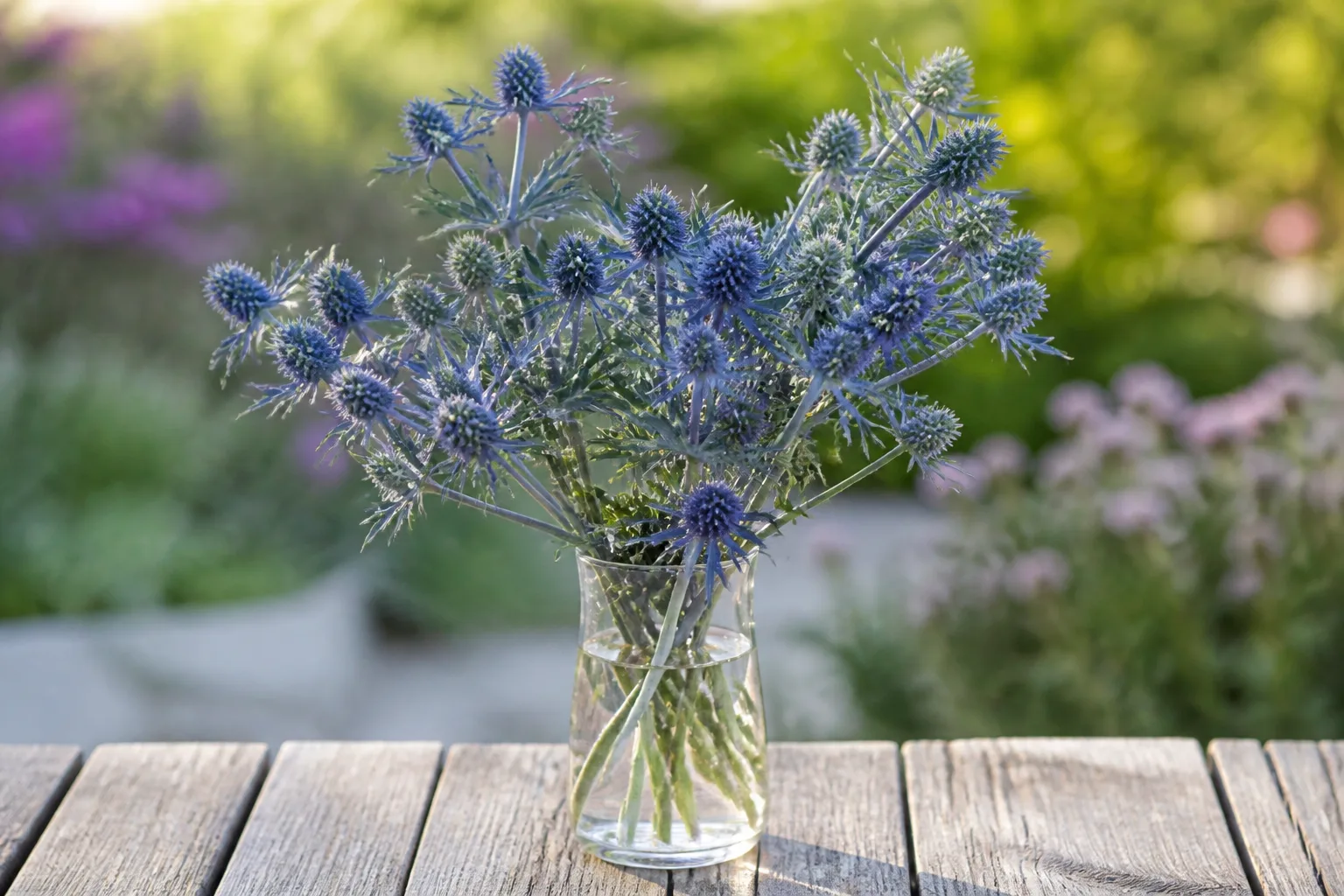
Cut flowers: RHS recommends cutting stems before flowers are fully open for the longest vase life. Fresh stems last up to two weeks in water. For drying, harvest when color is strong but before pollen sheds, strip lower leaves, and hang upside down in a warm, dark, airy space for two to three weeks.
Winter interest: Leave seed heads on plants if you like the silhouette against snow. Birds may pick at seeds, and self-sowing happens — usually at a manageable level in well-drained beds.
Pruning, Deadheading, and Overwintering
During the season: Snip spent flower stems to a side shoot or base when you want a tidier look or more rebloom. Stop deadheading in late summer if you want seed for self-sowing or drying.
Fall cleanup: After flowering, cut stems to a few inches above the crown — or leave them standing for winter structure. Both approaches work.
Winter protection: Protect basal rosettes from soggy soil more than from cold. RHS advises growing in full sun with protection from winter wet. In zones 5–6, a loose mulch of evergreen boughs or pine needles over the rosette — not packed bark — helps without trapping moisture. Pull mulch back in early spring.
Do not move potted sea holly indoors for winter. Plants need a cool dormancy period. Containers should overwinter beside a sheltered wall or in a cold frame with dry soil.
Propagation: Seeds, Cuttings, and Offsets
Basal offsets (easiest): In early spring, gently separate small plantlets from the base of the parent clump and replant immediately. NC State Extension lists division and seed as recommended strategies.
Seed — requirements: Sea holly seed needs cold stratification (4–12 weeks near 40°F) and light to germinate. Do not bury seeds — press them onto moist sand-based mix surface.
Seed — fall sowing (simplest): Scatter ripe seed in autumn where you want plants. Winter provides natural stratification; seedlings emerge in spring. Germination can take 1 to 4 weeks in warm soil or up to 90 days with variable outdoor conditions.
Seed — indoor start: Refrigerate seed 4 weeks, sow 10–12 weeks before last frost on sterile mix, keep lightly moist, and transplant after hardening off. First blooms may appear in year one for fast cultivars like ‘Blue Glitter’, but many seedlings need a full season to size up.
Root cuttings (advanced): In late winter or early summer dormancy, dig the parent carefully, cut pencil-thick root sections into 3-inch lengths, replant parent immediately, and bury cuttings vertically with the top flush at soil level. Overwinter pots in a cold frame. This method clones cultivars true-to-type but risks parent stress — never remove more than one-third of the root mass.
Pests, Diseases, and Common Problems
Sea holly is generally trouble-free in dry soil. Problems cluster where drainage fails.
Root rot and crown rot: Mushy crowns, collapsed plants, blackened base stems. Cause: overwatering, heavy clay, winter wet. Fix: improve drainage, reduce irrigation, remove affected plants. Prevention beats cure — site correctly the first time.
Leaf spot and powdery mildew: Brown or white patches on leaves during humid, wet summers. Improve air circulation, water at the base, remove affected leaves. Severe cases may need fungicide, but fixing moisture is the real solution.
Aphids, slugs, snails: More common in damp beds. Hand-pick slugs at dusk, blast aphids with water, or use horticultural oil on aphids if populations build. Damage is usually cosmetic.
Leggy, flopping stems: Almost always too much shade, too much fertility, or too much water. Move plants or accept staking — do not respond with more fertilizer.
Short lifespan in rich soil: Counterintuitively, plants in compost-heavy beds may live fewer years than those in lean sand. If your sea holly dies after three to four years in a pampered border, the site was probably too cushy.
Conclusion
Sea holly rewards gardeners who treat it like a sun-loving wildflower, not a thirsty bedding annual. Pick the hottest, best-drained spot you have, plant with a straight taproot in spring, water steadily through the first year, then step back. Deadhead if you want more blue cones, leave seed heads if you want winter structure, and skip the fertilizer entirely.
Get the site right and Eryngium planum delivers metallic summer color, pollinator traffic, and stems worth cutting — for years, with almost nothing asked in return.