Build a Backyard Birdhouse: 32 Free Plans + Sizing Guide
Build a nest box birds will use: 32 free DIY birdhouse plans sorted by skill level, plus hole-size charts, pole-mount tips, and predator guards.

A free DIY birdhouse plan is only worth the afternoon you spend on it if the finished box matches a bird that already lives near your yard. The prettiest cedar cottage in the world stays empty when the entrance hole is too big, the box hangs on a predator highway, or the habitat outside is all lawn and no insects. Before you scroll for plans, decide the tenant: eastern bluebird, house wren, tree swallow, or chickadee. That choice sets hole diameter, floor size, mount height, and spacing—details most plan roundups skip entirely.
This guide keeps the 32 free plans readers expect, but organizes them by skill level and target bird. You also get a NestWatch-based hole-size chart, pole-mount and predator-guard guidance, and the maintenance steps that turn a weekend build into an occupied nest box by spring.
Quick answer: match the hole, then pick a plan
Eastern and western bluebirds need a 1 1/2-inch round entrance (or a 2 1/4 × 1 3/8-inch oval) on a box mounted 3–6 feet on an open lawn or orchard edge, spaced 300 feet from another bluebird box. Mountain bluebirds use a slightly larger 1 9/16-inch hole. House wrens want a 1-inch hole 5–10 feet up near shrubby cover. Tree swallows need 1 3/8 inches, open fields near water, and boxes as close as 35 feet apart when paired with bluebird boxes on separate poles.
If you want the fastest credible build, start with the Birds & Blooms one-board plan: one 5-foot 1×6 pine board, a spade bit sized to your target species, and an afternoon. If bluebirds are the goal, use Audubon’s bluebird nest box guide or NestWatch’s species table below before you cut.
How to choose the right birdhouse plan before you build
Most failed birdhouses fail at selection, not carpentry. Three decisions come first: which cavity nester you are building for, how the box will mount, and whether the surrounding habitat actually supports nesting.
Match the entrance hole to the bird you want
Entrance diameter is a lock, not a suggestion. A hole that is too large invites European starlings (they squeeze through 1 9/16 inches) and house sparrows (1 1/4 inch and up). A hole that is too small excludes the bird you wanted while still advertising empty real estate to invasives. NestWatch publishes species-specific diameters used by conservation monitors nationwide; the table in the next section is distilled from that data (NestWatch nest box placement).
Build for birds already present. A bluebird box in deep shade under mature forest will not magically create bluebirds. A wren box on an open pole in the middle of a mowed lawn may sit empty while the wrens nest in your garage eaves instead.
Pick a mount style that fits your yard
Pole or post mounts are the default recommendation for small cavity boxes because they accept predator guards, sit at consistent height, and avoid tree-trunk routes for raccoons, cats, and snakes. NestWatch notes that free-standing metal poles or PVC pipes let you mount higher than fence posts and are easier to equip with baffles (NestWatch placement guidance).
Tree mounts work for some species in predator-light yards but are harder to guard and can damage bark when nailed. Hanging houses suit decorative wren projects but swing in wind and are difficult to monitor. Fence mounts are convenient for humans and convenient for climbing mammals—use only with a serious baffle and no nearby jump points.
Entrance hole sizes for common backyard birds

Use this chart when evaluating any free plan link. If the plan’s hole does not match your target bird, adjust before you cut—not after a season of empty boxes.
| Species | Hole size | Mount height | Min. spacing | Habitat notes |
|---|---|---|---|---|
| Eastern bluebird | 1 1/2” round (or 2 1/4” × 1 3/8” oval) | 3–6 ft | 300 ft | Open lawn, orchard, sparse ground cover; hole faces open field |
| Western bluebird | 1 1/2” round | 4–6 ft | 215 ft | Same open-country pattern as eastern |
| Mountain bluebird | 1 9/16” round | 4–6 ft | 300 ft | Open grass with scattered trees |
| Tree swallow | 1 3/8” round | 5–6 ft | 35 ft (can pair near bluebird box on separate pole) | Open fields near water |
| House wren | 1” round | 5–10 ft | 100 ft | Shrubby edges, gardens, partial cover |
| Carolina wren | 1 1/2” round or 2 1/2” × 5” slot | 3–6 ft | 330 ft | Thicker cover, near trees or tall shrubs |
| Black-capped chickadee | 1 1/8” round | 5–15 ft | 650 ft | Deciduous woods/edges; add 1” wood shavings |
| Tufted titmouse | 1 1/4” round | 5–15 ft | 580 ft | Deciduous forest edges |
| Purple martin | 2 1/8” round or 3” crescent | 10–15 ft | 10 ft between compartments | Open area; pole 40+ ft from trees |
Do not intentionally attract house sparrows or starlings with general-purpose boxes in the U.S.; both are invasive competitors that evict native cavity nesters. If invasives take over a box, close it for the season or switch to a species-specific design with a smaller hole and monitor weekly.
Materials and tools most free plans share

Nearly every credible free plan converges on the same shopping list. Stock up once and you can run through several designs in a single weekend.
Lumber: One 5-foot 1×6 (actual thickness about 3/4 inch) builds multiple simple boxes. Cedar fence pickets appear in modern and half-picket designs because they resist rot without paint. Avoid pressure-treated lumber for interior nest surfaces; birds and nestlings contact the walls for weeks.
Fasteners: 1 5/8-inch galvanized deck screws for removable fronts; 2-inch galvanized finishing nails for fixed backs and recessed floors. Predrill every hole in pine to prevent splits.
Cutting and boring: Hand saw or miter saw, power drill, and a spade bit matched to your target hole size. A hole saw gives cleaner circles on cedar but is optional.
Mounting: 1/2-inch galvanized electrical conduit with rebar stake, or a 4×4 post with metal predator baffle, depending on plan. Audubon’s bluebird design uses the Gilbertson pole system with a mounting block on the box back (Audubon bluebird nest box build).
Best wood for outdoor nest boxes
Cedar and pine are the workhorses. Cedar weathers gray without structural failure for years; pine is cheap and easy for first builds—plan to repaint or replace sooner. Plywood appears in some kit-style plans; use exterior-grade only and keep edges sealed. Hardwood scraps work for decorative roofs but add weight on hanging designs.
Skip stained or painted interiors. If you paint exteriors for decoration, use water-based exterior paint on outside faces only and leave the inside bare wood so fumes do not linger at hatch time.
Build basics every solid plan includes
Before you follow any link below, check the plan against this checklist. Missing any item is a reason to modify the cut list.
Drainage, ventilation, and a clean-out door
Drainage: Trim 1/2 inch off each corner of the floor or drill four small drain holes so rain and nest debris do not puddle. Ventilation: Drill 1/4-inch holes under the roof eaves or leave a slight gap at the peak—summer heat kills nestlings faster than cold snaps. Clean-out access: One wall—usually front or side—should open with screws after nesting season so you can remove old nests and scrub the box. Birds & Blooms’ one-board design attaches the front with deck screws specifically for post-season cleaning (Birds & Blooms one-board birdhouse).
Recess the floor 1/4 inch above the bottom edge so the walls shed water past the floor rather than soaking it. Floor dimensions of roughly 4 × 4 inches suit bluebirds and many backyard species; wrens tolerate slightly smaller interiors.
Why nest boxes should not have perches
Store-bought decorative houses often include a twig perch below the hole. Remove it. Native cavity nesters do not need it, but predators and house sparrows use perches as leverage while harassing occupants or enlarging access. A clean hole drilled slightly downward through the front panel sheds rain without offering a grip point.
Free beginner birdhouse plans (one board or less)
These builds assume minimal tools and no joinery beyond screws and nails. Each link opens the original plan with diagrams; specs below note what to verify before cutting.
One-board pine box (best first build). Birds & Blooms one-board DIY birdhouse — single 5-foot 1×6, removable front, recess floor with drainage corners. Size the spade bit to your target species from the chart above.
Lowe’s basic birdhouse. Lowe’s Creative Ideas basic birdhouse — straightforward nailed-to-post design; confirm hole diameter before building.
Lowe’s one-board variant. Lowe’s one-board birdhouse — even simpler silhouette for kids with adult supervision on the drill.
This Old House simple birdhouse. This Old House build a birdhouse — classic school-project layout with clear cuts; good for groups.
100 Things 2 Do straightforward box. 100 Things 2 Do DIY birdhouse — protective roof overhang and open perch area outside the cavity (keep the hole unperched).
True Value beginner nesting box. Archived True Value nesting box plan — encourages customizing dimensions; use NestWatch limits when you do.
Amateur Woodworker nesting box. Amateur Woodworker bird nesting box — winter-roosting dimensions; ventilate if using as summer nest box.
DIY Garden Plans bluebird box. DIY Garden Plans bluebird house — afternoon bluebird-specific cut list; verify 1 1/2-inch hole.
My Weathered Home scrap-wood birdhouse. Scrap wood birdhouse — excellent for offcuts; maintain interior dimensions and hole size despite rustic exterior.
Bluebird and tree swallow nest box plans
Bluebird recovery across North America owes much to standardized nest boxes mounted on guarded poles in open habitat. Audubon documents Dick Peterson’s sloped-roof Peterson box and the Gilbertson pole system that helped restore populations in the Upper Midwest (Audubon bluebird nest box history and plans). Space bluebird boxes at least 300 feet apart or out of line-of-sight; pair a second box 15–25 feet away on its own pole if you want both bluebirds and tree swallows on the same field edge (NestWatch paired boxes).
Audubon / Peterson-style bluebird box. Use Audubon’s measured plan above; mount 6–8 feet if cats roam, with conduit pole and predator baffle.
Family Handyman bluebird house. Family Handyman build a bluebird house — classic NABS-influenced proportions; double-check floor and hole.
Family Handyman backyard birdhouse. Family Handyman backyard birdhouse — taller roofline; confirm hole for intended species.
The DIY Dreamer bluebird houses. Building bluebird bird houses — simple nailed-to-tree layout; prefer pole mount with baffle if predators are present.
Empress of Dirt nesting box. Empress of Dirt free nesting box plans — clean PDF-friendly layout with monitoring tips.
Tall Texan birdhouse (MyCarpentry). MyCarpentry free birdhouse plans — regional styling; verify hole before building for bluebirds vs decorative use.
Log cabin style (Instructables). Instructables log cabin bird house — advanced cuts; keep interior volume and hole within NestWatch ranges.
For tree swallows, use the 1 3/8-inch hole and open-field placement near water. Swallows aggressively defend nest sites; paired boxes reduce bluebird/swallow conflict when each species has its own pole.
Wren, chickadee, and titmouse box plans
Smaller holes mean fewer invasions—but also fewer species. Match the bird you hear singing at dawn, not the bird you wish visited.
House wren boxes need a 1-inch hole and shrubby context 5–10 feet up. Carolina wrens accept 1 1/2-inch round holes or slot entrances closer to the ground (3–6 feet). Chickadees and titmice use 1 1/8 to 1 1/4 inches with 1 inch of wood shavings on the floor (not sawdust, which clumps when wet).
Ana White modern birdhouse (half cedar picket). Ana White modern birdhouse — stylish cedar picket build; resize hole for wrens or chickadees, not default craft-store openings.
Homedit hanging pine birdhouse. Homedit cute DIY birdhouse — chain-hung design; stabilize in windy yards and size hole down for wrens.
Built by Kids modern birdhouse. Built by Kids modern birdhouse — angular roof; verify interior depth so fledglings cannot climb out prematurely.
Dream a Little Bigger single-plank house. Dream a Little Bigger birdhouse from one plank — durable roof overhang; excellent template if you adjust boring depth.
Runnerduck teacup-shaped wooden house. Runnerduck teapot birdhouse shape — decorative silhouette; maintain proper cavity depth behind the facade.
Hertoolbelt whimsical birdhouse. Hertoolbelt whimsical birdhouse — advanced scroll-work; treat as art unless interior meets spec.
Decorative and upcycled birdhouse projects

Decorative builds are valid landscape features and kid crafts. Label them honestly: many prioritize appearance over NestWatch dimensions. If occupancy matters, build a spec-compliant box first, then experiment with upcycles.
Gourd birdhouses. Happiness Is Homemade gourd birdhouses — cure gourds fully, drill angled hole, add drainage, mount under eaves for wrens or swallows in warm climates.
Stone-covered retrofit. Empress of Dirt stone birdhouse — start with a functional wooden box, then glue stone veneer; do not seal ventilation.
License plate roof. Runnerduck license plate birdhouse — metal roof sheds water; watch sharp edges near entrance.
Teapot and drawer upcycle. Robin’s Nesting Place teapot birdhouse — fun porch accent; cavity volume often suits wrens if drainage exists.
Penny roof paint upgrade. Dream a Little Bigger penny roof birdhouse — no-build embellishment on an existing box; pennies are copper—fine exterior, never interior.
Flower pot combo. The Idea Room flower pot bird house — display piece; drill hidden drainage through pot bottom.
Old clock conversion. Sadie Seasongoods clock birdhouse — deep cavity; verify depth and heat buildup in sun.
Rustic twig makeover. My Bright Ideas rustic birdhouse — cosmetic twig/moss wrap on existing box; keep entrance clear.
Red church plan (Freewoodpuzzles PDF). Freewoodpuzzles church birdhouse PDF — novelty shape; treat as decorative unless resized to spec.
Minimalist / coastal modern variants. Search “modern birdhouse birch white paint” plans from craft blogs; half-picket cedar designs like Ana White’s reduce lumber cost while staying rot-resistant.
Pair decorative boxes with functional poles elsewhere in the yard so native birds still get safe cavities even if the showpiece stays empty.
Where and how to mount your birdhouse
Right box, right place is NestWatch’s shorthand. Bluebirds need open sight lines and low grass; wrens need partial cover; chickadees need deciduous woodland edge with dappled light (40–60% sun on the box face). Face entrance holes away from prevailing winter winds where possible; many monitors prefer east or north for bluebirds, then south, then west (NestWatch placement table).
Avoid mounting near pesticide-sprayed lawns, golf courses, or heavily treated gardens. Insect-eating nestlings depend on caterpillars and adult insects; chemical-treated turf reduces food and can expose birds directly.
Keep boxes out of busy pet zones. A cat that sleeps beneath a pole-mounted box waits more efficiently than any predator guard fails.
Pole mounting and predator guards
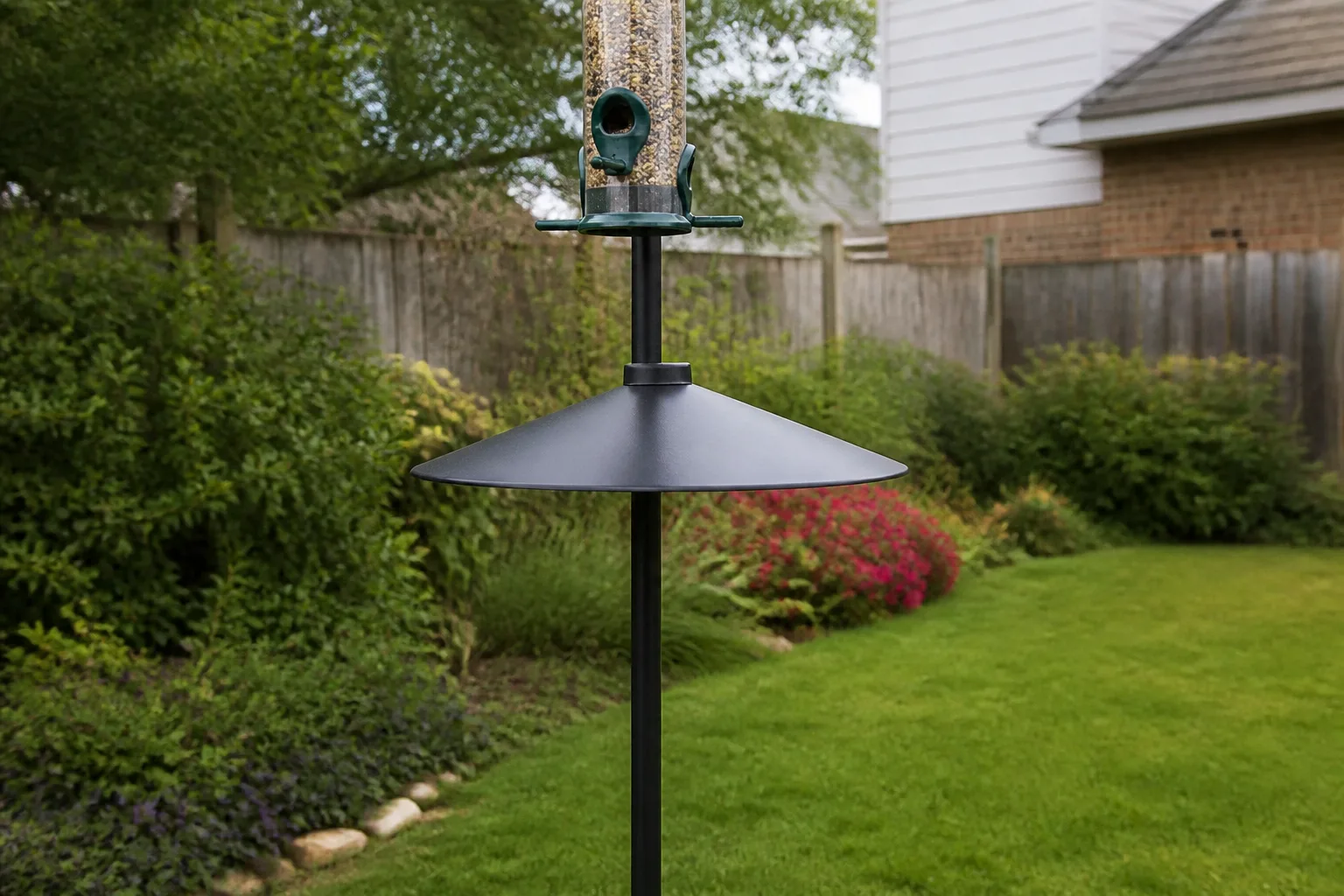
Step 1: Drive rebar or a ground sleeve so the pole does not lean. Step 2: Mount a ** stovepipe or cone baffle** on the pole below the box and above any jump point from the ground. Step 3: Set box height per species table; 6–8 feet is a practical bluebird height when cats visit. Step 4: Orient hole toward open habitat, not toward dense brush where ambush predators hide.
NestWatch links construction plans for predator guards in its resource center (NestWatch dealing with predators). Audubon explicitly warns against fence and tree mounts where climbing mammals or snakes are common (Audubon mounting guidance).
If you must hang a house from a branch, use wire that cannot be chewed easily and accept that monitoring and cleaning are harder. Never mount directly over a feeder—seed debris attracts rodents and nest predators.
When to install nest boxes and how to maintain them
Timing: Install boxes well before egg laying. NestWatch recommends by February in southern regions and by mid to late March in northern regions (NestWatch when to place boxes). Late installs still work—birds discover boxes mid-season—but first-year occupancy is lower.
First-year patience: Empty boxes in year one are normal. Leave them up; chickadees and bluebirds often inspect in fall for spring use.
End-of-season cleaning: After nestlings fledge and adults abandon the box, open the clean-out panel, remove the nest, scrape mud and parasites, wash with mild soap and water, rinse, and dry completely before closing. Optional light bleach soak (1 part bleach to 9 parts water, ten minutes) helps during disease outbreaks; rinse thoroughly. Add fresh 1-inch wood shavings for chickadees/nuthatches before winter if using boxes as roost sites.
Monitoring: Brief weekly checks during nesting are fine if you tap lightly, open quickly, and never touch eggs or nestlings. Remove house sparrow nests promptly where legal and safe to discourage invasives; they build messy domed nests with feathers and trash.
Winter storage: Permanent pole mounts can stay up year-round. Thin hanging crafts may last longer if stored dry off-season.
Common birdhouse mistakes that keep boxes empty
Oversized entrance holes are the top retail-birdhouse flaw—often 1 3/4 inches or larger, which is starling territory. Perches below the hole help invasives more than tenants. Pressure-treated lumber and painted interiors create chemical and heat risks. No drainage rots floors and chills nestlings. Tree mounting without baffles feeds raccoons and rat snakes documented in nest-box monitoring programs nationwide.
Wrong habitat beats wrong carpentry: a perfect bluebird box under dense forest shade will not compete with a wren box in your lilacs. Spacing violations—two bluebird boxes in sight of each other—trigger territorial fights instead of two nests.
Competition with feeders concentrates mammals. Place nest boxes 50+ feet from seed piles when possible. Ignoring invasives lets house sparrows destroy native broods; active monitoring matters as much as build quality.
If boxes stay empty after two seasons with correct holes and habitat, shift target species based on what you observe, not what you prefer. The house wren singing from your fence every May wants a 1-inch hole near shrubs, not a bluebird palace on a bare pole.
Conclusion
The best free birdhouse plan is the one sized for a bird already visiting your yard, mounted on a guarded pole in the habitat that species expects, and cleaned every fall. Use the 32 linked builds above as starting points—not as gospel— and always cross-check entrance diameter, floor size, and spacing against the NestWatch chart before the first cut.
Start with a one-board pine box or Audubon bluebird plan if you want occupancy over ornament. Save gourds, teapots, and penny roofs for personality once a plain box proves birds will trust your yard. Install early, monitor lightly, evict invasive nests when appropriate, and adjust hole size or placement instead of assuming birds are picky—they are precise.